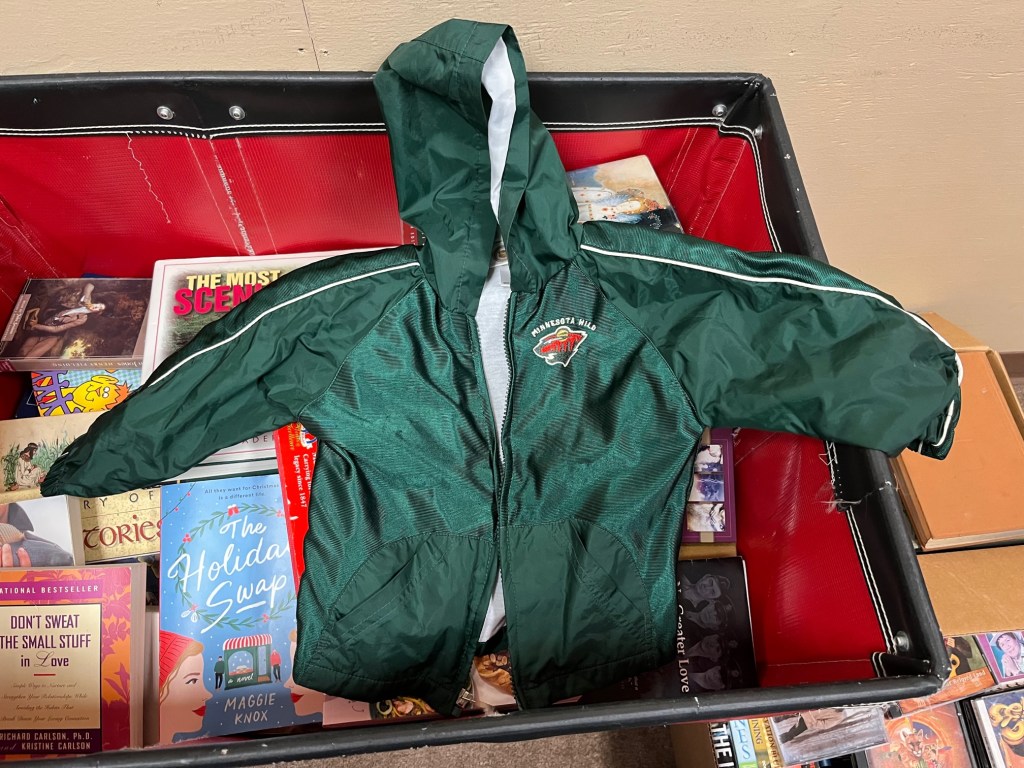
I bought the deep-green Minnesota Wild windbreaker at Goodwill for $3.99. Its 2T size was perfect for my grandson Michael, who was two years old at the time. I kept it at my house as a spare jacket because where I live the weather changes faster than a runway model. Michael wore the jacket on misty days and sunny-but-cool breezy days and gray chilly days when the sun refused to show its face. When needed, he pulled up the hood and slipped his hands into the pockets, hiding his ears and hands from the cold.
When Michael outgrew the jacket, I saved it for Evan who wore it until he outgrew it. Then, I saved it for Charlie who wore it until a year ago when he told me, “I’m too big for this.” I had run out of grandchildren, but I kept the jacket. Throughout the year, I thought about donating it back to Goodwill, but it held memories. My grandsons wore it to the library, to parks, and on walks. When they ran and played, the windbreaker’s waterproof material serenaded them with a crinkly tune.
I’m somewhere between my mother and father on the what-to-purge-and-what-to-keep scale. My mother saves very little. A few years ago, I asked her where the instructions were for her bike lock because I needed to reset the combination. Her answer: “I threw that out.” When I complained, she snapped, “I can’t save everything.” She claims she doesn’t want to make her children clean and sort through piles and piles of possessions. But really? Even small amounts of clutter unsettle her.
Very little exists from my mother’s childhood, but I think that’s because her family had very little. What happened to the other bits and pieces from her youth? I don’t ask. Perhaps her mother threw them away, or perhaps my mother did. Sometimes memories connected to objects are painful, a place one wants to walk away from, not revisit.
In contrast, my father saved a lot of stuff: old newspapers, if an article interested him; letters, including the ones I sent him; his childhood artifacts; his pilot logbooks; trinkets of all sorts; and bits and pieces of mechanical objects because he never knew when he might need that specific part or screw or nut and bolt. He wasn’t a hoarder, and we could walk through his house without fear of being consumed by his possessions, but his garages, closets, and spare rooms were filled with his history, both the small and momentous moments. He would’ve saved the instructions for the bike lock.
My father also kept old issues of Trade-A-Plane, a publication printed on yellow paper, where pilots could buy and sell airplanes and their parts. When the Trade-A-Plane came in the mail, he would dodge his responsibilities and read every classified ad, even if he wasn’t looking to buy or sell because, as he would say, “You never know.” He had lengthy telephone conversations (at a time when long-distance was expensive) with other pilots about planes, even if no buying or selling took place.
Frustrated, my mother once asked him why he needed to save every Trade-A-Plane, and he said, “Well, you never know.” He might want to look up something in one of them. Sounds ridiculous that with decades of old issues, he would be able to find something specific from years ago. Maybe he could have, maybe he couldn’t have, but he was comforted by their presence. They held memories of the planes he bought and sold and dreams of the planes beyond his reach. When he needed to buy a pair of wings for his Cessna 196, he called the airplane junkyards that advertised in the paper. He found a set of wings in New Jersey and had them shipped to Milwaukee.
My father saved the letters his father wrote to his mother in 1937 when she was pregnant with him and in the hospital on bed rest. Her pregnancy had become difficult, and if an emergency developed, the doctor didn’t want her to be an arduous forty-mile drive from the hospital. My father was born on November 24, 1937, and his parents saved a copy of Life magazine from that week, along with the cards family and friends sent on the occasion of his birth. My father treasured all of it. He had a vein of sentimentality that ran deep through his curmudgeonly bedrock. After he died, I inherited these keepsakes, and I cherish them.
The letters my grandfather wrote to my grandmother while she was in the hospital hold the ordinariness of daily life, recounting the weather, what he ate, how much gas he sold at the station, how deer hunting season was progressing, and when he would be coming to visit her. But with each mundane line, I imagined my grandfather writing around his fears about his young wife and child, praying for them to be well and hoping for them to come home soon. Always he signed his letters, “Lots of love, George.” In one letter he wrote about his day and mentioned he’d gone “to sleep without his bed companion.” It was the only personal line in all of his letters – subtle, but filled with longing to have his wife and child home and to be a family. This would’ve been important to my grandfather who was orphaned when he was eleven years old.
I can leaf through that Life magazine from 1937 and know I’m reading the same pages my father and his parents once read, learning what was newsworthy the week their first baby was born. When I read it, I found an article about Dy-Dee doll, “the most popular doll in the world” because she wet her diapers. My mother-in-law received a Dy-Dee doll for Christmas in 1937. The doll was all the rage, and she never forgot Santa left one for her under the Christmas tree. That 1937 issue of Life is a keeper because it connects me to my father and my mother-in-law, making it something I save. My children will have to throw it away.
I understand why my father kept the letters and artifacts of his childhood. I still have the teddy bear Santa brought me for my first Christmas in 1959. In my forties, I put Teddy in a plastic garbage bag. He had holes in his neck and crotch, and most of his fur had worn off. I tried to throw him away, but I couldn’t. After I pulled Teddy out of the garbage, I told my son, “I just can’t let him go.” And my son, who embraces minimalism to the point of nothingness, said, “Somethings you just need to keep.” So, Teddy sits in my closet on a stack of quilting material. I have my yearbooks and old report cards. I have photographs and a scrapbook. I have toys and clothes and artwork that belonged to my children. I have a pair of onyx owls from Nana and a colorful laughing porcelain Buddha from Grandma Olive. I have an antique hutch filled with glassware. I save all the instructions for every appliance and bike lock I buy. But I sympathized with my mother about Dad’s Trade-A-Plane obsession.
And so, after hanging in a closet for a year, the size 2T Minnesota Wild windbreaker became like my father’s old issues of Trade-A-Plane, no longer useful. Because I wanted others to make happy memories with the jacket, and because having too much clutter in my house unsettles me, it was time to let go. I placed the jacket in the wooden clothes bin at Goodwill. Having heard the door open, a young woman with a broad smile approached me and asked if I needed a receipt. I told her no, and she went back to sorting donations. I turned to leave but I couldn’t, so I grabbed the jacket and laid it on a bin of donated books and took a picture. That helped. It’s what my father would’ve done. He was the champion of taking pictures of everyone and everything. In his later years, he always tucked a small camera in his shirt pocket.
I lifted the jacket off the books, but I wasn’t done yet. I felt compelled to tell its story, so I stepped into the large sorting room, and the young woman asked, “Can I help you?”
I held up the officially licensed NHL windbreaker with the Iron Range Red, Forest Green, Minnesota Wheat, and Harvest Gold “wild animal” logo that appears to be a bear or a wildcat or a wolf. (When asked, the Wild organization will only refer to it as a “wild animal.”) And I told the young woman the story of the jacket’s full-circle journey from Goodwill, through three grandsons, and back to Goodwill.
I felt like an old person telling a story that a young person isn’t particularly interested in hearing, but she smiled, said it was a good story, and thanked me for sharing. I’m fairly certain she meant it. On my way out of the sorting room, I dropped the jacket back into the clothing bin and hoped that soon some child’s parent or grandparent would buy it.
A few weeks later Evan and Charlie came for a sleepover, and we took my dogs for a walk. None of us thought about the windbreaker because it was a clear, cold winter’s night, and we wore snow pants and heavy jackets, knit hats and insulated mittens. We passed the west side of the park, and Evan pointed to a tree and asked, “Do you remember when we circled around this tree last summer?” I didn’t remember, but I said yes because it was important to him. On that particular day, he might have been with his mother at the park, but that’s the slipshod nature of memory. Perhaps that’s why we keep physical remnants from our past. And on that clear, cold winter’s night with stars sparkling above us and a moon peering down at us, I remembered the Minnesota Wild windbreaker I’d given away.
Evan climbed the snowbank by the road, hugged the tree, and said, “This tree holds all my old memories.” He might grow up to be the kind of person who will save every issue of the Trade-A-Plane, all his Nana’s cards and letters, and the instructions for a bike lock. Or perhaps not. But at the agèd year of six, Evan already treasures his memories. And he understands the ability of an object to hold his heart.
 Writing Near the Lake
Charming story that I will remember. In my family it was a red satin baseball jacket.
LikeLiked by 1 person
Lovely piece, Vickie!
LikeLiked by 1 person
I swear we had/have the same parents!
LikeLiked by 1 person
Funny!! Perhaps it is somewhat the era in which we grew up, too!
LikeLike
What a lovely story.
LikeLiked by 1 person
Thank you.
LikeLiked by 1 person
Wowzer, Vickie! I wish there were heart emojis to plaster this space. THIS story is a keeper.
LikeLiked by 1 person
Oh, this is such a sweet story. I’m guilty of being intolerant of even the least amount of clutter, but after reading this I sure wish I had held on to a few more things. I really wish you had held on to that jacket though; maybe one day your grandkids kids would have been wearing it.
LikeLiked by 1 person
Thank you for your kind words. I could have saved the jacket in anticipation of having great-grandkids one day. But somehow it became important to me that some other child would wear it.
LikeLike
I so love this story. So much of me, grandparents and parents are tied the same way. Letting go, but not really letting go. I also had a Grandma Olive, which I still have a few things of hers, and now giving to my niece, her great-granddaughter.
LikeLiked by 1 person
Thank you so much, Sally. It’s nice to have things to remember our past. I feel so bad for the people who are losing their homes to fires and other natural disasters.
LikeLike