

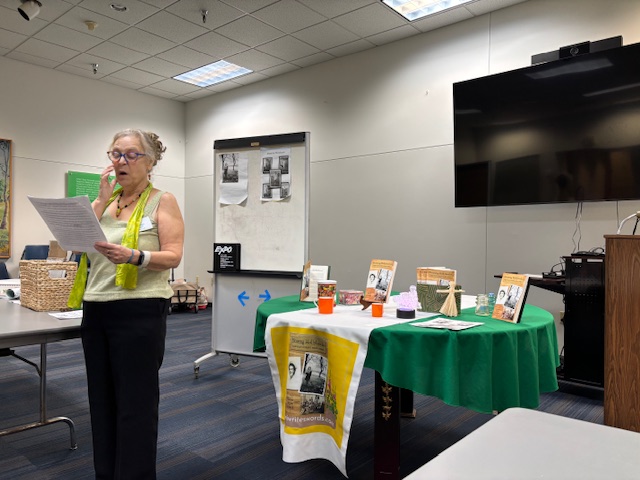
On St. Patrick’s Day, I went to the public library to listen to author Naomi Helen Yaeger read from her book Blooming Hollyhocks: Tales of Joy During Hard Times. Yaeger’s book is a warmhearted biography about her mother’s childhood in Avoca, Minnesota, during the Great Depression and World War II. [To read my review of Yaeger’s book, click here.]
One of the selections Yaeger read was about St. Patrick’s Day. The small town of Avoca had a mix of Protestants and Catholics. The Irish Catholic children celebrated the day by wearing green to school. Yaeger’s mother Janette, and her family were Methodist and not Irish, and so Janette didn’t wear green to school on St. Patrick’s Day. Her classmates who wore green teased her, telling her they could pinch her because she wasn’t wearing green. Janette, who didn’t want to be pinched, told them, “You stay away from me.”
As I listened to Yaeger read this selection, I remembered wearing green to school on St. Patrick’s Day. My great-great-grandfather was Irish. But I couldn’t recall anything about the pinching of classmates who didn’t wear green. Later, I called my sister who is four years younger than me, and I asked her if she remembered the game of pinching classmates who didn’t wear green on St. Patrick’s Day. She did, very clearly. Ironically, she had just jokingly reminded her daughter, who is thirty-something, to wear green on St. Patrick’s Day so she didn’t get pinched. Long past her school days, her daughter laughed and shrugged off the advice.
A few days later, I asked my other sister who is a year younger than me if she remembered the pinching tradition, and she did. So why don’t I remember it? Someone suggested that if I always wore green, I wouldn’t have been pinched, so I might not remember the game. And I know I wouldn’t have pinched anyone who didn’t wear green. I was often teased and called names when I was in elementary school, and it was hurtful. I made a point to avoid certain classmates and to behave kindly to the rest — pinching someone wouldn’t have been okay with me.
This seemingly harmless childhood tradition upset Yaeger’s mother when she was a child. It probably wouldn’t have occurred to me when I was young, but as an adult listening to Yaeger read her mother’s words, “You stay away from me,” I thought about the darker side of games like these. (My oldest grandchild confirmed being pinched for not wearing green is still a thing.) I don’t think children see it as a statement about being Protestant or Catholic, British or Irish. Nor do I think children know anything about the history of the British occupation of Ireland and its brutal consequences. But the St. Patrick’s Day pinching tradition pits one group of children against another group of children based on the color of one’s clothes on a certain date. Perhaps, one could argue it’s a small thing, a fun game played for one day a year. But it also singles out a group of children who, for whatever reason, don’t wear green on March 17.
Of course, to escape the fate of being pinched, a child could simply wear green to school on St. Patrick’s Day. But that’s not harmless either, compelling someone to either fit in or get pinched. Some youngsters probably had fun with this — chasing each other and laughing — like it was a game of tag. But other children probably felt like Janette: “You stay away from me.”
I wonder at all the subtle and not so subtle “seemingly harmless” ways children are taught to marginalize others who are not like them. I like that Yaeger included this story in her mother’s biography. It’s a story that takes us back to the days of our youth, while at the same time making us think about something differently as grownups.
[To read the reviews of both a nonfiction and a fiction book dealing with the Time of Troubles in Ireland, click here.]
 Writing Near the Lake
Even adults still do the pinching thing. Russ just told me that it happened to him at his pickleball group recently. I had never heard of the tradition until then, either!
LikeLike