What is this nonfiction book about?
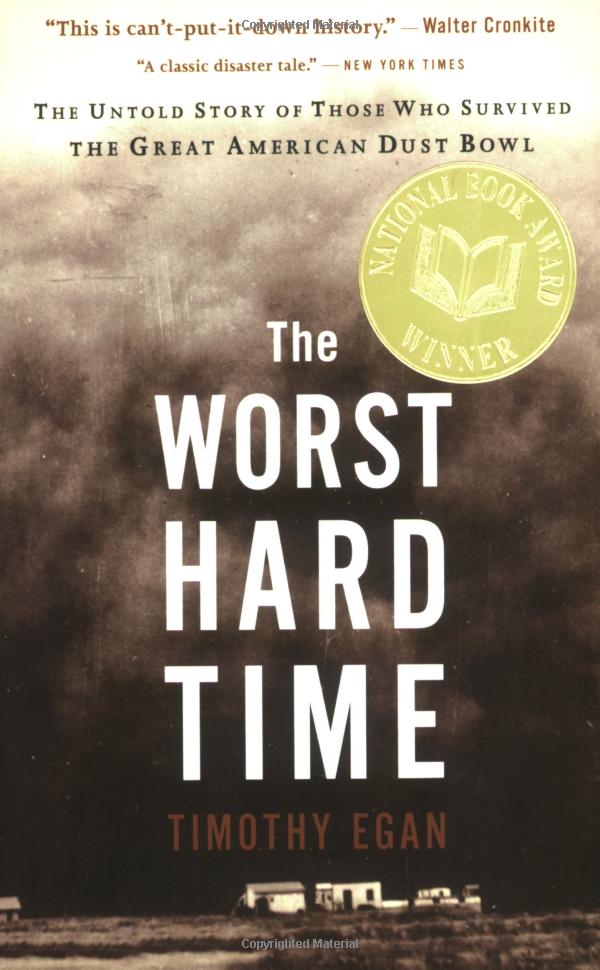
The Worst Hard Time by Timothy Egan is about the Dust Bowl of the 1930s. It tells the story of an ecological disaster of epic proportions caused by greed triumphing over reasonable behavior.
Before white people arrived on the American High Plains (the setting of Egan’s book) the tall grasses and buffalo had thrived for centuries upon centuries in a symbiotic-type relationship that allowed them to survive bitter cold, searing heat, and cycles of rain and drought. Then white people drove Native Americans off the plains and killed buffalo by the millions to ensure Native Americans wouldn’t have a food source.
Next came ranchers who raised cattle on the grasslands where the buffalo once roamed. But cattle, unlike buffalo, struggled to survive the extreme heat, cold, and drought. And when the prices of beef dropped or weather killed their cattle, many ranchers went bankrupt.
Then came farmers who believed they could grow wheat on the High Plains. At first there was enough rain and the price of wheat was high, so farmers borrowed more money and tore up more grassland, chasing higher and higher profits. But like a pyramid scheme, their dreams of wealth tumbled when wheat prices dropped precipitously and drought wrapped its hands around the neck of the High Plains and refused to let go. Wheat died in the fields, and farmers couldn’t pay their bank loans.
Ranchers and agricultural specialists warned against the unchecked removal of the grasslands because they understood the temperamental moods of the High Plains. The prairie is a place of wind, and so the winds, drought, and bare fields whirled like a dog chasing its tail, wearing itself out, completely spent. In a couple of decades, American farmers destroyed an ecosystem that had thrived for thousands of years.
Most of Egan’s book describes the horrific dust storms that raged over the plains, lifting millions of tons of topsoil and depositing it hundreds of miles away. He interviewed people who lived through the fierce, stinging storms. He retells their harrowing stories of survival, despite displaced dirt that filled their nostrils, mouths, and eyes, buried their possessions, killed their loved ones, and destroyed their livelihoods and communities.
Why is this book important?
People have changed the earth’s temperature, and they can’t just say, “It’s cyclical. It’s a phase.” Human behavior is accelerating the warming of the earth. During the Dust Bowl, many people blamed the ecological collapse of the High Plains on the drought. They refused to believe their stripping of the grasslands was the real issue. But other people knew better because droughts had come and gone many times and the grasses held the soil in place, just how nature designed it to work.
Yesterday the air quality where I live registered 182 on the AQ Index. That’s in the red zone, labeled unhealthy. And a thirty-acre wildfire started burning in the Boundary Waters Canoe Area Wilderness in northern Minnesota. It’s the first wildfire in the beginning of what appears to be a season of drought in Minnesota. We had lots of snow this winter, but the spring rains haven’t come. And there will be more fires. But the smoke that tanked our air quality yesterday came from one of the Canadian fires.
A smoky haze filled the sky, and the acrid smell stung my nostrils. I kept the windows and doors closed, but I could still smell the smoke in my house. I canceled plans to take my grandkids to a big outdoor park in a neighboring town. Physical activity is not advised when the AQ Index is in the red zone. We went to the library instead, but I could smell smoke inside the library too.
I thought about families who lived during the Dust Bowl. The babies and children and the young and old who died of dust pneumonia. How people and animals caught in a dust blizzard sometimes suffocated on dirt. How everyday women and men tried to defeat mounds of dust, shoveling it out of their homes, barns, driveways, and roads. How they covered every crack in their houses with tape or paper and hung damp sheets and blankets over windows and doorways to stop the dust. But each night while they slept, dust seeped into the house and cloaked them in grime.
Yesterday when I looked at the skies hemmed in with brown smoke, I felt claustrophobic, and my sinuses hurt. I wondered how people coped day after day, month after month, year after year with tons and tons of dirt. Of course, not all of them did. Some left, some died, and some lost their minds. I don’t think I could have handled the Dust Bowl.
Today the AQ Index dropped out of the red zone, through the orange and yellow zones, and by the afternoon entered the good green zone. But what will happen as the earth continues to heat up? There will be more wildfires. Will the air be filled with brown smoke every day?
If anyone has any doubt about how quickly greedy, ignorant humans can destroy a habitat, read The Worst Hard Time. It’s a well-written, well-researched book. And although it’s sad to read about the disaster of the Southern Great Plains and its tragic impact on the people who lived there, it’s an important story.
I have about one hundred pages of the book left to read, so I don’t know how it ends yet. It’s 1935, five years into the story, and drought still strangles the High Plains. Black Sunday, the worst storm of the Dust Bowl, has just occurred. And finally, the politicians in Washington, D.C. have decided they need to act. I don’t know how people worked to solve the Dust Bowl disaster, but I’m optimistic there was a workable solution. I hope to finish Egan’s book tonight.
I’m not so optimistic about today’s politicians in Washington, D.C., and their willingness to handle climate change.
 Writing Near the Lake
Dust pneumonia is likely what killed my husband’s grandfather. Born in Virginia, moved to Arkansas, then to Oklahoma where he was buried in 1947. His grandmother had died in the 1930s.
LikeLiked by 1 person
The dust pneumonia was often deadly. It’s all so sad.
LikeLike
I read this book some years ago. It is haunting. I think he was right, though in the people who lived through it didn’t want to talk about it later. This seems borne out by things I heard in my own family.
LikeLiked by 1 person
Great review! I have this book on my reading list, After reading elsewhere about this era, I can’t imagine how anyone survived.
LikeLiked by 1 person
I’m not sure how I would have managed the dust storms. The book is very interesting.
LikeLike
Thank you for reviewing this important book. Reading it opened my eyes to how greed and self-serving action can cause a catastrophe. The book is so much more than a historic record of a miserable time in our history. I try to have hope. It’s hard.
LikeLiked by 1 person
I try to have hope too, and I work to be careful with the earth’s resources. Thanks for reading my review.
LikeLike
Two days ago, the Twin Cities had the worst air quality in the nation. It was awful here. I can’t imagine living through the Dust Bowl era. That book sounds interesting. I’ll have to put that one on my list.
LikeLiked by 1 person
This story is another example of how colonizer people ignore traditional native wisdom/animals /plants that live on a landscape sustainably. Mother nature is treated like a slave to greed, then blamed when the predictable consequence, destruction, occurs. It has been said that cultures treat the landscape like they treat their women. This dust bowl event, like so many other man made disasters, is typical of ‘rape and run’ thinking. When the natural system, like victims of #MeToo, have been abused beyond limit, there is and will be, no place to hide.
LikeLiked by 1 person