

It would be a groan-worthy pun if I had titled this piece “Fall into Books.” But on the race track of seasons, autumn is — by two horse lengths — my favorite season, plus I think autumn is a beautiful word. Autumn colors are magnificent, and this year nature outdid herself with luminous swaths of red, orange, and yellow. Autumn air is crisp (often code for cold and windy where I live), so it’s a good time to read. (Really, anytime is a good time to read.) And I read lots. I’m a writer, so reading is part of my craft. I hope to be inspired by and to internalize good writing: the plots and subplots, the organization, the characterization, and the dialogue. Before we get too far into autumn, I’m going to share some of my recent reads, all of which were enjoyable, stimulating, and page-turning. So, if you’re looking for ideas . . .
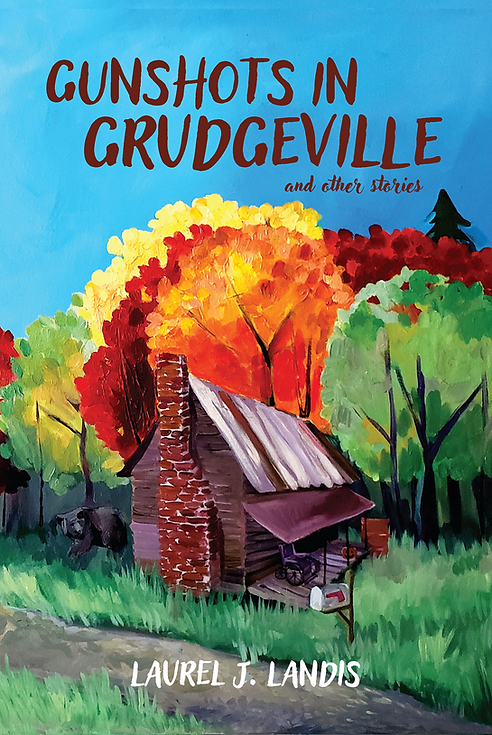
Gunshots in Grudgeville and Other Stories by Laurel J. Landis (Orange Hat Publishing – Ten 16 Press)
I loved the cover of this book and its catchy title. And Laurel J. Landis’s short stories beneath the cover are just as vibrant and intriguing as the autumn trees and the mysterious old shack — inviting readers to sit and connect with ordinary people living in a small town. Landis pulls readers into the lives of her characters and their tales of bad choices, grief, coming-of-age, love-gone-awry, and broken promises. I lived in a small town for three years, and Landis masterfully nails the feel of small-town life. Her characters and settings are authentic, reminding me of people I once knew in the unincorporated town of 350 where I once lived. Landis’s short stories remind us we don’t have to travel to faraway lands or other worlds because life happens everywhere, even in small towns. My favorites: “Tornado,” “Small Injuries,” “Breathless,” “Junction, County T,” and “Gunshots in Grudgeville.” [To order Landis’s book, click here.]

A Winter’s Rime by Carol Dunbar (Forge Books, Macmillan Publishing Group)
Mallory Moe, a twenty-five-year-old Army vet, works overnights at Speed Stop, a gas station and convenience store in rural northern Wisconsin. She is estranged from her family, in an abusive relationship, and drifting through life. While out on a cold winter’s night, Mallory encounters Shay, a teenage girl, who is hurt and on the run from an abusive boyfriend who is trafficking her. As she tries to help Shay, Mallory realizes she must confront her own traumatic childhood.
Don’t expect this book to be a thriller about rescuing trafficked girls from the clutches of evildoers at the eleventh hour. Carol Dunbar‘s novel is so much better, deeper, and smarter. She researched the science of PTSD, the brain, and current counseling practices that help people recover from childhood traumas. Dunbar deftly weaves her research into A Winter’s Rime, keeping it in the background, so it’s Mallory’s riveting story that drives the novel. Dunbar’s supporting characters, even the ones who make short appearances are memorable and believable. Dunbar likes to say her novels are character driven, and they are. But she is also a master of settings that are beautiful and haunting, often metaphors for the struggles the characters face.
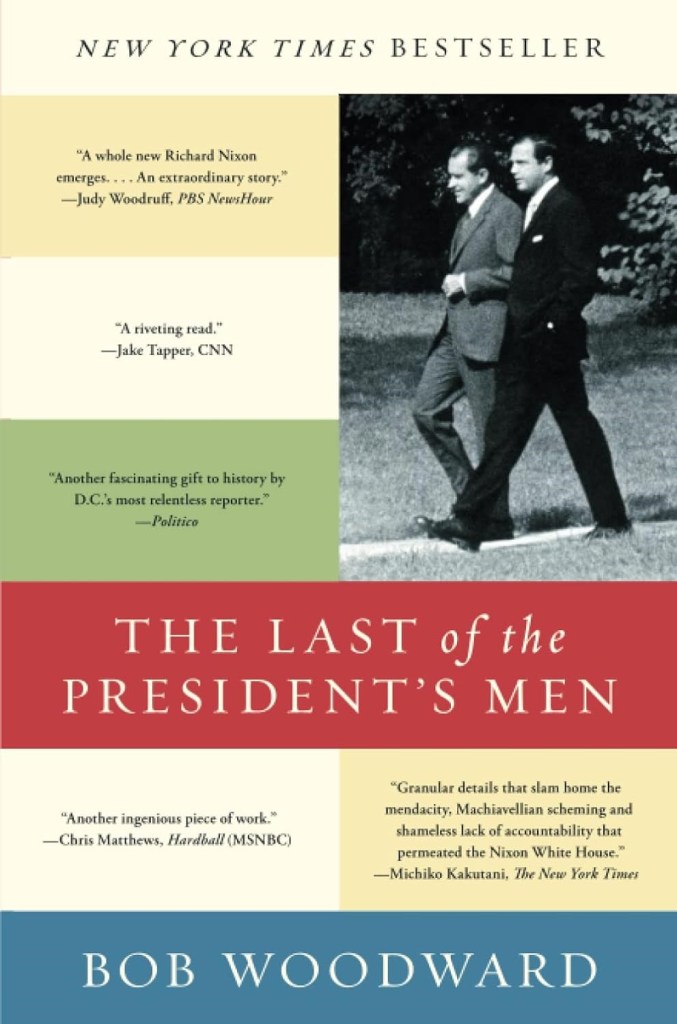
The Last of the President’s Men by Bob Woodward (Simon & Schuster)
I read this book because I heard Cassidy Hutchinson, author of Enough, talk about it. I was fourteen when Richard Nixon resigned from the presidency because of Watergate. In my early twenties, I read All the President’s Men by Carl Bernstein and Bob Woodward and Blind Ambition by John Dean. I decided it was time to read another book about Watergate.
Woodward held extensive interviews with Alex Butterfield, who worked closely with H. R. Haldeman and President Nixon. Both Butterfield and Haldeman knew about Nixon’s taping of White House conversations. During the Watergate investigation, Butterfield testified about Nixon’s tapes, effectively ending Nixon’s presidency.
The most frightening takeaway from The Last of the President’s Men is that so many of Nixon’s staff and supporters had blind loyalty to him, even though he broke the law, even though he believed his methods to maintain power were justified, even though he felt his presidency meant he was above the law — the behavior of dictators. Supporters saw Nixon as their president, and they ignored his abuses of power.
The Last of the President’s Men is well-researched and clearly written. Even though I knew Butterfield would testify about Nixon’s tapes and that Nixon would resign, Woodward’s book about Nixon and his staff, who believed it was their job to keep their president happy and do his bidding, even if they knew it was wrong, was very scary.
And if you don’t have time to read a book, try a single short story! Below are three choices to consider.

“APrayer4You.com” a short story by Kim Suhr (Published by Moot Point, a literary journal)
Isabelle and Blake are young, in love, and on their honeymoon. Everything is wonderful, until it isn’t. (My synopsis is short because readers need the joy of discovering Kim Suhr’s thought-provoking, well-crafted story for themselves.)
Suhr’s short story “APrayer4You.com” haunts my thoughts. I might go for weeks without thinking about it, then something nudges my brain, and I wonder, How is Isabelle coping? And what about Blake?
Even though “APrayer4You.com” is a short read, under 1,600 words, savor each word, sentence, and paragraph because Suhr weaves a gripping story in a short space. There are so many layers of meaning in her story that it would make a good selection for a book club. (Or, brilliant idea that just occurred to me: a short story club for readers who have busy lives!)
Note, if you’re a writer, read Suhr’s story as a reader first. Then go back and read it again as a writer. Pay attention to her use of opposites in the story. Opposite situations, opposite ideas, opposite beliefs, opposite personalities, opposite actions. Suhr skillfully uses all these opposites to create tension in her story. [Suhr has also published a wonderful collection of short stories titled Nothing to Lose. Visit Suhr’s author page. Click here to read “APrayer4You.com.” ]

“Effie’s Trinket” by Diana (wonkagranny blog)
Euphemia, Effie for short, has run away from home and the insults of her older brother. But she’s young, and so she’s hidden herself away in the yard. She refuses to come out of hiding when her mother calls her for supper. In a swift 690 words, Diana creates a story with a magical sense of wonder that takes readers back to a time when all things were possible to a young child.
I don’t want to say too much about this story and its themes or the different ways to think about it because I want readers to have the joy of reading this gem.
Diana writes the blog wonkagranny. Even though I follow her blog, I don’t know her last name, but she gave me permission to post a link to “Effie’s Trinket.”
Note, if you’re a writer, you will enjoy reading Diana’s comments about her writing process, which appear before and after “Effie’s Trinket.” Also, be amazed at how a simple story can be layered with the many textures of life.

“To Build a Fire” by Jack London
On an “exceedingly cold and gray” day in the Yukon Territory, a man who is inexperienced with the brutal arctic winters decides to walk to another camp to visit friends. Before leaving, he is warned about the dangers of hiking alone in the extreme sub-zero temperatures. But he has the arrogance of a newcomer, who neither respects nor understands the perils of his new home. His hike does not go well.
Jack London’s “To Build a Fire” is one of my favorite short stories. On a micro level, this story is about the arrogance of one man who brushes off the warning from an old-timer who tells him he shouldn’t go out alone because the temperatures are dangerously cold. On a macro level, this story can be read as a metaphor about the arrogance of the whole human race, who are newcomers on Earth, and their disregard for nature.
Note, if you’re a writer, part of what makes this story so horrifically chilling is London’s accurate, detailed, and graphic descriptions about what his character experiences, physically and emotionally, as he slowly freezes to death. London’s attention to these details teaches me that even in fiction, research is important to a story.
[The link I provided is for the 1908 version of London’s story, in which the protagonist dies. In the 1902 version, the protagonist lives. London was right to modify the story’s ending. The tragic version is powerful and thematically more complex.]
 Writing Near the Lake
Thank you do much Vickie for the link on your post. I will definitely check out the other stories you suggest. I love the short story genre. It’s nice to have some tucked away for the coming winter days.
LikeLiked by 2 people
MmmmmHmmmm- Reading is to winter like hot chocolate is to marshmallows. Your book recommendations are like the whip cream on top.
LikeLiked by 1 person
Thanks for the recommendations! That cover photo was awesome!
LikeLiked by 1 person
How wonderful to find that the kind reviewer of my short stories is a lover of one of my all time favorites. To Start a Fire was also a favorite of my nephew Tyrone for whom I wrote “Tomodachie” and “Tomo-dog” . Just FYI, Your web site is great!
LikeLiked by 1 person
Hi, P.J. Thank you so much for your kind comments! I enjoyed your short story collection very much!
LikeLike