
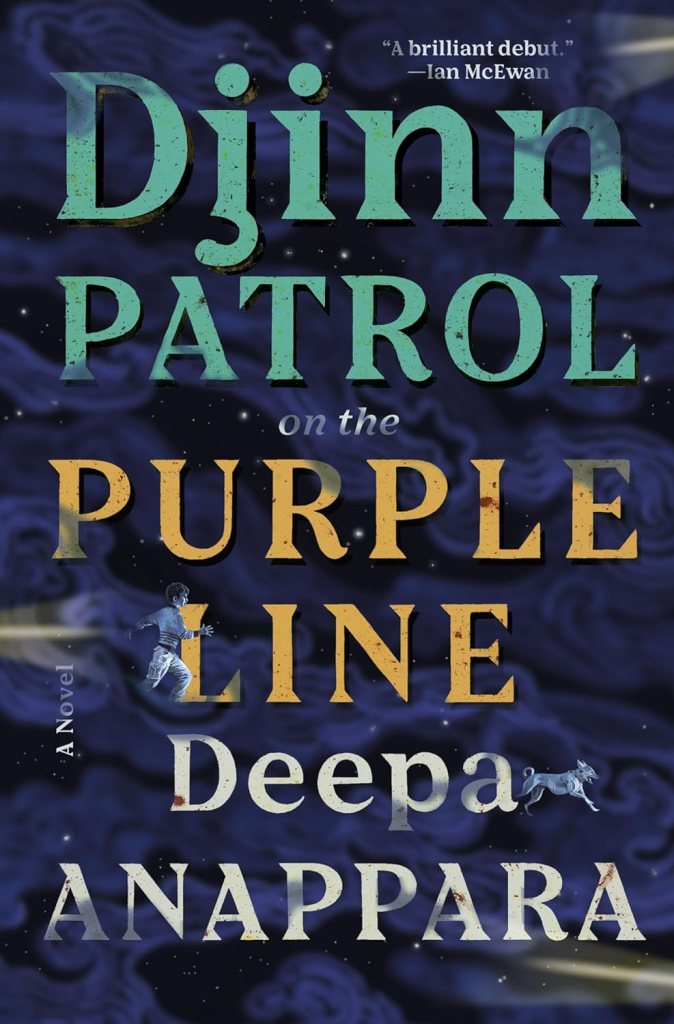
Why did I read this book?
A friend of mine suggested I might like to read Djinn Patrol on the Purple Line. Not only did she love the story, she liked how Deepa Anappara structured the novel. And my friend enjoyed how many of the chapter titles were also the beginning of the first sentence in a chapter. For example:
THREE WEEKS AGO I WAS ONLY A SCHOOLKID BUT–
–now I’m a detective and also a tea-shop boy.
(And what a great sentence it is.)
What is this book about?
Nine-year-old Jai lives in India in a poor, crowded neighborhood referred to as a basti. Bordered by a smoldering rubbish dump and enveloped by an unrelenting gray smog, Jai’s life in the basti is hemmed in by poverty, garbage, pollution, and classism. The wealthy lifestyle of the hi-fi residents who live in luxurious skyscrapers separated by a high wall from his basti is beyond his reach. He lives with his older sister Runi-Didi and his Ma and Papa. His best friends are Faiz and Pari, who are also classmates.
The story opens with the disappearance of Bahadur, a quiet and unassuming boy who others rarely notice. When Bahadur doesn’t turn up, his parents and other concerned adults from the basti beg the local police to investigate. But the police refuse to take Bahadur’s disappearance seriously, and instead they threaten to have the basti bulldozed if its residents insist on causing trouble over Bahadur’s disappearance.
In answer to the indifference of the police, Jai, Faiz, and Pari declare themselves detectives. Jai, who loves to watch detective and crime shows on TV, fancies himself as the head detective. The three friends wander through their basti and the Bhoot Bazaar, asking people if they’ve seen Bahadur. They even take the Purple Line train to a neighboring city on a hunch that Bahadur may have run away or been kidnapped and taken to that city.
Soon other basti children go missing, and fear, like the pervasive smog, engulfs the basti residents. Jai, Faiz, and Pari are forbidden to leave home without an adult. But they defy their parents, and while continuing to look for Bahadur, they make inquiries about the other children who have gone missing.
What makes this book so good?
Deepa Anappara was born in India and worked as a journalist in her home country from 1997 to 2008, where she wrote about education. There is no doubt that Anappara’s personal and professional connections to India enabled her to create the realistic world in which her impoverished and marginalized characters live. Although her characters are fictional, Anappara’s portrayal of their joys, fears, hopes, and disappointments are heartbreakingly real. And most importantly, Anappara takes care not to sensationalize or diminish her characters’ stories. Instead, she has written a literary novel about the worst kind of crime. Her beautiful writing along with her measured restraint carries readers through the difficult scenes.
During her years as a journalist, Anappara interviewed many disadvantaged children, whom she found to be full of “humor, sarcasm, and energy.” While working as a journalist she learned that children from poor families disappeared at a higher rate than children from families in better circumstances. These abductions rarely made the news unless a kidnapper was caught or the details of a kidnapping were particularly gruesome. It upset Anappara that the stories of the missing children “were nowhere to be found.”
When Anappara first tried to write Djinn Patrol, she labeled her attempt a failure. In 2016, she returned to her novel. This time when she thought about the children she had interviewed in India, she remembered “their determination to survive in a society that often willfully neglected them” and she knew the story must be told from the perspective of the children. She found a way into her story, and after reading her novel, I can’t imagine it being told any other way. The story is told mostly in first person by Jai, who is at turns earnest, careless, unselfish, jealous, kind, and churlish, but who, despite his faults and missteps, captured my heart. Other times the story is told in third person through the point of view of other children.
I have to return the borrowed book to my friend. But I ordered my own copy to keep on my bookshelf. In part because like my friend, I admire Anappara’s amazing use of voice, point of view, and structure. Perhaps, I won’t read the book again, or maybe I’ll only read parts of it. Regardless, I couldn’t bear the thought of being separated from Jai, Faiz, and Pari and their dreams. And that’s the other part.
 Writing Near the Lake
Exactly right. All of it, including this books well earned place on any bookshelf. I do appreciate the author’s craftsmanship and compassion in writing this novel.
LikeLiked by 1 person
I’m so glad you shared this…Another I will add to my “to be read” list!
LikeLiked by 1 person
It was such a good book. And the structure worked so well with her story.
LikeLike