
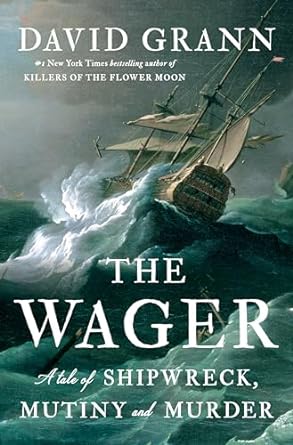
Why did I read this book?
I read a lot of novels; short stories; and nonfiction about history, people, and nature. But every now and then, I love a good book about a real shipwreck. (I’ve read at least nine over the years.) True stories about tumultuous weather, dangerous waterways, towering icebergs, or deadly torpedoes that cause a ship to falter upon rocky coastlines or to sink into dark, deep oceans keep me reading late into the night. Stranded sailors, whether they be in a lifeboat or marooned on uninhabited and untamed land, appeal to me. Both dastardly and brave deeds among the captains, officers, crew, and passengers pull me into a world of drowning, scurvy, starvation, dehydration, desperation, intrigue, cruelty, selflessness, fortitude, and perseverance. I’m not sure why I enjoy these stories so much — or what this says about me.
What is this book about?
In 1740, the Wager, a British ship, left England on a secret mission to seize a Spanish galleon loaded with treasure. Britain and Spain were at war, and wars are expensive. By capturing the Spanish treasure, Britain could fill its war chest while depleting Spain’s. British officers and sailors alike knew this was a dangerous mission.
In pursuit of its quest, the Wager sailed around the tip of South America, perhaps the most perilous stretch of water in the world, then wrecked itself on a deserted island off the coast of Patagonia. The men were able to salvage supplies from the wrecked ship, but they were stranded for months. As the threat of starvation grew, the men decided to build a makeshift watercraft and leave the island. They sailed back to safety and were welcomed home as heroes. However, six months later three more of the stranded sailors returned home, and they accused the first group of sailors of mutiny. Accusations of rebellion, murder, and treachery between the first and second groups of survivors resulted in an investigation followed by a court martial.
What makes this book so good?
David Grann writes a highly engaging and well-researched history about a risky sea mission driven by greed and glory that goes awry. Almost three hundred years later, Grann was able to access the ship’s logs and the transcripts from the ensuing court martial.
A captain and other officers aboard a ship were expected to keep meticulous records. When a ship returned to port in England, all logs were turned over to the Admiralty, who used the information to learn more about weather patterns, sailing routes, and faraway lands. Additionally, if something went wrong aboard a ship, the events and the measures taken to remedy the calamity were to be objectively and completely documented. Logs kept by officers and mates were supposed to be detailed and succinct without emotional slants. However, as things worsened on the Wager‘s journey and after its wreck, it became clear that each officer who kept a log recorded the events in a manner to put himself and his actions in the best light. As to which accounts might be accurate and which might be embellished, Grann smartly doesn’t take sides but simply presents the information.
Grann’s vivid descriptions of bad weather, inhospitable lands, and tempestuous seas recreate the backdrop in which the egotistical, short-tempered, avaricious officers strived to chase down the treasure-filled Spanish galleon that would have made them wealthy and famous.
It’s a rollicking read filled with courage, double-dealing, and foolishness. For 257 pages, I joined the adventure from the safety of my couch, and wondered, Why — before modern ships and navigational equipment — did anyone ever leave the shores of their homeland, especially for a voyage around the tip of South America that had only a slim chance of success? And perhaps that’s what draws me to books about shipwrecks: A group of people get on a small vessel and head across a broad expanse of water, trusting they will arrive on the other side. Often they do, but when they don’t — there’s a story in that. I’m glad Grann thought so too.
Want to read some other good books about shipwrecks?
- A Night to Remember by Walter Lord
- Dead Wake: The Last Crossing of the Lusitania by Erik Larson
- Icebound: Shipwrecked at the Edge of the World by Andrea Pitzer
- In the Heart of the Sea: The Tragedy of the Whaleship Essex by Nathaniel Philbrick
- Over the Edge of the World: Magellan’s Terrifying Circumnavigation of the Globe by Laurence Bergreen
- “The Open Boat” by Stephan Crane (This short story is a semi-autobiographical and fictionalized account based on Crane’s surviving a shipwreck and enduring over thirty hours in a lifeboat.)
In addition to the list above, I’ve read other books about shipwrecks, but I can’t remember their titles. I read two other books about the Titanic and the Lusitania, a book about the collision between the Andrea Doria and the Stockholm off Nantucket Island, and a book about a mutiny in the Caribbean in the 1800s. Endurance: Shackleton’s Incredible Voyage is on my to-be-read pile of books. On my list of books to get and read in the near future are Left for Dead: Shipwreck, Treachery, and Survival at the Edge of the World and The Wide Wide Sea: Imperial Ambition, First Contact and the Fateful Final Voyage of Captain James Cook.
 Writing Near the Lake
I have to read this. Thanks for sharing.
LikeLiked by 1 person
It’s a fascinating look at the history of sailing, imperialism, naval procedures, etc. of the time. It’s very well written, and because David Grann had so much access to primary documents, he was able to include a lot of information.
LikeLiked by 1 person
Much appreciated.
LikeLiked by 1 person
The more I read about this book and your descriptions, Vickie, the more I shrank back into MY couch. Going overland, or down rivers is an adventure, but the chronicles told and your book listings to read go beyond that. I’m happy other authors tell the story for me.
LikeLiked by 1 person
Pingback: A Mini Six-Pack of Book Reviews: Neil Gaiman, Peter Geye, Matt Goldman, Alfred Lansing, Richard Osman, Kurt Vonnegut | Writing Near the Lake
Pingback: Realm of Ice and Sky: Triumph, Tragedy, and History’s Greatest Arctic Rescue | Writing Near the Lake
Pingback: Into The Maelstrom: Navigating The High-Stakes World Of The Wager - Walton surgery