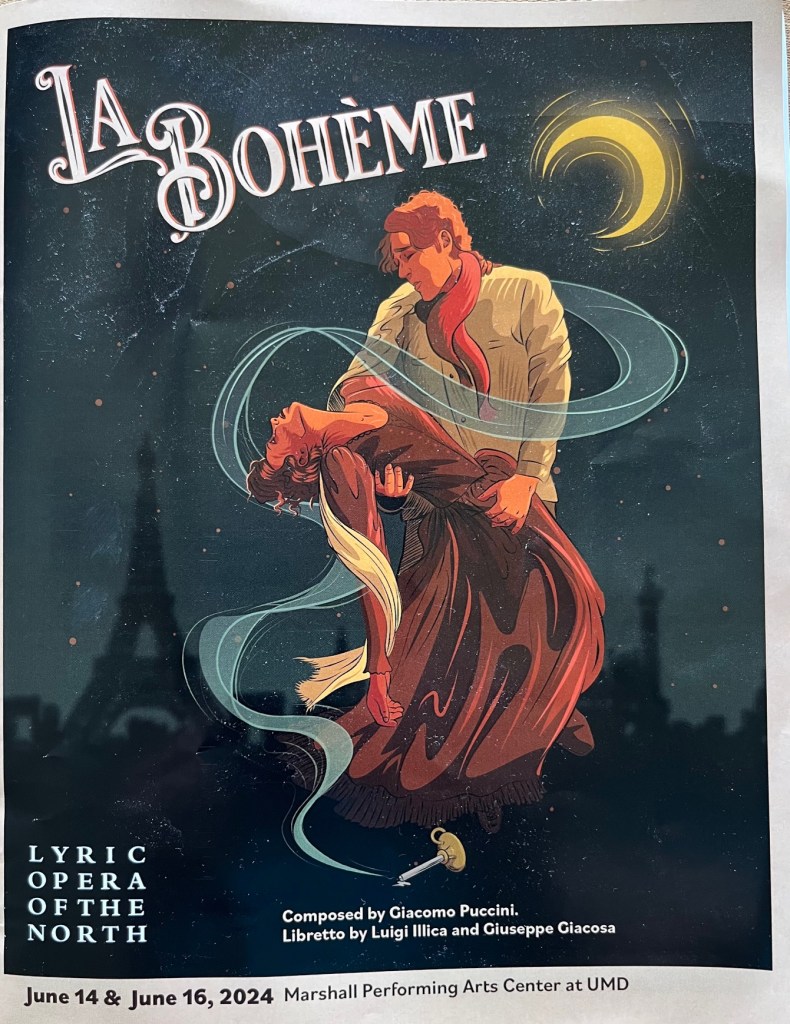
I went to see a live opera because it was on my list of things to do. (In case you’re wondering, I signed up for Medicare a few months before going to my first opera.) I had such a good time that I want to share some thoughts about my experience, but first I should point out my shortcomings as an opera critic.
I have no training in opera.
I don’t understand opera’s conventions. (Other than there is a lot of singing, which crescendos into an epic climax of either joyful or tragic proportions at the end of the opera.)

My exposure to opera as a child consisted of two events. One, in fourth grade I read a biography about Jenny Lind, an opera singer known as the Swedish Nightingale. This didn’t encourage me to learn more about opera. Instead, I just fancied myself to be the next Jenny Lind. I would sit by my second-story bedroom window and sing out into the neighborhood (with what I considered to be a lovely operatic voice) because that is what Lind did as a child. People passing by Lind’s window listened to her beautiful singing, and one passerby discovered her talent and helped her down the path to stardom. Only Mr. Geise’s cows across the road heard me sing, and none of them mooed about my talent.
Two, when I was about twelve, I saw Beverly Sills, a talented soprano, perform on Johnny Carson’s Tonight Show. I loved her voice and her flowing red hair. When Carson interviewed her, I fell for her wit and laughter. Over a handful of years, I saw Sills make appearances on various talk shows during the 1970s, but I never saw her in an opera. She was a gifted and well-respected opera singer, but it was the talk-show circuit that made her a household name and gave her celebrity status. Even people who knew nothing about opera, like me, usually knew who Sills was.
So, anything I say about my La Bohème experience isn’t intended to resemble a critique or a review. Also, I truly loved my debut at the opera, so my comments come from a place of affection, even if they sound cheeky.
I chose La Bohème to be my first opera because that’s what the Lyric Opera of the North performed this year. It’s a famous opera, so I’d heard of it. It’s the opera that Ronnie Cammareri (Nicholas Cage) takes Loretta Castorini (Cher) to see in Moonstruck. Ronnie knew what he was doing — Loretta loved the opera. And, this is where Loretta falls in love with Ronnie.
Because La Bohème is written in Italian, I read a synopsis of the libretto before attending the opera. While reading about La Bohème, I came across some unflattering critiques of Puccini’s opera — calling his musical composition simplistic, lacking in complexity, yada, yada, yada. For a moment, I wondered if I should wait to see a different opera. Then I remembered all the beautiful singing and music in Moonstruck’s La Bohème scene. I also learned that La Bohème has been performed over 1,000 times at the Met. So, not the first time critics have panned something that people love anyway. Besides, what would I know about the musical composition of an opera.
So, here’s what I loved about my first opera:
- I loved that the set design evoked a shabby-chic slice of Paris with a romanticized version of poverty, you know, without the half-starved rats, the rubbish in the streets, and the ever-present layer of grime. The rich jewel-toned costumes complimented the pastel-colored sets, like a well-chosen pair of earrings and necklace elevates an evening gown. After all, gritty reality is overrated. When we know that in the end a lovely young woman will die a tragic death while in the arms of her lover, we want some beauty along the way.
- I loved that on a long, narrow screen above the stage, an English translation of the Italian libretto scrolled by as the singers trilled, vibratoed, bel cantoed, and otherwise sang their way through scenes of comedy, anger, and tragedy. The subtitles provided a line-by-line translation. Without it, I would’ve missed out on so much of the story. I thought this was unique to the venue I attended, but a friend of mine said when she saw an opera in Michigan there were subtitles.
- I loved that the melodramatic, over-the-top, corny libretto sounded brilliant when sung in Italian. More than once, as I read the English translation, I thought, “As a writer, I could never get away with such sappy, syrupy, trite dialogue.” (Perhaps my characters should speak Italian.)
- I loved that although the pageantry on the stage was gorgeous, it was upstaged by operatic voices so strong, crisp, and clear, producing sounds so bewitching that I couldn’t believe they flowed from human voice boxes.
- I loved the magnificent, glorious, wrenching tragedy of it all. How can anyone hear Mimi ask, “Will my hands never be warm again?” and not shed a tear? (Charles Dickens would’ve loved to have written that line.)
- I loved that at the end of the opera, as Mimi reclines upon her couch in her freezing apartment, dying of tuberculosis, she sings her heart out with Rodolfo, the love of her life, reminiscing about their time together. Having read a book about dreaded plagues, which included a chapter about tuberculosis, the incongruity of performing an operatic finale when one would be coughing up blood and gasping for air, stuck me as darkly humorous. But I kicked the cold, hard reality from my mind, and I let Mimi and Rodolfo’s final moment together carry me away.
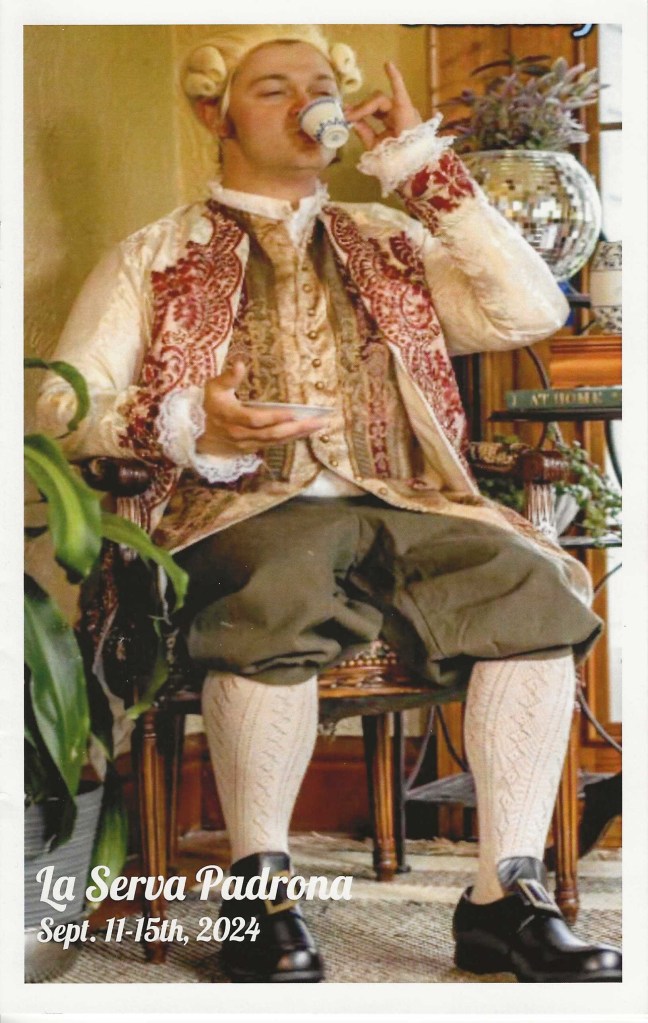
After the performers took their final bows, I left the theater knowing I would definitely see another opera. A few months later, I went to see La Serva Padrona, a light-hearted intermezzo by Giovanni Battista Pergolesi, which was translated into a modern English version by Steve Solkela. I loved everything about it.
In the movie Pretty Woman, Edward Lewis (Richard Gere) takes Vivian Ward (Julia Roberts) to see her first opera, La traviata by Giuseppe Verdi. Before the performance begins, it’s apparent that Edward hopes Vivian will love opera as much as he does. As the final song ends and Violetta dies in the arms of her lover (of course), Edward looks at Vivian and sees her eyes have pooled with tears and her face is filled with rapture. At this moment, Edward realizes Vivan has a depth beyond his stereotype of hookers. He has fallen in love with Vivan, he just doesn’t know it yet.
When another woman asks Vivan if she enjoyed the opera, Vivian answers, “Oh, it was so good I almost peed my pants.” Vivan, like me, doesn’t know how to talk about the conventions of opera, but she knows what she likes.
 Writing Near the Lake
Good for you to try something new! That’s funny that you sang to the cows out your window as a child. I’m not a big fan of opera. Whenever it comes on the radio on MPR, I almost always turn it off. But I did go to see Carmen at the DECC about a decade ago. That had subtitles, too. It was very good! Although I think the lead woman dies in that one, too.
LikeLiked by 1 person
I want to see Carmen. I so love the music and singing from that opera.
LikeLiked by 2 people
If you like it, then it doesn’t matter how you say it. It just matters if you enjoyed it!
LikeLiked by 1 person
Yes, and Vivian’s review was top-notch!
LikeLiked by 1 person
I have only seen one opera, Carmen, and with no subtitles. It didn’t matter. I loved the splash, drama and thunder of voices. Thank you for your take!
LikeLiked by 1 person
Thanks, Sally! Carmenn is on my wish list. I love the music from it.
LikeLike
Outside of Mozart and a few others, I’ve never gotten into opera. Now you have me singing Carmen in my head. What a delightful read! I chuckled thinking of you singing to the neighbors’ cows. If I were singing to them, they would have fled in abject terror, but that’s another story.
I think opera is best enjoyed live. Part of it is the spectacle—the costumes, the settings, and so on.
LikeLiked by 1 person
I love classical music and opera, and I know next to nothing about any of it. I love to play classical music when I’m writing. I want to see Carmen because I love the music from that opera.
LikeLiked by 1 person
I love to write to baroque music. Anything with lyrics, though, and I’m in danger of breaking out in song, and that—well, no one wants that.
LikeLiked by 1 person
I laughed all the way through this! I have never been to an opera and during the movies you mentioned, I probably would have used the opportunity to head for the bathroom when the opera scene came into view. I can watch musicals, but it took me years to appreciate them. I recall watching a few on TV as a kid, and when the singing started, I turned back to the book on my lap!
Maybe someday…
LikeLiked by 1 person
This is a great encouragement to go see an opera! Your growing up comments w/cows and the Jennie Lind picture book was interesting. I saw an English subtitle screen opera at the Calumet Theater in Michigan and the opera words and the English did translate into triviality. I was surprised, but the emotion, passion and costumes were all there.
LikeLiked by 1 person
I agree that the beautiful music and singing and the costumes and pageantry are what make the opera. They could be singing entries from the dictionary and it would sound wonderful.
LikeLike