
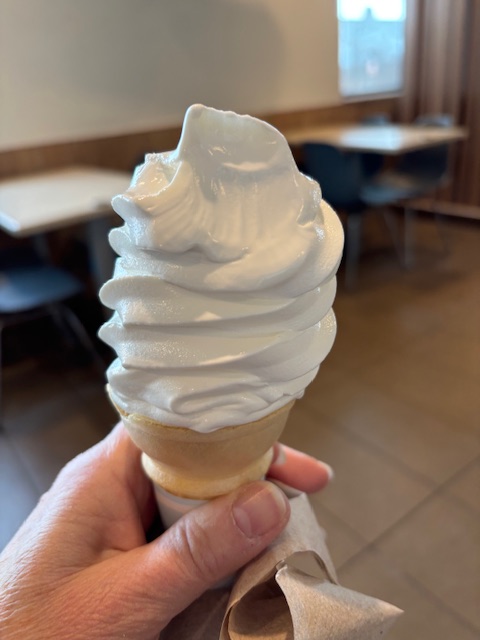
February 9th was a teacher in-service day, so I had my four grandkids. I took them to McDonald’s for lunch and $1 ice cream cones.
I also have a fifteen-year-old poodle, Ziva, with multiple myeloma. She is in the early stages of the disease, but she also has some other health issues. Her vision and hearing are iffy, she has some dementia-like issues, and her osteoarthritis makes her mobility a bit sketchy. But she still enjoys a very short walk and loves car rides.
So, when I took my grandkids to McDonalds, I invited Ziva to come along. My husband carried her down the basement stairs, and I lifted her into the van.
The temperature was in the 30s, so I knew Ziva could sit in the car for a bit while we ate at McDonalds. But I didn’t want to leave her in the car while we ate happy meals and ice cream cones.
Once inside McDonald’s, we approached the counter to place our orders. “How can I help you?” the clerk asked.
I had an idea.
I looked at my grandkids, and asked, “Would it be okay if we all got the $1 ice cream cones and ate them here? Afterward we can order our lunch to go and eat it at home? So, Ziva doesn’t have to be in the car by herself for so long?”
The grandkids looked at me like I was crazy for asking. I pressed on as though I had to convince them. “Is it okay? We could call it a ‘backwards lunch.’ Does anyone object to having dessert before lunch?”
“Not at all,” said a voice filled with chuckles. The oldest grandchild, whose face lit up with conspiratorial glee, had spoken. The other three laughed. They’d caught on that Nana was playing the straight man in a comedy routine.
We ordered five ice cream cones and sat at a table overlooking Lake Superior. We had a lovely conversation about this and that while licking our ice cream and crunching our cones.
After dessert we ordered lunch and headed home. The grandkids carried our food into the house while I lifted Ziva out of the van, then carried her up the basement stairs.
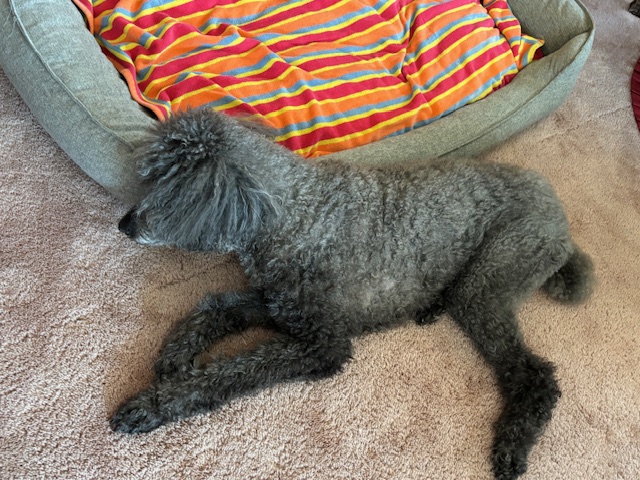
Ziva stretched out on her bed in the living room. Car adventures tucker her out. The grandkids gathered at the table, where we ate the first part of our lunch last.
While they jabbered and looked at their Happy Meal toys, I thought about my childhood and desserts.
“You can’t have dessert. It’s too close to supper. You’ll ruin your appetite,” said the adults in my life when I was a child and they didn’t want me to have goodies before a meal.
“If you don’t have room for your supper, you don’t have room for dessert,” said the same adults in my life when they wanted to make sure I cleaned my plate.
For added drama, they might add, “There are starving children in Ethiopia who’d love to have that food.”
So, I’d eat my food. (Unless it was split pea soup or ring bologna, then I’d stare at it, shifting it a round with a spoon or fork, trying to make it disappear.) And I’d wonder why the children in Ethiopia were starving. (In the early 1970s, I couldn’t google it.) But I didn’t ask because to question adults when they dished out words of wisdom (a.k.a. a lecture) was considered disrespectful, and usually met with, “Don’t talk back!” or “Go to your room!” I had a friend who suggested to her mother that the food she didn’t like be packed up and sent to the starving children in Africa. It didn’t go well. My friend was sent to her room for the rest of the day.
Not spoiling one’s supper by eating dessert first, cleaning one’s plate, being forced to eat things one didn’t like, and holding one’s tongue while a parent prattled on were all standard customs when I was a child.
Dessert was a special treat in my childhood home. Mom occasionally bought cookies, ice cream, or potato chips and French onion dip, technically not dessert, but oh so yummy. My dad was a mechanic and my mother was a waitress, so with four children, money was tight. Desserts and salty snacks were considered luxuries, and my mother wisely spent most of her grocery budget on food for our meals. My nana Kitty’s house was a dessert desert, unless you count the raisins or saltine crackers she tried to pass off as goodies. On the other hand, my grandma Olive’s house was dessert oasis filled with freshly baked cakes, cookies, or pies, and she always had ice cream in the freezer. But Grandma Olive lived 350 miles away, and we only saw her for two or three weeks a year.
Our neighbors had dessert after every evening meal. I don’t think Shirley ever baked anything, unless it was a ready-to-pop-in-oven item, but her husband Bill expected a sweet after supper. So, Shirley bought cookies, Danish, ice cream, and pies. My mother bristled at this, saying that having dessert every day was unhealthy.
My sisters and I never cared that Shirley and Bill’s children had dessert every night while we didn’t. We envied them because they had a built-in dishwasher! While my sisters and I cleared the kitchen table and washed and dried all the dishes and pots and pans after a meal for six people, the neighbor kids unloaded and loaded a dishwasher after a meal for five people. Bill went to work in a suit and tie, and Shirley was a stay-at-home mom. Bill made more money than my mother and dad did together. And even as a child, I knew this was why they could afford daily desserts, a dishwasher, and Scrubbing Bubbles, while my sisters and I dreamed of Oreos, washed dishes by hand, and scoured our kitchen sink with Comet.
Occasionally, we’d plead with our parents: “Please, can we get a dishwasher?” To which, my father always answered, “We don’t need a dishwasher, we already have three of them.” Of course, he was referring to my two sisters and me. We didn’t think he was funny. But as an adult when I think about his retort, it always makes me smile. And if I’m in the right mood when I think about it, I laugh out loud.
My parents never owned a dishwasher until I moved out of the house. When I became a parent, I followed my mother’s example about desserts, instead of Bill and Shirley’s. And as soon as I could, I bought a dishwasher.
But I never made my children eat things they didn’t like. I remembered the horrors of being made to chew and swallow ring bologna and split pea soup, both of which I detested. I remember my sister and I helping our youngest sister hide, then dispose of red kidney beans on the nights my mom served chili. Our little sister would be forced to sit at the table long after everyone else was done with their food. Her brown eyes filled with tears as she stared at the kidney beans, but she refused to eat them. Our hearts broke for her. Even our dog, Fritz, often sat nearby in a show of support. We always managed to find a way to get rid of those beans. Sometimes Fritz ate them. Sometimes the beans were surreptitiously wrapped in a napkin and tucked into a nook under the table then later thrown in the garbage.
My parents weren’t trying to be cruel. It’s how they and most of their generation were raised. If there was food on your plate, you ate it. It didn’t belong in the garbage. Their parents all grew up during the depression. Nothing was wasted. My grandma Olive saved every scrap of leftovers, even if the scraps only amounted to several bites. She stored them in small plastic containers that once held margarine, which she’d washed and dried, along with plastic baggies. Everything was reused. About once a week, my grandmother would serve a meal by using up all the leftover food in the fridge. Grandma Olive and Grandpa George weren’t poor. They could’ve afforded to toss leftovers and buy more baggies. They were against throwing out anything that was still useful. Nana Kitty, who did live on a tight budget, shared Olive and George’s viewpoint. “Waste not, want not,” Nana would often say.
My grandkids and I ate our ice cream cones and all of our food. Still, I wisely kept my thoughts about dessert and food and wastefulness to myself. My grandkids probably would’ve considered any words of wisdom I might have on these subjects to be a lecture.
 Writing Near the Lake
What fun. And including Zika, too, even if it tuckered her out.When I was growing up and turned my nose up a food, I heard about the kids starving in China. My mother was born during a war. She still loves fresh fruit and vegetables more than anything else. We had a salad with tomatoes every night. I couldn’t stand tomatoes. The only way I could eat them was to cut them up into little pieces and swallow them like pills. They still make me gag. My grandmother used to have a pantry full of canned soups, canned vegetables, pasta, flour, etc. You never knew when another Depression might hit. I remember she washed out the plastic wrappers bread came in and re-used them, though I don’t recall for what.She also said that my brother and I made enough noise we sounded like a couple of banshees.
LikeLiked by 1 person
Oh yes, we were told about starving children in China too, and sometimes the starving children in Africa. My grandma Olive washed out the plastic bread bags too, and she hung them on the line to dry, with the baggies. My grandparents were very frugal. Having lived with both Nana Kitty and Grandma Olive, I picked up some of their frugal habits. And many of the proverbs!
LikeLiked by 1 person
One of my coworkers had a saying, “Life is uncertain. Eat dessert first.” I heartily agree. I used to live near the McDonalds in Duluth on London Rd. I have fond memories of my son and I walking there for ice cream cones, They’re HUGE — a great buy for the money.
LikeLiked by 1 person
I had a very similar upbringing to yours, I am guessing. But one difference is dessert. We were a working-class family without a lot of extra cash to spend, but dessert was always served with supper—of course, only after the “real” food was finished. Dessert was nothing fancy or expensive. Often just cookies or a cake that my mother would have baked. Maybe it was a Scandinavian thing. My mother was not of Scandinavian heritage, but my father was. Desserts or sweets seem to be an important thing for Scandinavians–or at least to those I knew. I don’t really like cooking and avoid it as often as possible, but regardless of what my “real” food is for a meal, I always include dessert . . . sometimes, actually, I only “do” dessert. So, hats off to your ice-cream first idea. P.S. I am so sorry to hear about your dog.
LikeLiked by 1 person
My mom didn’t bake, except for Christmas, otherwise, we might have had dessert more often because it’s cheaper to bake your own goodies, and usually better tasting. I know my dad wouldn’t have objected. Even though we didn’t usually have dessert or goodies in the house all the time, we still had them. My mom would sometimes buy ice cream and cookies, and during the summer whe usually had popsicles! I guess this is why my sisters and I coveted the neighbor’s dishwasher instead of their desserts! LOL. Thanks for your words about Ziva. She is holding steady for now. She still has a quality of life.
LikeLiked by 1 person
Oh Vickie, I laughed all the way through this! Our households were so much the same!
LikeLiked by 1 person
I know, right!
LikeLike