Ziva Baby, the Diva Dog

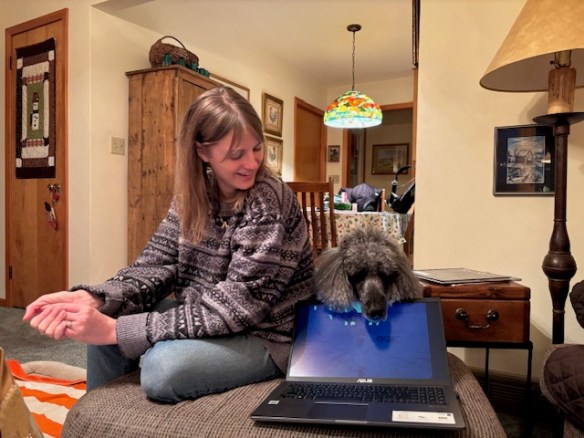
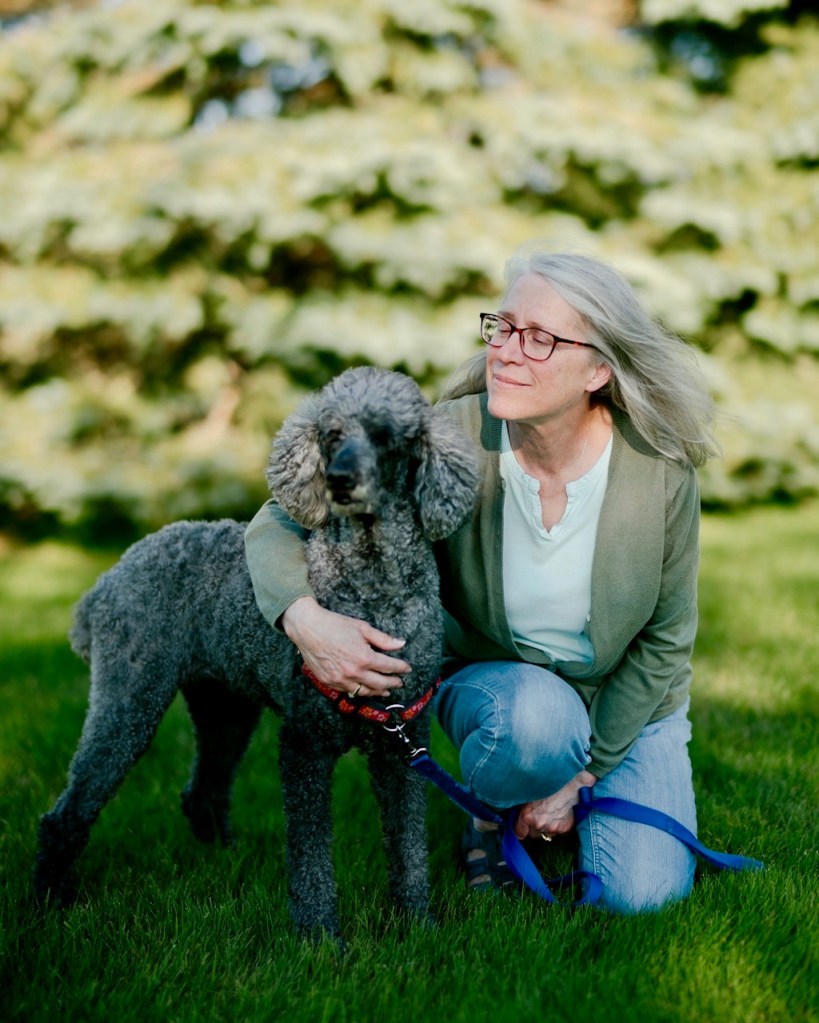
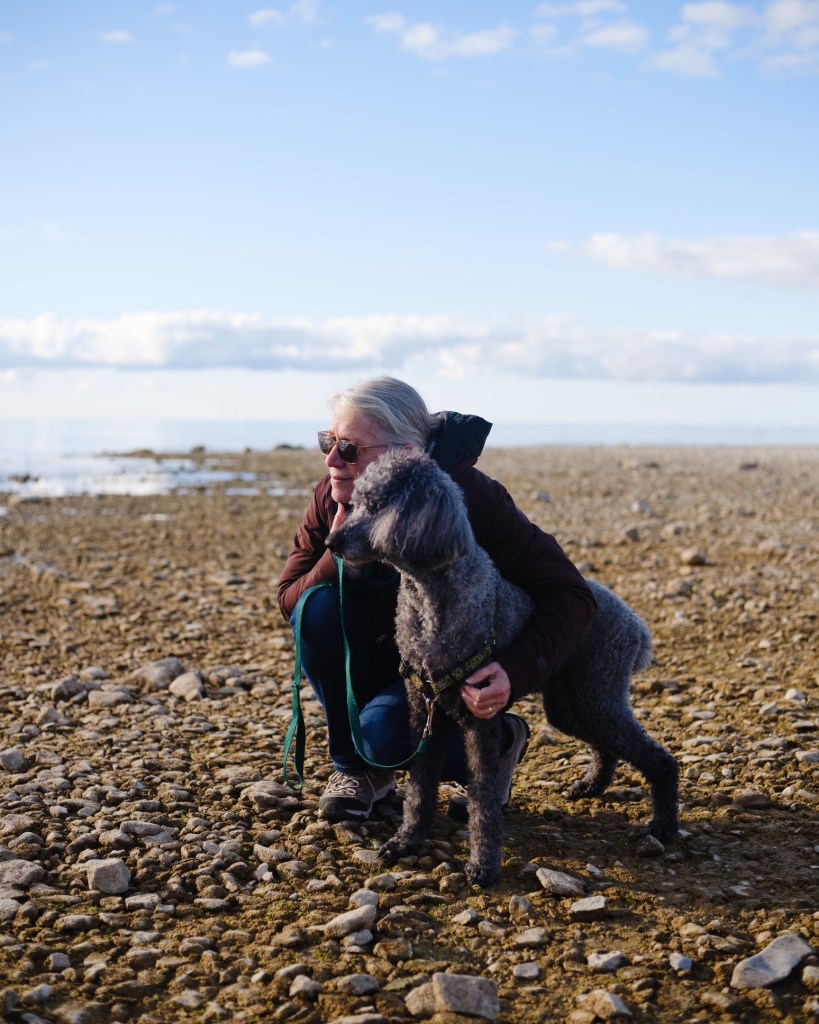
Me and Ziva, our last trip to Michigan in October 2025, photo by Max Youngquist

On April 6, our poodle, Ziva, passed away. She was fifteen years and two months old. I’ve tried to write about her passing for the last six months. But choosing the right words to capture her personality is difficult–she had such a big personality–and writing about her makes me sad. There is so much to say about Ziva that if I put it all in this blog, it would become a novella (though not with a story arc). But I need to say something about a dog I loved so much, who left such a hole in my heart.

So here goes . . .

Ziva was born on January 23, 2011. She was ten weeks old when we picked her up from Ruth and Emmett who were Minnesota farmers but also raised dogs. Ruth raised the standard poodles; Emmett raised the Labradors. They did not–as they said more than once–raise Labradoodles. At the time we got Ziva, we had another poodle, Cabela (almost three years old), whom we had also purchased from Ruth and Emmett. Ziva snuggled on my lap the whole way home, nearly four hours of bonding time. I remember feeling bad about taking her away from the farm and her dog family.
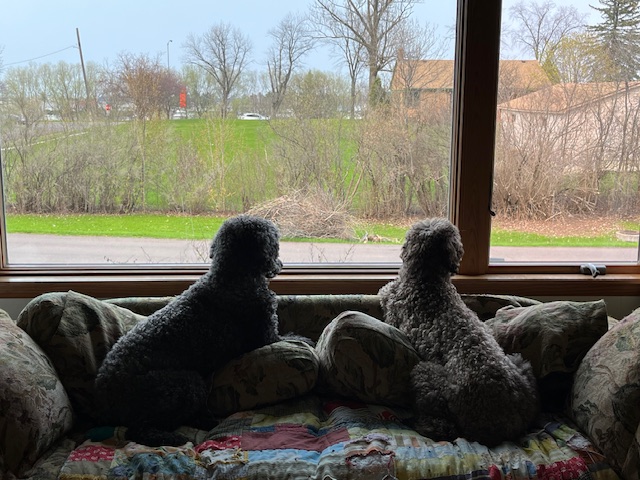
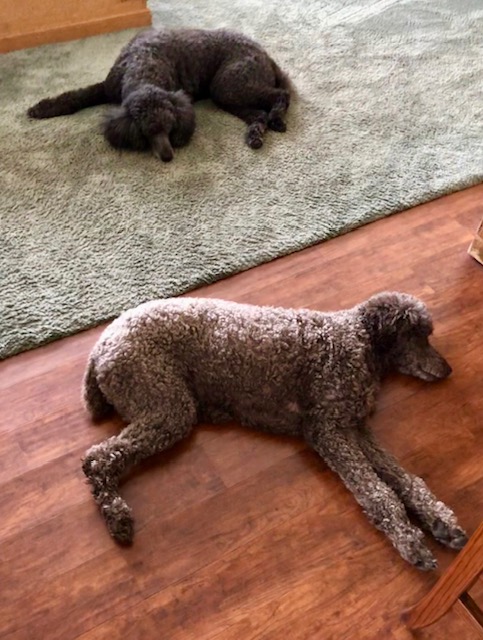
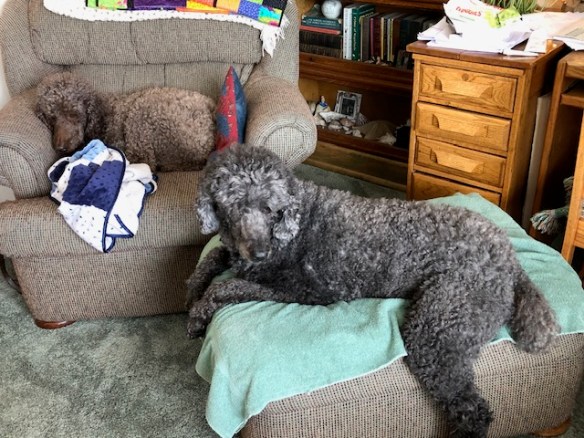
Ziva (L) and Cabela (R) loved to share the couch

We bought Ziva because our first poodle, Bailey, died, leaving Cabela without a four-legged companion. From the moment they met, Bailey and Cabela were great friends. We expected the same would happen when Cabela and Ziva met. Ha! For the first two weeks anytime Cabela came near Ziva, she shrieked like someone had stepped on all four of her paws. Each time Ziva squealed, Cabela walked away. “Oh great,” my husband and I said each time this happened, “so much for getting a companion for Cabela.” But two weeks to the day after her arrival, Ziva invited Cabela to play. Per Ziva’s wishes, they played gently and in short spurts. This is how Ziva played with dogs for the rest of her life.
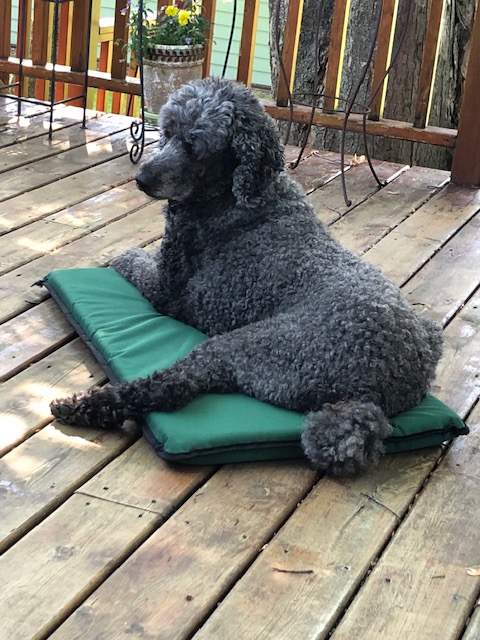
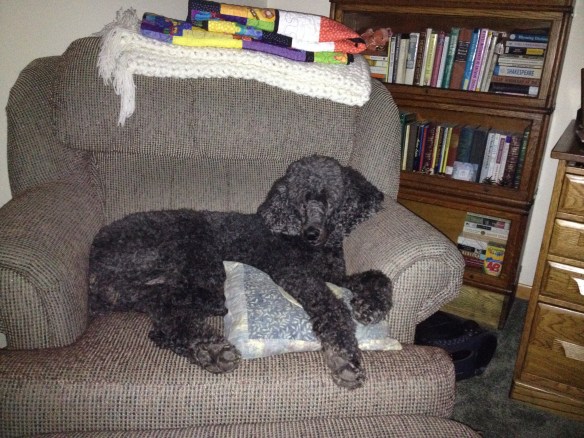
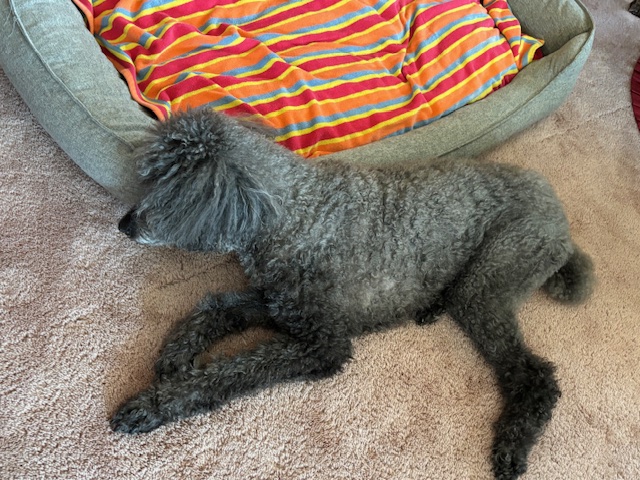
Ziva loved to chill

Ziva wasn’t anxious or timid, but she could be a bit of a baby, especially when compared to Cabela, who was more stoic in nature. So, Baby became Ziva’s middle name. We also called her Ziva the Diva and Zippy. Calling her Ziva the Diva was never meant ironically, but calling her Zippy was, as she was usually anything but zippy!

Ziva did most things at a leisurely pace. (Except at treat time when she beat everyone into the kitchen. Or at car-ride time when she beat everyone to the garage door.) As a puppy she never had lightning-paced zoomies. At best she trotted. While Cabela sprinted hot laps around our house, Ziva jogged, completing one lap to Cabela’s two or three. Often Ziva gave up and turned around after completing a partial lap. She thought it silly to run around the house in circles when she could be relaxing on her outdoor bed on the deck in the warm sunshine.

The same vet who told me Cabela had the heartrate of an athlete, discovered Ziva had a heart murmur so quiet it was nearly undetectable. Ziva’s heart murmur never seemed to affect her health or her personality. Her murmur never went away, but it never grew worse. She never needed treatment for the condition.
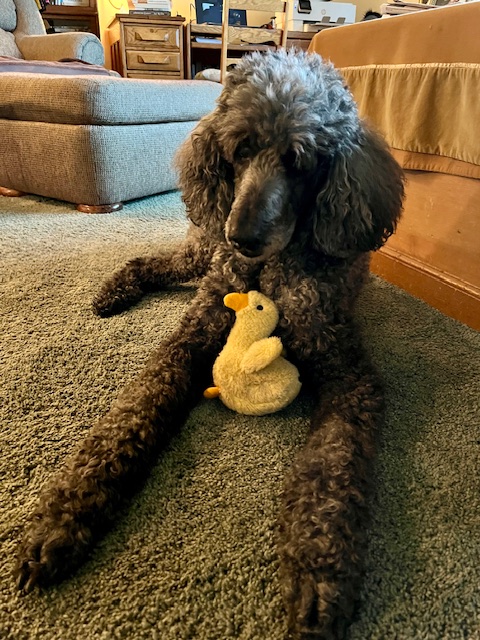
Ziva and Ducky

Ziva didn’t play much with toys, but she had a favorite — a stuffed duck that said, “Quack, quack, quack, quack, quack,” when squeezed. She loved the sound. She’d bite it gently, trying to make it quack, but she often failed. So, she would toss it or drop it at someone’s feet, her way of asking, “Please, make it quack!” When our grandkids played on our living room floor, she would find Ducky and lie down on the floor near them. My grandkids all learned to make her duck quack. Over the years we bought her that same duck again and again. A few months before she died, her duck stopped quacking, and we couldn’t find a replacement. Ziva didn’t understand why we couldn’t make her duck quack. Mostly, we kept it out of sight, high up in a basket. The look in her eyes when we couldn’t make it quack anymore bruised my heart.

Ziva was a talker. In a classic Ziva-the-Diva move, she would stand in the hall by the kitchen, and grumble when she wanted her evening treat–a low, soft grrr to start. Either my husband or I would say, “Did you hear that?” But neither of us would move. Ziva’s next grumble would be louder. But my husband and I would just chuckle; we loved this evening routine. Finally, Ziva would give one loud bark: “Hey, I’m talking here. How about my treat?” My husband would ask her, “Is it that time?” Understanding what that meant, Ziva would dash to the treat cupboard.
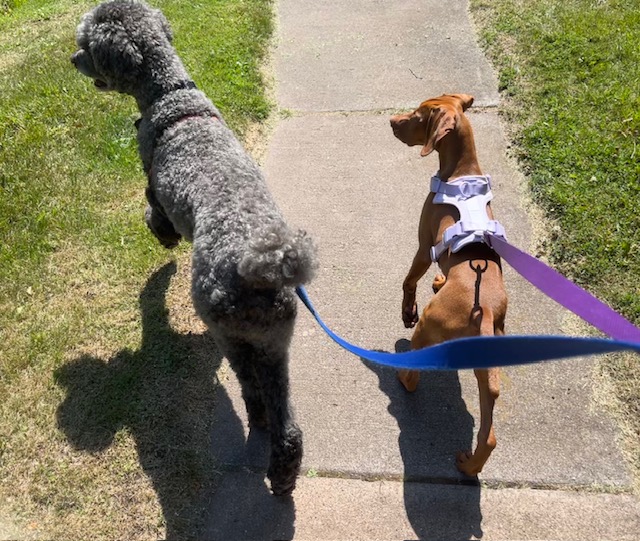
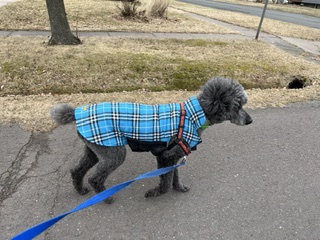
Ziva on a walk with her cousin Nellie

While on walks, she greeted strangers with a bark. Sometimes people asked if they could pet her, but I always declined because I wasn’t sure what Ziva would do. She was eleven years old when I finally figured out that this particular bark was meant as a greeting. A man in my mother’s neighborhood begged to pet her, saying he loved dogs. But I was leery. He insisted it would be okay. Ziva and I approached slowly. As soon as we reached the man, Ziva leaned her body against his legs, her way of hugging, while the man stroked her ears and neck. Ziva was ecstatic. From then on, if someone asked to pet her, Ziva and I would approach slowly. Ziva would give hugs and relish the petting. She was never in a hurry to move on. And once we walked away, she often gave another bark. I like to think it was her way of saying, “Until next time, my friend.”
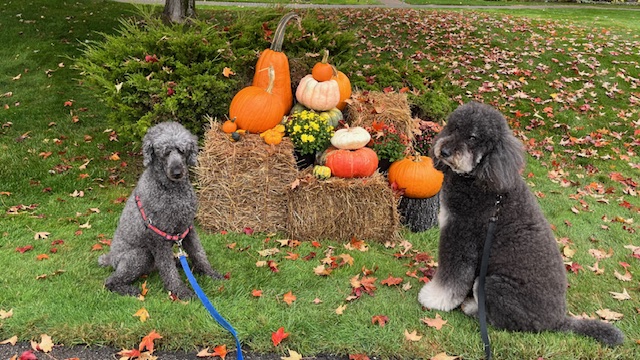
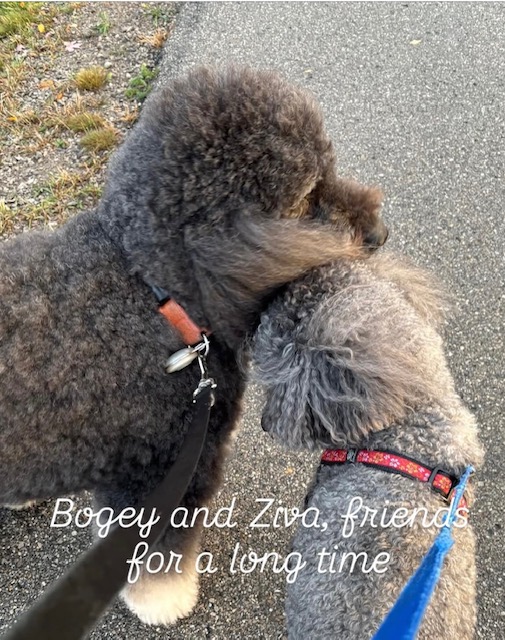
Ziva (L) and Bogey (R) on one of their many, many walks together

We often visited my mom who had a standard poodle named Bogey. He was taller and longer and weighed almost double what Ziva weighed. In the evenings while we watched TV, Bogey would decide it was time to grab one of his toys and make it squeak over and over. After about thirty seconds of this, Ziva would hop down off the couch, approach Bogey, and let loose with several loud barks, as if to say, “Knock it off. It’s time to relax.” Bogey would stop, and Ziva would settle back on the couch. But Bogey was always brazen enough to squeak his toys again. Once more, Ziva would hop off the couch, look him in the eyes, and bark, “What part of ‘Knock it off’ didn’t you understand?” Bogey rarely pushed it a third time. Bogey had great respect for Ziva, deferring to her wishes. My mother liked to say Bogey was afraid of Ziva, but they were companionable. I often took them on car rides and for long walks together. They sometimes played together in Ziva’s gentle manner. They shared their food with each other. In a silent agreement, when their bowls of different food were placed on the floor at separate ends of the kitchen, they swapped places, each believing they were getting the better meal. There was never a cross word about meals or treats.

Ziva didn’t like kennels. We tried to kennel train her as a puppy, but she would cry nonstop if she was in a kennel. The first time we left her home alone in a kennel, we came home to find a few of the metal bars on the kennel bent, and on the outside of the kennel, a puddle of drool with spots of blood dotted the floor. I never put her in a kennel again. She was a tad claustrophobic. I understood because so am I.
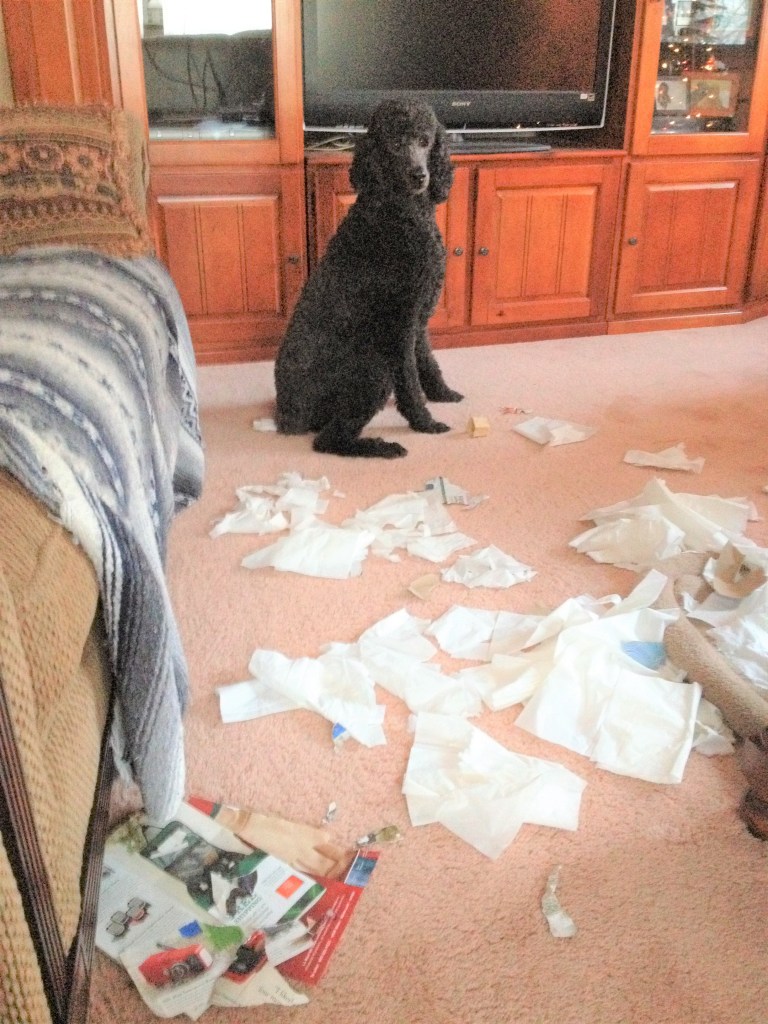
Ziva after shredding a box of tissues and a sales flyer. I couldn’t scold her. If I did she became absolutely dejected. At best I could calmly say, “This is a no-no.” Then I’d work to improve my paper-defense strategies.

She loved ripping paper of any sort. I became an expert at keeping books, newspapers, magazines, and boxes of tissues away from her. She became an expert at finding the weaknesses in my defensive strategies. She never ate the paper. I don’t think she did it because she was anxious or bored. She just seemed to find great joy in shredding it, especially if no one was at home to tell her to stop. Eventually, for the most part, she outgrew this. But even in her senior years, if I left a tissue or a piece of paper towel on the end table at night, in the morning I would usually find she had shredded it.
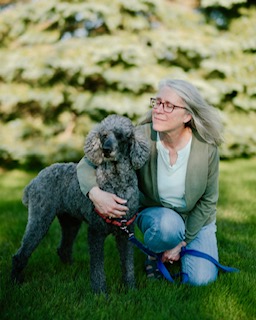
Me and Ziva, photo by Max Youngquist

Ziva loved everyone in the family, including extended family members, but I was her preferred pet. If I was reading or writing in the front living room, she had to be with me. If I was in the kitchen, she was in the kitchen. When I wrote in my office, she napped on her bed near my desk. If I got ready to leave the house, she asked to go with me. If she saw me take out a suitcase, she wouldn’t let me out of her sight. Our first two poodles tended to be daddy’s girls. So, why didn’t Ziva become a daddy’s girl? I have a theory. When Ziva arrived, I think she figured out that Cabela had dibs on my husband, so I became her chosen person by default. If that’s the case, I’m honored to have been the second fiddle who ended up first chair.
Book Review: The Best Dog in the World: Essays on Love edited by Alice Hoffman (and by the way, August Is National Dog Month!)

Why did I read this book?

I love dogs. I love the cover–the sheer joy on the dog’s face. I love that the essays are written by well-known writers, some of whom I’ve read. I love that no one is ever too famous to be bowled over by the mysterious nature of a dog, even one with frustrating quirks!

What is this book about?

Dogs: rescue dogs, puppies, big dogs, little dogs, working dogs, pampered dogs, dogs with big personalities, shy dogs. Dogs who come into our worlds and make our lives better. Dogs who need our help to make their lives better.
Why did I like this book?

I laughed. I cried. I sighed. I nodded my head in complete understanding at least once as I read each essay, recognizing at least one trait that could be found in one of the many dogs I’ve known. Each essay is a delight–a well-written, mini-philosophical exploration of our relationships with dogs.

The best way to read this book?

With a dog!

I’d been writing in my office, when my grand-dog Nellie entered with a toy in her mouth, her whole body wiggling, her tail furiously wagging. My interpretation: “Hey, Nana, you’ve been writing long enough. Come spend time with me and I’ll give you this toy.” I followed her out of the office and picked up The Best Dog in the World. I sat on the couch and invited her up. Content, she curled up into a tight ball.

I read the last few essays with her curled up by my side, the warmth of her body radiating into mine, my left hand gently resting on her back because human touch is important to her. After all, she’s a Vizsla: aptly nicknamed the Velcro dog.

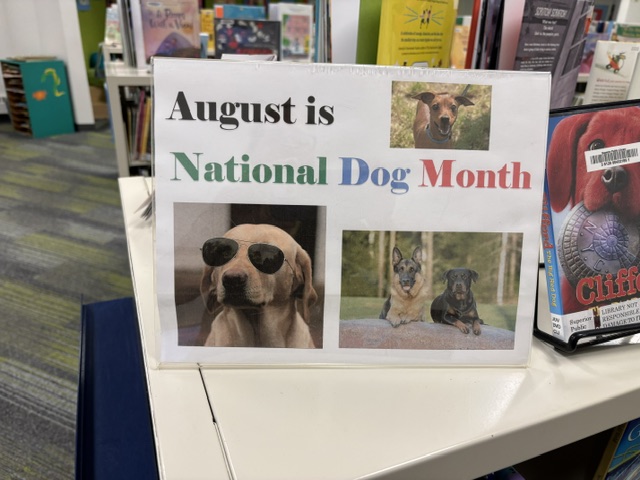
Our local library’s display of dog literature!

AND TO CELEBRATE NATIONAL DOG MONTH . . .

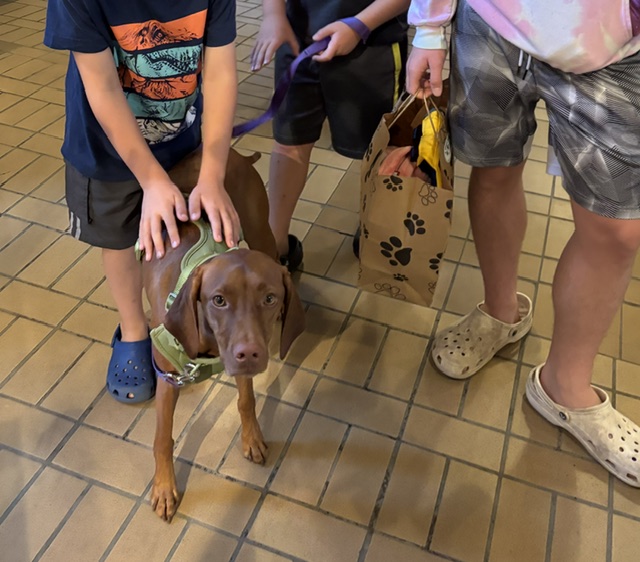
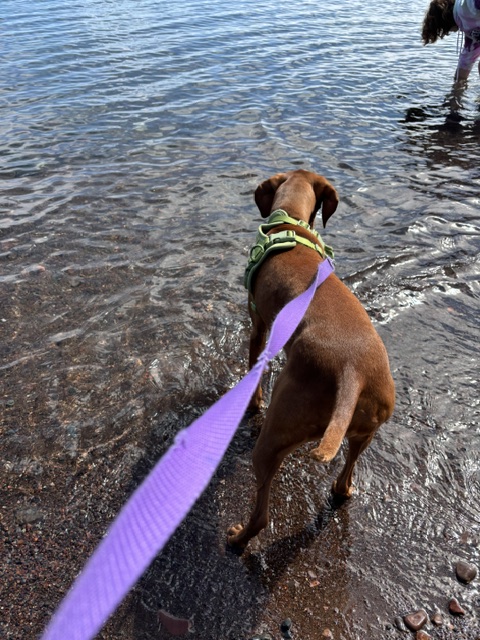
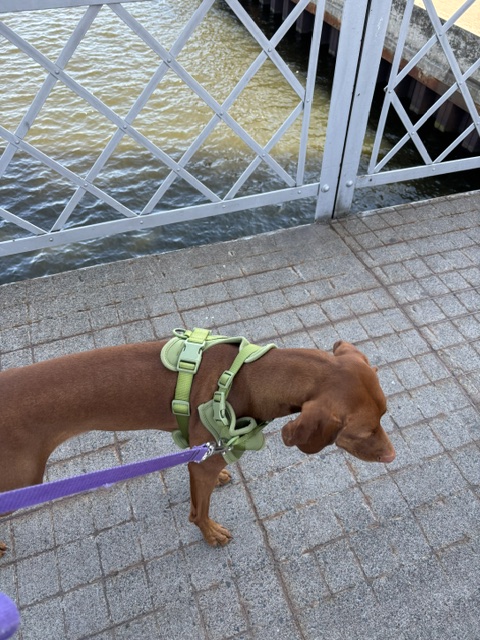
Nellie had a trip to Canal Park and Fitgers in Duluth, both dog-friendly places. She started with a shopping spree at A Place for Fido, located in Fitgers. She picked out a dog flotation device for her upcoming water adventures, a pink flamingo stuffy, and a bag of treats. Next, she pranced along the Duluth Lakewalk with my grandkids and me. She dipped her toes in Lake Superior, received numerous compliments about her pretty looks, had a bit of vanilla ice cream, and walked with us across the Aerial Lift Bridge.

My Resolution to Behave More Like a Child: Dessert First, Then Lunch — It’s What a Kid Would Do!

February 9th was a teacher in-service day, so I had my four grandkids. I took them to McDonald’s for lunch and $1 ice cream cones.

I also have a fifteen-year-old poodle, Ziva, with multiple myeloma. She is in the early stages of the disease, but she also has some other health issues. Her vision and hearing are iffy, she has some dementia-like issues, and her osteoarthritis makes her mobility a bit sketchy. But she still enjoys a very short walk and loves car rides.

So, when I took my grandkids to McDonalds, I invited Ziva to come along. My husband carried her down the basement stairs, and I lifted her into the van.

The temperature was in the 30s, so I knew Ziva could sit in the car for a bit while we ate at McDonalds. But I didn’t want to leave her in the car while we ate happy meals and ice cream cones.

Once inside McDonald’s, we approached the counter to place our orders. “How can I help you?” the clerk asked.

I had an idea.

I looked at my grandkids, and asked, “Would it be okay if we all got the $1 ice cream cones and ate them here? Afterward we can order our lunch to go and eat it at home? So, Ziva doesn’t have to be in the car by herself for so long?”

The grandkids looked at me like I was crazy for asking. I pressed on as though I had to convince them. “Is it okay? We could call it a ‘backwards lunch.’ Does anyone object to having dessert before lunch?”

“Not at all,” said a voice filled with chuckles. The oldest grandchild, whose face lit up with conspiratorial glee, had spoken. The other three laughed. They’d caught on that Nana was playing the straight man in a comedy routine.

We ordered five ice cream cones and sat at a table overlooking Lake Superior. We had a lovely conversation about this and that while licking our ice cream and crunching our cones.

After dessert we ordered lunch and headed home. The grandkids carried our food into the house while I lifted Ziva out of the van, then carried her up the basement stairs.

Ziva stretched out on her bed in the living room. Car adventures tucker her out. The grandkids gathered at the table, where we ate the first part of our lunch last.

While they jabbered and looked at their Happy Meal toys, I thought about my childhood and desserts.

“You can’t have dessert. It’s too close to supper. You’ll ruin your appetite,” said the adults in my life when I was a child and they didn’t want me to have goodies before a meal.

“If you don’t have room for your supper, you don’t have room for dessert,” said the same adults in my life when they wanted to make sure I cleaned my plate.

For added drama, they might add, “There are starving children in Ethiopia who’d love to have that food.”

So, I’d eat my food. (Unless it was split pea soup or ring bologna, then I’d stare at it, shifting it a round with a spoon or fork, trying to make it disappear.) And I’d wonder why the children in Ethiopia were starving. (In the early 1970s, I couldn’t google it.) But I didn’t ask because to question adults when they dished out words of wisdom (a.k.a. a lecture) was considered disrespectful, and usually met with, “Don’t talk back!” or “Go to your room!” I had a friend who suggested to her mother that the food she didn’t like be packed up and sent to the starving children in Africa. It didn’t go well. My friend was sent to her room for the rest of the day.

Not spoiling one’s supper by eating dessert first, cleaning one’s plate, being forced to eat things one didn’t like, and holding one’s tongue while a parent prattled on were all standard customs when I was a child.

Dessert was a special treat in my childhood home. Mom occasionally bought cookies, ice cream, or potato chips and French onion dip, technically not dessert, but oh so yummy. My dad was a mechanic and my mother was a waitress, so with four children, money was tight. Desserts and salty snacks were considered luxuries, and my mother wisely spent most of her grocery budget on food for our meals. My nana Kitty’s house was a dessert desert, unless you count the raisins or saltine crackers she tried to pass off as goodies. On the other hand, my grandma Olive’s house was dessert oasis filled with freshly baked cakes, cookies, or pies, and she always had ice cream in the freezer. But Grandma Olive lived 350 miles away, and we only saw her for two or three weeks a year.

Our neighbors had dessert after every evening meal. I don’t think Shirley ever baked anything, unless it was a ready-to-pop-in-the-oven item, but her husband Bill expected a sweet after supper. So, Shirley bought cookies, Danish, ice cream, and pies. My mother bristled at this, saying that having dessert every day was unhealthy.

My sisters and I never cared that Shirley and Bill’s children had dessert every night while we didn’t. We envied them because they had a built-in dishwasher! While my sisters and I cleared the kitchen table and washed and dried all the dishes and pots and pans after a meal for six people, the neighbor kids unloaded and loaded a dishwasher after a meal for five people. Bill went to work in a suit and tie, and Shirley was a stay-at-home mom. Bill made more money than my mother and dad did together. And even as a child, I knew this was why they could afford daily desserts, a dishwasher, and Scrubbing Bubbles, while my sisters and I dreamed of Oreos, washed dishes by hand, and scoured our kitchen sink with Comet.

Occasionally, we’d plead with our parents: “Please, can we get a dishwasher?” To which, my father always answered, “We don’t need a dishwasher, we already have three of them.” Of course, he was referring to my two sisters and me. We didn’t think he was funny. But as an adult when I think about his retort, it always makes me smile. And if I’m in the right mood when I think about it, I laugh out loud.

My parents never owned a dishwasher until I moved out of the house. When I became a parent, I followed my mother’s example about desserts, instead of Bill and Shirley’s. And as soon as I could, I bought a dishwasher.

But I never made my children eat things they didn’t like. I remembered the horrors of being made to chew and swallow ring bologna and split pea soup, both of which I detested. I remember my sister and I helping our youngest sister hide, then dispose of red kidney beans on the nights my mom served chili. Our little sister would be forced to sit at the table long after everyone else was done with their food. Her brown eyes filled with tears as she stared at the kidney beans, but she refused to eat them. Our hearts broke for her. Even our dog, Fritz, often sat nearby in a show of support. We always managed to find a way to get rid of those beans. Sometimes Fritz ate them. Sometimes the beans were surreptitiously wrapped in a napkin and tucked into a nook under the table then later thrown in the garbage.

My parents weren’t trying to be cruel. It’s how they and most of their generation were raised. If there was food on your plate, you ate it. It didn’t belong in the garbage. Their parents all grew up during the depression. Nothing was wasted. My grandma Olive saved every scrap of leftovers, even if the scraps only amounted to several bites. She stored them in small plastic containers that once held margarine, which she’d washed and dried, along with plastic baggies. Everything was reused. About once a week, my grandmother would serve a meal by using up all the leftover food in the fridge. Grandma Olive and Grandpa George weren’t poor. They could’ve afforded to toss leftovers and buy more baggies. They were against throwing out anything that was still useful. Nana Kitty, who did live on a tight budget, shared Olive and George’s viewpoint. “Waste not, want not,” Nana would often say.

My grandkids and I ate our ice cream cones and all of our food. Still, I wisely kept my thoughts about dessert and food and wastefulness to myself. My grandkids probably would’ve considered any words of wisdom I might have on these subjects to be a lecture.

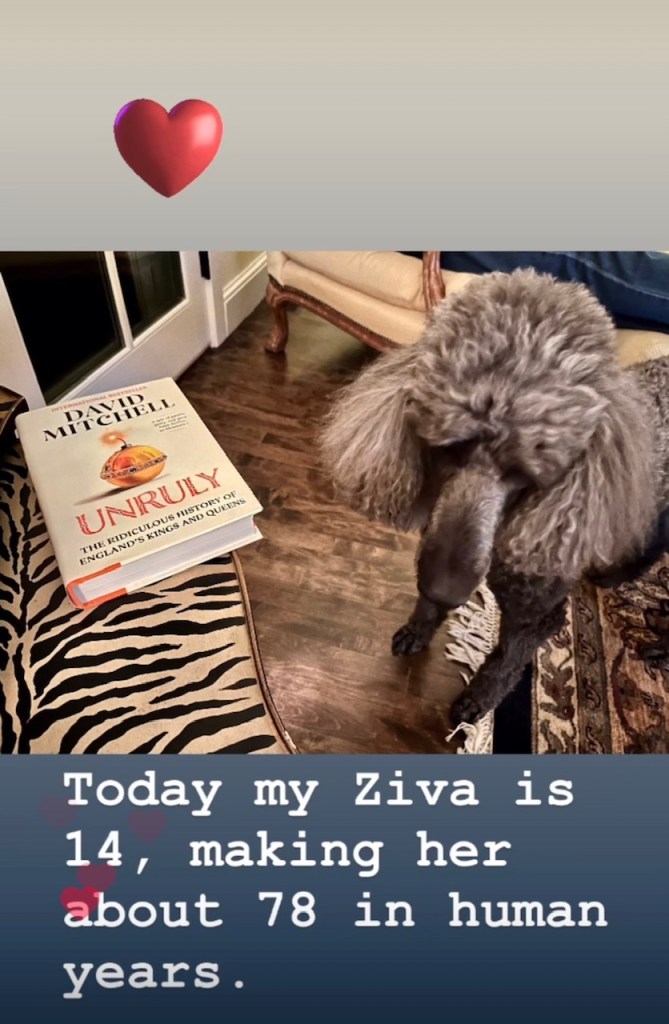
Today Is Ziva Baby’s 14th Birthday

Yes, her name is Ziva Baby. Baby is her middle name. It has nothing to do with my love of the movie Dirty Dancing. She earned her middle name because she was and still is quite the baby.

She didn’t read the book, and she’s not unruly. As a matter of fact, she is rather ruly these days, as in she rules the roost. And because while she’s only 14 years old in dog years, she’s 78 in people years. She is the oldest person in the house, and she wants her dinner and her treats and her walks when she wants them. She gets her way. She’s earned it.

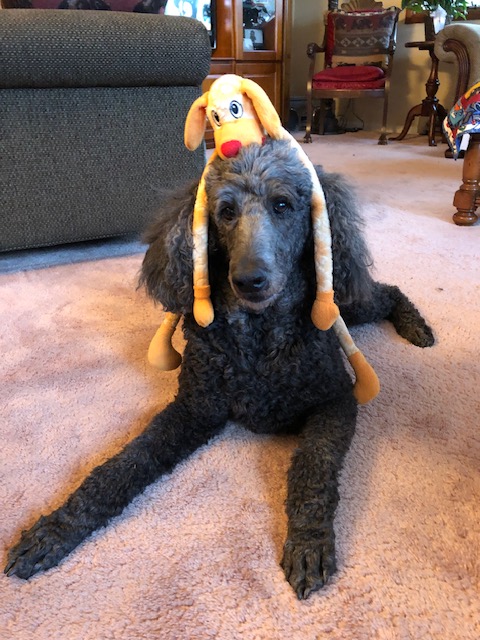
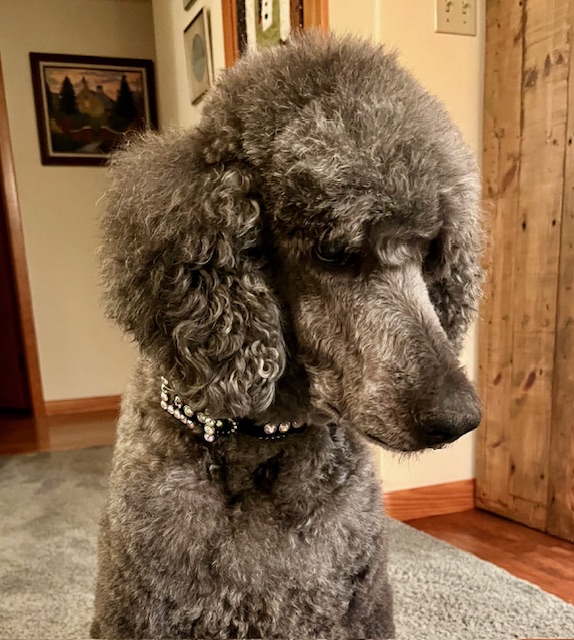
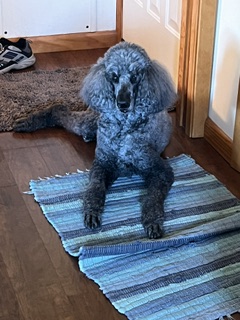
She’s a blue poodle, at least that was the consensus of two different poodle breeders. She doesn’t normally look this blue. The afternoon sunlight reflected off the rug and onto her fur. Ziva hangs out here if my husband is in the TV room and I’m in the kitchen or front room. This way neither of us can leave the house without her noticing. She loves car rides, even though she occasionally gets carsick. My van’s floor is covered with a layer of car blankets and towels. Last week she threw up on one of the leather seats, and I didn’t notice until the next day. The throw up was chunky, but frozen solid. It was super easy to clean up. So, there’s a good point to sub-zero temperatures.

Yes, Ziva is a charmer. For months, I’ve been telling people that she’s going to be 14 years old on January 23, 2025. And people keep telling her she looks amazing for her age. Ziva never gets tired of hearing this. She’s a mouthy charmer. I think that’s about the most wonderful thing a person can say about a dog. Ziva likes to talk, and I like that she likes to communicate. She can’t speak English, and I can’t speak bark, but I pretty much know what she wants by the tone of her bark or the timbre of her grumble.

Ziva loves her walks. Most dogs do. It’s one of the nicest things we can do for our dogs — take them for a walk. Ziva loves to walk with me. She loves to walk with Nellie, my grand-dog. When we go to Michigan, she loves to walk with Bogey, my mom’s dog. Ziva can’t always walk as far as she used to. Some days she walks farther and faster than other days. She used to strut, with her poodle sashay, looking like a runway model. Now she often has a hitch in her stride. My vet says I’m very in tune to Ziva. And she’s right. I notice the smallest changes. Ziva and I have walked many miles over the years.

Ziva is my writing buddy. My watchdog. My traveling companion. My walking partner. My cuddle bunny.

She had a low-key birthday this year. After all, I couldn’t buy her another fancy bed. But she did have some extra treats. She also had a car ride, and didn’t throw up. And, tonight she has a couch all to herself and both of her humans are in the same room with her watching Animal Control.

Staying Home with an Old Dog after a Near Accident

Ziva and me, July 2024

Yesterday morning I asked my dog, Ziva, if she wanted to go for a car ride. Of course, she said yes. She’ll go anywhere in the car, around the block or on a ten-hour trip to Petoskey, Michigan. She is just happy to be included.

We had three errands to run: go to the post office, go to the bank, and pick up my grand-dog Nellie. Before we could do any of those things, Ziva and I had a mishap. In a residential neighborhood, a speeding truck pulled out in front of us. Not only was the driver speeding, but he couldn’t see us as he approached the street that I was driving on because several thick evergreen trees grew on the corner of the lot. When he did see us, he drove even faster to avoid us, which was the better choice because he could not have stopped in time.

I was already going slow, but I had to use a heavy foot on the brakes, causing Ziva to slide from the front seat onto the floor. After I stopped, I honked my horn loud and long. The man stomped on his gas pedal, zooming away like an Indy race car driver after the green flag waves. If he thought he was fleeing from an angry woman, he was right. Had I been alone in the car, I would not have honked at him, as my honking would have come too late to serve as a warning. But my dog was tangled up on the floor, struggling to regain her footing. I used my horn to scream at him.

Ziva gingerly worked to untangle her feet. She slowly climbed back up on the front seat. Nothing appeared to be broken. For a moment I wondered if she would ever want to get in a car with me again.

Fritz, the dog who never forgot, Christmas 1962

When I was almost one, my mother had a car accident. Our two-year-old German Shepherd, Fritz, and I were in the car. After the accident the car was not drivable, but other than my mother having some cracked ribs, everyone was fine, including Fritz, who had been sleeping when the accident occurred. He never forgot that accident or that he had been sleeping instead of on guard. Afterward, if my mother was driving, no matter how long or short the journey, Fritz would sit on the seat and watch the road. His head might bob and his eyelids might droop, but he would jerk himself back to consciousness if he momentarily drifted off. If my father drove, Fritz would curl up and go to sleep. Fritz lived to be fifteen years old, and he never again slept in the car when my mother drove.

Nellie and I settled on the couch for some reading time. December 16, 2024

Ziva and I finished our errands then picked up Nellie. I was glad my grand-dog hadn’t been in the car when I had to slam on my brakes. She has an excellent memory, and in the future she might have become reluctant to get in my car.

As for Ziva, she was more than happy to get back in the car when we took Nellie home. And later on when I went to the grocery store, she was excited to ride along. She blamed neither me nor our car for her mishap, and she had been oblivious about the stupid, lead-footed pickup driver.

But after Ziva got up this morning, her head was crooked and she couldn’t seem to hold it straight, and when she walked, her gait was awkward. So, I decided to stay home with her. She ate a good breakfast, and after she moved around a bit, her stiffness disappeared and her head righted itself. People are always stiff and sore the day after an accident, so it would make sense animals would be the same.

Ziva is taking her morning nap as I write this. She’s happy to have me at home, and I’m happy to be with her. She is almost fourteen years old, and this morning, for a brief moment, I worried something might be wrong with her that couldn’t be fixed. After all, falling hurts more when we get older. We don’t bounce as well.

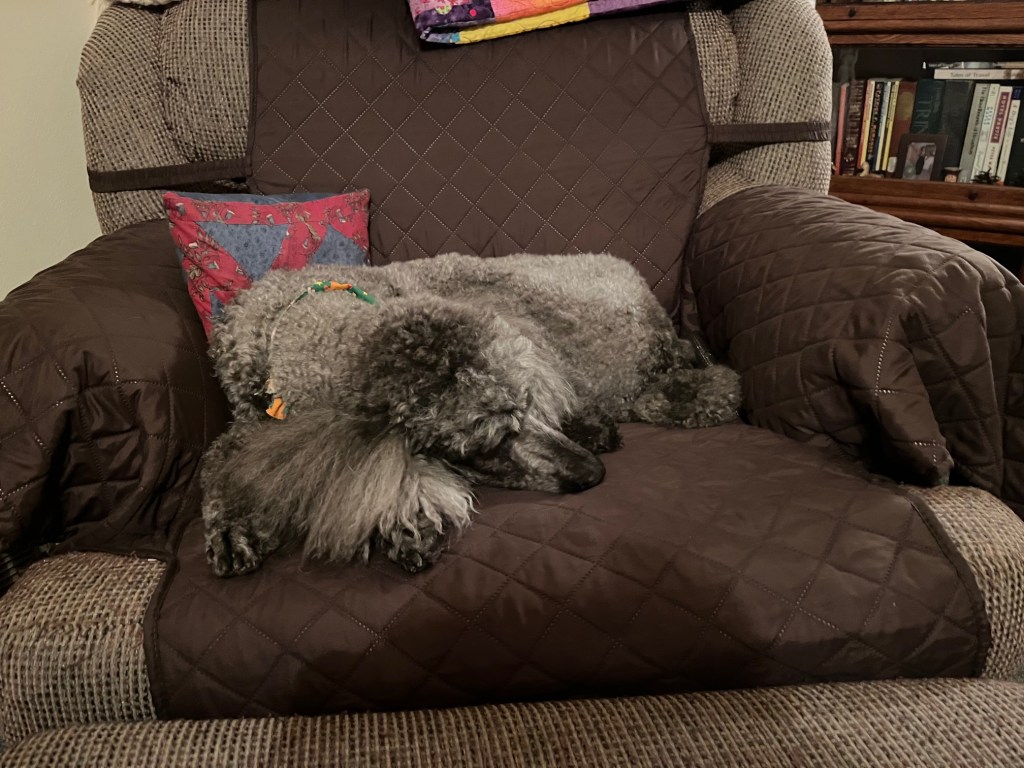
Ziva enjoying a good snooze after breakfast, resting up for our walk. December 17, 2024

I Have Gone to the Dogs, and It’s a Good Place to Be

A Place for Fido, Fitgers, Duluth, Minnesota. The stuffed toy display is straight ahead on the left.

Yesterday I went to a boutique pet store to buy my grand-dog Nellie a stuffed toy for Christmas. Next to the toy display stood a black, brown, and white, medium-sized dog. The dog looked at me and wagged its tail. Its big brown eyes were merry and its toothy smile was bright, so I asked its people, “May I pet your dog?”

“Of course,” said the woman, “she loves that.”

After petting the dog, I turned to the toys. I wanted one that didn’t squeal, squeak, groan, moan, or crackle because when my grand-dog sinks her teeth into one that makes noise, she is relentless.

The tri-colored dog turned with me. She watched me select toy after toy and squeeze it. The dog and I began a conversation.

“This one’s too high pitched,” I said to her.

“It sounds good to me. I like that toy,” the dog’s eager face said.

“This one makes a low noise,” I said. “It might work.” I kept it in my hand instead of hanging it back up.

Yeah, don’t even think about it — my grand-dog is cuter than your grand-dog.

“It sounds good to me. I like that toy, too.” The dog’s eager face filled with anticipation. She wanted a toy, but she was too well-mannered to do more than drop a hint. (My grand-dog is a Vizsla and she would have reached up and grabbed the toy. She’s not rude, mind you. She’s very, very sweet, but she’s a Vizsla. They’re impulsive. They’re enthusiastic. They’re larger than life.)

I tested toy after toy, telling the dog that each one was too loud, and each time the dog looked at me and the toy in my hand and answered, “It sounds good to me. I like that toy.”

I looked at the dog’s kind face. “My grand-dog will drive me crazy with these toys,” I told her. I decided even the toy that made a low noise was too noisy, so I hung it back up. I walked around the back of the display to see if there were more toys.

At this point I realized I’d been talking with the dog for several minutes while her owners looked at products on a display rack opposite the stuffed dog toys. Other than asking for permission to pet their dog and telling them I had a dog at home, I’d ignored them. It occurred to me this might be considered rude. It occurred to me that carrying on a conversation about noisy dog toys with a dog I’d just met might be considered strange. But in my defense, the dog was a good conversationalist.

I turned to look at the dog’s mother. “I guess you might think I’m a bit strange, standing here in a store having a conversation with your dog.”

“Not at all.” The woman smiled warmly. “I talk to her all the time. I would think it strange if you didn’t want to talk to her.”

Nice of her to say. I talk to my dog all the time too.

The owners and their dog moved on. And I wondered if they had stayed longer than they had wanted, thinking it rude to interrupt their dog’s conversation with a lady who was trying to find the right toy for her grand-dog.

I did find the right toy for Nellie. A nice clerk helped me find the only toy in the store without a squeaker. It looks like a cross between a squirrel and a beaver. Maybe it’s a woodchuck. Doesn’t matter. It’s nice looking, well-made, and quiet.

Ziva, September 2024. She’s loving the pâté.

I didn’t forget about my dog, Ziva. She’s not interested in toys, so I bought her two fancy-schmancy cans of dog food: Venison and Lentil Pâté and Lamb Recipe in Bone Broth. Both sound as though they should have come with a footman from Downton Abbey to dish up her food.

A heart without a pet is just an empty cockle shell.

Nellie “Bly” on Assignment with Me — Something Published, “Creating Holiday Traditions with Books”

Nellie “Bly” ponders an important question regarding investigative journalism: “Isn’t it time for lunch?”

On October 10, my grand-dog Nellie, whom I like to refer to as Nellie “Bly,” went on assignment with me. I was working on an article for Northern Wilds magazine. Our mission was to interview one bookstore owner in Two Harbors, Minnesota, and one bookstore manager in Grand Marais, Minnesota, and to take photos. Nellie Bly was game. (Although, if she had been given a choice, she would have rather chased small game instead of facts.)

Going on a reporting job with a dog is fun, but it requires more time. We were gone for over six hours. In addition to doing interviews and snapping photos, our assignment included four walks, a lunch break, and a supper break.

Nellie waited in the van while I did the hard-boiled investigative work inside the bookstores, asking the managers about the history of each bookstore and which books they anticipated would be hot for the holidays. Good investigative journalism means I had to ask the tough questions too, such as “What is your favorite holiday book? and “Do you have any holiday traditions involving books?” Of course, in the name of gathering evidence, I bought some books at each store.

Nellie got paid in food and treats. However, when I ate my Happy Meal for lunch, she made it clear that she wanted to exchange her bowl of dried kibble for my cheeseburger. And when I had my six-inch sub for supper, she again made it clear she wanted to swap her bowl of kibble for my sandwich. There were no trades. I told her life in the field as a reporter is filled with sacrifices.

Perhaps, if this article goes over well, it will lead to a TV series, where I travel the country, reporting on independent bookstores, asking probing questions about each bookstore’s origins and what’s selling well, all while spending my writing paycheck on books. Maybe Nellie Bly would like to be my assistant. We could travel in a RV with a driver so I could read and she could look out the window. I can hear Nellie now — trying to negotiate a better meal deal and asking for top billing in the credits. With her good looks, she would be the star of the show in no time anyway.

[To read my article click here: Northern Wilds, pages 14-15.]

Honest Dog Books: A Bayfield, Wisconsin Bookstore, Part II

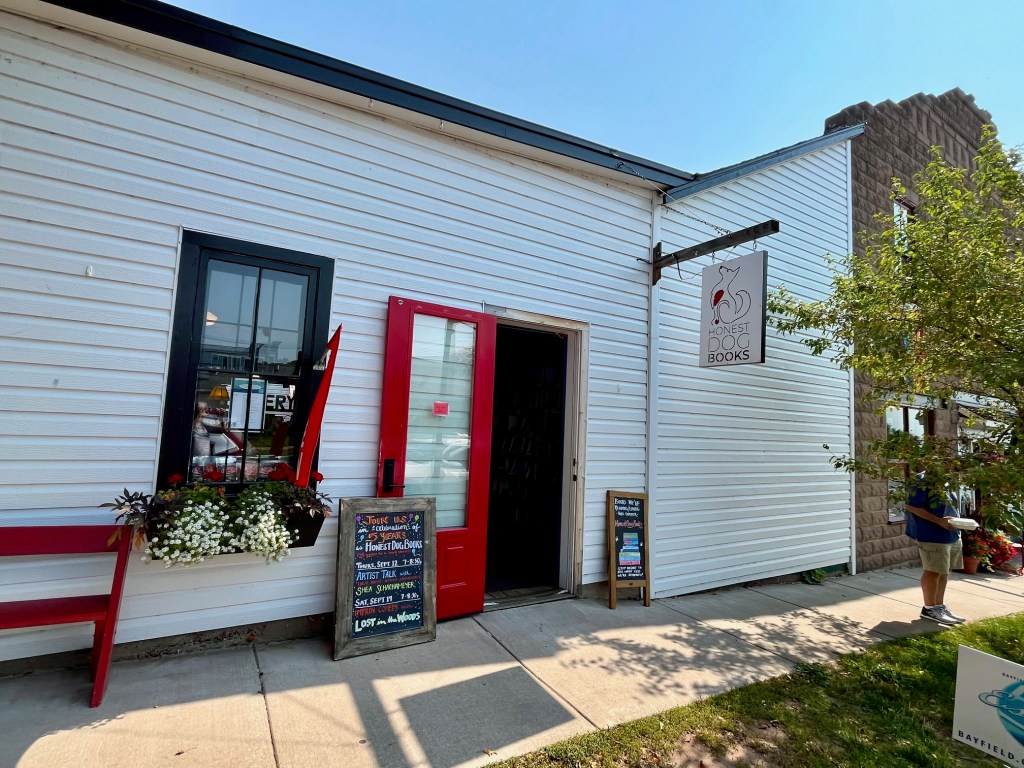
The welcoming red door to Honest Dog Books. It’s a humble entry into an amazing interior.

Bayfield, Wisconsin, has two wonderful bookstores: Honest Dog Books and Apostle Island Booksellers. Last week I wrote about Apostle Island Booksellers. Today, I will write about Honest Dog Books.

Inside Honest Dog — there are more books to the left and the right!

Yes, your dog is welcome in the store. And yes, treats will be provided for your dog while you shop for books. Also, you might meet the shop dogs, Elton and Matt — unless they’re at the beach or in the woods. (If I ever come back as a dog, I want my human to be a bookstore owner!)

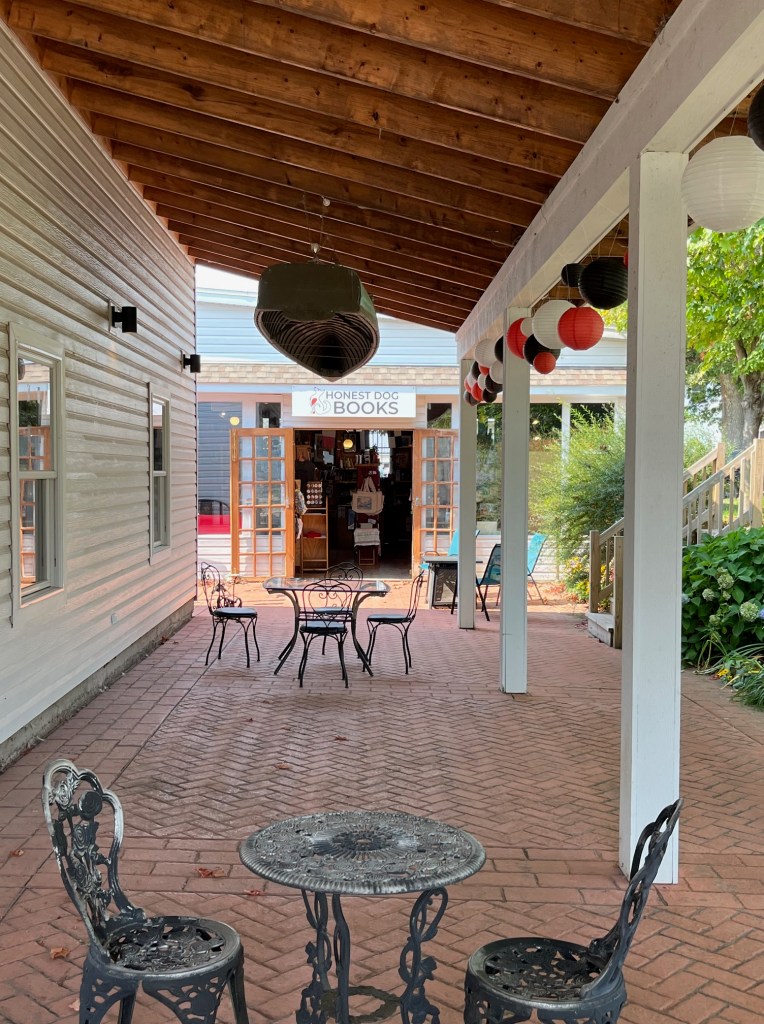
Honest Dog’s courtyard

When you walk into Honest Dog Books, it’s like entering a cozy rustic lodge. Warm wood tones gather you into a big bear hug.

The store is stocked with loads of wonderful books. You will find classics and new releases; local authors from Wisconsin, Michigan, and Minnesota; books on the great outdoors; and books for people of all ages. And yes, books about dogs, fiction and nonfiction.

You can walk in the front door of Honest Dog, buy a book, and walk out the back door into a beautiful courtyard, a wonderful place to sit and read the first chapter of your new book or talk about books with a friend.

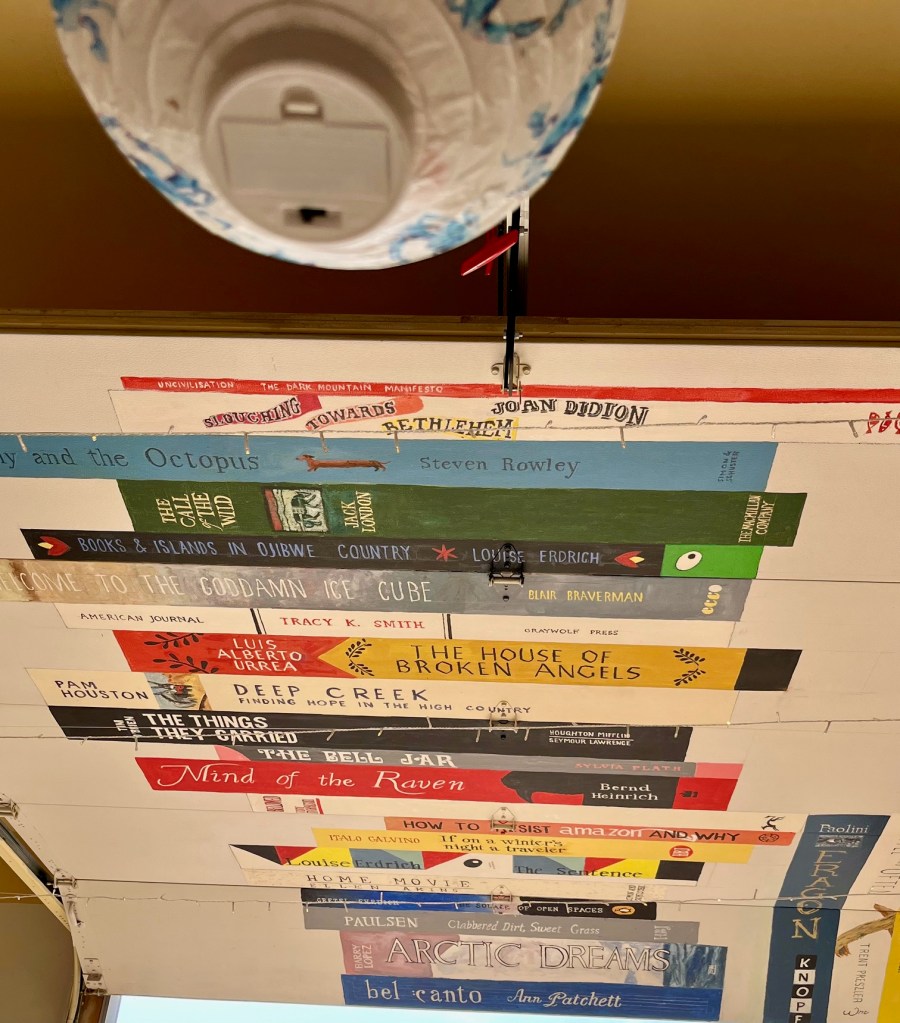
If you walk through the courtyard, you will enter a separate space called the Dog House where you can buy rare used books and vinyl records displayed in a small charming building with painted murals of book spines. The book-painted stairs lead back to the courtyard. The books painted on the inside of the garage door decorate the ceiling when the door is open on a nice day. On a cold or rainy day, the painted books become part of the wall.

What’s on your to-be-purchased list?

So, what did I buy at Honest Dog Books? The Curious Incident of the Dog in the Night-Time by Mark Haddon. The book has been on my to-be-purchased list for a long time, and it seemed right to buy it at Honest Dog Books.

During COVID, Honest Dog Books hosted author talks via Zoom. At a time when in-person social events were severely limited and businesses were closed, Honest Dog’s Zoom events gave readers and writers a chance to talk to authors. It also gave authors a way to launch their books during the lockdown. I will forever be grateful for the evenings spent meeting writers and listening to them talk about their books. It helped ease the isolation of COVID.

Below are the books that I bought — and loved — from Honest Dog during COVID after meeting the authors on Zoom. They are listed in no particular order.

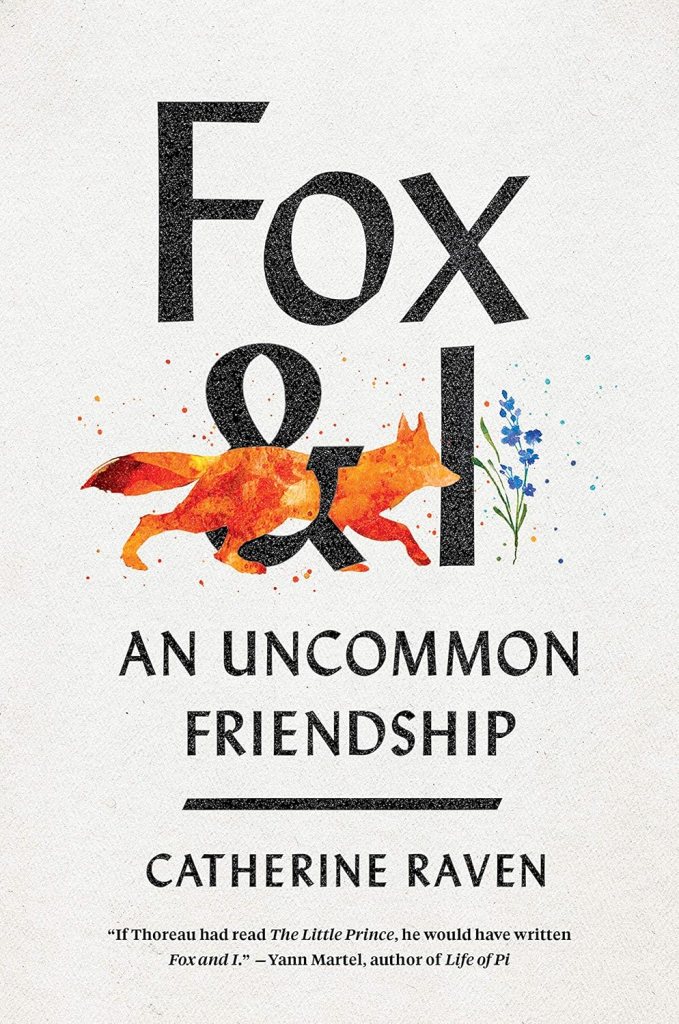
Fox & I: An Uncommon Friendship by Catherine Raven, a memoir

Welcome to the Goddamn Ice Cube: Chasing Fear and Finding Home in the Great White North by Blair Braverman, a memoir

North of the Tension Line by J. F. Riordan, a novel

The Audacity of Goats by J. F. Riordan, a novel

Robert’s Rules by J. F. Riordan, a novel

Icebound: Shipwrecked at the Edge of the World by Andrea Pitzer, nonfiction history

To read a post from February 2021 about my joyful experience of ordering books from Honest Dog during a brutal cold snap in the middle of COVID. Click Here.

Ziva’s Trip to the Vet and Her Life for Now

Ziva is pretty much back to her old self this morning.

Ziva loves to be with the grandkids when they visit. March 2024

Yesterday morning Ziva met Dr. F, a new vet, and Ziva loved her immediately, but she loves everyone. I really liked the new vet, too; although, I refrained from leaning my head against the vet’s leg and nuzzling her.

I had been nervous about having a stranger examine Ziva because she already has two other vets, Dr. J. and Dr. M., who treat her. I wanted Ziva to see one of the vets who currently care for her. But now we have three wonderful vets to choose from, which might make it easier to get an appointment when we need one.

From Tuesday, when I made Ziva’s vet appointment, until Thursday, when Ziva saw the vet, she had improved. However, I had videos on my phone to show the vet, so she could see how poorly Ziva had been moving in the previous days. The vet examined Ziva and determined that she most likely had a soft-tissue injury that needed to heal. The vet recommended increasing Ziva’s Librela shots for her osteoarthritis from every four weeks to every three weeks, giving her a three-to-five-day course of an anti-inflammatory medicine, and monitoring her movements.

Monitoring Ziva’s movements is the tricky part. Because when she feels better, she likes to run up the side of the house. She likes to run out to the front yard and prance around while she barks at a squirrel scrambling up a tree or a passing dog or the neighbor who is once again for the zillionth time mowing his lawn. Right now, I cringe when I watch her do these things, so I’ve been taking her outside on her leash. She’s limited to a couple of walks a day, but only around the block, which suits her just fine. And if I take her in the car, I put her on the leash and walk her to the back passenger door, so she can’t dance, prance, and spin in happy circles because she’s excited for a ride.

The reality is that while Ziva’s doing much better, going forward we’ll have to take care with her by limiting her exposure to situations where she could reinjure herself. But we’ll also have to make sure she is living the best life she can. This includes making sure she moves because “move it or loose it” applies to dogs too.

Ziva’s Moving Slowly, but She’s Doing Better

Ziva, cooling her toes in Lake Michigan, September 2023

Yesterday, after her rough morning, Ziva had a slightly better afternoon. She still slept most of the time, but when she did get up, she moved better, slowly and cautiously, but better.

I’ve become an expert at watching Ziva’s movements and her gait. I’ve been doing it for five or six years now. We walk a lot, so I’m able to note how she moves from day to day, week to week, and month to month. In 2017, I read Being Mortal: Medicine and What Matters in the End by Dr. Atul Gawande. He wrote that if doctors know what they are looking at, they can tell a lot about an older person by the way he or she walks. When I worked at a bookstore, medical students sometimes came in with a list of suggested reading (beyond medical texts) given to them by a professor. I always suggested they add Gawande’s Being Mortal to their stack because it deals with aging and death, topics about which they would receive little exposure to in medical school. They usually bought the book because I was able to convince them that geriatric and end-of-life concerns were going to figure in their practice — regardless of their medical specialties. And so, I watch Ziva’s gait and movements. I note the changes over time, and I can describe them to the vet in a manner that impresses her and helps her to treat Ziva. I did the same with Cabela, Ziva’s sister, as she aged.

When my husband and I came home from the grocery store yesterday afternoon, Ziva met us at the door and wagged her tail. I realized how much I take her incessant tail wagging for granted. We made a big fuss over her swirling tail and gave her a treat. It might sound like Ziva gets a lot of treats, and she does. Most days she eats her breakfast and supper too, as long as we doctor it up with good stuff (eggs, boiled chicken, a bit of canned food), what my husband likes to call “frosting.” Ziva isn’t overweight. Rather when we go to the vet’s, I hold my breath and hope she hasn’t lost another half-pound. When she weighs the same as she did the last time, I joyfully exhale.

Around three o’clock, while she appeared to be sound asleep, I whispered to my husband that I was going for a walk. Unbeknownst to me, while I got ready, Ziva got up, walked to the back door, and waited for me. (There is nothing wrong with her hearing or her ability to look like she’s in a deep sleep when she’s actually keeping tabs on her people.) She looked at me with big pleading eyes — the ones that say: You’re surely not going without me?

In the morning we’d agreed that Ziva should have lots of rest. No car rides, no walks, no extended outside time. But she stood at the back door, telling she felt better and wanted to walk. I worried she might tweak her injury if she stumbled. But I kept my comments to myself because she didn’t want to hear about my fears. She had her own. And even though she was hurting, she wanted some say in how she was going to get better. In that moment, I weighed her need for a small outing against the chances she might aggravate her injury. I decided her emotional well-being was important to her healing.

When I was nineteen and living with my grandparents, I got very sick. I was on bed rest for two weeks. Finally, I started to feel better. I wanted to do something other than lay in bed. I hadn’t been out of the house since coming home from the hospital, but I was weak. I called my mother, and I started crying as I explained how I felt. She told me to get out of the house for a bit, that if I felt like going out, it was a sign I was getting better. I called my girlfriend, who said that she and her boyfriend were going to a softball game, and they would come and pick me up, take me to the game, then bring me home. My grandmother and I had a big argument about my going out. Of course, she was worried about me. But I didn’t back down. I finally told her, “I called my mother this morning, and she told me I could go out for a bit.” I felt so much better when I returned home a couple of hours later; although, I did need a nap. My grandmother, noting my happy face, said, “It was so nice of your friends to take you out and bring you back.” I believe she was also relieved I hadn’t overdone it.

While I grabbed Ziva’s harness and fastened it around her, I thought about my grandmother and our argument. I explained the rules to Ziva. We would walk down through the grass instead of down the stairs, and our walk would be slow and short. We walked less than one city block, but Ziva went to the bathroom and sniffed a few of her favorite spots along the way. When I announced it was time to go home, she happily turned around. After we got home, she curled up for a big nap, but she had enjoyed herself. After her nap, she wasn’t any worse for the walk, but she didn’t want her after-dinner walk.

This morning Ziva is moving a little faster and with more confidence, but still carefully. And her tail wagging, while not back to normal, tells me her pain has eased a bit.