Book Review: The Jilted Countess

What is this book about?

WWII has completely upended the life of Roza Mészáros, a young Hungarian countess. Her life as a privileged member of Hungarian society is over, and after years of practice and training, Roza’s dream of becoming a ballerina is also over.

Shortly after the war ends, Roza meets Joe, a kind and loving American soldier, and they fall in love. Before he ships back to Minnesota, he proposes to her. It takes her almost two years to run the maze of red tape before she is able to join Joe in America.

When Roza arrives at the train station in St. Paul, Minnesota, Joe isn’t there to meet her. She learns he has married someone else only a few months before her arrival. She is heartbroken, but she is also scared. She has only two weeks to marry or she will be deported back to Hungary, where she would be labeled an American sympathizer by the Soviets who now control Hungary.

Facing the possibility of imprisonment or death at the hands of the Soviets, Roza makes a bold decision. With the help of a popular Minnesota newspaper columnist, Roza advertises for a husband. After meeting a handful of the over one thousand men who proposed to her by letter, she casts her fate with Finn Ericksen, a WWII veteran.

Why did I read this book?

Somewhere I read a brief summary about this book and thought, “Sounds like an interesting story.” But I have a large TBR pile, so I didn’t rush out and buy it. I forgot about the book until I read that one of our local bookstores was hosting a talk with Loretta Ellsworth about the book. I like to hear authors talk about their journeys as writers and why they wrote a particular book, so I went to meet Ellsworth.

Once I learned that The Jilted Countess was based on a true story, I was hooked. Only the very beginning of the book is based on facts: the Countess was jilted, she did advertise for a husband, and she did marry one of the men who responded. Once the couple married, however, they shunned all publicity. Ellsworth tried to find out what happened to the real-life couple, but couldn’t. So, she used her imagination to create a wonderful historical fiction romance novel.

Why did I like this book?

It’s a well-written, character-driven love story that touches the heart without being sappy. It’s sort of a reverse fairy tale — the Countess is in search of a commoner, instead of a prince, who can save her from a perilous fate. She finds one, but will there be a happy ever after?

Wonderfully paced with an engaging plot, the book is a page turner. I stuck my nose in the book on a two-and-a-half-hour road trip to a golf shop where my husband would be fitted for a set of golf clubs. After each chapter or so, I’d close the book for a couple of minutes and say something to him. He likes it when I keep him company on road trips, so I usually don’t read, but I couldn’t resist returning to the pages of Roza’s life.

Once we arrived at the golf shop, my husband signed in for his appointment, and I was free to read without feeling guilty. I asked an employee if they had a small lounge area where I could sit and read while my husband had his fitting, but they didn’t. I wandered around, thinking I’d have to find a place to sit on the floor. But tucked at the end of a small hallway, I found a padded bench in an area that housed golf shoes. I sat and read for the next hour and a half, finishing the book.

At times my eyes welled up with tears, and I had to fish in my purse for a tissue to dab my eyes. A couple of times people wandered into the shoe area, and I’d stop reading and ask if they wanted to use the bench to try on shoes, but thankfully, no one did.

Ellsworth dedicated this novel to a friend of hers who told her to write the story. I’m glad she listened to her friend.

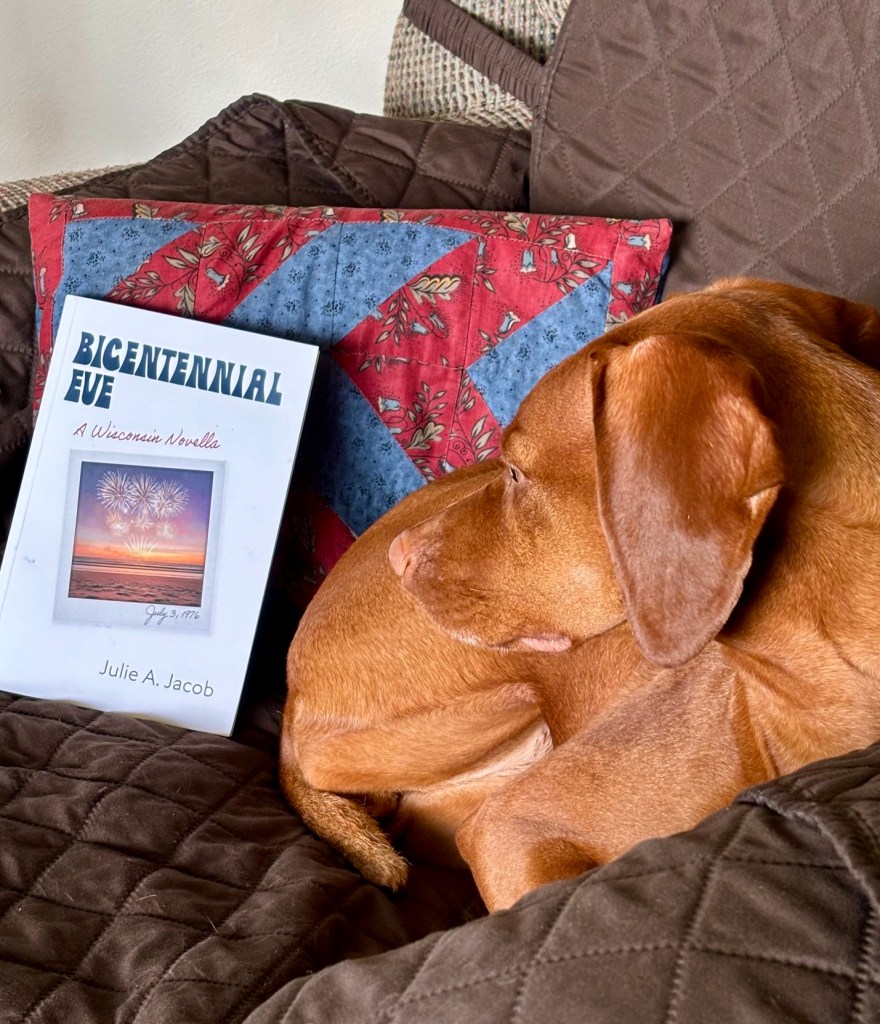
Book Review: Bicentennial Eve: A Wisconsin Novella by Julie A. Jacob, Fresh Water Press, 2026

Fresh Water Press, Two Rivers, WI, 2026

What is this book about?

It’s 1976, the eve of America’s 200th birthday. As communities across the country prepare to celebrate the Bicentennial, three generations of people living in a small town in southeastern Wisconsin explore what their own personal independence means to each of them.

Seventy-three-year-old Kitty Barrett longs to fulfill a childhood dream, but worries her family will think she’s too old. Kitty’s daughter Claire, in her early 40s, wants more out of life than domestic chores and her ten-hour-a-week job at the library. Claire’s daughters have dreams of their own. Grace is torn between the boy she loves and spending her junior year of college in France, and thirteen-year-old Skye hopes for a romance with a fickle-hearted classmate named Zack. Kitty’s other daughter Vivian, in her early 50s, tentatively rekindles a romance with a high-school sweetheart.

Silently hovering over the eve of their Bicentennial celebration is the memory of Vivian and Claire’s brother, Mike, who was killed during WWII in 1944. As the stories of Kitty’s and her family’s pursuit of happiness unfold, it’s apparent that even though thirty-two years have passed since Mike’s death, the sorrow of his untimely passing has cast a lingering shadow over the lives of Kitty, Claire, and Vivian.

Why did I read this book?

I read Julie Jacob’s collection of essays, Two States of Single: Essays of Love, Family, and Living Solo, and I loved it. After meeting Jacob at the Wisconsin Writers Association Conference in October 2024, I read her collection of essays a second time and loved it again. So, when I learned that her novella had been accepted for publication, I was excited.

Also, I was seventeen years old in 1976, and I remember the anticipation and excitement surrounding the Bicentennial. Although I would be on an adventure in Rome on July 4, 1976, at the time I felt sad about missing the Bicentennial celebration in the States. Reading Jacob’s book gave me a chance to travel back in time to my own southeastern Wisconsin hometown. I could experience the Bicentennial through the eyes and actions of her characters who are ordinary people dealing with the same type of issues that my family, friends, neighbors, and I faced.

Why did I like this book?

Jacob’s story writing skills shine in Bicentennial Eve. She writes great scenes, which come to life through well-written descriptions and dialogue delivered by relatable characters with compelling stories. The dilemmas faced by the characters drew me into the novella. Skillfully paced, Jacob weaves tension into her story from beginning to the end. I always wanted to read just one more chapter right up until the end of the book.

I read Bicentennial Eve twice, first in manuscript form then after it was published. It was just as lovely the second time around.

I loved the book for its engaging story. My grand-dog loves the book because it coordinates with her fur! Also, I told her that the book mentions a dog named Honey a few times!

Book Review: Blooming Hollyhocks: Tales of Joy During Hard Times by Naomi Helen Yaeger

Naomi Helen Yaeger, in a delightfully engaging biography, tells the story of her mother Janette Yaeger (née Minehart) who grew up in Avoca, Minnesota. Yaeger spent hours interviewing her mother before her mother died. In her book, Yaeger lovingly recounts the stories of Janette and her siblings, parents, and extended family. Most of the book concentrates on Janette’s life from toddlerhood through young adulthood. However, toward the end of the book, Yaeger summarizes the key highlights of Janette’s and her family’s lives as they moved through adulthood. I’m glad Yaeger did this because after reading about the early lives of Janette and her family, I wanted to know what happened to them as adults.

Yaeger’s book invites readers into a bygone era. We learn about the history, culture, and lives of ordinary people who lived through the depression, WWII, and the Korean War. We read about their daily joys, disappointments, and sorrows. Usually, the history we are taught in school focuses on major events and well-known people. But I find the daily lives of people and how they lived while major historical events happened around them fascinating. And I learned a few things that I didn’t know before reading the book.

As I read Blooming Hollyhocks, I laughed and I cried. I felt connected to my own relatives who grew up in the same era as Yaeger’s. And I remembered the stories they had told me, often similar to the stories Janette Yaeger shared with her daughter Naomi. As I finished Yaeger’s book and closed it for the last time, I was already missing the Mineharts, their relatives, and their friends.

[When I attended Naomi Yaeger’s book launch, someone mentioned that Yaeger’s book would make a great present. After finishing her book, I wholeheartedly agree. If you know someone who lived through this time or grew up listening to the stories of relatives who lived through this time, I believe they would enjoy Yaeger’s book as much as I did.]

Book Review: McGarr on the Cliffs of Moher by Bartholomew Gill (Also published as The Death of an Irish Lass), Charles Scribner’s Sons, 1978

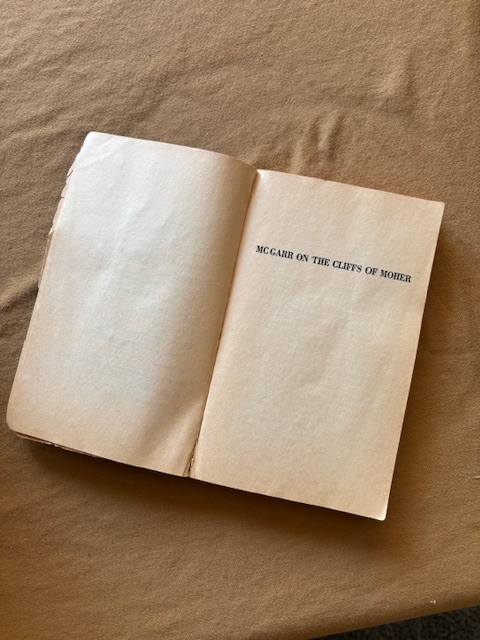
Penguin Books edition, 1982. I love the pocketbook edition. It’s been well loved over the last forty-three years. Sometimes as I read it, bits of the aged cover flaked away, and I imagined all the other hands that held this book.

I’m back with a quick review of the third mystery in the Peter McGarr series by Bartholomew Gill. I said I’d keep you updated about how Gill’s series progresses. [To read my thoughts about Gill’s first two novels, click here.]

McGarr on the Cliffs of Moher debuted forty-seven years ago. I believe it’s out of print because Amazon sells only used copies. I bought well-worn copies of Gill’s first three books from ThriftBooks. In my review of Gill’s first two McGarr mysteries, I said if I liked the third book, I would buy a couple more. Well, when I finished reading The Cliffs of Moher, I bought Gill’s fourth and fifth mysteries, once again from ThriftBooks.

What’s McGarr on the Cliffs of Moher about?

Shortly after traveling from America to visit her parents in Ireland, May Quirk is found dead in a pasture near the Cliffs of Moher. She has been run through the chest with a pitchfork. May was born and raised in Ireland, but shortly after becoming a young woman, she left Ireland for New York City, partly to follow a young man whom she loved and partly to seek opportunity and adventures not available to her in Ireland. In New York her romance with the young man falters, but they remain friendly. May finds success as a well-respected journalist.

CID Peter McGarr has a list of suspects, each with a motivation worthy of murderous intent. Did the man she originally left Ireland with kill her in a jealous rage? He had returned to Ireland about the same time she did. Did the country farmer down the road from her parents kill her? The farmer has been obsessed with May for years, believing God intended them to be together. Did the man who discovered May’s body in the field kill her? He doesn’t seem to have a motive, but he was so drunk on the night of May’s murder he can’t remember passing out next to her body. Did someone in the Irish Republican Army have her killed? If threatened, the IRA is capable of swift and cruel violence. Did May’s current lover, who is married, kill her? He wanted to marry her, but he’s an Irish Catholic with a passel of children, and May seemed uninterested in becoming anyone’s wife.

Why did I like this book?

It’s a page-turner. Once I start reading one of Gill’s books, I don’t want to put it down. The dialogue is snappy, with just the right amount of levity. I like the rivulets of sarcasm permeating McGarr’s conversations with suspects or other people who try to get in the way of his investigation. So far Gill’s books have interesting plots, and I’m kept guessing about whodunit. Finally, McGarr’s books are quick reads with well-written prose that often sparkles, but they don’t require deep thought on my part. And for this reason, while I enjoy them, they don’t rank as high as some other detective series that I have read.

Back to my thoughts about Gill’s books from a standpoint of craft . . .

You might remember I mentioned there was so much drinking in Gill’s first two books that I often felt like I’d wake up with a hangover in the morning. The consumption of alcohol in this book surpasses anything found in the previous two, partly because a lot of scenes are set in pubs in Ireland and New York. I don’t know how some of the characters can drink so much and still walk, talk, and think, let alone commit crimes or try to solve them. I have moved beyond the idea I might be vicariously hungover in the morning to seriously thinking I might need a vicarious twelve-step program after reading the series. I wonder if McGarr can keep up his pace of drinking throughout the series.

I’m still waiting for McGarr to have some sort of crisis of the soul. We don’t learn much about him in this book either. It’s mentioned again that he grew up in poverty, but that doesn’t seem to have affected him in any visible way. But where does all that drinking come from? Is Gill perpetuating a stereotype about the Irish love of whiskey and beer? In Gill’s stories there is a fine — but uncommented upon — line between McGarr and other characters, some of whom seem to be able to drink without getting drunk, and others who cannot hold their liquor. McGarr is one of the characters who can hold his liquor and solve crimes.

I’m waiting to see if female detectives will become part of the Irish constabulary landscape. However, it’s still the 1970s in McGarr’s world, and it’s a male dominated society.

McGarr’s marriage is another curiosity. His wife, Noreen, is twenty-one years younger than him. He married late in life because he considered himself a confirmed bachelor. In this book we learn why he married, but I’ll let you discover the reason for his marriage. It’s tossed in as a single sentence, but the sentence is striking and not easily missed. I always like to discover these little gems in a story for myself, rather than being told. The McGarr marriage could become an interesting side story. There are many ways Gill could play it.

The pages have mellowed into a yellow brown. It’s hard to imagine they were ever white.

So, I bought the next two books because I’m still curious to see if and how Gill develops his characters. In the meantime, his crime mysteries are entertaining reads just as they are.

Book Reviews of My Latest Reading Accomplishments, Part 3 of 6: The Death of an Irish Politician and The Death of an Irish Consul by Bartholomew Gill

[To read Part 1, click here. To read Part 2, click here.]

The Death of an Irish Politician and The Death of an Irish Consul by Bartholomew Gill

Book 1 and Book 2. The three books I bought are pocket books. When I toss one in my Mary Poppins purse, it nearly disappears!

Recently, someone in something I read suggested that Bartholomew Gill’s Peter McGarr police detective mysteries set in Ireland were a wonderful read, so I looked them up. Bartholomew Gill was the nom-de-plume of Mark C. McGarrity (1943-2002), an Irish-American crime and mystery novelist. McGarrity’s first Peter McGarr mystery was published in 1977 and set in Dublin, Ireland. The summary mentioned something about a crime at a marina, a beautiful woman, an ambitious politician, the Irish Republican Army, and the conflict between the British and the Irish over Northern Ireland. I came of age in the 1970s during some of the worst violence in Ireland, I’m part Irish, and I like police detective mysteries, so I bought the first three books in the series from ThriftBooks. I’ve read the first two.

When Gill’s series begins, his fictional character Peter McGarr, has recently returned from continental Europe to accept the coveted position of chief inspector of detectives with the Dublin police department. McGarr, known for his leadership, brilliance, cunning, and successful arrest rate, has had an exemplary career with INTERPOL before returning to Ireland. The officers under his command respect him. He’s clever, likable, and incorruptible.

I enjoyed Gill’s first two McGarr books. CID McGarr is an interesting character. He doesn’t come across as deeply flawed or deeply troubled by demons of the past. He’s usually a half step ahead of the criminals, and he can smell when something is rotten in Denmark. Gill doesn’t spend a lot of time in McGarr’s head, so readers don’t get a lot of that internality that often comes with detectives in newer stories. (Which, depending on one’s preference, could be good or bad.) What readers do get are interesting plots, conspiracies, double and triple crosses, great dialogue, and wry humor. The novels mix murder, politics, and business together, exploring themes of political corruption, corporate greed, and personal ambition. (Some things in this world never change.)

McGarr’s wife, who is about fifteen years his junior, is a good cook. She’s also bright and loves to discuss his cases with him, but she’s had a minor role so far. There are no women detectives in the first two books. Women who appear in the novels are of the femme fatale variety. It’s the 1970s, and it’s a man’s world. There is a lot of drinking in these two books. Not the hard-hitting-sit-at-the-bar-until-you-pass-out-on-it kind, but rather the steady-throughout-the-day-as-you-go kind. CID McGarr rarely turns down a drink — doesn’t matter if he’s on duty or not. The police station has beer on hand for the detectives and the suspects. Although, officers prudently strive to keep the suspects from getting drunk to avoid having their statements tossed by the courts as unreliable. Sometimes at night when I read one of these books, I was afraid I’d wake up in the morning with a hangover!

I liked these books. They were an easy read and interesting — a nice escape at the end of my day. I’ll read the third one soon. If I like that one, which I hope I will, I’ll buy the next two or three because I’m intrigued to see if Gill’s character changes over time. Does his wife stay with him? (A brief moment in the second book gave me pause.) Does he have to curtail his drinking or get sober? (McGarr mentions a line in the sand, which if he crosses, would mean he’s an alcoholic. But has he ever heard the phrase functioning alcoholic?) Will past demons surface?

Gill’s last McGarr mystery was published in 2002. By that time, I would hope to meet women detectives in his novels. I would think that drinking on the job is forbidden and that suspects aren’t offered anything stronger than water during an interrogation. I would expect to find that McGarr has changed as a person. Of course, all this depends on whether or not Gill continued to set his novels in the 1970s and 80s, or if he sets them in the times in which he wrote them. I’ll keep you posted.

Book Reviews of My Latest Reading Accomplishments, Part 1 of 6: Girl with a Pearl Earring by Tracy Chevalier

I’ve been reading a lot. Every time I finished one of the books in this six-part review, I thought, “This was wonderful. I should post about it on my blog.” But, dear fellow readers, did I? No. Instead I read another book. However, these books, now stacked next to my computer, kept harrumphing at me, like when my restless grandchildren who’ve been so good finally run out of patience while waiting for me to take them to the park. And so, I placated the books by telling them I would write a short review for each of them. But things got out of hand, and the two- to three-hundred-word reviews I’d envisioned grew and grew. And try as I might, I couldn’t bring myself to cut any words because I loved the books. So I’m posting the reviews in six parts, in alphabetical order by author’s last name.

If you can’t own the painting, read the book!

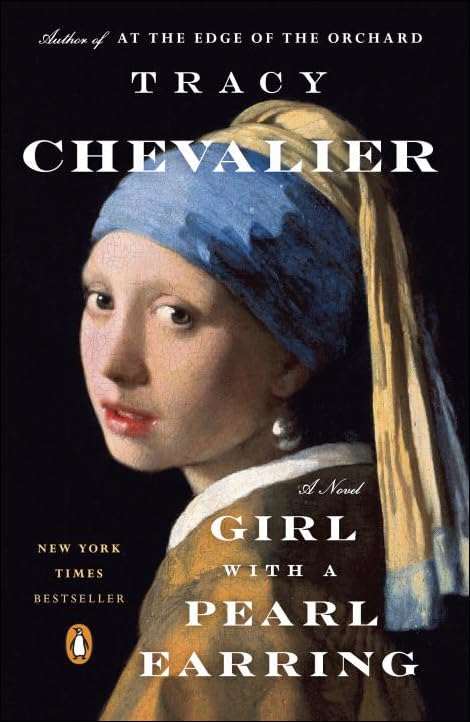
Girl with a Pearl Earring by Tracy Chevalier, 1999

Seventeen-year-old Griet is hired out by her parents as a domestic servant to the household of Johannes Vermeer. From the first pages of the novel, it’s clear that something, although unspoken, has transpired between Griet and Vermeer. Griet’s acceptance in the artist’s home is mixed. She is Protestant and the Vermeers are Catholic. She is distrusted and disliked by Vermeer’s wife, one of his daughters, and the head domestic servant. Life is difficult for Griet until one day when Vermeer insists that she be the only person allowed to clean his studio. A choice his mother-in-law completely supports. Vermeer soon relies on Griet to mix his paints, and he occasionally seeks her advice when setting his scenes.

Tracy Chevalier has written a historical novel as exquisite as Johannes Vermeer’s famous painting for which the book is named. Set in the 1660s in Delft, Netherlands, Chevalier portrays the life and paintings of Vermeer as accurately as she can because not much is known about Vermeer. Girl with a Pearl Earring is considered his masterpiece, but the girl in the painting is a mystery. Chevalier’s prose is as artfully chosen and applied to the page just as Vermeer’s brilliant colors and brushstrokes were applied to his canvases. Her novel paints a captivating fictional story about how Vermeer came to paint the girl.

From the standpoint of craft . . .

As a writer I admire Chevalier’s book for the historical details that make the late 17th Century Netherlands come to life. She puts us in the streets and marketplaces of Delft. She takes us inside Vermeer’s home, and gives us a first-row seat to the domestic life of a financially insecure upper-class family and their servants, with all their petty jealousies, passions, kindnesses, and cruelties. Additionally, Chevalier’s novel is worth studying for the great sense simmering tension she creates between Vermeer and Griet.