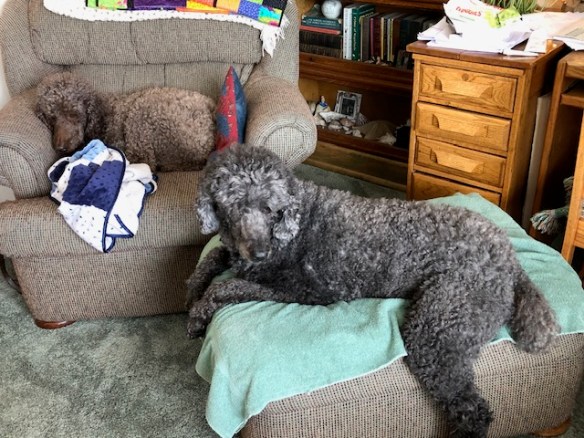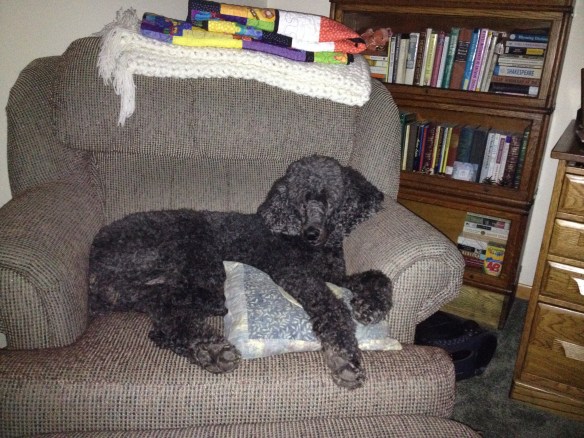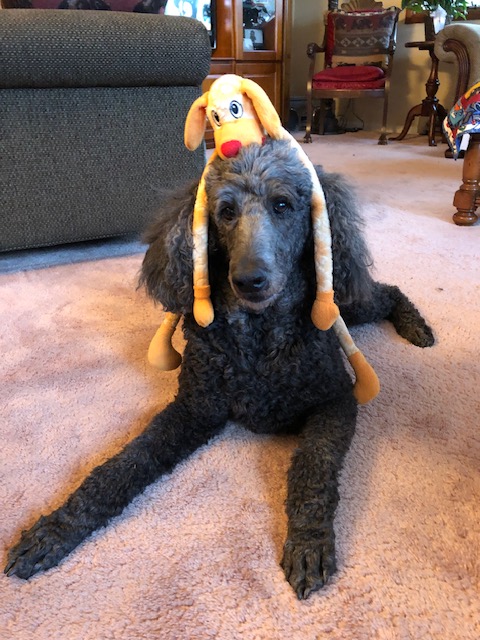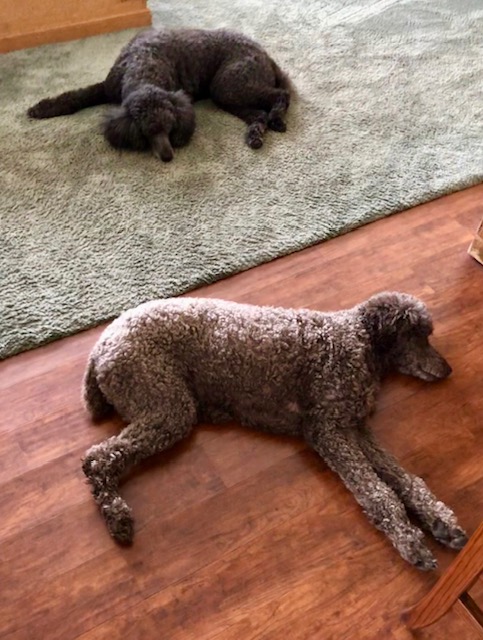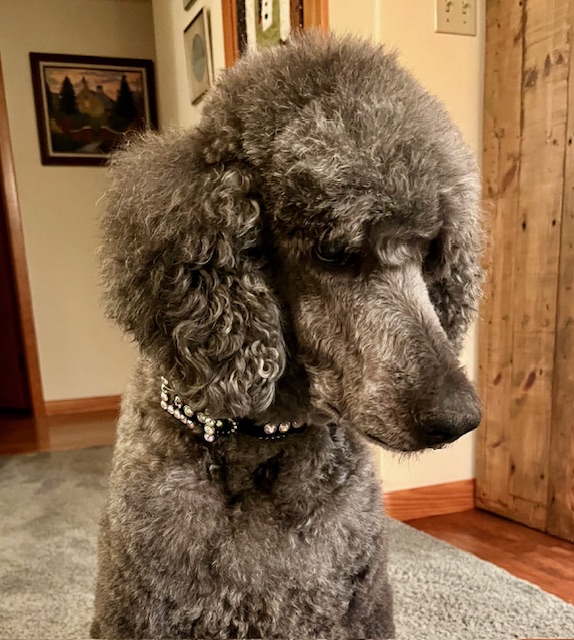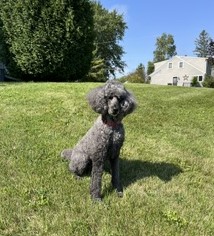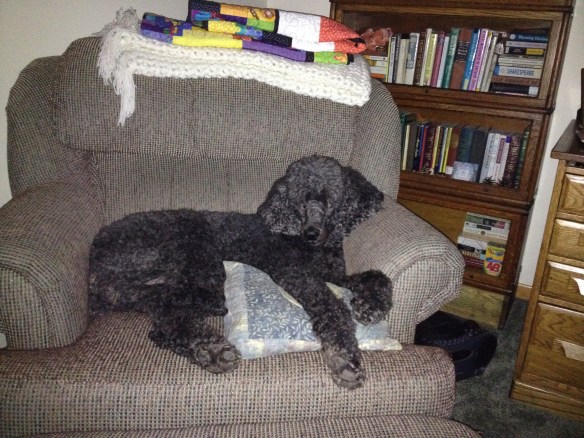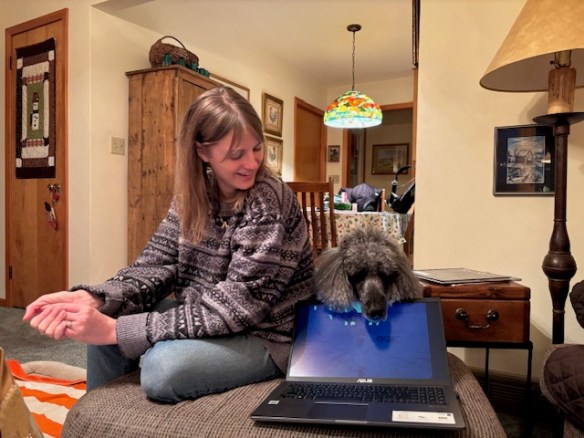
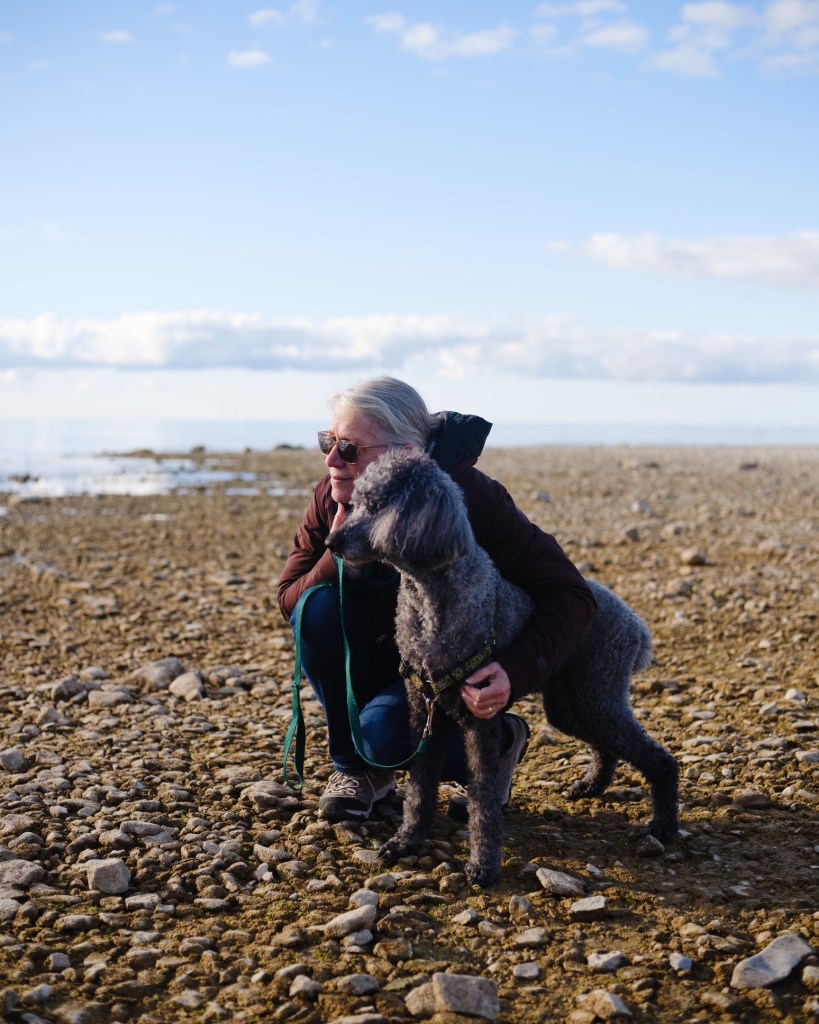
On April 6, our poodle, Ziva, passed away. She was fifteen years and two months old. I’ve tried to write about her passing for the last six months. But choosing the right words to capture her personality is difficult–she had such a big personality–and writing about her makes me sad. There is so much to say about Ziva that if I put it all in this blog, it would become a novella (though not with a story arc). But I need to say something about a dog I loved so much, who left such a hole in my heart.
So here goes . . .
Ziva was born on January 23, 2011. She was ten weeks old when we picked her up from Ruth and Emmett who were Minnesota farmers but also raised dogs. Ruth raised the standard poodles; Emmett raised the Labradors. They did not–as they said more than once–raise Labradoodles. At the time we got Ziva, we had another poodle, Cabela (almost three years old), whom we had also purchased from Ruth and Emmett. Ziva snuggled on my lap the whole way home, nearly four hours of bonding time. I remember feeling bad about taking her away from the farm and her dog family.
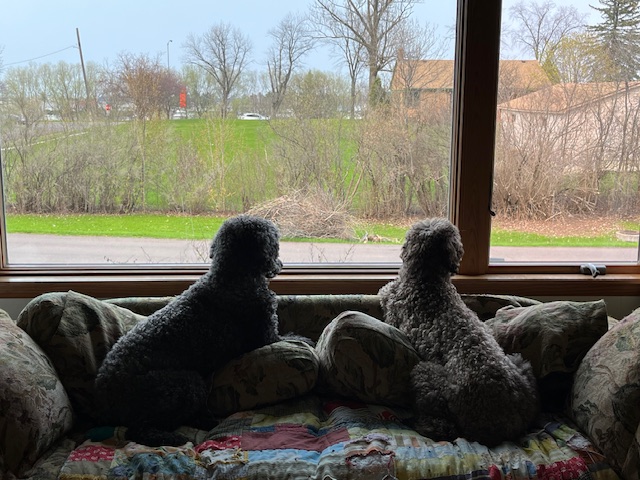
We bought Ziva because our first poodle, Bailey, died, leaving Cabela without a four-legged companion. From the moment they met, Bailey and Cabela were great friends. We expected the same would happen when Cabela and Ziva met. Ha! For the first two weeks anytime Cabela came near Ziva, she shrieked like someone had stepped on all four of her paws. Each time Ziva squealed, Cabela walked away. “Oh great,” my husband and I said each time this happened, “so much for getting a companion for Cabela.” But two weeks to the day after her arrival, Ziva invited Cabela to play. Per Ziva’s wishes, they played gently and in short spurts. This is how Ziva played with dogs for the rest of her life.
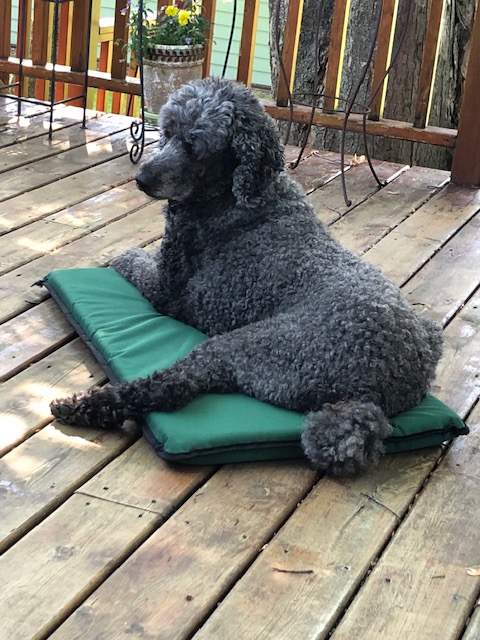
Ziva wasn’t anxious or timid, but she could be a bit of a baby, especially when compared to Cabela, who was more stoic in nature. So, Baby became Ziva’s middle name. We also called her Ziva the Diva and Zippy. Calling her Ziva the Diva was never meant ironically, but calling her Zippy was, as she was usually anything but zippy!
Ziva did most things at a leisurely pace. (Except at treat time when she beat everyone into the kitchen. Or at car-ride time when she beat everyone to the garage door.) As a puppy she never had lightning-paced zoomies. At best she trotted. While Cabela sprinted hot laps around our house, Ziva jogged, completing one lap to Cabela’s two or three. Often Ziva gave up and turned around after completing a partial lap. She thought it silly to run around the house in circles when she could be relaxing on her outdoor bed on the deck in the warm sunshine.
The same vet who told me Cabela had the heartrate of an athlete, discovered Ziva had a heart murmur so quiet it was nearly undetectable. Ziva’s heart murmur never seemed to affect her health or her personality. Her murmur never went away, but it never grew worse. She never needed treatment for the condition.
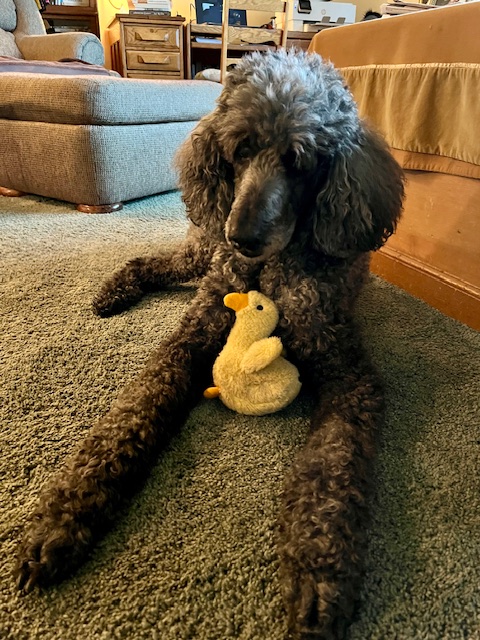
Ziva didn’t play much with toys, but she had a favorite — a stuffed duck that said, “Quack, quack, quack, quack, quack,” when squeezed. She loved the sound. She’d bite it gently, trying to make it quack, but she often failed. So, she would toss it or drop it at someone’s feet, her way of asking, “Please, make it quack!” When our grandkids played on our living room floor, she would find Ducky and lie down on the floor near them. My grandkids all learned to make her duck quack. Over the years we bought her that same duck again and again. A few months before she died, her duck stopped quacking, and we couldn’t find a replacement. Ziva didn’t understand why we couldn’t make her duck quack. Mostly, we kept it out of sight, high up in a basket. The look in her eyes when we couldn’t make it quack anymore bruised my heart.
Ziva was a talker. In a classic Ziva-the-Diva move, she would stand in the hall by the kitchen, and grumble when she wanted her evening treat–a low, soft grrr to start. Either my husband or I would say, “Did you hear that?” But neither of us would move. Ziva’s next grumble would be louder. But my husband and I would just chuckle; we loved this evening routine. Finally, Ziva would give one loud bark: “Hey, I’m talking here. How about my treat?” My husband would ask her, “Is it that time?” Understanding what that meant, Ziva would dash to the treat cupboard.
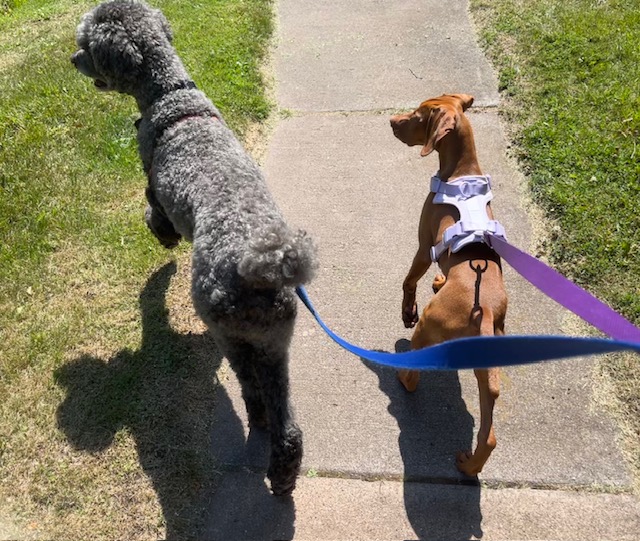
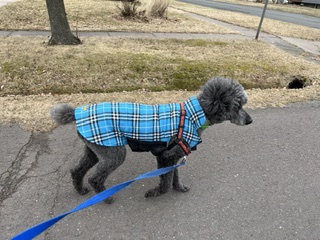
While on walks, she greeted strangers with a bark. Sometimes people asked if they could pet her, but I always declined because I wasn’t sure what Ziva would do. She was eleven years old when I finally figured out that this particular bark was meant as a greeting. A man in my mother’s neighborhood begged to pet her, saying he loved dogs. But I was leery. He insisted it would be okay. Ziva and I approached slowly. As soon as we reached the man, Ziva leaned her body against his legs, her way of hugging, while the man stroked her ears and neck. Ziva was ecstatic. From then on, if someone asked to pet her, Ziva and I would approach slowly. Ziva would give hugs and relish the petting. She was never in a hurry to move on. And once we walked away, she often gave another bark. I like to think it was her way of saying, “Until next time, my friend.”
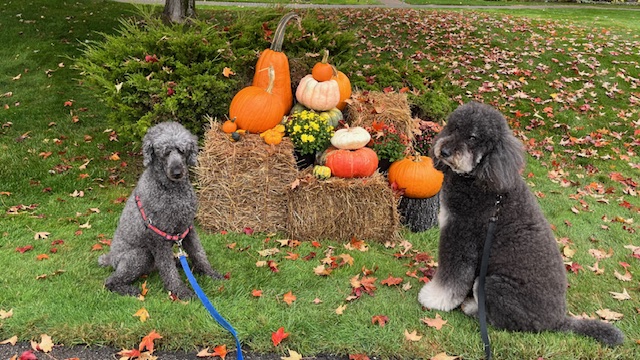
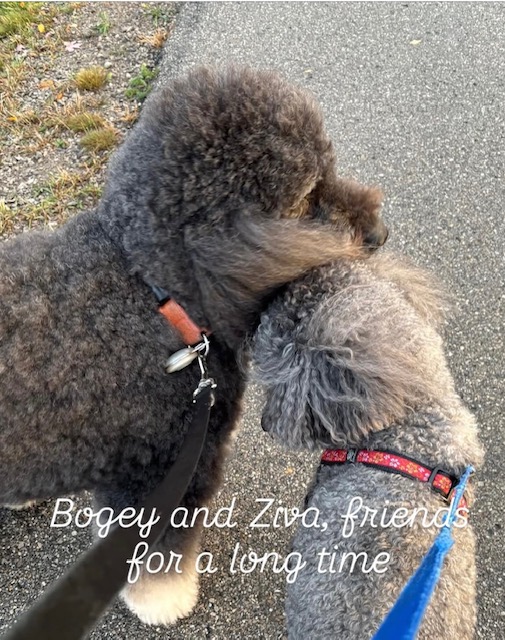
We often visited my mom who had a standard poodle named Bogey. He was taller and longer and weighed almost double what Ziva weighed. In the evenings while we watched TV, Bogey would decide it was time to grab one of his toys and make it squeak over and over. After about thirty seconds of this, Ziva would hop down off the couch, approach Bogey, and let loose with several loud barks, as if to say, “Knock it off. It’s time to relax.” Bogey would stop, and Ziva would settle back on the couch. But Bogey was always brazen enough to squeak his toys again. Once more, Ziva would hop off the couch, look him in the eyes, and bark, “What part of ‘Knock it off’ didn’t you understand?” Bogey rarely pushed it a third time. Bogey had great respect for Ziva, deferring to her wishes. My mother liked to say Bogey was afraid of Ziva, but they were companionable. I often took them on car rides and for long walks together. They sometimes played together in Ziva’s gentle manner. They shared their food with each other. In a silent agreement, when their bowls of different food were placed on the floor at separate ends of the kitchen, they swapped places, each believing they were getting the better meal. There was never a cross word about meals or treats.
Ziva didn’t like kennels. We tried to kennel train her as a puppy, but she would cry nonstop if she was in a kennel. The first time we left her home alone in a kennel, we came home to find a few of the metal bars on the kennel bent, and on the outside of the kennel, a puddle of drool with spots of blood dotted the floor. I never put her in a kennel again. She was a tad claustrophobia. I understood because so am I.
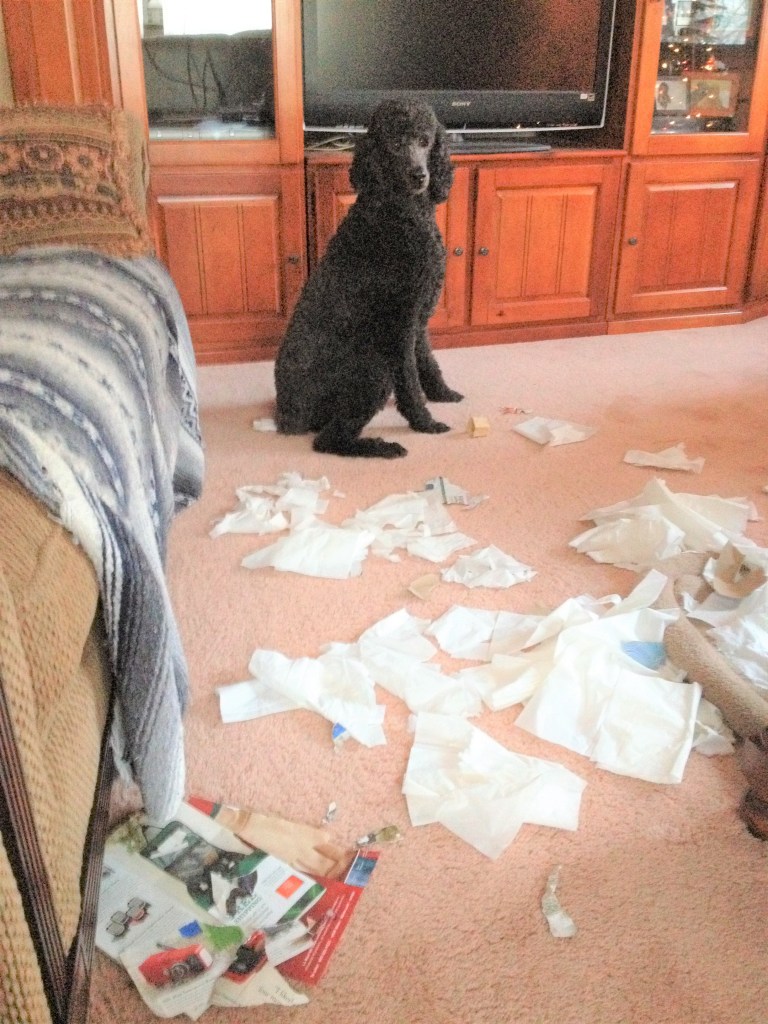
She loved ripping paper of any sort. I became an expert at keeping books, newspapers, magazines, and boxes of tissues away from her. She became an expert at finding the weaknesses in my defensive strategies. She never ate the paper. I don’t think she did it because she was anxious or bored. She just seemed to find great joy in shredding it, especially if no one was at home to tell her to stop. Eventually, for the most part, she outgrew this. But even in her senior years, if I left a tissue or a piece of paper towel on the end table at night, in the morning I would usually find she had shredded it.
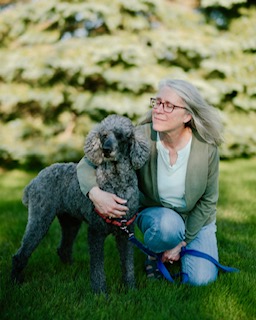
Ziva loved everyone in the family, including extended family members, but I was her preferred pet. If I was reading or writing in the front living room, she had to be with me. If I was in the kitchen, she was in the kitchen. When I wrote in my office, she napped on her bed near my desk. If I got ready to leave the house, she asked to go with me. If she saw me take out a suitcase, she wouldn’t let me out of her sight. Our first two poodles tended to be daddy’s girls. So, why didn’t Ziva become a daddy’s girl? I have a theory. When Ziva arrived, I think she figured out that Cabela had dibs on my husband, so I became her chosen person by default. If that’s the case, I’m honored to have been the second fiddle who ended up first chair.