
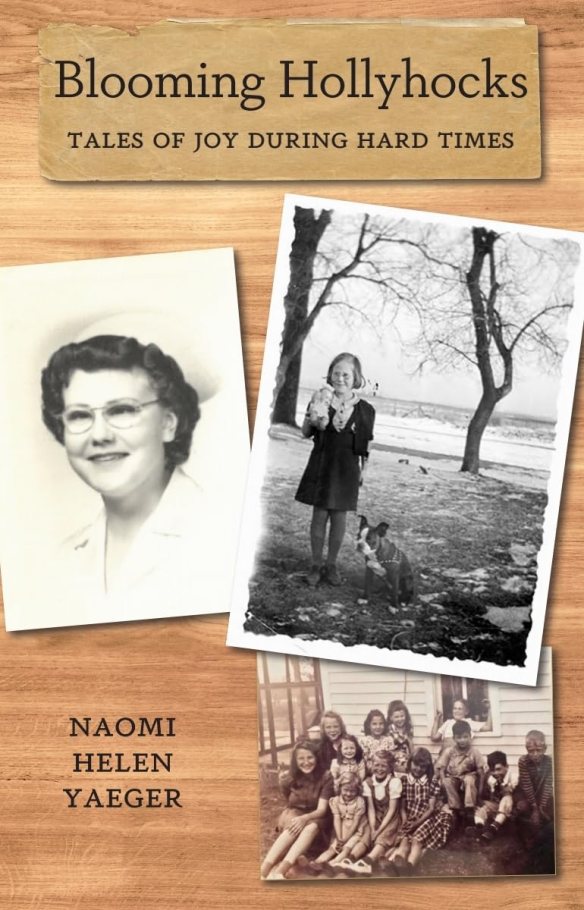
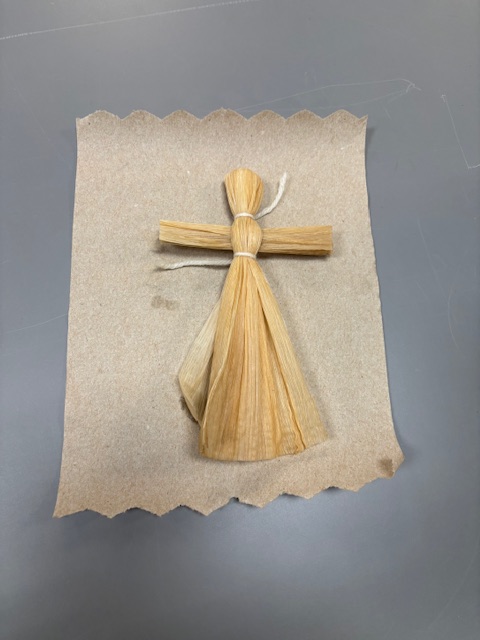
On March 17, I attended a book talk at our public library. At the end of her presentation, author Naomi Helen Yaeger taught the audience how to make corn husk dolls because there’s a reference to them in her book Blooming Hollyhocks: Tales of Joy During Hard Times. I decided to stay and make a doll. I figured it was a good way to honor my New Year’s resolution to behave more like a child.
Because of Yaeger’s crafty idea, the librarians had set up tables and chairs for people who attended Yaeger’s book talk, so we had a nice surface to work on. Yaeger provided moistened corn husks, pieces of yarn, and instructions. All I had to do was relax and have some fun.
Using one piece of corn husk, I rolled arms for my doll then slipped them between several pieces of husk that would become the body. Using pieces of yarn, I tied off sections in order to create the head, torso, and hands. In no time at all, I had my very own corn husk doll.
While I made my doll, I thought about my Girl Scout days because we often did craft projects at our meetings. Making a corn husk doll is the kind of project my Girl Scout leader would’ve loved. She could’ve talked about how toys, like dolls, were important to children throughout history and across cultures. My mother-in-law, Audrey, was born in 1931 during the Great Depression, and she and her parents lived with her mother’s parents until 1938. Occasionally, Audrey’s grandfather would help her make a doll from a thick piece of kindling wood pulled from the box next to the old cookstove. Together they would pound nails into the wood for arms and legs, then pound tiny nails into the wood to create a face. I imagine when the doll broke, they reused the nails for the next kindling doll. Nothing was wasted during the depression.
As I worked on my corn husk creation, I remembered another doll, which I hadn’t thought of in years. The doll came in a kit, so it had to be assembled. The picture of it on the package had an old fashioned, handmade look, similar to a Raggedy Ann doll, which I liked. I don’t remember much about the kit, except there were lots of pieces, yarn was involved, and the minimum age recommendation on the box was a few years above my age. I was eight or nine. It was a Christmas gift from Santa, whom I didn’t believe in anymore, so I knew my mother had bought it. I hadn’t asked Santa for the doll kit, but I liked the present and was excited to put it together. My mother told me she’d have to help because it was too difficult for me to do on my own.
Of course, I wanted to make the doll on Christmas day, but my mother was busy cooking a big turkey dinner with all the trimmings, so I knew not to ask. Over the next couple of months, I occasionally asked her about helping me with the doll, but she was always too busy or too tired. My mother had four children and a big old house to look after, plus she worked as a waitress, an exhausting job, and my father didn’t help with the household chores, typical of the times. But he worked hard as a mechanic, and in the evenings after supper, he worked side jobs in his garage to earn extra money to support his family.
At the time I didn’t think about it, but before my mom bought the doll kit, she’d always made sure Santa delivered toys that my siblings and I could enjoy without adult supervision or help. I don’t know why she picked out something I couldn’t do on my own. Had she liked the doll on the cover of the kit? Did it remind her of her childhood? Had she wanted to do a mother-daughter project with me? I could call and ask her, but I don’t think she’d remember. But I remember because a couple of months after Christmas on a cold winter’s night, I told my mother a whopping, premeditated lie about that doll kit and got away with it.
After the supper dishes were done, I went outside to play. Several inches of packable snow had fallen during the day, and I was itching to make a snowman. I don’t remember my siblings being with me. Because if they’d been outside with me, I would’ve been busy playing with them. I wouldn’t have had time to concoct a devious plan to trick my mother into helping me make the doll.
Under a starry sky in the frosty air, I rolled and shaped three large balls of snow in decreasing sizes. As I stacked them to make my snowman’s body, I thought about the unmade doll languishing in my closet. As I created the snowman’s face from a carrot, some rocks, and pieces of sticks, I formed a plan to convince my mother we needed to make my doll that very night. As I placed a stocking cap on the snowman’s head and wrapped a scarf around his neck, I wondered if I would be brave enough to carry out my plan.
I went back inside the house and found my mother, and I began to lie. “Mom,” I said, “I’m supposed to bring something to school tomorrow that I made at home, something like a craft project, for a special show-and-tell.”
My mother glared at me. I believed she could see the lie on my face. (She had my siblings and me convinced she could always tell if we were lying.) Her brown eyes hardened. She pushed her lips together. She held her next breath, as if to build up steam. When she spoke, I was certain she’d ground me for the rest of my childhood.
“Why did you wait so long to tell me this?” she snapped. Her angry eyes held mine, but I couldn’t look away. When my siblings and I misbehaved, my mother’s stare could wilt us like spent flowers after a late spring frost. But if I turned away, she might think I was lying. Committed to my plan, I pressed on. “I forgot,” I said.
And my mother pressed on. “Just what do you think you’re going to make? It’s almost time for bed.” She ranted about responsibility and my lack of it, but she never asked if I was telling the truth. I couldn’t believe she fell for it. Didn’t guilt fill my face? Wasn’t my voice shaking with fear? Wasn’t she going to realize I was lying, and yell, “Liar!” But none of that happened.
I kept with the lie. At that point, admitting I’d been lying would’ve been just as bad as if she somehow found out in the next few days that I’d lied, and so far, the lie was working. “What about the doll kit I got for Christmas?” I asked.
I was certain my mother would finally put two and two together, narrow her eyes, and ask, Did you come up with this story, so I’d make the doll? Instead, she growled, “Go get it.”
Creating the doll from all the pieces turned out to be complicated, and it was my mother who put it together. I placed a finger here or there to help hold something in place as she assembled the doll, but mostly I watched. I was in third grade at the time, but I was old enough to know that if the assignment had been real, it was my mother’s craft project, not mine.
As my mother put the doll together, her anger waned. The finished red-headed doll was adorable, but fragile, a doll meant to live on a shelf. In some ways that describes my relationship with my mother when I was a child.
Before sending me to bed, she reprimanded me one more time for procrastinating, then added, “Don’t forget to take the doll to school.” I nodded and left the kitchen as quickly as I could. The entire time she’d worked on the doll, I was sure she’d figure out that I’d lied. I went to bed expecting to hear her stomp upstairs and call me a liar. I woke up in the morning expecting her to call me a liar when I came down for breakfast. None of that happened.
I put the doll in a brown paper bag and carried her to school. She sat in the bag on a shelf in the cloak area. I didn’t show her to anyone. At the end of the day, I carried the bag home and placed it in my closet. I didn’t want my mother to see the doll and start asking questions about the show-and-tell that never happened. Already in too deep, I would’ve lied about that too. I kept the red-headed doll out of sight, not because I was filled with guilt about lying to my mother, but because the longer the lie went on, the bigger I felt my punishment would be when I was eventually found out. For the first few days, I half expected my mother would call my teacher or run into her somewhere and ask how she’d liked my project. Days passed, then weeks, then months, then years. I was never punished for lying about the doll, but the dread I lived with for months was its own type of punishment.
I’d like to say I never lied to my mother again, but anyone who’s ever been a kid or teenager knows that would be a lie. However, I never told a blatant, red-headed-doll-type of lie again. Rather there were things I just didn’t tell my mother, unless she confronted me.
I don’t know what happened to the red-headed doll. You’d think after her dubious beginning, I’d know how her story ended, but I have no idea. I hid her away in a bag in my closet to forget about her.
As a child I couldn’t believe my mother bought such a hasty, clumsy lie. But as an adult I know how children will suddenly remember they are supposed to bring something to school the next day, something they’ve known about for a week or more. When I look back on it, my mother probably thought I stammered and fidgeted because I’d forgotten about my school assignment and had to tell her at the eleventh hour.
I also couldn’t believe my mother agreed to bail me out and make the doll. She was big on letting her children suffer the consequences of their actions, or in my case inaction. When my mother didn’t call me a liar after the tale I told, I’d expected her to say, Well, since you forgot about it, you can go to school without a project and explain it to your teacher. I’m not sure why she didn’t tell me to suffer the consequences, but I have a guess. In the 1960s, my mother worked outside the house, while all my friends’ mothers stayed at home. Good mothers, especially those with working husbands, were supposed to stay home, and cook, and clean, and raise perfect children. Perhaps she felt my failure would be laid at her feet. A stay-at-home mom would’ve had everything under control.
Over the years my siblings and I have confessed some of our youthful misdeeds. We’ve told our mother how we’d hide the clean laundry in one of our closets when we forgot to fold it and put it away. We’ve told her how we — and not our Old English Sheepdog — broke the window in the kitchen storm door. We’ve told her how we used to sneak bottles of Coca-Cola out of the fridge and share them in one of our bedrooms where we kept a bottle opener. And we’ve laughed about these escapades with our mother. But I’ve never confessed about the red-headed doll, and I never told my siblings about it, at least not at the time. One of them might have let it slip.
I’ll never tell my mother about my whopping lie. I don’t think she’d remember the incident. But more importantly, if I told her I lied because two months had passed since Christmas, and I really, really wanted to make the doll, she’d feel bad. She’d see it as another indictment against her days as a young mother when she was often overwhelmed, tired, and angry, and living with my father, who was difficult. If I told her about the doll now, she’d feel guilty about not having made the time for me, about my having to lie in order to get her to keep her promise about helping me make the doll. She’d regret not having been a better mother. We’ve had these kinds of conversations before; there’s no need to have them again. Mom did the best she could, which I’ve come to realize was sometimes pretty good.


Wow, Vickie, that’s quite the story. I don’t know If I should be sad or happy hearing that story. At least you’ve come full circle in forgiving you mom for not spending as much time with you as you yearned for. (I keep trying to log into WordPress and making new password and keep getting locked out.!!!!GRRR)
Naomi Yaeger, writer/photographer218-591-5277 : sun_dog_press@yahoo.comDuluth, MN
LikeLiked by 1 person
I think the story is both sad and happy. Reading your book was nice because it made me think about so many stories that my parents and grandparents told me. Plus, it reminded me of some of my own stories.
LikeLike
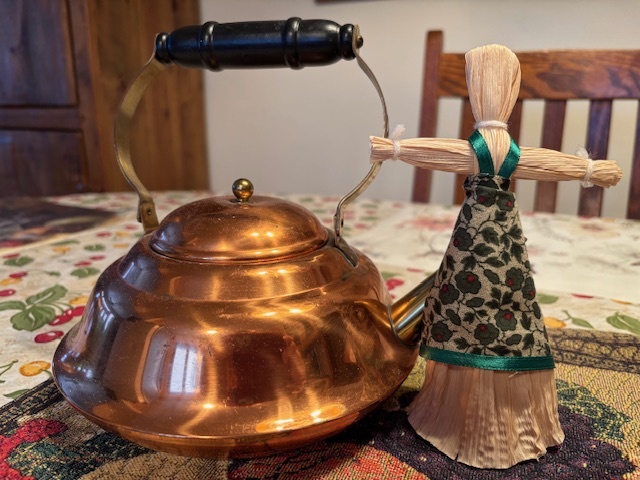
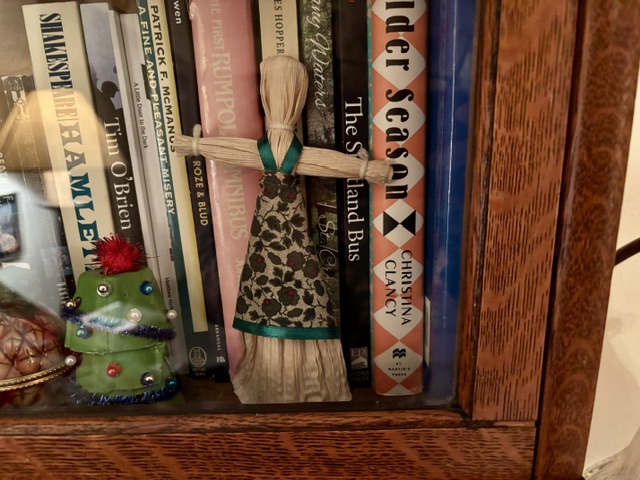
A wonderfully told story. Some childhood memories are silly, and others are poignant—and this falls into the latter category. It is strange that as we get older, we understand that parents were just people, trying their best. Thanks for sharing your memory. BTW, cute corn husk doll.
LikeLiked by 1 person
Thanks, Diana. I’m glad that you enjoyed the story. It took me many mornings of writing to get it to hopefully capture how I felt then and how I feel now.
LikeLiked by 1 person
Vickie, isn’t it amazing how one thing leads to another? In this case, you make a corn husk doll that led you down the path to recall the red headed yarn doll. So much depth of truth, or lie, for one simple want or need and how to get it. Your corn doll looks fantastic on your bookshelf. Well done.
LikeLiked by 1 person
Thanks, Sally. One of the reasons that I like writing is because when I connect thinngs like this together, writing gives my a place to explore what it all means.
LikeLike
That is the magic of writing, connecting lost dots.
LikeLiked by 1 person
Fortunate people in the sphere of Vickie’s wisdom and honesty -in -the -tale. She teases out memories for us all. I so much like the apron on the cornhusk doll! This is so Vickie, bestowing value to the simplest.
LikeLike