

Cabela died at 11:30 on the night of August 4. She was fifteen years old, and we loved her very much. She was a brown standard poodle born on June 24, 2008, in a red barn on a farm in Barret, Minnesota. Her first human parents were Emmet and Ruth, a pair of kind farmers who raised Labradors and standard poodles for pin money. Cabela spent her early puppy days playing outside on their farm with her siblings in the summer sunshine. She developed a life-long love of being outdoors.

When we brought Cabela home, she wanted to be outside all the time. She liked to sit or lay under my husband’s maple tree in the front yard. She believed her job was to patrol the yard, watching cars and pedestrians move up and down the streets at the front and the side of our house. She and the priest who lived across the street became friends. When he left or returned home in his silver Buick, he would slow to a crawl to see if Cabela was outside. If she was, she would line up with his car, he on the road and she in our yard. The priest would slowly accelerate and Cabela would accelerate. They raced until she reached our lot line. The priest always ended the race in a tie, and the two of them enjoyed their game for years. In her prime when Cabela was excited, she ran hot laps, up to six or seven of them in a row, around our yard at warp speed, or she launched herself six feet into the air along the trunk of a tall pine tree. Drivers would stop and watch her performance. Dr. Jenny, her regular vet, once remarked, “Cabela has the heartrate of an athlete.” I said, “She is an athlete.”
Cabela died because her stomach twisted. The medical term for this is Gastric dilatation-volvulus (GDV). It’s more common in deep-chested dogs like standard poodles, and it’s more problematic in older dogs because the muscles and ligaments holding their stomachs in place become weak and more elastic. The emergency hospital vet, Dr. H, asked me if Cabela was spayed and when I said yes, he asked if her stomach had been tacked at the time. I’d never heard of this, but it’s supposed to help prevent GDV. I have no idea if Cabela’s stomach was tacked when she was fixed.

On August 4, Cabela’s evening started out normal. She ate her supper, and an hour later she went for a walk with her sister, Ziva, and me. Cabela still loved her walks, but they were now a slow, grass-sniffing shuffle around the block, then she was done. After the walk she rambled around the house. This too was part of her evening routine. She had a touch of dementia, which often became more noticeable in the evening. In humans with dementia, this is called sundowning. Cabala would look like a person who had entered a room but couldn’t remember why, no matter how hard she tried. Usually after thirty to sixty minutes of intermittent ramblings, she settled into a deep peaceful sleep until the wee hours of the morning when she would wake me up so she could go outside and potty.
But on that night, Cabela wouldn’t even lay down for a short rest. She moved from the family room to the living room and back again. My husband and I encouraged her to lay down. We stroked her head and ears when she came near us. We patted the couch cushion, inviting her to hop up and rest. But she backed away and kept moving. We wondered if her hips or legs were in pain. She was arthritic and her hind leg muscles had begun to atrophy. We wondered if she’d torn a ligament. She didn’t cry or whine or wince. Cabela was so very stoic all her life, and at the end of her life she would be no different. Later that night while treating her, Dr. H would remark, “Cabela is one of the most stoic dogs I’ve ever treated.”
At nine o’clock, I gently helped Cabela lay down on her sheepskin bed. She resisted for a moment, then relaxed. She closed her eyes, and I stroked her face and neck. She fell asleep. Later I would realize that for a few minutes either fatigue got the best of her pain or the position in which she lay gave her a brief respite from it. But at that moment, it appeared she would sleep until the wee hours of the morning. I sat with her for five minutes, watching the peaceful rise and fall of her chest, her only movement. Then I let her be and returned to the family room.
But a few minutes later Cabela was up and walking around, lost and confused, looking at me with sad eyes. I tried to lay her down again and soothe her, but she was having none of it. She snapped at me, placing her teeth gently on my arm. She kept pacing. At ten o’clock I took Cabela to the animal hospital.
I had to carry her into the van. Again she whipped her head around and nipped at me. This time her head banged into my glasses, bending my wire-rim frames. She rested her teeth on my shoulder, but did not bite down. Only later would I understand she was saying, “It hurts so bad.”
We arrived at the hospital, and I had to lift Cabela out of the van. She snapped at me one last time, still all warning and no bite. After I described her symptoms to the receptionist, Cabela was seen immediately. Dr. H and the techs were wonderful to Cabela and me. The vet suspected her stomach had twisted. I felt awful. I told the doctor that I thought she had been sundowning. He understood because he’d had a beagle who had episodes of sundowning as an old dog. He remarked that Cabela had a very good heart rate for a dog her age. “She was an athlete,” I said.
Cabela was taken back into the hospital where she was sedated to relieve her pain, then she had her abdomen x-rayed. I knew if her stomach was twisted, she would need to be put to sleep. Dogs do have surgery to correct twisted stomachs and often survive if the condition is caught early. But Cabela was fifteen years old with some dementia, nearly deaf, arthritic with weak muscles, and during her initial exam, Dr. H had discovered she was nearly blind in her right eye.
Cabela’s x-ray confirmed that her stomach had twisted. The vet said because I’d brought her in so quickly, she would’ve been a good candidate for surgery if she had been younger and in good health. “But to do this surgery on her at this stage of her life,” he said, “would be cruel.” And I agreed. The vet left to get the medicine needed to put Cabela to sleep.
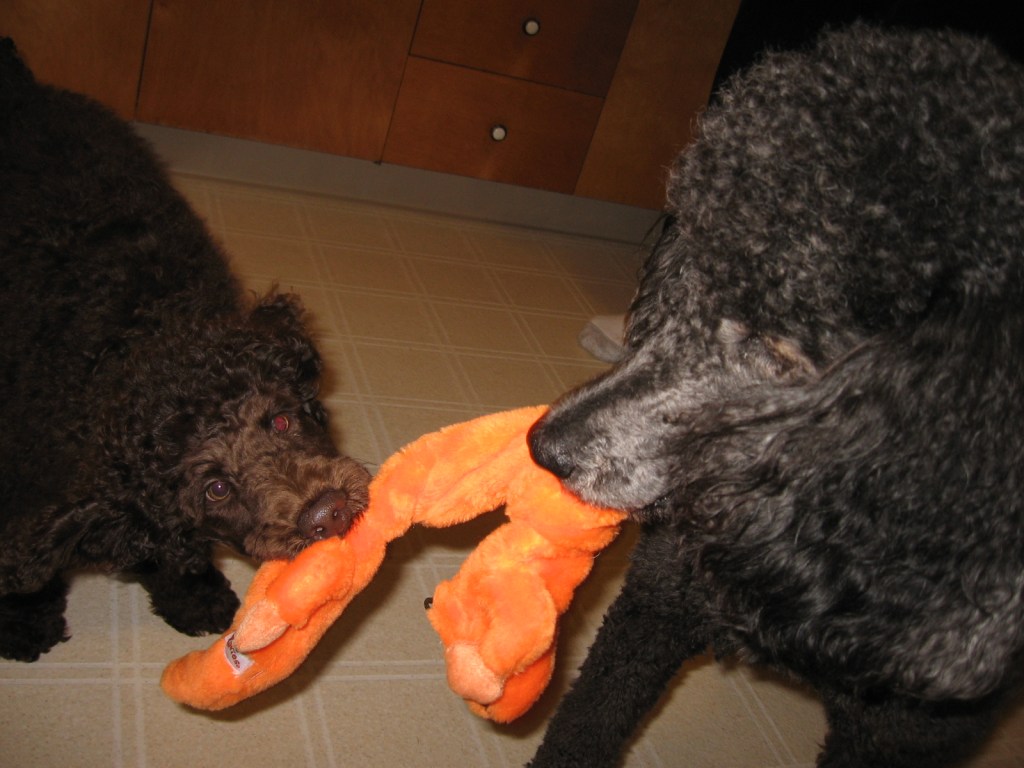
The tech brought Cabela back to me and I sat on the floor and held her. She was heavily sedated, breathing quietly, soft and warm in my lap. I asked the tech if he had a pair of scissors so I could have a snippet of Cabela’s hair as a keepsake. He kindly made this happen. Then the vet returned. After Cabela died, I was given time alone with her. I held her. I thanked her for being such a good dog. I told her she would see her old pal Bailey, our first standard poodle, and they could play and nothing would hurt. They loved to chase one another and play tuggy with an elastic-filled, furry toy we called Lizzy. Bailey died when Cabela was two and a half, and she looked for Bailey for weeks. When my husband and I brought Cabela home and introduced the two of them, they began to play immediately. Every minute or so, Bailey would run back to my husband or me, wagging her tail and smiling as if to say, “Thank you! Thank you so much for bringing me a puppy!” Then she would dash back to play with Cabela.
We met Cabela on a pleasant September day in 2008 in Owatonna, Minnesota, near the Cabela’s sporting goods store, for which she would be named. My husband and I and my youngest son and his future wife were eating lunch in a restaurant and watching out the window as people walked up and down a row of dog breeders who had set up along a wide grassy boulevard. The breeders came from Iowa, Wisconsin, Illinois, and Minnesota to sell leftover puppies they hadn’t been able to sell back home. We decided after lunch to look at them. I thought about free puppy cuddles. We already had our two-year-old standard poodle, Bailey, so I had no interest in getting another dog.
The four of us visited the standard poodle puppies first, and my son scooped up a chocolate one and snuggled her to his chest. Content, the puppy nuzzled in and closed her eyes. I talked to the woman about her poodles and my poodle. And while I talked, my son whispered, “Take her home, please, just take her home.” He repeated the words over and over. I looked at my eighteen-year-old son, holding this puppy, and my heart melted. I asked the lady how much she wanted for the puppy. Her answer was reasonable. I asked my husband if it was okay with him, and without hesitation he said it was. I wrote the woman a check, and my son carried her to the car. We never visited the other breeds of puppies.
We named our new puppy in record time. Because she was a chocolate-colored dog, my husband suggested Hershey, which I immediately nixed. “That name will encourage jokes about the Hershey squirts.” My husband laughed, but this was an indignity I felt no dog should have to endure. My son suggested Cabela, and we all agreed it was a great name. Cabela was eleven weeks old when we bought her, and I am eternally grateful that no one else had chosen her. She earned her middle name when during a case of the zoomies, she misjudged the width of the hallway and ran head first into a wall. As she shook her head, I said, “Your middle name is now Grace.” Over the years we gave her lots of nicknames: The Brown Bomber, Range Rover, Ichabod, Snickerdoodle, Kadiddlehopper, and Bel. I once read somewhere that a well-loved pet will have many nicknames.
It was after midnight when I came home without Cabela. I came in through the garage and up the basement stairs. Ziva stood at the top of the steps, waiting. She kept looking to either side of me, watching for Cabela to come up the stairs. Even though it was late, I knew I wouldn’t sleep, so I sat on the loveseat and Ziva climbed up on her favorite couch. I turned on the TV, but I have know idea what I watched. Every now and then, Ziva heard a noise and her head popped up. She looked toward the hallway, waiting to see Cabela come into the family room.
In 2011, after Bailey had died, Cabela was lonely. She had liked having a dog buddy, so we called Emmet and Ruth. Luckily one of their poodles had recently had puppies, so we reserved one for Cabela. But, when we brought Ziva home, she didn’t want to play with Cabela. Every time Cabela came near her, Ziva squealed like she was in mortal danger. And each time Cabela moved away and gave her space. “Won’t that be something if Ziva never wants to play?” my husband and I would say. Thankfully, two weeks later, Ziva approached Cabela and said, “Let’s play.” And they, too, became buddies.

Cabela died on a Friday night, and that weekend I couldn’t stay in the house. I wanted to be outside where Cabela had loved to be. I felt her spirit would be in the yard. I spent the whole weekend outside, making things look pretty for Cabela. I weeded gardens and picked up sticks. My husband helped me wash windows, clean gutters, and dig up some scraggly, out-of-control bushes so we could plant new ones next spring. If I mentioned Cabela’s name and Ziva heard me, she looked at me quickly and intently and cocked her head. “Where?” she would ask. She seemed so sad, too.
I miss Cabela. I loved how her ears flapped in the wind when she sat in our front yard on breezy days. I miss how she poodle-pranced down the street on our walks. I miss how she could raise one eyebrow and then the next, alternating back and forth when she asked for a treat. I miss seeing her on the living room couch, her front paws resting on its back and her head resting on her paws as she looked out the window, working the yard from inside the house. I miss how she would turn to look at us each night before she headed down the hall to her sheepskin bed. “Calling it a night?” my husband would ask, then say, “Have a good sleep.”


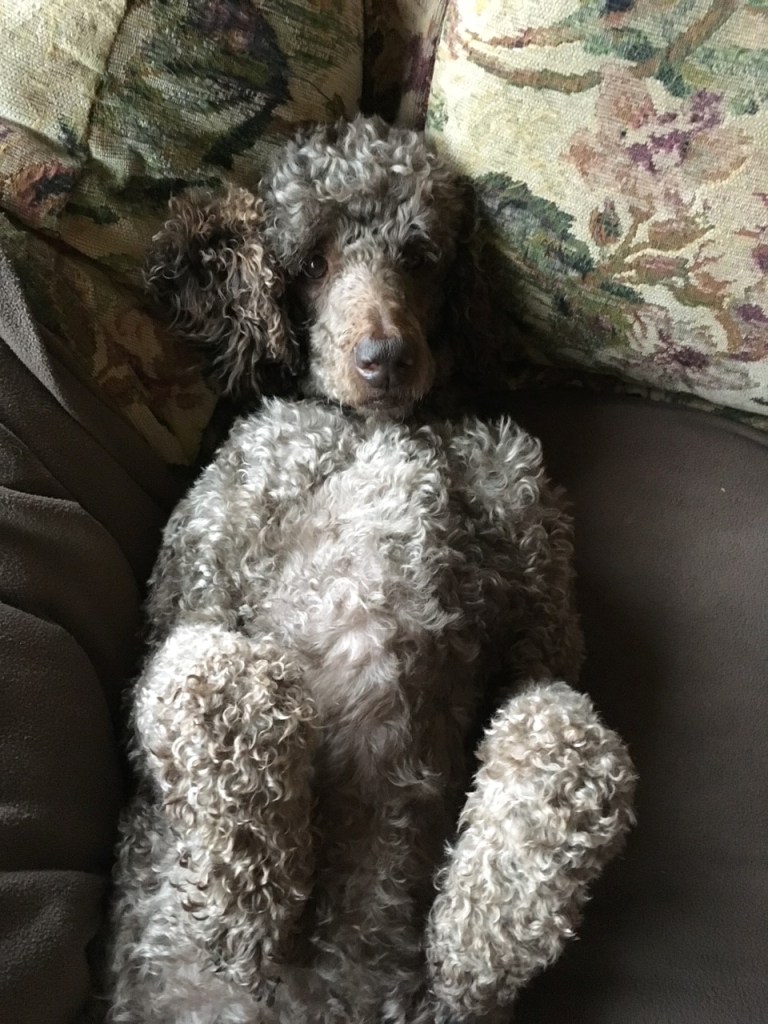
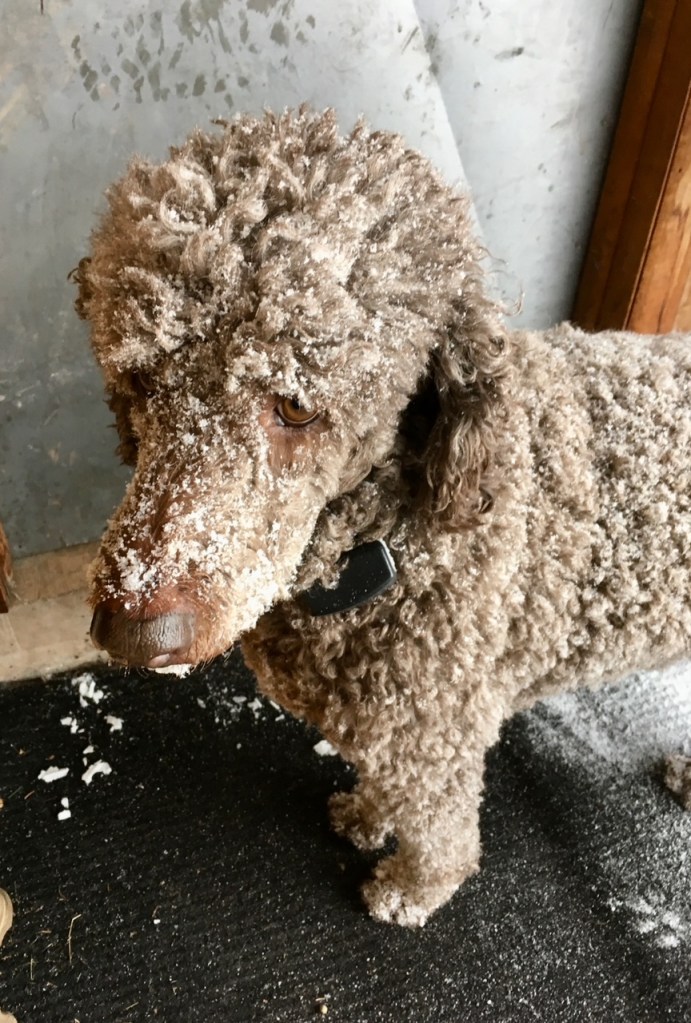
[My dog Cabela died two months ago. I’ve tried to blog about her dying (because I blogged about her when she was living) but I would end up crying. Then I would decide my words were fluff, unable to capture her essence and the hole left in my heart by her death. A couple of days ago I read “When a Cold Nose is at the Pearly Gates: Writing a Pet’s Obituary” by Laurel E. Hunt on Brevity Blog. After I finished reading Hunt’s blog, I tried writing about Cabela’s death in the form of an obituary, but that didn’t work for me either. And I cried again. Even thought Hunt’s writing idea didn’t work for me, I’m thankful I read her blog on October 6 because she inspired me to try and write about Cabela again. To learn more about GDV click here.]


I’m so sorry. *BIG HUG* Saying goodbye is so hard, even when it’s the best thing for the animal.
What a lovely piece, though. I feel like I knew Cabela.
LikeLiked by 1 person
Thank you. I appreciate knowing Cabela’s personality came through.
LikeLiked by 1 person
🤗🤗
LikeLiked by 1 person
A heartwarming tribute!
LikeLiked by 1 person
Thank you.
LikeLike
Vickie, I have been wondering about Cabela. I felt like I knew her. You did her justice; you gave her the best as true pet lovers do for their kids in fur suites. Thank you for being able to write this.
LikeLiked by 1 person
Thanks, Sally.
LikeLike
I’m so sorry. She was a sweet, beautiful dog, and it seems she enjoyed her life with you. A lovely tribute.
LikeLiked by 1 person
Thank you.
LikeLike
I am sorry to hear about this, Vickie! Thank you for sharing her story with us. I’m glad you found the fortitude to do so. Poodle prancing is the best.
LikeLiked by 1 person
Standard poodles are amazing dogs. We still have Ziva and she’s a hoot. Over the years I’ve had three standard poodles, and they are almost like having girlfriends.
LikeLiked by 1 person
So sorry for your loss. Your writing brought tears to my eyes. Thanks for your information about the twisted stomach. Take care.
LikeLiked by 1 person
Thanks, Janet.
LikeLike
((Vickie)) I always loved your posts about Cabela…such a sweet dog, and your love for her is, and will continue to be, palpable.
LikeLiked by 1 person
Thanks, Lynn. She was special in her very own way.
LikeLike
So sorry for the loss of Cabela. Glad you were finally able to find the words to express memories of her and what she meant to you. Sounds like she was a wonderful companion 💔.
LikeLiked by 1 person
Thank you.
LikeLiked by 1 person
Such a sweet story about Cabela. I loved all the pictures. So sorry Cabela had to go.
LikeLiked by 1 person