It’s late afternoon on August 18, 2018. My friend Sandi and I have escaped her pre-fab house and her unstable caretaker, who is out running errands, but we cannot escape her stage IV cancer. That sits with us in the car. Sandi fancies we are the movie friends Thelma and Louise, trying to outrun it all.
Fifteen minutes earlier, I’d come to show her the quilts I’d finished piecing before taking them to the machine quilter. She’d started them for her son and grandson but was too sick to finish them. As I was leaving, she said, “Wait, I’m coming with you.”
A dazzling sun hangs in a spacious cloudless sky. I wear sunglasses because the tinted windows in my van aren’t dark enough to subdue the afternoon’s harsh glare. I don’t ask if I’m Thelma or Louise – I’ve never seen the movie – but my sunglasses are similar to the ones Louise wears in the promotion stills. The movie is one of Sandi’s favorites.
Sixteen days from now Sandi will die, but today she’s full of mischief and life, if one doesn’t look too closely. She refused more chemo, so she has hair. She’s thinner, but far from frail. She’s quick with a smile and a laugh, but moves slowly.
During the drive, we joke and laugh, making light of our escape from the caretaker, whom we call Nurse Ratched.
My friend taps her perfectly manicured and sparkly-red painted nails on the console between our seats and says, “I wish I could take you with me.”
I stop talking. Silence mingles with the cold air blowing from the vents on the dash.
I have no words. But within one beat of my heart, I know that her words are the most profound expression of love I’ve ever received. And, I have no words.
She speaks first. “But your husband wouldn’t like it.”
Still, no words.
We both know she doesn’t want me to die.
I truly believe she has said this to no one else. Yet, I have no words.
Ordinary chitchat begins again.
After dropping off her quilts, we return to her home. The caretaker is back, silently seething. We left her a note, but that didn’t matter. The caretaker believes if she controls all of Sandi’s end-of-life decisions, Sandi will live longer.
My friend settles into her easy chair. I kiss her cheek and whisper in her good ear, “I’m going to go.” The caretaker, a dark cloud, will become a thunderhead if I stay.
“That’s probably best.” Sandi whispers too.
I kiss her cheek again, and murmur, “I love you. I’ll see you tomorrow.”
“I love you too,” she says.
I tell myself I’ll watch Thelma and Louise after Sandi is gone, but I don’t believe I ever will. Thelma and Louise drove off a cliff together. In sixteen days, Sandi will leave without me, a Thelma without her Louise. Or perhaps a Louise without her Thelma.
I never asked her, “Which one am I?”
[This flash essay was originally published by Persimmon Tree in their “Short Takes” section in Summer 2023. I’ve posted it here because while I think about Sandi everyday, there are certain times of the year when she plays in my memories throughout the whole day. ]
I taught my twelve-year-old granddaughter, Clara, how to play cribbage. The first two rounds we played were full-disclosure games because we laid our cards face up on the table. It’s the easiest way to teach someone to play. I taught her strategies for tossing cards into the crib, how to maximize her chance for a better hand, and how to peg points while preventing her opponent from doing the same. I taught her how to count the pairs, runs, and combinations of fifteens. Cribbage is a complicated game, but that’s what makes it fun.
I learned to play cribbage when I was nineteen years old. I was a bartender in a small unincorporated town, population 350. One of my customers asked me to play cribbage. I told him I didn’t know how. “Well,” he said, “you’re going to have to learn because when customers come in and it’s slow, they’re going to expect you to play.”
I’d grown up eight hours away in a metropolitan area, and I’d never heard of cribbage.
The customer grabbed the cribbage board and a deck of cards off a ledge from behind the bar. “I’ll teach you,” he said. He placed the pegs in their starting holes and shuffled the cards. I carried over a barstool and sat down in front of him but stayed behind the bar. After all, should another customer have shown up, I might’ve had to pour a beer, mix a whiskey-7, or pop a top on a soda. He taught me well, and I played many games of cribbage with him and other bar patrons, especially on quiet winter days and nights.
Shortly after Clara and I started our third game, I asked, “Do you want to play without us seeing each other’s cards?”
“Sure!” She smiled and her eyes sparkled, excited that Nana felt she was ready to be in charge of her own hand. She did well and quickly caught on to counting her hands, but luck plays a part in cribbage, and I had better cards. Yet none of that mattered. We laughed and celebrated our high-scoring hands. We laughed and mocked our low-scoring hands, saying, “two, four, and there ain’t no more,” or “I got nineteen.” (Nineteen equals nothing because it’s not possible to score nineteen points in a cribbage hand.) I almost skunked her in one of the games, but she managed to avoid the stink of getting beat by 31 points or more. And we laughed about that too. Both of us like to play cards and board games, but neither of us is bothered by losing. There is always another game to be played.
Clara and I played on the same cribbage board I used when I taught my grandma Olive to play cribbage. I have two other boards, but I liked knowing that Clara and I were touching the same pegs and moving them along the same holes on the same board Grandma Olive and I used forty-five years ago.
When I was eighteen, I moved in with my grandparents, George and Olive, and lived with them for almost three years. Grandma Olive and I didn’t always agree about how I should live my life. She believed I should sing in the church choir and attend Sunday sermons. She believed I should be present at the dinner table for breakfast, lunch, and supper. She believed I should be home before midnight. She believed I should have a better class of friends. She believed I should iron my shirts instead of wearing them wrinkled.
I believed Sunday mornings were for sleeping in. I believed if a friend said, “Let’s go swimming” or “Let’s play tennis,” skipping lunch or dinner was no big deal. I believed being home by midnight was for Cinderella. I believed my friends were wonderful. And I believed the heat from my body would smooth out most of the wrinkles in my shirts.
But I loved Grandma Olive, and I knew she loved me and worried about me. And because neither of us liked conflict, our disagreements were soft-spoken, thirty-second exchanges of point and counterpoint, in which neither of us would change our minds. Then I would leave the room. And she would exhale a heavy sigh.
When I wasn’t working or with my friends, I liked spending time with Grandma in her kitchen. She taught me how to make an angel food cake (lots of sifting and gentle folding) and Amish sugar cookies (pressed with the bottom of a cut-glass crystal sugar bowl). She taught me how to play Shanghai rummy, which used two decks of cards and had increasingly complicated hands of sets and runs, which players had to attain to score points.
Grandma often heard me talk about playing cribbage with customers when I bartended. “I wish I knew how to play,” she would say, so I bought a cribbage board. One evening as we finished up the supper dishes, I offered to teach her how to play. I can still picture her standing in her slightly remodeled 1940s kitchen, wearing her patterned apron trimmed in red rickrack, one of its pockets bulging with an ever-present handkerchief. She teared up, smiled, and said, “Oh, yes!”
Grandma Olive loved me even if drove her crazy, and I loved her even if she didn’t understand my generation.
Grandma Olive with me on her lap and Grandpa George with my sister on his lap, 1960. Seventeen years later I would move in and teacher Grandma how to play cribbage.
I lived with my grandparents for nearly three years. I thought I was easy to have around, and in many ways I was. But looking back, I realize that my grandparents, especially Grandma Olive, worried about me. They’d already raised three children, so having their eighteen-year-old granddaughter come to live with them during their golden years wasn’t ideal. Grandpa, who was never a talker and still worked at his gas station six days a week, would remain an enigma to me. But Grandma and I came to know and appreciate one another, most of time.
So sometimes when the baking and cooking and dishes were done, Grandma Olive and I would sit at the old wooden kitchen table covered in oilcloth and play Shanghai rummy or cribbage. We talked and laughed, and forgot about our disagreements, neither of us caring if we won or lost the game.
A few years after I moved out of my grandparents’ house, Grandpa George died, and Grandma Olive developed dementia. She and I couldn’t play cards anymore.
Comes a time when there isn’t another game to be played.
It would be a groan-worthy pun if I had titled this piece “Fall into Books.” But on the race track of seasons, autumn is — by two horse lengths — my favorite season, plus I think autumn is a beautiful word. Autumn colors are magnificent, and this year nature outdid herself with luminous swaths of red, orange, and yellow. Autumn air is crisp (often code for cold and windy where I live), so it’s a good time to read. (Really, anytime is a good time to read.) And I read lots. I’m a writer, so reading is part of my craft. I hope to be inspired by and to internalize good writing: the plots and subplots, the organization, the characterization, and the dialogue. Before we get too far into autumn, I’m going to share some of my recent reads, all of which were enjoyable, stimulating, and page-turning. So, if you’re looking for ideas . . .
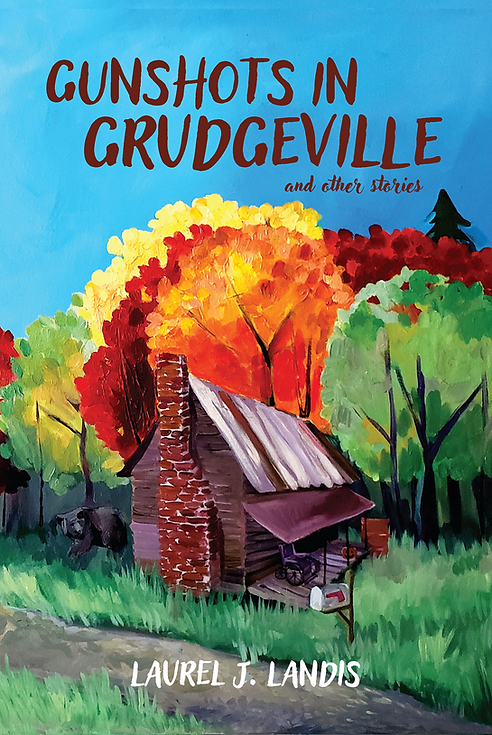
I loved the cover of this book and its catchy title. And Laurel J. Landis’s short stories beneath the cover are just as vibrant and intriguing as the autumn trees and the mysterious old shack — inviting readers to sit and connect with ordinary people living in a small town. Landis pulls readers into the lives of her characters and their tales of bad choices, grief, coming-of-age, love-gone-awry, and broken promises. I lived in a small town for three years, and Landis masterfully nails the feel of small-town life. Her characters and settings are authentic, reminding me of people I once knew in the unincorporated town of 350 where I once lived. Landis’s short stories remind us we don’t have to travel to faraway lands or other worlds because life happens everywhere, even in small towns. My favorites: “Tornado,” “Small Injuries,” “Breathless,” “Junction, County T,” and “Gunshots in Grudgeville.” [To order Landis’s book, click here.]
Mallory Moe, a twenty-five-year-old Army vet, works overnights at Speed Stop, a gas station and convenience store in rural northern Wisconsin. She is estranged from her family, in an abusive relationship, and drifting through life. While out on a cold winter’s night, Mallory encounters Shay, a teenage girl, who is hurt and on the run from an abusive boyfriend who is trafficking her. As she tries to help Shay, Mallory realizes she must confront her own traumatic childhood.
Don’t expect this book to be a thriller about rescuing trafficked girls from the clutches of evildoers at the eleventh hour. Carol Dunbar‘s novel is so much better, deeper, and smarter. She researched the science of PTSD, the brain, and current counseling practices that help people recover from childhood traumas. Dunbar deftly weaves her research into A Winter’s Rime, keeping it in the background, so it’s Mallory’s riveting story that drives the novel. Dunbar’s supporting characters, even the ones who make short appearances are memorable and believable. Dunbar likes to say her novels are character driven, and they are. But she is also a master of settings that are beautiful and haunting, often metaphors for the struggles the characters face.
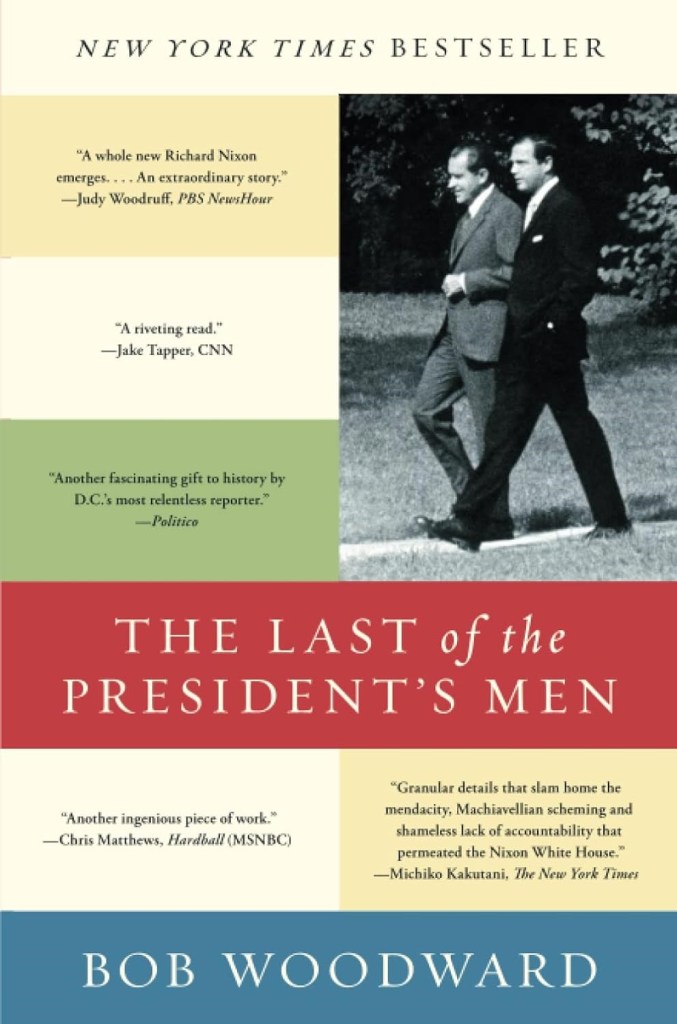
I read this book because I heard Cassidy Hutchinson, author of Enough, talk about it. I was fourteen when Richard Nixon resigned from the presidency because of Watergate. In my early twenties, I read All the President’s Men by Carl Bernstein and Bob Woodward and Blind Ambition by John Dean. I decided it was time to read another book about Watergate.
Woodward held extensive interviews with Alex Butterfield, who worked closely with H. R. Haldeman and President Nixon. Both Butterfield and Haldeman knew about Nixon’s taping of White House conversations. During the Watergate investigation, Butterfield testified about Nixon’s tapes, effectively ending Nixon’s presidency.
The most frightening takeaway from The Last of the President’s Men is that so many of Nixon’s staff and supporters had blind loyalty to him, even though he broke the law, even though he believed his methods to maintain power were justified, even though he felt his presidency meant he was above the law — the behavior of dictators. Supporters saw Nixon as their president, and they ignored his abuses of power.
The Last of the President’s Men is well-researched and clearly written. Even though I knew Butterfield would testify about Nixon’s tapes and that Nixon would resign, Woodward’s book about Nixon and his staff, who believed it was their job to keep their president happy and do his bidding, even if they knew it was wrong, was very scary.
And if you don’t have time to read a book, try a single short story!Below are three choices to consider.
Isabelle and Blake are young, in love, and on their honeymoon. Everything is wonderful, until it isn’t. (My synopsis is short because readers need the joy of discovering Kim Suhr’s thought-provoking, well-crafted story for themselves.)
Suhr’s short story “APrayer4You.com” haunts my thoughts. I might go for weeks without thinking about it, then something nudges my brain, and I wonder, How is Isabelle coping? And what about Blake?
Even though “APrayer4You.com” is a short read, under 1,600 words, savor each word, sentence, and paragraph because Suhr weaves a gripping story in a short space. There are so many layers of meaning in her story that it would make a good selection for a book club. (Or, brilliant idea that just occurred to me: a short story club for readers who have busy lives!)
Note, if you’re a writer, read Suhr’s story as a reader first. Then go back and read it again as a writer. Pay attention to her use of opposites in the story. Opposite situations, opposite ideas, opposite beliefs, opposite personalities, opposite actions. Suhr skillfully uses all these opposites to create tension in her story. [Suhr has also published a wonderful collection of short stories titled Nothing to Lose. Visit Suhr’s author page. Click here to read “APrayer4You.com.” ]
Euphemia, Effie for short, has run away from home and the insults of her older brother. But she’s young, and so she’s hidden herself away in the yard. She refuses to come out of hiding when her mother calls her for supper. In a swift 690 words, Diana creates a story with a magical sense of wonder that takes readers back to a time when all things were possible to a young child.
I don’t want to say too much about this story and its themes or the different ways to think about it because I want readers to have the joy of reading this gem.
Diana writes the blog wonkagranny. Even though I follow her blog, I don’t know her last name, but she gave me permission to post a link to “Effie’s Trinket.”
Note, if you’re a writer, you will enjoy reading Diana’s comments about her writing process, which appear before and after “Effie’s Trinket.” Also, be amazed at how a simple story can be layered with the many textures of life.
“To Build a Fire” by Jack London
On an “exceedingly cold and gray” day in the Yukon Territory, a man who is inexperienced with the brutal arctic winters decides to walk to another camp to visit friends. Before leaving, he is warned about the dangers of hiking alone in the extreme sub-zero temperatures. But he has the arrogance of a newcomer, who neither respects nor understands the perils of his new home. His hike does not go well.
Jack London’s “To Build a Fire” is one of my favorite short stories. On a micro level, this story is about the arrogance of one man who brushes off the warning from an old-timer who tells him he shouldn’t go out alone because the temperatures are dangerously cold. On a macro level, this story can be read as a metaphor about the arrogance of the whole human race, who are newcomers on Earth, and their disregard for nature.
Note, if you’re a writer, part of what makes this story so horrifically chilling is London’s accurate, detailed, and graphic descriptions about what his character experiences, physically and emotionally, as he slowly freezes to death. London’s attention to these details teaches me that even in fiction, research is important to a story.
[The link I provided is for the 1908 version of London’s story, in which the protagonist dies. In the 1902 version, the protagonist lives. London was right to modify the story’s ending. The tragic version is powerful and thematically more complex.]
Ziva slept while I wrote, and the birds and the squirrel visited the feeder.
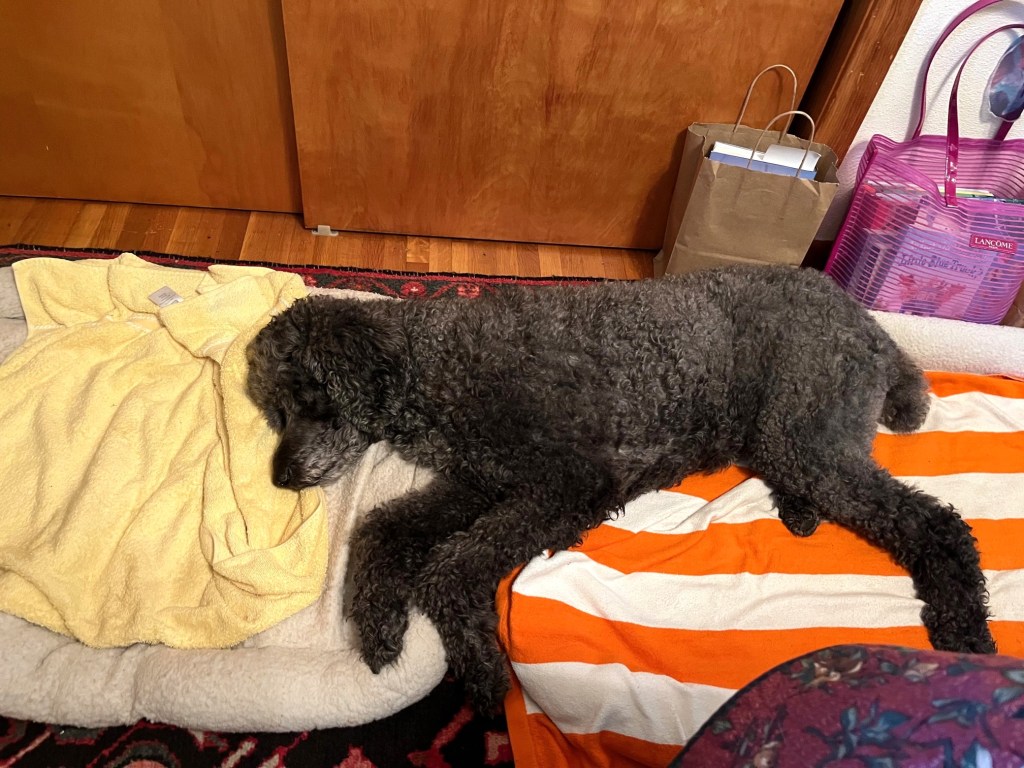
Today while I was writing, Ziva, my twelve-year-old standard poodle, slept on her dog bed in my office. She doesn’t take my writing seriously. She takes a nap. And when she is bored with napping, she will get up and jab my right elbow with her nose. This means she wants a walk, because when we return she knows she will get a treat. She’s very good with cause and effect. If I ignore her first jab, she will jab again and again, until I say, “Okay, just let me finish this sentence.” It’s difficult to type when my elbow is suddenly tossed into the air by Ziva’s snout. But, today we walked before I started writing, so she was content to sleep instead of interrupting my stuttering flow of creative whatever.
Today’s big distraction took place outside my office window. Nuthatches, chickadees, house finches, a downy woodpecker, and a squirrel showed up at the bird feeder that hangs in the pine tree. It was a comic opera of dance, birdsongs, and slapstick.
The nuthatches and chickadees were happy to take turns at the feeder, but when a pair of house finches arrived, the other birds backed off and lit upon nearby branches in the pine tree. The house finches parked themselves on the feeder and ate, and ate. House finches are about the same size as the nuthatches and chickadees, but they obviously have an unsavory reputation in their small-bird community.
Occasionally, a chickadee attempted to fly in and snitch a seed, but the finches refused to yield. The chickadee, chickening out at the last second, would furiously flap its wings, nearly come to a screeching halt, then hover a moment before veering off to the left or right, returning to a branch in the tree. One chickadee flew up to the feeder, and one of the house finches turned its head, making a motion like a dog barking to defend its dish of food. The chickadee made a hasty retreat.
For the most part, the nuthatches made do with eating insects they found on the bark of the pine tree. But occasionally, one of them, craving a tasty sunflower seed, bravely approached the feeder. The house finches weren’t intimidated by them either.
During all this comedic drama, a squirrel arrived. His fluffed-out, bad-ass, tail-twitching demeanor made all the birds, including the house finches, seek higher branches. I chuckled because my bird feeder is squirrel proof. Many squirrels have tried, and all have failed. In a scene of choreographed comedic buffoonery, I watched the squirrel walk back and forth on the branch, eyeing the feeder. Next, he climbed on top of the feeder and stretched a paw downward toward the opening filled with sunflower seeds. Maybe, I thought, this one will figure out how to nab a seed from the squirrel-proof feeder. But no. He was only providing that moment in a story when we think a character will get what she wants, which made the next moment funnier because the squirrel fell off the feeder and onto the ground. My laughter startled Ziva, who lifted her head. The birds, however, wasted no time guffawing. They vied for position at the feeder.
And the squirrel was fine. He climbed back up the tree and sat a couple of branches above the feeder. He made a big show of licking his paws then smoothing the fur around his face and ears. Finally, he fluffed his tail with his tiny claws then gave it a swish, swish through the air. His rendition of a human tripping, picking herself up, looking around to see if anyone saw her fall, then smoothing out her clothes, before moving along like nothing happened. The squirrel made no second attempt at the feeder. The house finches came and went a few times, and each time they departed the chickadees and nuthatches rejoiced.
A downy woodpecker joined the troupe, an extra without a speaking role, relegating herself to the background while she pecked at the branches and trunk of the pine tree. Downy woodpeckers like to chum with chickadees and nuthatches, maybe because they take turns at the feeder, and downy woodpeckers like sunflower seeds. But today she was above jostling for seed, maybe she didn’t like house finches either.
I was supposed to be writing, but all the drama at the bird feeder was as good as a rousing, twisting, turning period drama on Masterpiece Theatre. Cooperation, backstabbing, greed, ingenuity, snobbery, high drama, and comic relief all outside my window. All potential themes and plot twists for a future story I might write.
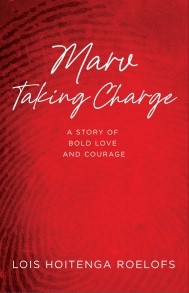
On May 5, 2023, I wrote about Lois Hoitenga Roelofs’ wonderful memoir Marv Taking Charge. It’s the story of her husband, Marv, and his decision to skip chemotherapy when he is given a terminal cancer diagnosis. He decides to live what is left of his life without the often debilitating side effects of chemo. Roelof’s book is a well-written and important story. Readers learn about the process of hospice and dying. She covers the emotional and practical aspects with honesty and courage. Congratulations on the award, Lois! Marv would be so proud!
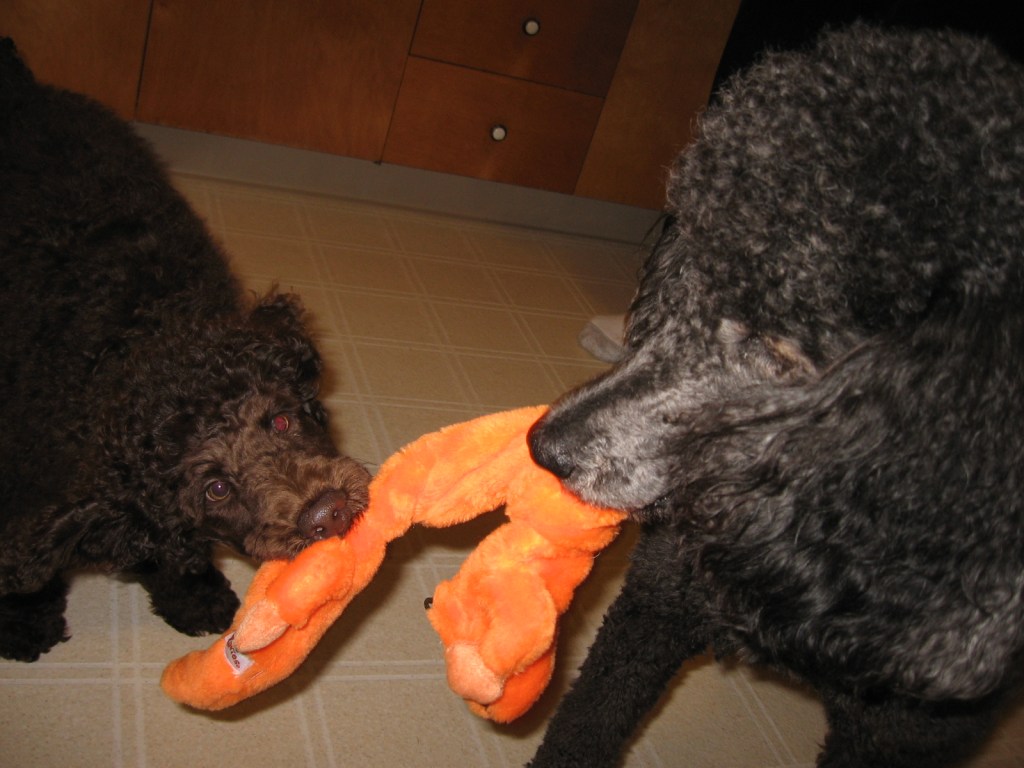
Cabela with one of her favorite toys. She was always so gentle with her stuffed toys.
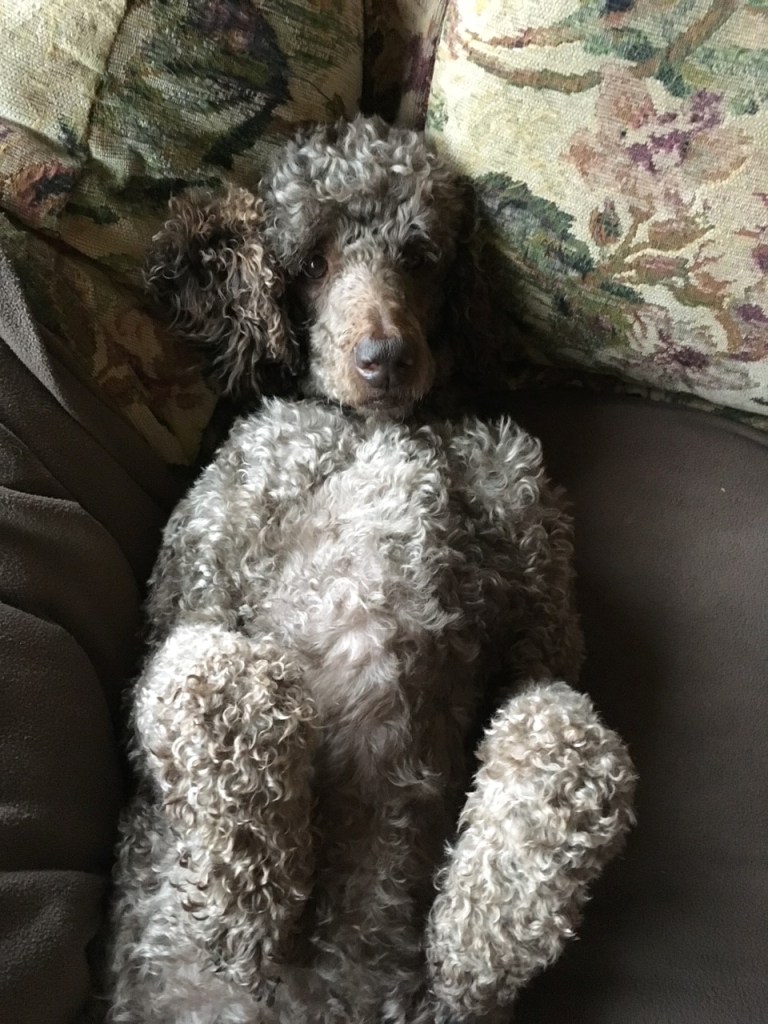
Cabela died at 11:30 on the night of August 4. She was fifteen years old, and we loved her very much. She was a brown standard poodle born on June 24, 2008, in a red barn on a farm in Barret, Minnesota. Her first human parents were Emmet and Ruth, a pair of kind farmers who raised Labradors and standard poodles for pin money. Cabela spent her early puppy days playing outside on their farm with her siblings in the summer sunshine. She developed a life-long love of being outdoors.
Cabela on patrol.
When we brought Cabela home, she wanted to be outside all the time. She liked to sit or lay under my husband’s maple tree in the front yard. She believed her job was to patrol the yard, watching cars and pedestrians move up and down the streets at the front and the side of our house. She and the priest who lived across the street became friends. When he left or returned home in his silver Buick, he would slow to a crawl to see if Cabela was outside. If she was, she would line up with his car, he on the road and she in our yard. The priest would slowly accelerate and Cabela would accelerate. They raced until she reached our lot line. The priest always ended the race in a tie, and the two of them enjoyed their game for years. In her prime when Cabela was excited, she ran hot laps, up to six or seven of them in a row, around our yard at warp speed, or she launched herself six feet into the air along the trunk of a tall pine tree. Drivers would stop and watch her performance. Dr. Jenny, her regular vet, once remarked, “Cabela has the heartrate of an athlete.” I said, “She is an athlete.”
Cabela died because her stomach twisted. The medical term for this is Gastric dilatation-volvulus (GDV). It’s more common in deep-chested dogs like standard poodles, and it’s more problematic in older dogs because the muscles and ligaments holding their stomachs in place become weak and more elastic. The emergency hospital vet, Dr. H, asked me if Cabela was spayed and when I said yes, he asked if her stomach had been tacked at the time. I’d never heard of this, but it’s supposed to help prevent GDV. I have no idea if Cabela’s stomach was tacked when she was fixed.
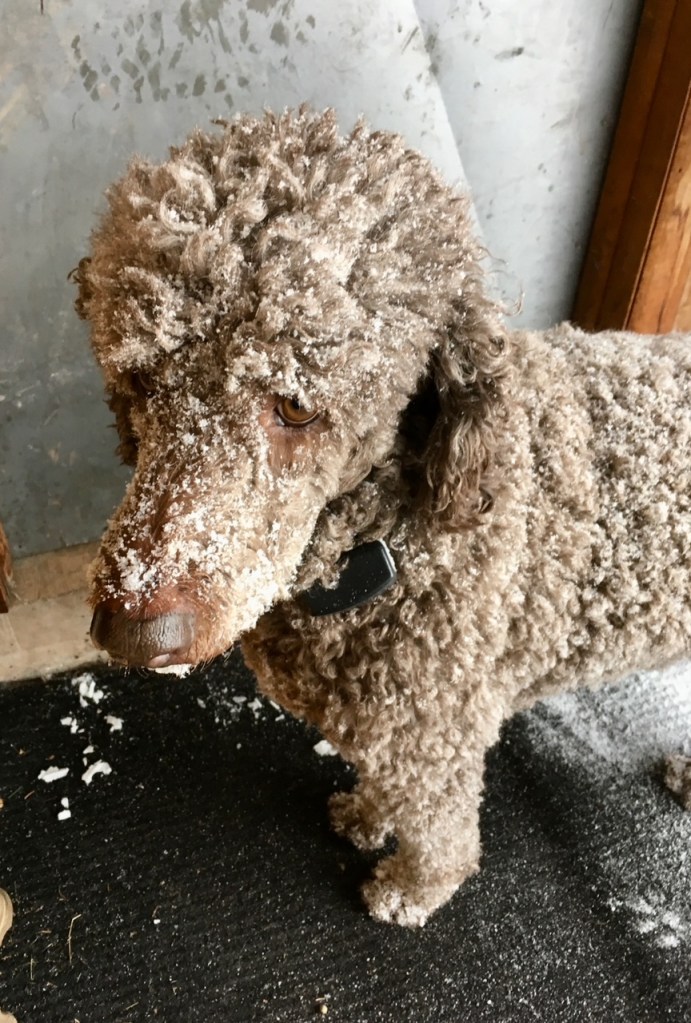
Cabela and Ziva on a winter’s walk. Many of our winter walks in the snow were magical.
On August 4, Cabela’s evening started out normal. She ate her supper, and an hour later she went for a walk with her sister, Ziva, and me. Cabela still loved her walks, but they were now a slow, grass-sniffing shuffle around the block, then she was done. After the walk she rambled around the house. This too was part of her evening routine. She had a touch of dementia, which often became more noticeable in the evening. In humans with dementia, this is called sundowning. Cabala would look like a person who had entered a room but couldn’t remember why, no matter how hard she tried. Usually after thirty to sixty minutes of intermittent ramblings, she settled into a deep peaceful sleep until the wee hours of the morning when she would wake me up so she could go outside and potty.
But on that night, Cabela wouldn’t even lay down for a short rest. She moved from the family room to the living room and back again. My husband and I encouraged her to lay down. We stroked her head and ears when she came near us. We patted the couch cushion, inviting her to hop up and rest. But she backed away and kept moving. We wondered if her hips or legs were in pain. She was arthritic and her hind leg muscles had begun to atrophy. We wondered if she’d torn a ligament. She didn’t cry or whine or wince. Cabela was so very stoic all her life, and at the end of her life she would be no different. Later that night while treating her, Dr. H would remark, “Cabela is one of the most stoic dogs I’ve ever treated.”
At nine o’clock, I gently helped Cabela lay down on her sheepskin bed. She resisted for a moment, then relaxed. She closed her eyes, and I stroked her face and neck. She fell asleep. Later I would realize that for a few minutes either fatigue got the best of her pain or the position in which she lay gave her a brief respite from it. But at that moment, it appeared she would sleep until the wee hours of the morning. I sat with her for five minutes, watching the peaceful rise and fall of her chest, her only movement. Then I let her be and returned to the family room.
But a few minutes later Cabela was up and walking around, lost and confused, looking at me with sad eyes. I tried to lay her down again and soothe her, but she was having none of it. She snapped at me, placing her teeth gently on my arm. She kept pacing. At ten o’clock I took Cabela to the animal hospital.
I had to carry her into the van. Again she whipped her head around and nipped at me. This time her head banged into my glasses, bending my wire-rim frames. She rested her teeth on my shoulder, but did not bite down. Only later would I understand she was saying, “It hurts so bad.”
We arrived at the hospital, and I had to lift Cabela out of the van. She snapped at me one last time, still all warning and no bite. After I described her symptoms to the receptionist, Cabela was seen immediately. Dr. H and the techs were wonderful to Cabela and me. The vet suspected her stomach had twisted. I felt awful. I told the doctor that I thought she had been sundowning. He understood because he’d had a beagle who had episodes of sundowning as an old dog. He remarked that Cabela had a very good heart rate for a dog her age. “She was an athlete,” I said.
Cabela was taken back into the hospital where she was sedated to relieve her pain, then she had her abdomen x-rayed. I knew if her stomach was twisted, she would need to be put to sleep. Dogs do have surgery to correct twisted stomachs and often survive if the condition is caught early. But Cabela was fifteen years old with some dementia, nearly deaf, arthritic with weak muscles, and during her initial exam, Dr. H had discovered she was nearly blind in her right eye.
Cabela’s x-ray confirmed that her stomach had twisted. The vet said because I’d brought her in so quickly, she would’ve been a good candidate for surgery if she had been younger and in good health. “But to do this surgery on her at this stage of her life,” he said, “would be cruel.” And I agreed. The vet left to get the medicine needed to put Cabela to sleep.
Baby Cabela playing with her big sister Bailey and Lizzy, their favorite toy.
The tech brought Cabela back to me and I sat on the floor and held her. She was heavily sedated, breathing quietly, soft and warm in my lap. I asked the tech if he had a pair of scissors so I could have a snippet of Cabela’s hair as a keepsake. He kindly made this happen. Then the vet returned. After Cabela died, I was given time alone with her. I held her. I thanked her for being such a good dog. I told her she would see her old pal Bailey, our first standard poodle, and they could play and nothing would hurt. They loved to chase one another and play tuggy with an elastic-filled, furry toy we called Lizzy. Bailey died when Cabela was two and a half, and she looked for Bailey for weeks. When my husband and I brought Cabela home and introduced the two of them, they began to play immediately. Every minute or so, Bailey would run back to my husband or me, wagging her tail and smiling as if to say, “Thank you! Thank you so much for bringing me a puppy!” Then she would dash back to play with Cabela.
We met Cabela on a pleasant September day in 2008 in Owatonna, Minnesota, near the Cabela’s sporting goods store, for which she would be named. My husband and I and my youngest son and his future wife were eating lunch in a restaurant and watching out the window as people walked up and down a row of dog breeders who had set up along a wide grassy boulevard. The breeders came from Iowa, Wisconsin, Illinois, and Minnesota to sell leftover puppies they hadn’t been able to sell back home. We decided after lunch to look at them. I thought about free puppy cuddles. We already had our two-year-old standard poodle, Bailey, so I had no interest in getting another dog.
The four of us visited the standard poodle puppies first, and my son scooped up a chocolate one and snuggled her to his chest. Content, the puppy nuzzled in and closed her eyes. I talked to the woman about her poodles and my poodle. And while I talked, my son whispered, “Take her home, please, just take her home.” He repeated the words over and over. I looked at my eighteen-year-old son, holding this puppy, and my heart melted. I asked the lady how much she wanted for the puppy. Her answer was reasonable. I asked my husband if it was okay with him, and without hesitation he said it was. I wrote the woman a check, and my son carried her to the car. We never visited the other breeds of puppies.
We named our new puppy in record time. Because she was a chocolate-colored dog, my husband suggested Hershey, which I immediately nixed. “That name will encourage jokes about the Hershey squirts.” My husband laughed, but this was an indignity I felt no dog should have to endure. My son suggested Cabela, and we all agreed it was a great name. Cabela was eleven weeks old when we bought her, and I am eternally grateful that no one else had chosen her. She earned her middle name when during a case of the zoomies, she misjudged the width of the hallway and ran head first into a wall. As she shook her head, I said, “Your middle name is now Grace.” Over the years we gave her lots of nicknames: The Brown Bomber, Range Rover, Ichabod, Snickerdoodle, Kadiddlehopper, and Bel. I once read somewhere that a well-loved pet will have many nicknames.
It was after midnight when I came home without Cabela. I came in through the garage and up the basement stairs. Ziva stood at the top of the steps, waiting. She kept looking to either side of me, watching for Cabela to come up the stairs. Even though it was late, I knew I wouldn’t sleep, so I sat on the loveseat and Ziva climbed up on her favorite couch. I turned on the TV, but I have know idea what I watched. Every now and then, Ziva heard a noise and her head popped up. She looked toward the hallway, waiting to see Cabela come into the family room.
In 2011, after Bailey had died, Cabela was lonely. She had liked having a dog buddy, so we called Emmet and Ruth. Luckily one of their poodles had recently had puppies, so we reserved one for Cabela. But, when we brought Ziva home, she didn’t want to play with Cabela. Every time Cabela came near her, Ziva squealed like she was in mortal danger. And each time Cabela moved away and gave her space. “Won’t that be something if Ziva never wants to play?” my husband and I would say. Thankfully, two weeks later, Ziva approached Cabela and said, “Let’s play.” And they, too, became buddies.
Ziva and Cabela liked to be near one another.
Cabela died on a Friday night, and that weekend I couldn’t stay in the house. I wanted to be outside where Cabela had loved to be. I felt her spirit would be in the yard. I spent the whole weekend outside, making things look pretty for Cabela. I weeded gardens and picked up sticks. My husband helped me wash windows, clean gutters, and dig up some scraggly, out-of-control bushes so we could plant new ones next spring. If I mentioned Cabela’s name and Ziva heard me, she looked at me quickly and intently and cocked her head. “Where?” she would ask. She seemed so sad, too.
I miss Cabela. I loved how her ears flapped in the wind when she sat in our front yard on breezy days. I miss how she poodle-pranced down the street on our walks. I miss how she could raise one eyebrow and then the next, alternating back and forth when she asked for a treat. I miss seeing her on the living room couch, her front paws resting on its back and her head resting on her paws as she looked out the window, working the yard from inside the house. I miss how she would turn to look at us each night before she headed down the hall to her sheepskin bed. “Calling it a night?” my husband would ask, then say, “Have a good sleep.”
[My dog Cabela died two months ago. I’ve tried to blog about her dying (because I blogged about her when she was living) but I would end up crying. Then I would decide my words were fluff, unable to capture her essence and the hole left in my heart by her death. A couple of days ago I read“When a Cold Nose is at the Pearly Gates: Writing a Pet’s Obituary” by Laurel E. Hunt on Brevity Blog. After I finished reading Hunt’s blog, I tried writing about Cabela’s death in the form of an obituary, but that didn’t work for me either. And I cried again. Even thought Hunt’s writing idea didn’t work for me, I’m thankful I read her blog on October 6 because she inspired me to try and write about Cabela again. To learn more about GDV click here.]
On Friday morning I woke up with several goals in mind. I needed to wash some blankets and area rugs. I planned to cook an enchilada casserole using some homemade enchilada sauce a friend gave me. And I wanted to submit my 45,600-word collection of short stories to the 2024 Iowa Short Fiction Awards.
I have been working on a collection of short stories since January 2019, when I wrote my first short story, one I actually completed from start to finish. I submitted the story to a local contest, and it won first prize.
But I had a lot to learn.
For the next four years, I kept writing stories and essays. I started a blog. I took writing classes and attended writing seminars. I went to hear authors speak about their writing. I subscribed to writing magazines and read them. I read books on the craft of writing. I shared my drafts with writing groups, friends, and family members who were willing to give me feedback. I read lots and lots of books, novels and memoirs, short stories and essay collections. I was always a reader, but I kicked it up to a new level. And I revised “finished” stories based on my new insights.
I have submitted stories and essays to journals and contests, and I have nearly two hundred rejections to prove it. But some of my stories and essays have been published, and a handful have won or placed in contests. A year ago I did some math and discovered my acceptance rate was almost fifteen percent, but I don’t get published in the higher-ranking literary journals.
The writer’s bio I send with my submissions usually contains the words: “She is working on a collection of short stories.” Because a writer’s bio is written in the third-person, it feels like I’m talking about some other person, way over there, sitting at the other end of the room. But putting the words about writing a book of short stories in my bio was a contract with myself. That I wouldn’t just say it — I would do my best to make it happen. And my story collection grew.
On Friday morning the only thing I had left to do was finalize the order in which my stories would appear in my book. I paced like a traveler on a platform, waiting for an overdue train. I put the dishes away, made oatmeal, paid the power bill, and did a load of washing. I waited for my husband to go to work, so I could concentrate without interruptions, then I waited for feedback from one of my readers regarding which seven stories she felt were the strongest. I had asked four different readers to choose their top seven stories. The goal in arranging a short story collection is to start and end strong, and sprinkle other strong stories throughout the collection.
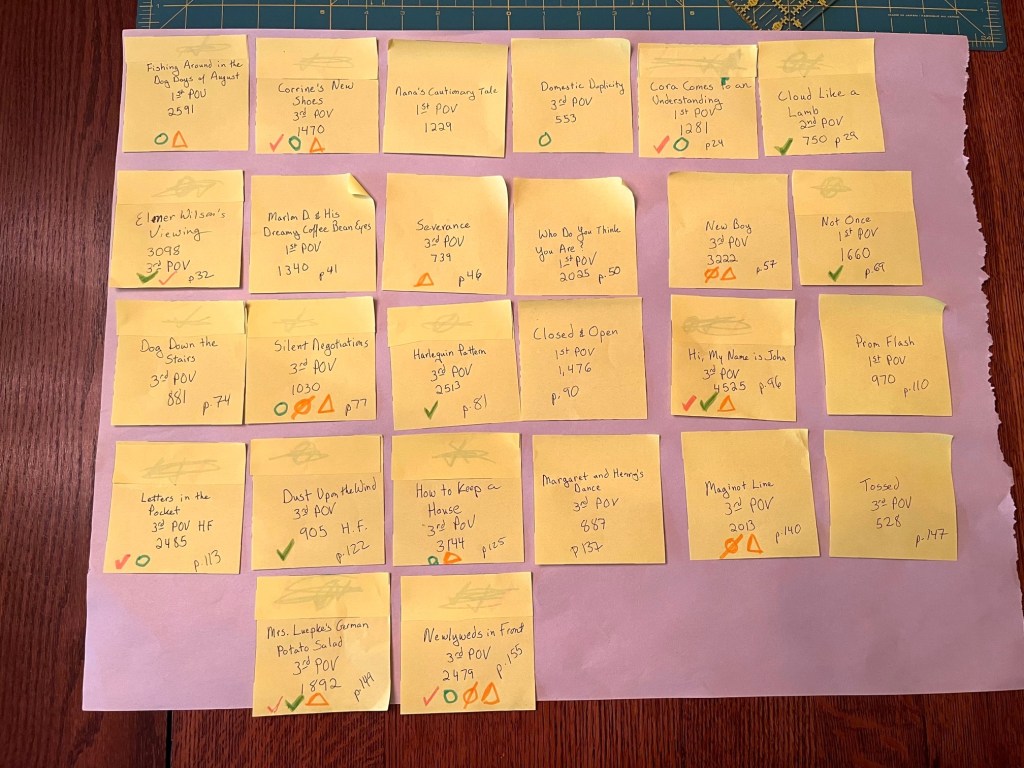
I knew which story would be the engine and which one would be the caboose, but I agonized over how to arrange the rest of the cars in my train of stories. I finally told myself, “Stop being ridiculous. If the judges don’t choose your story collection, it won’t be because they felt you should have put “Silent Negotiations” before “Elmer Wilson’s Viewing.”
I took a deep breath and folded over in the ragdoll yoga pose. After all, I didn’t even need to write a query letter to accompany my submission, and I didn’t have to pay a reading fee. Just a minimum of 150 pages, double spaced, with one-inch margins, preferably as a PDF file. Geez, I just needed to relax.
A short while later, I received my last reader’s list of favorites. Using Post-its on a large piece of newsprint, I moved story titles around until I was happy with their sequence. I copied and pasted the stories into one document then reviewed it. I filled out the electronic submission form and uploaded my file. After a slow inhale, I clicked submit, then exhaled. My stories had left the station on their first adventure. I won’t hear about them until January 2024. In the meantime, I will keep reading and learning and writing.
In the afternoon I washed the blankets and rugs, then I made the chicken enchilada casserole for supper. It was marvelous, and to celebrate my first book submission, I paired the casserole with a Bell’s Oktoberfest beer.
Now my bios will include: “She has finished her first short story collection and is submitting queries to publishers,” or something like that — it might need a few revisions.
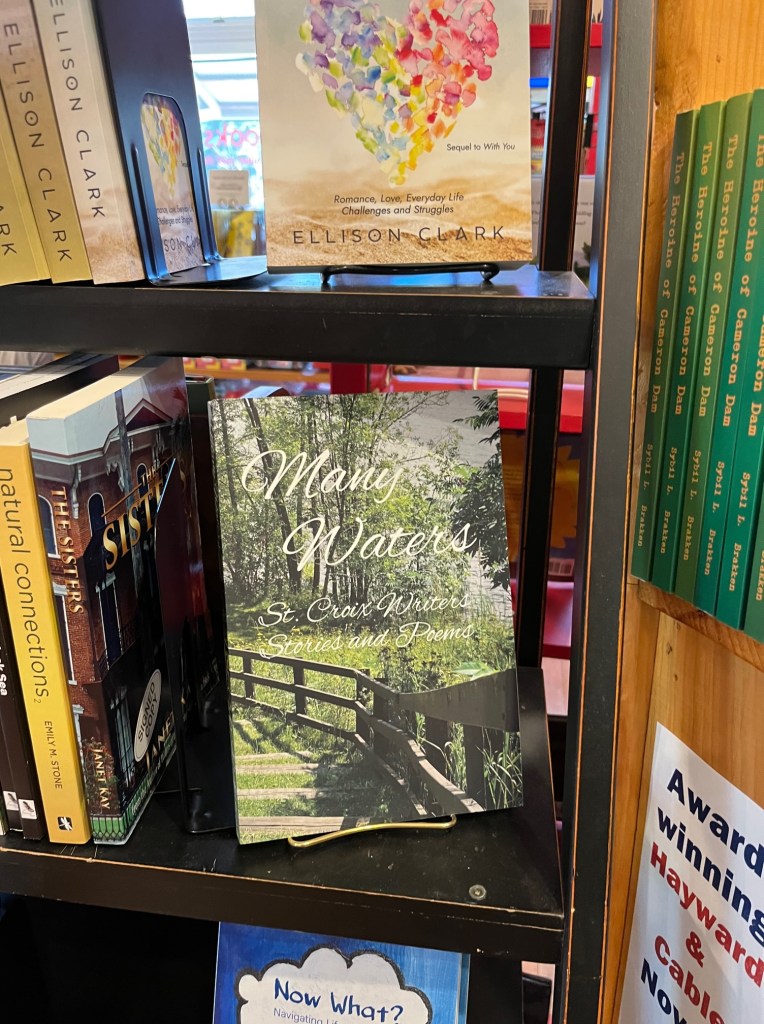
“I have a story in this book,” I whisper to my granddaughter. We are in Redbery Books in Cable, Wisconsin. I hold an anthology of essays, short stories, and poems published by the St. Croix Writers of Solon Springs in 2020.
I whisper because I don’t want the clerk to think I’m bragging. Yet, I’m itching to tell the clerk, I have a story published in this book.
“That’s nice,” my granddaughter says, her voice mixed with a bit of awe, excitement, and curiosity. “What’s it called?”
I open the book to the table of contents and find my entry. As I show my granddaughter, I run my finger under my name and the title of my piece — Victoria Lynn Smith: A Cracker Jack of a Story, page 192. “It’s an essay about eating Cracker Jacks with my nana and the story she would always tell about finding a real diamond ring inside one of the boxes when she was a girl.”
I love the Redbery Books! It’s charming and cozy.
I want to tell the clerk, I’m in this anthology. Instead I return the book to the shelf where it’s displayed cover-side out, in a place of prominence. To see a book, in a bookstore, with my writing in it, fills my body with loads of tiny giggling bubbles joyfully bouncing around, tickling my insides.
But, I don’t want to come across as boastful.
I move away from the book but chide myself, What’s wrong with you?If you can’t even tell a clerk in a bookstore that you have an essay in a book they are selling, how are you going to promote the book of short stories you’ve almost finished writing.
I realize if I don’t tell the clerk, I will regret it. My book of short stories doesn’t have a publisher yet, maybe it never will. This is the first time a piece of my writing is in a book, in a bookstore, for sale. Maybe that won’t ever happen again.
I turn back, take a deep breath, and lift the book again. I walk up to the clerk who is behind the counter and say, “I have an essay in this book.”
She smiles and gives me the best possible response: “So you’re a writer, then?”
“Yes,” I say, and the tiny giggling bubbles inside of me shift into overdrive.
The clerk asks my name and the title of my piece. I hope she will read it later but realize she probably won’t. But I will remember her moment of undivided attention and kindness.
When I leave the shop, I don’t feel like a braggart. I feel proud. If my book of short stories gets published, promoting it will be difficult for me, but I will remember the clerk who was gracious — because most people are gracious.
Before I leave the bookstore, I buy a journal with dapper foxes on the cover and a greeting card featuring a few lines of poetry by William Butler Yeats. I hope to one day have a book of my own on a shelf in a bookstore, so the words by Yeats are encouraging.
[Note: When I sat down to write this blog, I opened my copy of Many Waters and found I actually have three pieces in the anthology. I’d forgotten about the other two, which aren’t listed in the table of contents. My other two pieces are “Writing’s Daily Worries,” an essay first published by Brevity Blog; and “Tossed,” a short story that won first place in a contest and was also selected for WritersRead at Northland College in Ashland, Wisconsin, where it was recorded for Wisconsin Public Radio.]
[I’ve read many good books in the past few months. I’m reviewing some of them in a series of blog posts. So, if you’re looking for a summer read, maybe you’ll find a book to enjoy in one of my book review posts. Note: Autumn Equinox begins September 23!]
Why did I read this book?
I follow Lynn Haraldson’s blog. I love her writing — how she expresses herself, how she captures the essence of an experience, and how she weaves the past into the present. After all, our pasts are part of us, always influencing our current lives. She blogs about many things, including some of the events in her memoir An Obesity of Grief. When her book came out, I bought it, certain it would be very good. I was right. I read her book in two nights — on both of them staying up much later than I normally do, telling myself over and over, “I’ll just read one more chapter.”
What is this book about?
Lynn Haraldson is nineteen years old, and deeply in love with her husband Bruce. Their life together — filled with dreams — stretches ahead of them. They plan to be married for seventy-five years. They have recently taken over the farm owned by Bruce’s parents, who have retired. They are the joyful parents of an eleven-day-old baby girl. Then Bruce dies in an accident.
The day Bruce dies begins as an ordinary day. Lynn takes care of their infant daughter while Bruce leaves the house to tend to the farm. But Lynn never sees Bruce again. He dies in a tractor-train collision. Filled with grief, she wants to see her husband’s body, to touch his hand, to say goodbye. But people tell her she shouldn’t because it will traumatize her, better to remember Bruce as she knew him. Because Lynn is nineteen, older adults treat her more like a child than a grown woman who has just lost her husband.
After Bruce’s death, Lynn tries to hide her grief, telling people that she is just fine. But her grief won’t stay put. It manifests itself in two failed marriages, in gaining and losing over one-hundred pounds twice, and in recurring nightmares featuring Bruce. She struggles with a nagging question: How could Bruce not see or hear the oncoming train?
For years, even though Lynn’s life moves forward in some ways, she remains stuck in a cycle of grief-driven behaviors until she begins therapy, confronting Bruce’s death and her grief.
What makes this book memorable?
Haraldson tells her story with unflinching honesty. If readers have experienced a tragic loss, reading An Obesity of Grief will help them understand they are not alone in their thoughts about grief and their struggles with it. If readers haven’t experienced the type of profound loss Haralson confronts, the book will help them understand the impact of grief because chances are they know someone who has faced the untimely death of a spouse or loved one.
Haraldson’s prose is both lean and powerful. She tells her story, moving back and forth in time, building suspense for her readers, taking them along with her on her journey. And as she grapples with the painful memories and emotions surrounding her grief, she gives readers a memoir that is deeply moving, insightful, and offers hope.
[I’d like to give a shout-out to the cover art on Haraldson’s book. It’s stunning and haunting, and it captures the essence of her memoir.]
“Hey, boys,” comes a lively greeting from a tall, white-haired man, whose cheery voice emanates from an equally upbeat face that gives the impression it has spent a lifetime brimming with friendliness. The man, who is at least as old as I am, is dressed in a pair of jean shorts and a casual blue shirt that matches the color of his fun-loving, twinkling eyes.
My six- and four-year-old grandsons have just entered the assistant lighthouse keeper’s home in Two Harbors, Minnesota. The jovial man, however, isn’t the assistant keeper. He is a tourist, like us, visiting the lighthouse grounds, which are now a museum.
He points toward the corner of what would’ve been a small sitting room. “What’s that, boys?” he asks my grandsons. I haven’t crossed the threshold yet, so I can’t see what he points at.
Without skipping a beat, my six-year-old grandson answers, “That’s a typewriter.”
“Wow,” the man says, now looking at me. “Most kids don’t know that!” He reminds me of my father who would’ve put this kind of question to anyone, young or old, in a museum, hoping the person wouldn’t know the answer, giving him the opportunity to burst into a history lesson. In the absence of strangers, my father would quiz me, “Do you know what this is?”
I smile at the man, and as an explanation, I say, “Their nana is a writer.” But this isn’t why my grandson knows a typewriter when he sees one. None of my grandchildren have seen me use one. I do my writing on a laptop. Although I wrote plenty of college papers on a typewriter, I can’t say I miss it. I made too many mistakes and smeared thick globs of whiteout on typos, which resembled miniature frescos when they dried, but without any artistic flair.
I’m not sure why I blurt out, “Their nana is a writer,” but something in the tall man’s happy manner makes me happy, so I say it because writing makes me happy. I’m already thinking about our encounter as something to write about.
So, why does my six-year-old grandson know that the machine with rows of letters is a typewriter? Because I like to take my grandkids to small museums. A month ago we visited the Old Firehouse and Police Museum. On the second floor in an old office displayed with artifacts, he pointed to a typewriter sitting on a wooden desk and asked, “What’s that?” I explained what it was and how it worked, and that the fire chief used it to type reports about the fires they fought.
The white-haired man moves on to another room in the assistant keeper’s house turned museum. My grandsons and I look at the typewriter. “Can I touch it?” one of them asks. My first impulse is to say no. Instead, I look at the typewriter. I don’t see a do-not-touch sign. If I had, I would’ve said no. In my family there are two kinds of people: those who can’t ignore signs and those who feel they are merely suggestions. But I’m flirting with a technicality because I know museum curators don’t want visitors touching artifacts.
I think back to the mid-1990s when I took my father and my two sons to the same fire and police museum that I recently visited with my grandkids. Inside the museum was an old fire truck, with a hand crank used to start its engine. I came upon my father turning the crank, which was located right below a sign that said: DO NOT TURN THE HAND CRANK.
“Dad,” I said, “you can’t do that. Look at the sign.” I wondered if he thought the engine might roar to life.
“Well, they left the crank here,” my father said, as if the presence of the crank negated the command: DO NOT TURN THE HAND CRANK. The old hand-crank fire truck was still there when I took my grandkids, but the sign was gone and so was the hand crank. I don’t think my father was the only person who turned that crank. He was a mechanic nearly all of his life, and the urge to tinker with mechanical objects never left him.
My grandsons and I are still staring at the typewriter. I think about my father and his belief that signs weren’t meant for him. He routinely ignored handicapped parking and speed limit signs. When he taught me to drive, he said that I could take curves at twenty miles over the posted limit. I stare at the typewriter, thinking about the fingers from the past that pushed its keys, sending thin metal bars with raised letters clacking to an inked ribbon, leaving black words on white paper. My grandsons stare at the typewriter as if it’s a mystical object, but I have no idea what they are thinking.
“You may touch it,” I say, “but very gently, like this.” And, I brush my fingers like feathers across a few keys. There is no one to tell me, “You can’t do that.” There is no one I can answer back to by saying, “Well, there isn’t a sign.”
I add, “Do not push down on the letters.”
Each grandson takes a turn, stroking a few keys softly, like they are a newborn’s forehead. Sensing they’ve been granted a special privilege, they are silent. Neither of them pushes down on a key. But I imagine they think about what it would feel like and how the typewriter would react if they did.
Suddenly, I understand something about my father and the old fire truck and its hand crank. He wanted to feel that crank turn. Perhaps, because he’d never had the opportunity. By the time he was born in 1937, hand-crank cars were a thing of the past. But his father, who opened a gas station and repair shop in 1920, would’ve worked on cars with hand cranks. Perhaps, my father wanted to touch something that linked him back in time to his father.
After all, I enjoyed touching the typewriter keys and wondering about the lighthouse keepers and the documents they typed. Perhaps, in their off-hours, they wrote novels or stories or poems about the solitary life of lighthouse keepers and the stormy moods of Lake Superior.
We move on from the typewriter, looking at a way of life from the early 1900s. An old stove waits for someone to start a fire in it and cook a meal in cast iron pots. Old dishes sit on a scarred table, waiting for a meal to be served upon them. An ancient washing machine waits for someone to load it with soiled clothes. Oil lamps wait to be lit after the sun sets, and an old stuffed chair waits to be filled by a weary person at the end of the day.
Over and over my grandsons ask, “What’s this?” And I explain. Over and over their hands reach to touch an object, and I say, “Don’t touch.” I point to the signs saying, Please, Do Not Touch, which had been absent by the typewriter, but are now everywhere. And each time they withdraw their hands. I can’t ignore an actual sign asking, Please Do Not Touch.
But I’m glad there wasn’t a sign by the typewriter, and I wonder if my dad would’ve pushed the keys.















 Writing Near the Lake