Walk in Another Person’s Shoes, A Lesson Learned from Mom

[This personal essay was published in the April/May 2023 issue of Our Wisconsin. Last year and this year, the editors asked for submissions on the theme “Lessons Learned from Mom” in honor of Mother’s Day. Our Wisconsin is a print-only magazine. Happy Mother’s Day to everyone who mothers someone.]
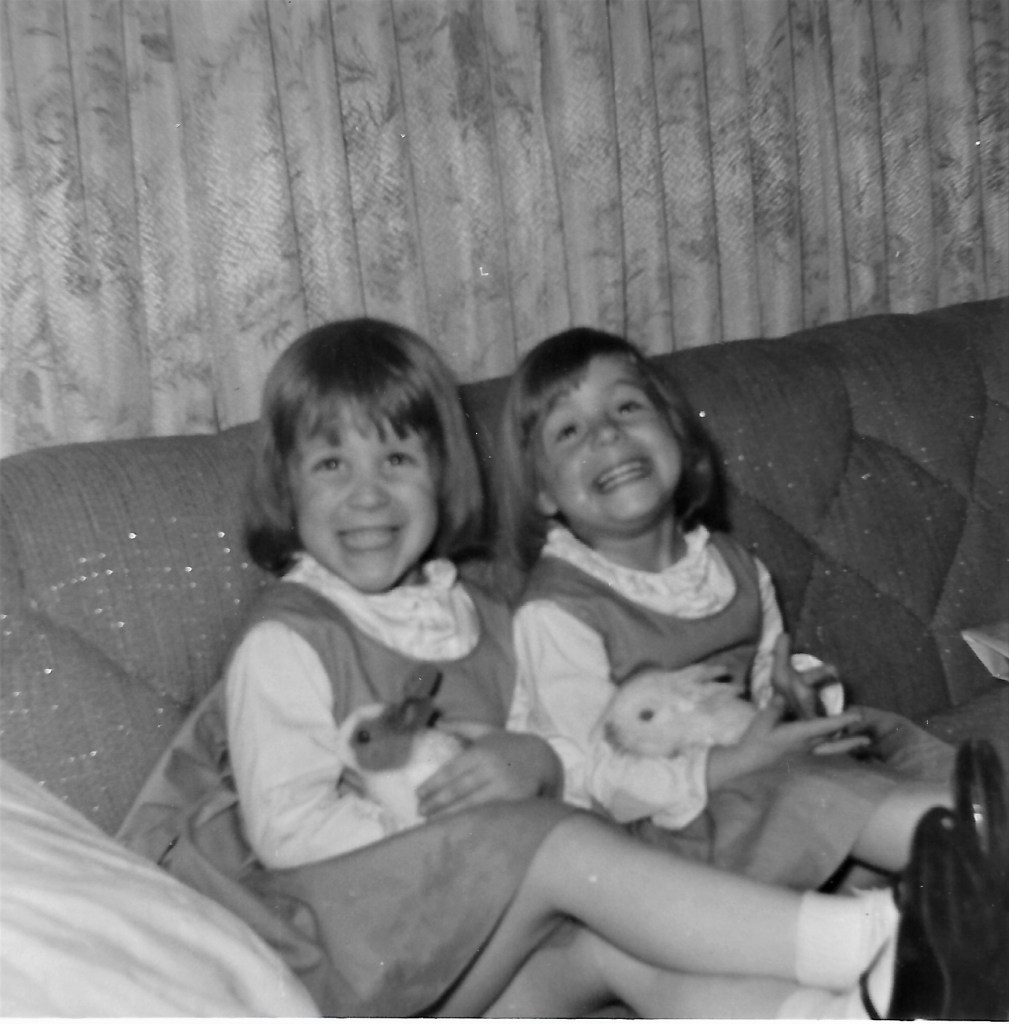
Me (l) and my sister (r), circa 1963, about a year before our candy caper.

Mom taught us to think about how our actions affected other people. My sister and I were about 5 and 6 the first time I remember Mom delivering this lesson.

We lived in rural Franklin, Wisconsin, a mile north of the Racine County border. Sometimes Mom shopped at a small, independent grocery store. It was nearby, and she liked the store’s butcher shop.

On an autumn day around 1965, Mom loaded us into the car for a trip to the local store, which my sister and I relished. The vibrant-colored penny candy located by the checkout counter made our mouths water. Our pockets normally jingled with coins from our piggy banks, but Halloween was creeping up, so Mom had nixed buying sweets. “You’ll soon have plenty of candy,” she said. “Leave your money home.” We grumbled but left the house with empty pockets.

The store was old-fashioned compared to the supermarket where Mom usually shopped. At the supermarket, we had to stay with Mom, so we didn’t get lost. At the local store, we could roam. Mom could either see or hear us from anywhere in the store.

Mom walked to the back of the store to talk to the butcher. My sister and I remained near the candy. We yearned for Life Savers.

While Mom talked to the butcher, our chance arrived. The cashier left the counter while other shoppers browsed the aisles. I grabbed a roll of Life Savers and stuffed it into my pocket. “We’ll share them,” I whispered to my sister.

Mom finished shopping and paid the cashier. The pilfered goods rested in my pocket. My sister and I didn’t attempt to eat them in the backseat on the way home. Mom had something akin to eyes in the back of her head.

After returning home, Mom put groceries away in the kitchen, and my sister and I sat in the family room, opening the Life Savers. A debate about favorite flavors, eclipsed caution. Mom heard us arguing and appeared in the doorway connecting the kitchen to the family room.

“Where did you get those?” Her voice squashed our argument and dread rendered us speechless. We knew that she knew.

“Did you pay for those?” she asked.

We shook our heads. Lying to Mom wouldn’t work. She’d call the store to check.

“Get a nickel from your bank.” She glared at us. “You’re returning the candy, paying for it, and apologizing to the owner.”

The words, apologize to the owner, were the harshest part of the punishment. The butcher, a muscular man, owned the store. He wore a white apron splattered with blood. He chopped meat into chunks with sharp knives. Would he be holding a big knife when my sister and I had to stand before him and admit we robbed him? Would he yell at us?

Driving back to the store, Mom painted various scenarios, hoping we’d absorb what she said. She wanted us to understand the far-reaching effects our seemingly insignificant 5-cent theft might cause.

“You didn’t just steal from a store—you stole from the owner, a person.”

I hadn’t thought about that.

“He has a wife and children. If people steal from him, he can’t pay his bills. His family will go hungry.”

I pictured his starving children.

“He won’t be able to pay his employees, and their families will go hungry.”

I pictured more starving children. Guilt joined my apprehension.

“You stole from him, his family, his employees.”

I pictured a line of angry people.

“If he doesn’t make money, his store will close. His customers will be unhappy.”

Mom’s talk continued all the way to the store. I don’t remember what the butcher said to us, but he wasn’t holding a knife and he didn’t yell.

I never shoplifted again. When my 7th grade friends wanted to steal gum from a drugstore, I refused to go with them. I remembered Mom’s lesson—I wouldn’t just be stealing a pack of gum.

Mom applied this lesson to other situations, compelling us to be mindful of people’s feelings, explaining thoughtless behavior hurts people. But the hidden gem in her moral? We learned humanity.

[Essay appears here as it was submitted.]
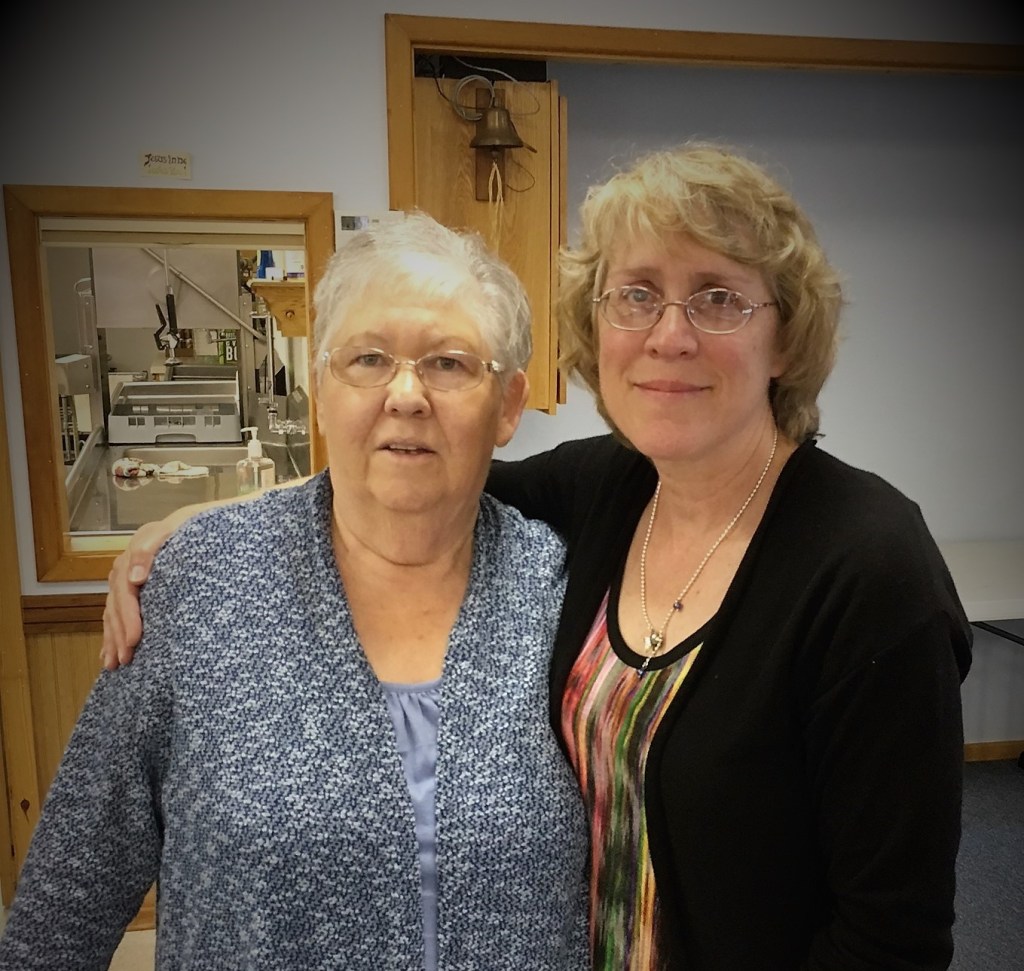
A Birthday Anniversary

Sandi and me, July 2017

Today my dear friend Sandi would’ve been eighty years old. She isn’t here to celebrate because she died almost five years ago. But if she were here, she would tell everyone she didn’t like having birthdays, she didn’t want to celebrate her birthday, and if anyone mentioned her birthday, she would be angry. One year her family took her at her word, and she was deeply hurt. (I hadn’t been so foolish.) I knew her birthday needed quiet acknowledgement: a card in the mail, a text, an invitation to lunch for “a chance to chat,” and a small inexpensive, but just-what-she-wanted gift.

The first time I met Sandi was in a law office. She was a paralegal, and I was a newly hired paralegal. When our mutual boss introduced us, he added, “Vickie has an English degree.” (I rarely tell people I’m an English major because I’ve learned they think I’m secretly judging their grammar. I also don’t want them secretly judging my grammar.) Sandi remarked, “Oh, good. That’ll be useful because I can never keep the possessive-apostrophe-s rules straight.” I told her I struggled with affect/effect and to lie vs. to lay. I thought about Humphrey Bogart and Claude Rains in Casablanca. I suspected the sharing of our grammatical weaknesses was the beginning of a beautiful friendship. Later we would laugh about this. She had been intimidated by my being an English major. But it turned out, having attended a private, rigorous Baptist school, she had some good grammar chops herself.

I was forty-five when I met Sandi, who was sixteen years older than me. And the first time I met her oldest son, he said, “I’m surprised that given the age difference you and my mom are such good friends.” I answered, “Your mom’s a little young for me, but I try to be tolerant.” He burst out laughing with the same raucous from-the-bottom-of-his-belly laugh that often erupted from Sandi. “Point taken,” he said. He knew exactly what I meant about his mother.

One year, just after Sandi had become sick, I cleaned her garage for her as a birthday present. Her son owned the house where she lived and he was coming to visit. Through no fault of her own, the garage was a mess and she knew he would be upset. She couldn’t get the responsible party to clean it, and she didn’t have the strength to clean it herself. However, she was embarrassed about me cleaning up the mess, until I pointed out to her that it was a free birthday present, and weren’t we always about free or very inexpensive presents? It took me hours over the course of a couple of days to sort, stack, and sweep the mess into submission. But Sandi and I had some good times going to the Goodwill and to the hazardous waste disposal site together. If you can have fun going to the dump with someone, that’s friendship. A week later when her son arrived, the garage was shipshape, and he complimented his mother on how good it looked. She told him it looked good because she had been given the best birthday present ever.

I think of Sandi every day, and on some days, I cry because she isn’t here. But I did my heavy sobbing when she was still alive. I’d come home from visiting her and sit on my wooden deck stairs and sob.

A picture of two white ducks paddling on water that her niece painted hangs on my family room wall. Because she knew I loved the painting, she gave it to me before she died. A quilt graced with cheerful red cardinals perched in pine trees that she made for me rests on my bed. And when I turn out the lights before going to bed, two LED nightlights glow from outlets in my house, ready to light my way should I need to move about in the dark. When she gave the motion sensor nightlights to me, I looked at her rather dubiously. I’m not a gadget person, but she was. She had a light-up-in-the-dark toilet seat that could be set to glow in different colors. She assured me I would grow to appreciate their usefulness. But what I’ve really come to appreciate is that I think of those nightlights as her watching out for me.

Sandi and I agreed on important stuff. Like Stephanie Plum novels by Janet Evanovich were the funniest, but the casting for the movie One for the Money was awful. That Antiques Road Show was binge-worthy, but we should always begin watching it with Dairy Queen treats in hand. That potato salad should always be made from scratch and only with real mayo. That sometimes husbands and children had to be humored.

We loved British sitcoms, The Full Monty, and inside jokes. We shared an irreverent, nonlinear, cheeky sense of humor. We could poke fun of each other, ourselves, and situations, making one another laugh out loud, sometimes hysterically, which always made her snort.

But we always knew when to batten down the hatches and look out for one another. That is, after all, why she gave me the motion sensor nightlights.

What I’m Reading This Week: Robert’s Rules by J. F. Riordan (Book Three)

Robert’s Rules is J. F. Riordan’s third book in her award-winning North of the Tension Line series. In 2022, I read North of the Tension Line and The Audacity of Goats, the first two books in the series. [Click on blue titles to read my reviews.] The fourth book in the series, A Small Earnest Question, waits for me on my bookshelf. And Throwing Bears for George, the fifth book, is due to be released in April 2024.

Like a gourmet chocolate bar, which I eat square by square over the course of a week, I have rationed Riordan’s books, reading one then waiting several months before reading another one. Even though I’m pacing myself, I hope Riordan will write a sixth book.

I’m almost halfway through Robert’s Rules, and it’s as wonderful as the first two books. My favorite kind-hearted, charming characters (and a couple of not-so-favorite, mean-as-snapping-turtle characters) are back. Some characters from the previous books have expanded roles, and a new character, Oliver Robert, an accountant from Milwaukee, has come to Washington Island to be Fiona’s assistant. I wonder if Oliver’s going to be an asset or a liability.

Fiona, the newly elected town chairman, faces budget shortfalls at a time when the Island’s harbor needs dredging and the fire department needs money for equipment and staffing. Fire Chief Gil, concerned about safety, threatens to resign if his budget isn’t increased. In the middle of the Island’s financial woes, Fiona and her boyfriend, Pete, have a falling out.

Ben is bullied at school, but won’t tell anyone. Ben’s father, Pali believes he should move his family to the mainland so Ben can learn the ways of the world beyond Washington Island, even though they all love life on the Island. Ben’s bully, Caleb, is a deeply unhappy and angry child.

Caleb’s mother, Emily, the know-it-all, busy body interferes in everyone’s business. Jim, the DNR ranger, still carries a torch for Fiona. The diabolical Stella has gotten over her embarrassment after losing the election to Fiona and has begun a Twitter campaign of innuendo to sabotage Fiona. Roger still enjoys yoga and his coffeehouse Ground Zero, but he needs to find a way to discourage all the yoga tourists who come to practice at his coffeehouse.

And mysteriously woven throughout the stories of Riordan’s characters, is the chilling voice of a new person whose identity hasn’t been revealed yet. However, we learn in the prologue that the character is fascinated by fire.

So far Robert’s Rules has all the interesting characters, masterful storytelling, and beautiful prose found in Riordan’s first two books of the series.

[I’m forever grateful to Honest Dog Books of Bayfield, Wisconsin, for hosting J. F. Riordan on a Zoom presentation during COVID. And I’m forever thankful that in my need to be connected to writers during COVID, I tuned into Zoom talks to hear many fine authors talk about their amazing books, many of which I bought, read, and enjoyed!]

Mrs. Luepke’s Wunderbar German Potato Salad

Mrs. Luepke is part of my childhood, but I don’t remember her. She was my parents’ neighbor when I was born. But she is a legend in my mind because she taught my mother how to make a wunderbar German potato salad.

I grew up hearing stories about Mrs. Luepke who kindly shared cooking tips with my mother, who in 1958 was a young bride with no cooking skills.

My mother made Mrs. Luepke’s German potato salad for special events, holidays, and picnics. When I was old enough, I helped. The kitchen filled with the smells of boiling red potatoes and sizzling bacon. Followed by the sweet, tangy smell of vinegar and sugar simmering on the stove in a bath of bacon fat and butter roux, which would be poured over the potatoes, bacon, and sliced green onions.

My favorite way to eat the German potato salad was when it was warm. I’d sneak a spoonful (or two) while I mixed the ingredients together.

For years the recipe had been lost. But this winter my mother discovered that her brother, who now lives a thousand miles away, had a copy of the recipe. My mother copied down the ingredients on a piece of small paper, and handed it to me when I visited her for Christmas last year. The paper contained no instructions, so when I made the potato salad, my mother explained the steps. Our mother-daughter-German-potato-salad project was the highlight of my Christmas. And the salad tasted as wonderful as I remembered it tasting when I was a child.

If you make the potato salad, think of Mrs. Luepke. During the years when her recipe was lost to my mother and me, I never found another German potato recipe that tasted as good as hers. In some small way, I’m glad to keep her memory alive.

The Ingredients

  1. 3 to 5 pounds of red (new) potatoes (I used 4 pounds)
  2. 1 bunch green onions, sliced, including the greens
  3. 1 pound of bacon
  4. 1 stick of butter (I used no-salt)
  5. 4 tablespoons flour
  6. 2/3 cup vinegar
  7. 1 cup sugar
  8. 2 cups very hot water, not boiling

The Recipe

  1. Boil the potatoes with their skins. Cook until a fork slides in and out easily, but they shouldn’t be falling apart. Let them cool while you start the other steps.
  2. Fry 1 pound of chopped bacon until crispy. Remove the bacon from the pan. Remove 3 to 4 tablespoons of the bacon fat. Keep the rest of the bacon fat in the pan.
  3. Add 1 stick of butter to the pan. (I used no-salt butter.) Melt the butter on medium heat.
  4. When the butter is melted, add 4 tablespoons of flour, making a roux. Stir while it thickens.
  5. Add 2/3 cup of vinegar and 1 cup of sugar. Continue to gently whisk while it simmers until the sugar dissolves and the mixture thickens more.
  6. Next add 2 cups of very hot water–but not boiling. Simmer and gently whisk together. The mixture will thicken again, but it won’t be as thick as it was before. Turn off the burner.
  7. Return the bacon to the pan and add the green onions. Mix to combine. Cover the mixture to keep it warm.
  8. Peel then slice the potatoes into a big mixing bowl.
  9. Pour the warm bacon mixture over the potatoes. Gently combine.
  10. Eat some when it’s warm!
  11. Refrigerate leftovers. Thanks to microwaves, the potato salad can be rewarmed. But warm it, don’t zap the heck out of it!
  12. Maybe don’t tell your doctor you ate this.

Cabela the Mighty Hunter Is Still Queen of the Yard

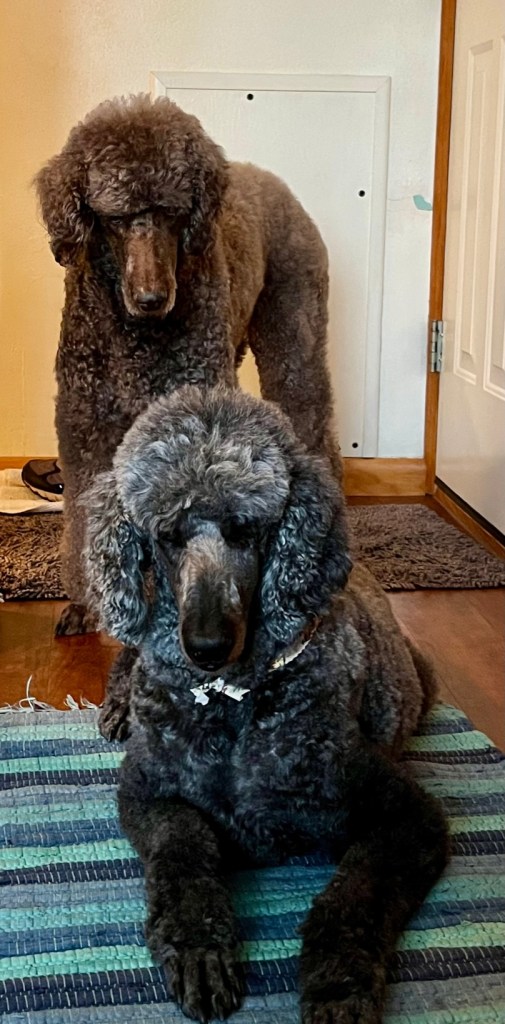
Ziva, front, and Cabela, back, April 16, 2023. Ziva wants you to know she almost caught a squirrel once.

Cabela, my fourteen-and-a-half-year-old standard poodle, has been moving slowly over the past two days. But she has a good excuse. She treed a big raccoon on Friday evening. Then she stood under the tree and barked at it, warning it to stay put. She barked some more to alert my husband that a big raccoon was up the tree, but that he didn’t need to worry about it. She had it all under control.

My husband brought Cabela into the house, then he watched the raccoon through a window. When the raccoon finally decided to come down the tree, its descent took twenty minutes because it inched its way down while keeping an eye out for Cabela the Mighty Hunter.

After the raccoon skedaddled down the road, my husband took the dogs back outside. Cabela ran hot laps around the house, probably looking for the raccoon. It’s the hot laps that she’s paying for. She’s moving like an old athlete who needs an anti-inflammatory and a heating pad after a rowdy game of touch football.

“Old enough to know better, but young enough to do it anyway.” That’s what my father would’ve said about Cabela’s escapade with the raccoon. It was one of my father’s favorite expressions. When someone asked him how old he was, he answered, “Old enough to know better, but young enough to do it anyway.” If someone did something foolish (and that someone was often my father), he would repeat the mantra, “Old enough to know better, but young enough to do it anyway.”

Years ago, Jelly Bean, the first dog my husband and I owned, spent a night on the lam. One of my nephews had let her outside, and I didn’t realize it until a couple of hours later. I drove all over the neighborhood, several different times, but I couldn’t find her. I was upset when I went to bed because she still hadn’t returned.

Around midnight the temperature dropped and heavy rain accompanied by thunder and lightning rumbled through the night. I kept dreaming that I heard Bean barking. I’d wake up and listen, then sad and disappointed, I’d go back to sleep. Finally, at four o’clock in the morning, I heard a loud bark outside, and I knew it wasn’t a dream. At the backdoor stood my soaking wet, black lab mutt with her tail between her legs. I dried her off and wrapped her in a blanket. We both went to sleep. The next day Jelly Bean was sick, so I took her to the vet.

During the exam, I told the vet about Bean’s night in the cold and rain. He asked to be reminded how old she was. “She’s ten,” I said. “Old enough to know better, but young enough to do it anyway.” He laughed. This was a big deal because that vet barely smiled let alone laughed. Additionally, he didn’t like small talk, and he could be cantankerous. Most people didn’t like him, but he was a good vet. His demeanor hadn’t ever bothered me because he was just a milder version of my father. In the past when I had to take Bean to the vet, I gave the pertinent information and refrained from talking about the weather.

But after I made the quip about my old dog’s youthful folly, the vet and I had a different relationship. My father’s expression must have struck a chord with the vet because during future visits, he smiled and made small talk with me. Perhaps, his father had used the expression, or maybe he often felt that way about his own life.

My Cabela isn’t keen on small talk, and she still thinks she’s young enough to do whatever she wants. She and the cantankerous vet would’ve understood each other. And my father, who knew Cabela, would’ve been proud of her for treeing the raccoon and doing hot laps around the house, age be damned. I don’t think Cabela would like using a heating pad, but I gave her canine anti-inflammatory medicine last night and this morning.

I hope the raccoon is old enough to know better and stays away.

Lost Cat, Please Call With Sightings

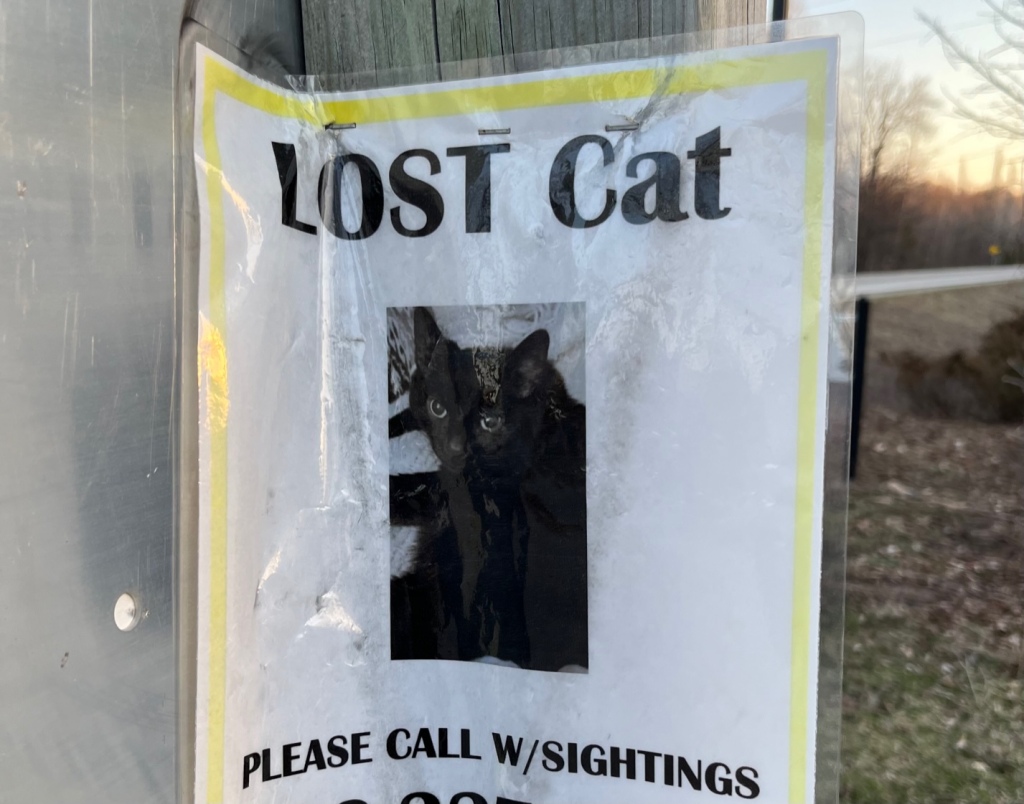
I’m away from home, and I’ve been taking lots of walks. On day two of my amblings, I noticed a couple of signs had been posted with a picture of a black cat and the words: Lost Cat Please Call w/Sightings. There is, of course, a phone number.

When I’m walking, I look for the cat, but all I’ve seen are deer, woodpeckers, crows, small birds, rabbits, geese, ducks, turkey vultures, and two foxes frolicking in a farmer’s field. But I haven’t seen the black cat, so I haven’t used the phone number.

Several days have passed and the notices are still up, so the cat is probably still missing. I like to think if the cat had been found, the owner would have removed the signs. I leave for home tomorrow, but I expect to see the signs on my morning walk before I go. I hope the owners find their pet, but the longer the cat is gone, the less likely it will return.

Something might have killed the cat. It also might have found a new home. Cats have been known to do that. I had a good friend who gained a gray cat that way when it showed up at her house. While she tried to find its owner, she fed it and took care of it, and the confident cat made itself right at home. Then the cat disappeared for a couple of days. Then it returned, only to disappear and reappear again over several weeks. Finally, she discovered the cat lived across the alley and down a few houses. The cat, like a bigamist, had been keeping two families. Plenty of jokes were cracked about its behavior, and both of the cat’s families kept in contact in order to keep tabs on their mutual pet. Eventually, the cat dumped the other family and settled in with my friend. She felt badly and kept asking the owners if they would like their cat back. Sure, but only if the cat wanted to come home. They were pragmatic about the situation because it turned out that was how the cat had come to live with them the year before.

But that’s not much comfort to the owners of the missing black cat because they wouldn’t know if their pet was safe.

We had a black cat when I was ten years old. My mother brought it home. I’m not sure if it was because my siblings and I wanted it or if she wanted it. She didn’t need much prompting to bring home animals, and what little kid doesn’t want a playful kitten with a soft, rumbly purr.

My father wasn’t happy when he came home and was introduced to a black kitten named Lucifer. He claimed he didn’t like cats. Lucifer, sensing my father was his enemy, joined ranks with him. That cat greeted my father when he came home from work, sat on his lap when he read the newspaper at the kitchen counter, and curled up with him when he fell asleep on the couch. My father grew fond of Lucifer, the cat with a name that belied his personality. Dad had a soft spot for animals too.

Lucifer was full grown but less than a year old when he died. No one noticed that he was missing because he hadn’t been gone long enough. One of my siblings discovered his body floating in our above ground pool in the backyard. The sides of the pool were four feet off the ground, but cats have leaping superpowers. However, once he’d gotten in the pool, he was unable to get out.

We were all upset about Lucifer, especially Dad.

A few months later, the pool, too, would have a sort of death. My father flew skydivers, and one weekend afternoon, Dad and some of the jumpers thought it would be fun if a couple of them were to land in our pool. Boredom was probably the mother of this crazy idea because the skydivers normally aimed for a small metal disk in the middle of much larger circle of pea gravel back at the airport. I can picture the scales in their adventurous brains as they weighed their options: Same gray pea gravel, again? Or a Caribbean-blue pool filled with chlorinated water? Tipping the scale was the much smaller size of the pool, twenty-five feet in diameter, making it a more challenging target. The skydivers were thrill junkies. Besides, the pool’s water was only three feet deep. No one was going to be in over his head.

We lived out in the country on two-point-two acres, and our land was surrounded by sprawling fields of tall grass. So, if the skydivers missed their target, they had plenty of grass to land on. Also, my father had a certain reputation in the neighborhood, and if someone saw a couple of guys with parachutes drifting toward earth in our backyard, well, that kind of thing was business as normal at our house.

But like many good ideas hatched in the heat of a Saturday summer afternoon, this one was a near miss or a near hit, depending on your point of view about the half-a-glass-of-water personality test. One of the skydivers didn’t land outside the pool or inside the pool. He landed on the edge, crumpling the side. Skydivers don’t float like dandelion seeds landing gently on terra firma. They come down a bit fast, so part of their ground school training covers proper techniques for landing to avoid injuries.

The skydiver wasn’t hurt, but he took some ribbing for “riding the fence.” The pool was totaled because once metal is bent that badly, there is no unbending it, so my father dismantled it and took it to the dump. That fall we got another cat, a Siamese kitten we named Cleopatra but called Cleo. A few months later, sadly, she was run over by a car. We didn’t get another cat for several years, and we never got another swimming pool. My father kept flying skydivers, but there were no more landings in our backyard.

I hope someone finds the cat on the poster, and it returns home. And if not, I hope the cat finds a nice second home. I’d like to think of the cat as keeping someone’s lap warm.

What I’m Reading This Week: Ford Tramps by Seegar Swanson

Swanson (l) and Nystrom (r). At age 94, after writing Ford Tramps, Swanson made a motor car trip to Alaska and toured the 49th state.

In 1924, Seegar Swanson and Elliott Nystrom, both twenty years old and friends since elementary school, decided to take a year off and tour the perimeter of the United States, making sure to visit the four corners of the country: Maine, Florida, California, and Washington. They saved money for their trip and bought a 1919 Model T Ford touring car for $125. They left Ashland, Wisconsin, in the late summer of 1924, and returned to their hometown in 1925. The trip took about a year because they worked at different jobs along the way. Also, Swanson points out, more than once, that the top speed of their Model T was 25 mph, if the roads were good.

Along the way Swanson and Nystrom kept a log of their experiences and expenses and took many photographs. Additionally, they wrote long letters home. After Swanson and Nystrom finished their journey, Swanson attended Northland College in Ashland. In 1936, he became the editor of the Superior Evening Telegram and later on he worked at the Duluth News-Tribune. After a long career in journalism, he retired at seventy-two. At the age of ninety, when he started writing Ford Tramps, he had his detailed resources and years of writing experience. He spent three years writing his book, and his hard work and dedication paid off because Ford Tramps is a well-told story that captures the mood of the country and its people in the mid-1920s and gives readers a glimpse into the daily lives of ordinary Americans and the places they lived.

Published in 1999, Ford Tramps is out of print, so if you want to buy a copy from Amazon, it will be used and it will cost between $56.26 and $154.63. Thriftbooks has one copy listed for $59.99. I paid under $20 per book when I bought two copies in 2000. I gave one to my father, and I kept the other.

My father read Ford Tramps right away and loved it. I cracked open my copy in March 2023. It’s amazing how fast twenty-three years can drive by. And if I hadn’t read a blog about autocamping in the 1920s written by Chris Marcotte, my copy of Ford Tramps would still be parked on my bookshelf.

I wish I’d read Ford Tramp years ago, when my father was still alive so we could’ve talked about the book and why we liked it. Even though we never had that conversation, I’m going to tell you why I think he enjoyed the book so much.

He liked it because Swanson’s descriptions of the 1919 Model T bring the car to life. The Model T that Swanson and Nystrom drove had three pedals on the floor and a lever by the door side of the driver’s seat that controlled the transmission, and it had a lever on the steering wheel that controlled the throttle. A complex coordination between feet and hands was needed to shift gears. Machines fascinated my father. He loved being a part of them, manipulating them, controlling them, understanding them, and pushing them to their limits. He drove cars and motorcycles, and he flew planes. Just as Swanson and Nystrom had to learn the personality of their Model T and what it could and couldn’t be asked to do, my father took pride in mastering his cars, motorcycles, and planes.

He liked the book because the Model T broke down on the road, and its tires often went flat. Swanson and Nystrom played nursemaid to the Model T, learning what they could fix themselves or rig up until they could afford a mechanic. My father, a savvy mechanic, would’ve reveled in the Model T’s challenges. Sure, when the car broke down, he would’ve sputtered and cursed. Then he would’ve put the Model T in its place and back on the road. He owned his own garage where I once heard a customer with an old sports car ask him, “What if you can’t get a part?” My father answered, “I’ll rig something up, and it’ll work.” That 1919 Model T would’ve been putty in my father’s hands.

He liked the book because he was in his 60s when he read it, but he could be young again, on a vicarious adventure from the comfort of his couch where his standard poodle and his greyhound curled up near him. In 1955, he was eighteen when he moved from a small unincorporated town in northern Wisconsin to the big city of Milwaukee, hoping to make his way in the world. My father never took a road trip like Swanson and Nystrom, but in a small way, he liked to travel and experience new places and meet new people. Swanson and Nystrom met many interesting and kind people while working odd jobs and autocamping. Swanson’s writing breathes life into these men and women, allowing readers to work beside them in an orchard picking crops or sit with them around a cookstove as they share stories and food with other autocampers.

My father liked the book because Swanson included many photographs, maps, log entries, expense accounts, and receipts. It was fun to see what food, lodging, camp fees, car repairs, and other necessities cost in the mid-1920s. Swanson and Nystrom also reported how much they were paid doing manual labor. My father, an avid photographer, took photos when he traveled. After he had his film developed, he would show you ten pictures of the same vista, then ten pictures of the same museum display, then ten pictures of the same man who took him out fishing on a charter boat. My father considered maps to be among the most useful items in his life. He used them when driving to someplace unfamiliar, and he used them to plan his flights from one airport to the next. As a pilot he kept a log of all his flights, and as a businessman he kept expense accounts and receipts.

My father liked the book because the Ford Tramps spent time in his beloved state of Arizona. He moved to Arizona when he was forty, and he thought his adopted state was amazing. Swanson and Nystrom marveled at the Petrified Forest, amazed that trees had turned to stone. The pair debated between seeing a bullfight in Mexico or seeing the Grand Canyon, with both of them favoring the bullfight. The Grand Canyon won out because in Mexico, bullfights were only held as part of major holiday celebrations, and it was too long a wait for the next holiday. Some things are meant to be. Swanson and Nystrom fell in love with the Grand Canyon, agreeing it was, as Nystrom remarked, “The greatest thing we’ve seen so far.” They stayed for five days. They hiked to the bottom of the canyon and swam in the Colorado River. They hiked along the rim in both directions, and they attended a Native American ceremony. One afternoon they took shelter in their Model T during one of the desert’s quick moving and furious storms accompanied by lightning that seemed to touch the ground and thunder that redoubled its intensity as it echoed off the canyon walls. My father never tired of watching desert storms roll through Tucson.

I’m at the point in the book, when Swanson and Nystrom have just crossed into California. Even in 1925, in an effort to contain harmful pests, California border patrol officials stopped cars to make sure people weren’t carrying fruit into the state. The Model T was searched from top to bottom because Swanson and Nystrom admitted to having a handful of oranges that they’d been given in Florida. Embarrassed, but having nothing else to hide, they were allowed to enter California. I have eighty-eight pages left to read, and Swanson and Nystrom are about to visit Yosemite Park. I’m sorry my journey with them will soon come to an end.

Someone suggested I sell my copy of Ford Tramps, pointing out my investment in the book had at least tripled. I’m not selling my copy, but if I did I could list it as “like new” because it’s only been read almost once, and I haven’t spilled any coffee on it. I wish I had my father’s copy of the book, but I wouldn’t sell his copy either. However, I would’ve been willing to share one of the copies with someone else. My father would’ve liked that, too.

I discovered a nice surprise under the jacket cover.

Ansel Adams Mornings

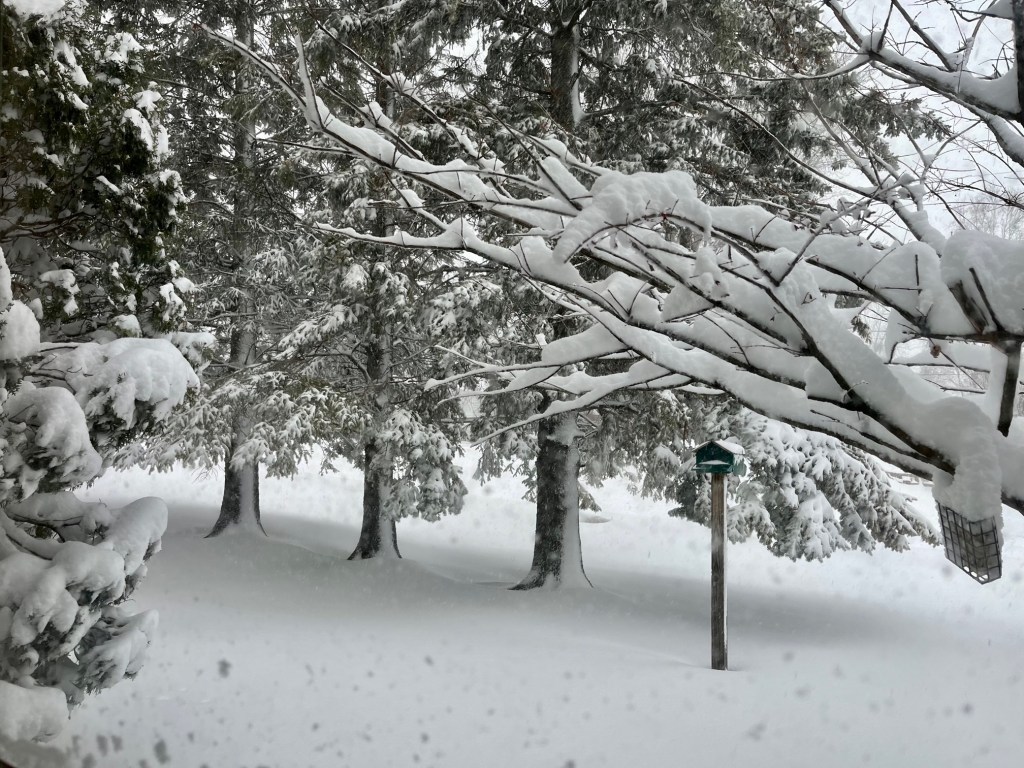
I think of these mornings as Ansel Adams mornings, when overnight the snow has fallen wet and heavy, clinging to branches, railings, and the sides of houses. The sky is tinted with the blue-gray of first light, and sunrise is moments away. It’s a world captured in gray and black and white.

Aiming my phone out the window, I take color photos, but they come through as black and white. Later when I apply the noir setting to them, the difference between the original and edited photos is nearly nonexistent, so I discard the changes.

Adams, one of my favorite photographers, captured the American West in black-and-white images, and his landscape photos featuring snow are among my favorites. I learned about Adams in a college photography class that I enrolled in because friends were taking the class for their art requirement. Having taken a ceramics class that summer, I didn’t need anymore art classes, but I signed up anyway because the class met on Monday nights when we all went country swing dancing at a local bar. If I was at class with them, it would be easier for us to carpool to the bar. I miss those days of whimsical logic.

That autumn I had a marvelous fling with country swing dancing, but I fell in love with the photography class. My friends spent just enough time completing assignments to earn what we called Charity C’s. But I spent hours photographing people, architecture, nature, and landscapes. And I spent hours and hours in the photo lab developing negatives and printing pictures, experimenting with different papers and exposures. I saved up money and bought my own 35 mm camera, playing with the f-stop, shutter speed, and film speed. I took four more photography classes over the next two years.

I thought about a career in photography, but I was more in love with taking pictures than the idea of earning a living by taking pictures. After I married and had children, my manual 35 found a shelf on a closet and retired. My husband bought me one of those instamatic 35 mm, a point and click camera that used 35 mm film. I used it for years, until I bought a digital camera with an SD card. But now my camera is a smart phone. And I can be a photojournalist wherever I travel or from the inside of my house.