American Canopy by Eric Rutkow takes a unique look at a slice of United States history by focusing on its relationship with its immense forests. When settlers first arrived in North America, forests covered more than half of what would eventually be the forty-eight contiguous states. Rutkow notes that in the United States people will find giant sequoias, the largest trees in the world; coastal redwoods, the tallest trees in the world; bristlecone pines, the oldest trees in the world; and the biggest single living organism in the world, a stand of quaking aspens in Utah.
When the first settlers arrived on the Eastern shores of the New World, they encountered dark, dense forests. Settlers viewed the forests as something to be cleared to make way for farms and towns and as a resource to be used in trade and manufacturing. And with so many extensive forests, people and lumber companies cut down trees as if the supply was endless.
Rutkow’s book is a comprehensive, chronological history of America’s forests and how those forests played an integral role in the building of a nation. Rutkow’s history covers how trees were used to build ships, trains, railroad tracks, and airplanes until other materials like steel and aluminum were developed. And while some new technologies meant a decreased demand for wood, other innovations called for an increased demand. He covers the lumber industry’s devastating impact on forests and the growing movements to save forests in order to protect water and air quality and to mitigate climate change. Readers meet lumber barons, conservation advocates, politicians, botanists, environmentalists, naturalists, and entrepreneurs, among others.
Why I loved this book . . .
It’s well-organized, well-written, and interesting. I learned so much about the history of our forests. I liked this book so much that I bought Eric Rutkow’s book The Longest Line on the Map: The United States, the Pan-American Highway, and the Quest to Link the Americas. But most importantly, at this moment in history when some of our political leaders have turned their backs on our national parks and forests, and hope to sell public lands to private industries, Rutkow’s book informs us why our national parks and forests are vital to our well-being and the health of our planet.
In 1959, Hardborough is a quiet English village on an island between the sea and a river. It’s a town steadily losing bits of itself as the years go by — its sources of income, its land to erosion, its youth to the cities. It’s a town where everyone is intimate with everyone else’s business. If you sneeze over breakfast, by noon people all around town will have asked, “Do you have a cold or is it hay fever?”
Florence Green, a childless widow nearing middle age, decides to open a bookshop. For ten years she has lived in Hardborough. Over the years, she has carefully measured the words and actions of her neighbors against an imaginary yardstick representing the progress of her acceptance in the community. She believes her fellow townspeople will shop in her store.
Florence obtains a loan from the bank and purchases a property referred to as Old House, which has stood empty for many years and is rumored to be haunted. Florence converts the first floor into a bookstore, and having given up her flat, she lives on the second floor.
For the first time, Florence is invited to a party at the Stead by Mrs. Gamart, a woman of status and means in Hardborough. Mrs. Gamart smiles and chats with Florence, appearing to approve of her bookshop. Mrs. Gamart, with all the glib banter of a cobra offering to watch over a nest of eggs, claims she wants to help Florence. However, what Mrs. Gamart really wants is Old House because she wishes to turn it into an arts center. She suggests to Florence that the soon-to-be-empty wet fish shop would be a better place for a bookstore.
But Florence doesn’t want to sell. She has legal title to Old House, which comes with a rumbling ghost, and who doesn’t want a ghost in their bookstore? Especially one that while noisy at times is always standoffish. Although Florence has legal title, Mrs. Gamart has money, status, and connections to influential people. As Florence hires a clerk, stocks the shelves, and wrestles with the question of whether or not to sell Vladimir Nabokov’s new controversial novel Lolita in her store, Mrs. Gamart calls on her connections and forges a devious plan to obtain Old House for an arts center.
It was short-listed for the Booker Prize.
Why I loved this book . . .
The Bookshop is a slim novel that reads like a long literary short story. I love these types of novels, strung together like a pearl necklace with graduated beads. The early scenes start out small, then expand like the pearls in the necklace: perfectly shaped and incrementally growing in size — until the largest moment of the story hangs like the largest pearl in the luminous strand. And at that moment, a truth about people and life resonates. These are the kind of novels that play in my mind for months and years to come.
The Death of an Irish Politician and The Death of an Irish Consul by Bartholomew Gill
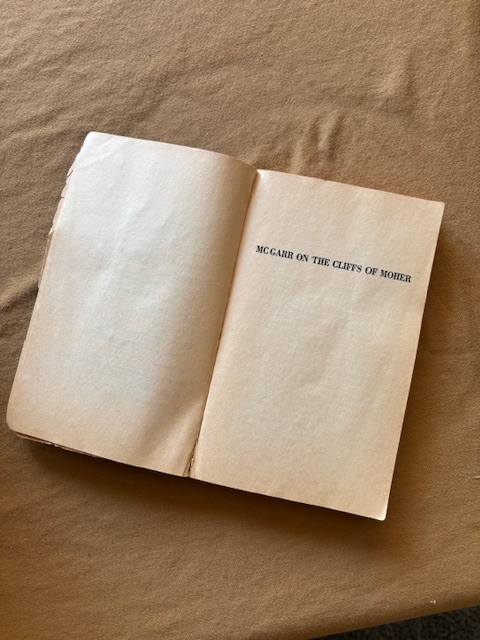
Book 1 and Book 2. The three books I bought are pocket books. When I toss one in my Mary Poppins purse, it nearly disappears!
Recently, someone in something I read suggested that Bartholomew Gill’s Peter McGarr police detective mysteries set in Ireland were a wonderful read, so I looked them up. Bartholomew Gill was the nom-de-plume of Mark C. McGarrity (1943-2002), an Irish-American crime and mystery novelist. McGarrity’s first Peter McGarr mystery was published in 1977 and set in Dublin, Ireland. The summary mentioned something about a crime at a marina, a beautiful woman, an ambitious politician, the Irish Republican Army, and the conflict between the British and the Irish over Northern Ireland. I came of age in the 1970s during some of the worst violence in Ireland, I’m part Irish, and I like police detective mysteries, so I bought the first three books in the series from ThriftBooks. I’ve read the first two.
When Gill’s series begins, his fictional character Peter McGarr, has recently returned from continental Europe to accept the coveted position of chief inspector of detectives with the Dublin police department. McGarr, known for his leadership, brilliance, cunning, and successful arrest rate, has had an exemplary career with INTERPOL before returning to Ireland. The officers under his command respect him. He’s clever, likable, and incorruptible.
I enjoyed Gill’s first two McGarr books. CID McGarr is an interesting character. He doesn’t come across as deeply flawed or deeply troubled by demons of the past. He’s usually a half step ahead of the criminals, and he can smell when something is rotten in Denmark. Gill doesn’t spend a lot of time in McGarr’s head, so readers don’t get a lot of that internality that often comes with detectives in newer stories. (Which, depending on one’s preference, could be good or bad.) What readers do get are interesting plots, conspiracies, double and triple crosses, great dialogue, and wry humor. The novels mix murder, politics, and business together, exploring themes of political corruption, corporate greed, and personal ambition. (Some things in this world never change.)
McGarr’s wife, who is about fifteen years his junior, is a good cook. She’s also bright and loves to discuss his cases with him, but she’s had a minor role so far. There are no women detectives in the first two books. Women who appear in the novels are of the femme fatale variety. It’s the 1970s, and it’s a man’s world. There is a lot of drinking in these two books. Not the hard-hitting-sit-at-the-bar-until-you-pass-out-on-it kind, but rather the steady-throughout-the-day-as-you-go kind. CID McGarr rarely turns down a drink — doesn’t matter if he’s on duty or not. The police station has beer on hand for the detectives and the suspects. Although, officers prudently strive to keep the suspects from getting drunk to avoid having their statements tossed by the courts as unreliable. Sometimes at night when I read one of these books, I was afraid I’d wake up in the morning with a hangover!
I liked these books. They were an easy read and interesting — a nice escape at the end of my day. I’ll read the third one soon. If I like that one, which I hope I will, I’ll buy the next two or three because I’m intrigued to see if Gill’s character changes over time. Does his wife stay with him? (A brief moment in the second book gave me pause.) Does he have to curtail his drinking or get sober? (McGarr mentions a line in the sand, which if he crosses, would mean he’s an alcoholic. But has he ever heard the phrase functioning alcoholic?) Will past demons surface?
Gill’s last McGarr mystery was published in 2002. By that time, I would hope to meet women detectives in his novels. I would think that drinking on the job is forbidden and that suspects aren’t offered anything stronger than water during an interrogation. I would expect to find that McGarr has changed as a person. Of course, all this depends on whether or not Gill continued to set his novels in the 1970s and 80s, or if he sets them in the times in which he wrote them. I’ll keep you posted.
The title of this book works on so many levels and in so many ways.
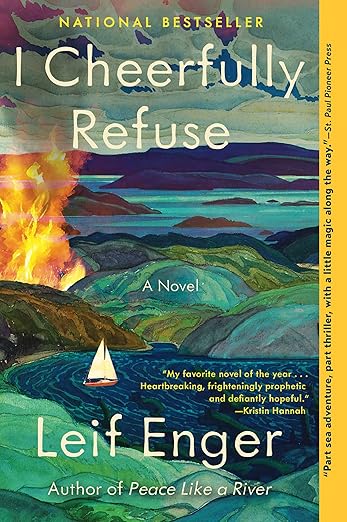
Somewhere in the near future, perhaps twenty or thirty years from now, Leif Enger’s novel takes readers on a journey of magical-dystopian realism along the shores of Lake Superior and out into its waters. His main character Rainy has a happy life. He loves his wife, Lark, who runs a bookstore inside of a bakery shop. He loves to read and to play his bass guitar in a band with his buddies. He has inherited Flower, a small sailboat, which he works to restore because he fancies himself a bit of a sailor.
But readers soon realize that something is wrong with the world in which Rainy lives. Books have nearly disappeared and reading is frowned upon. The climate has changed, and Lake Superior has warmed, creating powerful storms. Lawlessness, mostly unchecked, lurks in places once considered safe. Ominous medicine ships anchored near the shores, seek to cure the youth by breaking their willful behavior and bending their thoughts in a manner deemed acceptable by the wealthy Astronauts, who wish to mold them into compliant, cheaply-paid laborers.
When Kellen, a young man, arrives in town, Rainy and Lark allow him to live in their attic. Kellen himself is not trouble, but trouble is following him. And when that trouble arrives, he is a man called Werryck, leaving Rainy no choice but to flee in his sailboat upon the tempestuous waters of Lake Superior.
Enger’s tale is spellbinding. His lyrical prose hovers above the dark underbelly of a society that has come undone. We experience a world of natural beauty and serenity along Minnesota’s North Shore. Yet, we know something is profoundly wrong because we can feel the pulsating evil that lives beneath Enger’s exquisite prose. Enger doesn’t dwell on how the world in which Rainy lives fell apart. Instead, as we follow Rainy on his journey, Enger trusts us to ponder those possibilities.
From the standpoint of craft . . .
I admire Leif Enger’s rich prose. He uses language to create imagery and metaphors that are fresh, but never out of place or over the top. His descriptions of Lake Superior, the weather, sailing, and playing a bass guitar add realism to his story. Lake Superior and its weather become a character in his novel. His story is tightly woven: A throw-away remark, or an infectious smile, or a benign action may seem to have been randomly tossed into the story, but later I would realize it was a telling moment, making me feel like I’m a smart reader.
Several people who read Enger’s book before I did would say they loved the book, but it was dark. And here is where Enger’s writing shines. Some of his themes are dark, but others are hopeful. Some of what happens in the story is sad and scary, but he tells the story in a way that gives his readers a reason to hope. Enger knows what to tell in a story, what to hint at, and what to leave to a reader’s imagination. If you’re a writer looking for a mentor book with a story told as a hero’s journey, this is a great book to read.
I’ve been reading a lot. Every time I finished one of the books in this six-part review, I thought, “This was wonderful. I should post about it on my blog.” But, dear fellow readers, did I? No. Instead I read another book. However, these books, now stacked next to my computer, kept harrumphing at me, like when my restless grandchildren who’ve been so good finally run out of patience while waiting for me to take them to the park. And so, I placated the books by telling them I would write a short review for each of them. But things got out of hand, and the two- to three-hundred-word reviews I’d envisioned grew and grew. And try as I might, I couldn’t bring myself to cut any words because I loved the books. So I’m posting the reviews in six parts, in alphabetical order by author’s last name.
If you can’t own the painting, read the book!
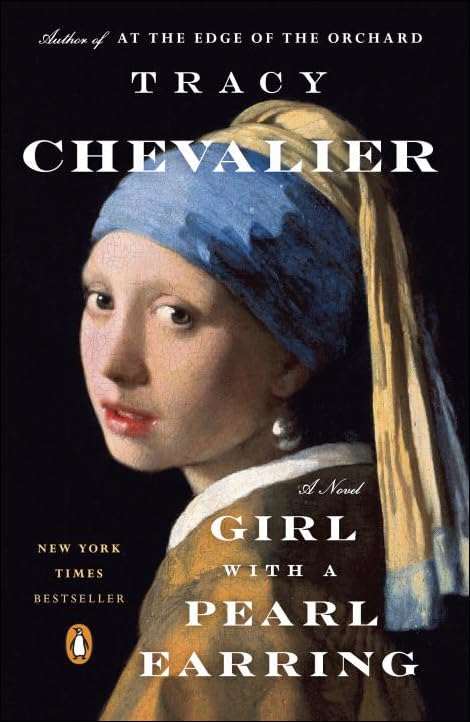
Girl with a Pearl Earring by Tracy Chevalier, 1999
Seventeen-year-old Griet is hired out by her parents as a domestic servant to the household of Johannes Vermeer. From the first pages of the novel, it’s clear that something, although unspoken, has transpired between Griet and Vermeer. Griet’s acceptance in the artist’s home is mixed. She is Protestant and the Vermeers are Catholic. She is distrusted and disliked by Vermeer’s wife, one of his daughters, and the head domestic servant. Life is difficult for Griet until one day when Vermeer insists that she be the only person allowed to clean his studio. A choice his mother-in-law completely supports. Vermeer soon relies on Griet to mix his paints, and he occasionally seeks her advice when setting his scenes.
Tracy Chevalier has written a historical novel as exquisite as Johannes Vermeer’s famous painting for which the book is named. Set in the 1660s in Delft, Netherlands, Chevalier portrays the life and paintings of Vermeer as accurately as she can because not much is known about Vermeer. Girl with a Pearl Earring is considered his masterpiece, but the girl in the painting is a mystery. Chevalier’s prose is as artfully chosen and applied to the page just as Vermeer’s brilliant colors and brushstrokes were applied to his canvases. Her novel paints a captivating fictional story about how Vermeer came to paint the girl.
From the standpoint of craft . . .
As a writer I admire Chevalier’s book for the historical details that make the late 17th Century Netherlands come to life. She puts us in the streets and marketplaces of Delft. She takes us inside Vermeer’s home, and gives us a first-row seat to the domestic life of a financially insecure upper-class family and their servants, with all their petty jealousies, passions, kindnesses, and cruelties. Additionally, Chevalier’s novel is worth studying for the great sense simmering tension she creates between Vermeer and Griet.
Its belly wounded, the Italia hangs in the air, brooding over a group of explorers who stand on the frozen, barren Arctic snow. The sun flames between the sky and the ice, perhaps a promise, perhaps an omen. The cover art compelled me to buy the book.
The title, Realm of Ice and Sky, invited me to enter a world ruled by those two endless and formidable expanses and to meet the men who risked their lives, their money, and their reputations in search of fame and glory and discovery as they vied for the North Pole and a place in history.
The subtitle, Triumph, Tragedy, and History’s Greatest Arctic Rescue, promised me a shipwreck story of sorts, and I love nonfiction books about shipwrecks.
Each night I would sit on my cushy couch with a patchwork quilt over my legs and enter the realm of ice and sky. I followed the adventures of Walter Wellman, Roald Amundsen, and Umberto Nobile, who were all driven by an inner desire to venture into a dangerous and largely unknown world, reaching for a sense of immortality.
While Levy’s book isn’t a biography, he does delve into the lives of Wellman, Amundsen, and Nobile just enough to give readers a glimpse of who those men were and what inspired them to leave the comforts of civilization and venture into the hostile and largely unexplored regions of the Arctic. Wellman, Amundsen, and Nobile were all talented, knowledgeable explorers, who, when it arrived, faced adversity and danger with calmness and bravery.
But Levy refrains from portraying these men simply as heroic figures because, although they could be heroic, they also had their faults. In the early 1900s, Polar explorers were a small, tightly-knit group who looked out for one another. However, they could also be aroused by petty jealousies that sometimes became public disputes, which their fans eagerly followed in the newspapers and radio broadcasts of the day.
The beauty of Levy’s book goes far beyond its cover. Levy’s talent for clear descriptive writing lets readers easily imagine the enormity of the airships, marvel at their mechanical intricacies, and hold their breath as the crews battle against the unpredictable Arctic weather of ice, snow, rain, hail, and gale-force winds. Readers can picture the magnificent views from the top of the world: the midnight sun, the blindingly-white snow, and the changing hues of the ice floes and water.
Levy, an award-winning author, deftly weaves together the stories of explorers who conquered the earth’s last frontier, the rise of airships, and the dawn of the golden age of radio. Starting with Wellman, explorers could send messages via radio transmissions to the outside world, giving almost real-time updates of their progress, which then appeared in newspapers and radio broadcasts, feeding a public who hungered for the thrilling news of the Arctic explorations. It’s been almost a hundred years since the airship Italia flew over the North Pole, but stories of daring explorers still fascinate us, especially when told in the capable hands of an author like Buddy Levy. [For more about Levy and his work, click here.]
In addition to a well-written and well-researched story, readers will appreciate the book’s extras. Maps at the beginning of the book track the different flights and give readers a better understanding of the geography of the North Pole and Arctic Circle. The table of contents and index make it easy to find information. At the end of the book, there is a glossary of airship and aviation terms, a list of each expedition and the crew members who participated, and a bibliography. Sixteen pages of wonderful photographs are also included.
I liked this book so much that I plan to read two other books by Levy: Empire of Ice and Stone: The Disastrous and Heroic Voyage of the KarlukandRiver of Darkness: Francisco Orellana and the Deadly First Voyage Through the Amazon.
Shepard’s historical short story takes place in May 1937 aboard the Hindenburg while on its doomed flight from Frankfurt, Germany, to Lakehurst, New Jersey. Among the ninety-seven people aboard the airship are two male crew members who are in love with each other. It’s a powerful story, written with a lyrical heaviness that foreshadows both the impending explosion of the Hindenburg, and the looming disaster of World War II.
Some extra thoughts:
Until I saw this book, I had no idea that dirigibles had been used in Arctic explorations. I knew only two things about these airships. One, that the Hindenburg had exploded in Lakehurst, New Jersey, in 1937, killing thirty-six people. In my high school history class, we watched the newsreel footage of the explosion and fire, while we heard the radio reporter’s poignant utterance, “Oh, the humanity” as the burning airship crashed on the ground. My second experience with airships was watching the Goodyear Blimp fly above arenas in order to provide overhead coverage of sporting events.
After reading Realm of Ice and Sky, I did a little research on dirigibles. Below is a YouTube video about the USS Akron disaster, which had seventy-three fatalities compared to the Hindenburg‘s thirty-six. It’s about ten minutes long and very interesting. [Footage of the Hindenburg disaster is easy to find on YouTube.]
[I reviewed Two States of Single for Wisconsin Writers Association (WWA) almost a year ago. Julie Jacob’s book is a collection of memoir essays. I loved this book the first time around. In October 2024, I met Julie at the WWA writer’s conference in La Crosse. I was an excited fan. It was fun to meet someone whose book gave me such pleasure. When I returned home from the conference, I reread Julie’s book. I’m happy to say, I loved it just as much the second time around, even though I knew how each essay ended. So I’m posting my review that was posted on the WWA website.]
Two States of Single: Essays on Family, Love, and Living Solo by Julie A. Jacob is a collection of well-crafted, engaging essays. In her opening essay, “Anything You Could Want,” readers meet Jacob’s grandparents, aunts, uncles, sister, and parents as she recounts the parties her mom and dad hosted when she was a child and living in southern Wisconsin. With humor and tender nostalgia, Jacob describes her parents working together as a team to provide a bounty of food and love for the guests who would soon arrive. In this essay, Jacob recognizes a credo by which her family lived: “They knew that life was filled with bumps so they enjoyed themselves while they could.” This theme threads its way throughout her book.
Jacob’s essays continue to follow the arc of her life as she describes her years in Chicago; a daring adventure in Brazil; joining sports clubs for young professionals; buying her own condo, then later on a house; taking a chance on love; caring for her aging parents; and losing her parents. Throughout Jacob hopes to marry and have children, but as the years slip by, neither marriage nor children happen for her. However, her desire to find a soulmate does not drive the book. Instead, what shines through in Jacob’s essays are her decisions to live in the present and to explore new roads rather than waiting for something that may never happen.
Vivid writing and crisp dialogue breathe life into Jacob’s essays. Readers will feel they know the people and places she writes about. Her essays are more than just good stories. They resonate because of Jacob’s ability to convey why each story matters, both to her and to her readers. In memoir writing a writer is supposed to do more than tell an anecdote. The essay needs to answer the question, “So why should I, the reader, care about this?” Jacob’s essays impact readers because as she writes about her past, she answers that question every time. As readers discover why each of these moments are important in Jacob’s life, they are given the gift of being able to do the same with the significant events in their lives.
By the time I finished Jacob’s collection of essays, I found myself longing to meet with a group of fellow readers, sip a good latte, and discuss Jacob’s essays. Her book would make a wonderful nonfiction read for a book club. Because married or single, male or female, we all have stories and insights to share about our choices, careers, loves, family, sorrows, and joys.
Ever have someone tell you to keep your head down? I interpret that to mean I should put my head in a book. And sometimes a book is the best place to be. I’ve been hanging out in a lot of books lately.
The Ski Jumpers by Peter Geye. I read The Ski Jumpers because I read The Lighthouse Road and Safe from the Sea, both beautifully written novels. Geye writes stories with brooding, flawed characters who are self-reliant and tough, yet vulnerable, which makes me like them and root for them. The vivid landscapes in Geye’s novels become a character that his protagonists must work with and sometimes fight against. In The Ski Jumpers family secrets gather like dust bunnies hiding in the dark, under a heavy, nearly immovable antiquated piece of furniture. Because each family member knows only a part of their family’s secrets, misconceptions develop and resentments grow. Pops Bargaard loves his wife, Bett, but she struggles with her own demons, one of which is her inability to love both of her sons. She dotes on Anton while despising Johannes “Jon.” Pops, an accomplished ski jumper in his youth, introduces his sons to the sport. Ski jumping becomes an escape for Pops and his sons. And as the years go by, ski jumping becomes what Pops and his sons talk about when they are still hiding secrets, when they aren’t ready to talk about their pain, when they are holding on to happier times. One of the joys in Geye’s novel is his detailed, vivid descriptions of ski jumping, which fly off the page, taking me along, letting me ski jump with Johannes and Anton. At some point while reading Geye’s book, I skipped to the “Acknowledgments,” and as I had come to believe, I found that he grew up ski jumping, which explained how he could write so intimately about it.
Still Waters by Matt Goldman. I read Still Waters because I’ve read three of Goldman’s Nils Shapiro detective novels: Gone to Dust, Broken Ice, and The Shallows, and enjoyed them all. Still Waters is one of Goldman’s stand-alone novels. It’s a murder mystery, but one that is solved with the help of ordinary people. Siblings Liv and Gabe, who are estranged, must reunite for their older brother Mack’s funeral in their rural northern Minnesota hometown. Mack’s death has been ruled a medical event, but Liv and Gabe receive emails from their dead brother saying he was murdered. While Liv and Gabe try to make sense of Mack’s email and uncover the truth about his death, someone else dies, and it’s clearly murder. Liv and Gabe discover mysterious letters in a box that belonged to their deceased mother, and they suspect the letters hold the key to Mack’s death and the second murder. This smartly woven mystery with multiple theories and a number of potential suspects kept me guessing. Plus, I could read it before I went to bed and still drift off to sleep without checking under the bed. (I like mysteries without psychopathic serial killers.) Goldman’s mystery does have some scary moments, but only enough to make the heart race a little.
Endurance: Shackleton’s Incredible Voyage by Alfred Lansing. I read Endurance by Lansing because I like reading about shipwrecks. (Click here for proof.) The Endurance isn’t wrecked on a shoal or reef, she isn’t tossed over by a violent storm, and she isn’t irreparably wounded in battle. Instead, she has purposefully sailed into the Weddell Sea filled with ice floes, looking for a place to land on Antarctica. She is stalled by the ice, which sandwiches her in a death grip, squeezing and squeezing until she groans, and parts of her snap like toothpicks. After becoming unseaworthy, her crew have no choice but to abandon her and their mission to be the first to cross the width of Antarctica using sled dogs. Now the twenty-eight men must survive the beyond-bitter cold, the howling winds, and the snow and rain while hoping to rescue themselves. When Alfred Lansing wrote this book, he had access to the daily journals kept by some of the men, and he was able to interview some of the survivors. Lansing took great care to write an accurate and descriptive account of one of the greatest survival stories, and his book is a tribute to the human ability to put one foot in front of the other and to cling to hope. When Endurance was published in 1959, it was a critical success, but not a commercial one. By the time the book became a commercial success in 1986, Lansing was dead. If you read this book curl up with a blanket and a cup of something hot! This book chilled me to the bone!
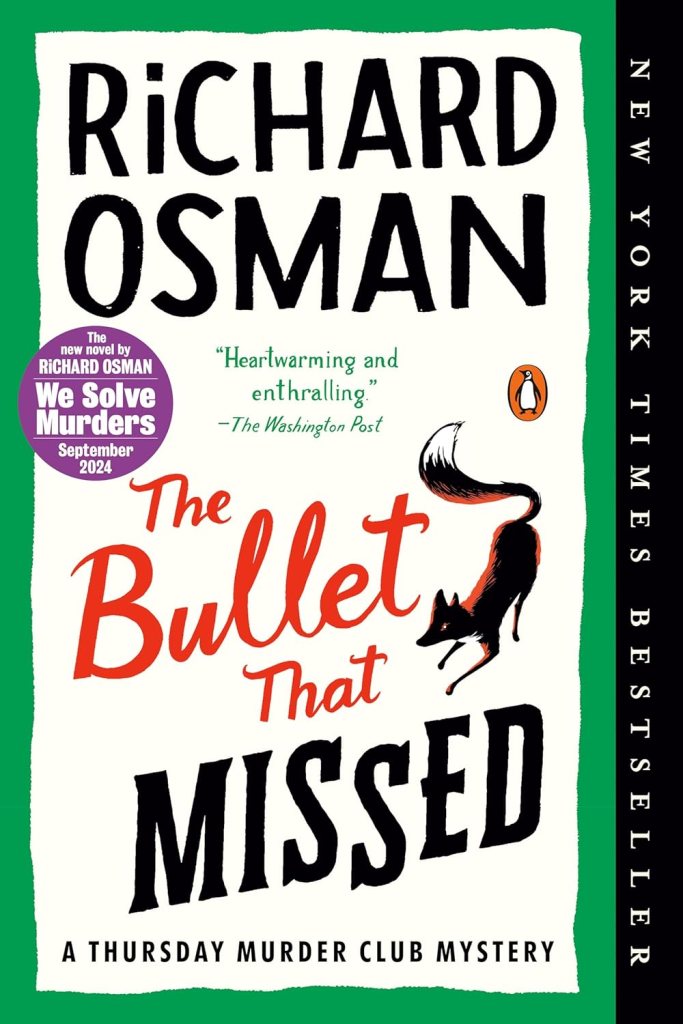
The Bullet that Missed: A Thursday Murder Club Mystery by Richard Osman. I read this book because I read the first two books in the Osman’s series, and they were fun, fun, fun. These murder mysteries are a treat. They are cozy but do have some un-cozy scenes. (And yay! No serial killers, which are so overdone.) Most of the main characters live in a retirement home in the English countryside. While they participate in some of the traditional retirement activities, they have one that’s unusual — they meet on Thursdays to look at cold cases that haven’t been solved. The unsolved murders somehow become entangled in a new murder case, which then also involves the police. One of the characters, Elizabeth, is a former MI-6 agent, and as it turns out, it’s not easy for her to give up the thrills of spying and sleuthing. Her fellow retirees join in the criminal-case-cracking adventures. This mystery series earns top kudos from me for its characters, its dialogue, and its plots. Most of the characters are senior citizens, but that doesn’t mean they have checked out of life. The older characters in the book are presented as people, who all have the same hopes, dreams, desires, and brains as the younger characters, even if the older ones do occasionally battle aches and pains. Osman’s snappy dialogue creates characters that are witty and quick thinking, conversations often drip with verbal irony and humorous understatements. The criminal characters are well-developed, too. They are brilliant and devious, but, of course, never a match for the Thursday Murder Club. While you could read these books out of sequence, I suggest they are best read in order.
Slaughterhouse-Five by Kurt Vonnegut. I read this book because I walked into Apostle Islands Booksellers and saw it prominently displayed on a shelf. I’ve had people say to me, “Have you read Slaughterhouse-Five? No? Well, you should!” I’ve read articles where writers suggest to their readers, “If you haven’t read Slaughterhouse-Five, you should!” And there it was — Vonnegut’s book — on a shelf, looking at me, waiting for me, so I bought it. Slaughterhouse-Five is described as an antiwar book focused on the firebombing of Dresden in 1945. It follows Billy Pilgrim, a WWII veteran, who time travels from his old age to Dresden, to his wedding day, to life with his family, to a veteran’s hospital, to a planet in outer space, to his youth, like a pinball pinging across a fantasy-themed pinball game. I’m not listing Billy Pilgrim’s time travels in the necessarily correct order; besides, as the story unfolds, Billy travels back and forth among these places in time. But Vonnegut clearly had a plan, and as I read the book, it not only made sense to me, it all worked seamlessly. I never felt like I was being yanked around. A book like Slaughterhouse-Five is hard to explain in words. I like it for its satire, its experimentation, its ambiguity and clarity, and its themes. I like Vonnegut’s simple, but powerful sentences. Slaughterhouse-Five is often spoken of as anti-war novel, and that theme runs through it. However, Vonnegut’s slim novel is thematically rich, and there is much more being said than war is terrible. As I read the novel, I sometimes thought about “The Swimmer” by John Cheever. Raymond Carver’s short stories also came to mind.
Time to go keep my head down in a book. The Heaven & Earth Grocery Store by James McBride is waiting for me.
Next year I’m going to Shetland. I’ve been learning as much as I can about the group of islands, which are so far north of Scotland that most maps represent Shetland with an arrow that points north and the words to Shetland. And you have to take their word for it that it’s up there, beyond the edge of the map.
I bought Shetland: Your Essential Travel Guide (2024) by Laurie Goodlad. Her travel guide has a section titled “What to Read before You Arrive” with a list of fiction and nonfiction books. I chose Catherine Munro’s Ponies at the Edge of the World (2022) because where I grew up, we lived next to a farmer who had a small herd of American Shetland ponies, a cross between Shetland ponies and other horses. My sisters and I spent hours petting those ponies and feeding them tall grasses. The farmer who owned them taught us which grasses his ponies liked and how to hold our hands flat while the ponies nibbled their treats from our palms so our fingers wouldn’t get chomped.
What is this book about?
Catherine Munro is an anthropologist who specializes in human-animal relationships. She spent a year in Shetland to study the relationship between humans and Shetland ponies for her PhD. She interviewed people who spent their lives raising and taking care of Shetland ponies. For some Shetlanders, the tradition of caring for the ponies goes back generations.
While Munro’s book focuses on the relationship between Shetland ponies and people, she also describes some of the astonishing wildlife and the mystical landscapes that make the Shetland Islands one of the most unique and beautiful places on earth. She also brings to life the pragmatic and reserved but warm-hearted and community-minded people who live in Shetland.
What did I love about this book?
In her book, Munro describes why human-animal relationships are so important. The bond between the Shetland ponies and the people who raise them, care for them, and love them is fascinating. Shetland ponies developed over thousands of years, adapting to the climate and the terrain of Shetland. These small, thick-coated, hardy ponies became the perfect workmates for crofters who worked the land. Munro talks about the concerns for the survival of Shetland ponies as a distinct breed. She asks us to think about the importance of animals, to see them as our equals, and to understand that a respectful relationship with animals is essential for the survival of all species, including people.
Yesterday I read a blogger’s post stating that the Slender-billed Curlew has been officially declared extinct by scientists, a stark and sad announcement. To read the blog, click here. We need to do better for our earth and the plants and animals that inhabit it.
[You can follow Catherine Munro on Instagram at catherine_m_munro.]
Ziva (l) and Nellie (r), my two favorite dogs, share a seat on a bookstore run.
The winds howl, trees drop leaves, and squirrels, in a frenzy, bury seeds. Halloween decorations are coming down, and Christmas decorations are going up. I wear my down coat and knit hat and sometimes my mittens when walking my dog. It’s the perfect season to enjoy cozy mysteries. I like to tuck them between the more serious books I read.
I enjoy a good cozy mystery, as long as it’s not too cozy. There has to be some close calls, some murder, and some despicable characters. But there also has to be some humor, some quirky characters, and it has to be tame enough to read or listen to before bedtime. Of course, the line between a cozy and a not-so-cozy mystery is subjective, but I know where my line is when I read one.
I have recently discovered two cozy historical mystery series, both set in England, that I like well enough to read the next book in each series.
A Samuel Pepys Mystery: The Brampton Witch Murders by Ellis Blackwood
The Brampton Witch Murders is the first book in the Samuel Pepys Mystery series. It’s set in 1666 in England. Samuel Pepys runs an investigating agency in London. He has two inquisitors, Abigail Harcourt and Jacob Standish, who work for him. Pepys learns that his sister, Paulina, has been accused of witchcraft, and Simon Hopkins, a devious, zealous witch hunter has been sent to prosecute her. Pepys dispatches Abigail and Jacob to the village of Brampton, where they are to gather evidence to prove that the charges of witchcraft against Paulina and her friend are false. To complicate matters Paulina and her friend are accused of using witchcraft to commit murder.
[Note: The term inquisitors threw me at first because it made me think of an inquisition. I had to re-read the first few pages to understand that Abigail and Jacob were called inquisitors because it was their job to question other characters in order to uncover facts and evidence that would prove Paulina and the other women in the story were being falsely accused of witchery.]
Why did I like this book?
I liked the historical setting and subject matter of this cozy mystery. It’s scary how many characters in the story are willing to believe in Simon Hopkins and his accusations of witchery against the female characters without any proof. While men were sometimes found guilty and executed as witches, it was mostly women who were convicted and executed. Makes you wonder.
This is a fast-paced story and a quick, easy read. Because the book is small and a lot of the chapters are short, I kept it in my purse, so I could read it should I become stuck somewhere waiting for something or someone. The characters are interesting, the dialogue is good, and there are enough plot twists to keep readers engaged and guessing. And while it’s not thick with historical description, I still felt like I was in another time and place. Its themes of hysteria, greed, zealousness, and small-minded thinking are timeless.
A Lady’s Guide to Etiquette and Murder (A Countess of Harleigh Mystery) by Dianne Freeman
As a young naive woman, Frances was a wealthy American with an ample dowry. In a Downton Abbey move, she married Reggie, an aristocrat with a large crumbling manor and a shrinking bank account. Unlike the marriage between Cora and Robert Crawley, romance does not blossom between Frances and Reggie. After nine years of marriage, Frances’s philandering husband dies of a heart attack while in bed with his mistress. There is a cover-up because scandal among the British upper class is to be avoided at all costs. After a year of mourning, Frances leases a house in London and packs up her daughter and her possessions. She is determined to start a new life.
But life becomes complicated for Frances. A Metropolitan police officer shows up at her new home to inform her that the police are investigating Reggie’s death as a possible murder, and she is a suspect. Her brother-in-law has filed a suit against her and her bank account is frozen. Her sister arrives from America for her first London season. And, someone is stealing expensive items at society parties. On the upside, Frances’s next-door neighbor is handsome, intelligent, and helpful. Joining together, Frances and her friends, along with the Metropolitan police officer, work to solve the mystery of Reggie’s death and the rash of thefts at society gatherings.
Why did I like this book?
Freeman’s book is delightful. It’s narrated by the main character, Frances, who is witty, self-effacing, intelligent, unflappable, and perfectly charming. I enjoyed keeping company with her as she traded her widow’s clothes for amateur sleuthing.
With an undercurrent of humor humming through its pages, Freeman’s book gently pokes fun at the upper crust of British society in 1899. Embracing the bravado and the stiff-upper-lip mindset of the British upper class, Frances, her friends, and the police follow certain protocols and unspoken rules revered by Britain’s high society, even while solving serious crimes like murder and theft. (The rich do live in a different realm of reality, whether it be 1899 or 2024.) Freeman delivers a good mystery with an ending I didn’t see coming, except in hindsight.
I listened to this book on my library app. Sara Zimmerman reads this cozy mystery, expertly giving voice to a wide array of characters. I particularly felt her keep-calm-and-carry-on voice was ideal for the character Frances. I’m already listening to the second book in Freeman’s series.