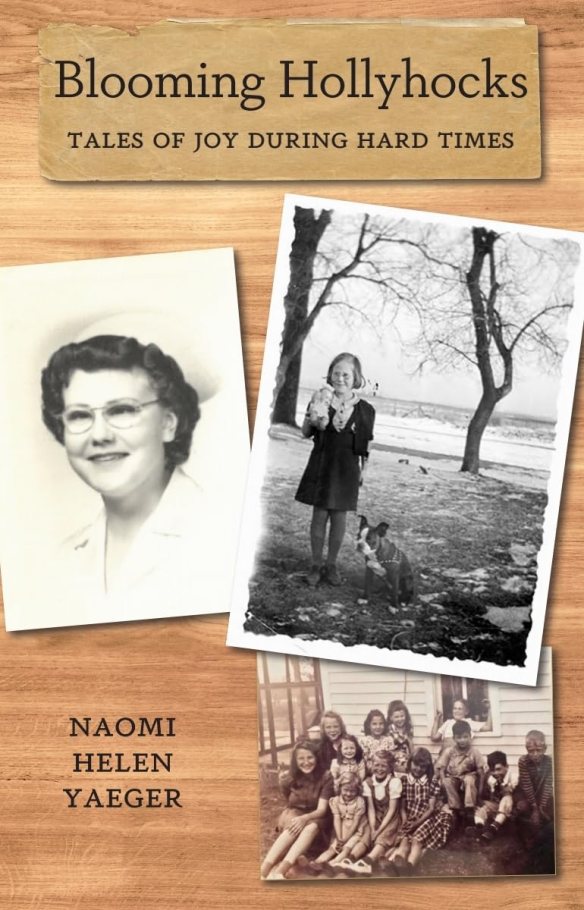
On St. Patrick’s Day, I went to the public library to listen to author Naomi Helen Yaeger read from her book Blooming Hollyhocks: Tales of Joy During Hard Times. Yaeger’s book is a warmhearted biography about her mother’s childhood in Avoca, Minnesota, during the Great Depression and World War II. [To read my review of Yaeger’s book, click here.]
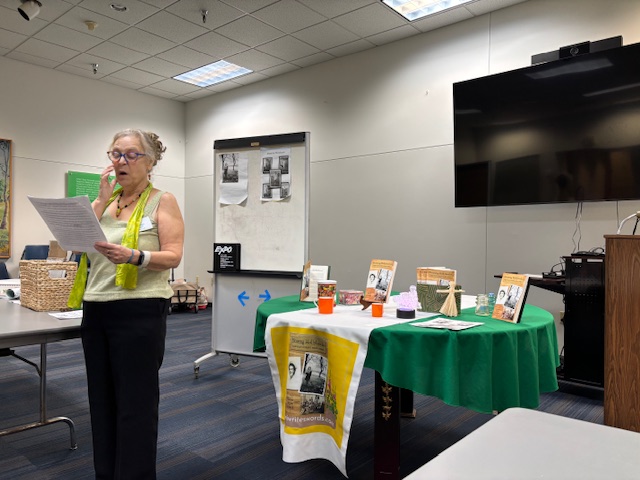
One of the selections Yaeger read was about St. Patrick’s Day. The small town of Avoca had a mix of Protestants and Catholics. The Irish Catholic children celebrated the day by wearing green to school. Yaeger’s mother Janette, and her family were Methodist and not Irish, and so Janette didn’t wear green to school on St. Patrick’s Day. Her classmates who wore green teased her, telling her they could pinch her because she wasn’t wearing green. Janette, who didn’t want to be pinched, told them, “You stay away from me.”
Author Naomi Helen Yaeger reads a selection from her book, March 17, 2026
As I listened to Yaeger read this selection, I remembered wearing green to school on St. Patrick’s Day. My great-great-grandfather was Irish. But I couldn’t recall anything about the pinching of classmates who didn’t wear green. Later, I called my sister who is four years younger than me, and I asked her if she remembered the game of pinching classmates who didn’t wear green on St. Patrick’s Day. She did, very clearly. Ironically, she had just jokingly reminded her daughter, who is thirty-something, to wear green on St. Patrick’s Day so she didn’t get pinched. Long past her school days, her daughter laughed and shrugged off the advice.
A few days later, I asked my other sister who is a year younger than me if she remembered the pinching tradition, and she did. So why don’t I remember it? Someone suggested that if I always wore green, I wouldn’t have been pinched, so I might not remember the game. And I know I wouldn’t have pinched anyone who didn’t wear green. I was often teased and called names when I was in elementary school, and it was hurtful. I made a point to avoid certain classmates and to behave kindly to the rest — pinching someone wouldn’t have been okay with me.
This seemingly harmless childhood tradition upset Yaeger’s mother when she was a child. It probably wouldn’t have occurred to me when I was young, but as an adult listening to Yaeger read her mother’s words, “You stay away from me,” I thought about the darker side of games like these. (My oldest grandchild confirmed being pinched for not wearing green is still a thing.) I don’t think children see it as a statement about being Protestant or Catholic, British or Irish. Nor do I think children know anything about the history of the British occupation of Ireland and its brutal consequences. But the St. Patrick’s Day pinching tradition pits one group of children against another group of children based on the color of one’s clothes on a certain date. Perhaps, one could argue it’s a small thing, a fun game played for one day a year. But it also singles out a group of children who, for whatever reason, don’t wear green on March 17.
Of course, to escape the fate of being pinched, a child could simply wear green to school on St. Patrick’s Day. But that’s not harmless either, compelling someone to either fit in or get pinched. Some youngsters probably had fun with this — chasing each other and laughing — like it was a game of tag. But other children probably felt like Janette: “You stay away from me.”
I wonder at all the subtle and not so subtle “seemingly harmless” ways children are taught to marginalize others who are not like them. I like that Yaeger included this story in her mother’s biography. It’s a story that takes us back to the days of our youth, while at the same time making us think about something differently as grownups.
[To read the reviews of both a nonfiction and a fiction book dealing with the Time of Troubles in Ireland, click here.]
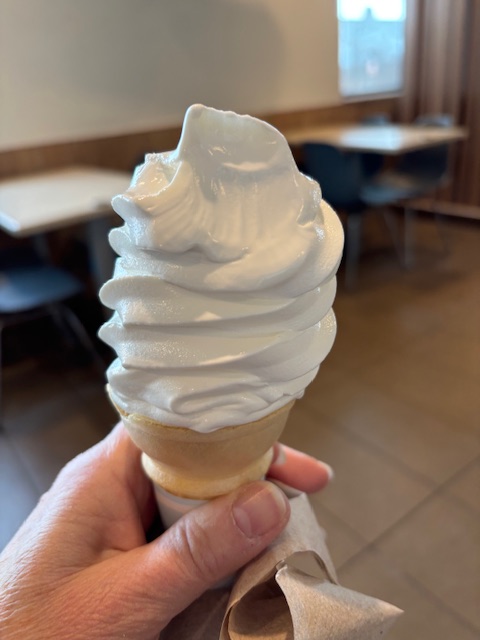
February 9th was a teacher in-service day, so I had my four grandkids. I took them to McDonald’s for lunch and $1 ice cream cones.
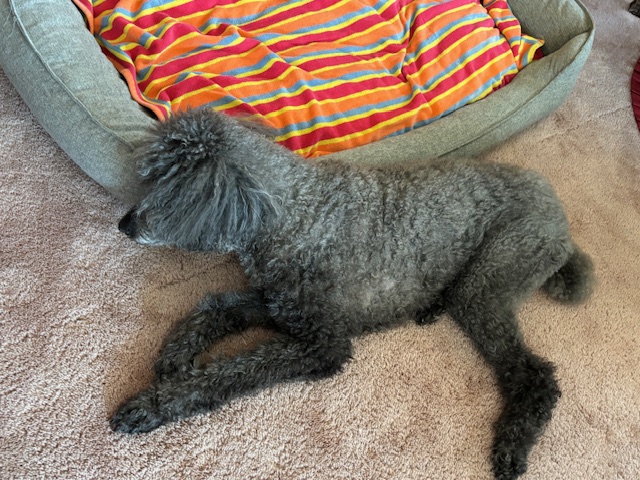
I also have a fifteen-year-old poodle, Ziva, with multiple myeloma. She is in the early stages of the disease, but she also has some other health issues. Her vision and hearing are iffy, she has some dementia-like issues, and her osteoarthritis makes her mobility a bit sketchy. But she still enjoys a very short walk and loves car rides.
So, when I took my grandkids to McDonalds, I invited Ziva to come along. My husband carried her down the basement stairs, and I lifted her into the van.
The temperature was in the 30s, so I knew Ziva could sit in the car for a bit while we ate at McDonalds. But I didn’t want to leave her in the car while we ate happy meals and ice cream cones.
Once inside McDonald’s, we approached the counter to place our orders. “How can I help you?” the clerk asked.
I had an idea.
I looked at my grandkids, and asked, “Would it be okay if we all got the $1 ice cream cones and ate them here? Afterward we can order our lunch to go and eat it at home? So, Ziva doesn’t have to be in the car by herself for so long?”
The grandkids looked at me like I was crazy for asking. I pressed on as though I had to convince them. “Is it okay? We could call it a ‘backwards lunch.’ Does anyone object to having dessert before lunch?”
“Not at all,” said a voice filled with chuckles. The oldest grandchild, whose face lit up with conspiratorial glee, had spoken. The other three laughed. They’d caught on that Nana was playing the straight man in a comedy routine.
We ordered five ice cream cones and sat at a table overlooking Lake Superior. We had a lovely conversation about this and that while licking our ice cream and crunching our cones.
After dessert we ordered lunch and headed home. The grandkids carried our food into the house while I lifted Ziva out of the van, then carried her up the basement stairs.
Ziva stretched out on her bed in the living room. Car adventures tucker her out. The grandkids gathered at the table, where we ate the first part of our lunch last.
While they jabbered and looked at their Happy Meal toys, I thought about my childhood and desserts.
“You can’t have dessert. It’s too close to supper. You’ll ruin your appetite,” said the adults in my life when I was a child and they didn’t want me to have goodies before a meal.
“If you don’t have room for your supper, you don’t have room for dessert,” said the same adults in my life when they wanted to make sure I cleaned my plate.
For added drama, they might add, “There are starving children in Ethiopia who’d love to have that food.”
So, I’d eat my food. (Unless it was split pea soup or ring bologna, then I’d stare at it, shifting it a round with a spoon or fork, trying to make it disappear.) And I’d wonder why the children in Ethiopia were starving. (In the early 1970s, I couldn’t google it.) But I didn’t ask because to question adults when they dished out words of wisdom (a.k.a. a lecture) was considered disrespectful, and usually met with, “Don’t talk back!” or “Go to your room!” I had a friend who suggested to her mother that the food she didn’t like be packed up and sent to the starving children in Africa. It didn’t go well. My friend was sent to her room for the rest of the day.
Not spoiling one’s supper by eating dessert first, cleaning one’s plate, being forced to eat things one didn’t like, and holding one’s tongue while a parent prattled on were all standard customs when I was a child.
Dessert was a special treat in my childhood home. Mom occasionally bought cookies, ice cream, or potato chips and French onion dip, technically not dessert, but oh so yummy. My dad was a mechanic and my mother was a waitress, so with four children, money was tight. Desserts and salty snacks were considered luxuries, and my mother wisely spent most of her grocery budget on food for our meals. My nana Kitty’s house was a dessert desert, unless you count the raisins or saltine crackers she tried to pass off as goodies. On the other hand, my grandma Olive’s house was dessert oasis filled with freshly baked cakes, cookies, or pies, and she always had ice cream in the freezer. But Grandma Olive lived 350 miles away, and we only saw her for two or three weeks a year.
Our neighbors had dessert after every evening meal. I don’t think Shirley ever baked anything, unless it was a ready-to-pop-in-oven item, but her husband Bill expected a sweet after supper. So, Shirley bought cookies, Danish, ice cream, and pies. My mother bristled at this, saying that having dessert every day was unhealthy.
My sisters and I never cared that Shirley and Bill’s children had dessert every night while we didn’t. We envied them because they had a built-in dishwasher! While my sisters and I cleared the kitchen table and washed and dried all the dishes and pots and pans after a meal for six people, the neighbor kids unloaded and loaded a dishwasher after a meal for five people. Bill went to work in a suit and tie, and Shirley was a stay-at-home mom. Bill made more money than my mother and dad did together. And even as a child, I knew this was why they could afford daily desserts, a dishwasher, and Scrubbing Bubbles, while my sisters and I dreamed of Oreos, washed dishes by hand, and scoured our kitchen sink with Comet.
Occasionally, we’d plead with our parents: “Please, can we get a dishwasher?” To which, my father always answered, “We don’t need a dishwasher, we already have three of them.” Of course, he was referring to my two sisters and me. We didn’t think he was funny. But as an adult when I think about his retort, it always makes me smile. And if I’m in the right mood when I think about it, I laugh out loud.
My parents never owned a dishwasher until I moved out of the house. When I became a parent, I followed my mother’s example about desserts, instead of Bill and Shirley’s. And as soon as I could, I bought a dishwasher.
But I never made my children eat things they didn’t like. I remembered the horrors of being made to chew and swallow ring bologna and split pea soup, both of which I detested. I remember my sister and I helping our youngest sister hide, then dispose of red kidney beans on the nights my mom served chili. Our little sister would be forced to sit at the table long after everyone else was done with their food. Her brown eyes filled with tears as she stared at the kidney beans, but she refused to eat them. Our hearts broke for her. Even our dog, Fritz, often sat nearby in a show of support. We always managed to find a way to get rid of those beans. Sometimes Fritz ate them. Sometimes the beans were surreptitiously wrapped in a napkin and tucked into a nook under the table then later thrown in the garbage.
My parents weren’t trying to be cruel. It’s how they and most of their generation were raised. If there was food on your plate, you ate it. It didn’t belong in the garbage. Their parents all grew up during the depression. Nothing was wasted. My grandma Olive saved every scrap of leftovers, even if the scraps only amounted to several bites. She stored them in small plastic containers that once held margarine, which she’d washed and dried, along with plastic baggies. Everything was reused. About once a week, my grandmother would serve a meal by using up all the leftover food in the fridge. Grandma Olive and Grandpa George weren’t poor. They could’ve afforded to toss leftovers and buy more baggies. They were against throwing out anything that was still useful. Nana Kitty, who did live on a tight budget, shared Olive and George’s viewpoint. “Waste not, want not,” Nana would often say.
My grandkids and I ate our ice cream cones and all of our food. Still, I wisely kept my thoughts about dessert and food and wastefulness to myself. My grandkids probably would’ve considered any words of wisdom I might have on these subjects to be a lecture.
Some of you may remember that after I went sledding with my two youngest grandkids a few weeks ago, I made a New Year’s resolution to behave like a child more often. I’m still working on it, unlike resolutions of the past, which I’d have tossed into the trash bin by now.
On January 20, I went roller skating with all four of my grandkids. I was sixteen years old the first time I went — still a child then — so this counts as behaving like a child now. The last time I went I was in college, and probably about twenty-three.
I fell a lot the first time I went roller skating. I’m sure the seat of my blue jeans kept a good part of the roller rink floor buffed and shiny. But despite all the falling, I loved it, so I went skating once or twice a week. My skills improved, and I rarely fell.
Before my skate date with my grandkids, I made the mistake of telling someone, “Yes, I’m going to skate too,” while my husband was in earshot. Afterward, he asked, “Do you really think that’s a good idea?”
“I used to roller skate a lot in high school and college,” I said. (A lot is a relative phrase.)
“That was decades ago,” he said. (Ouch!)
“It’ll all come back, like riding a bicycle,” I assured him. (It didn’t all come back, unless I compare it to the first time I went roller skating.)
“You’re going to fall and get hurt, maybe break something,” he said.
“I’m not going to fall. I passed that stage years ago,” I said. (I fell seven times. Five of the falls were gentle with soft landings; the other two smarted and then some, one left a respectable bruise on my forearm. Good man that he is, my husband never asked how many times I fell.)
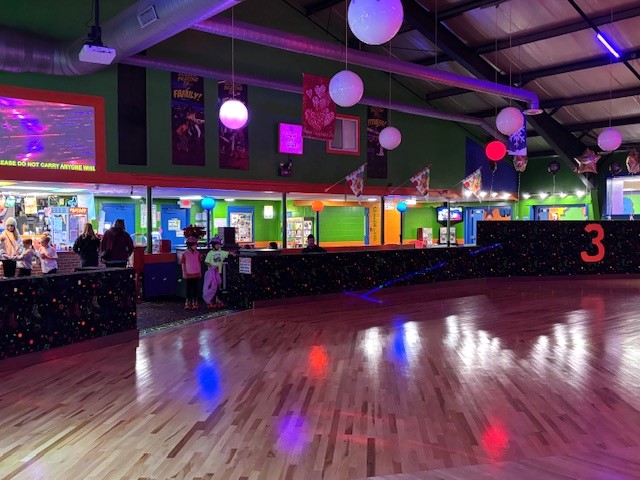
Walking into the roller rink was kind of like a trip back in time. It’s the same rink where I skated with my college friends, but the inside has been refurbished and updated. The walls and ceiling surrounding the rink feature bold graphic art scenes painted in vibrant colors that glow under black lights. The old bumpy greenish-blue floor was recently replaced with a beautiful, smooth wooden surface. There are new booths, benches, and carpeting, but the layout is still the same. I have no idea if the roller rink I frequented in Milwaukee County when I was in high school still exists, and I don’t remember its name.
“Are you going to skate with us?” This question was repeatedly asked by my two youngest grandkids, even as I paid for five skaters, picked up my skates at the counter, then laced them up while seated on the bench with my grandkids. I don’t know if they worried about me being too old, or if they kept thinking I’d change my mind. I like to think they were amazed Nana could skate. Well, sort of — after watching me fall.
The moment I stepped on the rink, I realized my return to roller skating wasn’t going to be smooth. At first, I spent all of my time concentrating on maintaining my balance, waiting for the memory in my leg muscles to wake up and recall how to skate. When I didn’t stay upright, getting off the floor was a challenge. Trying to stand on a slick floor while wearing wheels on your feet is the stuff slapstick comedy is made of. Once I fell too far away from the wall and struggled to stand, so I began crawling toward the wall. My oldest grandchild skated up and gave me a hand.
I’d forgotten how heavy roller skates are. Lifting my leg up to do a crossover or to push off, felt like pumping iron. Resistance training. Good for the bones. My doctor wants me to do more resistance exercises because while my bone density test wasn’t bad, it wasn’t great. She’d be proud of me, I thought — skating around the rink with the equivalent of ankle weights laced to my feet. Then again, she might have something to say about me breaking a bone. She’d probably be Team Husband.
After twenty minutes, I felt more confident, and as I slowly, cautiously, precariously skated around the rink, my mind wandered back to my high school skating days and a boy named Mark, who I had a crush on through most of my junior year.
School crushes are funny things. Some of my infatuations were all consuming. I daydreamed about those boys from the moment I slid out of bed in the morning, until sleep swept away my romantic fancies at night. Like Randy in seventh grade, whom I never worked up the nerve to speak to, but whose name filled the pages of my diary, and whose image occupied my nearly every waking moment. Sometimes I had crushes on boys at the same time: one at school, one in my neighborhood, and one at work. Some crushes expired faster than an egg salad sandwich left out in the summer sun. My crush on Mark started in our American literature class during our junior year and carried over to the roller rink, but I didn’t particularly pine after him when he was out of sight. He was funny and talkative. We were school and skating friends.
I was out of Mark’s league. He was handsome, tall, and muscular. He had thick blond hair nearly touching his shoulders and cut like a rock star’s. I don’t remember the color of his eyes, but they were often filled with mirth. His sense of humor ranged from puns to bawdy, from slapstick to stand-up. He smiled constantly and laughed easily. In a category for “Student Most Likely to Become a Comedian,” Mark would’ve won.
I’m not sure how I started roller skating, but I never had a date at the roller rink. Instead, lots of kids from my high school and surrounding schools would show up on the evenings designated for teenagers. It was one big group date. Mark never came with a date either, but on almost every teenage skate night, he was there. Sometimes during the day at school, he would ask me if I was going to the rink that night.
We often skated side by side, making small talk. Rock ‘n’ roll from the 1960s and 70s pulsated through the air. The mirrored disco ball tossed flashes of color across the rink. Sometimes there was a couples’ skate, and he would take my hand. For the length of a slow song, I’d imagine we were boyfriend and girlfriend. Other times, he’d ask another girl he happened to be skating next to when the DJ called for a couples’ skate. Mark was kind to everyone. Of course, I was disappointed when he didn’t ask me every time because it meant he didn’t have a crush on me.
During the summer, after my junior year, I went to Europe for a month, and my family moved. When I returned home, I settled into a new home, a new school, and a new town. I developed two crushes, one on a boy across the street and one on a boy at school. I never saw Mark again.
In the late 1990s, I learned Mark had died of cancer in 1995 at the age of thirty-six. One of my high school classmates, who’d become a dental hygienist, told my sister, whose teeth she was cleaning, to let me know. She knew that Mark and I’d been buddies. Did she know that I’d had a crush on him? Did she think he had one on me? I’d rarely thought about Mark after I moved, but I was sad when I heard he’d died. He’d been so full of life. He’d married and had children.
Over the years, I’d occasionally think about Mark. Something would spark a memory that reminded me of my junior American lit class or the roller rink. For example, I can’t hear or read about A Raisin in the Sun without thinking about Mark and a play he wrote for a class assignment, which featured me and some of our classmates. Of course, Mark being Mark, the play was humorous, but in a kind way, a gentle satire that kept us all in stitches.
A few months ago, I was looking through my junior yearbook — nothing to do with Mark — and I came across a long entry penned by him. I was stunned by what I read both on the page and between the lines. His words were an unabashed admission of affection and love, but at the end of his heartfelt reveal, he’d sandwiched the word lies in parentheses as if shrugging off the whole letter as a joke, giving himself enough plausible deniability to save face if I didn’t return his feelings. Why had I missed his declaration of romantic affection? Probably because I was convinced that he’d never be interested in dating me. Turns out he felt I’d never be interested in dating him. Why had I thought he was joking? Probably because he never flirted with me, and he was always joking. What about his writing “I love you” and “I’ll miss you if you move”? Lots of my yearbook entries were filled with words of love and miss-you-over-the-summer sentiments, from both my male and female friends. I have several yearbooks filled with gushy prose to prove how sappy my classmates got when signing yearbooks. Some things are easier to write than say.
I kept skating, mostly upright now. “Y.M.C.A.” played, fast-paced and upbeat, the kind of music that would’ve sent me zipping around the rink when I was a teenager, but not anymore. I skated as if I were keeping time with Perry Como’s rendition of “Moon River.” When we left the rink, I told my grandkids, who had a blast, that we would come back in February and March on their school breaks. I plan to skate again, so I hope my legs won’t develop amnesia. I don’t know what my husband will say, but I know what my father would’ve said, “Old enough to know better, but young enough to do it anyway.” Hopefully, I’ll stay off the floor.
I will think about Mark again, and his life cut short by illness. I will smile at the thought that he had an unrequited crush on me too, but Mark and I were never destined to be together. We weren’t each other’s one that got away. If we had dated during our junior year, we most likely would’ve spoiled a fun friendship. School crushes are funny things. They’re often ignited by a physical trait: a dimpled cheek, sky-blue eyes, a smattering of freckles across a nose, luxurious wavy hair, a lopsided melt-your-heart grin. They consume our lives for a moment, but like a match, once struck, they often burn out quickly.
I remember Mark fondly because we were friends who laughed, and talked, and roller skated together. He’d be pleased to know that I still think about him now and then. How I sometimes tell the story about a boy from my American lit class who climbed out of a classroom window on a warm spring day, joyfully followed by me and most of the class. (No, we didn’t get into trouble. Teachers were also charmed by Mark.)
It’s what we want when we’re gone, that people will remember us and tell our stories.
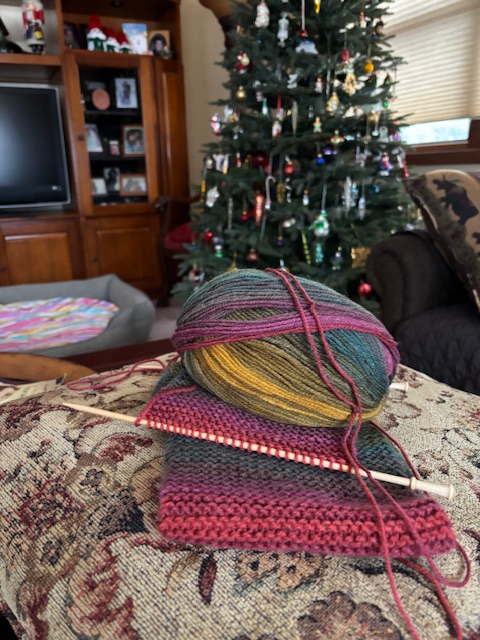
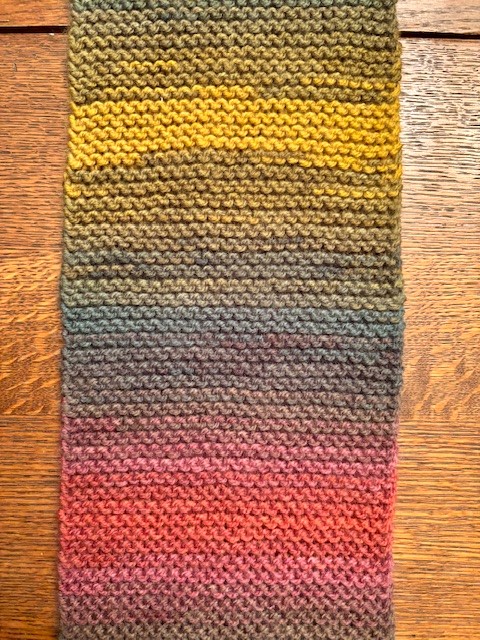
My Shetland yarn, 80% acrylic and 20% wool, is soft, warm, and gorgeous. I’m using the knit stitch for every row, which gives a simple knit, purl design that allows the beauty of the yarn’s color gradations to steal the show.
Last September when I traveled to Shetland, I bought some yarn at Loose Ends and Anderson & Co., both shops in Lerwick.
Shetland is known for its yarn shops, knitted goods, and expert knitters. I was in Shetland September 15 – 20. If I’d gone eight days later, I could’ve taken part in Shetland Wool Week, an annual event, which runs in late September/early October. But having never been to Shetland before, I went to experience its natural beauty, so I spent lots of time outdoors. According to the guide books, the month of September is a quieter part of Shetland’s tourist season. The weather is more unpredictable, and the puffins, a popular attraction, have flown to warmer climates for the winter. But fewer tourists mean less congestion, and that appeals to me.
In late September/early October, Shetland’s weather begins to turn, and it becomes a place of cold temperatures, gale-force winds, sideways rains, and thick gray skies, so sight-seeing tourists shy away. It’s a great time of year to have a knitting conference filled with indoor gatherings. Of course, stormy weather can show up anytime in Shetland, but it becomes more prevalent as September runs into October and winter settles in. Shetland winters are perfect for knitting, as demonstrated by the large quantities of knitted goods to be found in shops, museums, and heritage centers throughout Shetland. After all, I bought four skeins of yarn with the idea that I would knit scarves during northern Wisconsin’s upcoming winter. I also bought three wool sweaters in Scotland because I’m never going to knit a sweater.
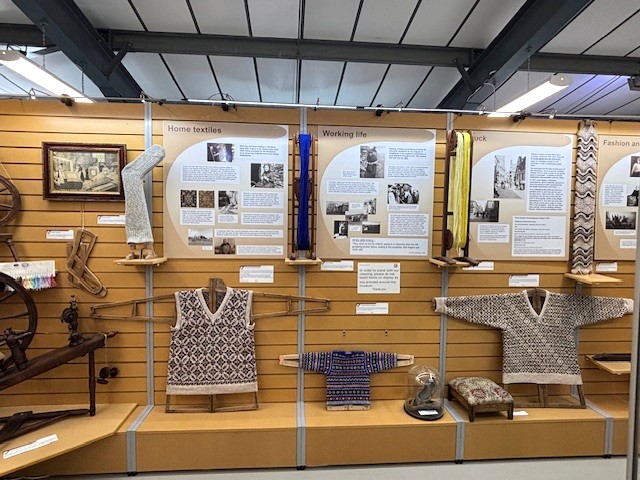
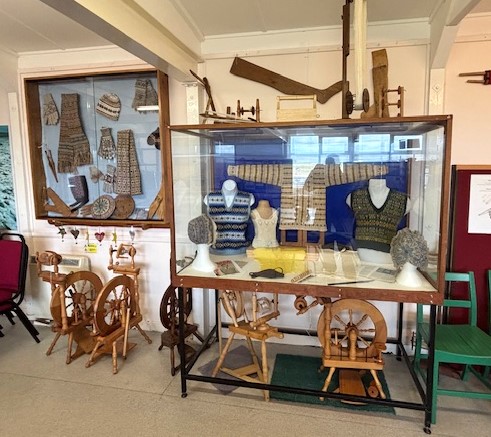
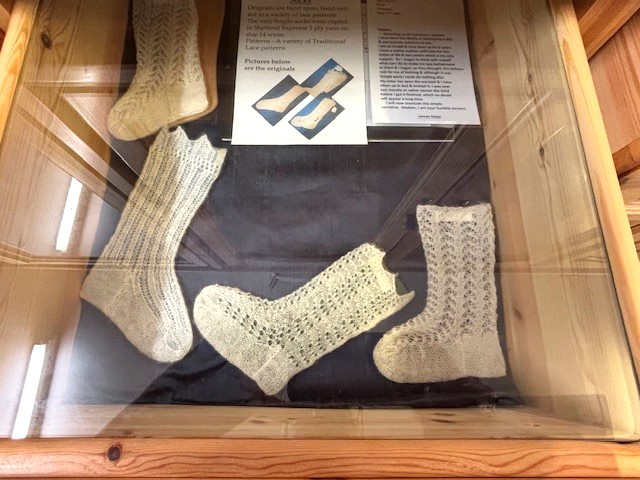
Home textiles display in Scalloway Museum, Shetland. As a cottage industry, woolen goods have been and still are an important source of extra income for many Shetlanders.
I knit beautiful scarves, as long as the pattern is simple and repetitive, and there are no cables involved. Or lacy-like patterns. Or miniature figures or graphic designs prancing across the scarf. Also, no increasing and decreasing stitches. But otherwise, I make nice scarves because I select pretty yarn.
I don’t knit sweaters, slippers, or hats. Only scarves. Although, in the past I have knitted a few dishcloths. But that’s like knitting a miniature square scarf.
Long ago, I tried to knit something more complicated. When I was a senior in high school, I signed up for a community ed class so I could learn how to knit something other than scarves. I selected a pattern for a simple pair of slippers. Because the class was in the fall, I decided I would give the slippers as a Christmas gift to some lucky family member. I went to class and learned how to read a knitting pattern, how to increase and decrease, and how to gauge stitches — in theory. By the end of the class, I had two forest-green slippers — in two different sizes. Since none of my family members have mismatched feet, I couldn’t give the slippers to anyone. Eventually, I threw them away.
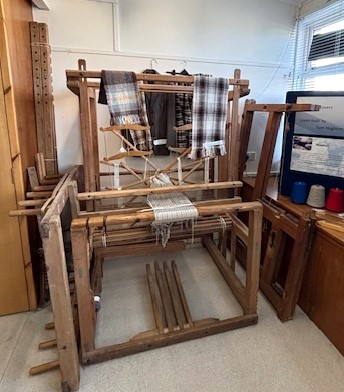
Unst Heritage Center, Shetland. Some woolen goods, like these scarves, are still made on a handloom and can be found for sale in shops throughout Shetland. I bought a rose-colored lambswool tartan scarf in Edinburgh. Mine was made on a factory loom by Lochcarron in Scotland.
I never again tried to knit anything that required I gauge my stitches so the left side of something would match the right side of something. I gave up after one try. I’m like that with some things: I’ll quickly throw in the “mismatched slippers” and call it a day.
I took one year of high school math. I studied hard, but I struggled and I hated it. Thankfully, at that time the state and my high school only required one year of math. As sophomore I took German instead of geometry. I did the same with downhill skiing. I tried it once. I fell every time I went down the slope, and I nearly broke my arm while using the tow rope. I never went downhill skiing again. My attempts at cake decorating, shorthand, sewing clothes, woodworking, and agility training with my dog Ziva met the same fate.
But I can be tenacious. My younger sister learned how to ride a bicycle before I did. I couldn’t get the feel for balancing my body on the bike. But I wanted freedom from training wheels, so I spent hours practicing in our driveway. The first time I went roller skating, I fell again and again. But during the moments I managed to remain upright, I loved it. So, I kept going. The same for cross-country skiing. I kept falling and getting up, wondering if I’d ever maintain my balance on the skinny skis, but I loved it. So, I kept getting up. For years bicycling, roller skating, and cross-country skiing were some of my favorite pastimes.
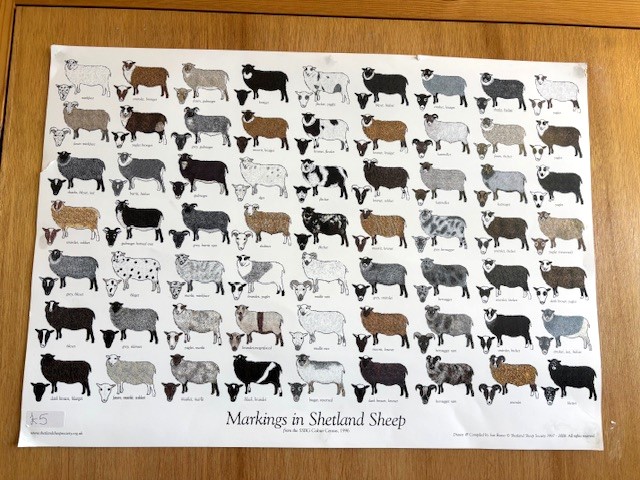
There are almost 300,000 sheep in Shetland, and about 23,000 people! We saw sheep everywhere. This guide to sheep markings is displayed in the Unst Heritage Center.
I took three years of Spanish in high school. Although I sometimes struggled with pronunciation and didn’t grasp the verb tenses, I took Spanish in college because I loved learning a language. I still remember the day, when the Spanish verb-tense thing clicked for me. Professor Stevenson stood in front of an antiquated blackboard in Old Main delivering a lesson about verb tenses. He wore a pair of dress trousers, a white shirt, and a bow tie. I sat in a modern desk, taking notes. I wore a pair of faded, patched blue jeans and a pale-yellow T-shirt with the rainbow-colored word Adidas printed on the front. I’m sure my face lit up like a light bulb. At the same time, I realized that was how verb tenses worked in English. I was giddy with Spanish and English grammar knowledge for the rest of the day. I enrolled in Spanish II the following year.
Unst Heritage Center. While some of the woolen goods in the museum are for display only, the Unst Heritage Center does sell pieces that are handmade by local crafters. The woman working in the museum on the day we visited was busy knitting.
So, what makes the difference between something I’m willing to keep working at and something I give up on? It depends on the amount of joy I experience in between my feelings of frustration and inadequacy. If there is something I love about the new activity I’m learning, I keep going, even if I look foolish while others are quickly grasping the skills. I don’t care about becoming an expert. I just enjoy my level of competence. I never learned to roller skate backwards or do spins. I never became a fast cross-country skier. I’m not fluent in Spanish. I’ve never again attempted to knit anything other than a scarf, but I love knitting them. I’ve made them for my grandmothers, mother and mother-in-law, sisters, nephews, nieces, grandkids, and friends. I love the meditative, mindless, repetitive movements of combining purl and knit stitches as I watch the colors and patterns meld together.
My scarf: I’ve never seen yarn with a gradation like this. It’s stunning. I love how the colors change — not all at once, but rather slowly and as if they can’t quite make up their minds.
I’ve never regretted giving up on high school math classes or advanced knitting or downhill skiing or any of the other endeavors I tried briefly then ditched. But we’re taught to try and try again. If at first you don’t succeed, try again. The only failure is giving up. Give 110%. If you’re not failing, you’re not trying. Fall down eight times, get up nine.
But sometimes failure teaches us when it’s time to cut bait and walk away. To stop banging our head against the wall. To stop throwing good money after bad. To stop turning the other check, only to have that one slapped too.
Failure is normal, and sometimes we have to keep at it, and in the end, we’re glad we persevered. But failure can be a way of telling us that maybe we aren’t suited to something. That sometimes it’s okay to give up, and knit scarves.
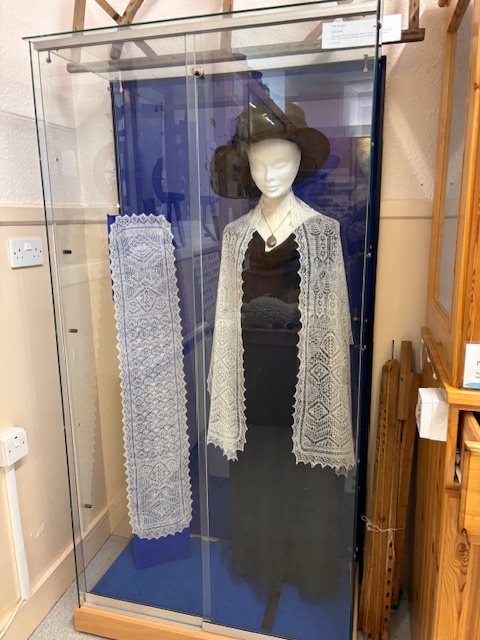
[The pieces below are knitted with a very fine wool. They take a crazy amount of hours to complete. The delicate scarves, shawls, and baby garments are used for life’s special occasions, such as weddings and baptisms. Whether made by a family member or purchased in a shop, these pieces are treasured and passed down through generations. I saw some exquisite lacy shawls and baptism gowns for sale in local shops in Shetland. They cost two to three times more than wool Shetland sweaters, reflecting the time and skill needed to produce them. And I’d bet the artisans are still woefully underpaid.]
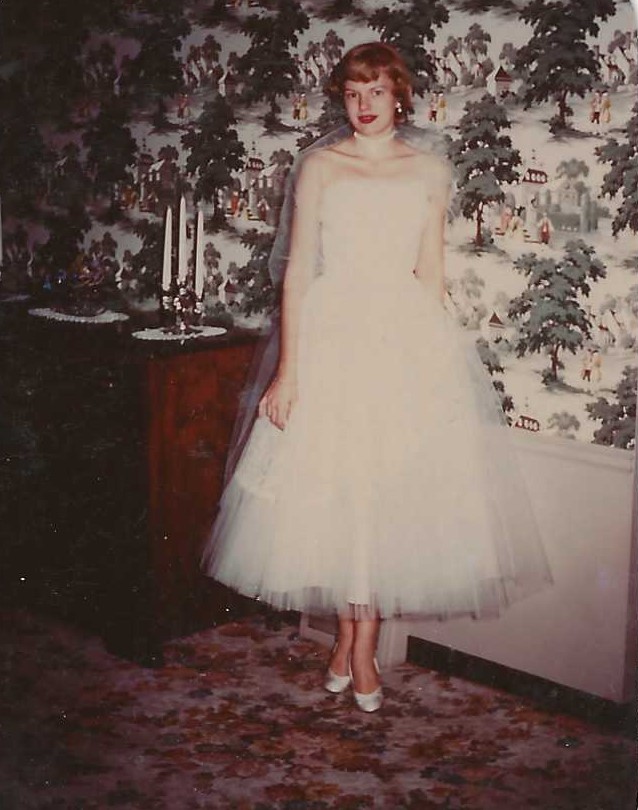
During the holidays I was sifting through old family photos when I came across a picture of a young woman in an elegant tea-length dress, the kind she might have worn to a prom. If you look closely at the picture, you can see the whisper of sheer filmy material wrapped around her shoulders and trailing down her back. From her classic pearl jewelry to her satin-sheen shoes, she’s ready for the red carpet.
She looks like Rosemary Clooney: the hair, the face, the dress. If I hadn’t watched White Christmas a few days before, I might not have noticed the resemblance. But because I had, I found the similarity uncanny. Was the young woman in the photo trying to look like Miss Clooney or some other movie star of the time? Adoring fans often copy the fashions and hairstyles of their favorite celebrities. In 1976, after figure skater Dorothy Hamill won an Olympic gold medal, many fans rushed to their hairdressers, asking for the Dorothy Hamill haircut. The graceful movement of Hamill’s hair as she skated across the ice was nearly as beautiful as her figure skating. Five years later Prince Charles would become engaged to Lady Diana, who also had gorgeous haircuts throughout the years. Once again women rushed to their hairdressers, this time with photos of Diana’s most recent hairstyle.
I hadn’t seen White Christmas in years, but when my sisters and I were kids, we loved the movie. We made sure to watch it every Christmas season, along with Frosty the Snowman, Rudolph the Red-Nosed Reindeer, A Charlie Brown Christmas, and The Grinch Who Stole Christmas. We had one chance to see these specials during the holidays. If we missed it, we had to wait until the next year. I hate to sound like an old person whining about how tough it was when I was young, but we didn’t have anything on demand. There were no streaming services, no VCRs or DVDs, and no marathon runs of shows playing over and over. If we missed one of our favorite Christmas shows, we had to wait until the next year to see it. We had four channels: ABC, CBS, NBC, and PBS. Our neighbors had the same four channels, but they had a bigger antenna than ours, so they picked up a channel out of Chicago which ran old TV shows. My sisters and I were Grinch-green envious, and we often spent time at their house watching reruns of old sitcoms and westerns.
I don’t recognize the Rosemary Clooney look-alike in this photo. I sent a copy of it to my two aunts, but neither of them remembered her. She might’ve been the child of one of my grandmother’s friends or relatives. She could’ve been one of my dad’s girlfriends, but the photo was taken at Rainbo Studios in St. Louis, Missouri, and my father grew up in northern Wisconsin. Still, there were lots of families who came from faraway places to spend all or part of the summer on the lakes in the north woods of Wisconsin. Many of the local teens had summer romances with the vacationing teens. I did some research on Rainbo Studios and learned that it operated during the 1950s.
All I’ve learned about the girl is that she put on a pretty dress and had her picture taken at a now defunct studio in St. Louis, Missouri.
Studio photo of Rosemary Clooney, 1954, the year White Christmas was released
“I wish someone would’ve written a name and year on the back of this photo,” I said to my husband. Then added, “I should write the names of people I recognize on the backs of the photos that aren’t labeled.”
“Who’s going to care after you?” he asked. He has a point. When I’m gone, what will become of these old photos? Pictures of grandparents, great-grandparents, aunts and uncles, great-aunts and great-uncles, cousins and shirt-tail cousins, not to mention the friends and neighbors who appear in some of the photos. I don’t know most of them, but I do know some of them.
These photos will eventually end up in the garbage. I hate writing that sentence, but unless someone in my family develops an interest in family history that will probably be the case. I’ve worked on some family history. I wrote a book with my mother-in-law about her life, and I re-typed and updated a family history that my grandpa George’s cousin wrote. I’ve written about some of the family history on my mother’s side too. But I’m a short story and essay writer, so I spend most of my spare time writing fiction and essays.
I won’t be the one to throw the old photos away. I love them, and occasionally, I look at the people in the pictures and imagine their stories. What happened in the days before and after their pictures were snapped? What were their dreams and hopes? How did their lives play out? I know the answers to some of these questions, but mostly I don’t. Sometimes one of my aunts can tell me about the people in a photo and may also remember something about the day the photo was taken. But often they can’t because they either weren’t born yet, or they were small children at the time.
I’ll never know the name of the Rosemary Clooney look-alike, but on the back of her photo I wrote, 1950s. It’s all I have to offer her. Somewhere, someone knows who she is. She could still be alive. For now, I’m keeping the photo on my writing desk. Now and then, I hold it in my hand and wonder, “Was she a Rosemary Clooney fan? Where was she going? What was the rest of her life like? How did her picture end up in my grandparents’ box of photos?” Perhaps I’ll hit upon an idea and be inspired to write a short story about her. Of course, the answers to my questions will be fiction, leaving the real young woman a mystery.
I’ve taken great care to write names and dates on the backsides of the photos I’ve snapped over the years and put into albums, but eventually, the photos of my family and friends will end up in boxes, becoming memories without stories. Ultimately, they will end up in a landfill.
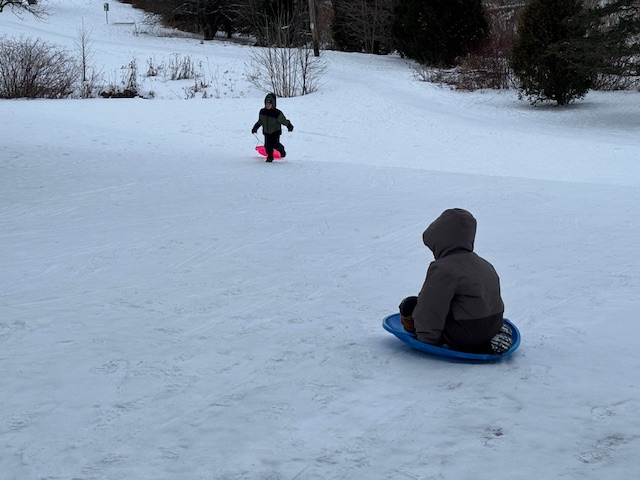
Evan coming up the hill and Charlie going down the hill. Because the weather was about 15 degrees colder than the day before, we had the hill to ourselves.
On Monday and Tuesday, both warm winter days, my grandkids and I drove by Central Park numerous times while running errands. Not the famous 843-acre Central Park in New York City, but the Central Park in my hometown, around ten acres in size. Each time we drove by, we saw children sledding down the hills at the western side of the park.
“Can we go sledding there?” Evan, the nine-year-old, asked each time we passed it.
“If you bring your snow pants with you tomorrow, I’ll take you sledding,” I said. “But it’s supposed to be below zero in the morning.”
On Wednesday, the grandkids came with their snow pants, and the morning temperature was actually fourteen degrees, so after breakfast we stowed the sleds in my van and went sledding. I wore long underwear under my jeans, thick wool socks inside my boots, and a wool sweater under my down coat. To complete my winter ensemble, I donned a thick stocking cap, slipped my hands into a pair of lined mittens, and wrapped a scarf around my neck. But I knew it wouldn’t be enough, and that I would be cold while standing on the hill in the park as the wind circled around me.
“What if they have sleds there we can use?” Evan asked as we drove to the park.
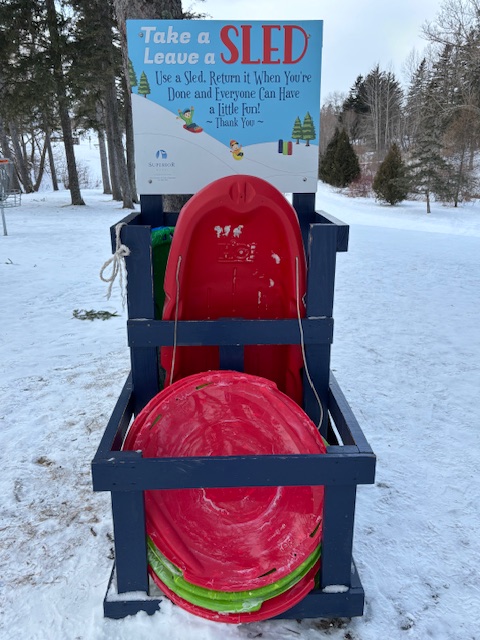
The parks & rec department in my town does a wonderful job.
“I don’t think so,” I said. I didn’t believe the city would spend money to provide sleds, only to worry about them being pilfered or broken. But when we arrived at the hill, there was a rack filled with sleds and topped with a tiny poem: “Use a Sled, Return it When You’re Done and Everyone Can Have a Little Fun!”
I’d been the one with the jaded heart, but my city’s parks & rec department had faith in its young citizens. “Look, Evan,” I said, pointing at the sign, “you were right.” My grandsons mostly used their own sleds, but occasionally borrowed one of the saucer sleds from the rack.
Peals of laughter and shouts of joy filled the air as they sped down the hill. I pulled my phone from my pocket to take some pictures and to look at the time — only five minutes had passed and I was already freezing. At that moment, as if to mock me, Old Man Winter exhaled a powerful gust of frigid air. I huddled next to a pine tree, but the narrow trunk did nothing to protect me from the wind’s icy breath. I wanted to go home, but anything less than a solid thirty minutes on the hill, and my grandkids would be disappointed. They were having a great time.
My chariot of fun!
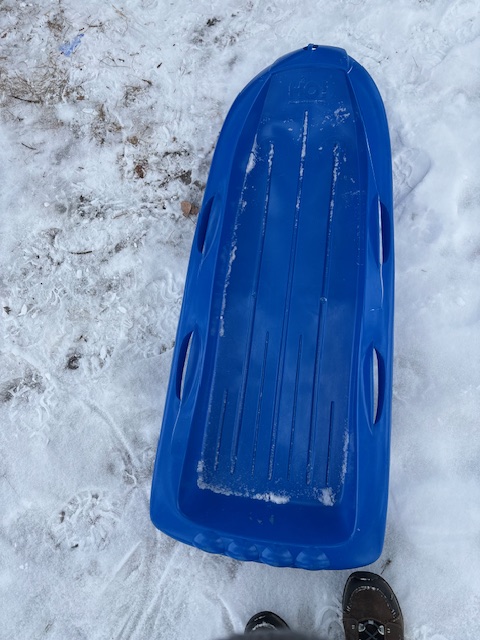
I decided I had two choices. I could stand on the hill and freeze, or I could hit the slopes. I placed a blue sled at the top of the hill and looked down at it.
“Nana, are you going to sled down the hill?” one of the grandkids asked.
“Yes,” I answered. I gazed at the sled and remembered how much I loved sledding when I was young. Plus, there were no adults around (like my husband) to ask, “Do you think that’s a good idea at your age?”
With grins on their faces and anticipation in their hearts, my grandsons waited to see Nana “bomb” down the hill. They knew I could do it.
Successfully, but not too gracefully, I lowered myself into the sled. I pushed off with my hands and raced down the hill, bobbing up and down on the slightly uneven terrain. By the time I used my feet as brakes to stop the sled before reaching a line of trees along a frozen creek, I felt much warmer.
Was it the thrill of the ride that pumped blood through my veins and warmed my body? Or was it the memory of getting a toboggan for Christmas as a girl and using it to sled at Whitnall Park throughout my childhood and teenage years? Either way I was ecstatic as I walked back up the hill with my sled in tow. I wasn’t cold anymore. The key to being outside in winter is to keep moving and have fun.
I went down the hill many times. I felt ageless, still capable of doing something I did when I was young. Dopamine filled my brain, and I was over-the-moon happy.
We stayed for forty minutes. On our way back to the car, Evan asked if we could come back in the afternoon.
“Sure,” I said, and I meant it. I wasn’t just saying it in the moment, figuring I’d find a way to back out later on. Sometimes we do that as adults. But like my grandkids, I wanted to go sledding again, even if it meant the dishes didn’t get done or supper would be late.
I fed the boys lunch then took them to the library for a kids’ craft hour. I went to the grocery store for ingredients so I could make chicken enchiladas after our second round of sledding.
We returned to Central Park just before three o’clock, and stayed for more than a half hour. This time I didn’t wait to get cold. I grabbed a sled immediately and began zooming down the hill, loving the speed and the winter’s air that filled my lungs, caressed my face, and returned me to my youth.
Sledding with my grandkids was the most fun I’d had in a very long time.
I made a New Year’s resolution to behave like a child more often.
Final Approach into Minneapolis-St. Paul International Airport, September 23, 2025
The pilot’s voice comes over the PA, asking passengers and flight attendants to prepare for the final approach.
If I’m reading, I close my book. If I’m resting, I open my eyes. If the window shade is down, I raise it. From the moment of the pilot’s announcement until the wheels touch the runway, and the force from the plane’s thrust-reverse system pushes me back against my seat, I will keep watch out the window.
Out the window I’m met by thick, irregular shaped clouds spattered through the Midwestern skies over Minneapolis-St. Paul and its suburbs. I have a window seat. I always try to have a window seat. Considering I don’t like to be boxed into a space, this is unusual for me. But instead of feeling claustrophobic and trapped, I’m comforted by the world outside the window, even if I’m thousands of feet above the earth. The pilot asks passengers to fasten their seatbelts, stow their trays, and return their seats to an upright position. Flight attendants make their final walks up and down the aisle.
My love of the window seat on a plane began as a young child. I would fly with my father, who had a private pilot’s license. Over the years he owned a series of mostly single-engine airplanes, so every seat had a window. If my mother wasn’t on the plane, and she rarely was, I rode in the front passenger seat. Views surrounded me. Flying north and south across Wisconsin, I was mesmerized by patchworked parcels of land seamed together with ribbons of road. Rivers meandered and lakes nestled in the landscape. Houses and buildings, cows and horses looked like toys left behind by children. And I liked to imagine the cars and trucks had been wound by hand and set upon the roads. Every time I flew with my father and he landed the plane and shut it down, he’d declare, “Cheated death again.”
Our approach into Minneapolis-St. Paul International Airport is a series of wide turns creating the illusion we are flying in slow motion as we descend through billowy clouds. The plane banks, then banks again. Each turn provides a view of the earth below then a view of the clouds above. I’m transcended. I’m fearless. I don’t worry about the plane falling from the sky. I’m not watching out the window in a hope to divert disaster. I’m watching out the window because I’m enchanted by the most beautiful final approach I think I’ve ever experienced. I’m not worried about the landing. If something goes wrong, I’ve had a seat to a stunning view after a lovely trip to Scotland.
As a child, I knew planes crashed, but I never worried when my father flew his small plane. I took my first commercial flight when I was seventeen, a trip to Europe with other students and chaperones. I don’t remember being afraid. But by the time I was in my early twenties, commercial flying scared me. There was a spate of commercial crashes from the 1970s through the 1980s. And there was the echo of my father’s words, “Cheated death again.”
On one of the plane’s banks, I see a shimmering steel-colored river reflecting the sun and clouds. I wonder if it’s the Mississippi or the Minnesota. In a final crescendo, the sky has become a cobalt blue, and shades of industrial gray dance across the land and river.
In my 20s, 30s, and 40s, I avoided commercial flying. I rarely traveled to see my family because it meant getting on a jet. When I did agree to fly to see my parents or siblings, dread stalked me. In the weeks and days before my flight, I’d wake in the middle of the night certain my plane would crash. My dread inflated like a balloon until I thought it would burst. Then my departure date would arrive, and I’d head to the airport. Caught up in waves of people coming and going, I, too, would become excited to be going somewhere. My fear would dissipate. I’d board the plane, buckle my seatbelt, open a book, and read. When the plane started moving, I’d look out the window. (Most crashes happen on takeoffs and landings.) I’d watch the plane roll down the runway, lift off the ground, and clear its controlled airspace. Then, and only then, I’d return to my book.
As we near the runway cleared for our landing, I know the plane is traveling at speeds faster than I ever drive, but that’s not how it feels from the air. I’m suspended in time and space. I realize I’m not in a hurry to land. I’d like to ask the pilot to go around one more time. I have just returned from Scotland, home to some of the world’s most beautiful scenery. But the views on this final approach rival the scenes of Scotland, not because they are similar, but because they are so different. I’m home. In my Midwestern part of the United States. A land with its own innate and man-made beauty.
By the time I was in my late twenties, my fear of flying spread to small planes like my father flew. After I married and had children, my father would fly his small plane from Arizona to Wisconsin every summer. He’d attend the Experimental Aircraft Association show in Oshkosh, visit friends in southern Wisconsin, then fly into the Bong Airport in Superior. He’d call me from the air, and I’d load my children and dogs into the car and meet him at the airport. I’d help him tie down his plane, a ritual we completed many times when I was young. At some point during his visit, he’d take my boys and me for a flight. At first, I was okay with this, but as each year passed, my fear of flying in a small plane surpassed my fear of flying in commercial jets. I knew the statistics. Small private planes were more dangerous. At least, with my children in the plane, he didn’t say, “Cheated death again.”
The flight attendants have all taken their seats. Our Delta Flight 1127 levels, ready for landing. I don’t experience a moment of panic.
Last February Delta Flight 4819 landed upside down on a runway in Toronto. No one died. My mother, who knew I’d be flying Delta to Scotland, lost no time in phoning to tell me about the inverted landing. “It’s comforting to know, “I replied, “that I’ve chosen an airline whose pilots know how to land a jet upside down.”
Up until our final descent, the jet engines droned quietly. But now just before we land, pilots adjust flaps and slats to increase drag in order to slow the plane even more. A loud rumble fills my ears. The wheels of the plane hit the ground and the spell is broken. The pilots reverse thrust and a deafening roar assaults my ears, and I’m pressed into the back of my seat.
One year, before my father came to visit, I asked my sister to tell him that I didn’t want to go up in his plane anymore. That I couldn’t handle the weeks of anxiety before the flight. My father came and went and never mentioned a plane ride. Later, on another one of his visits, he told me about a friend of his who had flown for years for work and for recreation. “Gary,” Dad said, “can no longer get on a plane, private or commercial.” I stood at my kitchen sink washing dishes, my back to my father. I didn’t turn around. He continued, “Gary said he’s flown for decades without an accident, and he feels he’s used up all his luck.” (Gary felt his time for “cheating death once again” had run out.) I said nothing, and my father said nothing else. I believe he told me this story because he knew I had a fear of flying, and this was his way of saying he understood. One of his occasional moments of empathy.
I still won’t get on a private plane, but I don’t worry about flying commercially, or take offs, or landings any more. My father’s refrain, “cheated death again,” doesn’t play through my head. Perhaps because I’m of a certain age, I’ve come to realize it’s a waste of energy, worrying about something I can’t control. Sometimes the only way to get somewhere is to fly. My mother can’t fly anymore but there are places she’d like to go. Her world has shrunk. Perhaps one day, I won’t be able to fly anymore either, so I’ll go while I can. And instead, I’ll fret about getting stranded in an airport or worse, getting stranded in a plane on the tarmac.
We taxi up to the gate, our plane is an hour late getting in (some mechanical thing in Boston), but I still have plenty of time to catch the airport shuttle for home.
After it was all said and done. After I’d decided on two pairs of shoes to purchase, and the mother and daughter who were shoe shopping alongside me had decided on three pairs of shoes between the two of them, the sales clerk reordered the chaos on the floor. She checked the labels and sizes to make sure two shoes (a left and a right) of the same size went into a box with the corresponding size, style, and brand. The young sales clerk, maybe twenty years old, was swift and accurate.
After the clerk walked away to meet the mother and daughter at the checkout, my husband said he was surprised that the sales clerk had let the area become so messy.
“Oh, no,” I said. “This is how women shop for shoes.”
He raised his eyebrows and gave that look people give when they want to say, “Wow! That’s just crazy” without saying, “Wow! That’s just crazy.”
He didn’t know women have rules for shoe shopping. He just picks out one pair of shoes at a time, asks for his size, and tries them on. But women circle the store and gather several different types of shoes before approaching the sales clerk.
“I’ve been shopping for shoes for years, with my mother, with friends, and this is how we’ve always done it,” I said.
I explained all this to my husband as I walked around the store in a pair of shoes I was still auditioning. I stopped in front of the shoe mirror to see how they looked from the side. I walked up to my husband and asked, “Do these shoes make my feet look big?”
He laughed. “Of course,” he said.
I laughed because he got the joke.
Women really do have their own set of rules for shoe shopping. We try one pair then another pair. Maybe try them again. We ask for different sizes. We look at more shoes, and try those. And while we do this, the unboxed shoes stay on the floor. Unless we specifically tell the clerk that a pair of shoes are definitely a no go. A good shoe sales clerk knows this. It’s not chaos. We need to be able to see the whole array of shoes in front of us.
I haven’t had so much fun buying shoes in a long time. The mother and daughter and I had a good time visiting with each other while we tried on shoes. We laughed and joked together. The mother and I bought the same shoes. “If I see those shoes out in public, I’ll recognize you,” she said.
Best of all, the sales clerk was a joy. She was knowledgeable about the shoes in the store. She kept all our requests for different styles and sizes straight while she helped all three of us at the same time. She treated us like our quest for the perfect shoe was important. She understood how women shop for shoes.
A happy pollinator on the first flowers we encountered
Two years ago I took my four grandkids to a rose garden. We smelled the roses, walked along Lake Superior, ate ice cream, and tossed rocks in the water. Then we did it again last year. So, of course, we had to do it again this year. It’s a tradition now. When my grandkids are grown up and old, they will say to each other, “Remember when Nana took us to the rose garden every summer, and we’d get ice cream then throw rocks in the lake?” Just like I recall my nana taking us to George Webb, Sherman Park, and Capital Drive, and letting us use her galvanized steel wash tubs as swimming pools on hot days.
Can you find the pollinator in the rose?
We arrived at the rose garden, which also has other flowers. We spotted bees slurping nectar. My oldest grandchild took photos of the bees and roses. I took photos of the bees and roses. My other three grandkids watched the bees and smelled the roses. We all love the flowers and bees. I like to refer to bees as pollinators, like it’s a royal title and the bees belong to a noble class. Watching pollinators feed on flowers gives me hope for the world. If you want to help create hope, plant something pollinators like, and make sure it’s pesticide free.
As we smelled the roses, we took care to look for bees before sniffing. We didn’t want our noses stung, or egads, to inhale a bee. We visited the rose garden a couple of weeks later than we normally do, so we missed the peak bloom. But the roses that had waited for us didn’t disappoint.
My grandkids love the functioning water fountain, a focal point in the garden. I handed out pennies for wishes. They splashed their hands in the water. One of them found a small, round, flat stone painted with the message Make a Wish. I think more than one of them would have liked to climb into the fountain. Kids and water just go together. The summer I was twelve, my siblings and I spent three weeks with our grandma Olive. Every day we begged her to take us to Bluegill Lake so we could swim. The fountain in the rose garden was originally located in a different part of the city, where it supplied fresh water for horses in the days before automobiles. Everything changes.
After spending time with the roses, we headed down the Lakewalk, and enjoyed the views of Lake Superior. Later, on our way back, my youngest grandchild stopped at several of the park benches and assessed the views, commenting on each one. Perhaps, he is a budding travel writer.
On our walk from the gardens to the ice cream shop, we always stop at a large stone stage. Flanked with two stout turrets, it has a castle vibe. My grandkids ran across the stage and through the hidden passageways behind it, then suddenly appeared once again. Their laughter and excited shouts to one another rang through the air. I thought about Shakespeare’s famous line, “All the world’s a stage,” followed by his musings about the “seven ages” of life from infancy to old age. I stood on the stage with my grandkids, yet apart from them, separated by several “ages” of life.
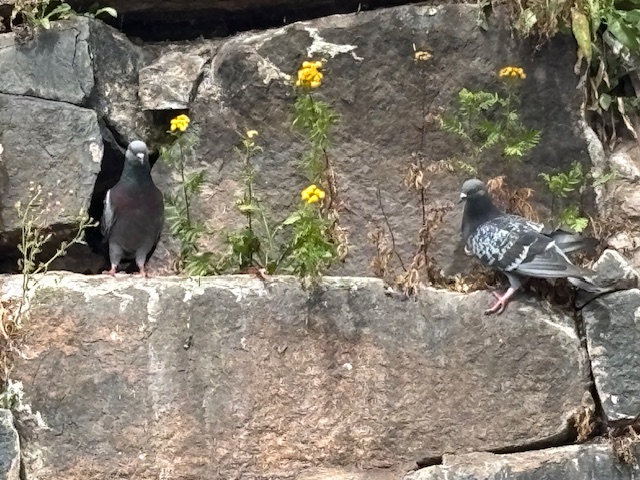
Peaceful pigeons
The cooing sounds of pigeons who nest in the nooks of a stone wall along the railroad tracks captured the attention of my grandkids. One grandchild was impressed by the range of their colors and the variety of their markings. And the other three started a cooing conversation with the pigeons. I have to say, the cooing sounds my grandkids made were impressive, but finally I said, “What if the pigeons hear your coos as a battle cry and attack?” Yes, you got it, I was thinking about Alfred Hitchcock’s The Birds. I saw the movie once, years ago, and I’m still miffed Hitchcock killed off Suzanne Pleshette’s character in the movie! She was one of my favorite actors.
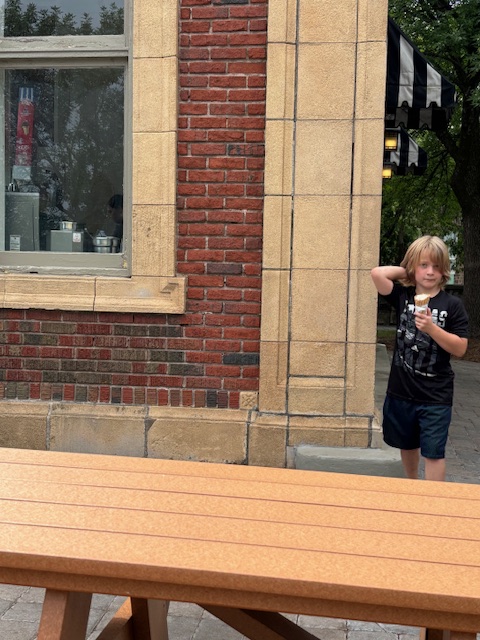
If you asked my grandkids what they liked best about our adventure, they would probably say the ice cream. It’s what I would have said when I was their age. The picnic tables at the ice cream shop were new and so was the chocolate mint ice cream used to make my malt. For thirty years I’ve been ordering chocolate mint malts, made with the same minty ice cream filled with thin, flat pieces of dark chocolate. This year the ice cream was a little too minty and the thin, flat pieces of chocolate were replaced by mini chocolate chips. It was good, but not as good as it used to be. Next year I’m going to order a different flavored malt. Maybe I will find a new favorite. The clerk at the shop said they could no longer get the same kind of chocolate mint ice cream. All things change. But don’t ask me to say change is good when it comes to my ice cream. Some wasps hung out with us while we ate our treats. None of us panicked, but neither did we share our ice cream with them.
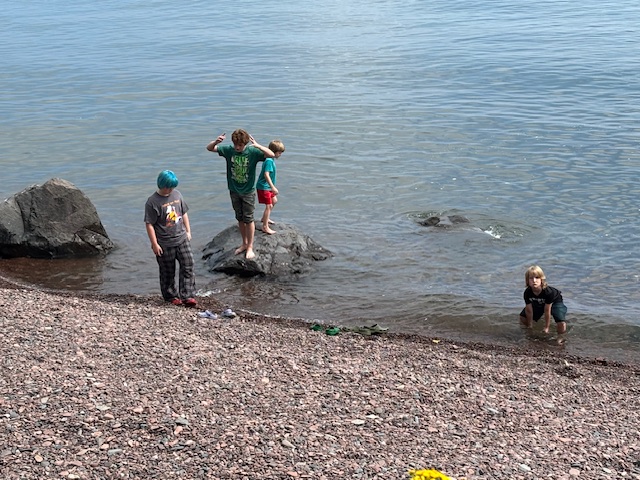
Our next stop was the lakeshore filled with rocks waiting for my grandkids to toss them back into the water. Now that they are older, they try to skip the rocks across the water instead of just throwing them. I planned to let them stay ten minutes, maybe fifteen, but they were having so much fun with each other. I watched them toss rocks, look for agates and beach glass, and play with driftwood, and suddenly I could see my siblings and myself on the sandy shores of Bluegill Lake seining for minnows, building sand castles, and floating on inner tubes in the water. I marveled at how long ago that was and yet how quickly the years had passed — in the snap of a finger. We stayed for more than a half hour. This was the best part of my day. Because while my grandkids on the beach had no idea how quickly time would slip by, I did.
On August 10, I posted a picture of a caterpillar that looked like it had been assembled by a young child with a vivid imagination.
One reader said that it looked like a wet Tussock Moth caterpillar. At first, I thought the word wet was part of the caterpillar’s name. Then I realized I’d been hosing dirt off the lower part of my house’s foundation. The caterpillar rested about five feet up, but the mist from the hose gave it a shower, making it look even more fanciful than when it’s dry. A few days later, another reader also identified the caterpillar as a Tussock Moth. (There are about thirty different varieties of Tussock Moths.)
To watch a video about White-Marked Tussock caterpillars and moths, click here. Note: In this video the Tussock caterpillar is crawling on a person’s finger and hand. Because the caterpillars release toxins to discourage being eaten by predators, humans handling the caterpillars could experience itching and burning after touching them. I’d say it’s best not to touch. To learn more about Tussock Moths and see a picture of an adult version, click here.
Tussock caterpillars eat the leaves of a wide variety of trees, bushes, and other plants. They have voracious appetites, sometimes leaving trees bare. Although I’m sure no one wants to see the leaves on their trees disappear, people need to keep in mind that because Tussock Moths are native to their North American habitats, they are part of a balanced ecosystem. So, Mother Nature has an answer for Tussock Moths when they become too numerous — a virus outbreak among the species causes their numbers to drop, and that gives trees a chance to recover. However, some trees will die or be weakened and become more susceptible to other diseases and pests. As part of their ecosystem, Tussock Moths also face predation from native species found in their habitat: some birds, insects, bats, and small animals will eat Tussock Moths in their various stages of development.
While some types of trees can better withstand hungry Tussock caterpillars, other trees, especially conifers, are more susceptible to destruction. If you notice the leaves disappearing off your deciduous or coniferous trees, it might be wise to seek advice from several reliable sources.
On a literary bent, and because I often make connections to things I’ve read . . .
While watching the video on White-Marked Tussock Moths, I learned female White-Marked moths are either wingless or nearly wingless, as are most Tussock Moth species. They will never take flight. The male will find them, mate with them, then fly away to mate with other females. The female will lay her eggs and die shortly after. That’s it. She will never experience flight. Now, I know Mother Nature has specific ways of providing for the continued survival of each species, and I know I’m anthropomorphizing the White-Marked Tussock Moth, but I felt for the female moth who would never fly.
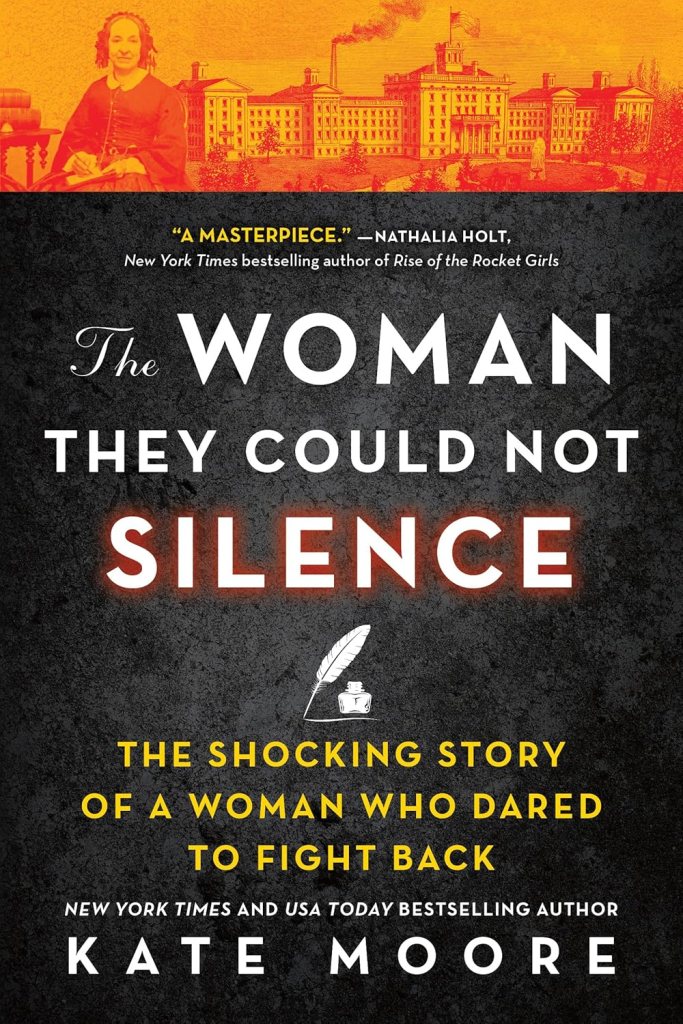
As I watched this video, I immediately thought about Kate Moore’s nonfiction book The Woman They Could Not Silence: The Shocking Story of a Woman Who Dared to Fight Back. In her book, Moore tells the story of Elizabeth Packard who is married to Theophilus Packard, a minister, and the mother of five children. It’s 1860, and after twenty-one years of marriage and being told what to think and say, Elizabeth dares to spread her wings and fly. A deeply devout woman, she begins to question some of her husband’s church’s teachings. She writes essays about her doubts and concerns. Theophilus tells her to stop, but she won’t because she believes she is a separate person from her husband and entitled to her own thoughts and opinions.
Outraged, Theophilus has Elizabeth declared insane and committed to the Illinois State Hospital in Jacksonville, Illinois. Shockingly, because Elizabeth is his wife, and because the state of Illinois allowed it, Theophilus is able to have her locked up simply on his say-so. After Elizabeth is placed in the state hospital, she discovers she isn’t the only married woman to have been declared insane by a husband who wanted his wife out of the way. Ironically, if Elizabeth and the other women had been single, it would have taken a jury of six people to agree they should be committed.
Through Elizabeth Packard’s powerful story set in the second half of the 1800s, Kate Moore explores the second-class status of women, the abysmal conditions in state hospitals, and the arrogant doctors and medical staff who professed to be experts in psychology, but who truly did great harm to the people they should have protected. Moore also talks about the people who, along with Elizabeth, worked tirelessly to change attitudes and laws to give women more rights and to reform state hospitals.
I’m just going to say it — Hey, Mother Nature, how about giving the female Tussock Moth wings?













 Writing Near the Lake