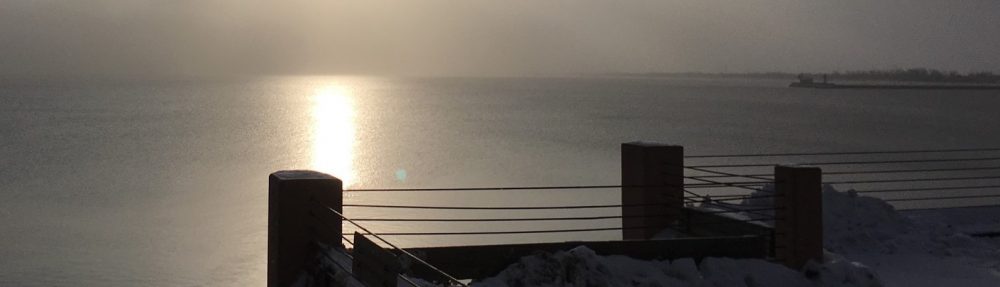
Old Love Inspires Me to Write Again

[When COVID-19 caused dangerous spikes and lockdowns in April and May, I became too anxious to write. I’d only been writing over a year, and this was my first serious bout with writer’s block. But I needed a creative outlet, so I turned to a cherished hobby. “Old Love Inspires Me to Write Again” appeared on Lake Superior Writers’ Blog on June 17, 2020.]

COVID-19. Schools are closed; nonessential businesses are closed. But I worry about my husband, an essential worker, getting sick. I fret about my 79-year-old mother living alone in Michigan. I miss my children and grandchildren. I think about death.

And, I can’t write.

Fellow writers describe their new writing routines. Breathlessly, like excited young lovers, they talk about the hours they spend writing. I flutter between cleaning, cooking, walking dogs, and checking email. I’m not admitting I can’t write. Scariest thought racing through my head: Do I ever want to write again?

A writer writes, even in tough times. I wonder, Am I a real writer? I have ideas, but my concentration has jilted me. Then I read an essay by another writer who says that it’s okay to not write at this time. Validation. Perhaps I need a break.

I turn to an old love—quilting.

A stack of my son’s hockey T-shirts, which I’d cut and ironed to fusible interfacing months ago, squat on the dining room table.

I look at the T-shirt blocks and freeze. I’ve no pattern, and it takes precise measuring to create one. The blocks taunt me, much like my writing when I’m away from my desk. At this point, both are unrequited lovers.

Just start the quilt. Or write. Make a choice.

I begin surrounding each block with a black border, difficult because each block is a different size. I abandon the quilt and mop the kitchen floor.

Stop it. Start sewing. Make a mistake? Use a seam ripper—the delete button of sewing.

I return to sewing borders around each block until I come to the black T-shirt. Dilemma. A black border along the black T-shirt lacks contrast. I delve into my fabric stash. I find a gray print with a hint of pattern, which compliments the black T-shirt. Audition time. I place the black T-shirt on the gray fabric and return it to the other blocks. It screams, “Look at me!”
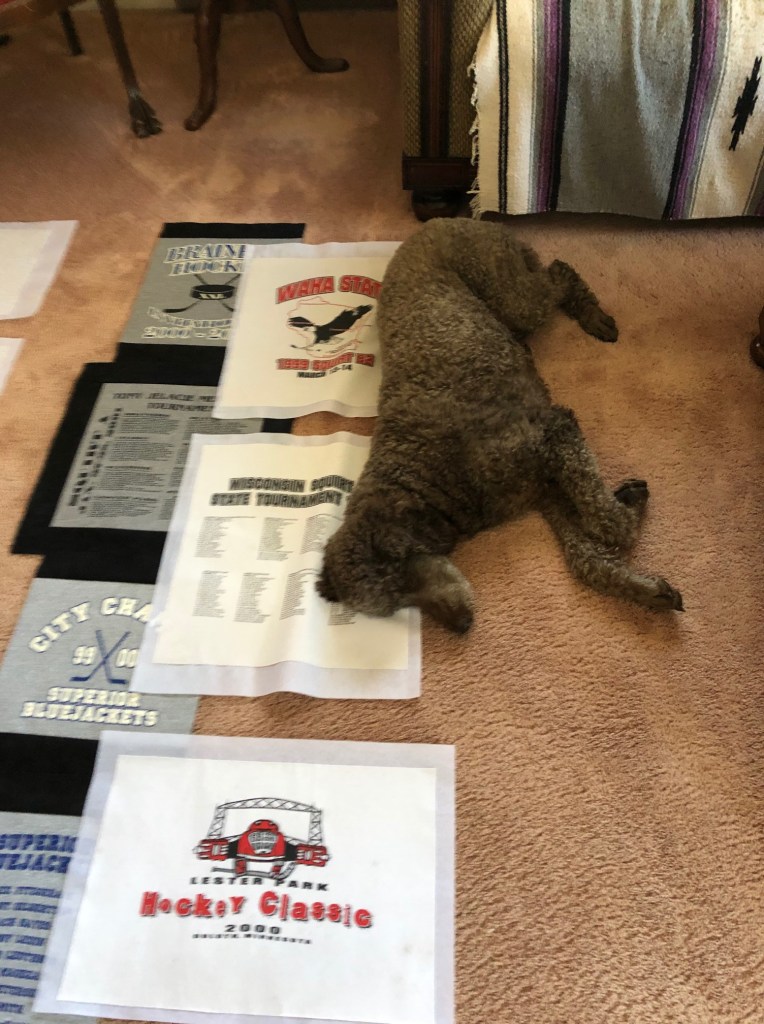
Cabela, our standard poodle, helps with the layout.

Egad, it’s a little darling. I kill it by replacing the gray border with the same black border I used on the other blocks. It no longer causes a scene and it works. Harmony returns to the quilt. Yes, the little darling had to go.

I arrange blocks on the floor. Blocks are sentences. Rows are paragraphs.I move blocks around. I exchange one row with another row. Reordering my “sentences” and “paragraphs” until the quilt reveals its best version.

I stitch the blocks together in vertical rows. Time to add narrow strips of bold color between each row. I select fabrics of blue, green, and red to enhance the bright colors in the final border. But the quilt is already bigger than I expected. I could cut a row, but each row tells a story about my son’s hockey days as a player. I study the T-shirt blocks on the floor. They float on the black background. Separating each row with a color would be superfluous: “words” that don’t belong. I stitch the rows together without colored strips. My son’s quilt is ready to go to the machine quilter.

The finished quilt top before it went to the machine quilter, who quilted it with a pattern of hockey sticks and pucks. My son now has the quilt to keep him warm this winter.

I escaped the pressure to write by quilting. My hunger for creativity was satisfied, and my pursuit of serenity was realized. But writing followed me throughout the composing and editing my son’s quilt. As I pieced the quilt, I wrote the rough draft of this essay, first in my head then at my desk. Quilting calmed me and gave me space to think about writing. It carried me back to my desk.

I’m writing again. But when I become too antsy, I throw myself into the arms of another quilting project.
From Journal Entry to Flash Essay

[Below is my journal entry from May 8, 2020, after discovering bunnies had eaten all my tulip buds but one. The journal entry was published by Passenger Journal’s Pandemic Diaries on May 12, 2020. I later developed the journal entry into a flash essay called “Tulips Beheaded.”]


Journal Entry May 8

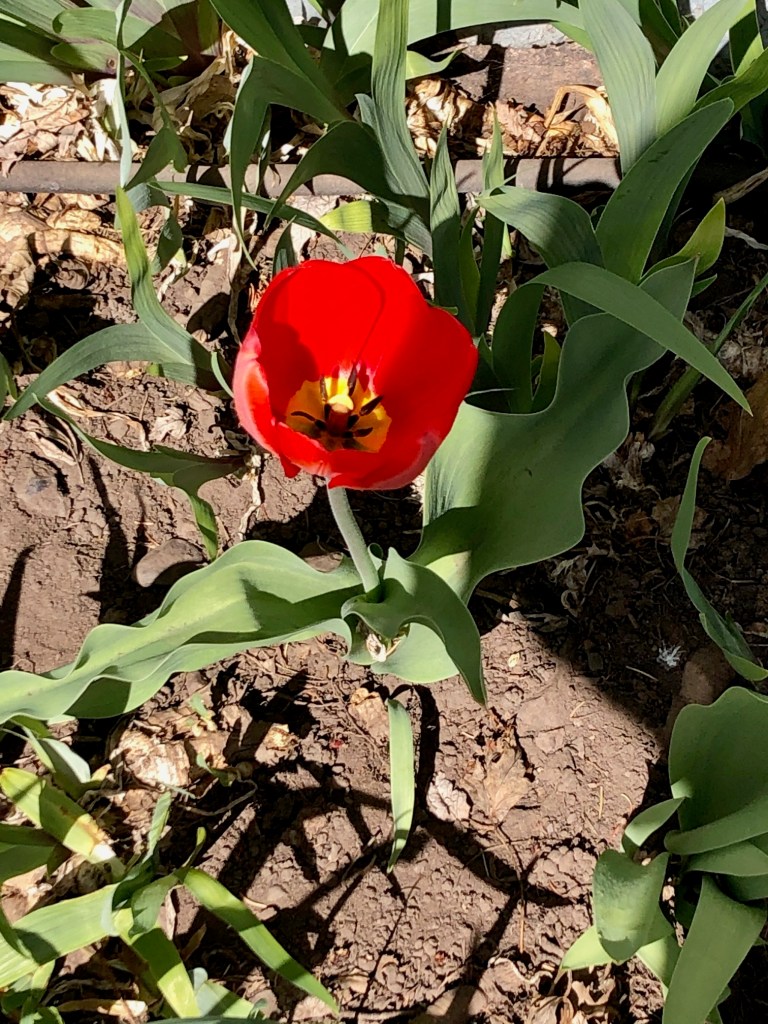
Only two daffodils bloomed, but the tulips showed great hope. Yesterday I counted nine tulip buds that were ready to burst open in red. This morning I walked to the back garden and found one red tulip with its petals fully opened to the sun. It caught my eye with its vibrant red. I looked at the other buds to see how close to blooming they were. Gone. All. Gone. Sheared off by some animal’s guillotine teeth. Probably some overly cute bunny. This has happened in past years, and this year we have lots and lots of bunnies in the neighborhood, so I wasn’t surprised to see my tulips decimated. What’s different is that I wanted to have a good, wailing cry. But I stuffed my tears because if I started, I wondered if I’d stop. 

Tulips Beheaded

Only two daffodils have bloomed, but the tulips show great promise. I count nine tulip buds ready to open and reveal their dressy reds, the color of tunics worn by the Queen’s Guard at Buckingham Palace. My tulips will stand watch in a humble stretch of garden nestled behind my house, allowing them to avoid cold spring winds advancing from Lake Superior. Because of the coronavirus and stay-at-home orders, I await the triumphant return of my tulips with enthusiasm.

The Lone Survivor

The following afternoon I return to my garden. A solitary red tulip, its petals open to the sun, stands at attention. I look toward the other tulip buds to see if they will soon join their companion. Gone. All gone. Only eight headless stems remain, each encircled by pointed leaves that failed to protect them, their buds sheared off by some animal’s guillotine teeth, most likely one of the hordes of rabbits pillaging the neighborhood.

I want to have a wailing cry. But I stuff my tears because decapitated tulips are nothing to cry about during a pandemic that has caused so much havoc. If I start crying, I wonder if I’ll stop.

An image of Elmer Fudd singing, kill the rabbit, kill the rabbit, from the cartoon parody of a tragic opera interrupts my thoughts. Fudd, performing an aria about killing his prey, sings what I feel. I sing with him, kill the rabbit, kill the rabbit. But Fudd is lampooning tragic opera. The parody strikes a chord with me because rabbits will not die by my hand. Tragic opera is about fatal flaws, vengeance, and remorse, and I can do without the remorse.

With kill the rabbit still echoing in my head, my brain retrieves the song “Circle of Life” from my memory bank. The tunes spar in my head. I smile at my dark humor, but the rabbits have won. Spring has been late in coming, and the rabbits are hungry.

I hope they enjoyed their fillet of tulip buds.

Elmer Fudd pops back into my head, singing, kill the COVID, kill the COVID.

Writing’s Daily Worries

[“Writing’s Daily Worries” appeared on Brevity Blog on December 18, 2019, and on Lake Superior Writers’ Blog on January 9, 2020. It was published in the anthology Many Waters: St. Croix Writers Stories and Poems in 2020.]

Thanks to writing, my worries have shifted. (So has my ability to make sure I put the milk in the refrigerator instead of the cupboard, but that’s another blog.)

I take a break from writing to get some water. In the kitchen I discover dishes are piling up and all the cereal bowls are dirty. But I worry about a story I want to submit to a contest, so I go back to my desk. I reread the story and forget to start the dishwasher. In the morning I’m handwashing cereal bowls.

“The truck needs an oil change,” my husband says.

“I’ll call,” I say, as I worry if a clause at the end of a sentence is nonessential or essential—to comma or not to comma. I don’t seem to have an ear for distinguishing between nonessential and essential clauses at the end of sentences.

Before I started writing, I worried about what to cook for supper. These days supper is a fleeting thought and easily evicted from my mind while I hunt for publications to submit a story. I play matchmaker. Is my story like their stories? Might it be considered even if it’s a little different? Or will some editor ask everyone in earshot, “Did she even read our journal?” My story doesn’t seem to fit. I read it again and wonder, Will I ever find it a date?

When my husband gets home, I’m reminded about supper. But it’s always another five minutes before he comes up from the basement. I keep looking at publications. When he gets upstairs, supper becomes a multiple-choice question: A) heat up leftovers, B) cook a frozen pizza, or C) go out for dinner.

Up from the basement, my husband asks, “Did you call the mechanic?”

“I forgot,” I say.

But I did rewrite the sentence I was fretting about. It lost its rhythm, so I changed it back. I played with the comma again. I put the comma in and read; I took the comma out and read. I raised my hands to the ceiling, threw back my head, and yelled. I thought about meditation, but I’d only think about commas. And comma meditation is an oxymoron. So, when he asks about the mechanic, I’m still worrying: nonessential or essential?

The real fear? I’ll make the wrong choice. An editor will read my story and notice a missing comma, in what she obviously knows is a nonessential clause. She’ll ask everyone in earshot, “How can this person call herself a writer?” It’s of no comfort that Oscar Wilde spent a whole day wrestling with one comma.

I give the comma a break and call the mechanic. If I wait until tomorrow, I might be prewriting a story in my head, and unless the story is about a mechanic . . .

After supper I go outside to pick up dog poop. I hardly notice the robust weeds in my gardens. Before I started writing, they’d registered in my brain like a 6-point earthquake. Embarrassment would lead me to pull the largest ones. But I’m looking for dog poop and trying to decide between two different endings for a short story that I’ve been working on for months. I don’t have any leftover brain capacity to feel shame about rogue weeds. Maybe I should abandon the story. But it taunts me when I ignore it, so I keep rekindling our relationship. I cut the story more slack than I’d give a person who gave me that much grief.

Maybe it would be easier to quit writing, but then I’d have to go back to my old worries.