It’s Fun to Discover that Someone Has Discovered You’ve Been Actively Writing

The editor of Perfect Duluth Day puts out a list every two years or so.

The “Guide to Duluth-related Blogs” was published in 2022 by Perfect Duluth Day, which is itself a blog, along with an events calendar and a section called “Saturday Essay,” where I’ve had three essays featured over the last couple years. But until yesterday, I hadn’t known that I’d been recognized as an active area blogger. This isn’t a prize or a big coup, but it made me smile like a red-carpet celebrity anyway.

In the photo to the right, I’m the blogger in the middle, standing in front of Lake Superior in Two Harbors, Minnesota, wearing my favorite raincoat, a raspberry red, flannel-lined Pendleton that I bought while shopping with my favorite aunt. My granddaughter took the photo.

I’ve been blogging since fall 2020. One Hundred and ninety-five people follow my blog. But out of those 195 followers, a certain percentage are hustling products. For example, I write about my dogs a lot, so occasionally companies who use blogs to market canine merchandise will “like” and “follow” my blog. Most likely an algorithm does this for them. And while I don’t write about makeup, skin care, or fashion, I have some followers who sell beauty products. Again, probably an algorithm, however misguided because I don’t wear makeup or use skincare products.

I don’t want to know how many of my 195 followers are companies trying to hawk products. Instead, I enjoy the people who interact with me via likes and comments. It’s heartwarming to know that something I wrote resonated with someone out there. So, thank you to all my readers. And thank you to Perfect Duluth Day for recognizing that I’m an active blogger in their area. As someone who knows she should get more exercise, it was nice to be labeled as active.

In an effort to hit 200 followers, I’m posting this picture of my standard poodle, Ziva. She had a bath and a haircut today at the doggie spa. She’s wearing a crystal and faux leather collar my mother bought for my first standard poodle, Bailey. As you can see Ziva is a reluctant, humble diva (but only when I take her picture). So, if there are any companies out there selling glamorous dog merch, turn on your algorithms. Ziva might be in the market for a glitzy coat, fur-lined booties, or specially formulated dog shampoo.

Ziva, the humble diva

Book Review: Hotel on the Corner of Bitter and Sweet by Jamie Ford

[Published in 2009 by Random House Publishing Group, Ford’s novel was a New York Times Bestseller.]

Why did I read this book?

First, the catchy title and the cover art intrigued me. Then, I read the synopsis on the back cover, and learned the novel was historical fiction, another plus. Next, I read the first page of the book, and I liked what I read. Finally, the cost of the book sealed the deal. It was $3.00. I was in a local hospital gift shop where they sell used books. Any time I go to either one of the local hospitals where I live, I stop in their gift stores. They have the loveliest gifts, and they sell used books, where I’ve purchased some wonderful books over the years. Hotel on the Corner of Bitter and Sweet is one of them.

What is this book about?

The story, set in Seattle, opens in 1986 in front of the Panama Hotel, a place that holds both bitter and sweet memories for Henry Lee, a Chinese American citizen, who is in his mid-fifties and has recently lost his wife, Ethel, to cancer. Since his wife’s death, Henry’s relationship with his adult son, Marty, has become even more strained because Ethel played go-between for the father and son. The story switches back and forth between 1986 and 1942. The chapters set in 1942 reveal twelve-year-old Henry’s childhood difficulties with his father; his friendships with Sheldon, an African-American jazz-playing saxophonist, and Mrs. Beatty, a cranky school cook; and his love for Keiko Okabe, a Japanese American girl who attends school with him.

An entrepreneur who recently bought the Panama Hotel has discovered suitcases and boxes of stashed possessions stored there for safekeeping by Japanese Americans in 1942 before they were transported to internment camps. But over the last forty-some years, no one has ever returned to claim their belongings. As Henry stands in front of the Panama Hotel, memories of his childhood sweetheart, Keiko, who was rounded up with her family in 1942 and sent to an internment camp, bubble to the surface. He decides to find an item that had special meaning to both of them, a symbol of their love for one another and their shared passion for jazz. He believes the item is somewhere among the hordes of forgotten objects in the basement of the hotel. Alone the search would overwhelm him, so he enlists the help of his son and his son’s girlfriend.

What makes this book memorable?

Jamie Ford’s novel has richly drawn characters and a finely crafted storyline that is, in turns, compelling, suspenseful, heartbreaking, and hopeful. This coming-of-age story about first love and forging one’s own way in the world, even against a parent’s wishes, is set against a backdrop of prejudice and misguided patriotism that rises to a crescendo after the bombing of Pearl Harbor in 1942. It’s also the story of immigrants who come to the United States, hoping for a better life for themselves and their children. But the parents and their children often clash as the older generation clings to the ways of the old country and their children adapt to the ways of the new country. The universal themes in Ford’s novel, told in a fresh way and set during a reprehensible episode in American history, are as relevant today as they were in 1942.

[To learn more about Jamie Ford and his other novels, click here. To learn more about the Panama Hotel, which was a real place and still exists, click here. To buy a copy of Ford’s novel, click here.]

A Conversation between Two Old Dogs

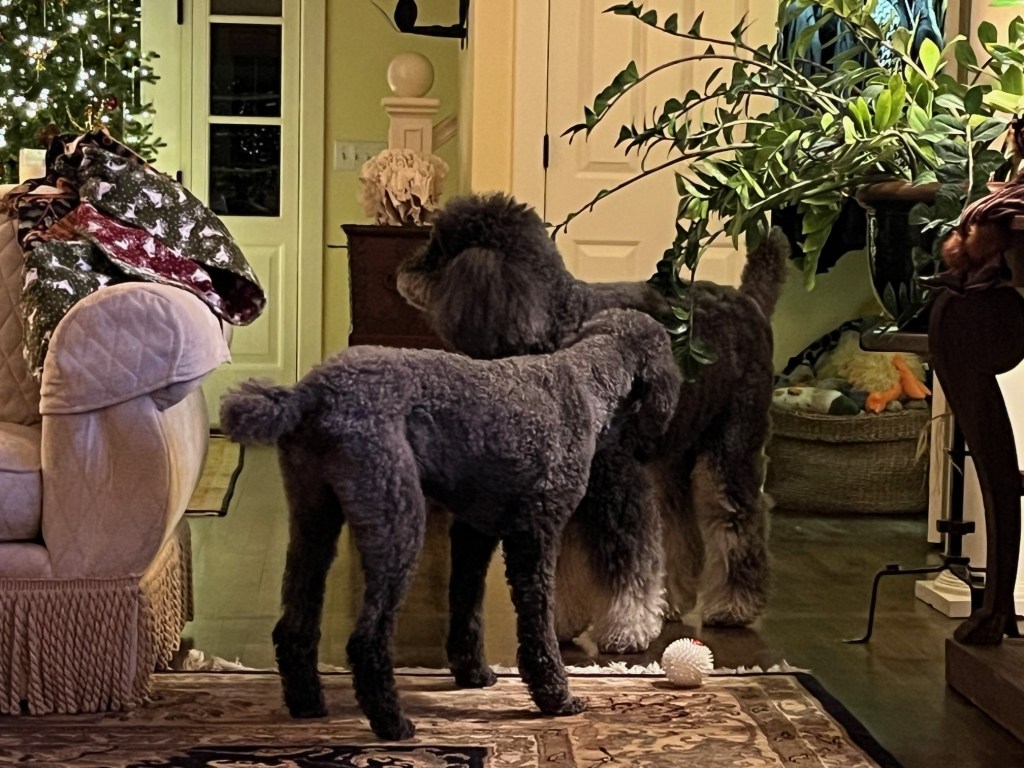
Bogey is the tall, fluffy poodle. Ziva, my poodle, stands in front of him.

“We’ve had this conversation before,” Ziva says. She is smaller than Bogey, four years older than Bogey, and a guest in his house. And he could easily knock her to the floor. But none of that stops her from putting her four paws down when he tries to play with a toy at night.

“Don’t touch that ball. Definitely, don’t squeak that ball,” Ziva says. “I tell you this every time I come to visit.” And she does. For the last eight years or so, Ziva has accompanied my husband and me to Petoskey, Michigan, whenever we visit my mother.

A moment before this photo was snapped, Bogey asked my mother to open the closet door. (If you look to the right in the photo, you can see his box of toys in the closet.) His yellow duck rested on the top, but Bogey selected the white ball because it has a delicious squeak, and because my mother will toss it in the living room for him. This is his nightly routine when we aren’t visiting Mom, and he sees no reason to give it up just because there’s company.

This bothers Ziva. And it bothers me too. Everyone has settled in on a couch or a chair. The humans are talking and watching TV. It’s hard to hear anything over the noise of Bogey’s squealing ball and stomping feet.

Tonight, Ziva rebukes Bogey as soon as she hears the first shriek from the ball. She springs from the couch where a second ago she seemed to be in a deep sleep and barks as she approaches him. Bogey drops the ball before she reaches him.

“Go ahead. I double dare you!” Ziva says, watching Bogey while she looks askance at the ball. They stand close together, frozen, for at least a minute. She doesn’t make a move for the ball because she doesn’t want it. She never wants his toys. At eight o’clock at night, she wants peace and quiet. Bogey has turned his head away, and refuses to make eye contact. He waits for her to go away, but she doesn’t. Not another word passes between them. Like a pair of disgruntled lovers, they’ve had this conversation so many times over the years that it has now become a wordless exchange, each side knowing what the other side would say if they did speak.

Ziva, asleep, yet completely tuned in

Ziva refuses to retreat. Finally, Bogey gives up and leaves the ball. He crawls under the long skinny table behind his favorite couch and sulks and waits. Ziva returns to her favorite couch.

Ten minutes later Bogey emerges from under the table and silently shuffles to the closet. He roots through his box of toys and pulls out a multi-colored stuffed caterpillar. He slinks into the den with his toy. He knows if he enters the living room with it, he won’t be allowed to have it. The ball Bogey had wanted to play with still lays on the living room floor. If Ziva heard him, she ignored him, allowing him a small victory.

Even tucked out of sight in the den, Bogey knows not to make the caterpillar squeal. He’s a very smart dog, and he has never won this argument.

Christmases at the Old Farmhouse

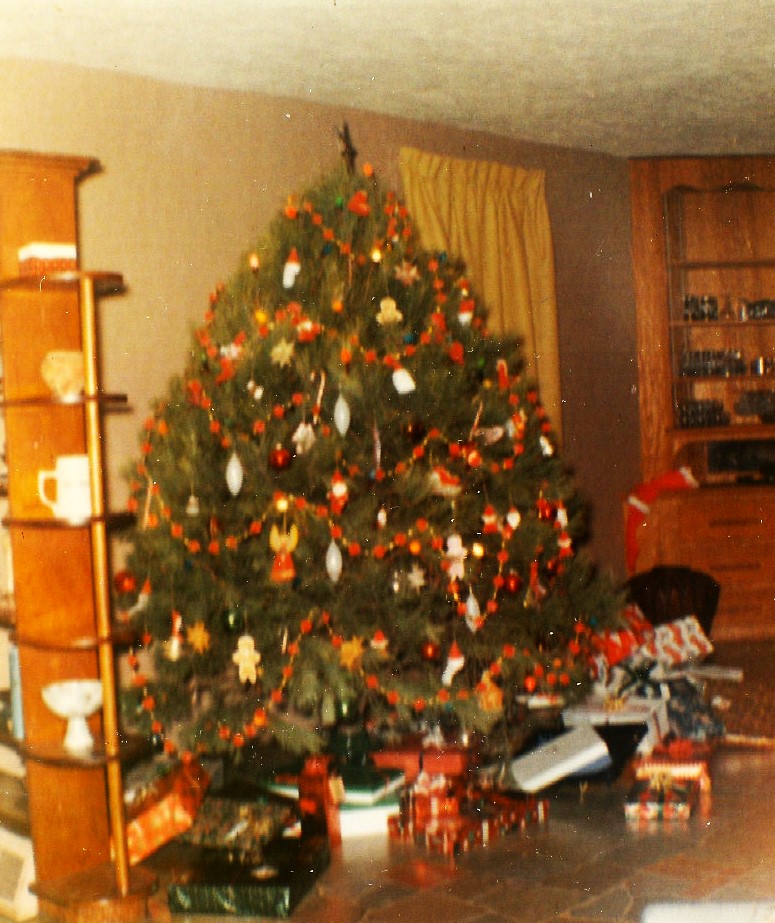
One of mom’s trees before she started putting them in front of the mirrored wall in the living room. Unfortunately, I have no pictures of the later Christmas trees.

At Christmas time when I was a child, my mother transformed our old farmhouse into a magical place. Fresh boughs of evergreen, sprayed with canned snow and trimmed with white twinkle lights, nestled on the mid-shelf of the corner hutch in the dining room. The soft glow of pastel-colored icicle lights outlined the large picture window in the living room. A tall, portly Christmas tree festooned with old fashioned ornaments and C7 lights stood in front of a mirrored wall, which made it appear as if we had two trees. Mom always bought a real tree. She would ask the attendant to hold tree after tree, while she walked around each one. The tree had to look good from all sides, and the trunk had to be straight. Once she sent my father to pick out the tree, but only once. Father’s tree spurred a loud conversation and a few tears.

Mom baked loads of homemade cookies, filling round tins with Mexican wedding cakes, sugar cookies, peppermint meringues, gingerbread men, and spritz cookies. In the days before Christmas, I skimmed cookies, sneaking one now and then from a tin then rearranging the remaining ones to fill the empty space.

The weekend before Christmas Mom took us to the American Soda Water Company, a place filled with bottles of the tastiest soda in so many delicious flavors, such as grapefruit, grape, strawberry, cherry, orange, root beer, cream, lime, cherry cola, black cherry, and more. She pushed the cart in which she had placed a wooden case that held twenty-four bottles. My siblings and I buzzed around the aisles plucking our favorite flavors and some of our father’s favorites. After we filled the case, mother placed another empty case on top of the full one. We would leave the store with four cases of soda, enough to see us well into the New Year because we weren’t allowed more than two or three a week. But we pilfered the occasional bottle of soda. Eventually, only empty bottles remained in the wooden cases, and Mom returned them to the soda company and collected her deposit, a nickel a bottle.

Winter at the farmhouse. The only animals we ever owned were dogs and cats. But it had been a working farm at one time. The buildings in the background belonged to neighbors.

On Christmas eve, my siblings and I nestled under our covers and tried to sleep. And when I couldn’t, I peered out the small window at the side of my bed and searched the starry sky, hoping to spot Rudolph’s red nose. However, by the time I was six, thanks to a know-it-all neighbor boy who was three years older than me, I knew there was no Santa Claus. Still, wanting to believe, I looked for Santa’s sleigh in the sky, and when I spotted red lights on a commercial jet heading to Billy Mitchell Airport, I would pretend it was Jolly Old St. Nick with Dasher and Dancer, Prancer and Vixen, Comet and Cupid, and Donner and Blitzen, all led by Rudolph and his shiny nose.

Eventually all was quiet in the house, my siblings and I softly snoring and dreaming of Christmas morning. At this time, my mother’s shift as Santa’s elf would begin. It took her hours to wrap presents for her four children. She couldn’t do this ahead of time because she needed her Christmas bonus from Marc’s Big Boy where she worked as a waitress, which she received just a few days before Christmas. Bonus money in hand, she drove to the store and paid off the layaway balance on our gifts, which she hid in the trunk of her car until Christmas Eve when her children were all fast asleep. Each package she wrapped with bright cheerful paper and tied up with ribbons or decorated with bows. She artfully arranged them under the tree as if she were staging a scene for the Gimbels storefront window in downtown Milwaukee. Then in the wee hours before dawn she slipped into bed for a few hours’ sleep.

We had strict orders not to wake my parents too early. This meant we weren’t to get out of bed until about eight o’clock. But sometimes before dawn, we might tiptoe down the stairs and into the living room to see the presents under the tree. We kept our distance, not wanting to break the mystical spell of the Christmas tree tending to our gifts tucked under its boughs. And we didn’t want to get into trouble with our parents. We tiptoed back up the stairs and climbed back into our beds. Waiting.

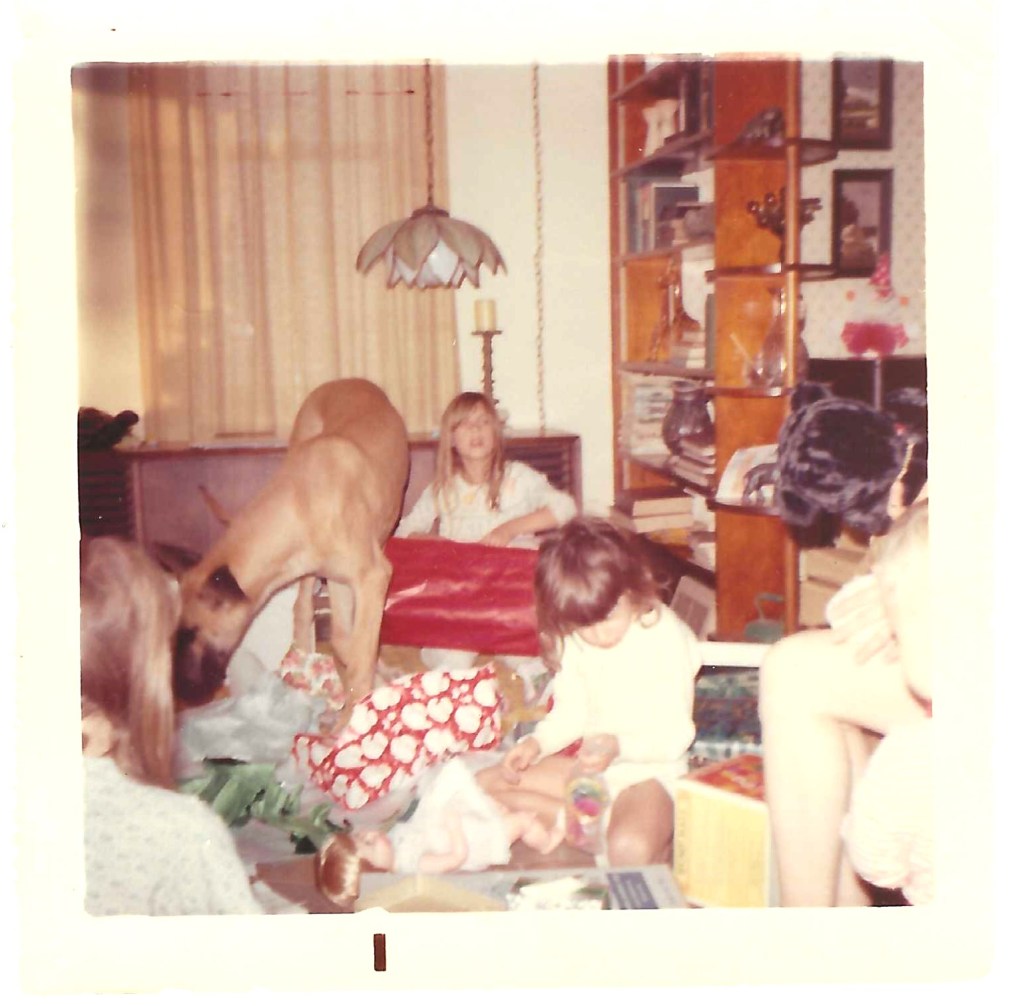
Christmas morning, circa 1969

Christmas morning never disappointed. We opened our presents one at a time because my parents wanted to see us enjoy each of our gifts. Mom was a wonderful Santa. There were always some toys from our lists, but each year she surprised us with wonderful presents we hadn’t even known we would want. Puzzles, games, art supplies, books, pajamas, and clothes spread across the floor as we unwrapped our gifts.

Once the wrapping paper was cleaned up and breakfast had been eaten, our job was to stay out of the kitchen and out of Mom’s way as she began to cook Christmas dinner, a feast of turkey, stuffing, sweet potatoes, mashed potatoes, gravy, and green bean casserole, all cooked to perfection. Later we would be asked to set the dining room table, and after dinner we helped wash and dry the dishes. But Christmas morning and afternoon belonged to us, a time to play with our new toys and games.

In mid-afternoon Uncle Freddy and Auntie Pat arrived with our three cousins (Brian, Dee Dee, and Lisa) and Nana Kitty. We ate at an elegant, second-hand burl wood dining table covered with a crocheted cloth my mother bought at an antique store. Before we filled our plates, someone said grace, giving thanks for our feast. Then began the passing of the dishes and the filling of the plates. With twelve people seated around the table, this took some time. It was fair game to interrupt any conversation with “Could you please pass me the . . . ?”

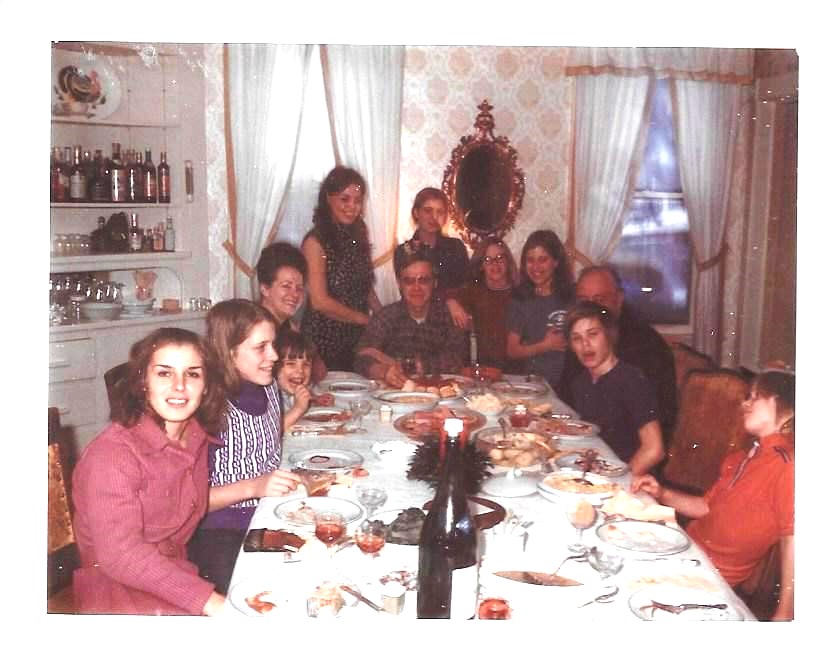
Christmas dinner. From the left and clockwise: Auntie Pat, me, Steve, Nana, Mom, Uncle Fred, Kimberly, Dee Dee, Suzanne, Grandpa Howard (who had recently married Nana) Brian, and Lisa. My father took the photo, circa 1972.

At the end of the day, when the dishes were done, when the company was gone, except for Nana who stayed to babysit us, my parents would meet up with friends at a local theater to see a movie. It was the perfect end to a perfect day. My siblings and I would fold up the crocheted tablecloth, exposing the thick pad that protected the dining table, and set up our new art supplies. We painted or sketched or wove hot pads while Nana visited with us. We snacked on cookies and soda. At bedtime we put on our new Christmas jammies. As we drifted off to sleep, we knew before we could do it all again, we had to wait 365 days. A lifetime to a child. A snap of the fingers to an adult.

Christmas Past and Present and Future

Christmas gives me the blues. I miss the magic of childhood Christmases spent with my siblings, and I miss the magic of Christmas mornings I spent with my young children. I miss family and friends who have passed away, and the special Christmas traditions we had. Because nothing stays the same, nostalgia can be heart-wrenching.

So, I’m weaving some new traditions into some old ones.

When I was in my twenties, my mother-in-law took me to my first ballet, along with my two sisters-in-law. It was December, so of course, we went to The Nutcracker. I loved it. For two hours enchanting music, graceful dancing, sparkling costumes, and magical sets swept me away to another world. Attending The Nutcracker with my mother-in-law became a tradition for a handful of years.

This year I took my twelve-year-old granddaughter, Clara, to see The Nutcracker, her first ballet. My mother-in-law would be happy to know I’m reviving her tradition.

Clara and I were dressed in the past and present. I wore a pair of old garnet earrings given to me by a friend, a black-and-red plaid sweater given to me by another friend, and a string of pearls given to me by my mother. I carried a black purse my sister had sent me. Clara wore a black skirt I’d bought her, black leggings, and a cream-colored sweater with a brown geometric design that her grandmother had worn when she was young. We were wrapped in the beauty of the present and the comfort of the past.

The ballet started at two o’clock, so we left the house at one o’clock. Because it’s a short drive to Symphony Hall, we arrived early. Happily, we discovered a foosball table in the lobby. This might be an odd place for a game table, but Symphony Hall is next to a college hockey arena. (An air hockey game would’ve been more appropriate, but they are noisy, like the ear-splitting clack-clack of a pickleball game.) There was no foosball table when I went to the ballet with my mother-in-law. But she would have approved. She liked quiet adventures. In her seventies she painted her nails with canary-yellow and key-lime-pie-green nail polish. She changed the spelling of her first name. She asked me to take her to see Willie Nelson. She went to see The Pirates of the Caribbean with me.

My granddaughter reached the foosball table first. She dropped the ball down the side chute and pushed and pulled on the handles. “Want to play?” I asked. “Sure,” she said. A small smile tickled the corners of her mouth.

Dressed in our semi-elegant, mostly black clothes and coats, we stood opposite one another. We cranked handles and spun our foosball players. Trash talking was minimal. We focused, each of us giving 110% to our plastic, featureless foosball athletes. The game went back and forth with the lead changing many times, but in the end, I prevailed by one goal. I wanted to do a Chariots of Fire victory stride, but well . . . I was wearing pearls.

The lights reflected in the window make it appear as if the sky has lights that illuminate the Aerial Lift Bridge.

It was after 1:30, but the ushers still weren’t taking tickets. I wondered why there were so few people in the lobby. But then a ship came through the canal, and the staff, Clara, and I walked out onto a balcony to watch it glide into the harbor. No matter how many vessels we locals see enter the canal, we never tire of watching them chug under the lift bridge and into the harbor to take on a load of cargo. After the ship passed by, the staff, Clara, and I returned to the warmth of the lobby.

The ushers still weren’t taking tickets, and I got a strange feeling. After I talked to one of the staff, I found out the ballet actually started at three o’clock. Clara and I had been an hour early. We had time to whittle away, so we explored the lower level of the building. We sat in lobby chairs and watched people walk by. We checked out The Nutcracker merchandise. I bought Clara a light-up wand made of optical fibers and myself a pair of socks decorated with nutcrackers.

Finally, the auditorium doors opened, ushers handed us programs, and we found our seats.

Shortly after three o’clock, the lights in the auditorium dimmed, the orchestra began to play, and the curtain rose. My Christmas blues were chased away by pirouettes and leaps, jumps and high kicks all performed by dancers in colorful costumes. Some of the old tradition of the ballet I’d seen with my mother-in-law remained, but it was given a new twist. Instead of being set in the Victorian-style home where Clara’s family and Drosselmeyer gather on Christmas Eve, the set had been transformed into a train station. The ballet was still set in the early 1900s, but the dancers, other than the lead ballet performers, were dressed as street vendors, travelers, lumberjacks, and gingerbread cookies. I have to admit that at first I missed the version I’d seen with my mother-in-law. But the ballet was so good. And clinging to the past too tightly brings a sense of melancholy. Nothing stays the same. So, I let it go and wove the night’s new traditions in with the old.

If life were A Christmas Carol, my mother-in-law would have been Fred, the ever-cheerful nephew of Ebenezer Scrooge. She knew how to keep the spirit of Christmas in her heart all year long and how to rise above characters like Scrooge. (Circa 1935, I chose this photo for the cover of the book I helped my mother-in-law write about her life because it captured her personality so well.)

After rounds of curtain calls and clapping until our palms hurt, Clara and I exited the auditorium. We left the bright lights of the lobby behind and walked out into the dark, cold night. We stuffed our chilled hands into our mittens. Beneath our stylish coats, our hearts were warm.

And for a while my Christmas blues were banished. Maybe next year we will go to the symphony or a Christmas play, then the following year back to The Nutcracker. It’s good to look to the future.

Book Reviews for December

During December you can shop or you can read books. Or better yet, you can shop for books! Recently, I learned about a delightful Icelandic tradition called Jolabokaflod, which loosely translates into Christmas book flood. Every November the Icelandic book trade publishes a catalog of new releases, which is mailed to every household in Iceland. People buy books for their family and friends as Christmas gifts. On Christmas Eve after gifts are opened, everyone is encouraged to start reading their books right away. Imagine the peace and quiet and magic as each person slips into the pages of a book and into another time and place. Perhaps, one of these books will help you start your own family Jolabokaflod.

A Highland Christmas by M. C. Beaton (Mysterious Press by Warner Books, Inc., 1999)

Hamish Macbeth, the usually unflappable town constable of Lochdubh, a small village located in the Highlands of Scotland, is out of sorts. Christmas is fast approaching, and Hamish is disappointed because he cannot spend the holidays with his mother, father, and six siblings, who have gone to Florida for the holidays. Hamish must tend to his beat in Lochdubh and to another constable’s beat in nearby Cnothan.

Author M. C. Beaton (1936-2019) wrote a series of cozy mysteries featuring Hamish Macbeth who uses his intelligence, keen observation, and intuition to solve murders, showing up his superior officers. But it’s Christmas and in the spirit of peace and goodwill, Beaton’s A Highland Christmas is a very, very cozy mystery — skipping the murder.

However, Hamish’s pre-Christmas days are filled with small mysteries. Mrs. Gallagher, a detested, ill-willed spinster, rings up the police station to report her cat is missing and demands that Hamish find it. He also wants to discover why Mrs. Gallagher is a nasty-tempered old woman who bars and bolts her door and seldom leaves her home. Meanwhile, in Cnothan someone has stolen the town’s Christmas lights and tree, and Hamish is called to solve the Grinch-like crime. Hamish also wonders how he can convince a little girl’s Calvinist parents, who view Christmas as a heathen celebration, that their daughter should have gifts for Christmas, like the other children in her school.

A Highland Christmas is a warm-hearted novella filled with interesting characters who discover kindness is the best Christmas gift of all.

[If you wish to read this book, you will need to buy a used copy, make a visit to your local library, or listen to a digital copy because it’s out of print. I have listened to it twice as an audio book. It’s become part of my Christmas tradition, like watching A Christmas Carol. This year I bought a used hardcover version and was delighted to find that it has charming illustrations. I don’t know if the paperback version is illustrated.]

Beware of Cat and Other Encounters of a Letter Carrier by Vincent Wyckoff (Borealis Books, imprint of the Minnesota Historical Society Press, 2007)

Most of us are familiar with the letter carrier’s motto: “Neither snow, nor rain, nor heat, nor gloom of night stays these couriers from the swift completion of their appointed rounds.” We know letter carriers sizzle under the hot summer sun, get wet in the rain, trudge through snow, and freeze on sub-zero winter days. But we don’t necessarily know about the rest of “their appointed rounds.

Wyckoff’s collection of stories about his job as a letter carrier made me smile, laugh, cringe, and cry. For over fifteen years, Wyckoff delivered mail in a neighborhood in South Minneapolis. He came to know the people on his route, most of whom were kind, although some could be difficult. Wyckoff is a wonderful storyteller and a very good writer. His stories entertain, enlighten, and educate. He encounters an attack cat, biting dogs, cranky customers, lost pets, and on one particular day, a young child waiting for his mother who isn’t showing up. He writes about people on his route who became his friends, sometimes inviting him to be part of their family milestones. Ever wonder how a letter carrier’s day starts or what happens when he has to deliver a registered letter? Wyckoff offers up a well-rounded, well-written, informative, and heart-warming collection of stories about his career as a letter carrier. As a bonus, readers come away with a better understanding of what it takes to deliver the mail.

I liked this book so much that when I couldn’t find any other way to let Vincent Wyckoff know, I mailed a letter to him in care of his publisher. [Vincent Wyckoff also writes mysteries. For more information, click here.]

Mr. Chartwell by Rebecca Hunt (The Dial Press, imprint of the Random House Publishing Group, 2010)

After my mother-in-law died, my father-in-law invited me to look through her books and take what I wanted. I found Mr. Chartwell on her bookshelf. The cover caught my attention. I turned the book over and one of the blurbs mentioned Winston Churchill and his “black dog of melancholy.” I knew Churchill suffered from bouts of depression. Intrigued, I placed Mr. Chartwell on the pile of books I wanted.

Mr. Chartwell, Rebecca Hunt’s debut novel, deals with depression — a heavy subject. (The cover art, which caught my eye, belies the book’s seriousness.) However, Hunt combines sardonic wit with verbal and situational irony, creating moments of comic relief that are at turns dry, surreal, and dark, but which also lighten the story’s somber mood.

Hunt’s story is set in England and takes place in 1964, from July 22 through July 27. Winston Churchill will soon retire from public service, and he isn’t happy about it. Mr. Chartwell, a large black dog, who has spent a lot of time with Churchill throughout his life, returns to keep him company. Churchill isn’t happy about that either because Chartwell is the black dog of depression. Hunt personifies depression through Chartwell who is a very large, intrusive black dog and who alternates between beating around the bush or cruel bluntness when speaking. Esther Hammerhans, a young widow of two years, advertises for a boarder, and Chartwell answers her ad. She is shocked when she meets Chartwell at her door because the big black dog speaks to her while extending his huge paw for a shake. Chartwell convinces Esther to let him move in, so he splits his time between Churchill’s estate and Esther’s house.

Hunt’s use of figurative language is often quirky and elbows a reader’s sensibilities off kilter, which mimics what depression can do to a person. Her use of unusual metaphors made me groan a few times, but overall, I admired and enjoyed her fearless approach to creating a unique narrator’s voice. Her striking prose invites readers to slow down, read each sentence carefully, and absorb the intricate range of emotions Churchill and Esther experience when confronted by Chartwell. Hunt deftly juxtaposes Churchill’s long-standing battle with Mr. Chartwell against Esther’s beginning struggles with the black dog.

Exciting News to Share

Today the 2023 Hal Prize winners were announced. I’m so excited and honored to have won 1st place for my short story “Newlyweds Standing in Front of a Lilac Bush” and 3rd place for my short story “New Boy.”

A list of all the winners in all the categories can be found here: https://doorcountypulse.com/2023-hal-prize-winners/

The winning short stories, nonfiction, poetry, and photos will be published in the 2023 8142 Review, which I believe will happen in January 2024. Here is a link to the 8142 Review: https://www.thehalprize.com/issues/. The 2023 edition isn’t for sale yet, but back issues can be purchased. My second-place story “Maginot Line” is in the 2022 journal and my second-place story “Silent Negotiations” is in the 2020 edition.

I was inspired to write “Newlyweds in Front of a Lilac Bush” after taking a historical flash fiction class with Rebecca Meachem. She is an excellent teacher. The class with Rebecca was offered through Write On, Door County.

Both of my short stories were workshopped through Red Oak Writing, which was so helpful! To learn more about Red Oak Writing and its wonderful offerings, such as roundtable writing critique groups, workshops, and literary services, click here.

I Wish I Could Take You with Me

Sandi (l) and me (r), July 2017

It’s late afternoon on August 18, 2018. My friend Sandi and I have escaped her pre-fab house and her unstable caretaker, who is out running errands, but we cannot escape her stage IV cancer. That sits with us in the car. Sandi fancies we are the movie friends Thelma and Louise, trying to outrun it all.

Fifteen minutes earlier, I’d come to show her the quilts I’d finished piecing before taking them to the machine quilter. She’d started them for her son and grandson but was too sick to finish them. As I was leaving, she said, “Wait, I’m coming with you.”

A dazzling sun hangs in a spacious cloudless sky. I wear sunglasses because the tinted windows in my van aren’t dark enough to subdue the afternoon’s harsh glare. I don’t ask if I’m Thelma or Louise – I’ve never seen the movie – but my sunglasses are similar to the ones Louise wears in the promotion stills. The movie is one of Sandi’s favorites.

Sixteen days from now Sandi will die, but today she’s full of mischief and life, if one doesn’t look too closely. She refused more chemo, so she has hair. She’s thinner, but far from frail. She’s quick with a smile and a laugh, but moves slowly.

During the drive, we joke and laugh, making light of our escape from the caretaker, whom we call Nurse Ratched.

My friend taps her perfectly manicured and sparkly-red painted nails on the console between our seats and says, “I wish I could take you with me.”

I stop talking. Silence mingles with the cold air blowing from the vents on the dash.

I have no words. But within one beat of my heart, I know that her words are the most profound expression of love I’ve ever received. And, I have no words.

She speaks first. “But your husband wouldn’t like it.”

Still, no words.

We both know she doesn’t want me to die.

I truly believe she has said this to no one else. Yet, I have no words.

Ordinary chitchat begins again.

After dropping off her quilts, we return to her home. The caretaker is back, silently seething. We left her a note, but that didn’t matter. The caretaker believes if she controls all of Sandi’s end-of-life decisions, Sandi will live longer.

My friend settles into her easy chair. I kiss her cheek and whisper in her good ear, “I’m going to go.” The caretaker, a dark cloud, will become a thunderhead if I stay.

“That’s probably best.” Sandi whispers too.

I kiss her cheek again, and murmur, “I love you. I’ll see you tomorrow.”

“I love you too,” she says.

I tell myself I’ll watch Thelma and Louise after Sandi is gone, but I don’t believe I ever will. Thelma and Louise drove off a cliff together. In sixteen days, Sandi will leave without me, a Thelma without her Louise. Or perhaps a Louise without her Thelma.

I never asked her, “Which one am I?”

[This flash essay was originally published by Persimmon Tree in their “Short Takes” section in Summer 2023. I’ve posted it here because while I think about Sandi everyday, there are certain times of the year when she plays in my memories throughout the whole day. ]

Playing Cribbage with Clara on an Old Board

The cribbage board connecting generations

I taught my twelve-year-old granddaughter, Clara, how to play cribbage. The first two rounds we played were full-disclosure games because we laid our cards face up on the table. It’s the easiest way to teach someone to play. I taught her strategies for tossing cards into the crib, how to maximize her chance for a better hand, and how to peg points while preventing her opponent from doing the same. I taught her how to count the pairs, runs, and combinations of fifteens. Cribbage is a complicated game, but that’s what makes it fun.

I learned to play cribbage when I was nineteen years old. I was a bartender in a small unincorporated town, population 350. One of my customers asked me to play cribbage. I told him I didn’t know how. “Well,” he said, “you’re going to have to learn because when customers come in and it’s slow, they’re going to expect you to play.”

I’d grown up eight hours away in a metropolitan area, and I’d never heard of cribbage.

The customer grabbed the cribbage board and a deck of cards off a ledge from behind the bar. “I’ll teach you,” he said. He placed the pegs in their starting holes and shuffled the cards. I carried over a barstool and sat down in front of him but stayed behind the bar. After all, should another customer have shown up, I might’ve had to pour a beer, mix a whiskey-7, or pop a top on a soda. He taught me well, and I played many games of cribbage with him and other bar patrons, especially on quiet winter days and nights.

Shortly after Clara and I started our third game, I asked, “Do you want to play without us seeing each other’s cards?”

“Sure!” She smiled and her eyes sparkled, excited that Nana felt she was ready to be in charge of her own hand. She did well and quickly caught on to counting her hands, but luck plays a part in cribbage, and I had better cards. Yet none of that mattered. We laughed and celebrated our high-scoring hands. We laughed and mocked our low-scoring hands, saying, “two, four, and there ain’t no more,” or “I got nineteen.” (Nineteen equals nothing because it’s not possible to score nineteen points in a cribbage hand.) I almost skunked her in one of the games, but she managed to avoid the stink of getting beat by 31 points or more. And we laughed about that too. Both of us like to play cards and board games, but neither of us is bothered by losing. There is always another game to be played.

Clara and I played on the same cribbage board I used when I taught my grandma Olive to play cribbage. I have two other boards, but I liked knowing that Clara and I were touching the same pegs and moving them along the same holes on the same board Grandma Olive and I used forty-five years ago.

When I was eighteen, I moved in with my grandparents, George and Olive, and lived with them for almost three years. Grandma Olive and I didn’t always agree about how I should live my life. She believed I should sing in the church choir and attend Sunday sermons. She believed I should be present at the dinner table for breakfast, lunch, and supper. She believed I should be home before midnight. She believed I should have a better class of friends. She believed I should iron my shirts instead of wearing them wrinkled.

I believed Sunday mornings were for sleeping in. I believed if a friend said, “Let’s go swimming” or “Let’s play tennis,” skipping lunch or dinner was no big deal. I believed being home by midnight was for Cinderella. I believed my friends were wonderful. And I believed the heat from my body would smooth out most of the wrinkles in my shirts.

But I loved Grandma Olive, and I knew she loved me and worried about me. And because neither of us liked conflict, our disagreements were soft-spoken, thirty-second exchanges of point and counterpoint, in which neither of us would change our minds. Then I would leave the room. And she would exhale a heavy sigh.

When I wasn’t working or with my friends, I liked spending time with Grandma in her kitchen. She taught me how to make an angel food cake (lots of sifting and gentle folding) and Amish sugar cookies (pressed with the bottom of a cut-glass crystal sugar bowl). She taught me how to play Shanghai rummy, which used two decks of cards and had increasingly complicated hands of sets and runs, which players had to attain to score points.

Grandma often heard me talk about playing cribbage with customers when I bartended. “I wish I knew how to play,” she would say, so I bought a cribbage board. One evening as we finished up the supper dishes, I offered to teach her how to play. I can still picture her standing in her slightly remodeled 1940s kitchen, wearing her patterned apron trimmed in red rickrack, one of its pockets bulging with an ever-present handkerchief. She teared up, smiled, and said, “Oh, yes!”

Grandma Olive loved me even if drove her crazy, and I loved her even if she didn’t understand my generation.

Grandma Olive with me on her lap and Grandpa George with my sister on his lap, 1960. Seventeen years later I would move in and teacher Grandma how to play cribbage.

I lived with my grandparents for nearly three years. I thought I was easy to have around, and in many ways I was. But looking back, I realize that my grandparents, especially Grandma Olive, worried about me. They’d already raised three children, so having their eighteen-year-old granddaughter come to live with them during their golden years wasn’t ideal. Grandpa, who was never a talker and still worked at his gas station six days a week, would remain an enigma to me. But Grandma and I came to know and appreciate one another, most of time.

So sometimes when the baking and cooking and dishes were done, Grandma Olive and I would sit at the old wooden kitchen table covered in oilcloth and play Shanghai rummy or cribbage. We talked and laughed, and forgot about our disagreements, neither of us caring if we won or lost the game.

A few years after I moved out of my grandparents’ house, Grandpa George died, and Grandma Olive developed dementia. She and I couldn’t play cards anymore.

Comes a time when there isn’t another game to be played.

Autumn into Books!

It would be a groan-worthy pun if I had titled this piece “Fall into Books.” But on the race track of seasons, autumn is — by two horse lengths — my favorite season, plus I think autumn is a beautiful word. Autumn colors are magnificent, and this year nature outdid herself with luminous swaths of red, orange, and yellow. Autumn air is crisp (often code for cold and windy where I live), so it’s a good time to read. (Really, anytime is a good time to read.) And I read lots. I’m a writer, so reading is part of my craft. I hope to be inspired by and to internalize good writing: the plots and subplots, the organization, the characterization, and the dialogue. Before we get too far into autumn, I’m going to share some of my recent reads, all of which were enjoyable, stimulating, and page-turning. So, if you’re looking for ideas . . .

Gunshots in Grudgeville and Other Stories by Laurel J. Landis (Orange Hat Publishing – Ten 16 Press)

I loved the cover of this book and its catchy title. And Laurel J. Landis’s short stories beneath the cover are just as vibrant and intriguing as the autumn trees and the mysterious old shack — inviting readers to sit and connect with ordinary people living in a small town. Landis pulls readers into the lives of her characters and their tales of bad choices, grief, coming-of-age, love-gone-awry, and broken promises. I lived in a small town for three years, and Landis masterfully nails the feel of small-town life. Her characters and settings are authentic, reminding me of people I once knew in the unincorporated town of 350 where I once lived. Landis’s short stories remind us we don’t have to travel to faraway lands or other worlds because life happens everywhere, even in small towns. My favorites: “Tornado,” “Small Injuries,” “Breathless,” “Junction, County T,” and “Gunshots in Grudgeville.” [To order Landis’s book, click here.]

A Winter’s Rime by Carol Dunbar (Forge Books, Macmillan Publishing Group)

Mallory Moe, a twenty-five-year-old Army vet, works overnights at Speed Stop, a gas station and convenience store in rural northern Wisconsin. She is estranged from her family, in an abusive relationship, and drifting through life. While out on a cold winter’s night, Mallory encounters Shay, a teenage girl, who is hurt and on the run from an abusive boyfriend who is trafficking her. As she tries to help Shay, Mallory realizes she must confront her own traumatic childhood.

Don’t expect this book to be a thriller about rescuing trafficked girls from the clutches of evildoers at the eleventh hour. Carol Dunbar‘s novel is so much better, deeper, and smarter. She researched the science of PTSD, the brain, and current counseling practices that help people recover from childhood traumas. Dunbar deftly weaves her research into A Winter’s Rime, keeping it in the background, so it’s Mallory’s riveting story that drives the novel. Dunbar’s supporting characters, even the ones who make short appearances are memorable and believable. Dunbar likes to say her novels are character driven, and they are. But she is also a master of settings that are beautiful and haunting, often metaphors for the struggles the characters face.

The Last of the President’s Men by Bob Woodward (Simon & Schuster)

I read this book because I heard Cassidy Hutchinson, author of Enough, talk about it. I was fourteen when Richard Nixon resigned from the presidency because of Watergate. In my early twenties, I read All the President’s Men by Carl Bernstein and Bob Woodward and Blind Ambition by John Dean. I decided it was time to read another book about Watergate.

Woodward held extensive interviews with Alex Butterfield, who worked closely with H. R. Haldeman and President Nixon. Both Butterfield and Haldeman knew about Nixon’s taping of White House conversations. During the Watergate investigation, Butterfield testified about Nixon’s tapes, effectively ending Nixon’s presidency.

The most frightening takeaway from The Last of the President’s Men is that so many of Nixon’s staff and supporters had blind loyalty to him, even though he broke the law, even though he believed his methods to maintain power were justified, even though he felt his presidency meant he was above the law — the behavior of dictators. Supporters saw Nixon as their president, and they ignored his abuses of power.

The Last of the President’s Men is well-researched and clearly written. Even though I knew Butterfield would testify about Nixon’s tapes and that Nixon would resign, Woodward’s book about Nixon and his staff, who believed it was their job to keep their president happy and do his bidding, even if they knew it was wrong, was very scary.

And if you don’t have time to read a book, try a single short story! Below are three choices to consider.

“APrayer4You.com” a short story by Kim Suhr (Published by Moot Point, a literary journal)

Isabelle and Blake are young, in love, and on their honeymoon. Everything is wonderful, until it isn’t. (My synopsis is short because readers need the joy of discovering Kim Suhr’s thought-provoking, well-crafted story for themselves.)

Suhr’s short story “APrayer4You.com” haunts my thoughts. I might go for weeks without thinking about it, then something nudges my brain, and I wonder, How is Isabelle coping? And what about Blake?

Even though “APrayer4You.com” is a short read, under 1,600 words, savor each word, sentence, and paragraph because Suhr weaves a gripping story in a short space. There are so many layers of meaning in her story that it would make a good selection for a book club. (Or, brilliant idea that just occurred to me: a short story club for readers who have busy lives!)

Note, if you’re a writer, read Suhr’s story as a reader first. Then go back and read it again as a writer. Pay attention to her use of opposites in the story. Opposite situations, opposite ideas, opposite beliefs, opposite personalities, opposite actions. Suhr skillfully uses all these opposites to create tension in her story. [Suhr has also published a wonderful collection of short stories titled Nothing to Lose. Visit Suhr’s author page. Click here to read “APrayer4You.com.” ]

“Effie’s Trinket” by Diana (wonkagranny blog)

Euphemia, Effie for short, has run away from home and the insults of her older brother. But she’s young, and so she’s hidden herself away in the yard. She refuses to come out of hiding when her mother calls her for supper. In a swift 690 words, Diana creates a story with a magical sense of wonder that takes readers back to a time when all things were possible to a young child.

I don’t want to say too much about this story and its themes or the different ways to think about it because I want readers to have the joy of reading this gem.

Diana writes the blog wonkagranny. Even though I follow her blog, I don’t know her last name, but she gave me permission to post a link to “Effie’s Trinket.”

Note, if you’re a writer, you will enjoy reading Diana’s comments about her writing process, which appear before and after “Effie’s Trinket.” Also, be amazed at how a simple story can be layered with the many textures of life.

“To Build a Fire” by Jack London

On an “exceedingly cold and gray” day in the Yukon Territory, a man who is inexperienced with the brutal arctic winters decides to walk to another camp to visit friends. Before leaving, he is warned about the dangers of hiking alone in the extreme sub-zero temperatures. But he has the arrogance of a newcomer, who neither respects nor understands the perils of his new home. His hike does not go well.

Jack London’s “To Build a Fire” is one of my favorite short stories. On a micro level, this story is about the arrogance of one man who brushes off the warning from an old-timer who tells him he shouldn’t go out alone because the temperatures are dangerously cold. On a macro level, this story can be read as a metaphor about the arrogance of the whole human race, who are newcomers on Earth, and their disregard for nature.

Note, if you’re a writer, part of what makes this story so horrifically chilling is London’s accurate, detailed, and graphic descriptions about what his character experiences, physically and emotionally, as he slowly freezes to death. London’s attention to these details teaches me that even in fiction, research is important to a story.

[The link I provided is for the 1908 version of London’s story, in which the protagonist dies. In the 1902 version, the protagonist lives. London was right to modify the story’s ending. The tragic version is powerful and thematically more complex.]