[I’ve read many good books in the past few months. I’m reviewing some of them in a series of blog posts. So, if you’re looking for a summer read, maybe you’ll find a book to enjoy in one of my book review posts.]
Why did I read this book?
A few weeks ago, I visited the library and spotted Alastair Gee and Dani Anguiano’s book on display. In 2018, I had followed news stories about the devastating Camp Fire in northern California. I decided I wanted to learn more about the fire because there are so many fires now, both in the United States and all over the world. I often read books about current events because I learn so much more than can be presented in a brief television news broadcast.
I worry about fire. I live in a small urban area that is surrounded by lots of woods and fields. While the temperatures tend to be cooler where I live (thank you, Lake Superior), we have been short on rain. And I wonder what might happen if the drought-like conditions continue for several years. If intense, uncontainable, hotter-than-hell fires can happen out West, on Maui, in Canada, and on the other side of the world, they can certainly happen here — in my backyard.
What is this book about?
The Camp Fire ignited on the morning of November 8, 2018, in Northern California in Butte County. Before the fire ended, it would burn most of the towns of Paradise and Concow and a large part of the towns of Magalia and Butte Creek Canyon, destroying more than 18,000 structures and killing at least eighty-five people. The fire, which cost over $16 billion, spread with unprecedented speed and intensity.
Gee and Anguiano’s narrative follows the stories of a variety of people who live in Butte County on the day the fire started. We learn something about their lives before the fire destroys their way of life. We learn how the violent fire spreads as it torches over 153,000 acres, and why the fire is able to devour so much so quickly. We learn about the attempts of both firefighters and civilians as they try to save homes, businesses, and people. And we learn about the fire’s aftermath as people struggle to rebuild their lives.
What makes this book memorable?
Alastair Gee and Dani Anguiano are both journalists. Gee has written for the Guardian, The New Yorker online, the New York Times, and the Economist. Anguiano has written for the Guardian and the Chico Enterprise-Record. They have researched and written a clear, concise piece of journalism covering the who, what, where, why, and how of the deadliest wildfire in California’s history.
As I finished reading Fire in Paradise, the fire in Maui started. I was struck by the parallelism between the two fires. Drought made each fire more potent. Once both fires started, they spread so quickly that evacuation of people was severely hindered. People in both fires survived by jumping in water. High winds played a part in making each fire more violent and deadly. Destruction in both Butte County and Maui was widespread, demolishing homes and businesses — the economy of whole communities.
A faulty electric transmission line started the Camp Fire, a recurring problem that had caused other fires in Northern California. The 2023 Maui wildfire is suspected to have been started by a sparking power line, and previous wildfires in Maui have been started by power lines. Burned buildings and cars leave behind toxic materials that pollute soil, water, and air, endangering the health of people and wildlife. Similar, heartbreaking stories are told as survivors hope to find their loved ones alive. The death toll in the Camp Fire was high, but the death toll in Maui will probably be much higher. People’s lives are forever ruptured.
Why is this book important?
Global warming caused the Camp Fire to be deadlier, faster, and more violent than fires that have preceded it, and the Camp Fire is part of an escalating trend of intense fires occurring around the world, like the recent wildfire in Maui. Fire in Paradise is an important story because global warming doesn’t care if some people deny its existence or if some people procrastinate, thinking there is more time to deal with it. Because global warming doesn’t care, we need to care. Fire in Paradise gives readers a chance to understand the enormity of what happened to people and whole towns. Perhaps reading personal stories about people who survive intense fires, storms, and floods attributed to global warming will make the cost of ignoring it more real.
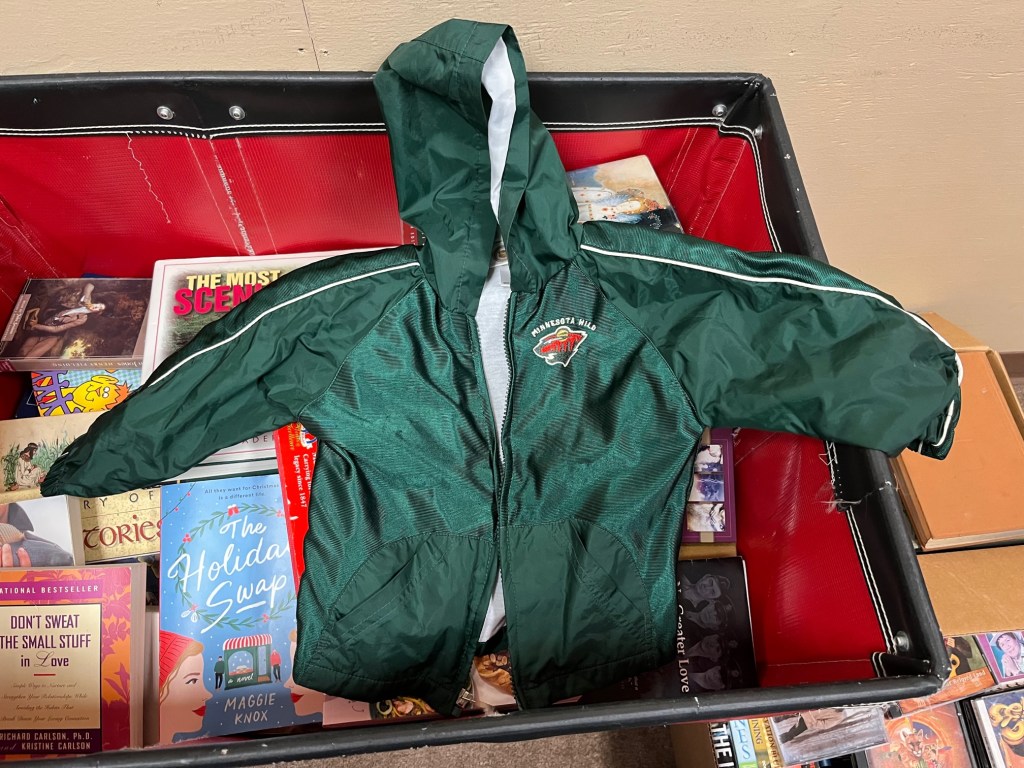
The jacket makes its return to the Goodwill, January 2023
I bought the deep-green Minnesota Wild windbreaker at Goodwill for $3.99. Its 2T size was perfect for my grandson Michael, who was two years old at the time. I kept it at my house as a spare jacket because where I live the weather changes faster than a runway model. Michael wore the jacket on misty days and sunny-but-cool breezy days and gray chilly days when the sun refused to show its face. When needed, he pulled up the hood and slipped his hands into the pockets, hiding his ears and hands from the cold.
When Michael outgrew the jacket, I saved it for Evan who wore it until he outgrew it. Then, I saved it for Charlie who wore it until a year ago when he told me, “I’m too big for this.” I had run out of grandchildren, but I kept the jacket. Throughout the year, I thought about donating it back to Goodwill, but it held memories. My grandsons wore it to the library, to parks, and on walks. When they ran and played, the windbreaker’s waterproof material serenaded them with a crinkly tune.
I’m somewhere between my mother and father on the what-to-purge-and-what-to-keep scale. My mother saves very little. A few years ago, I asked her where the instructions were for her bike lock because I needed to reset the combination. Her answer: “I threw that out.” When I complained, she snapped, “I can’t save everything.” She claims she doesn’t want to make her children clean and sort through piles and piles of possessions. But really? Even small amounts of clutter unsettle her.
Very little exists from my mother’s childhood, but I think that’s because her family had very little. What happened to the other bits and pieces from her youth? I don’t ask. Perhaps her mother threw them away, or perhaps my mother did. Sometimes memories connected to objects are painful, a place one wants to walk away from, not revisit.
In contrast, my father saved a lot of stuff: old newspapers, if an article interested him; letters, including the ones I sent him; his childhood artifacts; his pilot logbooks; trinkets of all sorts; and bits and pieces of mechanical objects because he never knew when he might need that specific part or screw or nut and bolt. He wasn’t a hoarder, and we could walk through his house without fear of being consumed by his possessions, but his garages, closets, and spare rooms were filled with his history, both the small and momentous moments. He would’ve saved the instructions for the bike lock.
My father also kept old issues of Trade-A-Plane, a publication printed on yellow paper, where pilots could buy and sell airplanes and their parts. When the Trade-A-Plane came in the mail, he would dodge his responsibilities and read every classified ad, even if he wasn’t looking to buy or sell because, as he would say, “You never know.” He had lengthy telephone conversations (at a time when long-distance was expensive) with other pilots about planes, even if no buying or selling took place.
Frustrated, my mother once asked him why he needed to save every Trade-A-Plane, and he said, “Well, you never know.” He might want to look up something in one of them. Sounds ridiculous that with decades of old issues, he would be able to find something specific from years ago. Maybe he could have, maybe he couldn’t have, but he was comforted by their presence. They held memories of the planes he bought and sold and dreams of the planes beyond his reach. When he needed to buy a pair of wings for his Cessna 196, he called the airplane junkyards that advertised in the paper. He found a set of wings in New Jersey and had them shipped to Milwaukee.
My father saved the letters his father wrote to his mother in 1937 when she was pregnant with him and in the hospital on bed rest. Her pregnancy had become difficult, and if an emergency developed, the doctor didn’t want her to be an arduous forty-mile drive from the hospital. My father was born on November 24, 1937, and his parents saved a copy of Life magazine from that week, along with the cards family and friends sent on the occasion of his birth. My father treasured all of it. He had a vein of sentimentality that ran deep through his curmudgeonly bedrock. After he died, I inherited these keepsakes, and I cherish them.
The letters my grandfather wrote to my grandmother while she was in the hospital hold the ordinariness of daily life, recounting the weather, what he ate, how much gas he sold at the station, how deer hunting season was progressing, and when he would be coming to visit her. But with each mundane line, I imagined my grandfather writing around his fears about his young wife and child, praying for them to be well and hoping for them to come home soon. Always he signed his letters, “Lots of love, George.” In one letter he wrote about his day and mentioned he’d gone “to sleep without his bed companion.” It was the only personal line in all of his letters – subtle, but filled with longing to have his wife and child home and to be a family. This would’ve been important to my grandfather who was orphaned when he was eleven years old.
I can leaf through that Life magazine from 1937 and know I’m reading the same pages my father and his parents once read, learning what was newsworthy the week their first baby was born. When I read it, I found an article about Dy-Dee doll, “the most popular doll in the world” because she wet her diapers. My mother-in-law received a Dy-Dee doll for Christmas in 1937. The doll was all the rage, and she never forgot Santa left one for her under the Christmas tree. That 1937 issue of Life is a keeper because it connects me to my father and my mother-in-law, making it something I save. My children will have to throw it away.
I understand why my father kept the letters and artifacts of his childhood. I still have the teddy bear Santa brought me for my first Christmas in 1959. In my forties, I put Teddy in a plastic garbage bag. He had holes in his neck and crotch, and most of his fur had worn off. I tried to throw him away, but I couldn’t. After I pulled Teddy out of the garbage, I told my son, “I just can’t let him go.” And my son, who embraces minimalism to the point of nothingness, said, “Somethings you just need to keep.” So, Teddy sits in my closet on a stack of quilting material. I have my yearbooks and old report cards. I have photographs and a scrapbook. I have toys and clothes and artwork that belonged to my children. I have a pair of onyx owls from Nana and a colorful laughing porcelain Buddha from Grandma Olive. I have an antique hutch filled with glassware. I save all the instructions for every appliance and bike lock I buy. But I sympathized with my mother about Dad’s Trade-A-Plane obsession.
And so, after hanging in a closet for a year, the size 2T Minnesota Wild windbreaker became like my father’s old issues of Trade-A-Plane, no longer useful. Because I wanted others to make happy memories with the jacket, and because having too much clutter in my house unsettles me, it was time to let go. I placed the jacket in the wooden clothes bin at Goodwill. Having heard the door open, a young woman with a broad smile approached me and asked if I needed a receipt. I told her no, and she went back to sorting donations. I turned to leave but I couldn’t, so I grabbed the jacket and laid it on a bin of donated books and took a picture. That helped. It’s what my father would’ve done. He was the champion of taking pictures of everyone and everything. In his later years, he always tucked a small camera in his shirt pocket.
I lifted the jacket off the books, but I wasn’t done yet. I felt compelled to tell its story, so I stepped into the large sorting room, and the young woman asked, “Can I help you?”
I held up the officially licensed NHL windbreaker with the Iron Range Red, Forest Green, Minnesota Wheat, and Harvest Gold “wild animal” logo that appears to be a bear or a wildcat or a wolf. (When asked, the Wild organization will only refer to it as a “wild animal.”) And I told the young woman the story of the jacket’s full-circle journey from Goodwill, through three grandsons, and back to Goodwill.
I felt like an old person telling a story that a young person isn’t particularly interested in hearing, but she smiled, said it was a good story, and thanked me for sharing. I’m fairly certain she meant it. On my way out of the sorting room, I dropped the jacket back into the clothing bin and hoped that soon some child’s parent or grandparent would buy it.
A few weeks later Evan and Charlie came for a sleepover, and we took my dogs for a walk. None of us thought about the windbreaker because it was a clear, cold winter’s night, and we wore snow pants and heavy jackets, knit hats and insulated mittens. We passed the west side of the park, and Evan pointed to a tree and asked, “Do you remember when we circled around this tree last summer?” I didn’t remember, but I said yes because it was important to him. On that particular day, he might have been with his mother at the park, but that’s the slipshod nature of memory. Perhaps that’s why we keep physical remnants from our past. And on that clear, cold winter’s night with stars sparkling above us and a moon peering down at us, I remembered the Minnesota Wild windbreaker I’d given away.
Evan climbed the snowbank by the road, hugged the tree, and said, “This tree holds all my old memories.” He might grow up to be the kind of person who will save every issue of the Trade-A-Plane, all his Nana’s cards and letters, and the instructions for a bike lock. Or perhaps not. But at the agèd year of six, Evan already treasures his memories. And he understands the ability of an object to hold his heart.
[I’ve read many good books in the past few months. I’m reviewing some of them in a series of blog posts. So, if you’re looking for a summer read, maybe you’ll find a book to enjoy in one of my book review posts.]
Why did I read this book?
I’m a writer, and I’m always trying to improve my craft. So, I take classes about writing, I read about writing, and I listen to other writers talk about their writing. Many, many times I’ve heard writers and writing teachers reference The Things They Carried by Tim O’Brien. But I’d never read it, so I kept promising myself that I’d get a copy and read O’Brien’s collection of short stories. It seemed that to be a short story writer but to not have read The Things They Carried would be like training to be a surgeon, but skipping the class on suturing.
Then a few weeks ago, I walked into a bookstore and The Things They Carried was on display. It was destiny. I bought the book and carried it home with me. O’Brien’s book was triaged to the top of my to-be-read pile of books, and I began reading it that night.
What’s this book about?
The Things They Carried is a collection of related short stories with recurring characters set during the Vietnam War, but some of the stories occur before and after the narrator’s time in Vietnam. These are the stories of young men who go to a war in a hot, humid jungle, so unlike any place they grew up; who don’t understand what they’re fighting for; who fight against what they often can’t see; who watch friends die horrible deaths; who die horrible deaths themselves. These are the stories of soldiers who survive, sometimes broken in body but always broken in spirit to some degree, with some of them permanently alienated from their former lives. The Things They Carried is an unvarnished war story without heroes and romanticism.
What makes this book memorable?
O’Brien’s beautiful, but haunting prose gives life to the torrid heat, claustrophobia, and disorientation soldiers faced in the jungles, swamps, rice paddies, and mountains of Vietnam. His prose gives life to the emotions of the soldiers: their fear of dying, their uneasy boredom, their numbness, their guilt over killing and their guilt over surviving. His beautiful but haunting prose helps readers through the horrific events that happen to the soldiers in his stories. And the horrific events he writes about are an integral part of the stories. It sounds like a paradox, but without O’Brien’s beautiful prose and story-telling skills, it would be difficult to digest the heartbreaking stories of the American soldiers in the Vietnam War; a war, which killed over 58,000 Americans and between two and three million North and South Vietnamese soldiers and civilians, and left countless survivors wounded and emotionally destroyed.
As a writer I will read O’Brien’s book again. I have to because the first time I read it, I was caught up in the characters and their stories, important stories that have so much to say about the human cost of war. The next time I will read the stories as a writer, paying attention to O’Brien’s writing techniques, hoping to better understand what makes his stories so powerful.
[To read excerpts or listen to a complete interview of Tim O’Brien from February 2021, click here: Fresh Air NPR.]
[I’ve read many good books in the past few months. I’m reviewing some of them in a series of blog posts. So, if you’re looking for a summer read, maybe you’ll find a book to enjoy in one of my book review posts.]
Why did I read this book?
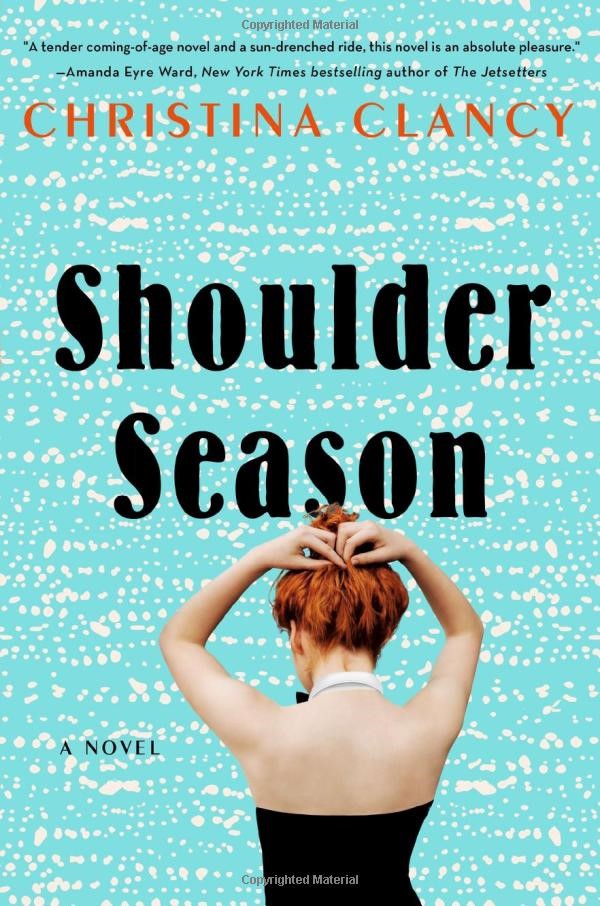
Three reasons. One, Christina Clancy’s novel Shoulder Season is set in East Troy and Lake Geneva, an area of Wisconsin where I spent time during my growing-up years. Two, the novel’s main character takes a job as a Playboy Bunny at the Playboy Club in Lake Geneva, Wisconsin; I wondered “What would that be like?”* And three, I attended a writer’s residency at Write On, Door County in April, and Christina Clancy was my roommate for part of my stay. She is a kind, funny, and interesting person, who generously gave me a copy of her novel Shoulder Season before she left.
What is this book about?
Shoulder Season is a coming-of-age story that takes place around 1980. Nineteen-year-old Sherri Taylor is an orphan. Her mother, after a lengthy illness, has recently died, and her father has been dead for several years. After caring for her terminally ill mother, Sherri wants to leave East Troy, her hometown. She craves fun and adventure and an escape from grief. She also needs to earn a living. Sherri’s best friend convinces her to interview for a job as a Playboy Bunny. Sherri, much to her surprise, gets the job and fun and adventure. But being a Playboy Bunny is difficult and at times demoralizing work. Left without family and alienated from her best friend, loneliness, confusion, and insecurity cloud her judgment, and she makes choices that lead to heartache.
What makes this book memorable?
Shoulder Season grabbed me from the first page and didn’t let go. Clancy’s story-telling skills compelled me to repeatedly wonder: What’s going to happen next? And how is it all going to shake out in the end? I was never disappointed.
Clancy’s main characters are well-developed with shades of nuance. Like real people they have strengths, weaknesses, insights, and blind spots. And she has taken care to develop secondary characters that are engaging also. We care about her characters, even if we don’t always like them all the time. If her novel were a movie, I’d say it has great casting from the leading roles to the supporting and minor roles.
Clancy’s power of description and setting bring East Troy, the Lake Geneva Playboy Club, and other locations in her novel to life. I grew up near East Troy and Lake Geneva and often visited those areas. I saw Journey play in East Troy in the early 1980s. Clancy nails the feel of those places during the early 80s. She smoothly weaves setting and story together, each element adding to the power of Sherri Taylor’s journey into adulthood.
Shoulder Season is a moving coming of age story for adults. Without ever becoming sappy or sentimental, Clancy’s beautiful prose takes readers on an emotional ride with Sherri Taylor as she struggles to follow her dreams, while at the same time taking readers back to their youth when they too were filled with dreams and so much was possible.
[* As a teenager, I’d heard about Hugh Heffner and his magazine, his playmates of the month, and his Playboy Clubs. The Playboy magazine came to our house every month. My parents hid it, but my siblings and I sometimes “read” it. Well, actually, I often did read the short stories because they were very good, better than the syrupy romantic stories that appeared in the women’s magazines my mother bought; although, as a teenager with starry-eyed romantic notions, I read those too. I came of age in the late-1970s, and I also remember hearing about Gloria Steinem and her undercover assignment as a Playboy Bunny.]
[I’ve read many good books in the past few months. I’m reviewing some of them in a series of blog posts. So, if you’re looking for a summer read, maybe you’ll find a book to enjoy in one of my book review posts.]
Why did I read this book?
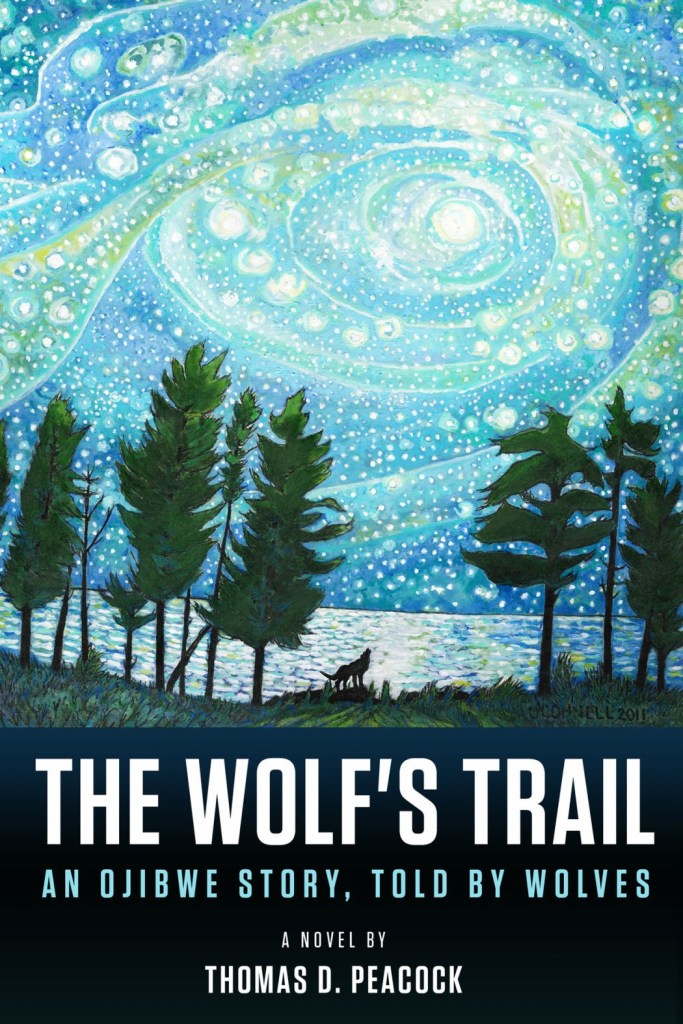
Three reasons. First, Thomas Peacock’s novel, The Wolf’s Trail is the 2023 One Book Northland community read, so it’s displayed in local bookstores. I like visiting bookstores, so the novel and I were bound to meet up. Second, I love the book’s cover, created by James O’Connell, an artist from Madison, Wisconsin. O’Connell’s cover art reflects the soul of Peacock’s novel. Third, the story is narrated by a wolf, which intrigued me.
What is this book about?
The Wolf’s Trail is a series of connected stories within a larger story. Zhi-shay, the Uncle wolf, is an old, wise wolf who “talks story” with the pups about creation, love, family, survival, and the Anishinaabe people. The stories are told to help the young wolves learn about the history of their world, the relationships between all living creatures, the nature around them, and the cycle of life and death. It’s the story of the importance of passing on wisdom, of passing on the wolf’s story; and through the wolf’s stories, the passing on of the Anishinaabe’s story.
What makes this book memorable?
Zhi-shay is a quintessential story teller. He is kind, wise, generous, humorous, reflective, and honest. His lessons are sometimes joyful and sometimes sorrowful, but they are all worthy of reflection. Each time I had to set the book aside, I longed for the time when I could pick it up again and sit with the wolf pups and listen to Zhi-shay, the Uncle wolf.
Peacock’s book is a beautifully written Native American literary narrative that does what powerful fiction should do: It builds bridges of understanding between people, and it expands a person’s view of the world. Without preaching to the reader, the book is a meditation, a guide for a better way to be in the world as we pass through our days on earth.
[Other Native American literature that I’ve read in the last couple of years and loved:
[I’ve read many good books in the past few months. I’m going to review some of them in a series of blog posts. So, if you’re looking for a summer read, maybe you’ll find a book to enjoy in one of my book review posts.]
Why did I read this book?
I bought Rin Tin Tin: The Life and the Legend in 2011 after listening to an interview of Susan Orlean on Minnesota Public Radio. (Click on the blue font to hear her talk about the book. She gives a good interview.)
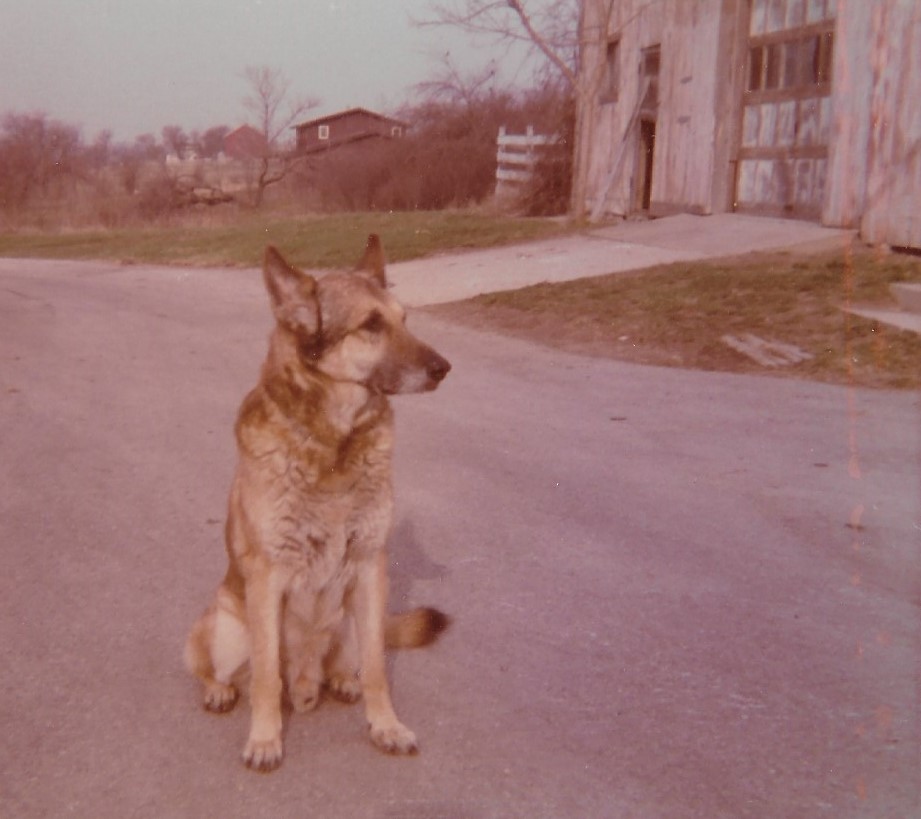
I’d never seen a Rin Tin Tin movie or TV show, but I’d heard of the famous Rin Tin Tin because he was often referenced in popular culture. Rin Tin Tin’s story appealed to me for two reasons. One, I like reading about the movie industry, especially the history of its beginnings. And two, I grew up with a German Shepherd named Fritz, who was intelligent and kind, and at times heroic. Our Fritz could’ve been the Rin Tin Tin of the silver screen.
Sad to say it took twelve years before I lifted the book off my to-be-read pile of books. Sad because Susan Orlean’s book is a fascinating combination of three stories.
What is this book about?
It’s the story of a man and his love for an extraordinary dog. Orlean’s book follows the life of Lee Duncan who rescues Rin Tin Tin, a German Shepherd puppy, from a bombed out kennel in France during WWI. In a way Rin Tin Tin rescues Duncan, too, because Duncan, who had a tough childhood, is a wounded soul. Duncan brings Rinty, as the dog was sometimes called, home to America. With Duncan’s care and training, Rin Tin Tin becomes a Hollywood superstar during the silent film era. After Rin Tin Tin dies, Duncan continues to work with other German Shepherds who acted in movies and the television show The Adventures of Rin Tin Tin.
It’s the story of canine and human actors; animal trainers; and Hollywood executives and producers; many of whom become famous and rich (and sometimes bankrupt then rich again then broke again) during the early days of Hollywood and television. Orlean delves into the behind-the-scenes pitches, ideas, deals, and strategies that created and promoted the Rin Tin Tin movies, TV shows, and actors.
It’s the story of Orlean’s fascination, research, and commitment to the story of Rin Tin Tin. She is old enough to remember watching the TV show The Adventures of Rin Tin Tin with her older siblings and loving Rin Tin Tin. But she was only four years old during the last season of the show and remembers nothing about the show itself. She writes about the fascination she and her siblings had with a small Rin Tin Tin toy her grandfather kept on his desk, out of their reach. She remembers the day when, while researching another story, she came across the name Rin Tin Tin, which brought back a flood of memories and emotions about the famous German Shepherd from her childhood. In her book Orlean writes about why she wrote this book, how she did the research, and how the book changed her.
What makes this book memorable?
Orlean is an outstanding journalist, which shows in her dedication to research and her passion for accuracy. Hollywood moguls, however, are in the business of creating legends, and they often spin legendary stories, which light up our imaginations but may have little or no truth to them. Orlean worked to track down the veracity of the many stories that had been handed down about the people and animals in her book. When she can’t find facts to either corroborate or refute a story, she lets readers know. As a reader, I appreciate Orlean’s extra effort to get at the truth, rather than repeating information that may not be true.
It took Orlean ten years to research and write Rin Tin Tin. She was granted access to the vast collection of documents saved by Lee Duncan and other people featured in the story. She interviewed as many people as she could who were connected to the story of Duncan and Rinty. Some of her research included traveling to the places she wrote about, like movie and TV locations where Rin Tin Tin films were shot, and Paris where Rin Tin Tin is supposedly buried in an elegant, verdant pet cemetery.
When Orlean writes about people in her books, she does so in a fair and balanced way, making them neither heroes nor villains. This is something about Orlean’s writing I came to appreciate when I read The Library Book (2018). [I read this nonfiction book a couple of years ago. It would make another excellent summer read.]
I grew up with a German Shepherd. Fritz was born in 1958, and I was born in 1959. After reading Orlean’s book about Rin Tin Tin, I asked my mother why she and my father decided to get a German Shepherd. I wondered because my mother was born in 1940, so too young to have seen the Rin Tin Tin movies. And when The Adventures of Rin Tin Tin ran on TV, she was a teenager, so too old to care about a kid’s show. Without a moment’s hesitation, she answered, “Because they were very smart dogs.” That made sense because Rin Tin Tin’s TV escapades made German Shepherds very popular in the 1950s. So my mother, who didn’t watch Rin Tin Tin as an actor, would’ve heard about the breed’s intelligence and loyalty. And while some German Shepherds have aggressive natures, many like Fritz, are loving and kind.
Orlean’s artful weaving of the stories of Duncan and Rinty, the early days of Hollywood, and her journey to uncover the mystique of Rin Tin Tin makes for an engaging narrative.
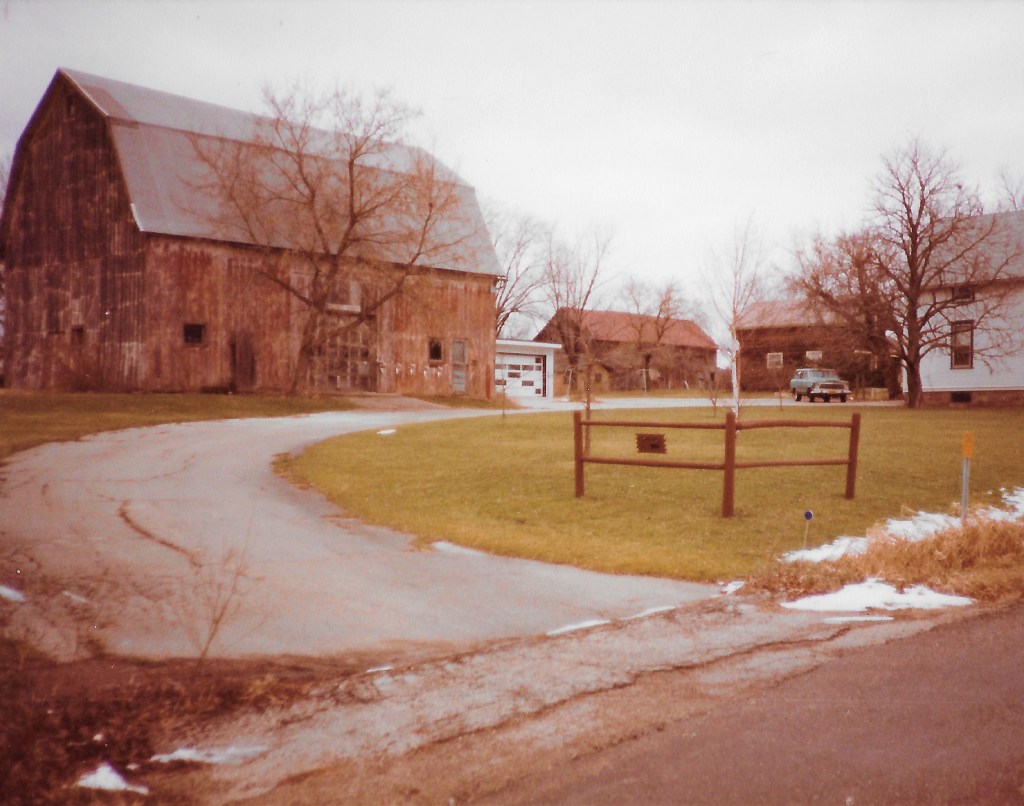
This was only part of our yard. We had land on the other side of the white house, the other side of the curved driveway, and behind the barn and white garage. The hill on which the Snapper became my bucking bronco was just to the left of the barn.
My husband and I live on a small hill. Because of this, we’ve always figured our yard had to be cut with a push mower, but recently we needed to hire a lawn service. Three guys showed up. One maneuvered the weed whacker. One swung a leaf blower. And one drove the riding lawn mower — a zero-turn, wide-cut machine that hugged the hills like a sure-footed mountain goat. I watched with glee, nearly jumping up and down, almost clapping my hands together, wanting to ask if I could take the mower for a spin. I thought, “If we buy one of those zero-turn, wide-cut, mountain-goat mowers, I can cut the grass too.” I used to ride my father’s mower like it was a newly-tamed mustang, and I was a free-wheeling cowgirl.
I was eight years old when I started mowing the 2.2 acres that was our yard, a ponderosa compared to the narrow city lot we moved from when I was five. My dad pIopped me on his 1960s Snapper Comet and taught me how to start, shift, and stop it.
I wasn’t to cut the large rocks that grew behind the barn and garage because they ground lawn mower blades like cowpokes chomping chewing tobacco. I got careless once, and Dad needed to replace the blade. I got careless a second time, and I bent something more serious on the lawn mower. But dad was an excellent mechanic, so he ordered parts and fixed the Snapper.
My father, who could be impatient in many things, was surprisingly calm about my attempt to mow rocks. But after he had to fix the lawn mower a second time, I scoured the back field for rocks, like a ranch hand on the lookout for a stray calf. We lived in southeastern Wisconsin, and thousands of years ago some geological force seeded the earth with large rocks, and every spring several of them would manage to bloom. When the rocks grew too tall, my father would dig them out, place them in a small trailer, and haul them to an overgrown field with a miniature tractor not much bigger than the Snapper.
When I cut the hill by the barn I pretended I was riding a bucking bronco in a rodeo. Because I was so light, I would stand and lean toward the hill to keep the mower’s four wheels on the ground, defying its urge to throw me. I conquered that hill — the only thrill in our otherwise flat yard.
Today, placing an eight-year-old child on a riding lawn mower to cut the grass by herself might be considered child endangerment, but I loved riding the red-and-white Comet, turning in tighter and tighter squares until the whole yard was clipped. No one seemed to think it was unusual — not my mother, not the neighbors, and not me. Besides our Snapper Comet, manufactured in the late sixties, was a pony compared to the muscular draft-horse riding lawn mowers of today.
When my father and mother moved to Tucson in 1977, they didn’t take the Snapper Comet with them. No need to cut the desert sands. My parents divorced in 1983, but my father remained in Tucson. After I married and had children, my father returned to Wisconsin for a couple of weeks every summer. He visited me, other relatives, and friends.
Years later on one of my father’s visits to Wisconsin, he found the same model as our 1960s Snapper Comet at a garage sale and bought it. I didn’t ask him why he bought a riding lawn mower to take home to Tucson, where he lived at an airpark without a blade of grass. But he did have a big garage, so he had plenty of space to store it.
But I looked at the Comet and remembered my bronco riding on the hill by the barn — a hill that seems so small now. I wondered if my father looked at that Comet and thought about teaching his daughters to mow the lawn. I wondered if he thought about the 2.2 acres and the farmhouse where his children mostly grew up, a time when we were all together, before several moves and a divorce separated all the things he held dear.
So now, my husband and I have a riding lawn mower savings account. Next spring we’re buying a zero-turn, wide-cut machine that hugs the hills like a mountain goat. I’m going to learn how to operate it. I’m going to cut the hills — at least once. There will be some who say I should stay off the draft horse. But my father, if he were still alive, wouldn’t be one of them. He’d tell me to hop on up. He’d teach me how to start, shift, and stop it. He’d help me shout, “Yippie-i-oh, Yippie-i-ay! Rawhide!”
So I’m reposting my blog about the American Dagger moth which originally posted September 24, 2021. In addition to being an important part of the food chain, moths are important pollinators too. To read more about why they should be respected and protected read: Bees Get the Glory, But Moths Are Also Key Pollinators, Study Says
To read about my discovery of an American Dagger Caterpillar in my front yard, click below.
I’m reposting this blog about Mayflies because it continues to be read. Last summer and this summer it has received occasional views from people in North America, Europe, and Asia. Perhaps it’s just bots finding the article, but I like to think that an actual person has searched “mayflies” and found my blog. I enjoy writing about backyard nature, and I’m often inspired by the animals, insects, and plants I find in my yard or as I walk down my city streets. It’s my hope that if people understand the importance of the critters and plant life in their yards, they will skip the pesticides and chemicals used to make the “perfect lawn.”
The dog’s water dish has gone missing. My husband has looked everywhere for it, and he announces he can’t find it anywhere.
I’m reading, trying to finish a book before we need to pick up his father and take him out to eat.
Not being able to find the stainless-steel water dish with a nonskid rubber bottom has flummoxed my spouse. He says, “This is bizarre.”
Not to me: In my world things have always occasionally gone missing, but most of the time the objects have returned. I’ve learned to take a deep breath, stop looking for the missing item, and trust it will reappear when it’s ready.
Over twenty years ago, I lost my purse. I searched the house and the car but couldn’t find it. I decided I must have forgotten it at work. I drove back to work and searched for my purse. I asked if anyone had turned it in. No luck. I returned home and cancelled my credit cards, which was the easy part. Going to the DMV to replace my driver’s license would have been a joyless, time-consuming task. I needed to cook supper, so I went into my bedroom to change out of my dress clothes. I shut the door behind me and there, hanging on the hook on the back of the door, was my purse. At that moment I remembered having hung it on the hook, a place I’d never before put my purse.
For years I played where-in-the-Sam-Hill-are-my-car-keys with myself. I’d come into the house with groceries or kids or both. The keys in my hand would get stuffed in a pocket or laid on a random surface somewhere in the house. A few hours later or the next day, the hunt for the keys would begin. After one particularly stressful search, I made a hard-and-fast rule for myself: I must either hang the keys on the hook in the hallway or put them in my purse. It’s been years since I’ve done a frantic search for my car keys.
My husband continues his search. I try to ignore the lost-water-dish ruckus. The book I’m reading is very good. Besides, I believe the dish will turn up, but only if he stops looking for it.
He wonders if someone stole it. I doubt someone would come onto our deck and take a dog’s water dish. Then for a moment, I think maybe a fox took it, which is even more preposterous, but more amusing to contemplate. I keep reading (the book is very good). He keeps searching and grumbling.
I try to ignore him because I know the dish will show up somewhere. Years of experience has taught me this. And when I find a lost object, I remember having put it there — but only after I’ve found it. However, this time I’m certain I’m not to blame for the missing item. And to my husband’s credit, he doesn’t ask me if I’ve done something with it. (Which would be a valid question, and I know it.)
The book is so good, and I’m reaching the end, a very interesting and poignant climax. But I realize I’m not going to enjoy the ending without interruption, so I get up and join the search party.
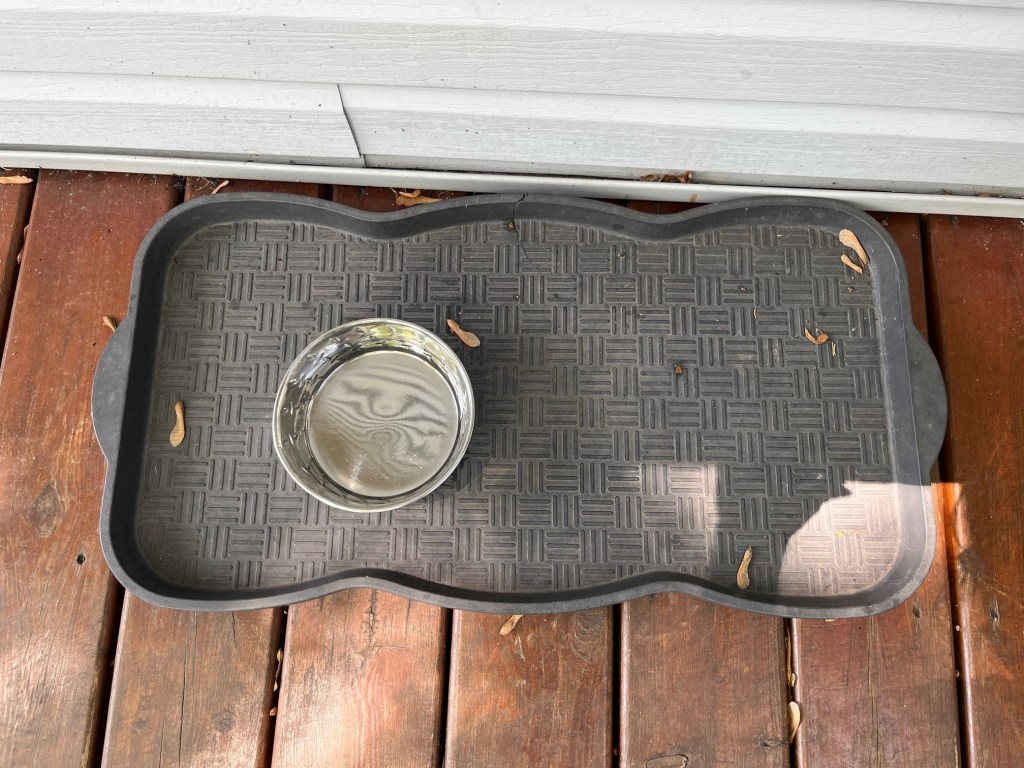
I look in the same places he has looked: the counter, the floor, the dishwasher. Then I go out on the deck and look at the dog’s tray. No water dish. I don’t know what makes me do it, but I walk about ten feet to the edge of the deck. Next to two plants waiting to be put into the ground is the dog’s water dish. Only then do I remember.
I pick up the dish and go back into the house. “I found it,” I say. “It was by the plants at the edge of the deck.”
“How did it get there?”
Not wanting to waste water, I used the old water in the dish to give the plants a drink. I don’t know why I set it next to the plants (which I’ve never done before) instead of refilling it and returning it to the tray. I must have been distracted, probably by one of the dogs in the yard.
“I have no idea,” I say. I’ve seen my fair share of spy thrillers and decide the explanation is on a need-to-know basis. Does he really need to know my forgetfulness caused him a few minutes of puzzlement? Not at all.
He doesn’t say anything more, and I imagine he believes Cabela somehow pushed it over there because lately she’s been banging her dishes about a bit with her clumsy feet.
Later, I wonder if my husband really suspects me of having moved the bowl, but to his credit, he doesn’t mention it. (It would be a valid suspicion, and I know it.)
[In case you’re wondering, I was reading This Is Going to Hurt by Adam Kay. The book is nonfiction. Kay tells stories from his years as a doctor, before he quit to pursue a career as a comedian and a writer for TV and movies. Doctors from all over the world have written to tell him that his experiences as a doctor mirror their experiences as doctors. If you’re a doctor, you’ll probably like the book because you’ll appreciate that someone gets you and understands what the job is like. If you’re not a doctor, you should read the book because you’ll gain insight into a profession that we might all assume we understand because we go to doctors, but we really don’t.]







 Writing Near the Lake