Submitting writing for publication can be scary and intimidating. But if you have written stories, essays, or poetry, and you are longing to see them published, you will need to submit. In her virtual workshop, Victoria Lynn Smith will cover the basics. You will learn about submission guidelines and where to send your work. We will discuss the issue of fee-based versus free submissions. Tips for writing a cover letter and bio and how to increase your chances of acceptance will be shared. Most importantly, we will take about rejection and how to deal with them. A list of resources and a class outline will be shared with all participants. Please note that this class does not cover submitting articles to magazines, which is often done through query letters.
This opportunity is presented free but registration is required. Goodwill donations are accepted. To register click here. (Donations go to support Write On, Door County and the many programs they provide for the writing community.)
Teaching Artist: Victoria Lynn Smith writes short stories and essays. Her work has been rejected more than 174 times but has been accepted thirty-eight times. She lives by Lake Superior, a source of inspiration, happiness, and mystery. Her work has been published by Wisconsin Public Radio, Twin Cities Public Television, Brevity Blog, Better Than Starbucks, Hive Avenue Literary Journal, Persimmon Tree, Jenny, 45th Parallel, Mason Street Review, and regional journals. Her essay “The Dummy Never Showed Up” won an honorable mention in the 2022 Wisconsin Writers Association’s Jade Ring Contest. Her essay “Show and Tell to Remember” won an honorable mention in Bacopa Literary Review’s humor category and was published in November 2022. She was a semi-finalist in the Wisconsin People & Ideas 2022 Fiction Contest, and she placed second in the 2022 Hal Prize Fiction Contest. She is working on a collection of short stories.
Today, March came in like a lion. The winds were 20 mph, and the gusts were a whole lot gustier. We were supposed to get one to three inches of snow, but at least six inches blew in off Lake Superior, and flurries are still coming and going. Around two o’clock this afternoon, a light pole fell over onto the Bong Bridge and blocked traffic from Duluth to Superior. Fortunately, it didn’t fall on a vehicle.
In my yard the snow piled up on existing drifts, turning hills into mountains. I will need a Sherpa, oxygen, and snowshoes to walk around my yard. When I opened my back door, I pushed it slowly, using it as a plow to move a drift just enough so I could reach around and grab the shovel. I cleared a path across the deck for the dogs, who unfortunately need to go potty outside, and do other stuff, like walk around the house to smell for bunnies. They come back inside looking like four-legged abominable snowmen, and I have to towel dry them and dig ice balls out of their feet.
I worked this morning, which left my afternoon wide open for cooking — something I feel compelled to do during a snowstorm. Perhaps it’s a primal instinct, meant to ensure I survive the brutal winter elements while I’m inside my house with central heating, electricity, and running water. First, I made taco soup in the crockpot. Nice and simple. This gave me time to make naan bread.
frying the bread
Why did I decide to make naan bread? Reading made me do it. I’ve read Behind the Lens and Double Exposure written by Jeannée Sacken. Her novels are about the adventures of photojournalist Annie Hawkins, who travels to Afghanistan. They are page-turning adventures with twists and turns and danger and romance, but they are also filled with the sounds, smells, and tastes of Afghan food, and naan bread is mentioned often. After reading the second book a few months ago, I decided I needed to make naan bread. On Sunday, I bought the ingredients.
sort of six-inch circles
I made bread once before when I was sixteen and babysitting for my younger cousins. And it turned out perfect. It was so good — just the right color and height and texture and taste — that I never made bread again. I figured I had nowhere to go but down. My next loaf of bread would have surely been a brick. But naan bread is mostly flat, so I was encouraged. The naan bread could be dipped in the taco soup or torn into bits and dropped into the soup.
My first attempt at activating the yeast was a failure. My water was warm enough, but when I put that warm water into a cool metal bowl, the water temperature dropped, and the yeast fizzled instead of bubbling. I had to throw it out. After some internet research, I tried again. This time I used my Pyrex measuring cup. I warmed it up with warm water, then I put warm water in the cup with the yeast. It bubbled up and doubled in volume, just like it was supposed to do. I mixed the other ingredients in and kneaded the dough on the pastry mat. I covered the dough and let it rise for an hour and a half, while I attended a Zoom write-in.
Triple play: soup cooking in the crockpot and dough rising in a bowl under a dish towel while I write.
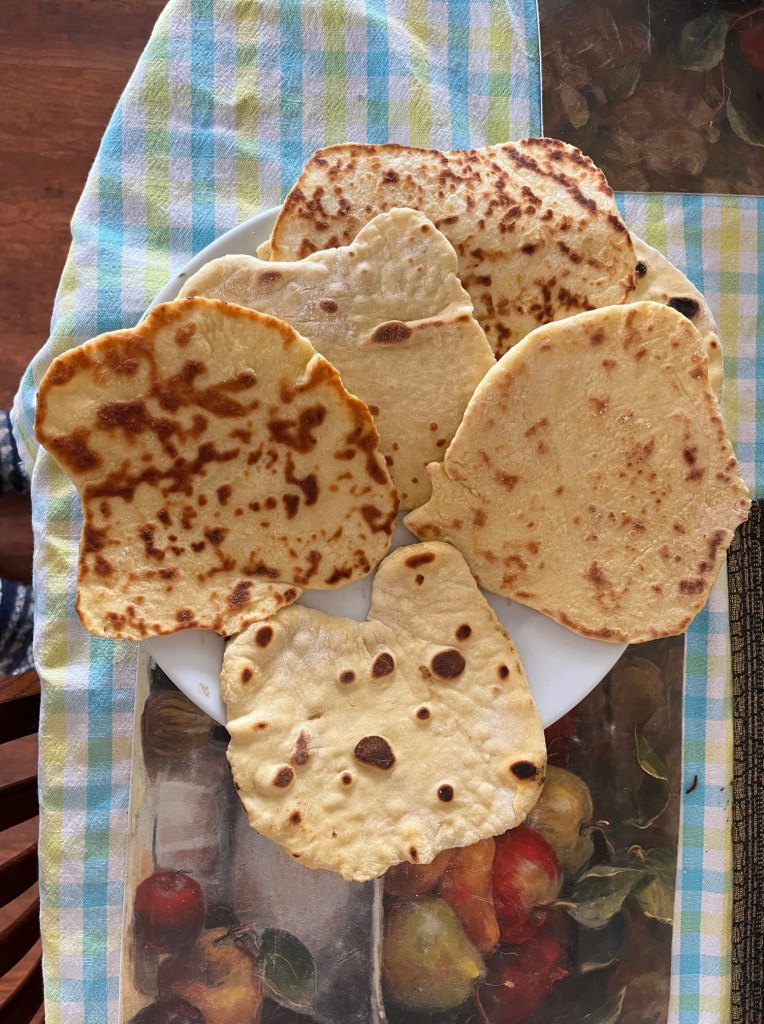
After the naan bread dough finished rising, I divided it into eight sections, rolled each one into a flat six-inch circle — more or less — and fried each piece. I set off the smoke alarm, but only once. I made a mess out of my kitchen. When I finished there were dishes all over the countertops and stove, and I found flour on the floor. I don’t know how I can cook something and make so many dirty dishes and create such a mess. I guess it’s a gift.
When my husband came home, there was no evidence of my afternoon cooking spree. The kitchen was clean and the dishes were done. (I even managed to read a bit and take a nap.) He looked at the plate of naan bread on the counter and asked, “What are those?”
“That’s naan bread. I made it this afternoon.”
“Yeah, right. You went to the grocery store and bought it,” he said.
“Nope,” I said, “I even took out the rolling pin and pastry mat and put them in the dish rack, so you would think I made them from scratch.”
He looked at the dish rack overflowing with bowls, pans, and measuring cups, and he laughed. He knew I’d been cooking and baking. He also doesn’t understand how I can cook something and make so many dishes and such a mess. Some talents are inexplicable. But he liked the naan bread and soup, happy to have a hot home-cooked meal after snow blowing.
In December 2022, Hive Avenue Literary Journal published my short story “Harlequin Pattern.” The story appears on page 262, which can be reached by scrolling down.
Milan and me in the fall of 2019
I dedicated the story to Milan Kovacovic, a kind mentor who gave me feedback on the story. Milan passed away in 2020. I miss him and think of him often. Milan said my story was “a fine piece of satire.”
Milan wrote a thought-provoking and beautiful memoir called Ma’s Dictionary: Straddling the Social Class Divide about his life in France and the U.S. He wrote lovingly about his primary-school teacher, Madam Mercier and her importance in shaping his life. He wrote about his movement between the social classes in France and his emigration to the U.S. When I met him, he was translating his book into French. His book is still available on Amazon.
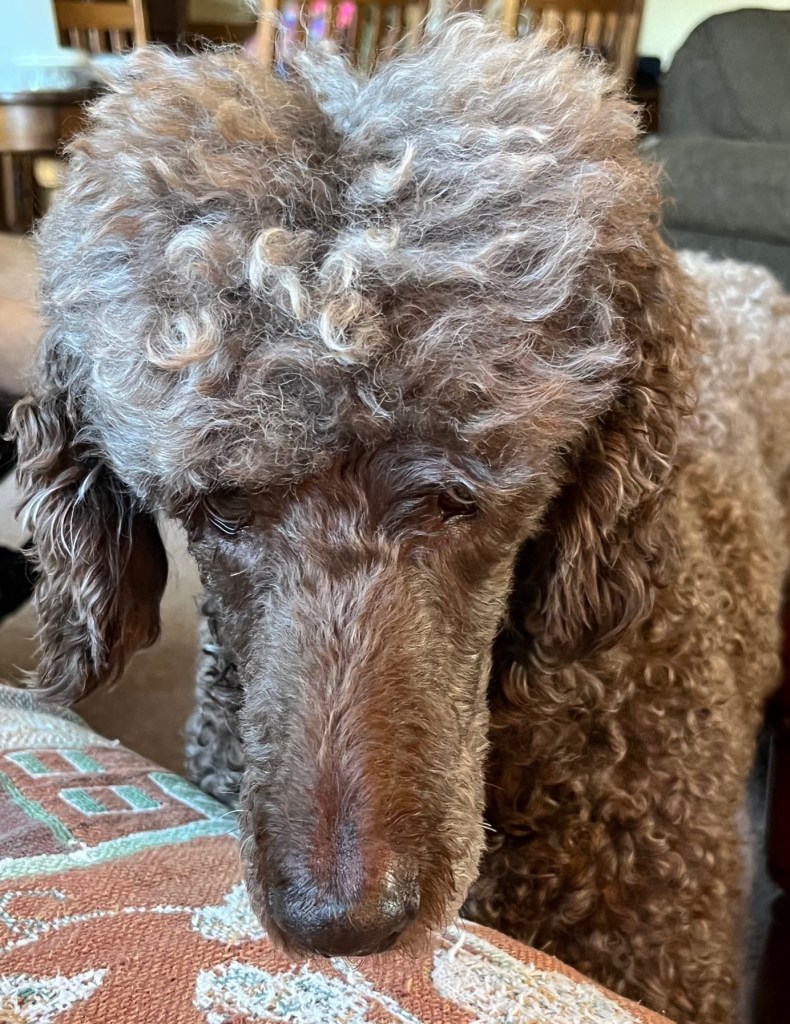
My dog Cabela is fourteen-and-a-half-years old, so in human years she’s ninety-and-a-half. Living with Cabela these days is like living with a very senior citizen. (I’m not sure I like that term. Maybe I’d prefer aged person. But maybe not. It’s February and I get cabin fever in February so I get moody. What sounds good to me one day, sounds awful to me the next day. But this post isn’t going to be about what to call old people. And by the way, winter doesn’t bother me. I don’t care how much snow falls or how many days it has been since the sun has made an appearance. But the quality of the daylight changes in February, and it awakens something in me, and I get cabin fever which recedes sometime in April when I return to ignoring the weather. But this post isn’t going to be about weather either.) It’s about living with an old dog whom I love dearly. And a hardworking grandfather who lost his sight when he was eighty.
Cabela often enters a room and stops abruptly. She stands still, not looking in any direction, and hangs her head, pondering. She’s asking herself, “Why did I come in here?” or “Where was I going?” It takes her a bit to figure it out. I know, I know, sometimes when I go into the basement, I forget why I went down there. But I usually remember as soon as I go back upstairs. And most of the time I don’t forget why I went downstairs.
At night Cabela’s more confused and she often paces. It’s called sundowning, which is not a disease, but a condition that can occur with dementia, and yes, dogs can get dementia. Sometimes I think Cabela has a touch of it. She knows all her people. She hasn’t forgotten when it’s time for her meals, treats, and walks. And she doesn’t mistake the floors for the yard. But she has changed.
On most nights, somewhere between midnight and two in the morning, Cabela begins the restless pacing, the waking up and wandering from the bedroom to the family room to the bathroom. The first time she does it, I get up and let her outside. Lots of older people need to get up during the night and pee, and if Cabela needs to go, she needs to go. It’s not good to hold it. But after she comes back inside, she can’t decide if she wants to sleep on her bed in the bathroom or her bed in the bedroom or on one of the couches in the family room. I hear her paws swoosh on the carpet as she walks by the bedroom on her way into the family room. I hear her walk by the bedroom again on her way to the bathroom where her nails click on the linoleum and her body thuds onto the sheepskin bed tucked between the end of the toilet and the cupboard. I hear her rise up and once again her nails click on the floor, but instead of walking by the bedroom, she enters it. I know she’s looking at me, wondering why I don’t get up. Because I believe she thinks it’s time to get up. Finally, she settles down for a few more hours, but eventually she begins pacing again before my husband and I have to get up.
Last night Cabela was more restless than normal. The only one who slept through it all was Ziva, our other younger dog.
Cabela, left; Ziva right
So my grandkids and I took Cabela and Ziva for a walk this morning before it started raining. Cabela can’t walk far, but we went slow. We walked three blocks up, one block west, three blocks down, and one block east. My idea was to give her more daytime activity, hoping she’d sleep better tonight. But we’ve only managed one walk because it’s still raining, and it’s cold, soggy, and windy. It’s not good weather for a “ninety-year-old” dog.
On our morning walk, I thought about my grandpa George who went blind at eighty years old. He didn’t have dementia, but he was restless at night. He kept waking my grandma Olive and asking her if it was time to get up. He’d fuss about who was taking care of his garden or about something that needed attention at his gas station. In the darkness of night, things are always a worry. And for Grandpa, who’d lost his sight, I imagine those worries became terrors.
Before Grandpa George went blind, he still went to work at his station six-and-a-half days a week. He pumped gas and tinkered in the garage. He’d been going to work at his station for over sixty years, rarely taking a vacation or even a day off. He planted a large garden and grew raspberries, strawberries, green onions, sweet onions, new potatoes, russet potatoes, corn, peas, beans, beets, asparagus, carrots, and a few flowers between the rows of fruits and vegetables. He did the sowing and the harvesting, even at eighty years old.
Olive and George, 1930s
But after he lost his sight, his life screeched to halt, like a pair of rusty brakes on a customer’s old car that he once would’ve fixed. Grandpa George, who got up every morning before six, ate at seven, and opened his station at eight, couldn’t walk from his bed to the bathroom without someone to help him find his way. Grandpa George, who raised the finest garden in town that provided food for his family throughout the summer, fall, winter, and spring, could no longer read the rain gauge or sort his seeds for planting.
Grandpa’s days and nights somersaulted. He dozed on the living room couch during the day when he should’ve been filling someone’s gas tank and checking her oil. He listened to the evening news when he should’ve been checking the corn and pulling potatoes in the garden. At night when he would’ve been sleeping after a day’s work, his mind raced and he kept his wife up with question after question, starting with, “Olive, you awake?”
Grandma Olive tried to keep Grandpa from falling asleep on the couch during the day. At first people came to visit, and he told them what to do at the station in order to close it down, and there were the last crops to reap from the garden, all activities Grandpa oversaw while sitting at the kitchen table, his calloused mechanic’s hands resting on a white oilcloth decorated with nickel-sized cherries.
Someone came and tried to teach Grandpa to read braille. Perhaps books would entertain him. But his hands shook slightly, and he couldn’t track the raised bumps on the page.
Nuts.
Someone decided pecans were the answer. Grandpa sat at the kitchen table and cracked pecan after pecan. He sorted the meat from the shells the best he could, but someone else, usually Grandma, needed to pick out the stray shells. Another job for her to take on, along with all her other chores that needed completing on a short night’s sleep. The pecans were stored in jars and given to family and friends, all of whom soon had more pecans than they could ever use.
Grandpa kept cracking nuts, but he didn’t sleep better. Nights were restless and his mind paced, although the rest of him couldn’t. Grandpa was certain dawn must be coming soon, even though it was hours away, and he would ask, “Olive, you awake? What time is it?” And Cabela, certain the day should begin even though it’s hours away, stares at me most mornings as if to say, “You awake? It’s got to be time to get up.”
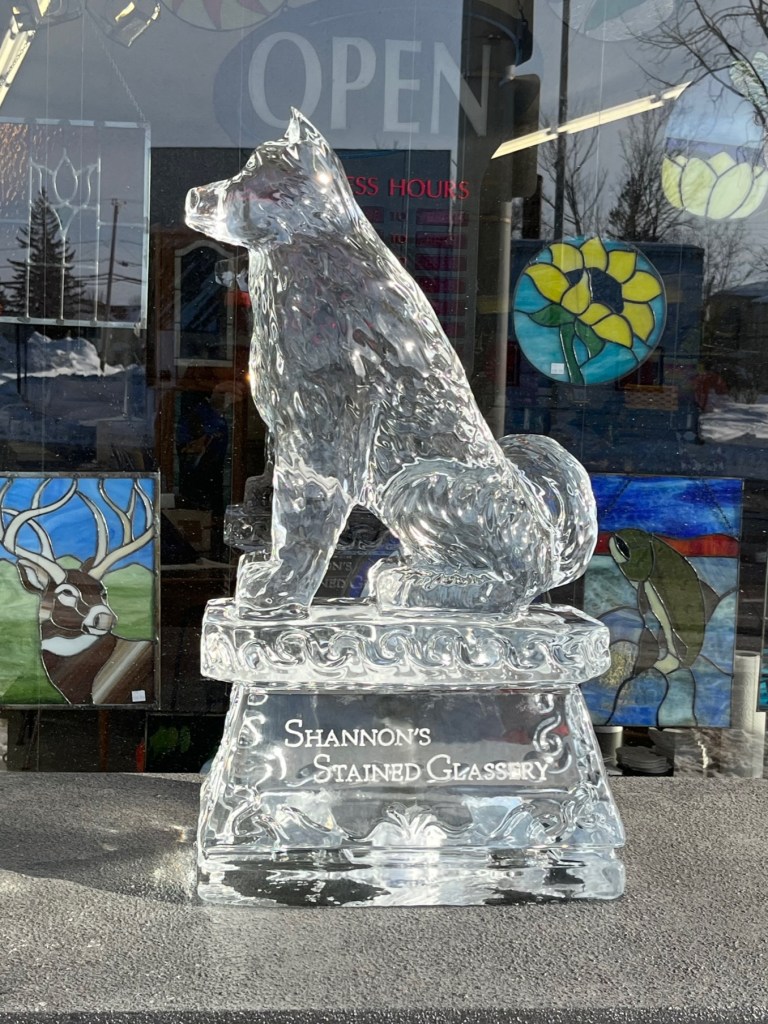
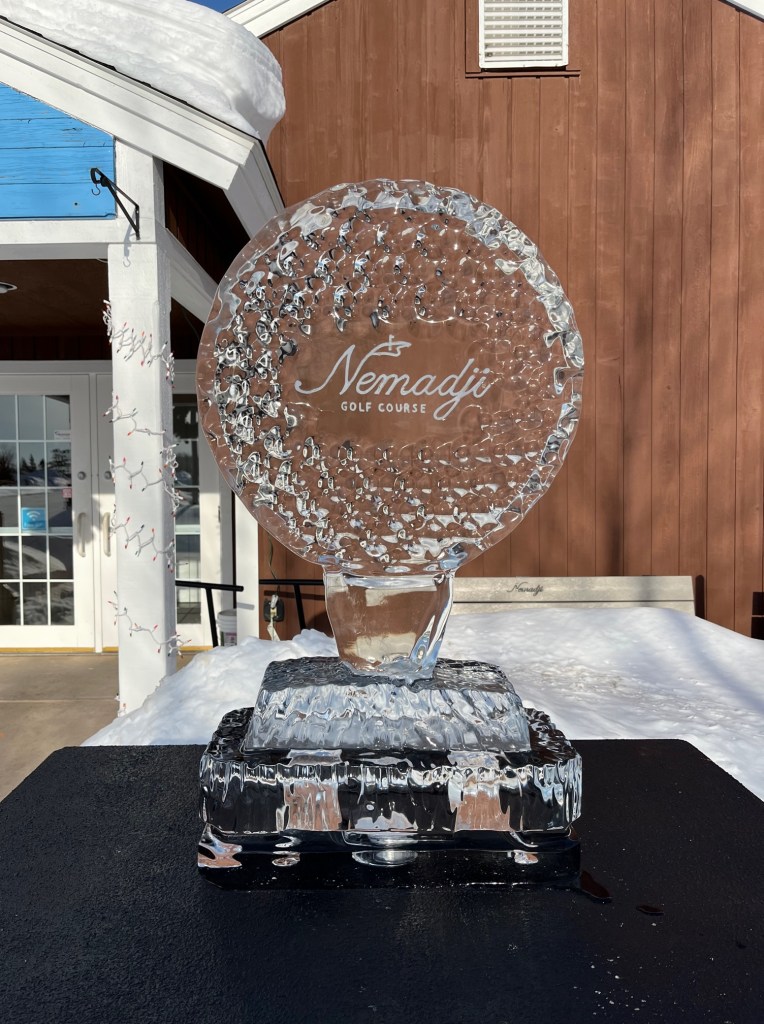
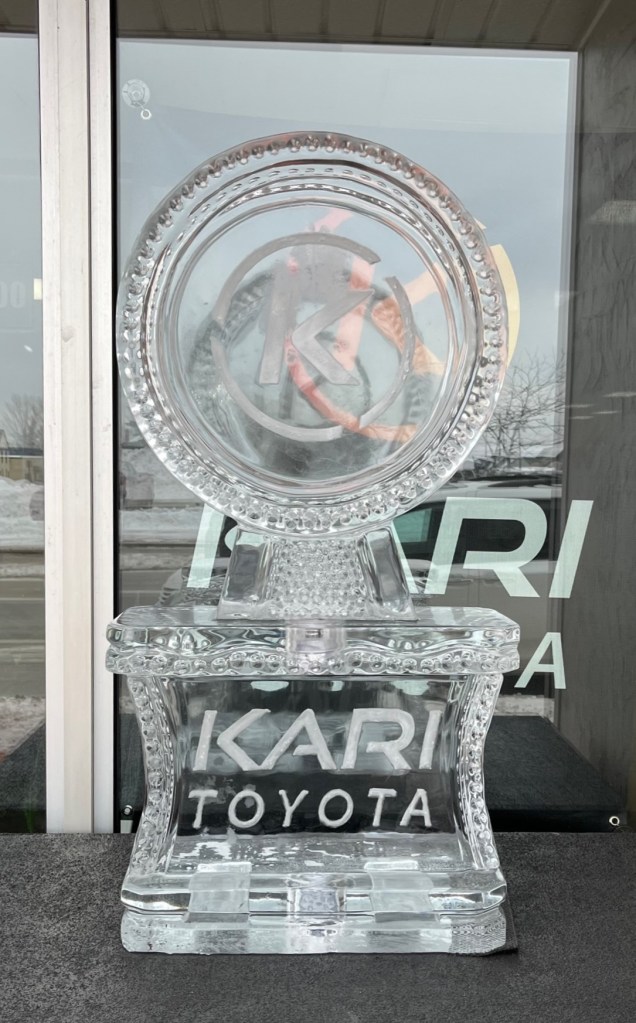
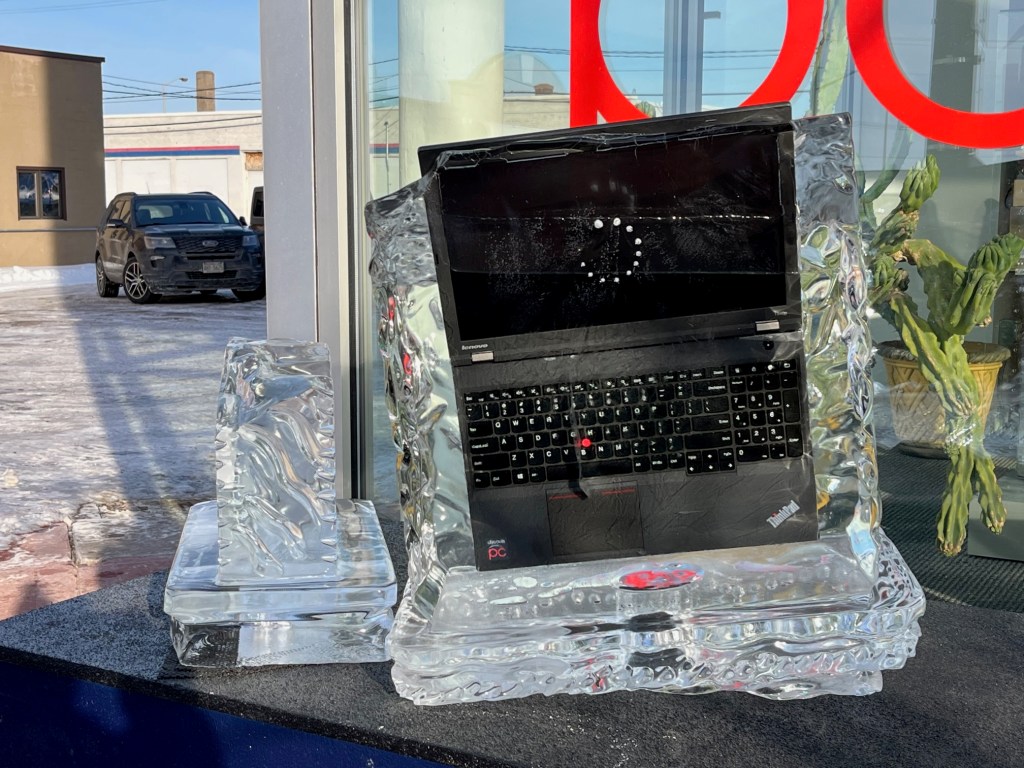
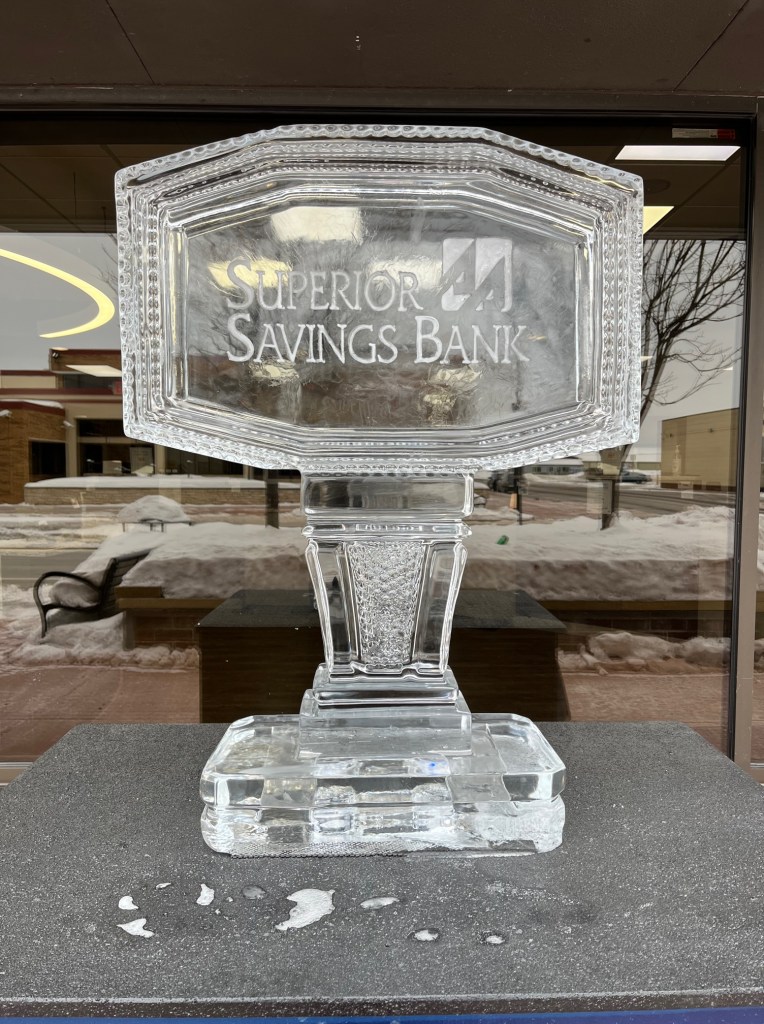
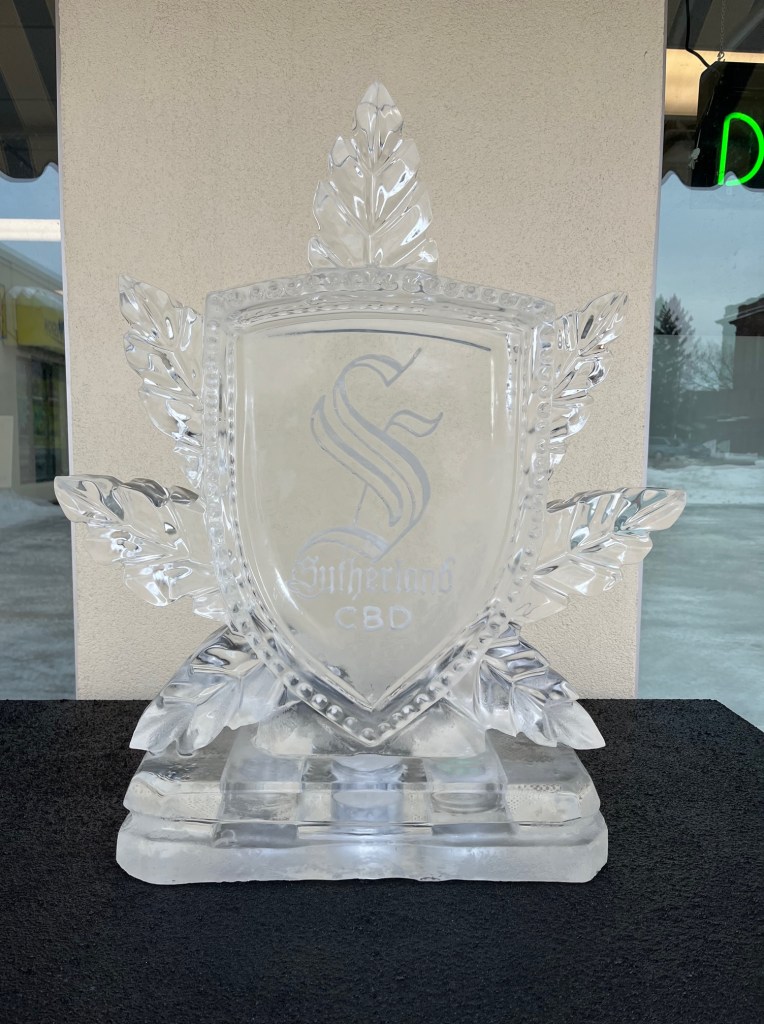
On the last weekend of January, my city celebrates winter with an Ice Festival, and as part of that celebration, small ice sculptures crop up around town. This year right before the festival weekend, an arctic front showed up carrying a couple of bags of windchill and settled in for a week like our town was an Airbnb.
I wasn’t bothered that Mr. Arctic Front crashed the festival because I never attend the outdoor tribute to winter. It’s not because I don’t like snow and cold, but I embrace it differently. I honor winter by reading, writing, walking my dogs, feeding the birds, baking, and marching briskly from my car to whatever building I’m entering. But on Saturday night, I enjoyed the festival’s closing fireworks, watching them from my kitchen window while sipping raspberry hibiscus tea with honey.
After the Ice Festival was over Mr. A. Front stayed on for the week. Each day his mood descended into a deeper frigid funk, deep enough by Friday morning to cause scads of school districts to either delay their start by two hours or completely cancel classes. The next day Mr. Front stuffed the windchill back into his bags and left town. The temperature rose to a glorious balmy 25°, and I got an itch to have some fun, which brings me back to the ice sculptures. I decided I needed to photograph each one.
I found the list of businesses that sponsored the sculptures, grabbed my phone, and set out on a mission. It was like a treasure hunt, but without the stupid clues. I’m no good at puzzlers or clues or those math problems with trains leaving stations at different times, going different speeds, and heading different directions. I always wanted to shout, “Take the damn bus or drive or fly!”
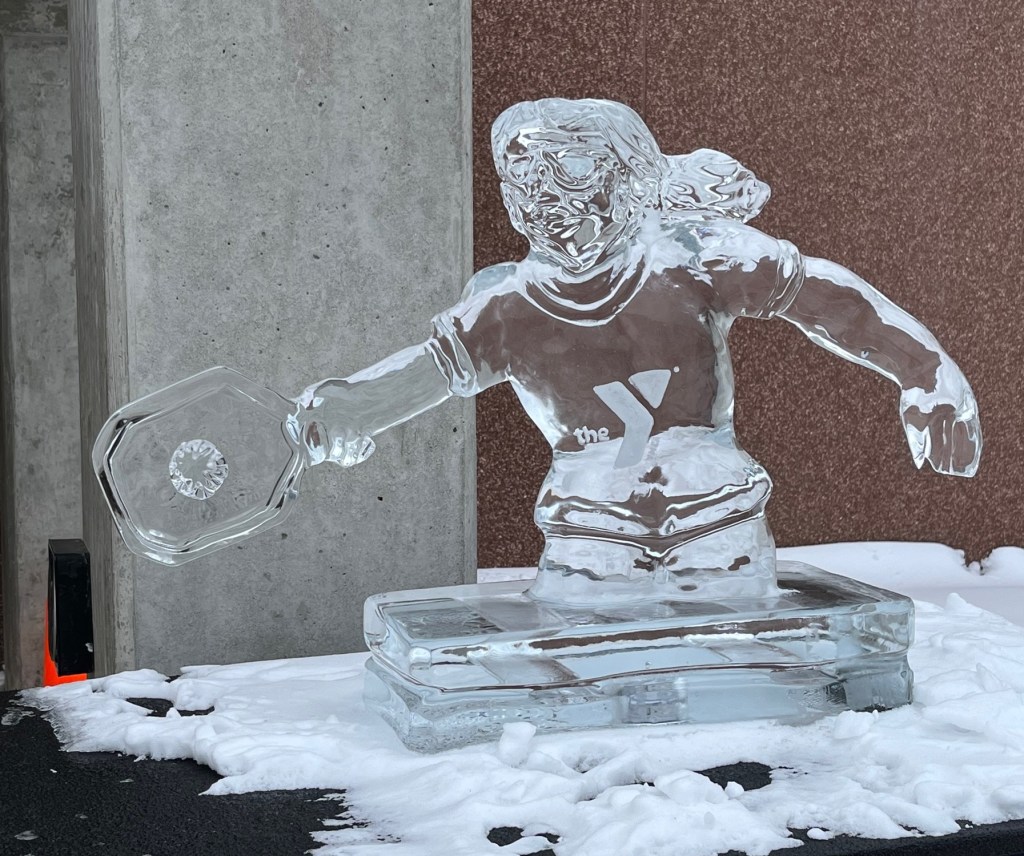
Pretending my phone was a righteous 35mm with a telephoto lens of phallic proportions, I fancied myself a photojournalist. (Hey, it’s my Walter Mitty fantasy.) I started my ice sculpture treasure hunt with some coin in the bank because I had already photographed the icy racquetball player in front of the YMCA when I dropped my grandson off at his 3K school on Wednesday, and I had snapped a picture of the sculpture in front of the vet’s when I dropped off a urine sample for Cabela on Friday. Years ago, I played many racquetball games with a college friend at the Y. The vet who takes care of my dogs was a former student of mine, and she has cared for all of our dogs accept the first one my husband and I had. My ice safari would turn out to be a trip down memory lane.
YMCAVet’s Office
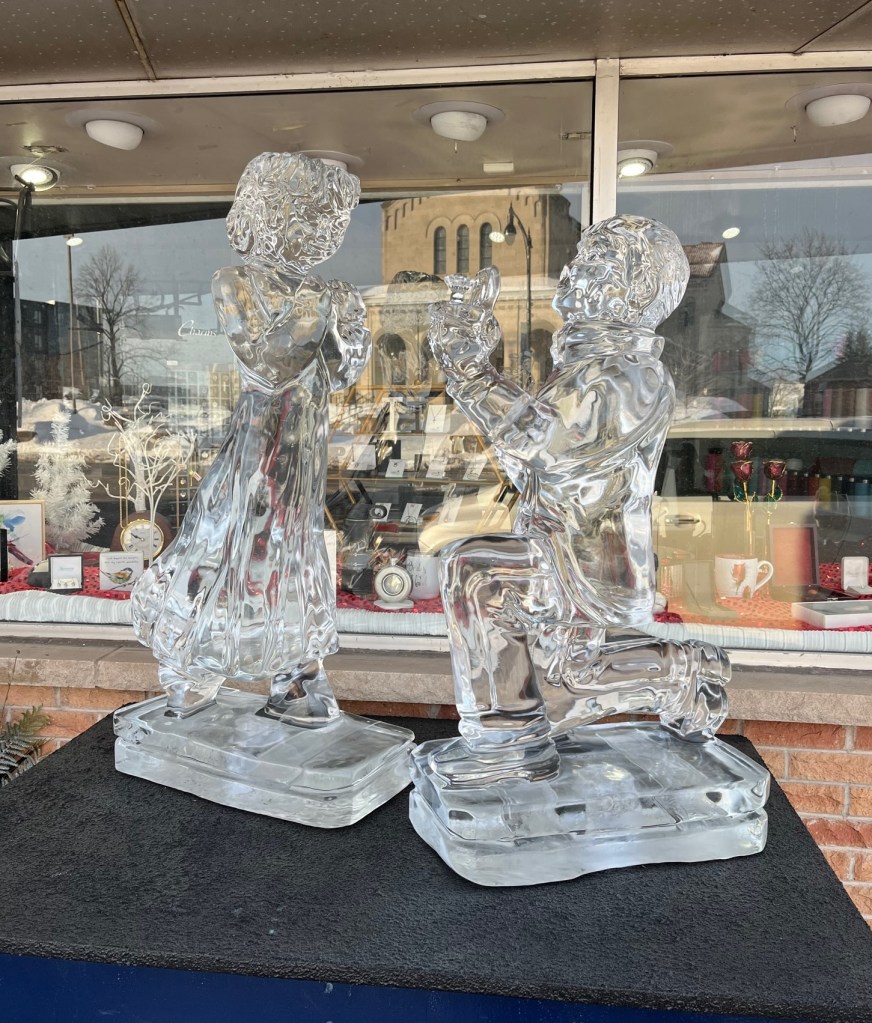
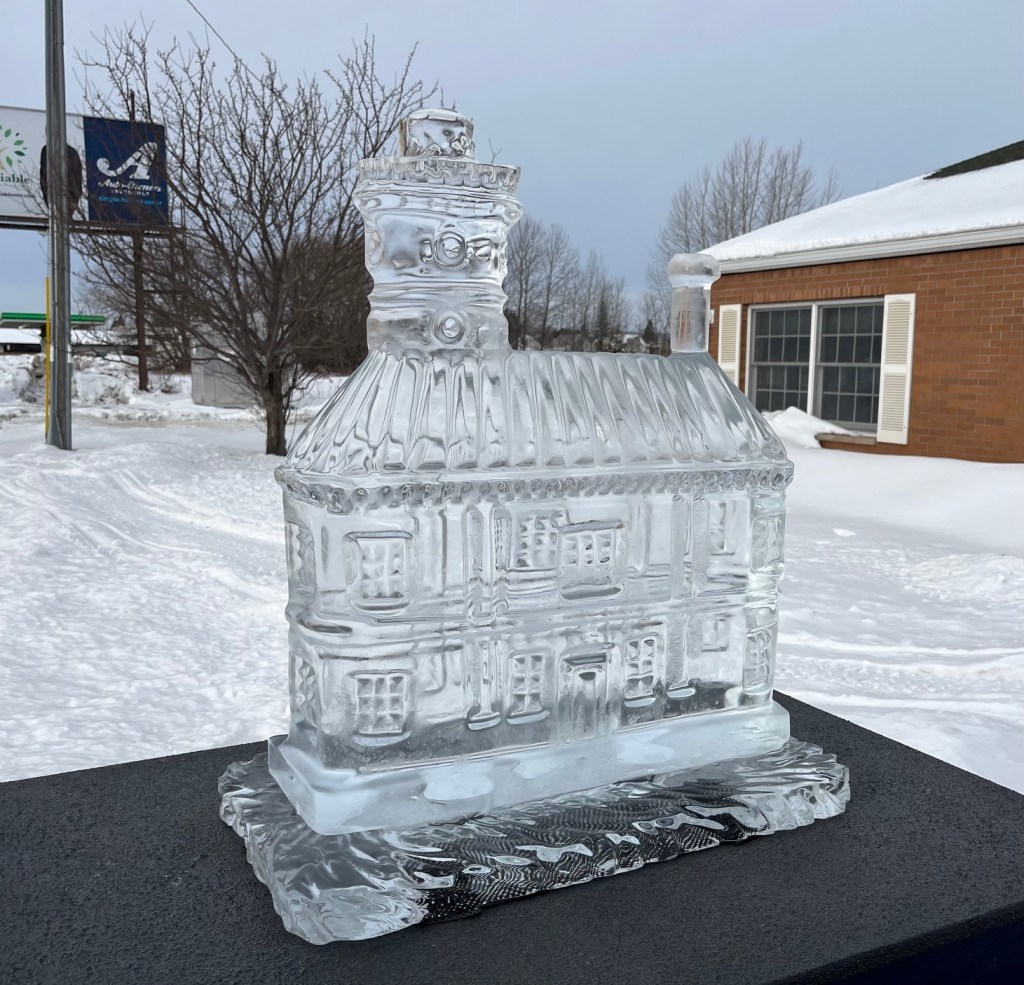
I photographed the tender proposal in front of the jewelry store where my husband and I bought our wedding rings in 1985. The Victorian house was captured in front of the chamber of commerce. It represents Fairlawn Mansion built by Martin Pattison, a lumber and mining baron. After Pattison’s death, his wife Grace donated Fairlawn to be used as a children’s home. Two of my uncles lived there for a brief time after they became orphans.
The ProposalFairlawn Museum
The cool Tramp wooed the adorable Lady while sharing a sparkly, silver noodle made from a pipe cleaner in front of Vintage Italian Pizza (VIP). A couple of days ago when I ordered a pizza to be delivered, I told the young person who took our order that my husband and I have been ordering pizza from VIP for almost thirty years. “Wow,” he said, “I’ve only been working here for five months.” He didn’t sound old enough to have been doing anything for thirty years. “Don’t worry,” I told him, “you’ll get there soon enough.”
My favorite coffee shop sponsored a frozen hot coffee with chilled steam rising out of the mug. I took a break from my self-imposed photojournalism assignment and went inside to order a decaf latte with a shot of raspberry. Sometimes when I write I get cagey, so I pack up my computer and go to the coffeehouse and write. There’s always at least one other person plunking on a keyboard. We never speak because we don’t know each other, but I feel a sense of community.
VIP PizzaMy Other Writing Office
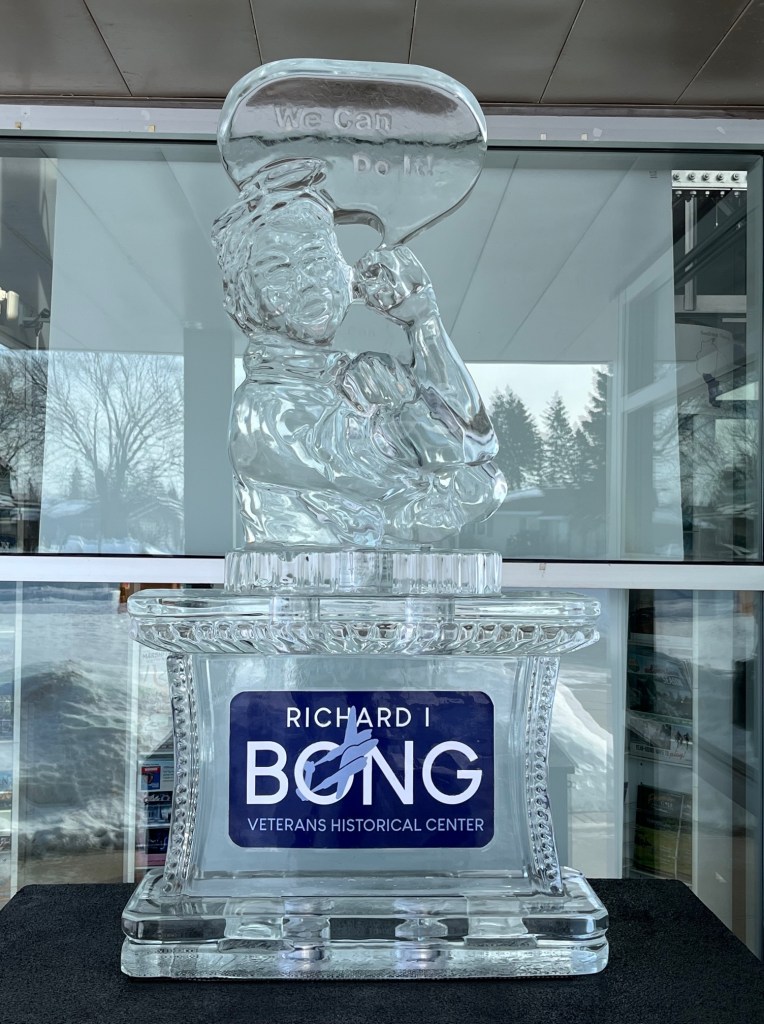
Richard Bong, a WWII flying ace, flew many missions and shot down many enemy planes. However, he didn’t die in battle, but while working as a test pilot in California.
The Richard Bong Center chose Rosie the Riveter to represent their museum honoring American veterans. My mother-in-law would have loved the cool-as-ice Rosie because she believed women were smart, capable, and strong.
My grandpa Howard served in the U.S. Army during WWII from January 1941 until August 1945. In 1943, he was wounded in Italy and received the Purple Heart. My sister, one of her sons, and I paid tribute to Howard through the Flag of Honor program started by American Legion Post 435 at the Bong Center. The American flag presented to Howard’s family at his funeral was raised during a short ceremony to commemorate his service in WWII
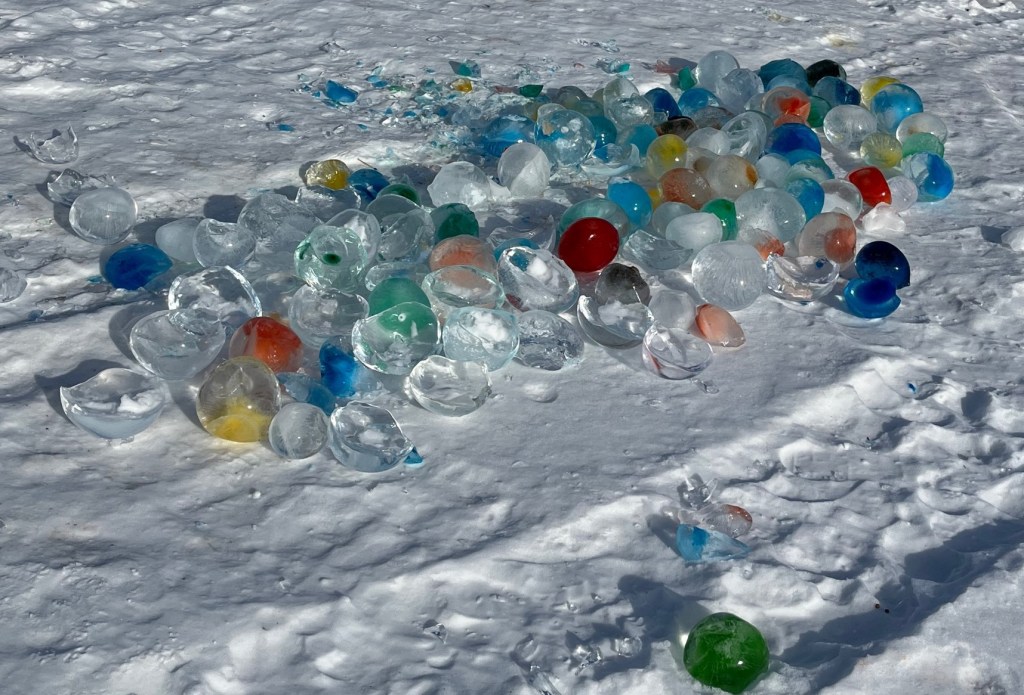
After photographing the ice sculptures downtown, I headed for Barker’s Island, the site of the festival, to track down more sculptures. When I parked the car, I spotted a large pile of misshaped ice marbles. They were part of the winter festival, but I’m not sure how. I liked thinking about them as giant marbles left behind by Paul Bunyan. I loved playing marbles when I was in second grade, and I could beat all the boys. In fifth grade I played Babe the Blue Ox in a play. I made my own costume by cutting out the silhouette of an ox from cardboard and painting it blue. When I was on stage, I was always behind the cardboard ox, and I had no lines, so I didn’t discover I had stage fright until I played the Wizard in the Wizard of Oz in seventh grade.
Paul Bunyan’s marblesZiva, my safari assistant
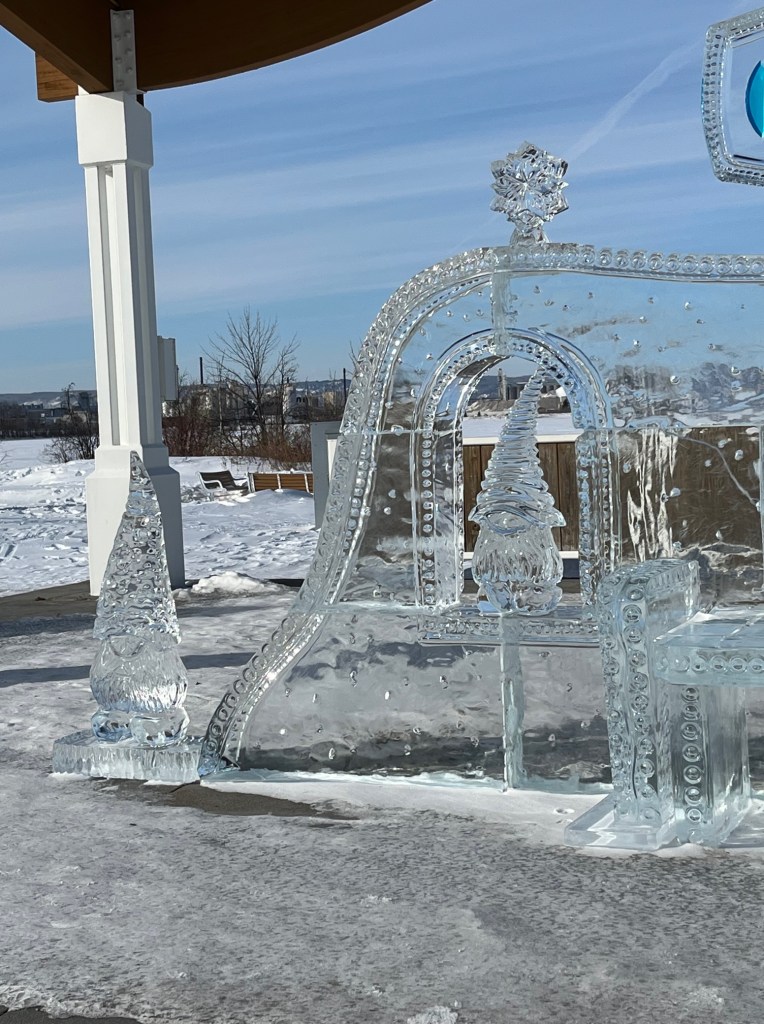
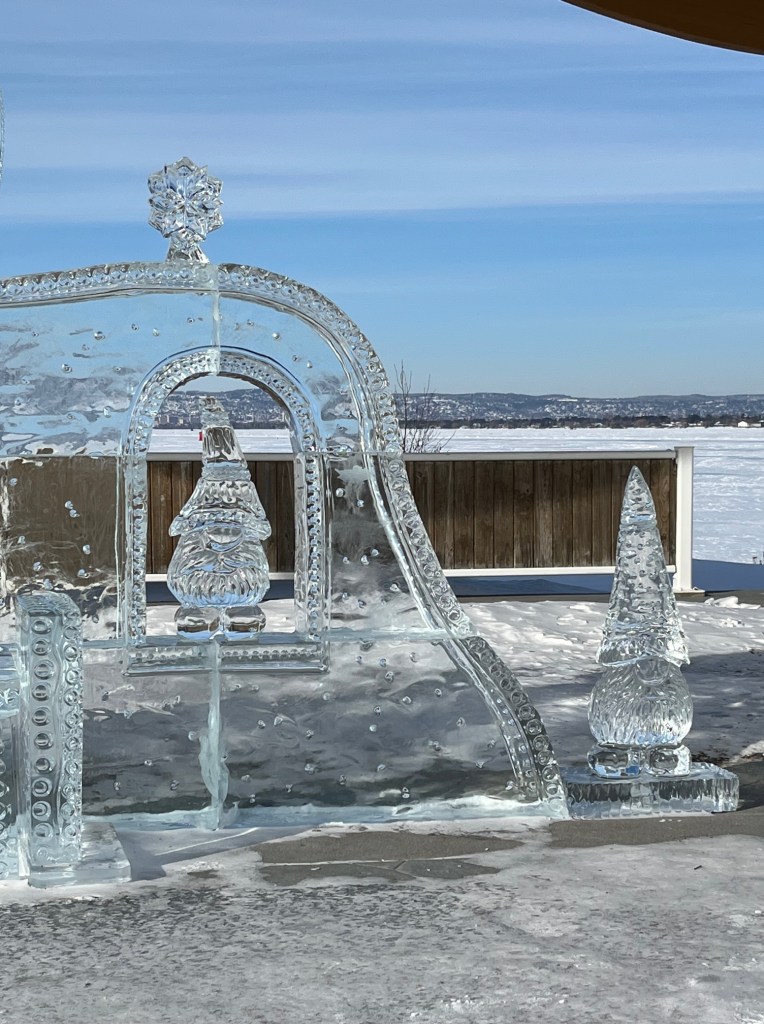
Across from Paul Bunyan’s abandoned marbles, were two of the prettiest ice sculptures. I don’t know what they symbolize, but I imagine they have a connection to sailors and ships and open waters. In the left photo in the background is the Seaman’s Memorial, a statue dedicated to sailors who have lost their lives on Lake Superior.
And the Ice Festival throne . . . heavy is the head that wears the crown and frozen is the butt that sits upon this throne.
Gnomes in waiting,the throne,and more gnomes
The Superior Refinery sponsored an ice sculpture. On April 26, 2018, an explosion and fire rocked the refinery, which was owned by another company at the time. Luckily no one was killed at the refinery, and even luckier the explosion wasn’t as bad as it could have been. Because if it had been, everyone within a twenty-five mile radius from the refinery would probably not be around to tell their stories. There was a large-scale evacuation. My mother-in-law, who was suffering from heart failure was in the hospital that evening in a neighboring city, which was less than fifteen miles away, and her husband was with her. It was their 66th wedding anniversary. My husband and I visited them at the hospital. Less than a month later my mother-in-law passed away. But on that night, she had her humor with her, and she quipped, “Well, I won’t ever forget the date of the explosion.”
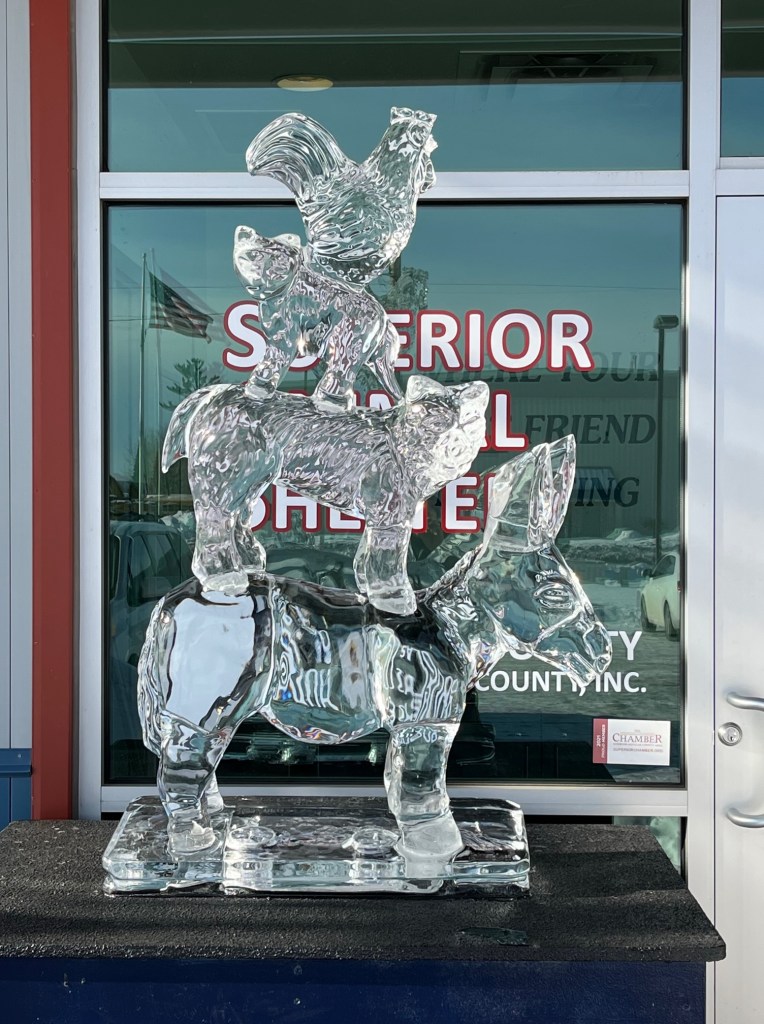
And on a happier note, my favorite ice sculpture, “The Town Musicians of Bremen,” was sponsored by the animal shelter. As a child, the story by the Brothers Grimm was one of my favorites. Turns out the four famous animal musicians have statues of themselves in Bremen, Germany, the Lynden Sculpture Garden in Milwaukee, and in front of some veterinary schools in Germany. (You can listen to the story here.)
The refinery is expected to begin operations again in 2023.The Bremen Musicians
And the rest of the sculptures . . . Click on the side arrows to move through the slideshow.
I related to their comparing their 2022 writing accomplishments to their 2023 writing attempts. I, too, have deadlines looming for journals and contests that I’ve submitted to in the past few years but wonder if I’ll submit to all of them again this year. I’ve been working on writing new stories and essays, but it’s harder this year, and what I have is a handful of rough drafts that I haven’t returned to working on yet because I tell myself I need to let them simmer. I’m not sure why writing seems harder this year, but I have some guesses. First, I spent large chunks of time this fall and early winter visiting my mom, who is recovering from major heart surgery. And I’m subbing a lot more, something I did infrequently during the 2021-22 school year. Both of those activities have taken time away from my writing. Also, I had short stories and essays published and a few won prizes in contests during 2022. Now, I wonder if I can write something as good or hopefully better. That kind of thinking makes my fingers freeze over the keyboard.
Like Burnett, I often admire another writer’s work, and say to myself, “Wow, I wish I could write like that!” It’s a little easier to put those comparisons aside and remind myself to be the writer I am and to compete only against myself. But that can be perilous too. Burnett has a point about looking back at our past accomplishments and using them against ourselves as a measuring stick – it’s not too helpful when sitting down to write in the present.
Reading Burnett’s blog made me feel better. It’s comforting to know someone else feels the way I feel. Writing is a solitary endeavor most of the time, and when I do get together with other writers, we often discuss what we’re working on, give each other feedback, and share resources. But if I’m struggling, I don’t want to be the little black cloud in the group raining insecurity, so I’m grateful that Burnett shared their feelings about the times when writing isn’t clicking. It’s wonderful to have a community of writers to share the good times and happy news with, but it’s also wonderful to have a community of writers to share the tough times with. Talking about the boogeyman hiding under my keyboard helps because the pesky monster shrinks in size when I talk about it.
Burnett suggests we be compassionate with ourselves. So, I’ve done a handstand and flipped my viewpoint, and I’m giving myself credit for what I’ve done so far this year. I have three rough drafts that might make good stories. I’m reworking an essay I thought was complete, giving it more depth and meaning (letting a piece of writing simmer isn’t just procrastination). In the last two weeks I finished a 900-word story and a 3,000-word essay, which I submitted a day before the deadline, and I started another short story that has promise. And I write for my blog.
The only cure I know for writing is to keep writing. And I’ve been doing that, just differently and slower. And it’s all okay.
Thank you, Finnian Burnett, for saying so in your blog and reminding us all to be kind to ourselves. And you said it so well!
[To read “Avoid Comparing Yourself to Other Writers – Even Yourself” by Finnian Burnett, click here.]
[Note: Kallio’s book is being released in February 2023, by Cornerstone Press.]
Open Finding the Bones by Nikki Kallio and buckle up because you’re in for a spellbinding, scary, stomach-dropping, heart-in-your-throat roller coaster ride through nine short stories and a novella, some written in the genres of science fiction, gothic, and speculative. I read Kallio’s page-turning collection in one day.
But ride that roller coaster in slow motion because Kallio’s stories are written with a wonderful literary flare, breaking the boundaries of genre labels. So read deeply and slowly, savor Kallio’s use of language. Study her characters, listen to their conversations, and read their thoughts. Look around at the worlds her characters inhabit, yet find yourself reminded of your own familiar world.
Some of Kallio’s stories launch us into other worlds: outer space, a haunted house, and an Earth where the sun is dangerous. Others are set in the ordinary homes of ordinary people who face extraordinary events. Her stories explore themes of death, isolation, aging, belonging, trauma, and displacement. And while Kallio’s stories transported me far away from my living room couch, they also connected me to what it means to be human during times of tragedy, mental health issues, or environmental devastation.
For example, “Shadow” and “Disappearing” explore grief and loss from different angles, helping readers understand that grief is a deep and complex emotion. “Disappearing,” one of my favorite stories, explores loss from a child’s viewpoint after his mother has gone missing, disrupting the notion that children don’t experience grief like adults do.
In “Geography Lessons” a father and daughter are traveling through space to another planet because Earth has been destroyed, but only a fraction of the population is chosen for the trip. As the former earthlings hurtled through space, I thought about migrants in our world who leave their homes because they are no longer safe, bringing with them only memories and perhaps a few trinkets. Family ties are broken, cultural heritage is fractured, and children drift between two worlds.
Kallio’s collection of short stories ends with The Fledgling, an eighty-three-page novella. It’s a powerful, tightly woven dystopian story with richly drawn characters navigating life on Earth after exposure to the sun becomes dangerous. Her novella is the pitch-perfect crescendo to the end of an amazing collection of stories.
Kallio’s stories entertain, but she also creates empathy for characters and in turn her characters enhance our ability to understand our fellow human beings. Years ago I was told that short stories are meant to be read more than once, and Kallio’s collection invites us to visit again.
[Bloganuary is hosted by WordPress. A new topic is presented each day during January. This is yesterday’s topic.]
Nana Kitty in front of her house, 1978
I cannot describe what my nana’s kitchen smelled like because there is no specific scent I know of to compare it to. But on rare occasions, I walk into someplace and unexpectedly inhale a whiff of the same smell that was a constant part of her kitchen. Permanent just like the yellowed-white plastic radio on her burgundy-red linoleum countertop or the see-no-evil, hear-no-evil, speak-no-evil statuette of monkeys perched next to the acorn-and-pipe-cleaner figurine who played a single bongo drum, both resting on a shelf above the ledge where her princess phone lounged.
It wasn’t the smell of cookies in the oven or bread dough rising because she never baked. Her bankrupt cookie jar squatted in a corner to the left of the sink, tucked next to the toaster. It wasn’t the smell of fried chicken sizzling on the stove or a Sunday roast baking in the oven because Nana never cooked the way most women did in the 1960s. I don’t have a single memory of our family gathering around her kitchen table for a holiday dinner or any other dinner. She had no dining room. My siblings and I often stayed with Nana for two or three days at a time, but I remember little about what we ate.
Her kitchen was a small space with a trivial parcel of countertop, an afterthought of cupboards, a narrow gas stove, and an old diminutive, single-door refrigerator with a miniature freezer box tucked inside. The kitchen was designed to discourage cooking.
Perhaps the distinct smell of Nana’s kitchen was a conglomeration of its tiny world: a tea kettle of water boiling over a gas flame to make instant coffee; a sunny-side-up egg in melted butter, frying in a cast iron pan, basted to perfection; Malt-O-Meal bubbling in a stainless-steel pot; a slice of bread browning in a toaster, then layered with butter or marmalade; tea steeping in hot water, brewed to soothe a queasy stomach; a rose or peony cut from the garden, standing in a vase; shoes or winter boots gathered on yesterday’s newspaper near the outside door; an old oak table covered with oilcloth; faux brick vinyl wallpaper on the front wall; white cotton curtains washed in Fels-Naptha soap; cleanser scrubbed against the porcelain sink; wax applied to the yellow, brown, and orange patterned floor; aging varnish on wooden trim; the metal-lined milk chute, waiting for the day’s delivery; the heavy, dark wooden door, layered with years of oil from the hands of Nana’s grandchildren, children, and her dead husband.
It’s been awhile since I have smelled anything like Nana’s kitchen. Perhaps that’s because many of the smells that lived there are now too old-fashioned, having been made from products no longer used. Perhaps my sense of smell has dulled. Recently, I looked at pictures of Nana’s home on a realtor’s site. The kitchen has been modernized, but it’s still tiny, still designed to discourage cooking. I imagine the smells have been updated too.
[Bloganuary is hosted by WordPress. A new topic is presented each day during January. With this post I’m both behind and moving in reverse through the topics. But Merlin aged backwards, growing younger, so there you go.]
Charlie in Turtle Park, November 2022
Choosing anything to label as “the best” or “most memorable” or “the greatest” is difficult. The answer to my most memorable gift would’ve been different last year, ten years ago, twenty years ago, or forty years ago, and if I wrote about any of those gifts, it wouldn’t mean the others were less memorable. So, I’ve decided to write about my most recent memorable gift for a couple of reasons. One, it’s recent, so I remember more details, and two, because, well, it’s memorable.
In December my youngest two grandchildren, Evan and Charlie, came for a sleepover. When they arrived, I opened the overhead door to let them in the garage. Charlie, the four year old, stood in front of me clutching the top of a sandwich baggie in his fists. His dad and grandpa talked to each other, Evan talked to everyone, and Charlie talked to me, keeping a firm grip on his baggie. But his voice is small, and his C‘s come out as W‘s, and sometimes he drops his S‘s. My ears have trouble distinguishing between M‘s and N‘s and B‘s and D‘s. Sometimes in a room of crowded voices, it’s hard for my ears to decipher Charlie’s words. But I figured he was talking about a snack in the baggie, so I patted his head and said, “That’s nice.” I told him to go inside and take his jacket and boots off. Charlie smiled big, and went into the house.
My son looked at me. He knew I hadn’t heard a word Charlie said because I had that look on my face. The look of someone pretending she has heard. “You know,” my son said, “Charlie filled that baggie with warm air from the car. He wants to give it to you for your house.”
I did not know. I had not heard. I followed Charlie into the basement.
“Charlie, you brought me some warm air. Thank you so much.”
“Yeah!” Charlie cooed, smiling even bigger, firmly holding the baggie, making sure none of the air escaped while he shook off his boots one at a time. I offered to hold the baggie of air while he took off his jacket.
I handed the air back to Charlie. “Let’s go upstairs, and you can set the warm air free.”
In the living room, he placed the baggie on the coffee table, opened it, and let the warm air loose. I opened my arms wide. “Can you feel all that nice warm air?”
“Yes, I can,” Charlie said, opening his arms wide, lifting his fingers up toward the ceiling to feel the warmth of his gift, his face filling with the joy of giving his nana such a fine present.
Last week as part of Bloganuary’s writing topics, I posted “A Treasure That I Have Lost.” Sally, another blogger, read my post and liked it, especially the part about the quilt that my twelve-year-old son and I made for his grandpa. It reminded her of a similar story in her life when she and her twelve-year-old son painted a special picture for his grandfather.
Sally wrote a touching essay about the painting and how much her son’s grandfather treasured the painting. When I read Sally’s blog, I broke out in goosebumps, and I had to blink back tears. Both Sally’s father and my father have passed away.
To read her essay and see the whimsical painting she and her son created, click here: “Beep-Beep.”
One of the greatest joys of writing is when a reader connects with something you’ve written.





















 Writing Near the Lake