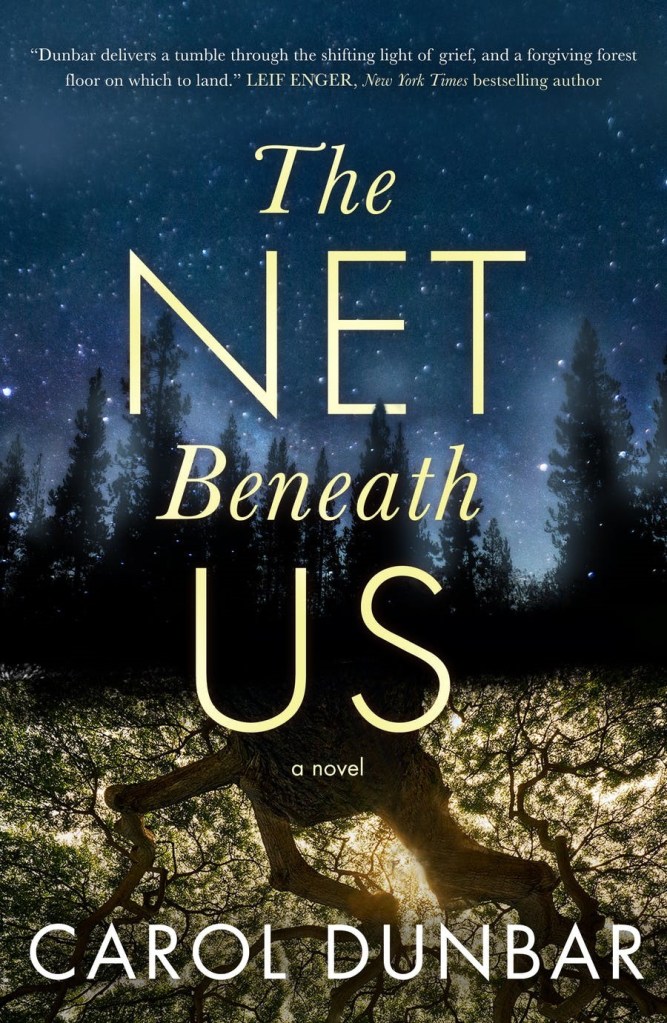
Carol Dunbar lives in northwest Wisconsin like I do. We live in separate towns, but they are close enough for me to be excited because an author near me has been published by a New York publisher. Also, in May 2022, Dunbar spoke at our local writers’ association. She was a warm-hearted and engaging speaker. After the meeting, I preordered her novel, The Net Beneath Us. And while you should never judge a book by its cover, the artwork on Dunbar’s book is stunning, and I have to admit that also influenced me.
What’s this book about?
Elsa lives with her husband, Silas Arnasson, and their two children, Hester, a first grader, and Finn, a toddler, in rural northern Wisconsin. They live in the basement of their future house, which they continue to build as time and money allow. Life in the woods is challenging. Weather and wildlife present difficulties as they build, haul water, and maintain a generator for electricity. But Elsa and Silas are partners, working together to achieve their dreams. They are happy and very much in love. Then everything changes.
Silas has a devastating logging accident. Elsa is determined to keep her family warm and safe during the approaching winter in a home without running water, central heat, or electricity, a home without Silas to help. Shrouded in grief, she isolates herself and her children from family and friends. She rebuffs help from Silas’s family, believing they already see her as incompetent and because they had envisioned another type of woman for Silas.
What makes this book memorable?
People experience loss uniquely, making it hard to understand each other’s grief. Family members overwhelmed by their own sorrow, struggle to comfort each other. Dunbar’s use of multiple points of view allows us to experience, firsthand, the heartache of Elsa, Hester, and Ethan and Luvera, Silas’s uncle and aunt. Additionally, Dunbar’s novel explores our need for self-acceptance and acceptance by others; and our wish to belong to a place, the land, a community.
Loss and grief are somber themes and make for heavy reading. But Dunbar’s use of beautiful imagery, sustained metaphor, and lyrical prose gives us hope as she guides us through a heartbreaking story, transporting us with her exquisite writing through darkness to a place of better understanding of both her characters and ourselves.
Sinclair Lewis said, “People read fiction for emotion—not information.” With The Net Beneath Us, Dunbar underscores the power of fiction as she draws us into an emotional story of loss, grief, forgiveness, and understanding, immersing us in a world of human nature that nonfiction cannot match. And, even though Dunbar’s story is fiction, it rings with truth.
[This essay was published in Red Cedar Review, Volume XXIV in the fall of 2022. Red Cedar Review is published by the University of Wisconsin-Eau Claire through its Barron County Campus. It’s a print- only journal, and its editors and staff consider art, prose, and poetry from northern Wisconsin residents.I decided to post this essay in honor of Thanksgiving because when I reflect on my childhood, I’m very thankful for our old farmhouse and our wonderful neighbors.]
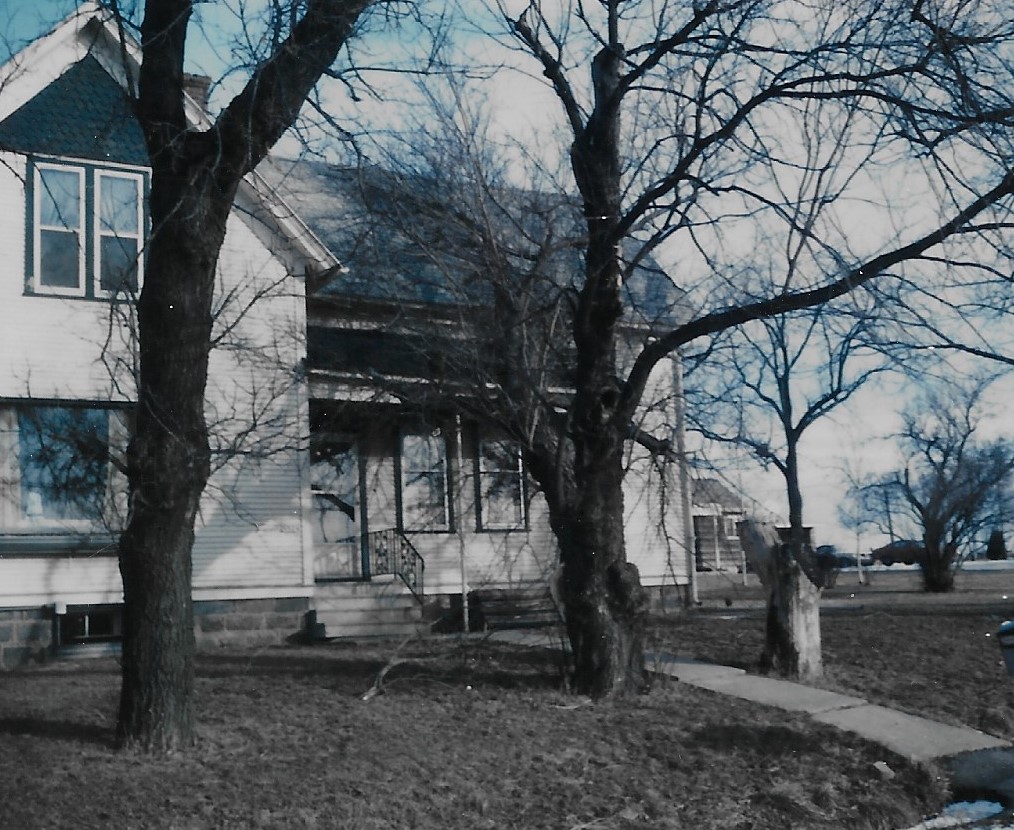
The Old Farmhouse, late 1960s or early 70s
Wrapped in thin white clapboard, the two-story farmhouse built in 1907 was 57 years old when my parents, my two sisters, and I came to live there in October 1964. It looked older to my five-year-old mind, much older, in the way a person of thirty or forty seems very old to a small child. My parents sold their duplex in Milwaukee where rows of houses sat a handshake apart, fronted by sidewalks and busy streets lined with parked cars. They moved their dysfunctional marriage and children to a country road with a smattering of houses fronted by rural mailboxes and a narrow road, on which no one parked. From age five to seventeen, I lived there with my parents, two sisters, and a brother, born in 1967.
A week after we moved into our farmhouse, a knock rattled the front door that opened into our large kitchen, the kind where a farmer’s wife could cook a hearty meal to feed her husband, their children, and the farmhands all in one shift. Mom was working in the kitchen while my sisters and I played on the floor. She was twenty-four. Her face, scrubbed clean of makeup and her chestnut-brown hair pulled up into a pony tail, made her look far too young to be the mother of three small girls. She gave birth to me, the oldest, when she was eighteen.
Mom opened the old wooden door and on the other side of a modern aluminum screen door stood John Giese, Sr., whom we’d soon come to refer to as “Old Man Giese,” distinguishing him from his son, John Giese, Jr.
The Giese barn
Old Man Giese stood on our front stoop, clutching two dead chickens by their feet, one in each hand. He and his three grown children, John Jr., Mildred, and Leona, lived across the street in a white farmhouse as ordinary as ours. But the Giese farmhouse, surrounded by fields to be planted and harvested; by cows and chickens to be fed and tended; by cherry trees, blackberry bushes, and current bushes bearing fruit to be picked and preserved, appeared grand. Our farmhouse, surrounded by two acres of mowed grass then acres of overgrown farmland, looked tired. Giese’s bright red barn stood proud in contrast to our barn layered with various shades of washed out red, which made it appear mostly pink.
“Ma’am,” began the old gentleman, for although he wore a frayed cap and shabby blue denim overalls, he exuded a dignity the two dead chickens and his working clothes couldn’t erase. Old Man Giese was the first real farmer I ever met. My previous knowledge of farmers came from watching Mr. Green Jeans on Capitan Kangaroo, and in my five-year-old mind, Old Man Giese was the opposite of Mr. Green Jeans in every way.
Mom, a city girl, gawked at his welcoming gift of two dead chickens. She knew nothing about cleaning them.
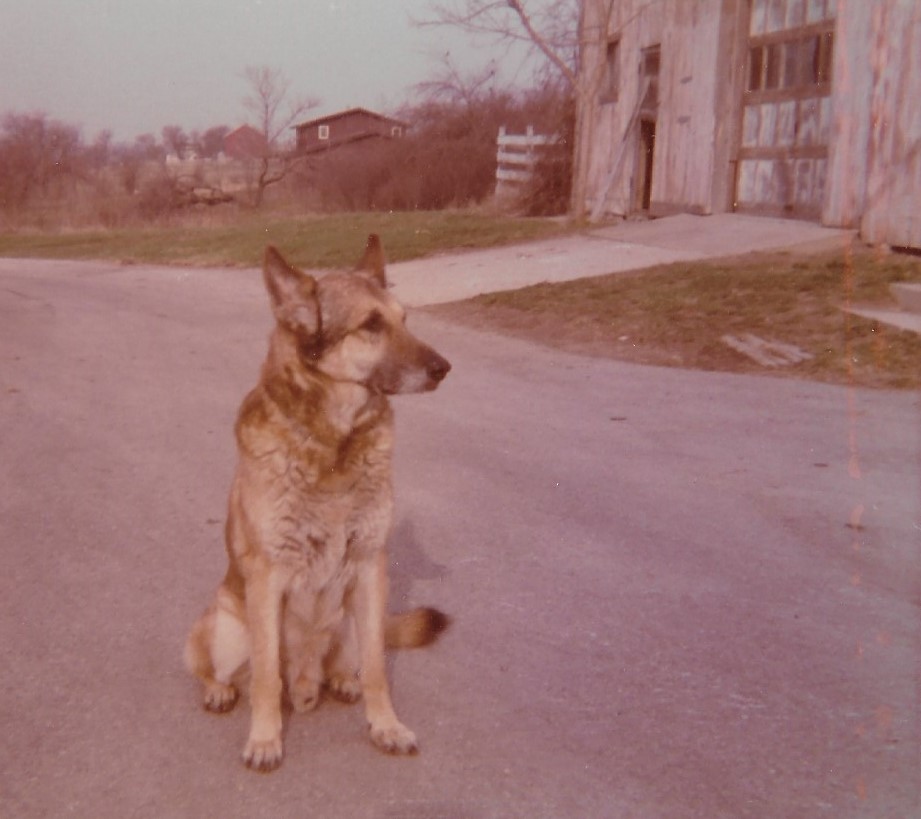
Fritz sitting by our pinkish-colored barn, early 1970s, a couple of years before he passed away
“Your dog,” Old Man Giese continued, “killed my chickens.”
Fritz, our six-year-old German shepherd, lay on the family room floor and made no move to join the conversation.
“I’m so sorry,” Mom said. “Can I pay you for the chickens?”
“No, just keep the dog off my farm, ma’am.” Old Man Giese put his back to us. A lifeless chicken in each hand, he descended our front stairs and returned to his farm. He never called on us again, and a few years later he, too, would be dead, gone to join his wife who died before we arrived.
Mom, relieved she wouldn’t have to clean chickens but mortified Fritz might have killed them, shut the door and strode into the family room. “No chickens,” she yelled at Fritz. “Never again.” He understood and stayed away from the Giese farm, but he still ran loose, up and down the country roads, chasing female dogs in heat.
That evening at dinner, she told Dad, “At first I thought the chickens were an apology for his cows chomping on our lawn the morning after we moved in.” But the chickens had been an indictment, not an apology.
In our new neighborhood, Fritz had committed the first faux pas, setting the standard by which my family’s behavior could be explained. When my parents fought in the middle of warm summer nights, their shouts crawling in and out of open windows, the neighbors could say, What do you expect? Their dog kills chickens. When my sisters and I threw apples at passing cars, but the parents of two older, well-behaved children, from down the road got a visit from the police, their parents could say, They can’t control their dog either. When Dad sped down the country road or set off cherry bombs in our yard, the neighbors could say, What do you expect from a man who lets his dog ignore good-neighbor etiquette?
Our existence in the neighborhood was like a hoppy beer—an acquired taste. Some people come to love the taste of hops, but others can’t force it past their taste buds. Most of the families up and down our sparsely populated road came to accept us, and we were welcomed into their homes and yards. Only two families never warmed to us, not bad considering our parents’ occasional nocturnal fights, dad’s shenanigans, and our string of dogs that never stayed home.
Dad, despite his bad-boy-James-Dean manner, was handsome and charming. An excellent mechanic, he was always willing to lend a hand to neighbors and offer them a beer. Mom was hard-working and friendly, and if she borrowed a cup of sugar or a roll of toilet paper, she always repaid her debt. My siblings and I stopped throwing apples at cars, and we behaved ourselves so no one had to call the police on us again. We were polite or Mom would’ve walloped us or grounded us for life, depending on the prevailing winds of her mood that day. Most of the neighbors decided we were okay.
And the Gieses? They didn’t hold Fritz’s chicken incident against us. After all, their cows had grazed in our front yard the day after we’d moved in. Old Man Giese and his son fixed their fence, and the cows stayed home. Fritz defied fences, but he obeyed Mom’s command and stayed out of their yard and away from the chickens, easy for him because they didn’t own dogs. To prove there were no hard feelings, when my siblings and I were old enough to cross the road, the Gieses gave us an open invitation to play in their yard, to eat fruit from specific trees and bushes, and to cross their fields in winter to ice skate on the frozen river running through their property.
None of Old Man Giese’s children had youngsters of their own. Looking back, I believe they enjoyed seeing us run through their yard, roll down the hill by their barn, and eat the fruit they grew. I believe they smiled when they heard our voices on the winter wind, echoing through the trees as we skated on the frozen waters just behind their fields. And I wonder what they thought, when as a teenager, I sat on a large tree stump near the barn and talked to their cows, who gathered by the fence, eager for gossip about my teenage troubles.
[I want to thank the editors and staff of Red Cedar Review for selecting my essay for their Fall 2022 issue. The ending of this essay is slightly different from the version that appears in their 2022 issue. I added the last two sentences because I felt the ending was too abrupt. As a writer, I often see ways to improve something I’ve written, even after it has gone to press.]
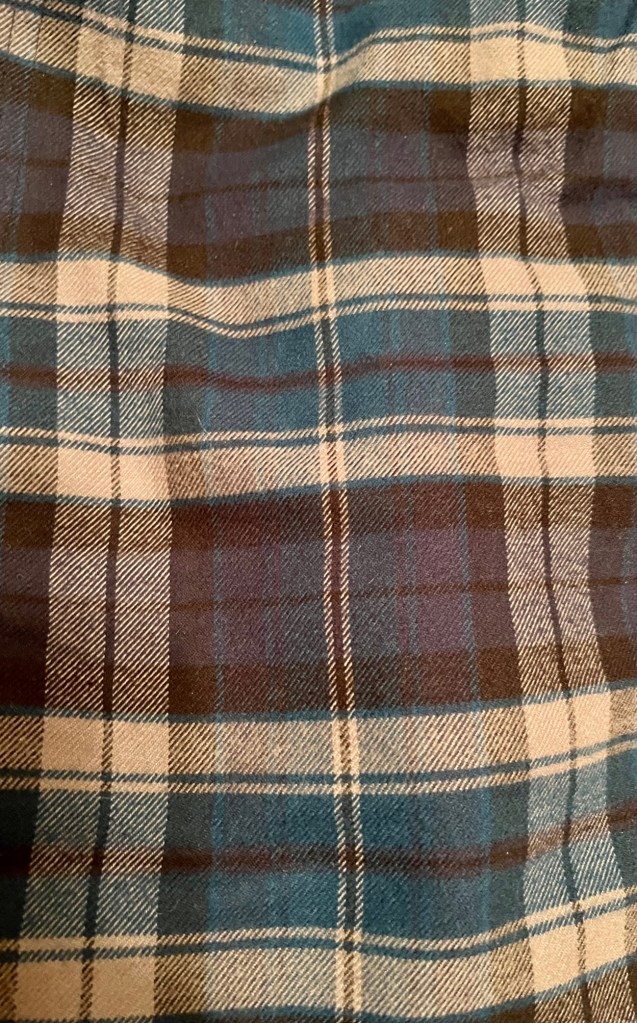
. . . when you squat down to get a frying pan out of the cupboard and rip your one-and-only pair of awesome flannel pants (which you’ve had for fifteen years) from mid-shin to mid-thigh, a split so long and jagged you can’t mend them, sending you on a search for a new pair, but only finding fleece (so second-rate) or flimsy flannel (so short-lived), then your husband joins the quest, and after searching online he announces that the outdoor retail store where you bought your awesome flannel pants still carries them, so you drive to the store and purchase a velvety-soft, blue-plaid pair; returning home, you slip out of your jeans and into the softest caress of flannel, and you know true love isn’t a bouquet of flowers, but a husband who wants you to have dreamy flannel pants.
Second, the title, Not the Camilla We Knew, captured my attention. Camilla grew up in Minnesota, and as a young woman she joined the Symbionese Liberation Army (SLA), an organization of domestic terrorists. Hanel’s book title promised to give me the rest of Camilla’s story. Camilla died in a shootout in Los Angeles in 1974. The SLA and the events before and after that shootout were widely reported in the news. People involved in tragic events are often vilified or exalted, but reality is often murkier.
Hanel doesn’t excuse Camilla’s behavior, but rather tries to understand why someone who grew up middle class with so many options available to them decided to join a domestic terrorist group. While Hanel’s book focuses on Camilla, I’m also learning more about the SLA. Hanel spent twenty years researching and writing this book. I’ve read almost half of the book, and I have to say that Hanel’s dedication pays off. The book is well-written and it’s a page-turner.
********************************************
I’m reading Shelby Van Pelt’s Remarkably Bright Creatures because I read a review about it onAngry Angel Books, a blog by Amanda Nissen. She raved about the book so enthusiastically that I had to check out a copy from the library. Nissen likes books “about women, especially older women,” and so do I. Older characters who are fully developed resonate with me, perhaps because I’m an older character. But also because older people are complete people, with all the thoughts, hopes, desires, and feelings of younger people. Often society wants to see older people as one-dimensional, as a stereotype. I’m about one-fourth into the book, and Van Pelt’s seventy-year-old character Tova, a widow, is a well-rounded, and I like her a lot.
But I was convinced that I absolutely had to read this book when Nissen described Marcellus, a remarkably bright octopus, who lives in the aquarium where Tova works. I find octopuses fascinating. Marcellus and Tova become friends. Readers meet Marcellus in short chapters, which are told from his point of view and interspersed among chapters told from the human point of view. His cantankerous voice is engaging and sarcastically witty as he describes his life in an aquarium, nudging readers to reflect upon how they interreact with nonhuman creatures.
Nissen’s review crackled with 1,000-watt-electric enthusiasm. Leaving no room for doubt, she discusses this book like one talks about a new love who is so perfect that there is nothing negative to be said. When someone touts a book or a movie in such glowing terms, there is always a chance that reality won’t match the hype. Nissen states that the book is “as bright and full of life as its cover.” And so far, I agree, wholeheartedly.
Yesterday, my dog Ziva and I walked a different direction, not to seek adventure but to find warmth. Every block we put between us and Lake Superior meant more houses to deflect the wind coming off the lake. It helped, but not much. When a cold wind rumbles off the lake, it finds you.
On our walk I saw a long-stemmed rose, and my first impulse was to smell it. Because you should stop to smell the roses, even when it’s 28 degrees and overcast and the sky is sprinkling snowflakes like salt from a shaker. The rose smelled sweet, like the roses my nana grew in the front of her 900-square-foot home, the smallest house by far on her street. Nana prized her roses and tended them with great care. They signaled that she, too, was a lady, even in her tiny home. Her long-stemmed, red roses announced that she had left behind her childhood of deep poverty and great difficulties.
My next impulse was to take a picture of the rose, which looked remarkably good. Amazing because this week’s basket of weather contained strong winds, drenching rains, and even some snow.
But sometimes survival is about luck.
This rose was blessed because its owners planted it in front of their house which works as a shelterbelt, saving it from the worst of the icy winds and horizontal rains that blow off the lake. It was fortunate because it bloomed at the end of a long stem, keeping it off the ground where colder air settles. It was spared because this week’s snow was light and melted quickly, postponing it’s red, velvety petals from freezing and turning brown.
It’s 23 degrees this morning, so the rose’s good fortune won’t hold much longer. But with care and some luck, new roses will bloom again next year.
It’s a fun literary website that publishes short works of fiction and poetry. Their pitch to writers: “Send us up to six pieces of your finest bullshit. This can be poetry, prose, art, fiction, whatever.” Bullshit Lit wants the type of writing other editors “will reject hands down.” I had the perfect piece. I didn’t expect Bullshit Lit to accept “Gossip and Dinner” but such fun to have a place to submit it!
Sometimes editors specifically state in their guidelines that they don’t want stories like “Gossip and Dinner.” So after I finished the story, I buried it in a file, deep inside my computer, hiding it from editors. I’d explain why, but if I did, it would be a spoiler. (Don’t worry–the story won’t make you blush or cry.)
But Bullshit Lit wants a writer’s “finest bullshit,” so I submitted, never believing my story would get accepted, Still, I was happy to finally have a place to send it, along with a humorous cover letter. This was the most fun I’ve ever had writing a cover letter:
Dear Ms. Bennett:
Attached is my 801-word short story “Gossip and Dinner.” It’s an unpublished story. Heck, it’s a never-been-submitted story. It’s so bullshit that I will understand if it’s rejected. However, I’m so grateful that I can submit it to Bullshit Lit. I was inspired to write “Gossip and Dinner” after my daughter-in-law uttered the phrase, “Ziva is such a cat.” Because I love my daughter-in-law, I’ve refrained from purging this story from my files. The concept for this story was brilliant in my head, but on paper it’s bird crap. But I love that I can actually submit it somewhere without feeling too much shame! Thanks for being there.
If you think I wrote bullshit too many times in this blog, it’s because I’m getting away with swearing! I had my mouth washed out with soap when I was about eight for saying shit, so I’m having a wicked good time repeating the name of the literary website.
Ziva
[After Bullshit Lit accepted my flash fiction piece, I signed up to receive notifications when they publish new stories. So, far “Millie and Me” is my favorite. You can read it by clicking here. You can read my story by clicking here.]
Last night Debra Raye King held a book launch for her memoir, Gravedigger’s Daughter: Growing Up Rural, at the Jim Dan Hill Library on the University of Wisconsin-Superior’s campus. King’s book was published by The WWA Press (Wisconsin Writers Association).
It’s the first book launch I have ever attended, and it was amazing. The space was cozy, warmly lit, and serene. A flickering fire rambled in the fireplace. Cookies and goodies, mostly baked by King, waited for attendees. The recipes for the cookies can be found at the back of King’s book. (At the end of the evening, King gave us baggies and invited us to take home leftover homemade cookies!)
King read from her memoir, and answered questions about her book asked by the host Mark Liebaert. King was a beautiful reader, and Liebaert was a gracious host. The audience and I laughed at the book’s touches of humor, and we nodded in empathy at the moments of poignancy.
Before I left the book launch, I bought a copy of King’s book and asked her to sign it for me. The WWA Press did an outstanding job with the book’s presentation. It feels substantial in my hands. The font type and size are easy on the eyes. It’s not a large-print book, but it’s not a tiny-print book either. Goldilocks would declare it just right.
Last night’s weather was cold, rainy, and windy, a perfect evening to be inside at King’s book launch enjoying snippets from a fine memoir while among fellow readers and writers. I’m looking forward to reading more of King’s memoir.
I can name many of the birds that show up at my feeders, but not all of them. Chickadees, goldfinches, red-breasted nuthatches, blue jays, cardinals, and house finches are easy.
But some sparrows, other finches, woodpeckers, and a variety of different black-colored birds throw me for a loop because they look so much alike that I’m reminded about how I tried to distinguish between the identical Martin twins who attended Pleasant View Elementary with me.
Sometimes I look up a bird online and manage to identify it after learning what distinguishes it from its near twin. But the next time the bird shows up, I’ve already forgotten about the distinction, much like my attempts to keep the Martin twins straight.
A few days ago, I read a poem by M. Soledad Caballero, “Someday I Will Visit Hawk Mountain,” which captures both my lofty dream to be an informed birder and my failure to do so.
[To read or listen to Caballero’s poem, click here: On Being.]
Recognizing Their Voices
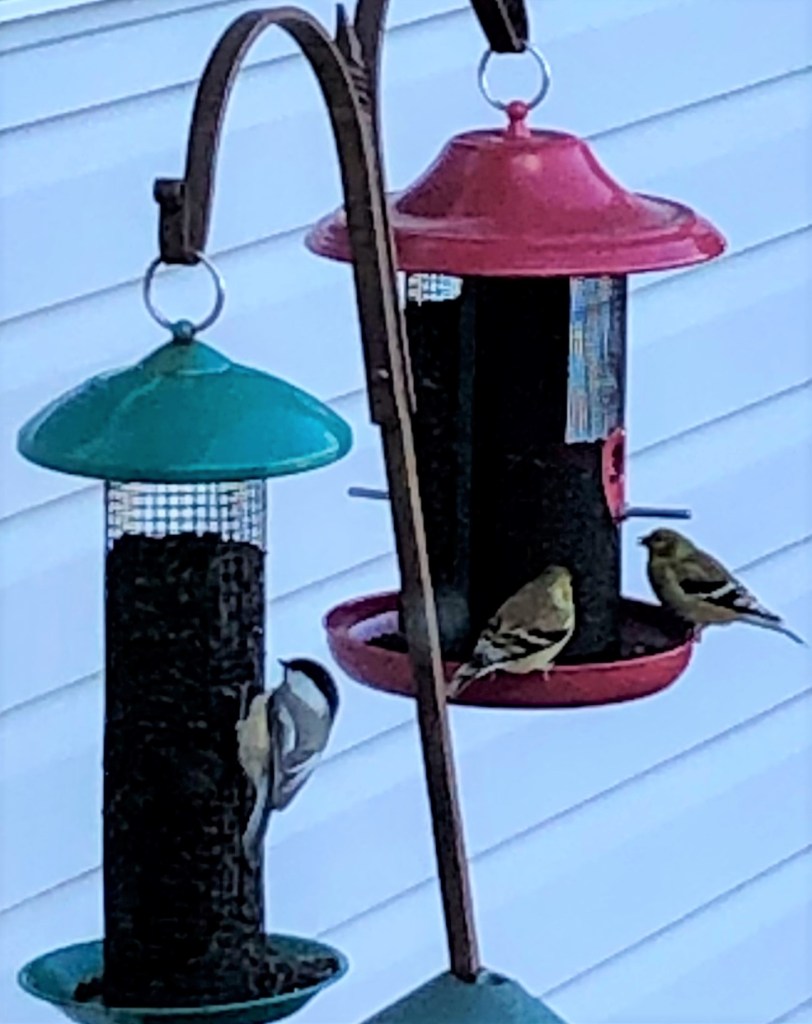
Chickadee and a pair of goldfinches. A goldfinch’s bright yellow color fades after summer expires.
Chickadees are handsome birds dressed in an eye-catching array of feathers, ready for an evening at a gala while singing lyrical tunes worthy of their attire.
Red-breasted nuthatches are elegant birds, striking art deco poses along branches and tree trunks. Then they open their beaks and belt out a whiny, nasal yenk, yenk, yenk. And I imagine them drunk on rum and singing a sea shanty off-key. But last week, when I heard a nuthatch yenk, yenk, yenk in my yard, I smiled, listening joyfully because I knew two bird calls!
[To see pictures of a chickadee and red-breasted nuthatch and hear their songs, click here: Audubon.]
The Interlopers
Squirrels show up at the feeders. I don’t invite them, but neither do I circle the feeders with a wall and barbed wire. I like to think of our agreement as “everybody has a fighting chance.” I buy sturdy feeders and hang them where the squirrels must invest time and ingenuity to get a meal. If a squirrel figures out how to climb, jump, or hang upside down to get seed, he’s earned a snack. There are still plenty of seeds left for the birds.
Last week I bought a new feeder to hang in the pine tree outside the window in my writing office. A few hours later, a squirrel arrived. He stretched his empty paw toward the feeder but couldn’t reach it. He lost his balance and fell off the branch, landing on the ground. Over the next couple of days, he tried different techniques, hoping to hang on the feeder, but each time he had to scramble back to the tree to avoid falling. However, failure rolled off his back like a bad dream disappearing at dawn. The squirrel, maybe after being bitten by a radioactive bat or using his bat intelligence or perhaps because he’s from a cave on Krypton, became Bat Squirrel, able to hang by his toes, poke his mouth into the mesh, and munch seeds.
During one of Bat’s visits to the feeder, a chickadee perched on a branch above him and waited patiently for him to finish eating. But after a few seconds, the chickadee flew off because that’s a chickadee’s idea of patience.
My four grandkids come trick-or-treating this evening with their parents. A grim reaper, a Pikachu, a hamburger with the works, and a firefighter.
And then I hear a small doctor (or maybe he’s a nurse) who’s about five years old.
“Trick-or-treat,” says the wee medical professional dressed in blue scrubs, pinned with a name badge. He smiles and looks at me with anticipation, holding out a small white bucket. His mother is standing with my daughter-in-law.
“I don’t have any candy,” I say. I didn’t buy any because I decided not to pass out candy. What I have in the house are four plastic zip bags with small toys, fancy pens and pencils, and lip balm for my grandkids.
The wee medical guy repeats, “Trick-or-treat” because surely the lady who just told him she doesn’t have any candy is confused. It’s Halloween. There must be candy.
I go inside and grab the four bags of goodies for my grandkids. As I slip the goodies in their trick-or-treat bags, I keep apologizing for not having something for the wee lad in blue scrubs. His mother says that it’s okay and explains to him that the lady didn’t know he was coming.
The little boy’s cheeks quiver, the corners of his mouth tilt down, and tears fill his eyes.
I’m so sorry, I say again. It’s okay, the mom repeats.
But it’s not okay. He’s a little boy, maybe five. He doesn’t understand. It’s not okay that he’s left out. And he’s too young to understand that some lady doesn’t have candy or something for him. He has done his part. He is dressed up. He has said, Trick-or-treat. He has watched four other kids get a treat, but he is getting the trick.
I think about finding something for him. I think about my purse. I have things in my purse. It’s like Mary Poppins’s bag. But there is nothing fun in my purse for the little medical guy.
Because we’re all standing in my driveway, I think about my van. Bingo. I have toys in my van.
“Wait a sec,” I say. I open the sliding door and look at several small toys. I grab a Minion because when you wind it up and push down on its curl of hair, it vibrates. Perfect because the wee fellow in blue scrubs deserves something fun, something interactive, something to evaporate his tears before they slide down his cheeks.
I hold it in front of him and demonstrate how to make the Minion vibrate. I place the pulsating toy in his hands, and his face lights up, like I’ve just handed him a beautiful beating heart.
I back up several feet and tell my grandkids and little medical dude to line up so I can take their picture. This Halloween my annual picture will have five children in it. I want that sweet little boy to feel welcome, not left out, so I only take pictures of all the children together.
Later I look at the pictures. My four grandkids are smiling at the camera. But little medical guy? In every picture, he is holding the Minion cupped in his hands, smiling at it like it’s a newborn he just helped deliver. It’s Halloween, it’s a time of pretending, it’s sweet spooky magic.
I’m glad I keep stuff stashed in my van. Medical dude doesn’t know it, but when I look at the picture of him looking at his Minion treat, and I see his smile, it’s clear that he gave me the better treat.
Marie Zhuikov’s newest book, Meander North, is a collection of essays, many from her blog Marie’s Meanderings, which she started writing in 2013. I look forward to each new post by Zhuikov, so when I had a chance to read Meander North, I was excited. Zhuikov selected some of her favorite blogs, then added essays, some of which have appeared in other publications.
Many of Zhuikov’s selections are about getting outdoors and enjoying nature. In her humorous essay “How X-C Ski Starvation Can Lead to Impaired Judgment,” she writes about one of her first cross-country skiing adventures of the season: “I . . . desperately needed to do something to break out of my winter slothfulness and raise my heart rate above seventy beats per minute.” Even though a mist turns into raindrops, Zhuikov slips on her skis and heads out on the icy trails. With caution and strategic moves, she completes her first cross-country ski of the season, and while she does, we hold our breath, admire her tenacity, and think about some of our own foolish escapades.
Zhuikov’s essays about her adventures are so enjoyable because they’re relatable. Her love of the outdoors and her ability to maneuver through nature shines through in her writing. But she is with us, inviting us along, never making us feel left behind. She makes us believe we can get out in nature and be adventurous too. That we can lower ourselves into a canoe or a whitewater raft, or that we can stand along a river and learn to fly fish.
Zhuikov’s essays connect with us because she is not afraid to let us peek at the moments when her life doesn’t go smoothly. Sometimes the outcomes are humorous, like in her story “Just Your Average Winter’s Day Walk and Squirrel Attack” about a walk with her wonderful eighty-pound dog, Buddy, that turns into a comedy of misadventures. Other times the outcomes are poignant, like in “An Evening Dog Walk” about a romance that didn’t work out. Occasionally, she shares heartbreak, like in “The Lake, It Is Said, Never Gives Up Her Dead.”
Zhuikov rounds out her collection of nature essays with an eclectic selection of entertaining and informative writings that cover a wide range of topics. Some cover Zhuikov’s adventures as a citizen of Duluth, such as, “Marie Versus the Post Office” and “My Neighborhood Rezoning Zombie Apocalypse Saga.” Other heart-warming essays like “I Saw Three Ships on Christmas Day” or “Kissing in the Coat Room in First Grade” are about her family or youth. She wraps up her book with a section titled Bookish Adventures where we get a taste of Zhuikov’s life as a writer and a reader, and where she introduces us to the wonderful poet Louis Jenkins.
Winter is coming so grab a copy of Marie Zhuikov’s Meander North, curl up in a cozy chair with a glass or mug filled with your favorite beverage, and start by reading “Cold as a Cage,” the first essay in her collection. And for those of you who live through winter every year, nod in agreement and laugh hopelessly as you read: “The cold defines our movements. Northern Minnesotans walk with shoulders hunched and hands in pockets, limiting our time outside to the bare minimum for the task at hand.” But know that you are a survivor because you are inside where it’s warm, ready to smile and laugh and shed a few tears as you join Zhuikov on her meanders through life.









 Writing Near the Lake