Book Review: Get Well Soon: History’s Worst Plagues and the Heroes Who Fought Them by Jennifer Wright

In the midst of a pandemic, I’ve been reading about pandemics. How depressing, you think! Not really. It’s more comforting than you might imagine. Most of the pandemics I’ve read about were worse than COVID-19, and I don’t say that to make light of COVID. It’s killed many people, caused long-term health issues, and disrupted lives and the economy, but it can’t compare to the Black Death or the Great Influenza of 1918.
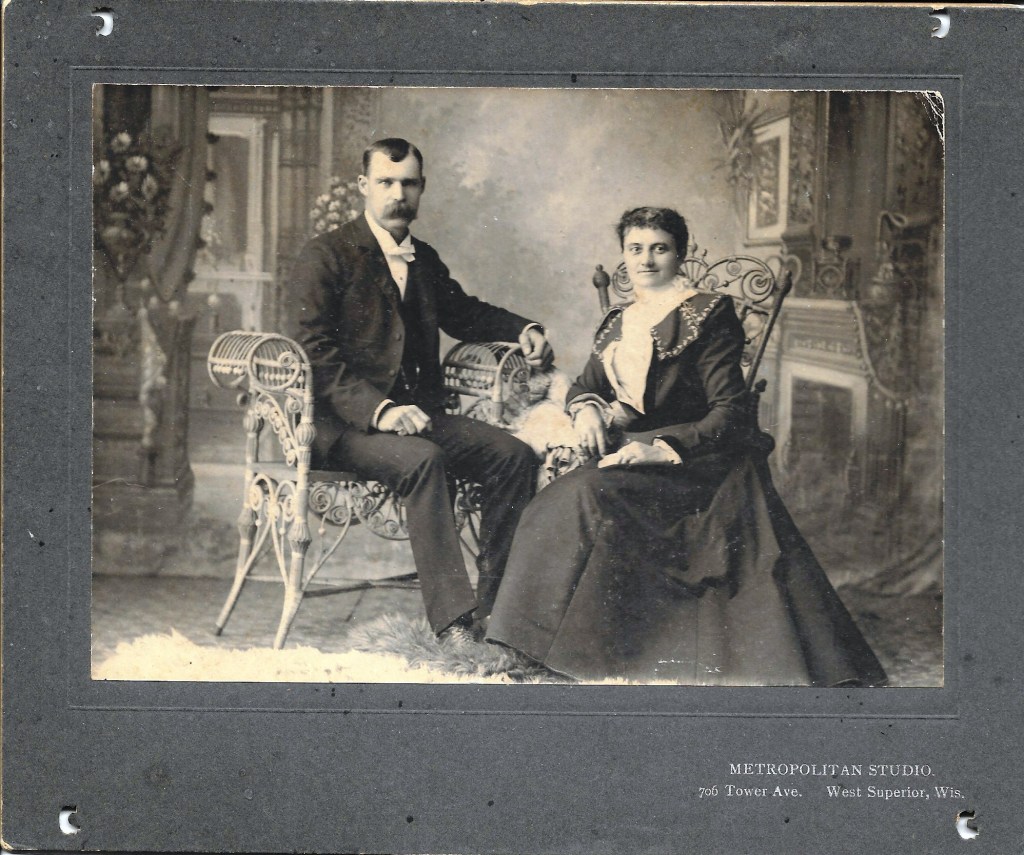
My great-grandfather Frank died of TB in 1910.

Get Well Soon: History’s Worst Plagues and the Heroes Who Fought Them by Jennifer Wright is a well-written sampling of killer pandemics. Her book covers the Antonine, bubonic, and dancing plagues, plus smallpox, syphilis, tuberculosis, cholera, leprosy, typhoid, the Spanish flu (Great Influenza of 1918), encephalitis lethargica, lobotomies, and polio. She describes the diseases and how they killed people, but doesn’t dwell on the grotesque. Instead, she focuses on the development of medical treatments and the people who worked to end plagues and pandemics. She writes with a gentle humor that helps readers digest what is a formidable list of population-depleting diseases. Fortunately, most of them have been mitigated by cures, treatments, or vaccines.
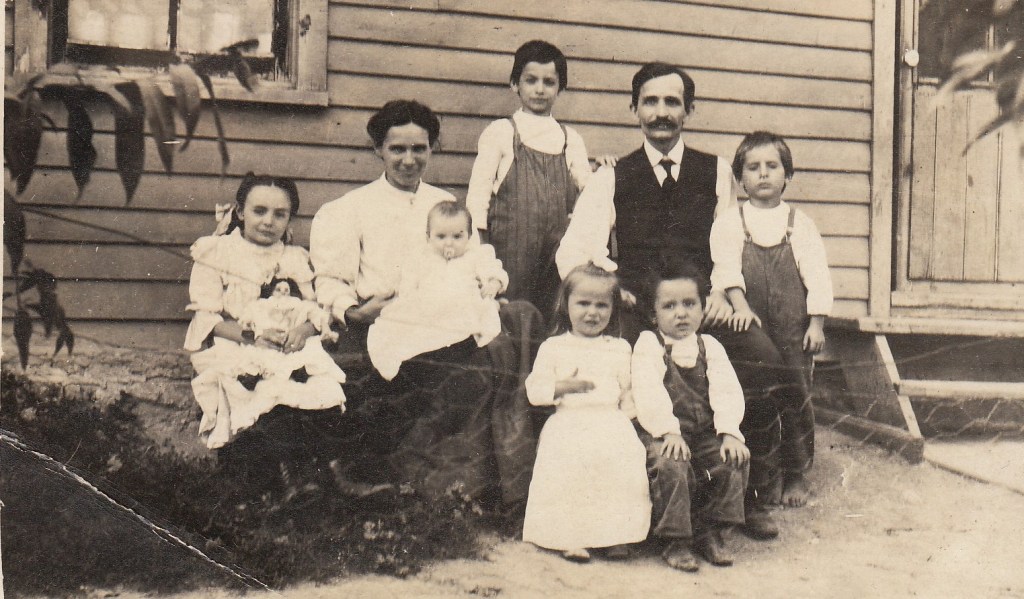
My great-grandfather Joseph, in the vest and tie, died of typhoid fever in 1922.

Wright’s book provides historical perspective. The bubonic plague killed quickly and painfully, wiping out tens of millions of people in the 14th Century. Worldwide death estimates from the Great Influenza of 1918 range between 25 million and 100 million (p. 197). It, too, killed quickly, especially people in their twenties. And horrifically, smallpox wiped out entire civilizations in the New World. Those statistics provide some comfort when compared to COVID statistics. Modern medicine is another comfort. Medical scientists have been able to develop working vaccines and helpful medicines in a short time to help combat COVID deaths.

Also, the historical details Wright’s book provides can—strangely enough—be a soothing balm. Some of what people are doing and saying about COVID seems tame in comparison to behavior during past pandemics. Some suggested “preventatives” against the bubonic plague were to eat crushed emeralds, live in a sewer, avoid bad smells, place chopped onions in your house, drink your urine, and don’t look at sick people (Wright p. 29-30). Among the many bizarre and useless cures for the bubonic plague were bloodletting and poultices made with feces (p. 40). Often prescribed treatments made people suffer more. In defense of people from the past, medical science wasn’t as advanced as it is today, and people were desperate during frightening times, like they sometimes are today.

Wright’s chapter on tuberculosis was scary. I was in the camp of people who thought that tuberculosis was mostly a disease of the past. It’s not. Tuberculosis kills 1.3 million (Wright, p. 125) to 1.5 million (CDC) lives a year. Most of the cases of TB occur in countries outside of wealthy nations like the United States. But mutations in the TB bacteria make it more resistant to drugs, and when people with TB travel, they spread the disease. “Recent models show that unless we scale up efforts to address this growing threat, the number of people dying from drug-resistant TB will nearly double every 5 years” (CDC). There’s also the wise adage: Those who do not learn from history are doomed to repeat it. We need to pay attention.

In her epilogue, Wright discusses the AIDS epidemic. She didn’t give AIDS its own chapter because she feels there are people who lived through the AIDS epidemic who could tell the story better than she can. However, she wrote eight pages about AIDS, explaining how the epidemic was mishandled and how prejudice against gays made the epidemic worse. I believe she could tell the story of AIDS and make it as engaging and enlightening as the other epidemics she wrote about. And if she did, I would read that book.

Remembering Audrey and Malene

Malene Fylling on her 88th birthday, September 14, 1958

My mother-in-law, Audrey Smith, loved learning about her ancestors. During her 60s and 70s, she took genealogy classes, but in her early 80s, early dementia slowed her down. Then a broken femur required surgery and an extended stay at a nursing home. Audrey balked at being in the nursing home. To help her pass the days, I interviewed her about her life. When she returned home, we continued working on her life story, and we used her genealogy research to add stories about her ancestors.

One of Audrey’s favorite relatives was her paternal great-grandmother, Malene Fylling, née Tenfjord. Audrey remembered her great-grandma as “the sweetest old lady” who was always happy to see her. When Audrey traveled with her parents from Superior, Wisconsin, to Crookston, Minnesota, Malene doted on her, giving her cookies, asking her questions, and telling her stories. When Audrey and her parents traveled to Crookston for Christmas, they ate lutefisk cooked by Malene. Audrey’s great-grandparents had a large house, so they put their Christmas tree in the middle of the living room. After dinner the family held hands, circled around the tree, and sang Norwegian and English songs, blending their old world with their new world.

Malene was born in Geiranger, Norway, on September 14, 1863. She had an eighth-grade education. On May 7, 1886, she married John Fylling. They had seven children in Norway, but a daughter died before they emigrated. I wonder what it was like for Malene to know that after she left Norway, she could never again visit her deceased daughter’s grave. After they settled in Crookston, Minnesota, she and John had two more children.

In June 1903, Malene, John, and their six children, ages 16, 12, 10, 7, 3, and 8 months, arrived in Quebec, Canada, on the SS Bavarian, a steamship owned by the Allan Line. Steamships were faster and more comfortable than sail ships, but imagine making a transatlantic crossing with six children. From Quebec they traveled to Winnipeg and applied for permission to enter the United States. Their destination was Crookston, Minnesota, where John’s brother, Ole Fylling, lived. Ole wrote to Malene and John about opportunities in Crookston. For Malene and John, having family in Minnesota eased the pain of leaving their families behind. By 1920, both Malene and John were naturalized citizens.

Economic hardship motivated Malene and John to immigrate to America. During the second half of the 1800s, Norway’s economy deteriorated. Steamships made it easier for Europeans to immigrate but also caused widespread unemployment among Norway’s shipbuilders, dockhands, and sailors. Farmers, who never had an easy time in Norway, were undercut by low-priced grain from Europe because of cheap transportation. Audrey often said, “The Norwegians had nothing but rocks.” She heard this repeatedly from her Norwegian relatives, who told her how difficult farming was in Norway.

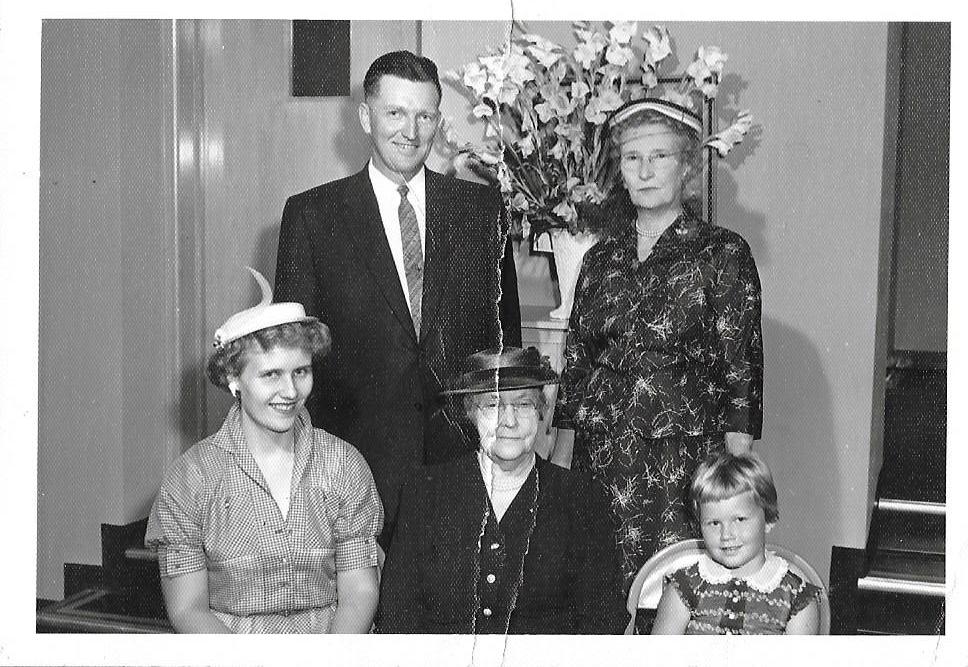
Five generations. Seated, L to R: Audrey (Malene’s great-granddaughter); Malene; Jennifer (Malene’s great-great-granddaughter); Standing: George (Malene’s grandson); Alpha (Malene’s daughter)

Malene was forty when she came to Minnesota, but she learned to speak English. Her status on the U.S. Census was always “wife” and “homemaker.” She didn’t need to work outside the home that she and John owned by 1910. John worked as a carpenter and later had a small grocery store. After John died in 1937 at seventy-three, one of his sons ran the store. Another son and a son-in-law owned a creamery. Their youngest daughter became a bookkeeper and worked for the public school system then at her brother’s creamery. At a time when marriage was the usual occupation for women, their daughters married well and had comfortable lives. Malene and John’s dreams of a better life in Minnesota, for themselves and their children became reality.

Malene stayed in the family home after John’s death but later lived with one of her daughters in Crookston. She died in 1960 at ninety-seven. Her funeral was held at Trinity Lutheran Church, and she was buried with family at Oakdale Cemetery in Crookston.

Years later Malene and John’s home was either razed or moved (along with other homes) because the Red Lake River, which ran behind their home, flooded so often. “Imagine living on the bank of a river—a good-sized river—and watching those kids,” Audrey said—shuddering as she pictured Malene raising children near the river. But, Malene never lost any of her children to the river. Her census status as “wife” and “homemaker” may not be exciting family history, but Malene was an important force in the lives of three generations of children, most of whom made Minnesota their permanent home.

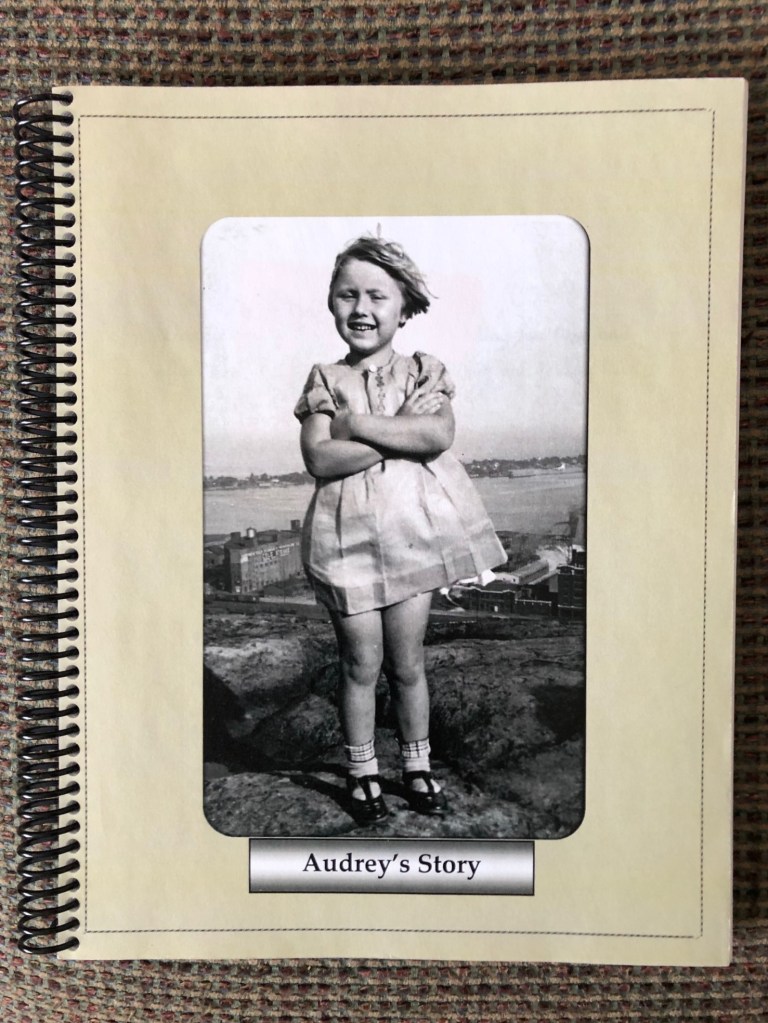
When I finished interviewing Audrey, I organized and typed up her stories. She had loads of wonderful photographs of her ancestors and family, so I was able to scan photos and add them to the book I made for her. When I finished, I took my file to a local printing shop, and they printed it on 8 ½ x 11 paper and spiral bound it. It was 257 pages. When I presented it to my mother-in-law, she thumbed through it, then looked up at me with tears in her eyes. “I can’t believe you did all this for me,” she said.

Once I saw this photo of Audrey (about 5), I knew it was the photo for her book cover. This photo captures so much of Audrey’s spirit.

“It was fun working with you on this,” I answered. What I should have told her was that she’d been the best mother-in-law a daughter-in-law could have. But neither of us were good with sentimental speeches. And we were both already choking back tears. A year later she passed away, about a month before her 87th birthday. When she started taking all those genealogy classes, it had been her dream to write a family history. I have so many fond memories of Audrey, but working with her to complete her book is my fondest memory.

Where Do I Go When I Need Solitude?

[Bloganuary wants to know. It’s the WordPress blog prompt for January 27, 2022.]

I hide in a book.

I’ve been doing it all my life.

I’m an introvert; I enjoy the solitude of a story coming off the page just for me.

In grade school I hid in Nancy Drew mysteries and Alfred Hitchcock’s Three Investigators and every biography in our school library. I read when I was supposed to be doing classwork. I read to keep my head down. I read to escape the everyday noise of a house filled with family. I read on long car rides to make the time pass. I read because people usually left me alone when I did.

In high school I read for all the same reasons. But my reading material graduated.

When I was nineteen, I worked in downtown Milwaukee. There are a lot of people in downtown Milwaukee. On my lunch break, I read while walking down Wisconsin Avenue. I fell in sync with the crowds on the sidewalk, moving and stopping with them, waiting for red lights and green lights, but rarely looking up. Solitude in a collective.

I read when I went to hockey games, before the ref dropped the puck and between periods. There are a lot of people in a hockey rink.

I read when I got on a plane, right after I buckled my seatbelt. There are a lot of people in an airplane. I put my head in a book and didn’t stop until after the plane taxied to the gate, and it was my turn to exit.

When I’m tired and don’t want to talk, I read.

When I’m upset or sad or discouraged, I read. Words and sentences and the rhythm of story pull me in and shut the world out. When it works right, it’s a mediation in solitude, even in a crowd.

I carry a purse that’s large enough to carry a hardback book, if needed. Solitude in a bag.

What Makes Me Feel Strong?

[Bloganuary wants to know. It’s the WordPress blog prompt for January 25, 2022.]

The dog is Colorado. He belongs to the shop owners, and he loves to paddleboard.

Paddleboarding makes me feel strong.

I took my first lesson last summer. The instructor mentioned an absurd number of calories that a person burns while standing upright on a paddleboard, maintaining balance. I don’t remember the number—numbers are my kryptonite. Plus, I don’t care about calorie-burning numbers like I did when I was young (and foolish).

The instructor explained all our muscles were working together and continuously to keep us upright on our boards while moving us over the water. That’s what impressed me—my muscles working to keep me balanced, upright, strong. As I age and watch older family members age, I realize balance is my friend, falling is my foe.

Standing on the board, paddling around Barker’s Island on Lake Superior makes me feel strong—Popeye strong. Sometimes when I circle Barker’s Island, I have to sit on my board for half the trip because the wind produces choppy waters on either the outside or the inside of the island.

When I have to sit, I use my paddle and board like a kayak and propel myself through the water. The choppier the waves, the faster I paddle, finding a rhythm that sends me speeding through the bumpy water. (Speeding might be hyperbole, but I feel strong—Bionic Woman strong.) The waves and I battle. They want to turn my board sideways or move it backwards. I grip the paddle, cut the blade into the water and pull, over and over. I am strong and resolute—Ziva David, kick-butt determined.

I skim across the water and watch the sky, water, trees, plants, birds and otters, while I fortify my future ability to stand upright, walk sure footed, and retain balance. I’m She-Hulk strong.

And all the strong-ness and grace as I skim across Lake Superior, floods my mind with strength and calmness, and hopefully, some wisdom.

A Growing Bouquet

Out for an October walk

When I take my grandkids for a walk, they stroll and run along the city sidewalks, and with a child’s imagination, they turn each walk into an adventure. On an outing last October, they each picked a small bouquet of dandelions, Indian paintbrushes, and tiny yellow flowers from lawns overdue for a trim.

After we returned home, I put each child’s bouquet in its own bud vase and placed them around my kitchen. My five-year-old grandson had a prolific bouquet, so his vase stood on the kitchen table. By the next afternoon, the dandelions and Indian paintbrushes boarded themselves up like roadside stands at the end of the season, and the tiny yellow flowers discarded their petals like ticket stubs after a rock concert. I tossed the bouquets.

The flowers my sister sent.

A couple of days later my sister sent me a large yellow, orange, and red autumn-themed bouquet of flowers, a mix of daisies, a rose, and a sunflower. I placed it on the kitchen table.

Two days later my grandkids returned to visit. My five-year-old grandson walked by the large bouquet on my kitchen table, paused, then said, “I guess my flowers really grew.”

I gave him the facts—his flowers had died and were thrown in the garbage; these flowers were from my sister. He moved on and played with blocks on the living room floor.

Later I told my sister about his belief that his flowers had grown into the bouquet she’d sent. She hoped I hadn’t told him the truth, but I had. I’d been the Grinch before his heart grew, Scrooge before the Christmas ghosts visited, Joe Friday with the cold, hard facts.

Instead of entering my grandson’s world where it was possible for a handful of tiny flowers to grow into a substantial bouquet of large flowers, I used words like died and garbage. I’d become the eight-year-old neighbor boy who told me and my sister when we were five and four years old that there was no Santa Claus. I can still see him standing at the side of his house telling us Santa wasn’t real. My sister and I argued with him, but he clung to his story. We tried to believe after that, but we couldn’t—not even when our mother assured us the boy was wrong and Santa was real.

But if I’d gone along with Evan’s belief that his flowers had grown, he would’ve bragged to his older siblings, who would’ve set him straight.

He would’ve come back and asked, “Nana, did my flowers really grow big?”

If I’d said, “Yes, they did,” he would’ve doubted me, weighing what I said against what his siblings said, just like my sister and I weighed what my mother said about Santa against what the boy next door said.

If I’d said, “No, they didn’t,” he would’ve asked, “Then why did you say they did?”

But I still felt bad—I’d squelched a magical moment for him and replaced it with reality.

But the five-year-old wasn’t done. A couple of weeks later, he asked me, “Nana, did my flowers at least get big before they died and you threw them away?”

With the Grinch, Scrooge, and Joe Friday as my wingmen, I explained, “The type of flowers you picked don’t get any bigger than when you picked them. But they’re beautiful flowers and an important part of nature even if they’re small.”

However, if he ever asks me if Santa is real, I’m going to lie through my teeth and say, “Yes, he is.”

Remembering Nana Kitty on Her Birthday

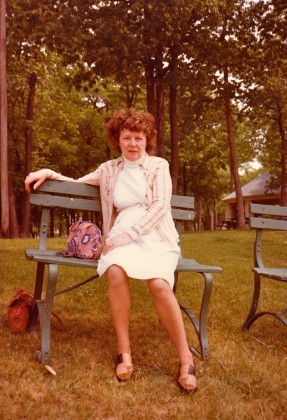
My nana, Katherine Karius Stern Stamper, wore dresses and stockings. Born January 22, 1915, she didn’t believe in pants, declaring ladies didn’t wear them. In the mid-1970s, my mother (her daughter) bought her a coordinating outfit consisting of a pair of pants and a short-sleeve shirt. She informed my mother she wouldn’t wear it. My mother told her to just wear it at home. Soon Nana began wearing the pants and matching shirt in public. It became her favorite outfit. She looked adorable in it, and she knew it.

Nana Kitty

Nana still wore plenty of dresses and skirts.

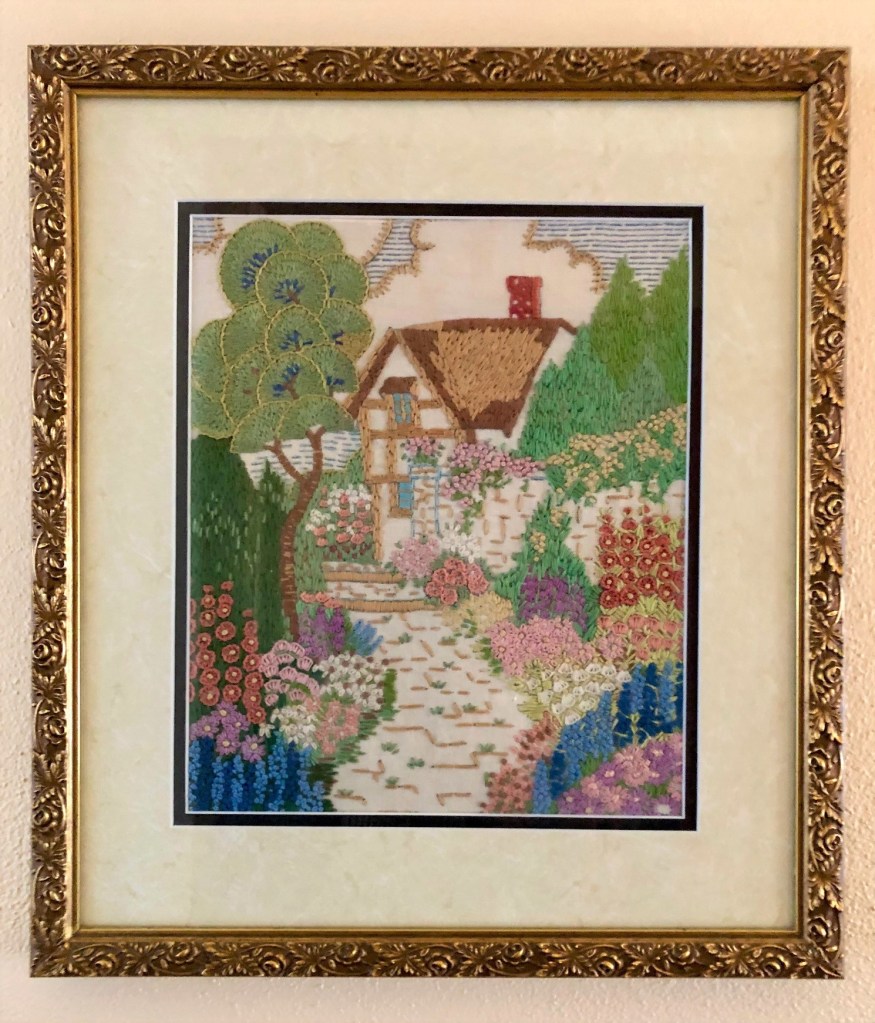
Before she sat on the park bench, where someone snapped this picture, she would’ve dressed in her tiny pink bathroom, a fascinating place to me because of its laundry chute and the intricately embroidered scene of an English cottage and garden that hung on the wall. My sisters and I surreptitiously tossed toys down the chute, then skedaddled to the basement to retrieve them from the laundry basket until Nana said, “Stop the shenanigans!” The embroidered scene was a gift from her oldest sister Margaret. Nana didn’t do crafts; although in her sixties, she took a watercolor class and painted flowers and butterflies—but not convincingly.

Because my sisters and I visited Nana, who lived in Milwaukee, for three or four days at a time, I often watched her get-gussied-up-to-meet-the-world routine. We were allowed to wander in and out of the bathroom while she got ready.

First, Nana put on white, ordinary undergarments. She spent her money, but never frivolously, on fashion the public could see, not on fancy underwear that never showed from beneath her clothes.

Next, she slipped bobby pins from her pin-curled hair and brushed the tight coils into luscious waves of Nice’n Easy-dyed tresses, replicating the reddish-brown color from her youth.  She pulled her white turtleneck over her loose curls then used her fingers to reshape them. She had sensitivities to most makeup, but she powdered her face to cover up a faded scar on her cheek. When she was a young woman, she’d been in a car accident and was cut by a piece of glass.

With care she rolled her pantyhose over her feet, easing them up her legs to avoid causing a runner. As part of a school assignment, I once asked her, “What’s the greatest invention of your lifetime?” Without a moment’s reflection, she answered, “Pantyhose.” Having used a garter belt the first time I wore nylons at my fourth-grade Christmas concert, I knew her answer wasn’t frivolous. Nearly finished she stepped into her skirt and fastened it at her back.

Finally, she looked into the mirror. Holding a tube of lipstick in her hand, she applied a shade between pink and red to her lips. She never left the house without lipstick. Face powder was the only other makeup she wore. But she needed none. Her high cheekbones, arched eyebrows, cocoa-brown eyes, and flawless complexion were of the quality that described a beautiful lady in a nineteenth-century novel.

Her last act before emerging from the bathroom was to blot her lips with a square of toilet paper, which she’d saved from the end of the roll. She was a child of the Great Depression. She called it tissue paper because she had sensibilities about what she termed “potty talk.” She folded the white square in half, parted her lips and placed the tissue between them, then pressed them together. She opened the tissue and admired the pink shaped lips she left behind. The best ones she stored on a shelf in the linen closet, small squares of vanity resting behind a closed door.

English cottage and garden, stitched by Nana’s sister Margaret

Smelling of soap, face powder, and freshly applied lipstick, Nana emerged–a butterfly from the cocoon of her snug, pink bathroom. She was ready for an outing.

We might go to Sherman Park to play, the same park my mother and her brother played at when they were children. She pushed us on the swings and sang “Puff the Magic Dragon.” Nearly a mile-and-a-half from Nana’s house, the park was a long walk for small children, so she splurged on bus fare.

On the way home, we’d stop at St. John de Nepomuc Catholic Church. In the 1960s and early ’70s, its doors were always unlocked. Nana led us into the church lit only by sunlight filtering through the stained-glass windows and candles burning near the alter. Like ducklings we followed her, imitating her moves. She would genuflect and make the sign of the cross before entering a pew, and we would genuflect and make the sign of the cross before entering the pew. She knelt on the kneeler; we knelt on the kneeler. She prayed, we prayed. I never asked Nana what she prayed about. I figured she prayed for her dead husband and her dead nephew, for she often talked about them. I prayed about whatever was bothering me that week. Catholicism, God, and Baby Jesus were very important to her. My sisters and I weren’t Catholic. My mother left the Church to marry a Presbyterian, but we didn’t practice Presbyterianism either. Nana neither asked about our church-going habits nor tried to convert us to Catholicism, and my mother never fussed about our side trips into St. John’s.

We might go to the grocery store. On the way there, my sister and I took turns pulling our little sister in a wagon. Nana never learned to drive. She walked or rode the city bus. On the way home, she pulled the wagon containing our sister and a bag of groceries, and my sister and I each carried another bag. On a hot summer day, the city became an urban desert. Heat rose off the concrete and choked the air as our small caravan traveled along the city blocks. Burdened with a sack of groceries and oppressed by the temperature, I spit like an angry camel: “It’s too hot. Can’t we rest? Why can’t the groceries ride in the wagon and Suzanne walk?” Nana wouldn’t stop or put my sister out of the wagon. She ignored me until I drove her crazy, then she’d snap, “Be quiet!” Nana never told anyone to shut up, a phrase she considered too rude, even for the devil.

If we were lucky, we went to George Webb’s for a hamburger, a rare treat on her tight budget. We always wanted to sit at the counter because the stools spun around, but Nana never let us. There were four of us. “Counters,” she said, “are for customers who eat alone.” She held different jobs over the years, but from my earliest memory until she retired, she worked as a waitress in a series of small diners and restaurants. Her last job was at the Perkins Pancake House on Wisconsin Avenue. She worked there for thirteen years, retiring when she was sixty-eight. The family who owned the restaurant adored her.

On our outings people often complimented “her beautiful children.” She always thanked them, and never corrected them, and neither did we. It was fun to share an inside joke with her. Later on, she would tell my mother how many times that day someone had assumed she was our mother instead of our nana.

She never told people how old she was, but if someone was tactless enough to ask, she’d say, “A lady never tells her age.” Today, if she were still alive, she’d be 107 years old. I like to think that if she’d lived that long, instead of being cryptic about her age, she would brag about it while wearing a pair of pants and asking how we all survived the toilet paper shortage during the big pandemic.

If I Could Travel Back in Time . . .

[Bloganuary wants to know. It’s the WordPress blog prompt for January 21, 2022.]

My uncle and mother with their mother, my nana,
circa 1946

I’d pick a summer day in 1950 when my mother was ten and her brother was eight. They lived in Milwaukee in a middle-class neighborhood about ten blocks from A.O. Smith, a large manufacturing plant.

The sun would shine, the temperature would be 75°, and the breeze would be slight.

I’d go out to play with my mother, her brother, and their friends. We’d run down the sidewalks on our way to Sherman Park or maybe Washington Park. We’d ride the bus at least one way because Washington Park is two-and-a-half miles from their house. At the parks we’d swim, play baseball, and swing. If we saved bus fare, we’d buy a treat at the concession stand.

Maybe we’d stay home and play games of tag through the front yards, up and down the block. Or games of cops and robbers or army, escaping through backyards by climbing fences or slipping through gates. Or games of hide-and-seek, hoping not to be the first one found.

We’d sit on the front stoop of someone’s house and drink a cold lemonade squeezed from lemons and sweetened with sugar.

Refreshed, we’d play hopscotch or jacks or marbles. If someone ran home to grab a section of clothesline, we’d jump rope and chant, “Teddy Bear, Teddy Bear” or “I’m a Little Dutch Girl” or “I Went Downtown.”

I’d know all the games and songs because an older child teaches a younger child. Ever notice that we don’t learn these from our parents?

We’d call each other by our childhood nicknames, squabble about the rules of games, laugh at our silly antics.

Maybe we’d go home with skinned knees or elbows, wouldn’t matter because we’d spent the day together. We’d eat our dinner and wash the dishes. We’d sit on the floor in front the radio and listen to Jack Benny, The Lone Ranger, or The Green Hornet.

If I could travel back in time, I’d pick that warm summer day in 1950 and play with my mother and her brother because Oh, what larks! to play with your mother and your favorite uncle when they were children.

What Is One of My Favorite Photos That I’ve Ever Taken?

[Bloganuary wants to know. It’s the WordPress blog prompt for January 20, 2022. The blog prompt actually asked me to choose my favorite photo ever. I have too many favorites, so I picked one of my favorites from 2021.]

Foreground to background: Evan, Clara, and Michael. Not pictured: me pushing Charlie in his stroller and walking my two dogs, Cabela and Ziva

This photo, taken April 14, 2021, is one of my favorites. My grandchildren love to go for a walk, so on days when they come to my house, we often stroll around the neighborhood.

Evan holds a grabber, and you can’t see it, but Michael carries a plastic grocery bag filled with trash and another grabber. In the spring our walks become garbage patrols. The snow has melted, and hidden wrappers, disposable cups, bottles, cigarette butts, and the odd mitten or piece of clothing dot the landscape.

My grandkids blurt exclamations of joy when they spot a piece of garbage. It’s an accomplishment. I know how they feel. When we were children, my sisters and I pulled a red wagon down our country road and picked up garbage. We were influenced by Lady Bird Johnson’s “Keep America Beautiful” campaign. We didn’t have grabbers, so we used our hands. Things were tougher when my generation was young. (As we age, we enter the I-walked-to-school-in-blinding-snow generation.)

I love walking with my grandkids. But before I took this idyllic photograph, pandemonium ruled, as it does before every walk. Once we decide to go, strategical planning and the ensuing chaos from working that plan almost swamp me. Everyone needs to go to the bathroom, including me. “There are no porta potties on the walk,” I say. I check Charlie’s diaper. We dress for the weather, and during the winter that means helping two toddlers into snow pants, jackets, boots, hats, and mittens. I put leashes on the dogs, who plead to be included, and I stuff poo bags in my jacket. It sounds simple, but understand that all four grandkids and both dogs are moving targets. Just as we are about to exit the house, one of my grandkids usually utters, “I think I have to go to the bathroom, again.”

At this point I think to myself, “Eisenhower had it easy–he only had to organize D-Day.”

However, once we hit the paved trail, serenity settles in, and my grandkids race each other, hunt for garbage, climb trees along the boulevard, and play games with rules only they know. Watching them, my memory of the pre-walk havoc fades. These walks will become cherished memories for my grandkids and me.

Kekekabic by Eric Chandler

Reviewed by Victoria Lynn Smith (This review was originally posted on Nov. 27, 2022.)

[To pre-order Chandler’s book click here: Finishing Line Press.]

Leo at Parent Lake in the BWCA

Kekekabic, Eric Chandler’s second book of poetry, will be released May 20, 2022. Prepublication sales for the book will run from January 18, 2022, through March 25, 2022. Chandler is the author of Hugging This Rock: Poems of Earth & Sky, Love & War (2017). He has won the Col. Darron L. Wright Award for poetry three times. His writing has been published in numerous journals and magazines.

Kekekabic combines prose and haiku in a poetry form called haibun. In 2018, Chandler wrote a poem after each of his workouts. His goal was “to pay attention to the world” during his workouts in the wilderness, in Duluth, and on the road as an airline pilot. In his introduction he states, “It’s a loss if skiing through the woods is just a workout. All these miles moving over the earth under my own power have meaning.” Chandler’s poems invite us to move over the world with him and share the meaning he finds as he runs, hikes, and cross-country skis.

On the cover of Kekekabic, Chandler’s dog, Leo, sits on the shore of Parent Lake in the serenity of the Boundary Waters Canoe Area (BWCA). Leo invites us to open the cover, read the poems, and reflect along with his hiking companion about being outside in nature. Chandler shares his wisdom about the outdoors in a haiku:

I think more people

should go outside. I think they’d

be much happier.

This resonates with me because on a bad day if I go outside, my spirits lift. Reading Chandler’s poems lifts my spirits too. Nature is an important theme in Kekekabic, and Chandler poems nudge us to go outside.

Chandler’s imagery appeals to the senses. About one of his runs, he writes, “The wind stacked the pack ice up at the fond du lac. The yellow sun sends a yellow stripe across the open water and it hits the shelf of ice and disperses. Brilliant sparkles randomly dot the expanse as the shards reflect the sun.” After a day on the Kekekabic trail, he writes, “Tail-slapping beavers sounded like full-grown men jumping into the lake.” Chandler’s poetic imagery will linger in our minds long after we close his book.

Leo joined Chandler on the five-day hike in the BWCA along the Kekekabic Trail. Chandler wrote a haibun for each day of the hike. The haiku he wrote on the fifth day—

The sound of peace is

my dog snoring on a rock

on a wild lakeshore

—mixes the wonder of nature and the joy of sharing it with family, which includes his dog. He writes of his daughter’s first time on cross-country skis: “I felt like my heart would explode due to an overload of blue kick wax joy, gliding through the trees in silence.” In another haibun Chandler recounts a run along Lake Superior with his son. They find a teddy bear on the path, and his son turns around and races back to where they had just run from to return the teddy bear to a child. Chandler’s poems remind us that small, quiet moments spent in nature with family are special.

Chandler studied the Japanese poet, Bashō, to learn about haibun. He quotes Bashō: “People often say that the greatest pleasures of traveling are finding a sage hidden behind the weeds or treasures hidden in trash, gold among discarded pottery.” In haibun that reflect Chandler’s workouts in large cities, he has taken Bashō’s words to heart—finding the sage, the treasures, and the gold among the grittiness and complexities of urban settings.

Some of Chandler’s haibun explore the theme of urban settings and nature colliding. In Fort Lauderdale as he runs, he notes “That crisp thread between the light blue of the sky and the dark blue of the water” in the distance. But as he observes the sky and water, he runs “Past the cigarette smokers. Past the marijuana smokers. Past the guy lifting dumbbells while he stands at the seawall, looking at the ocean while his car speakers thump.” He continues running down to the water where he concludes, “I got a moment’s peace and then found my way back to my room through the noise.”

Chandler’s poems written after running in cities, combine the beauty of nature and cityscapes with a harsher reality of urban landscapes, a comparison that invites us to think about people and nature as “reaching toward” one another. He writes, “Downwind now, I was struck that the world of man and the world of nature kind of reach toward one another at the border. The palm trees grow out of the sidewalk and the beach chairs cover the sand.”

In his haibun poems, Chandler encourages us to move through life with meditation and awareness. He encourages us to take journeys with family, friends, and our dogs, but also to take some journeys by ourselves. His poems inspire us to go outside and move through our world.

[For more information about Eric Chandler and his writing, click HERE to view his website, SHMOTOWN. Kekekabic will be available for prepublication sales at Finishing Line Press starting January 18, 2022, through March 25, 2022.]

What’s Next on My Reading List?

[Bloganuary wants to know. It’s the WordPress blog prompt for January 18, 2022. Click on blue lettering to connect to websites about the books, authors, and events mentioned.]

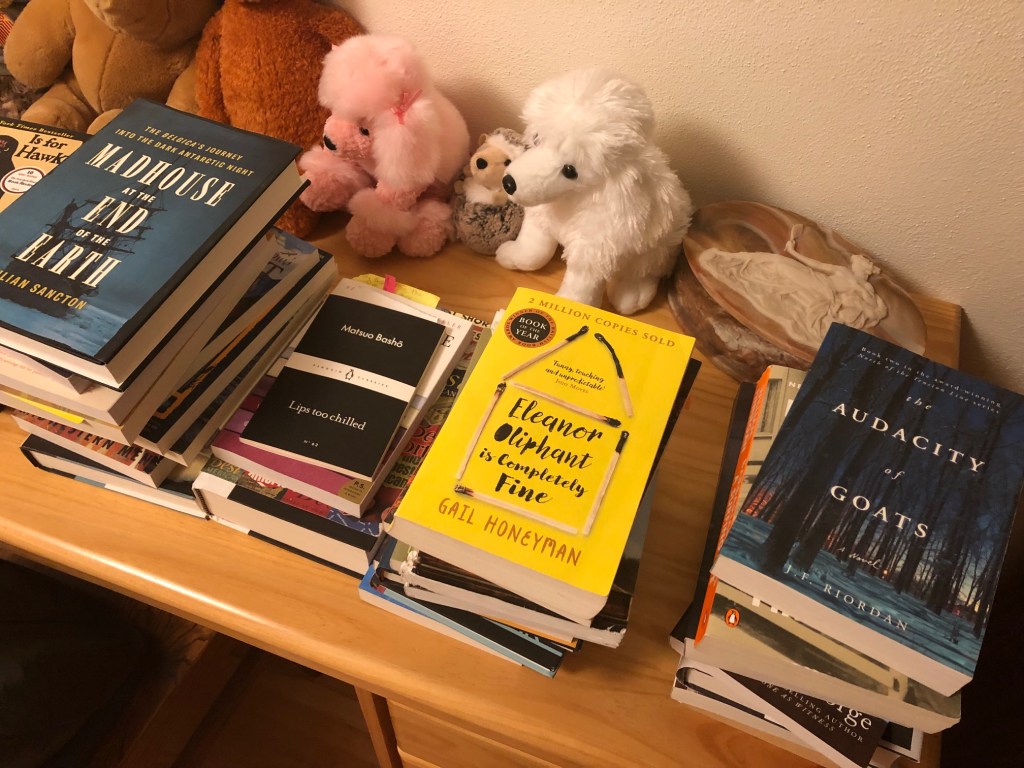
My non-writing desk

“What are you reading?” is one of my favorite questions. It gives me permission to talk about the books I’m reading and soon-to-be-read books that I have stacked on my non-writing desk, which functions as an extension of the nearby bookshelf. And, I love to hear about what other people are reading. It’s a good way to add more books to the stack on the desk.

I’m going to cheat a bit and answer this question two ways. First, I’ll discuss what I’m currently reading. Both books are my reward at the end of the day. I read the nonfiction book in front of the TV, so I don’t have to watch it. I like to sit in the family room with my husband in the evening, but our TV-watching tastes are not aligned. I read the fiction book in bed before I go to sleep. Second, I’ll discuss some books on my to-be-read list.

My current nonfiction read is Wicked River: The Mississippi When It Last Ran Wild by Lee Sandlin (2010). This is a beautifully written nonfiction book about the Mississippi River. The story starts in the 1700s, and I’m currently reading about events and life along the river in the 1800s. The Mississippi River, the star of the story, is complex and evolving, with a wide emotional range. The stories of the people who lived along the river and worked on the river are compelling too, but the Mississippi steals the show. I like this book because Sandlin’s writing is excellent and well researched. I’m learning so much about the river and how it worked and currently works as part of a large ecosystem throughout the middle of the United States. Unfortunately, I’m learning about how people have damaged that ecosystem. When I’m finished with Wicked River, it will have a permanent home on one of my many bookshelves.

My current fiction read is Saving the Scot by Jennifer Trethewey. It’s Book 4 in her Highlanders of Balforss series. I’ve read the other three books: Tying the Scot, Betting the Scot, and Forgetting the Scot. These books make me swoon, laugh, and cry, and I hold my breath during the engaging, suspenseful action scenes. Before I read these books, I hadn’t read a romance novel in over twenty years, and even then, I could count the ones I’d read on one hand. Trethewey’s books are different. True her characters are beautiful and handsome and brave and have fast-paced adventures on their way to true love. But her characters have human flaws and problems that make them endearing and relatable. And yes, the male characters do save the female characters. BUT the female characters save the male characters too. The females are intelligent, clever, resourceful, and brave, and they’re nobody’s doormat. The supporting characters are fully developed people, each with distinct personalities, who add to the enjoyment of Trethewey’s books. As a writer, I admire the storytelling and dialogue in these books. Her books entertain me and inspire me to be a better writer. After I die, my children will have to decide what to do with these books because I’m not giving them away.

Here are some books on my to-be-read list. I have lots of books that fit this category, but I’m going to limit my list to books that I plan to read in the very near future.

  1. We Were Never Here by Andrea Bartz. This book is first on my list because I checked it out from the library. It made my list because I heard the writer speak at a virtual Author Chat sponsored by Honest Dog Books. (Click here to view upcoming Author Chats, which you can listen to from home.) Bartz is originally from Milwaukee, and so am I. Her book was a Reece Witherspoon pick for August 2021. (I also read the Peter Ash series by Nick Petrie. I have one of his books in my stack. He’s a Milwaukee native too.)
  2. My Father’s Keep: A Journey of Forgiveness through the Himalaya by Ed Abell. This book made my list because I’ve met the author, I like reading books that combine adventure with self-discovery, and I had a difficult relationship with my father.
  3. Write Away: One Novelist’s Approach to Fiction and the Writing Life by Elizabeth George. I’m not a novelist, but I believe I can learn from George’s writing advice. This book made the list because I love George’s mystery series featuring Thomas Lynley. They are beautifully written: literary, suspenseful, and full of characters I care about.
  4. Lab Girl by Hope Jahren. Science is interesting, and I like memoir. I had a college professor who wanted to turn me into a biology major because I was so fascinated by my Intro to Biology course. I didn’t bite because I knew it would’ve been a mistake–the math would’ve doomed me. But I love reading about science, medicine, nature, and biology.
  5. Maggie Brown & Others by Peter Orner. This is a collection of short stories, a format that’s always appealed to me. I also write them, so I like to read short stories by other writers. I heard Orner talk at the Harbor Springs Festival of the Book in the fall of 2020. The festival is normally held in Harbor Springs, Michigan, but it was virtual in 2020. I like short story collections because I can read a story or two, read something else, and then read another story or two.

I’ll stop here because I need to go read something!

My writing desk