Dear Minnesota: The Story of Yost Yost

[This article was originally published in May 2021 by Minnesota PBS on their website Moving Lives Minnesota: Stories of Origin and Immigration.]

Yost Yost, my great-great-grandfather, was born in Nottwil, Switzerland, on November 19, 1829. At the time his double name was a common practice by Swiss parents. Yost’s father, Jacob Yost, was a nail maker and taught his son the trade. Yost, too, made nails before emigrating in 1854. But after he arrived in America and settled in Rochester, New York, he became a blacksmith.
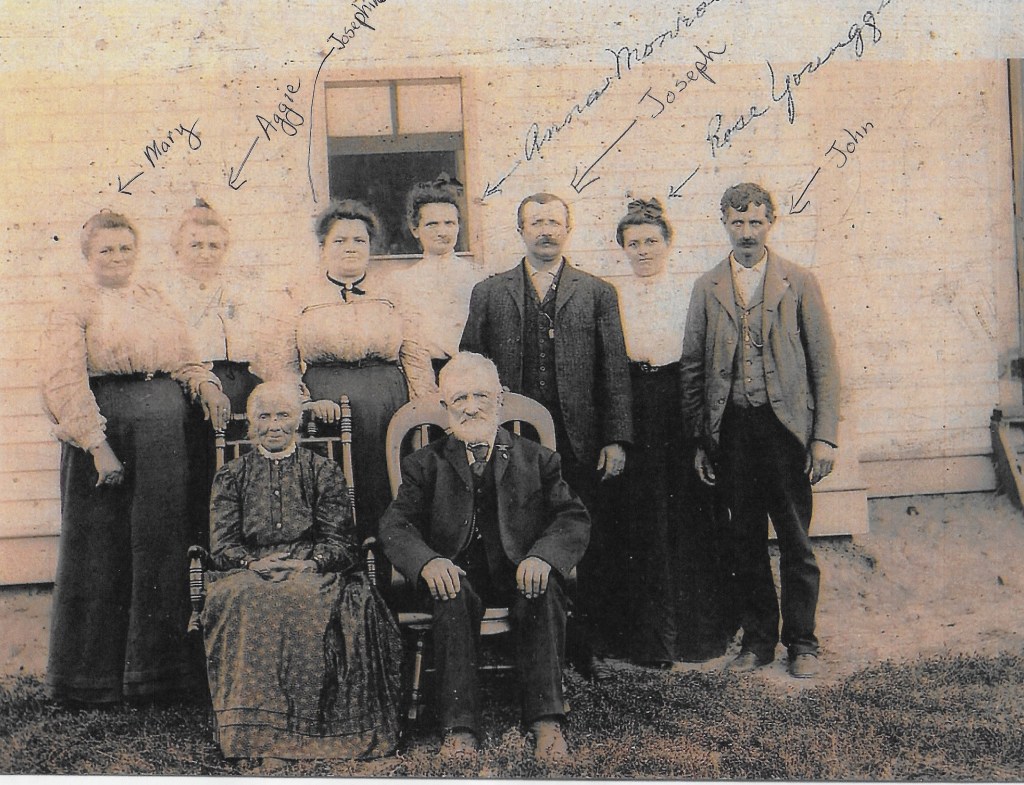
Seated: Agatha and Yost Yost; Standing left to right: Mary,
Aggie, Josephine, Anna, Joseph, Rose, and John

On July 16, 1855, Yost married Agatha Gassman in Rochester, New York. She’d arrived in New York City in January 1855. She was born in Switzerland, but her birth year is a mystery. It has been listed as 1820, 1823, 1825, and 1827. I can only guess why so many different birth years appear on documents clearly referring to the Agatha Gassman who married Yost Yost. Perhaps vanity tempted her to misrepresent her age. Perhaps others made mistakes and recorded her birth year incorrectly.

In the fall of 1856, the availability of land enticed Yost and Agatha to move to Columbus, Minnesota. Yost used his blacksmithing skills during the winter of 1856-57 to support himself and Agatha, pregnant with their first child, Maria, born in April 1857. They had six more children: Josephine, Joseph, John, Agatha, Anna, and Rose.

In the spring of 1857, Yost and Agatha attained land and built a log house. They were successful farmers, and their farm grew to 440 acres. They ground their own flour, sewed their own clothes, and made their own tallow candles. According to family lore, when they bought their first kerosene lamp, they proclaimed it was “real progress.” In spring and fall, Yost walked from Columbus to St. Paul, a distance of 50 miles, to buy supplies they couldn’t produce. After a road was built, he drove a wagon to make the trip.
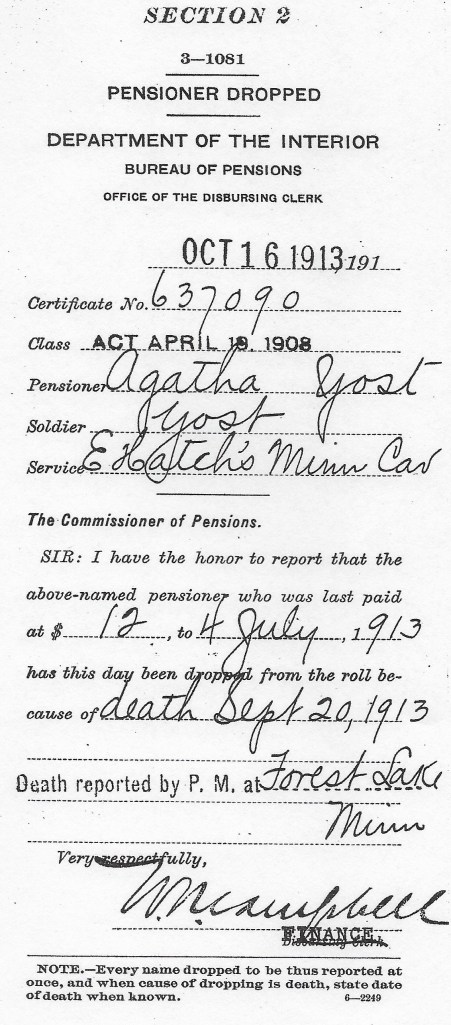
In August 1864, Yost, 34, enlisted in the Minnesota Cavalry, Hatch’s Battalion, Company E, serving until his honorable discharge in May 1866. I wonder how Agatha coped on a farm with five children, ages 1 to 7, while he served in the military. But he was granted at least one furlough during his enlistment. He was stationed on the Dakota-Minnesota frontier about 50 miles northwest of Mankato. According to a family history written by his grandson Fred, Yost “stopped a cannonball with his leg.” However, Yost’s military records tell a different story. In 1886, Yost applied for an invalid pension because of an injury he received near Fort Ridgely in June 1865. While out on patrol, his horse threw him, and he injured his back. It never completely healed, and as he aged, he developed rheumatism in his spine. How did an injury from tumbling off a horse become a story about being hit by a cannonball? Perhaps Yost was trying to impress his grandchildren. Perhaps once, when asked why he limped, he joked about getting hit by a cannonball, and that became the story.

While living in Columbus, Yost served as a town clerk, a justice of the peace, and a supervisor. The Compendium of History and Biography of Central and Northern Minnesota by George Ogle and Company, published in 1904, states, “Yost has resided in Anoka county for nearly half a century, and he has formed a wide acquaintance and is held in the highest esteem as an agriculturist and worthy citizen.” Yost became a naturalized citizen of the United States on March 23, 1897.

As Yost aged, his back injury made farming difficult. He retired, and his sons, John and Joseph, ran the farm. Yost died on November 3, 1906, just short of his 77th birthday. Agatha died on September 20, 1913. They’re buried at St. Joseph’s Catholic Cemetery in Wyoming, Minnesota.

[More Moving Lives posts written by other writers can be read at Moving Lives Minnesota: Stories of Origin and Immigration.]

Two Old Dogs Before Dawn

[Sunday, December 19, 2021]

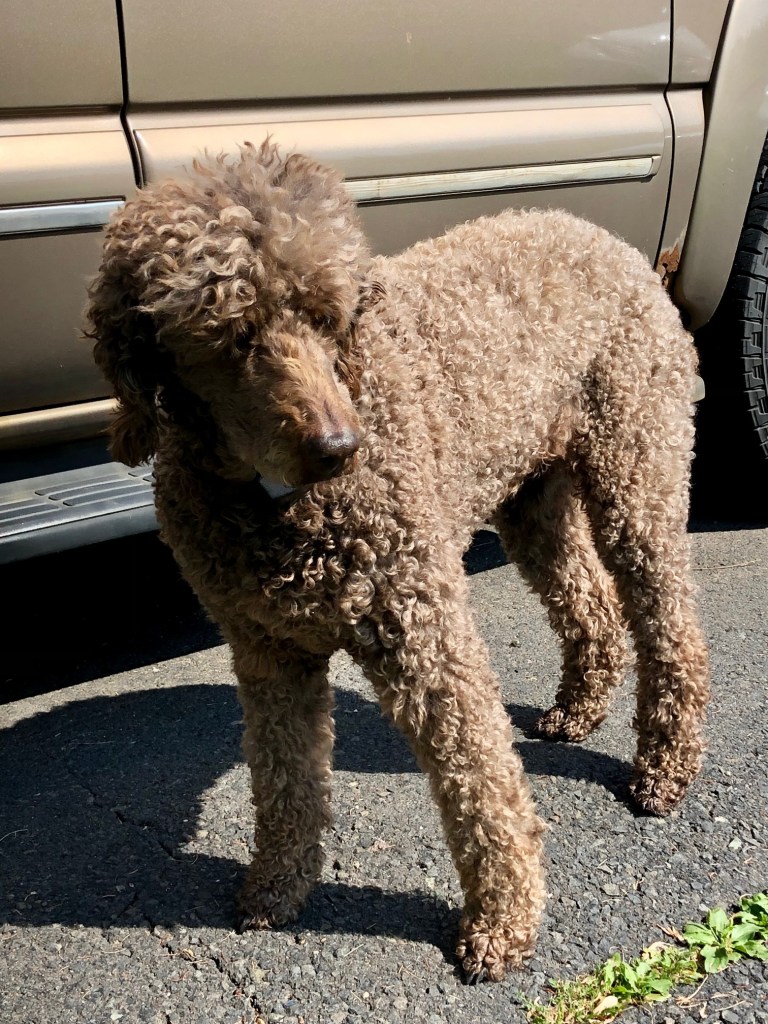
Frosty Cabela

Cabela’s nose is to the ground. I stand at the bottom of the deck. Our rabbit-in-residence streaks at warp speed across our backyard into the neighbor’s yard. Lately, I’ve been going outside with Cabela in the morning, and the rabbit is usually eating breakfast, nibbling at vegetation visible through a thin layer of snow.

Each morning I wonder if this time Cabela will spot the rabbit and give chase. (She hasn’t yet.) This morning she doesn’t see it because she’s sniffing the ground. She doesn’t hear it because she’s nearly deaf. But after it has kicked up snow, she smells it, points her nose to the sky, and inhales short snorts of frigid air. Even if she saw it, she’d have no hope of catching it—the rabbit possesses afterburners for hind legs and Cabela possesses thirteen-and-a-half-year-old hindquarters. We also have an electric dog fence.

It’s 6:30 a.m. and dark. First light will come shortly after 7:00, followed by sunrise just before 8:00. It’s 11 degrees, the wind is 9 m.p.h., and the feels-like temperature is 0 degrees. I don’t want to be outside. I’m sleepy, and I haven’t had any coffee. But the rabbit is entertaining.

Because of the electric fence, I should be able to put Cabela’s collar on her, let her outside, and wait at the door for her to return. But Cabela has taken to barking at things that I can’t see, and perhaps she can’t see. She’s eighty-five in human years. In a skewed aging process, Cabela entered our home as a puppy but is now twenty-three years older than me. Routines have changed, and allowances have been made. But at 6:30 in the morning, I don’t expect my neighbors to give Cabela a pass if she decides to bark at nothing.

I wear a mid-calf-length coat and a knit hat with a gold pom-pom. My feet shilly-shally in a pair of oversized, old sneakers my husband keeps by the back door. My hands are shoved in my pockets. Under the coat, I wear an ankle-length flannel nightgown, which, unfortunately, isn’t completely covered by the coat. I think about my nana who would walk outside in her nightgown and housecoat in the morning if she needed something. She lived on a city block in Milwaukee and, as a little girl, I thought she shouldn’t go outside in nightclothes where the neighbors could see her. Nana believed in ladylike behavior and good manners, so I concluded that old people, like babies, must be allowed outside in their pajamas.

Cabela saunters to the side of the house, scheming to enter the front yard. I block her path and point toward the back door. She still understands hand signals. She turns and canters to the deck and climbs the stairs.

One day last week every time she went outside, she stationed herself in the front corner of our yard and looked across the street. She barked then paused, barked then paused, again and again, as if to say, “Hey, is anyone there?” or “Hey, I’m over here!” Each time I had to go outside, walk up to her, and touch her to get her attention. I couldn’t see anything, but each time I went to get her, I stared across the street longer and longer, looking for a person or an animal. Once I looked to see if smoke was coming out of the house or garage across the street. I wondered if she was hallucinating.

Sometimes Cabela is in her own world. She awakes from a nap and stands, head bowed, as if she’s trying to remember why she got up. She’ll stand, motionless. Sometimes I bend down, rest my cheek against hers, and murmur, “Do you want to go outside? Do you need a drink of water? Are you okay?” She doesn’t respond to my questions. She moves only after she has made a decision about something that I’m not privy to.

To keep Cabela from barking, I’ve started going outside with her in the early morning hours. I shamelessly throw my coat on over my nightgown. She’s already waited for me to pee so she can go outside to pee. She makes it clear that she doesn’t want to wait for me to get dressed. I’m not being unladylike; I’m channeling my nana.

Once outside I stay close to Cabela. We’re two senior citizens starting our day, grateful to be together, and happy to be alive. But only one of us is thankful that it’s too dark for the neighbors to see her outfit.

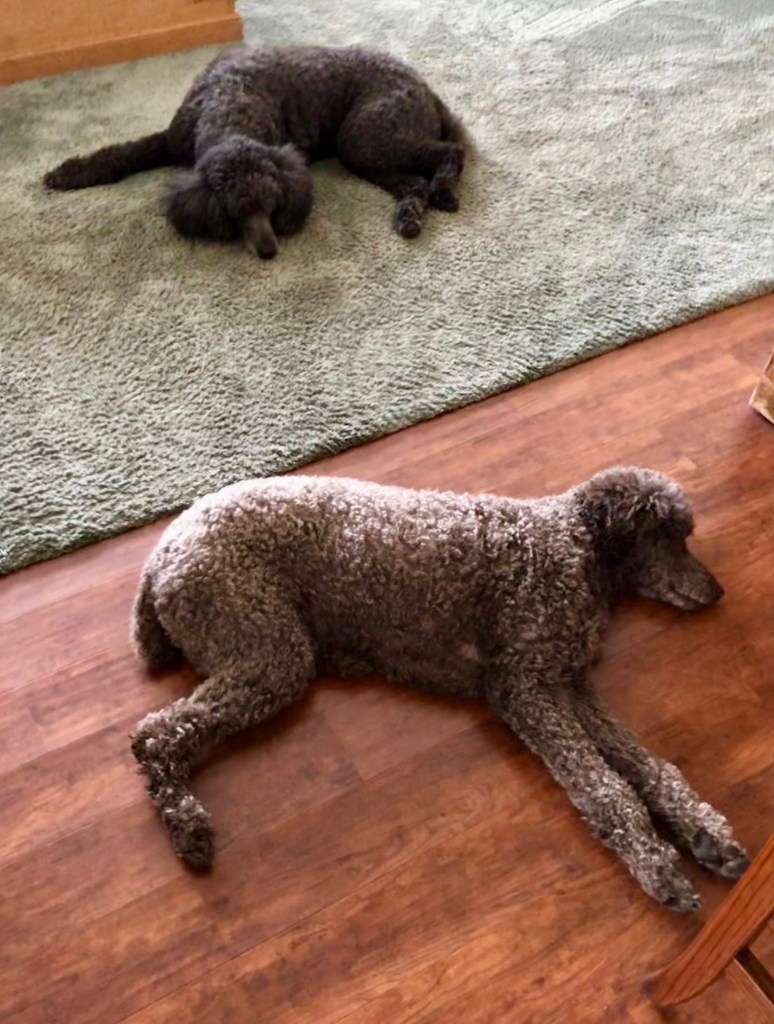
Naptime, Cabela, foreground, and Ziva, background
Cabela looks at Lake Michigan
Cabela waits for a ride

Bird Feeder Trilogy

Wednesday, November 24—

Charlie, September 2021

Charlie, my three-year-old grandchild, was cranky, and I was becoming cranky. I crossed my arms, looked at him, and said, “How about you and Nana take a timeout together?”

“Okay.” He agreed because he knows it’s not a real timeout if I’m joining him. I picked him up and carried him to the family room to begin our detention. On the way he wrapped his arms around my neck and snuggled his head on my shoulder, aah Charlie-Bear hugs.

Charlie and I needed a quiet place to gather serenity (and avoid tears). We knelt on the couch, rested our elbows on the back cushions, and watched the chickadees zip back and forth from the trees to the bird feeder. Our crankiness dissolved. Before long I heard Charlie’s five-year-old brother, Evan, ask, “What are you looking at?”

“The chickadees,” I said. Evan joined us on the couch, and we watched the chickadees dart to and from the feeder. Evan asked lots of questions—he always does. But he asked with a soft, reverent voice.

Next, their ten- and eight-year-old siblings, Clara and Michael, found us and asked, “What are you doing?” Funny how each child became aware that Charlie and I were missing from the front room and in turn abandoned their toys to find us.

The five of us sat in the darkened family room, stared outside into the dimming afternoon, and watched the chickadees dash in and out to grab seeds. I pointed to a red-breasted nuthatch cavorting on the branch of a pine tree near the feeder. Sometimes it hung upside down, and sometimes it hung right-side up in its frenzied search for food lurking in the bark.

The five of us were still and spoke in muted tones, sated with the joy of watching small birds eat supper. Timeouts are good for everyone.

Saturday, November 27—

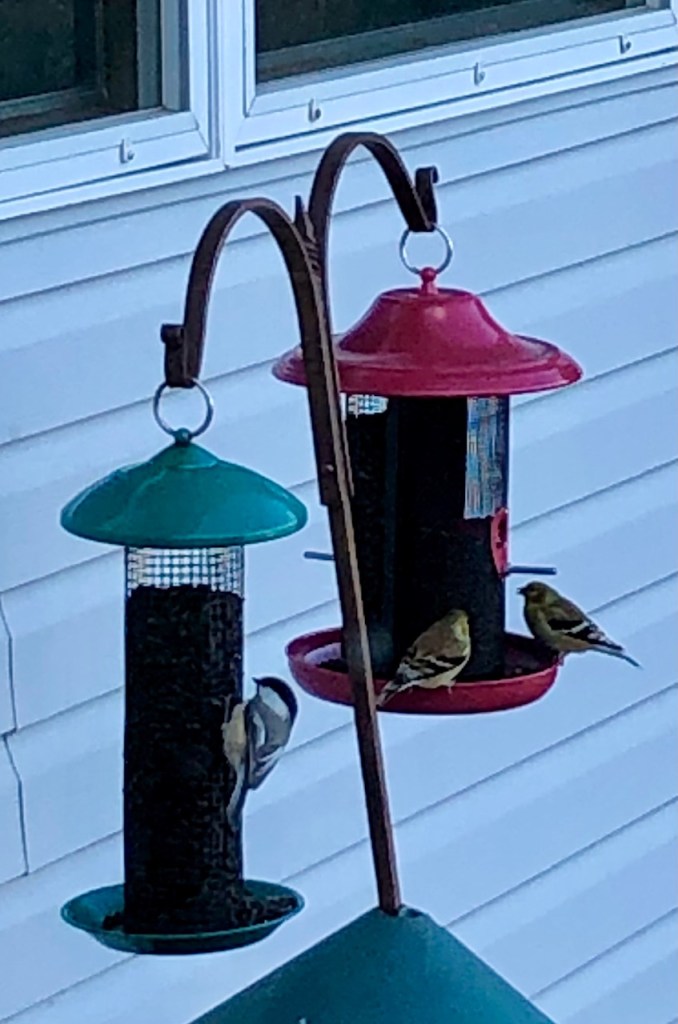
Chickadee and Goldfinches

It was cold outside, but there was no snow. I noticed small birds, including chickadees, goldfinches, and cardinals pecking at the ground and at tree branches and trunks, foraging for creepy crawlies, good sources of protein to nourish them through the winter.

A few chickadees swooped in and out to grab black oil sunflower seeds from the feeders outside my kitchen window, but only two or three chickadees at a time. In warmer months, I often see five or more doing touch-and-go landings at the feeder. Once the ground is covered in a thick, white batting of snow, the chickadees will dive bomb my feeders again. No matter how cold and snowy it gets, I keep their feeders clean and stocked.

A pair of goldfinches visited. Their yellow feathers, like the leaves and grass, have faded to brown. In the winter when a male goldfinch isn’t breeding, his brilliant yellow coloring turns a drab brown. A female goldfinch’s color fades too, but even in mating season, she’s never as flashy as her male partner. Mr. and Mrs. Goldfinch foraged on the ground and in the trees, but they also grabbed seeds from the feeders.

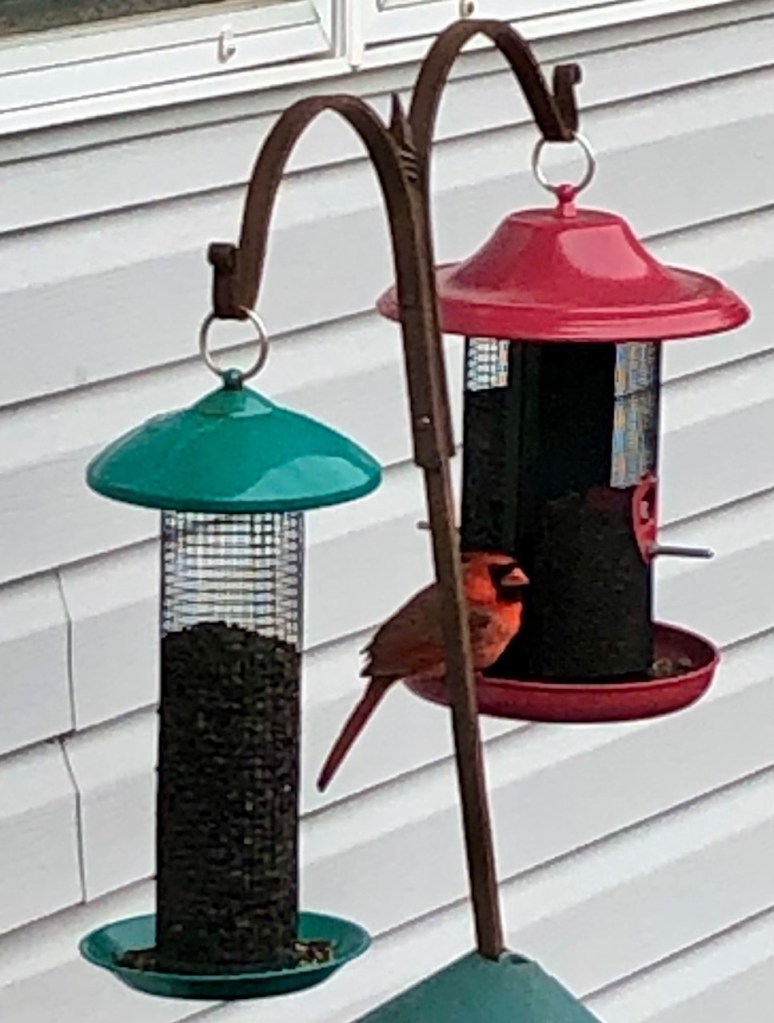
Mr. and Mrs. Cardinal dropped by. Mr. Cardinal was sporting his flashy red jacket. Unlike the male goldfinch whose colors fade in the winter, the male cardinal often turns a brighter red. Mrs. Cardinal was a shade of greyish-brown with a few red-feather highlights, a lipstick-orange beak, and a red-tinged mohawk. She’s always a combination of understated beauty and bold attitude.

Mr. Cardinal snuck up on the bird feeder. He started in the garden, poking his beak in the ground. He lifted his head, turned it left, then right. Looking, poking, looking, poking, in a nervous cha-cha-cha. After every couple of poke-and-look moves, he hopped a little closer to the feeders. Finally, a craving for sunflower seeds overtook him, and he flapped his wings. Lifting himself from the ground for a short flight, he landed on the tray of the red feeder. I snapped a picture of him eating and texted it to my family. My sister responded, “I like how the red bird goes to the red bird feeder.” I had the same thought when I took the picture.

Stopping by the kitchen window, I watched him fill up with seeds. Mrs. Cardinal, cloistered in a nearby cedar tree, watched him too. Cardinals usually mate for life, and she was looking out for her man. After all, he stands watch when she builds their nest.

Sunday, November 28—

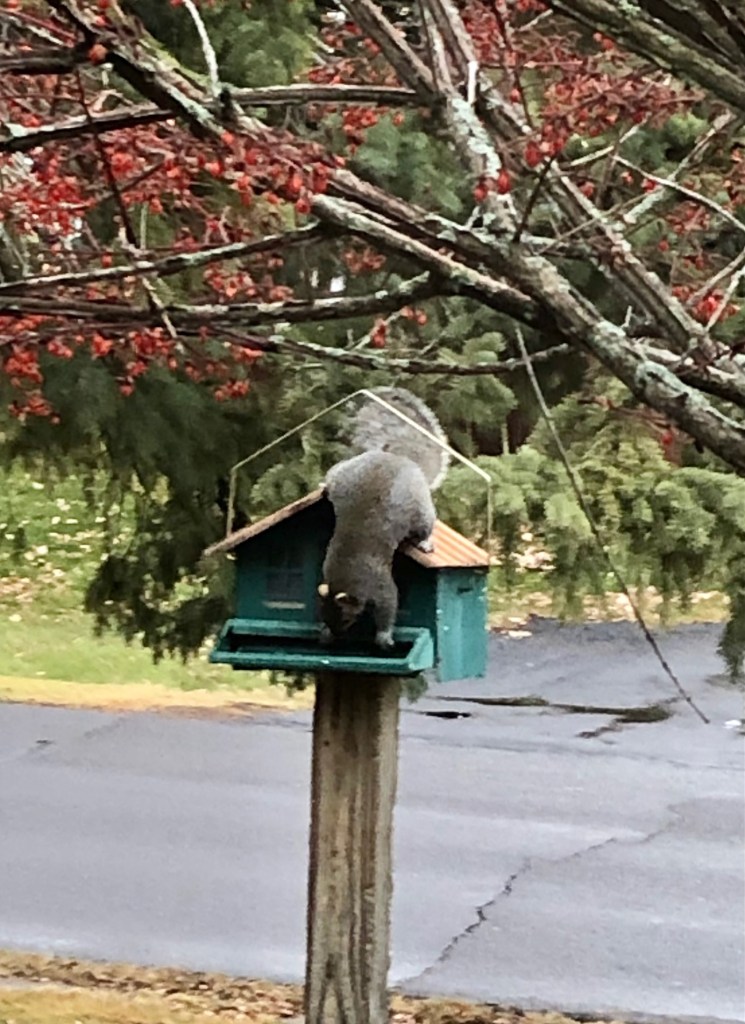
Today a grey squirrel ate lunch and dinner from the bird feeder at the side of my house. The feeder, shaped like a craftsman style home, is designed to thwart squirrels. Wally “The Hack” didn’t get the memo.

I like to think Wally “The Hack” is “Flying” Wally, who, this summer, mastered leaping from one shepherd’s hook to another shepherd’s hook from which my bird feeders hang. After his leap, he would shimmy down the pole, sit on the feeder’s tray, and munch sunflower seeds. I put the plant hanger away for the winter, so if this is Wally, he has adapted.

Wally (it has to be him) figured out he needed to climb up the back of the wooden post then sit on top of the feeder. Next, he hung upside down, grabbed seeds from the tray, sat up, then ate his morsel before repeating his moves. He had learned that if he tried to eat from the front of the feeder, his weight dropped a bar and obstructed his access to the seeds. (Other squirrels still try to get seeds out of the front of the feeder.)

I sat on the couch and watched him, and he watched me watching him. He gave off a vibe of bravado and triumph—his pilfering of each seed, a boast. I left him alone and the chickadees left him alone. They flew to the ground to grab spilled seeds then darted back to the pine tree.

I wanted to open the window and yell, “Leave the seed for the birds,” but I admired Wally’s problem-solving skills, so I let him eat. I hope he doesn’t learn to hack my wi-fi and order his own sunflower seeds.

[Local birder Rich Hoeg has a wonderful website with beautiful pictures. He loves to photograph and write about owls, but also posts gorgeous pictures of other birds: 365 Days of Birds.]

[For pictures of beautiful birds from around the world, click here. To enjoy Michael Sammut’s blog about birds, click here.]

Kekekabic by Eric Chandler

Reviewed by Victoria Lynn Smith (This review was originally posted on Nov. 27, 2022.)

[To pre-order Chandler’s book click here: Finishing Line Press.]

Leo at Parent Lake in the BWCA

Kekekabic, Eric Chandler’s second book of poetry, will be released May 20, 2022. Prepublication sales for the book will run from January 18, 2022, through March 25, 2022. Chandler is the author of Hugging This Rock: Poems of Earth & Sky, Love & War (2017). He has won the Col. Darron L. Wright Award for poetry three times. His writing has been published in numerous journals and magazines.

Kekekabic combines prose and haiku in a poetry form called haibun. In 2018, Chandler wrote a poem after each of his workouts. His goal was “to pay attention to the world” during his workouts in the wilderness, in Duluth, and on the road as an airline pilot. In his introduction he states, “It’s a loss if skiing through the woods is just a workout. All these miles moving over the earth under my own power have meaning.” Chandler’s poems invite us to move over the world with him and share the meaning he finds as he runs, hikes, and cross-country skis.

On the cover of Kekekabic, Chandler’s dog, Leo, sits on the shore of Parent Lake in the serenity of the Boundary Waters Canoe Area (BWCA). Leo invites us to open the cover, read the poems, and reflect along with his hiking companion about being outside in nature. Chandler shares his wisdom about the outdoors in a haiku:

I think more people

should go outside. I think they’d

be much happier.

This resonates with me because on a bad day if I go outside, my spirits lift. Reading Chandler’s poems lifts my spirits too. Nature is an important theme in Kekekabic, and Chandler poems nudge us to go outside.

Chandler’s imagery appeals to the senses. About one of his runs, he writes, “The wind stacked the pack ice up at the fond du lac. The yellow sun sends a yellow stripe across the open water and it hits the shelf of ice and disperses. Brilliant sparkles randomly dot the expanse as the shards reflect the sun.” After a day on the Kekekabic trail, he writes, “Tail-slapping beavers sounded like full-grown men jumping into the lake.” Chandler’s poetic imagery will linger in our minds long after we close his book.

Leo joined Chandler on the five-day hike in the BWCA along the Kekekabic Trail. Chandler wrote a haibun for each day of the hike. The haiku he wrote on the fifth day—

The sound of peace is

my dog snoring on a rock

on a wild lakeshore

—mixes the wonder of nature and the joy of sharing it with family, which includes his dog. He writes of his daughter’s first time on cross-country skis: “I felt like my heart would explode due to an overload of blue kick wax joy, gliding through the trees in silence.” In another haibun Chandler recounts a run along Lake Superior with his son. They find a teddy bear on the path, and his son turns around and races back to where they had just run from to return the teddy bear to a child. Chandler’s poems remind us that small, quiet moments spent in nature with family are special.

Chandler studied the Japanese poet, Bashō, to learn about haibun. He quotes Bashō: “People often say that the greatest pleasures of traveling are finding a sage hidden behind the weeds or treasures hidden in trash, gold among discarded pottery.” In haibun that reflect Chandler’s workouts in large cities, he has taken Bashō’s words to heart—finding the sage, the treasures, and the gold among the grittiness and complexities of urban settings.

Some of Chandler’s haibun explore the theme of urban settings and nature colliding. In Fort Lauderdale as he runs, he notes “That crisp thread between the light blue of the sky and the dark blue of the water” in the distance. But as he observes the sky and water, he runs “Past the cigarette smokers. Past the marijuana smokers. Past the guy lifting dumbbells while he stands at the seawall, looking at the ocean while his car speakers thump.” He continues running down to the water where he concludes, “I got a moment’s peace and then found my way back to my room through the noise.”

Chandler’s poems written after running in cities, combine the beauty of nature and cityscapes with a harsher reality of urban landscapes, a comparison that invites us to think about people and nature as “reaching toward” one another. He writes, “Downwind now, I was struck that the world of man and the world of nature kind of reach toward one another at the border. The palm trees grow out of the sidewalk and the beach chairs cover the sand.”

In his haibun poems, Chandler encourages us to move through life with meditation and awareness. He encourages us to take journeys with family, friends, and our dogs, but also to take some journeys by ourselves. His poems inspire us to go outside and move through our world.

[For more information about Eric Chandler and his writing, click HERE to view his website, SHMOTOWN. Kekekabic will be available for prepublication sales at Finishing Line Press starting January 18, 2022, through March 25, 2022.]

Day 30—A Gift of Kindness in Silver and Garnet

Today’s earrings arrived in the mail on November 4, 2021, otherwise known as “Day 11” in my series of blogs about earrings.

I began blogging about my earrings because I was having a blue day on October 25. I decided I needed to do something like I did before the pandemic. That something became earrings. I often wore earrings before the pandemic, so I decided for thirty days in a row, I’d wear a different pair each day and blog about them.

Wearing the earrings did make me feel better. Blogging about them gave something to write about. Having a friend proofread my blogs provided camaraderie.

Some stories came together easier than others. Some days I babysat my grandkids and other days I didn’t. I’d like to say that on the days my grandkids weren’t here, I wrote my blog faster and finished it earlier, but that wasn’t always the case. Sometimes it’s difficult to find the words to tell a story and have it say what I want it to mean. And the stories were about more than earrings.

On Day 11, I received a surprise in the mail. A small padded envelope with a bulging middle rested in the letterbox, lounging with junk mail.

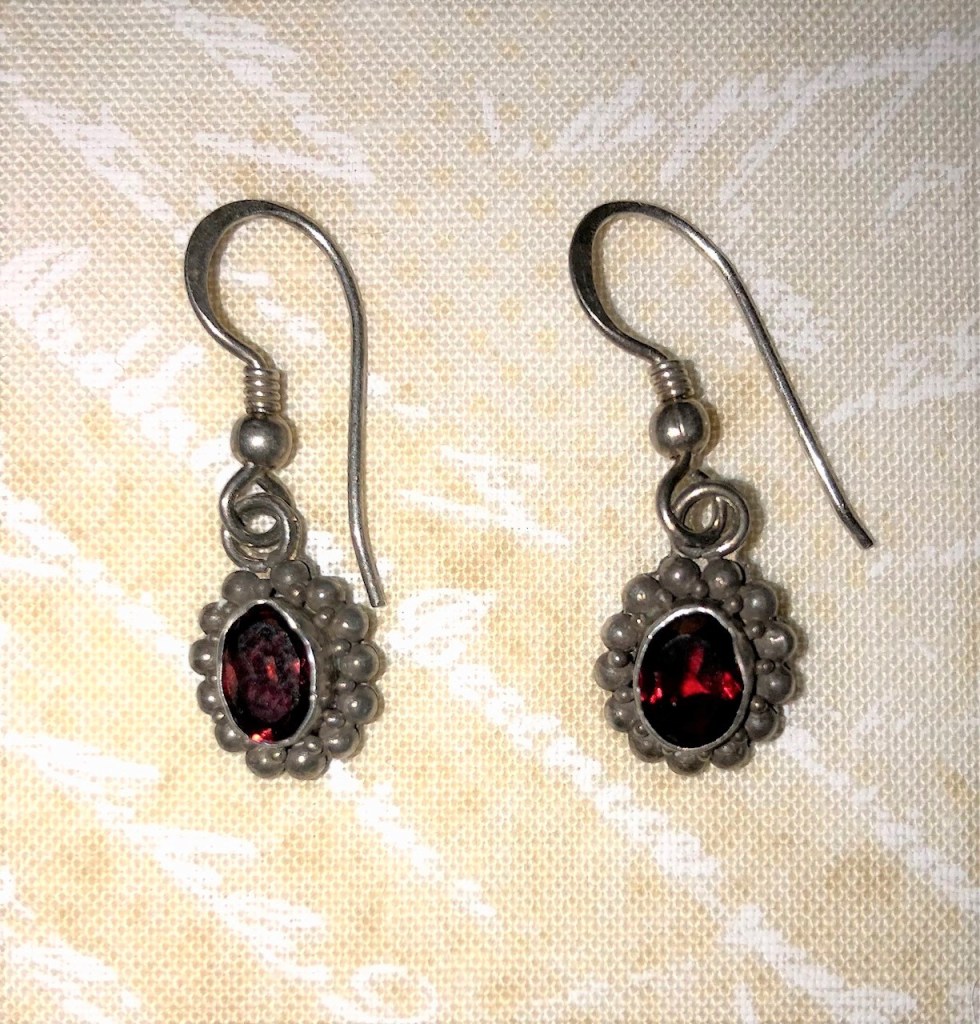
I recognized the name on the return address; the envelope was from a writing buddy. Inside, wrapped in tissue, were a pair of silver and garnet earrings. Beautiful. Old fashion. A style from a time when women wore long dresses that flounced along their feet. A movie still of Jane Seymour from Somewhere in Time flashed through my mind. I’ve never seen the movie but that image of Seymour with her hair swept up at the back of her head and a pair of Victorian earrings dangling from her ears, is filed in my memory bank.

What made these earrings special was the note that came with them. My writing buddy wrote that these earrings had belonged to her, one of the many pairs of garnet earrings she had been given over the years for her birthday. And these were a pair that she had especially loved. She wanted me to have them. She had been reading my earring blogs, and they had moved her.

It’s a gift from the heart when someone gives you something they’ve cherished. I started to cry. She gave me beautiful earrings, and she gave me a piece of herself, her history.

I saved her gift to wear for today’s final blog about my earrings because I can wear them tomorrow and every day through Thanksgiving. I don’t have to pick a new pair of earrings tomorrow.

I’ll wear them through the holiday and often because I’m thankful for her act of kindness and generosity.

A good thing came in small package—on a day when I thought nothing interesting would arrive in the mail—to bring me joy and adorn my ears.

Day 29—Earrings without a Turtle

Circa 2017

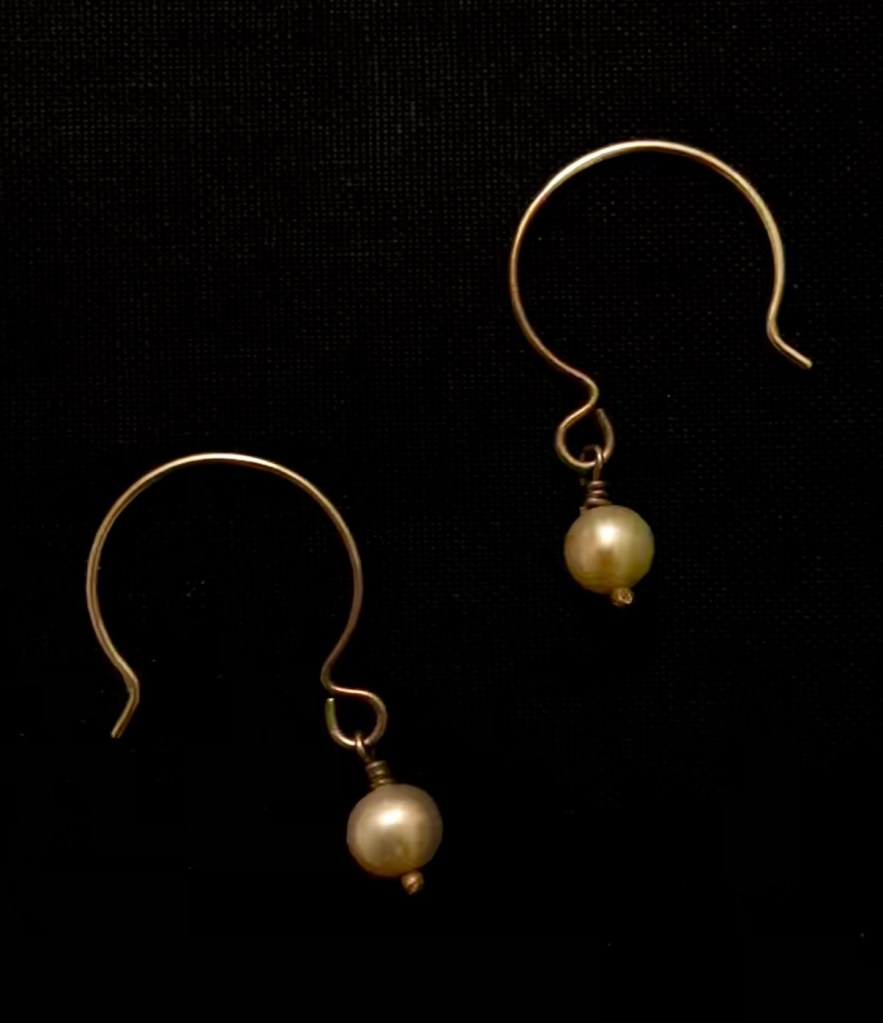
These earrings remind me of Bayfield, Wisconsin, because I bought them on a day trip to Bayfield with my mom. I liked the curve of the hoops and dainty pearls. After paying for them, I slipped them in my ears because I’d forgotten to wear earrings that morning.

Over the span of fifty years, I’ve been to Bayfield with family and friends and have fond memories of the small town on the hills overlooking Lake Superior. But one of my favorite memories of Bayfield doesn’t include me.

***

My mom took my first son to Bayfield when he was three years old and still an only child. I had to work, so they went by themselves. On the way to Bayfield, they found a turtle on the side of the road, and Mom stopped and put it in her car. When they arrived in Bayfield, Mom found a hardware store and bought a wash tub for the turtle. My son had a new pet, and the pet had a new galvanized home.

They ate lunch at a restaurant and Mom let my son order fries with his sandwich. If we ordered my son a meal with fries, he’d eat the fries and leave the meal untouched. Most of the time, we didn’t let him order fries. But he was with Grandma. He had fries for lunch—just fries. His sandwich went uneaten. But grandmas don’t scold about that sort of thing.

Mom went into a few clothing stores where my son entertained himself by crawling into the middle of circular clothing racks while she shopped. He invented his own world.

In one dress shop, he fell in love with a clerk named Sabrina. She was about twenty, petite, with big brown eyes and dark hair in a pixie cut. Mom said he followed Sabrina around the shop, talking to her, smiling at her, looking at her moon-eyed. He wasn’t happy when they left the store, and he was parted from his new love. But that’s the way it often is with a first love—it breaks your heart. My son’s May-December romance was doomed. But his three-year-old heart rebounded quickly. After all he had his turtle. And Mom took him to the shore so he could throw rocks in Lake Superior.

Before leaving Bayfield, Mom had second thoughts about bringing the turtle back to my house.

“Do you think the turtle will miss his family and friends?” she asked him.

My son thought so.

“Do you think we should take the turtle back to his family and friends?” she asked.

He did.

They set the turtle free, and returned with an empty wash tub. My son had parted with his first love and his pet turtle, but by the time they arrived home, he had moved on.

“How was your day?” I asked when he came in the house.

 “It was the best vacation I ever had!” he said.

Mom had a way of making an ordinary outing into a small adventure for her grandchildren.

***

On the trip to Bayfield when I bought these earrings, it was just Mom and me. My sons are grown with families of their own.

We didn’t see a turtle or toss rocks in the lake, but we had lunch and ate our fries and sandwiches. The dress shop where my son fell in love with Sabrina has been closed for years, but Mom and I still reminisced about her and my son’s first case of puppy love.

When Mom retells the story, I wonder about Sabrina, who’d be in her fifties now. Does she still live in Bayfield? Did she ever have children of her own, perhaps a little boy who fell in love for the first time when he was three?

Day 28—Happy Earrings

Today’s second choice

Today’s earrings are happy earrings. They’re also the second pair I put on this morning.

The first pair were sad. Their hooks are too small, so the earring in my right ear couldn’t dangle because the hook was squashed against my earlobe. I removed the earrings, which are nice enough, but I won’t wear them again. I bought them, so I won’t feel guilty deserting them.

The hole in my right ear is almost two millimeters higher than the hole in my left ear. And, it’s not because my right ear is higher than my left ear. The clerk in the store where I had my ears pierced miscalculated.

I thought about having my right ear pierced again to lower the hole, so earrings that are meant to dangle, can dangle. I was told to let the old hole close up first to avoid a potential tear between the old and new holes. That would’ve taken months, so I’ve kept my uneven hole. Instead, I’ve learned not to buy earrings with small hooks.

My friend Sandi bought these happy silver and green earrings for me on one of her cruises. Before today I’d only worn them a couple of times because I had lukewarm feelings about them. But this morning when I put them on as a second choice and looked in the mirror, a heatwave of happiness blew over me. How did I not love these earrings from the start? They bounce and swirl. They catch light and throw it back through the air. They’re sassy and amusing. They’re an incarnation of my friend Sandi.

The first time I met Sandi’s son, he said, “I’m surprised you and my mom are such good friends because of your age difference.”

“Yeah, your mom’s a little young for me, but I overlook that,” I said.

When he stopped laughing, he said, “Touché.”

Sandi was seventeen years older than me, but in numbers only. Her son knew exactly what I meant.

Today’s earrings are happy and young at heart, just like Sandi was. If not for my “Thirty Days of Earrings” blogging, I might not have ever worn them again.

But, today these earrings danced beneath my ears, and I felt young at heart.

I will wear them again, and often.

[Click here to hear Frank Sinatra sing “Young at Heart.”]

Day 27—A Super Clean Earring

About five years ago, my husband and I went to visit my mom in Michigan, and I forgot to wear earrings—I had left the house with naked earlobes! In my defense, we always leave ridiculously early. It’s a nine-hour drive plus time spent stopping for food, gas, and bathroom breaks. And we lose an hour driving east.

I didn’t like being earringless, but I didn’t want to shop for earrings. I decided to go without. I lasted for a day.

I turned to Mom for help. Did she have a pair of earrings I could borrow?

We mined through her jewelry box. I spotted a pair of gold and pearl earrings that I hadn’t seen her wear. She was happy to lend them to me because while beautiful, they weren’t her style. She likes silver earrings sized to pack a visual wallop.

As much as I loved wearing the earrings, I couldn’t ask her for them, so I was thrilled when she asked me if I wanted them.

A couple of years ago, I went to take them off at night and discovered one of them missing. I looked everywhere in the house because I felt certain I had both of them when I came home from work. I checked the floors, the sweater I had worn, the sinks, the dishwasher because I had been doing dishes. I checked the stairs, my car, the driveway, the garage, the deck.

I didn’t tell Mom. I didn’t want to admit I had been careless, or believe the earring was gone for good.

The next day at work, even though I still thought I had lost the earring at home, I emailed my coworkers a picture of the lone earring, asking if anyone had found its companion.

Coworkers were sympathetic: “Sorry you lost your earring.”

After a few days went by coworkers asked: “Have you found your earring?”

No, I hadn’t.

After a few weeks went by coworkers asked: “Did you ever find your earring?”

I hadn’t.

I kept looking in places I had already looked.

Two months passed.

One evening I opened the dishwasher to put away dishes. On the bottom of the dishwasher, in plain sight, was my earring.

It had spent two months—approximately sixty wash cycles—in the dishwasher, probably behind the bottom spray arm.

I told my coworkers who asked: “Was it okay?”

“Yep, it looks just the same.”

Another coworker asked: “Do you still have the other one?”

“Yeah, I couldn’t throw away a gold and pearl earring my mom gave me.”

But I had been thinking about having a jeweler make it into a pendant for a necklace.

I’m glad I procrastinated.

Day 26—Remembrance Earrings

In 2014, the day before her 47th birthday, my cousin Cally died of a heart attack. No one expected her death. She was young, full of life, part of the world.

Her mother is a cherished aunt of mine.

In remembrance of Cally, I made a quilt from scraps to give my aunt on the first anniversary of her daughter’s death. I purposefully chose to use scraps leftover from other quilts that I’d made for family and friends.

That so many pieces of other people’s quilts should be part of Cally’s quilt seemed appropriate. She touched so many lives. It didn’t matter whether or not she knew all of the people I made quilts for because she wouldn’t have known all of the people her love, laughter, friendship, and charity inspired and touched. Acts of kindness ripple from those we know to those we don’t know. It’s the premise of paying it forward.

When I finish a quilt, I sew a label on the back of it. Cally’s label was special because it was large, eight by ten inches. Using a special technique, I transferred three photos of Cally onto the label. In the first picture, the winds of Wyoming blow her dark blond hair off the sides of her face. Behind her a dirt road heads to the foothills of a mountain range near her hometown. Scarves of white clouds flutter though a blue sky. Cally is both smiling into and squinting against the wind. She’s about fourteen. All things are possible.

In the second picture, Cally is standing with friends in a market in Morocco. Cally loved to combine travel and adventure. She rode camels on this trip.

The third picture is a candid portrait of Cally, probably in her 30s. Her head is turned almost to a profile. She’s watching something or someone we can’t see. She’s beautiful. Her brow, nose, cheekbone, and jawline proportioned like a statue of a Greek goddess. Her given name Calandra is of Greek origin, meaning singing bird or lark. In her left ear, she wears an earring. I can’t see the details of the earring because it’s out of focus, but I like what I can see. It’s dainty, but not too small. It hangs down from her ear, but not too far.

I was twelve when Cally was born. Most of my memories of her are when she was a baby and a toddler. After her parents moved from Wisconsin to Wyoming, I didn’t see Cally or her older brother for years. In the early 2000’s, sometime after Cally had children of her own, her uncle who lived in my town died. Her mother, brother, and she came for the funeral. Cally and her mom stayed with me. We became reacquainted; the twelve-year age difference no longer mattered. We visited, ate meals together, and laughed a lot. I never saw Cally again, and after she died in 2014, I treasured that time we spent together.

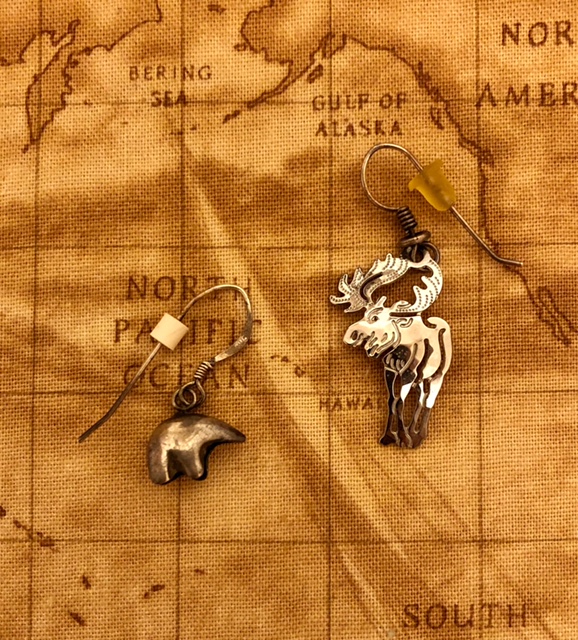
Today’s earrings belonged to Cally. One is a moose and the other a polar bear, both large, magnificent animals that are in peril as the earth warms. My aunt gave them to me when my husband and I drove to Wyoming in 2016 to visit. They don’t match. My aunt didn’t know why there was only one of each. These earrings weren’t sold as a set—each earring has a different rubber back. But I’ve seen earrings that are meant to be a mismatched set. Perhaps Cally and a friend each swapped an earring with one another as an act of friendship. It’s something Cally would’ve done.

Perhaps Cally lost the mate to each of these earrings. Like me, she wasn’t going to throw an earring away because then both would be lost. And because a lost earring is sometimes found.

I wonder if she ever wore them as a mismatched pair like I do. It’s something Cally would’ve done.

Day 25—Grand Marias Earrings

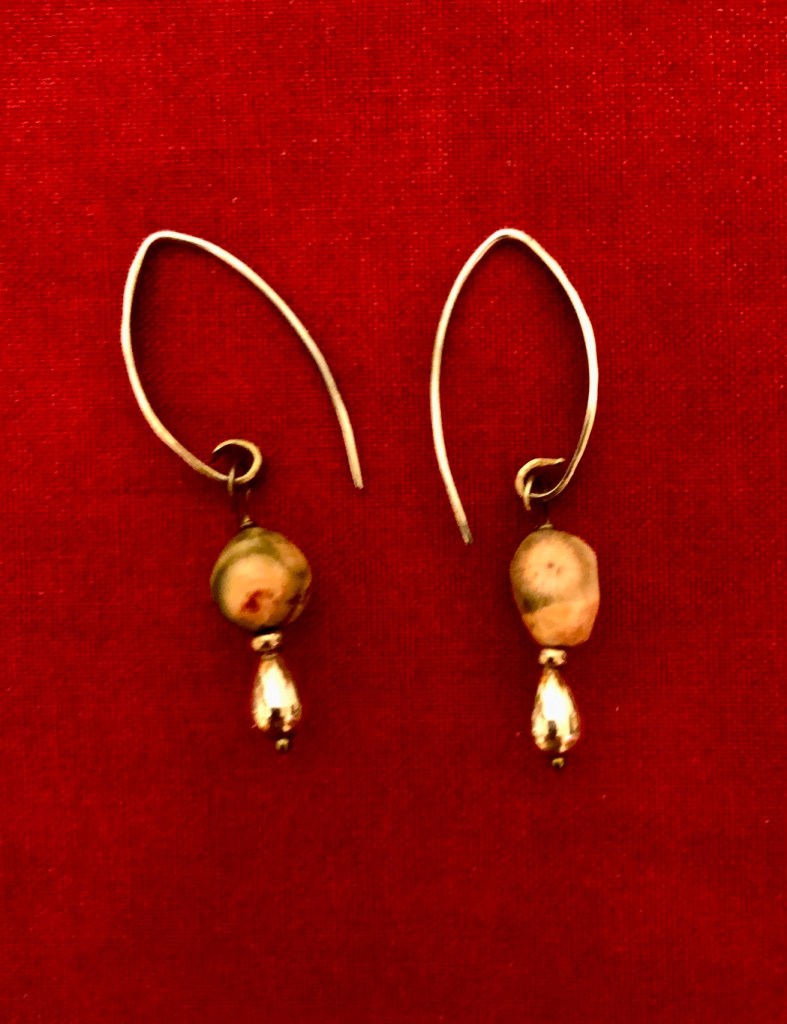
Today’s earrings are silver with Thomsonite stones, which are found in Minnesota.

Over the years my mother and I have trekked to Grand Marias every June. We like to eat at the Angry Trout as soon as we get to town. If the weather is nice we eat outside, but last time we ate inside because it was cold. June is capricious in the Northland.

After lunch we visit small art galleries, walk along Lake Superior, and shop at the Lake Superior Trading Post. Mom bought these earrings for me at the Trading Post in June 2019, the last time she came to visit. June 2020’s visit didn’t happen because of COVID-19 lockdowns. And this year’s visit was on-again-off-again, as COVID cases rose and fell, and we all got vaccinated. Ultimately, this year’s visit was canceled too. Instead my husband and I went to see Mom in July.

One year Mom and I took my sons, about 13 and 8, to Grand Marais for a few days. We stayed in a small hotel on Lake Superior. The boys had their own room with a TV and a remote control. They thought that was big stuff.

We started each morning with a hearty breakfast at the Blue Water Café, a cozy diner that both locals and tourists enjoy.

The first day Mom and I dropped my sons off at a small lake to fish. Flies were the only thing that bit. The next day we booked them an afternoon outing on a charter fishing boat on Lake Superior. They came back with a lake trout, but I don’t remember who caught it—maybe the boat captain. While they fished, Mom and I walked around town. She and I weren’t baiting hooks or cleaning fish.

For lunch one day, we gave them some money and sent them to Sven & Ole’s Pizza while Mom and I ate at a charming old home that had been converted into a restaurant. Grand Marais has a little something for everyone.

Mom had wanted to take us to Disney World, but I’m glad we went to Grand Marias instead. I liked our quiet vacation in a small town surround by natural beauty. I liked letting the boys fish and eat pizza and have a hotel room to themselves.

I like my Grand Marais earrings. They look good with that gray, white, and pink hand-me-down sweater Mom gave me.

I miss Grand Marais.

[To learn about Thomsonite stones click here.]