Flying Wally

The bird feeders are supposed to be for birds. The baffle keeps squirrels from accessing the feeders. They climb the pole, reach the baffle, try to climb over it, but slip when it tilts.

Then Wally, a grey squirrel, showed up last week. (He was nameless when he arrived.) I was washing dishes and looking out the window where I’m often entertained in turns by different birds, rabbits, and squirrels. Chickadees flit from the cedar tree, grab a sunflower seed, zoom back to the tree, eat, and repeat. Goldfinches and cardinals come with their mates and perch on the trays of the feeders. Juncos eat spilled seeds off the ground, and nuthatches hang upside down on the feeders, picking seeds through the mesh. Rabbits munch on dandelion leaves, clover, and grass, and squirrels also forage seeds from the ground.

Wally wanted a bigger share of the sunflower seeds. Winter is coming. He needs to prepare by storing fat, both for insulation against the cold and for energy reserves when food is scarce. He climbed the pole and tried to circumvent the baffle. He failed, but he didn’t give up. He climbed one shepherd’s hook and perched on the curve closest to the feeders hung on another shepherd’s hook. He looked, he calculated, he jumped. And he missed, landing gracelessly on the ground. He climbed the shepherd’s hook again, looked, calculated, jumped. And missed. He ran off, I assumed, humiliated—I would’ve been.

But Wally came back the next day. As I did dishes (again), I watched him climb the shepherd’s hook, look, calculate, and jump. I waited for him to fall to earth. But he stuck a perfect four-paw landing on top of the shepherd’s hook with the bird feeders. He paused for a moment, and I wondered if he was relishing his aerial triumph. Then he climbed onto a feeder, clutched the mesh, hung upside down, and noshed seed. The bird feeders are supposed to be for birds. I opened the kitchen window, and the noise sent him leaping to the ground and scrambling around the corner of the house.

I felt a twinge of guilt. It was only a three-foot jump, but it was precise, balanced, impressive. Squirrels are designed for jumping, and horizontal leaps of six to nine feet are routine. They have muscular, oversized hind legs, double-jointed ankles, and needle-sharp claws. Wally is designed for breaking into bird feeders.

I kept washing dishes, while, as it turns out, Wally was regrouping. In less than five minutes, he was back—his need to winterize overrode his fear of the noise I created. He climbed one shepherd’s hook and looked to the other one with the feeders. I thought, You can’t make the leap twice in a row. He jumped. I thought, You’re going to fall. He executed another perfect four-paw landing, climbed onto the mesh of the feeder, and continued eating while hanging upside down.

I admired Wally’s talent and tenacity. I didn’t open the kitchen window. I let him eat. I’ve lots of seed in the basement. The birds can share.

Because this squirrel keeps visiting the feeder, and hasn’t missed a jump since he mastered it, I named him Wally in honor of the Flying Wallendas.

Grey squirrels don’t hibernate, and I wonder, Does Wally have a prediction about the coming winter? If I leave the second shepherd’s hook up for the winter, maybe he’ll keep showing off his leaping skills, so he can stuff himself with sunflower seeds on cold days. And I’ll be entertained while doing the dishes.
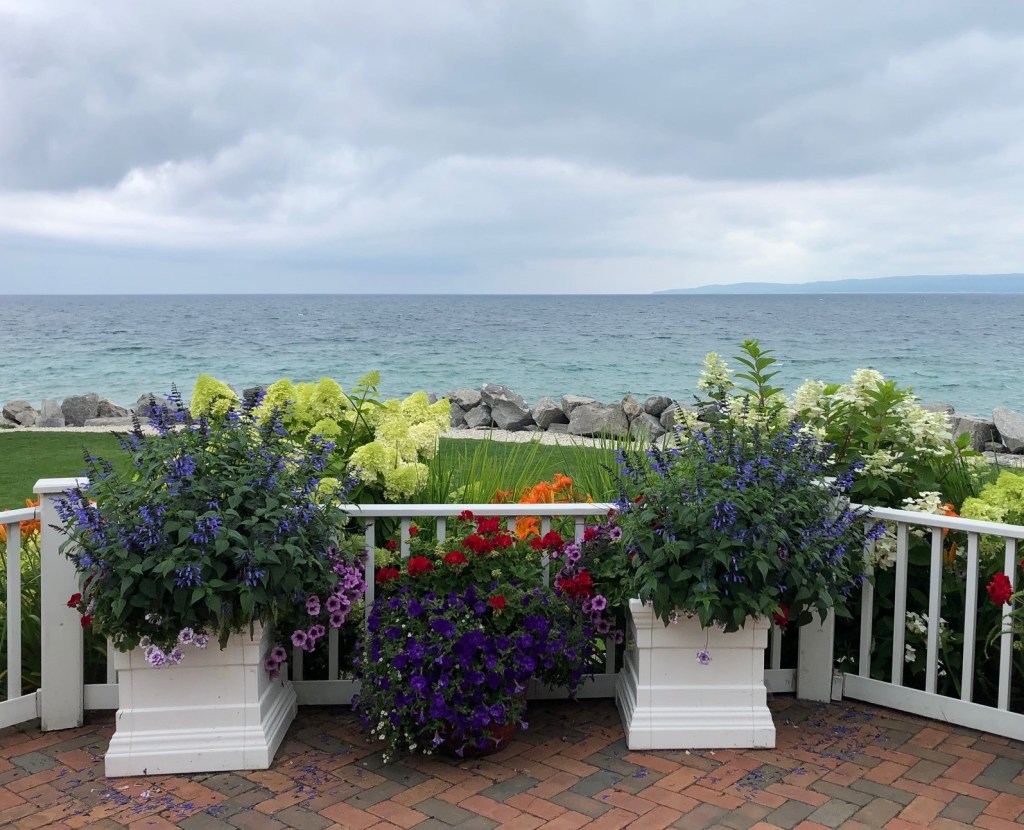
Flowers in a Summer of Pandemic Lull and Surge

Lake Michigan

July 27, 2021. I left my home on the western shores of Lake Superior to visit my mom on the eastern shores of Lake Michigan. It’s a nine-hour trip across northern Wisconsin, through the Upper Peninsula, and over the Mackinac Bridge.

The delta variant, snaking its way around the South, hadn’t seemed to arrive in the North.

My last trip to Mom’s was three weeks earlier. My next trip was supposed to be at Christmas when snow and ice bloom and high winds roar off the lake.

I decided to visit again because the pandemic canceled last year’s Christmas plans. And I’m not hopeful about this year’s plans.

I came by myself, leaving my husband and dogs at home. I wanted to spend time alone with Mom. We shared stories, ate Indian and Thai takeout, and walked her dog along Lake Michigan in warm, Technicolor evenings.

And I took pictures of flowers, lots of pictures. The characteristics of light in the Harbor Springs-Petoskey-Charlevoix area are different than the characteristics of light in the Duluth-Superior area. I wonder if it’s because the sky reflects the different colors of the two lakes. I wonder if it’s because the latitude of Petoskey is slightly over 43 degrees, and the latitude at the western tip of Lake Superior is about 46.6 degrees. Doesn’t sound like much, but that’s a difference of 207 miles. Whatever the reason, I get a Land-of-Oz feeling when the sun is shining at Mom’s.

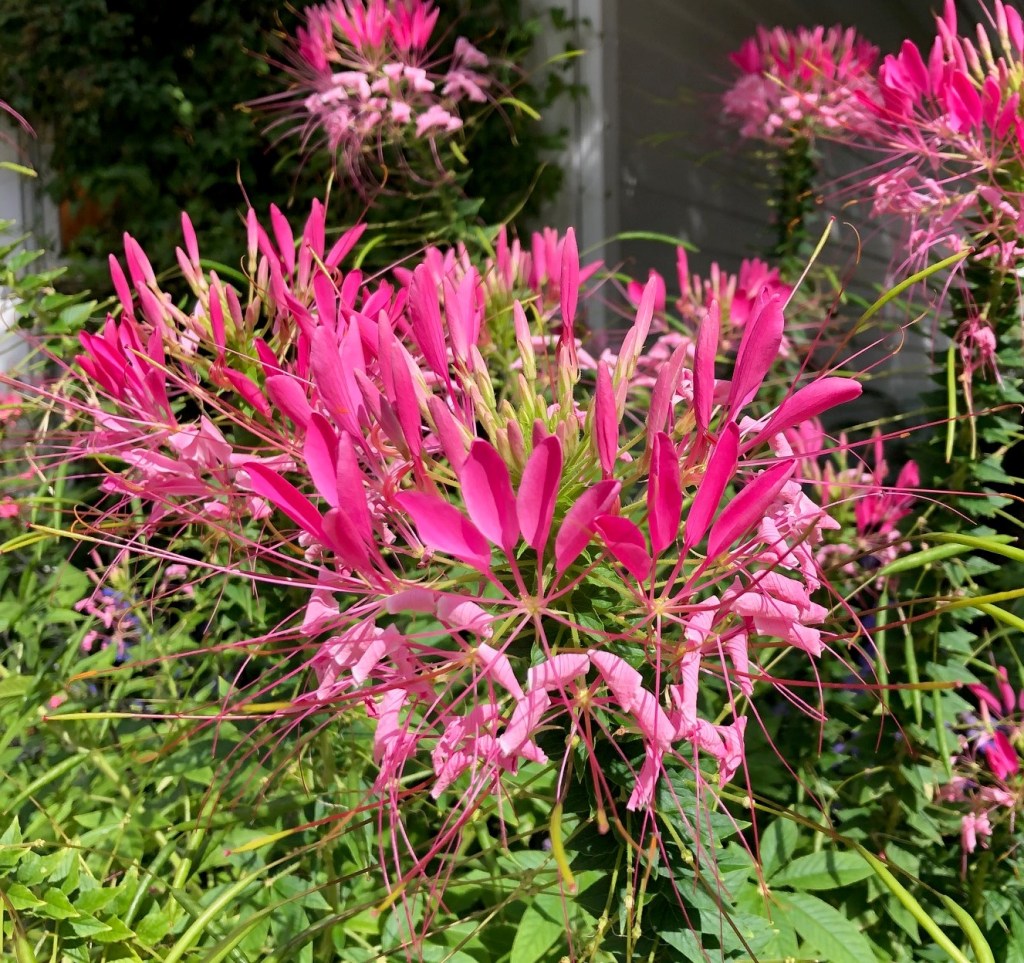
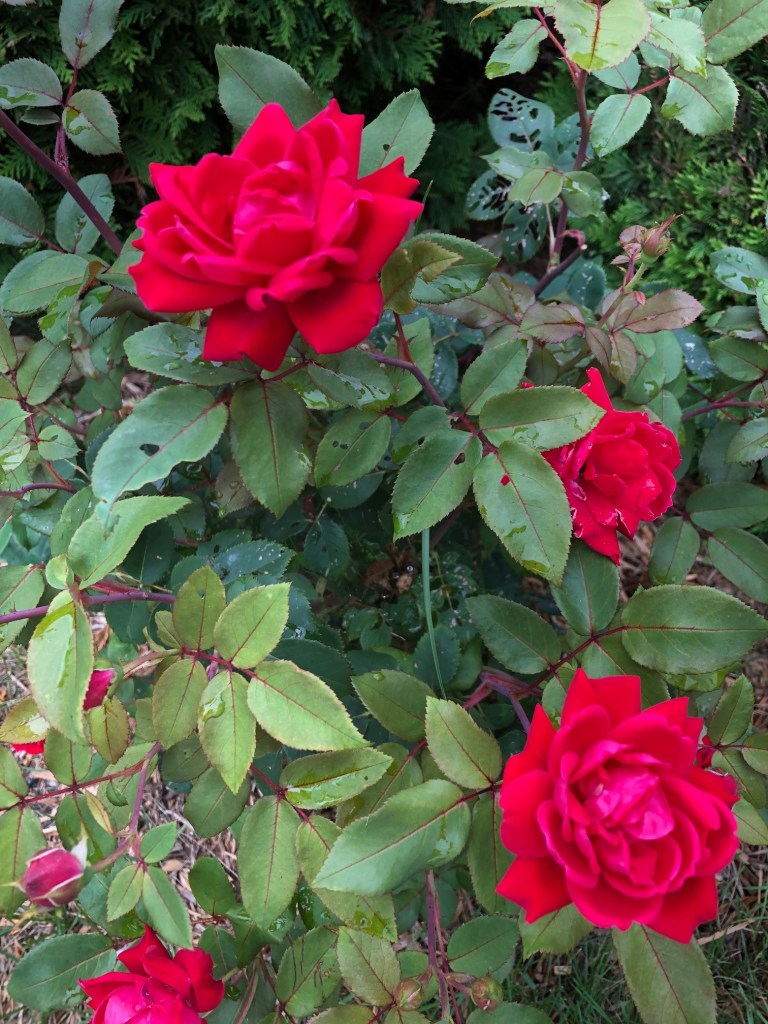
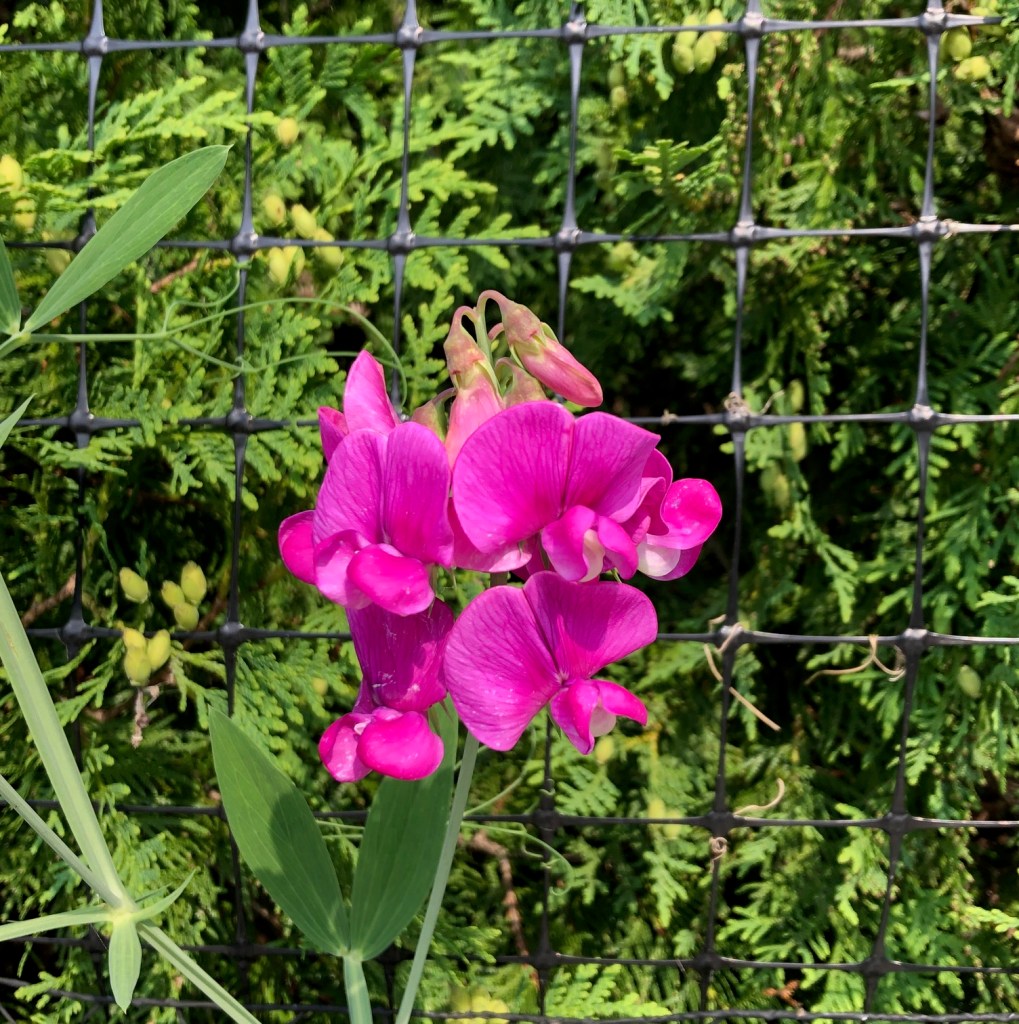
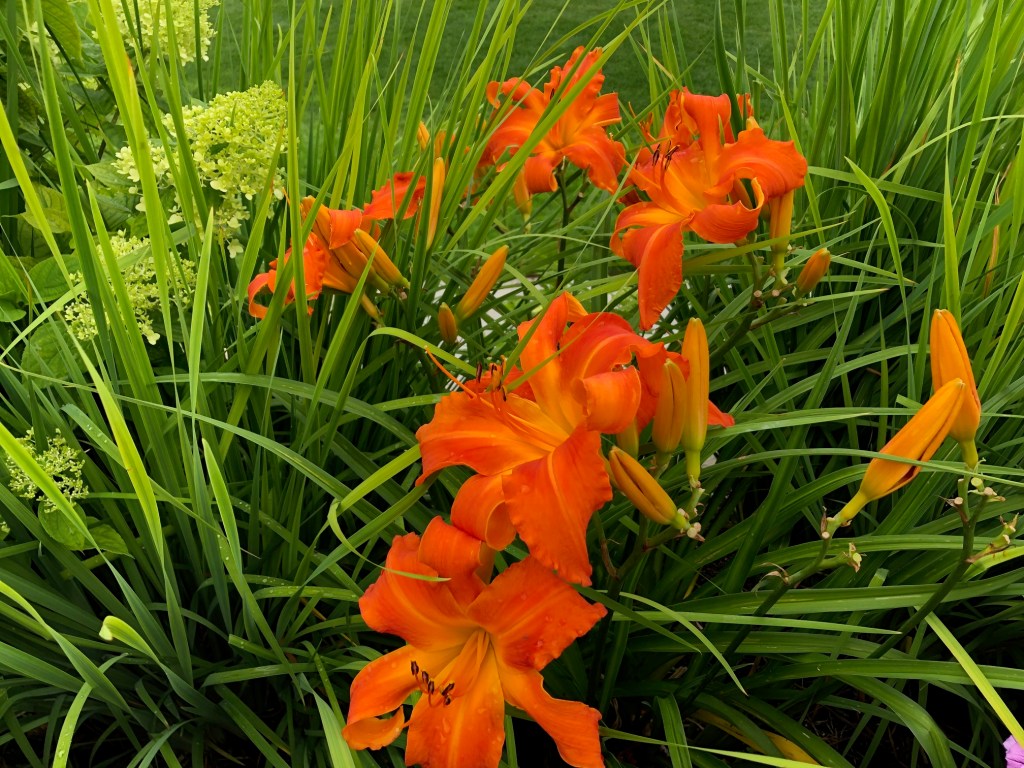
Flowers are everywhere in Harbor Springs, Petoskey, and Charlevoix–in yards, in front of shops, along city streets, hanging from lamp posts. Flowers greet residents and welcome tourists with vibrant oranges, blues, reds, pinks, purples, yellows, whites, and greens.

Some gardeners plant only two or three colors together, but many mix all the the colors together and it works. If I tried to dress in the same array of colors, people might call me eccentric.

A friend and I once noticed how nature can toss together a salad of greens (lime, forest, army, olive, sage, emerald, fern, pea, mint) and throw them across the landscape and none of them will clash.

In the mornings, Mom and I ran her errands and went for rides. When she entered shops, I spent little time inside with her. I’d go back outside and take pictures of flowers, lots of pictures.

The vaccination rate for her county is about 61% for people who’ve had at least one shot. The recommendation has been for unvaccinated people to wear masks. Less than almost no one wore a mask. Statistically, about 39% of the people should’ve been wearing masks.

I know some math.

I provide daycare for my grandkids.

My grandkids are too young to get vaccinated.

I wore a mask and stayed away from people.

I ate takeout.

And I took pictures of flowers, lots of pictures.

Paddle Boarding in August

A calm day. A cloudless, blue sky.

Floatplanes, motorboats, yachts, fishing boats, kayaks, paddle boards.

As I paddled by the marina, so many boats pulled out of their slips. I thought about cars exiting a parking ramp at quitting time.

59 minutes around Barker’s Island, my best time yet.

The best moment—six ducks in the water, their twitching butts pointed toward the sky while they ate their lunch underwater.

Sunday Afternoon at Brighton Beach

Sunday, August 8, Duluth, Minnesota

I take my grandkids to Brighton Beach once or twice a summer. It’s one of the beaches we visit every year. Today I take them because it’s the last day Brighton Beach will be open to the public for a year, maybe two. The Lakewalk will be extended, Brighton Beach Road will be relocated, and the shoreline will be restored. I wonder how much it will change. I hope “restoring the shoreline” doesn’t mean depositing wide swaths of immense jagged rocks on the beach that become a barrier which hinders kids from pitching stones in the water and from gamboling on the ancient lava formations along the shore.

Charlie, who’s almost three, has never been to Brighton Beach. Evan, who’s almost five, says he’s never been there. I remind him that I took him last summer. When I turn on Brighton Beach Road, he says, “Oh yeah, I’ve been here.” Clara and Michael, ten and eight, are seasoned visitors.

It’s a grey, breezy day (code for sustained winds of 16 mph). But it’s 64 degrees, so we don’t have to worry about hypothermia.

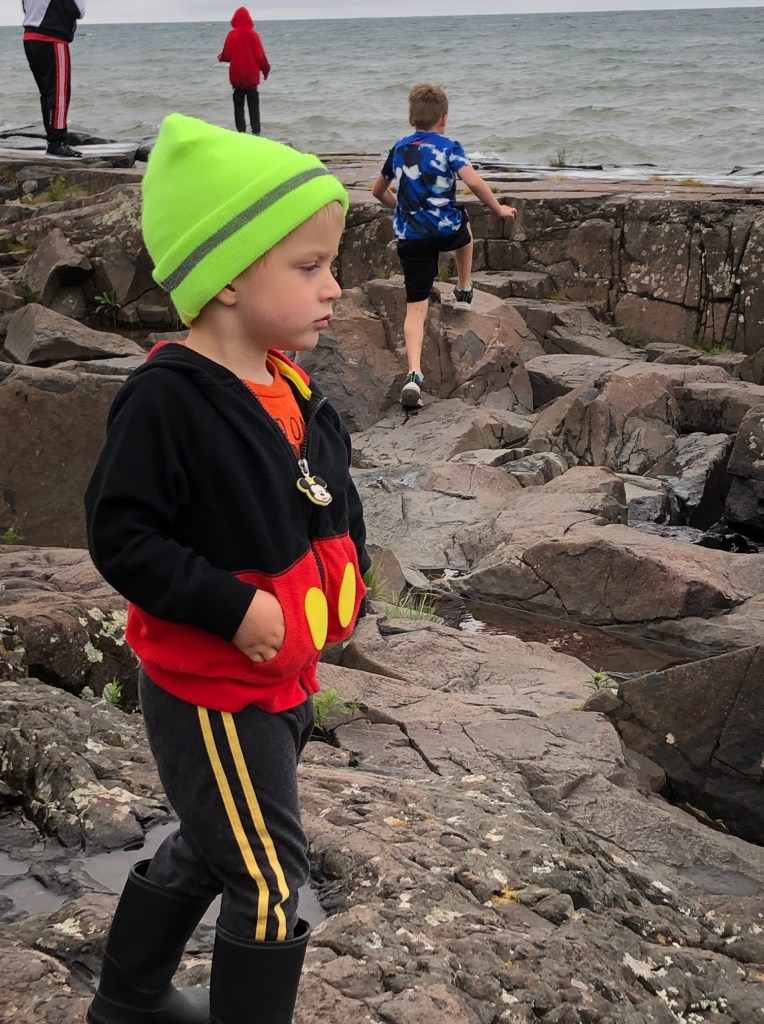
After parking and unbuckling, the kids pour out of the van and run toward the shore. Before they disperse, I bark a request, “Everyone up on that smooth rock. I want a picture of you all together.” A few clicks later, they’re off in four different directions. I stick with Charlie. I don’t want him to fall off a bank of rock and into the water.

“Charlie,” I say, “let’s throw rocks in Lake Superior and fill it up.”

“We can’t fill that up,” he says. Sometimes my dry wit is too parched for him.

But Charlie tries. For forty minutes, he picks rocks, shoves them in his pockets, walks to the water’s edge, and with lopsided degrees of accuracy, throws them in the water. Normally, he smiles and laughs easily, but absorbed by this task, his face scrunches with seriousness the whole time.

Clara, Michael, and Evan run and leap from one smooth lava formation to another. I yell, “Not so close to the water” and “slow down.” The wind and roar of the waves hitting the shore make it difficult for them to hear me. They toss a few rocks, but they’ve outgrown the thrill of flinging rocks in the water.

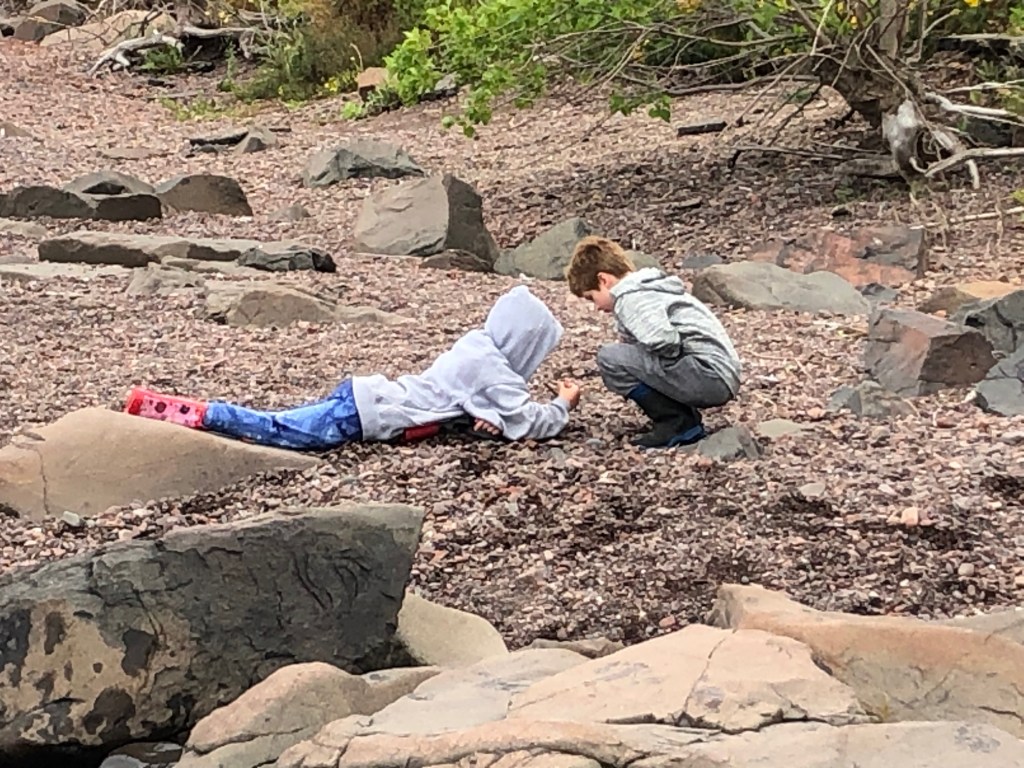
Clara and Michael comb through rocks on the beach, looking for agates. Evan keeps walking on the rock formations. My head is on a swivel as I watch all three of them while watching Charlie throw rocks, making sure he doesn’t fall in the water with one of his tosses.

There are three kids at the beach, around seven to nine years old. Evan’s been watching them, following them while keeping some distance. The next time I look up to locate each grandkid, I see the three kids forming a follow-the-leader line. Evan watches and at the last moment, he joins in as the caboose. A few minutes later, he’s talking with one of the kids.

Later, before we leave, Evan says, “I was making friends.” He’s almost five and he misses friends. There are no kids his age in his neighborhood. He remembers daycare and having friends before the pandemic. “Yes, you made friends,” I say. “That’s nice.” But he’s forlorn. He knows the new friendships are fleeting.

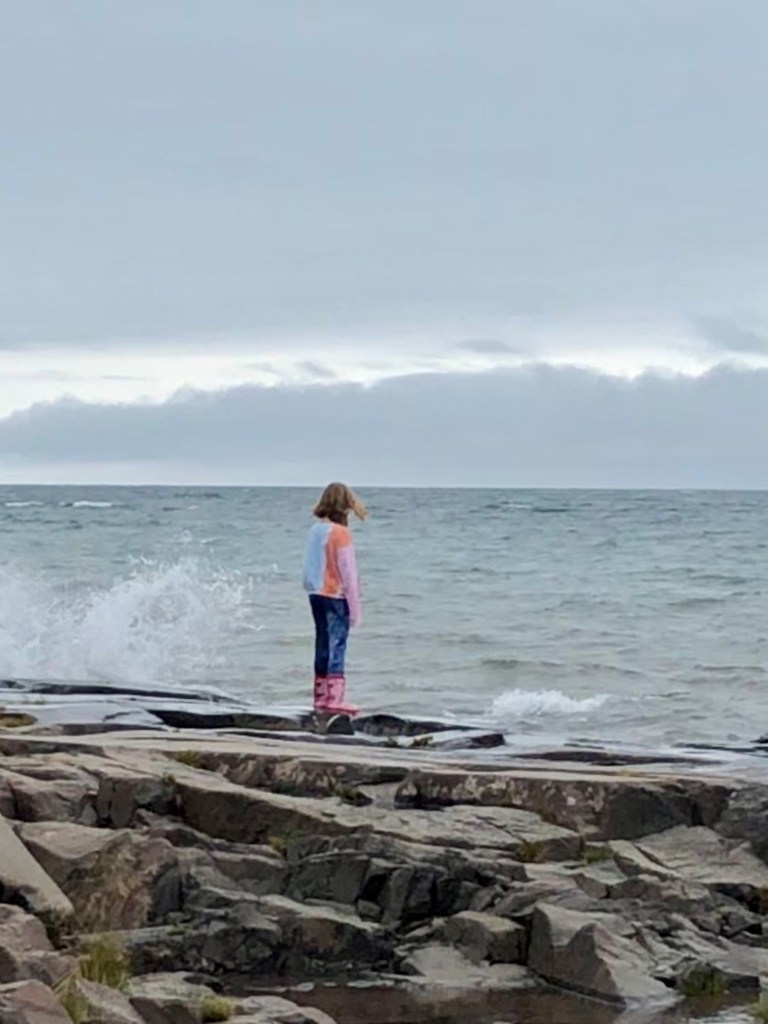
Shortly before we leave, Clara and Michael return to the rocky outcroppings. Clara stands near the edge and flirts with the surf breaking on the rocky shore, letting the water spray her but scurrying backwards when bigger waves break.

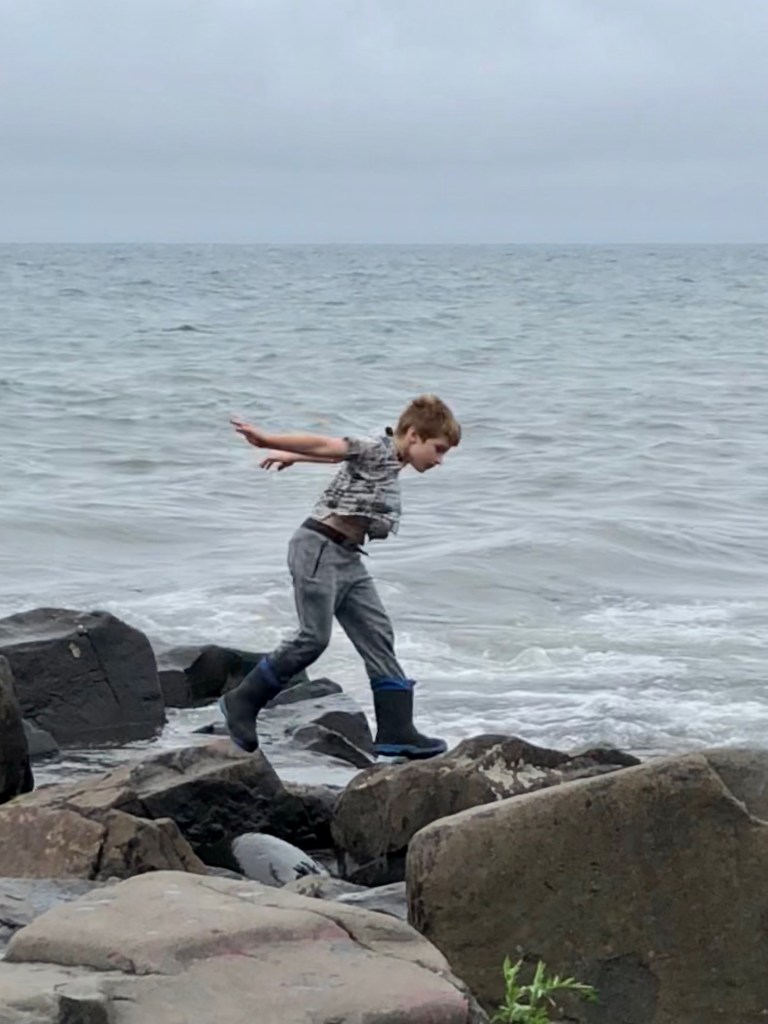
Michael runs and leaps along the rugged terrain. I stuff the urge to yell at him to stop. I’ve already issued too many warnings: “Slow down! Don’t get too close to the edge! Stay out of that puddle of water—you’ll soak your feet!”

My admonishment about the deep puddle of water was given to Evan right after one of his new friends walked through it with his tennis shoes while his dad watched. That dad must’ve thought I was hampering my grandkid’s fun. But when you watch kids who aren’t your own, the stakes are higher.

After forty-five minutes at the beach, I gather up my mostly-dry grandkids and we get in the van. “I suppose you’re all too cold for ice cream,” I say. None of them are too cold for ice cream. It’s a delicious way to end the afternoon.

[For more information about the plans for Brighton Beach: WDIO News: Story about Brighton Beach closing.]

Shifting Perspectives

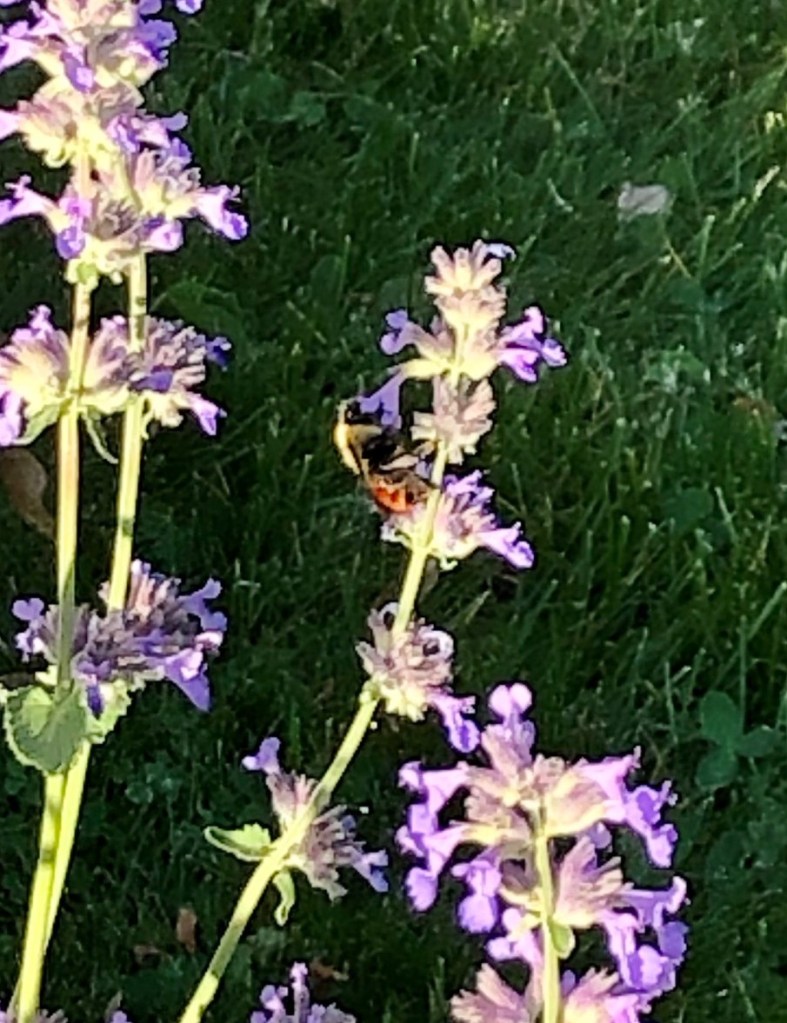
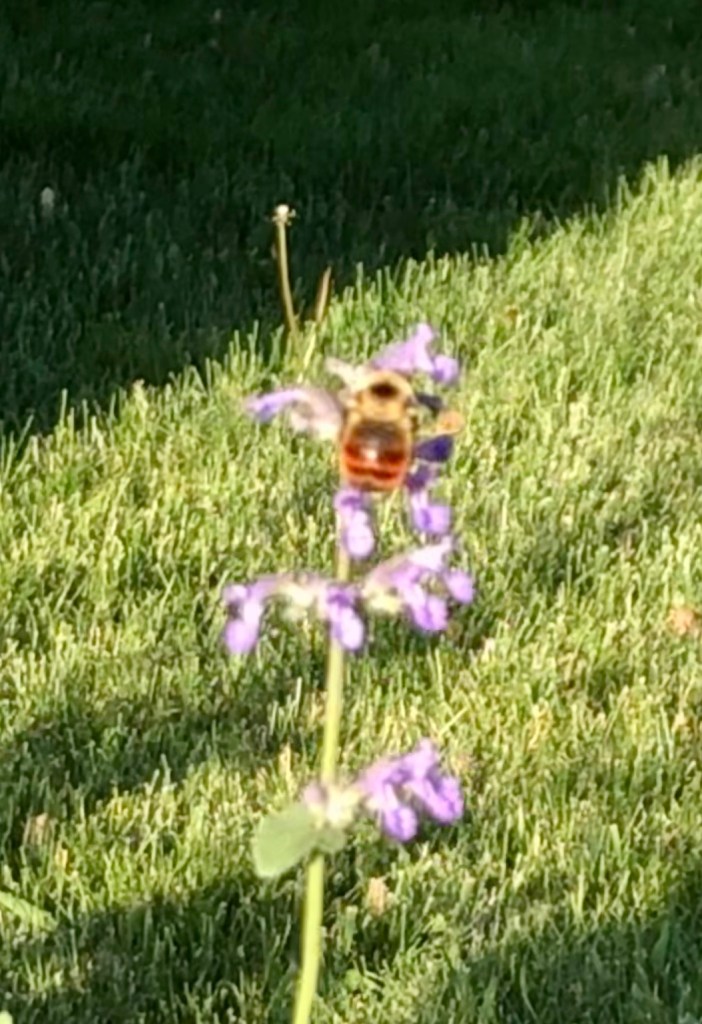
The bumble bee is working, flitting from flower to flower and slurping nectar. I’m drinking a cup of coffee and watching it work. You might say that makes me a supervisor, but the bumble bee knows what it’s doing and should never take direction from me. I’m not an apiarist, a botanist, a zoologist, a biologist, an entomologist. I’m not an -ist person. I’m an -er person, a reader, a writer, a photographer. So, I watch the bumble bee and take pictures because I’m going to write about it and my morning stroll around my gardens.

Finding the bumble bee on its nectar run delights me because I’ve stopped by the garden behind my shed to see what the rabbits noshed after I made my evening rounds yesterday. The rabbits like the leaves on my Asiatic lilies and have nibbled half of them back to the stalk. To a lesser extent, the rabbits also like my zinnias and dianthus. The lilies, pale yellow with dusky-red centers, bloomed profusely this year. I hope the lilies store enough energy through photosynthesis before the rabbits eat the rest of their leaves. (Yeah, I remember something from tenth-grade biology.)

Asiatic lilies before blooms faded and rabbits ate the leaves

I provide alternative food for the rabbits—my lawn is a mixture of grass, clover, wild strawberries, and dandelions, plus a few plants I’m unable to name. I’m thrilled when I see rabbits eating clover or dandelion leaves. But they still view my gardens as dessert trays.

Bees, butterflies, and other insects like clover and dandelions too. Dandelions are an import source of nectar to bees and other insects in the spring before flowers bloom. After learning how vital dandelions are to bees and other insects, I stopped digging them up.

Because bees and butterflies suffer from disappearing habitats, I plant flowers that provide nectar for them. Recently, I learned native plants are also important to caterpillars because they nibble on the leaves to store up the energy needed to become moths and butterflies. And, guess what? Birds need to eat those protein-rich caterpillars to store energy for laying eggs and raising their young. Now, when I notice my plant leaves have been gnawed, I see those “damaged” leaves as part of an important food chain.

While I’m planning more gardens for bees and butterflies, and begrudgingly, the rabbits, the bumble bee darts from yellow sundrops to flowering spearmint to tomato blossoms. I raise my coffee cup to the bumble bee and thank it for pollinating my tomatoes.

[For more about the importance of dandelions to the insect world, read “The War on Dandelions Is Killing Bees, But It Doesn’t Have To.” For more about the importance of caterpillars for birds, read “Singing Praise for Caterpillars.” To learn about the bird-larvae-caterpillar-moth-butterfly food chain and how it can limit pests in your garden, read “Birds Do Eat Butterflies.” If toxic insects and birds don’t worry you, it should. Read about Biomagnification, to understand how toxins used to kill weeds and insects impact animals and humans.]

Mayflies

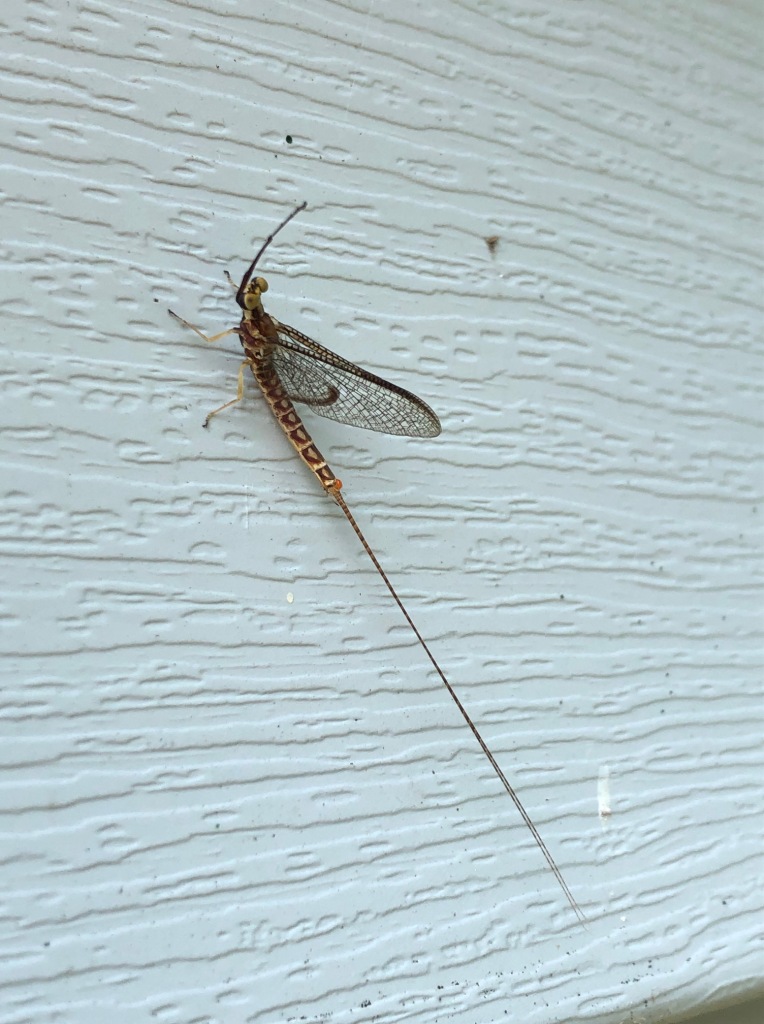
My view of Mayflies before learning about them

What I knew about mayflies: They’re called mayflies and they molt. I could’ve put my knowledge in a thimble and had room for War and Peace.

What I thought about mayflies: They’re creepy looking, and the exoskeletons they shed are even creepier. I could’ve imagined them starring in a B movie titled, Return of the Giant Mayflies.

Then in June my almost-ten-year-old granddaughter asked, “Why are they called mayflies? I never see them until June.”

“I’m not sure,” I said. “We’re going to have to look that up.” (My standard refrain to cover up my embarrassment because I can’t answer one of her questions about the natural world around me.)

But I had a theory: If mayflies arrive here in June, perhaps they appear in May in other parts of the Midwest. I live at the western tip of Lake Superior. Everything in spring arrives late because around here winter doesn’t like to pack its bags and leave.

It turned out my theory had holes. In the United States, mayflies hatch anywhere from May to September. Hatching usually starts near the end of May but peaks in June or July, depending on latitude and the current year’s weather. The name mayfly may be a misnomer. But I like the name, so even if they don’t appear around here until June, I’m not starting a movement to rename them juneflies. (Besides there are beetles called June bugs.) Depending on geography, mayflies are also called shadflies, sandflies, dayflies, fishflies, and drakes.

I learned more about mayflies than their aliases. They’re fascinating and useful insects. This shouldn’t have surprised me because our ecosystem is an intricately woven tapestry. Pull on one thread and the effect ripples through the whole landscape. I was ignorant to assume their only purpose was to gross me out every June.

After mayflies become adults, they molt once. Every year I’d see their exoskeletons stuck to my screen doors, siding, plants, and deck furniture, and I’d cringe. Filmy, cracked, and devoid of color, exoskeletons are eerie. But after learning about mayflies, I look at their abandoned outwear and think about their amazing lives.

Mayflies are adults for only one or two days, and on rare occasions three days, accounts vary. They begin life in the water as fertilized eggs. After they hatch they’re called nymphs and spend about a year (depending on the species) lounging at the bottom of riverbeds and lake bottoms. While not as beautiful as the water nymphs of Greek mythology known for protecting gods and humans who were in peril, the mayfly nymphs are important. They help clean water by eating algae and detritus. And scientists use the number of mayfly larvae present in a river or lake as a bioindicator to gauge the water’s health. So mayfly nymphs can protect humans by informing us if our water quality is in jeopardy–if we’re smart enough to listen.

Before mayflies leave their water homes, they shed their nymph skins, so they can take flight for the first time. At this point they’re called duns (or subimagos). After coming to the water’s surface, they rest and dry their wings. Waterfowl and fish dine on some of them. The duns that survive the predators fly away from the water and molt one last time, becoming adults called spinners (or imagos).

After emerging from the watery homes of their adolescence, mayflies have only one concern–to mate and produce eggs. They don’t have functioning mouths so they can’t eat. As adults they don’t have to worry about finding food or feeding their young. They don’t have to worry about a career path or a mortgage. They don’t have to worry about saving for retirement or signing up for Medicare. As adults they molt, mate, lay eggs if they’re female, and die, all in a day or two.

Of course, a mayfly’s adult life isn’t completely worry free. If spinners are to achieve their one adult ambition–reproduction–they must avoid becoming fresh meat for fish and birds. They also need to conserve energy for mating and laying eggs. This explains why the mayflies I see on my screen door or deck are so impervious to me: It’s risky for them to use up energy by fleeing from me.

After molting, adult males return to an imaginary dance floor above the water. Flying up and forward, then floating down, they beckon the female spinners to dance with them. The spinners pair up and mate in midair. All this looks nothing like my first seventh-grade dance, where boys and girls stood on opposite sides of the gym and gawked at each other. [Watch BBC’s Beautiful Video Clip About Mayflies to see the mayfly mating ritual.]

After the circle-of-life dance, the females descend to the water to lay fertilized eggs. Some females become food for fish before they deposit their eggs. In my research, I learned fly fishers use tied flies resembling duns then spinners during mayfly season. But many females do deposit their eggs, which drift to the bottom of a river or lake. Then most females die, but a few manage to mate again and lay another batch of eggs because they have extra energy reserves, most likely because of what they ate as larvae. (But I like to imagine they have extra energy because they danced a slow waltz instead of a hot-footed jig during their first tango with a male spinner.) Two weeks later the eggs hatch into nymphs.

My new view of mayflies: Lovely as flowers

Before my mayfly education, when I saw mayflies clinging to my door or siding or deck furniture, I left them alone. I didn’t touch them because they creeped me out. Now I can say I leave them alone because I understand they’re saving energy for their big dance. Now, I can appreciate mayflies for purifying rivers and lakes, for working as bioindicators, and for being part of the food chain. Now, I can answer my granddaughter’s question about why mayflies seem to be misnamed.

We need to cherish mayflies and protect them, and if their numbers decrease in our lakes and rivers, we need to figure out why.

[To read more about mayflies: Mayflies: National Wildlife Federation and Britannica: Mayfly. If you live where mayflies swarm, read How to Survive a Massive Mayfly Swarm by Leslie Mertz, Ph.D. Don’t worry it’s not as scary as my imaginary horror flick, Return of the Giant Mayflies.]

I Stopped Saying I Wanted to Learn to Paddle Board—and Just Did It

After a Saturday fling with a paddle board on Superior Bay, I was smitten. Within an hour of finishing my lesson, I wanted one. I experienced this same love-at-first-try feeling forty years ago when I cross-country skied for the first time and rushed out to buy skis. I used those skis for years.

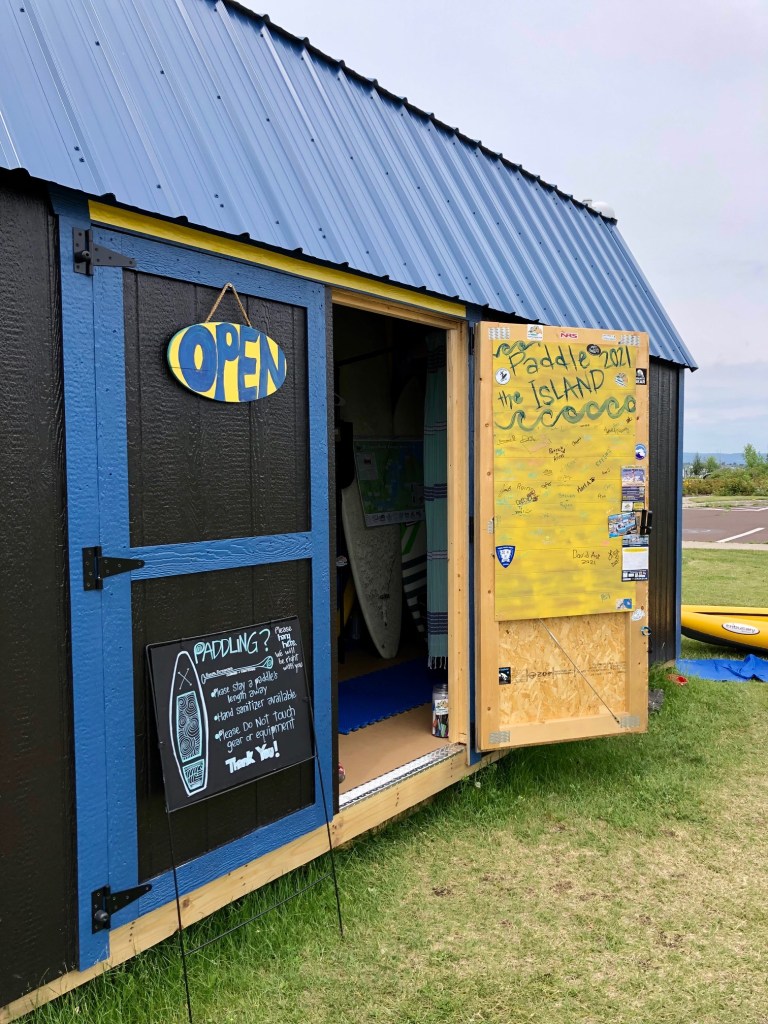
North Shore SUP on Barker’s Island

Before my lesson, a friend said, “Paddle boarding is Zen-like.” It’s true. After the instructor taught us some paddle strokes, I danced on the water, moving the board in lose turns and tight turns (which are rad). The rest of the world dropped away, until the instructor snapped my Zen-like focus, when he said, “If synchronized paddle boarding ever becomes an Olympic sport, I want to be on the team.” At first, I thought he was joking, but after I played around for an hour on a board, I believe he was serious. After all, I relished skimming across the water, making the board do what I wanted it to do.

The last stroke we learned helped us pull up to the dock sideways. The instructor called it parallel parking. I went to the dock early, so I could practice without other paddlers in the way. Success on my first try!

Me, wearing my quick-drying clothes, and Colorado, the North Shore SUP owners’ dog. He likes paddle boarding.

When I came home, my husband, who was golfing when I left for my lesson, looked at me and said, “Well, you certainly dressed for the part.”

“Yes, I did. It was wonderful!” Dress for the job you want, and I wanted to be a paddle boarder. I wore new quick-drying clothes and a new white baseball cap to protect my scalp from sunburn. I’d mastered paddle-board-causal couture. I told him I wanted a paddle board. He thought that was fine—I think my outfit convinced him. I returned to North Shore SUP, where I’d taken my lesson, and paid for a new board, which came with groovy accessories. (I’m allowed to say rad and groovy because I’m old enough.)

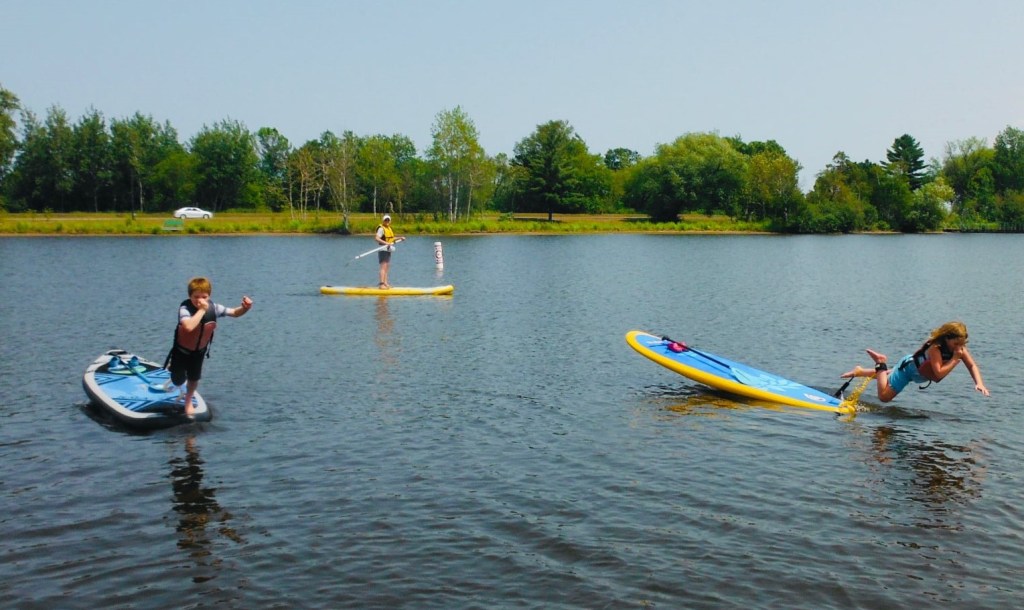
A couple of weeks after my lesson, I took my grandkids to an ice cream social paddle board event for kids at North Shore SUP. They took a lesson and ate ice cream. They had fun jumping off their boards and climbing back on. Photo credit: Garrett, co-owner of North Shore SUP.

The next day I picked up my board and another lesson. Because I bought an inflatable board, I learned how to inflate it, deflate it, and carry it. I learned how to attach the seat, the leash, and the fin. The seat lets me to use the board like a kayak. The leash keeps us together if the board dumps me. The fin, shaped like a dolphin’s, helps the board track in water. My board has a dolphin fin—how warm and fuzzy is that? I watched the TV show Flipper as child, and I can still sing some of the lyrics from the theme song.

I’m not athletic or graceful or fast. When it comes to persuading my brain and muscles to work together, my learning curve resembles Mt. Everest. I was six when my father removed the training wheels from my bike and attempted to teach me to ride. He gripped the seat and ran behind me, but as soon as he let go, I tipped over. After a half-hour he gave up, but I practiced for days, eventually learning to balance on two wheels.

But I could stand and balance on a paddle board the first time I tried.

I tried out for cheerleading, but lousy cartwheel skills doomed me. So, I thought I’d try out for pom poms. I was always two beats behind, and the dance steps confused my feet. I didn’t show up for tryouts.

But I’m graceful on a paddle board. And cartwheel skills don’t matter.

I was sixteen the first time I roller skated. I buffed the floors with my behind more than I skated. But I kept going to the rink, and eventually, I spent most of the time upright. I was seventeen the first and only time I downhill skied. I never made it down the hill without falling. I lacked the strength to coerce my legs to snowplough. I skied so fast that I’d lose my balance, fall over, and ride my butt down the slope. My mitten got caught in the tow rope, and if an alert operator hadn’t shut it down, I’d have broken my arm.

But I’m strong when I paddle board. And there are no snowy hills or tow ropes.

Other paddlers asked, “Have you fallen off the board yet?” Getting wet seemed to be a rite of passage. “No,” I’d say, until last Sunday when I lost my balance. I went under, but my life jacket thrust me to the surface like a cork popping from a champagne bottle. The leash kept me tethered to the board, the strap on my sunglasses held, and my friend rescued my white hat. I remounted my board, though not nimbly, and stood up. My quick-drying clothes dripped, but felt light—the right outfit for the job.

I stowed my gear and said goodbye to my friend. I couldn’t wait to text my paddle-boarding sister with the good news: “I fell off my board today!”

Initiation’s over—I’m a full-fledged paddle boarder. And my waterproof Timex is still ticking.

Paddle-the-Island Door. My name is now on this door with two hashmarks because I’ve paddled twice around Barker’s Island, a two-and-a-half-mile trip.

[North Shore SUP is located on Barker’s Island in Superior, Wisconsin, on Superior Bay, a natural harbor on Lake Superior. Friendly and encouraging, the owners work to make everyone’s paddle boarding experience a joy. They give lessons, rent paddle boards, and host other paddle boarding events and outings. For more information visit them on Facebook and their website.]

Come Again Now

[“Come Again Now” was published Minnesota’s PBS Stations on their webpage Moving Lives Minnesota: Stories of Origin and Immigration on April 17, 2021.]

FRANK AND ROSE MEET

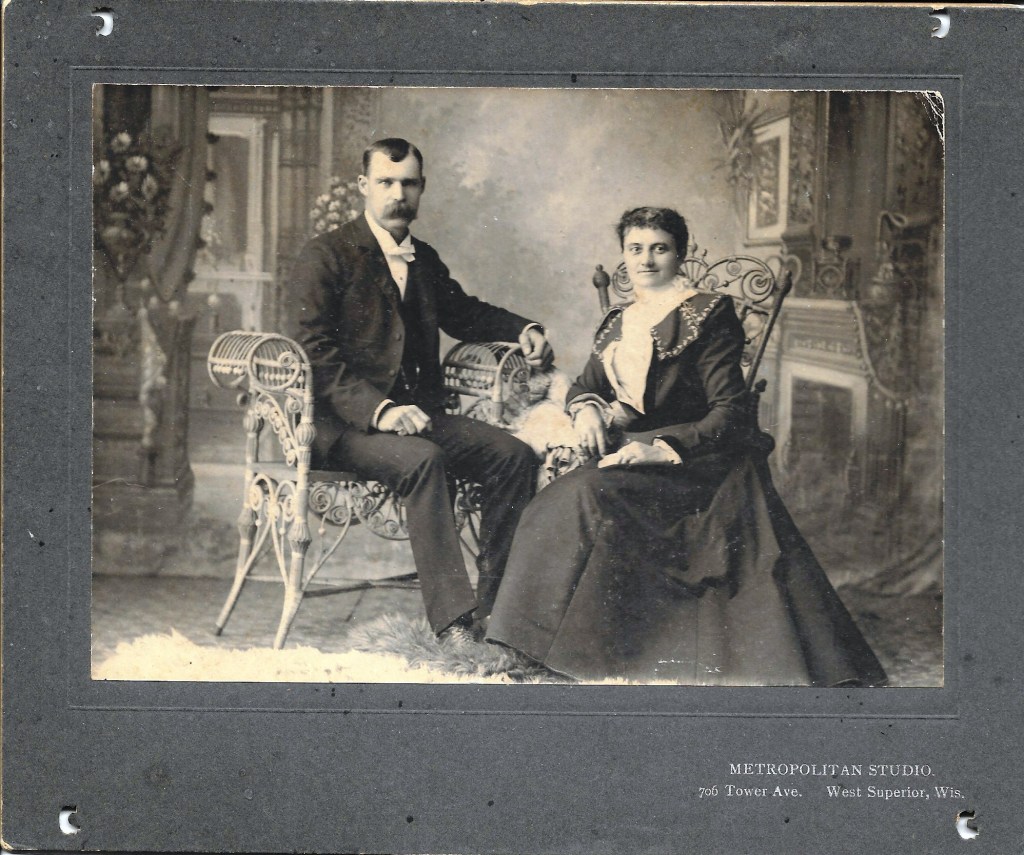
Frank and Rose Youngquist, wedding photo, September 1898

            About 1892, Frank Youngquist left Stillwater to work as a blacksmith in Gordon for Musser-Sauntry, a logging company with interests in Minnesota and Wisconsin. In 1897, Rose Yost left her parents’ farm in Columbus, Minnesota, to work at the Smith Hotel in Gordon, owned by her sister and brother-in-law, Aggie and Jim Smith.

            Frank, 32, handsome, brown-haired, and blue-eyed, met Rose, 29, pretty, dark-haired, and brown-eyed, at the Smith Hotel where he lived. They fell in love and married on September 21, 1898, in Hennepin County, which gave them an opportunity to visit family in Minnesota before returning to Gordon.

FRANK’S MINNESOTA CONNECTION

            Before Frank’s and Rose’s lives intersected in Gordon, they grew up 32 miles from each other in Minnesota. Frank’s father, Johan Youngquist, came from Sweden to Minnesota in 1868, and settled in the Stillwater area. A year later Johan’s wife, Eva, arrived with their four young children, including 2-year-old Frank. They would have four more children.

            Johan’s family probably emigrated because of economic hardships. Sweden’s rapid population growth in the 1800s diminished job opportunities and caused farmland shortages. Crop failures in 1868 and 1869 deepened economic woes, pushing more Swedes to seek opportunity in America. After reading letters from family, who spoke highly of their lives in Minnesota, many Swedes chose to settle there.

            Johan, Eva, and their children prospered as laborers, farmers, blacksmiths, lumberjacks, and business people. The railroads and lumber industry provided plenty of opportunities for immigrants. Five of Frank’s seven siblings spent most of their lives in Minnesota, and his parents lived there until they died.

ROSE’S MINNESOTA CONNECTION

            Rose’s parents, Yost Yost and Agatha Gassman, emigrated from Switzerland around 1854. Yost and Agatha, both Catholic, might have left Switzerland because of religious unrest during the 1800s. Yost lived in the Canton of Lucerne, which became embroiled in religious tensions between Catholics and Protestants after the Jesuits, reinstated by Pope Pius VII in 1814, returned to Switzerland.

            Yost and Agatha married in Rochester, New York, in 1855. A year or two later, they moved to Columbus, Minnesota, to homestead 160 acres. They raised seven children, all born on their farm. One son became an engineer for the Great Northern Railway, working on the mail train out of St. Paul. The other son ran the farm when Yost retired. Their five daughters all married, but only one remained in Minnesota. Yost served as a town clerk and justice of the peace in Columbus. From 1864 to 1866, he served in the Minnesota Cavalry, Hatch’s Battalion, Company E, and was stationed on the Dakota-Minnesota frontier. He and Agatha are buried in St. Joseph’s Catholic Cemetery in Wyoming, Minnesota.

TRAGEDY STRIKES

            In 1910, after twelve years of marriage and four children, Frank and Rose, still living in Gordon, died a month apart, Frank, 44, on October 18, and Rose, 41, on November 17.

            Frank lingered four months before dying of tuberculosis. He wished to be buried in Stillwater at the Fairview Cemetery with his father and two brothers. Frank had lived over half his life in Minnesota, and his mother and some family members still resided there. After Rose died from heart failure, she was buried next to Frank. Their children, George, 11, Elmer, 9, Leslie, 8, and Lola, 4, stayed in Gordon. Aggie and Jim Smith, Rose’s family, looked after them.

GEORGE’S COMFORTING TRADITION

George Youngquist with his wife Olive and Frank, their first child, circa 1940

            Perhaps because of a mysterious, debilitating illness George had when he was about 1½, he was close to his parents. The illness left him unable to walk, so his father forged railings in his blacksmith shop and attached them to the walls of their home. Encouraged by his parents, George pulled himself up and held the railings. He regained strength and learned to walk again. However, as a young schoolboy, his illness left him unable to run and play with other children. To entertain George, Frank taught him blacksmithing skills after school. George cherished the time with his father. Thirty-some years later, a doctor told George that he had had polio.

            From the 1930s until 1979, because George never forgot his parents’ love and kindness, he drove 120 miles from Gordon to Fairview Cemetery in Stillwater, Minnesota, to visit their graves either on or near every Memorial Day. By the time George and his family arrived, any Memorial Day services were over. But in the hushed cemetery with spring unfurling, George remembered his parents.

            Whenever George had company, he always bid farewell to his visitors by saying, “Come again now.” Perhaps, each year when he left the cemetery, he imagined his parents telling him, “Come again now.” And he did until he lost his eyesight in the winter of 1979, two-and-a-half years before he passed away just shy of his 82nd birthday.

[More Moving Lives posts written by other writers can be read at Moving Lives Minnesota: Stories of Origin and Immigration.]

Cora Comes to an Understanding

[This short story appeared in Talking Stick 29: Insights in 2020. The fiction judge selected it for an honorable mention.]

“It’s 72,” I say, after peeking at the thermometer outside the backdoor. I write the temp on the chalkboard hanging by the window overlooking Grandpa Harold’s gigantic garden.

“Needs to be 74 by one o’clock,” Grandma Cora says, “otherwise it’s too cold for swimming.” She wipes her nose and shoves a hanky back into her apron pocket, putting an exclamation point on her words.

And if it reaches 74 after that, she won’t take us because she’s got to can and freeze stuff that comes out of Grandpa’s garden. He gives her updates every morning. Yesterday, he said, “Cora, there’s peas need shelling.” This morning he said, “Cora, the beans need picking.”

Between all that canning and freezing, she’s baking bread, cookies, cakes, and pies. Grandpa doesn’t like store-bought bread, and I think he declared a law that his meals must end with dessert. Then, she’s got to cook supper before Grandpa gets home from the gas station he owns.

A week ago, instead of filling his plane with skydivers, Dad loaded up Christina and me and flew us to our grandparents. Mom had surgery the week before and almost died. To save her the doctors cut her open from her navel to her private parts. Being my sister’s nine and I’m ten, no one told us any of that, but they didn’t have to because we did some eavesdropping. Grandma met us at the small airport near her home. Dad stashed our luggage into her station wagon and said, “You girls behave yourselves.” As Grandma drove away, I watched Dad start his pre-flight check before he flew back home.

We’ve been here a week now and Grandma has us trapped in her routine. We eat breakfast and do the dishes. We eat lunch and do the dishes. We eat supper and do the dishes. Between meals we play outside or walk to the IGA and buy penny candy when Grandpa gives us each a dime. If the temp’s warm enough by one o’clock, Grandma takes us swimming. After, she has to hustle to get her chores done and supper cooking.
Today, our thermometer watching started while we set the table for lunch.

“You’re going to let all the flies in,” Grandma says. “You don’t need to check the temperature every five minutes. It’s either going to be 74, or not.”

She’s got a point, but it doesn’t stop us.

Grandma goes to church every Sunday and plays the organ and leads the choir. Dad says that she’s a God-fearing, praying woman. I believe she prays every day the temp won’t reach 74. Christina and I aren’t church going, but we pray for rising temps.

The firehouse siren wails, telling us it’s noon.

The backdoor opens. “Cora, I just came from the garden. The raspberries need picking too.” Grandpa’s home for lunch.

“It’s 73,” Christina says and writes the temp on the chalkboard.

Grandma’s shoulders sag, and she sighs.

After lunch, before we can check the temp again, Grandma sends us to the basement with old newspapers, which Grandpa burns in a small stove. When I come up the stairs, I see Grandma’s butt holding the backdoor open, and it looks like she’s messing with the thermometer. Behind me Christina belches and startles her.

“That was quick,” Grandma says smoothing her silver-gray hair. She’s acting like she always hangs out the backdoor to fix her hair. Her fingers are wet. I say nothing, but I know the temp has dropped. We aren’t going swimming.

Then the phone rings, and Grandma leaves the kitchen to answer it.

I wait until she’s all wrapped in her call and open the backdoor. It’s 70 degrees. I place my thumb on the thermometer and watch the red line rise. It hits 75. I go back inside and help Christina finish the dishes. Grandma returns to the kitchen.
Five minutes before one, I hang up my dishtowel and check the temp.

“It’s 75.” I grin.

“What?” Grandma says.

We look at each other—eyeball to eyeball—a cheater’s standoff.

After we get home from swimming, Grandma picks beans and cooks supper. We stay out of her way.

Shortly after five, Grandpa comes home. “Cora, I told you the raspberries needed picking.”

“Christina and I are doing that after supper,” I say. “We begged Grandma to let you teach us how to pick them.”

Grandma and I look at each other—eyeball to eyeball—a liar’s agreement.

She smiles first.

Rag Rug Art

Croc Art

I’ve fallen in love. My heart’s desire is a two-by-three-foot rag rug. It’s striped with crisp aqua greens and purple-tinged blues ranging from pale grey to dark cobalt. It’s a star-crossed love affair. Not because my husband doesn’t like the colors, he does, but because even though the rug won’t clash with our kitchen décor, it also won’t blend with it. “This is gorgeous,” I say, “but it doesn’t go with our kitchen.”

Still, the rug captivates my heart. My husband and I are in a home décor shop in Harbor Springs, Michigan, only a few blocks from the shores of Lake Michigan. We came to visit my mother who lives in Petoskey. Trying to be helpful, my husband points out other rugs. I spurn each one—too thin, too thick, too big, too small. And when a rug has the correct specs and compliments our kitchen décor, I say, “Too boring.”

I know I’m taking the bold rug home with me because it’s a color wheel for Lake Michigan. When we drove to Petoskey on July 3, the water in Little Bay de Noc, fed by Lake Michigan, was aqua green, the color of tropical ocean waters lapping at sandy beaches, the color of the aqua green in the rug I’m holding in my arms. As my husband drove along the curve of the bay, he said, “It looks like a tropical beach.” If I’d taken pictures of the water that day and omitted the deciduous and coniferous trees of the Upper Peninsula, I could’ve posted the pictures and claimed I was at a Caribbean resort. In a couple of days when we return to Wisconsin, the skies will be cloudy and grey, and the water, reflecting the sky, will mimic the deep purplish-blue color on my new rug.

Sippy Cup Art

I adore the rug because it reminds me of trips to Petoskey to see my mother. The first time I went was in 1992. Since, I’ve made the trip with my sons; a beloved friend, who passed away in 2018; my husband; and alone. The rug is a memory of my visits to Petoskey on the eastern shores of Lake Michigan.

Two days after laying the rug on the kitchen floor, my grandson sheds his Crocs on the corner of it. The rug and purple Crocs become art on my floor.  I take a picture with my cellphone and text it to family and friends with the caption, Croc Art.

A few days later, my youngest grandson either drops or tosses a sippy cup from his highchair. Serendipity. I take another picture and text it to family and friends with the caption, Sippy Cup Art.

Yesterday my dog lay down on the rug. Another picture. Another round of texts with the caption, Poodle Art.

Poodle Art

It’s a game now with two rules. One, I don’t put objects on the rug—I have to notice something that ends up on it. With four grandkids, who visit often, and my two dogs, I never have to wait long. Two, I decide if an object on the rug is art-worthy. (Poodle Art was an iffy choice, but I don’t need much encouragement to take pictures of my dogs.)

The rug, like Lake Michigan, color shifts in different lighting. It makes me smile. It feels good under my bare feet. And it lays near the backdoor, so it doesn’t provoke envy from the mossy-colored rag rug in front of the sink.

Before the pandemic, I wouldn’t have taken up with a nonconforming accessory, even if the colors enchanted me. But after a year and a half of strange events, I’m going with what moves my heart.

[Author’s notes: Alas, my cellphone camera doesn’t capture the vibrancy of the rug. My mother lives within view of Lake Michigan, and I live a few blocks from Lake Superior. When we visit each other, we enjoy each other’s Great Lake. Vote for your favorite picture by clicking on “Leave a reply” and casting your vote in the comment box. I purchased the rag rug at Finishing Touch in Harbor Springs, Michigan, at 237 East Main Street.]