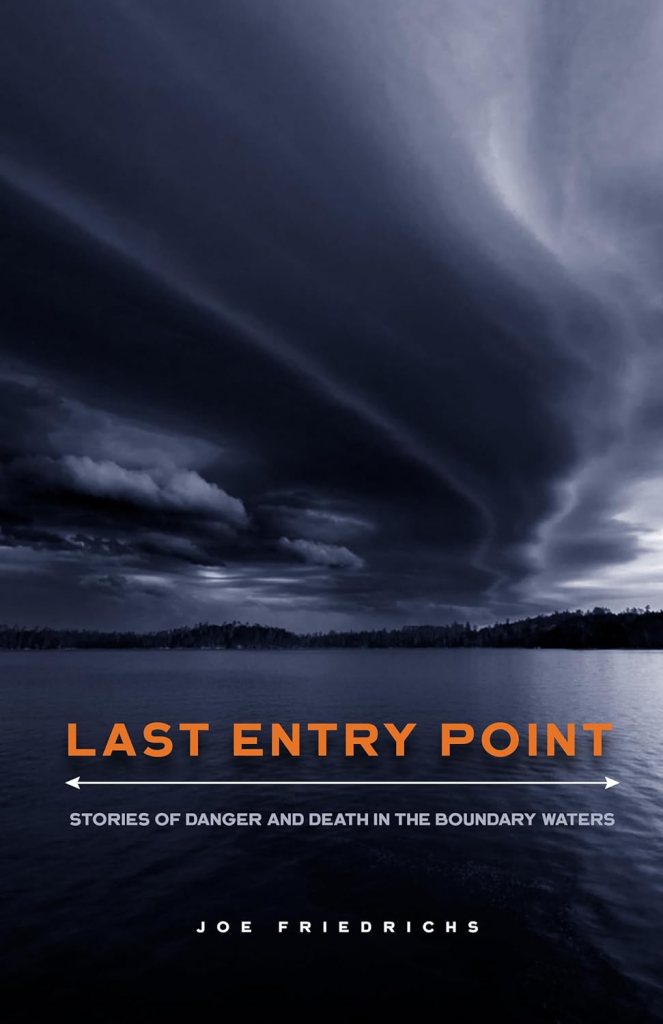
Why did I read this book?
I went to the Boundary Waters Canoe Area (BWCA) in May 1982 for several days. And although I’ve never returned, I was curious to read Joe Friedrichs’s book because it’s about a place that I once visited and found beautiful beyond words, mysteriously ancient, and intensely wild.
But because Friedrichs tells the stories of people who have died or nearly died in the Boundary Waters, I hesitated to buy his book. I wondered how he would approach his topic. Then I read a review that stated Friedrich didn’t sensationalize the stories of death, but rather treated the deceased people and their loved ones with compassion. So I bought the book, and once I started reading it, I was glad I had.
What is this book about?
Friedrichs covers stories about people who have died or almost died in the Boundary Waters due to lightning, drowning, fire, cold, and falling trees. He also tells about a couple of people who entered the BWCA, disappeared, and were never seen again. While the majority of Friedrichs’s book covers tragic and near-tragic events, he also writes about other topics connected to the BWCA.
As Friedrichs vividly describes the many lakes, rivers, portages, and trails, readers are immersed in the beauty of the nearly untouched primitive wilderness that draws so many people to the Boundary Waters. He covers some of the history about how the area became a designated wilderness, and he discusses the role of fire in the life of a forest. Readers learn about the St. Louis County Rescue Squad, the Cook County Sheriff’s Department, and other rescue teams who all work together to find and rescue people who are in trouble. Or sadly, when someone has died, who work together to recover the person’s body.
What makes this book so good?
Even though Friedrichs writes about people who have died in the BWCA, he tells those stories respectfully and compassionately. He makes sure that each person he writes about is more than just the story of their death, more than just a statistic. During the research for his book, Friedrichs talked to the loved ones of those who had died in the BWCA, even traveling to other states to speak with their family and friends.
People who visit the Boundary Waters have a love of the outdoors and a passion for canoeing, kayaking, hiking, and fishing. Friedrichs, after making his first trip to the BWCA, fell in love with the untamed wilderness and moved to Minnesota, making his home near the edge of the BWCA. He has made many trips to the BWCA, and his knowledge about the area and his understanding about the type of people who find both peace and adventure there add immeasurably to his book.
While people can certainly learn from Friedrichs’s book that one needs to be prepared and practice safety when going into the wilderness, his book isn’t a how-not-to-do-things book. Because almost every single person in his book who died or almost died was prepared, experienced, and serious about safety. Instead, some unforeseen, powerful event, usually weather-related, overtook a person or people, and then no matter how much planning had been done or safety had been practiced, it all came down to luck. Humans like to believe they can control and prepare for every outcome, and that if they do, disaster will be averted. But this isn’t always true.
Finally, Friedrichs is a wonderful writer who crafted a well-organized, thoughtful, and engaging account about a one-of-a-kind place on Earth.
Reflections about my one and only Boundary Waters trip after reading Last Point of Entry . . .
When I went to the Boundary waters in May 1982, there were five of us on the trip. We were all in our early twenties. We parked our vehicles near the lake we entered and paddled to our campsite, where we stayed for the next few days. We didn’t have to portage our canoes or supplies. I was the only person who’d never been there before, and I had almost zero experience in a canoe. But I put on my life jacket every time I stepped into the canoe. I knew this would be important to help keep me afloat should we capsize. What I didn’t know, until I read Friedrichs’s book, was how fast hypothermia might have claimed my life if I had gone into the water, even with my life jacket securely buckled around my chest. He points out that May and October are popular months for people to visit the BWCA, but those months have the highest number of drownings, not because people don’t wear life jackets, but because the water is so cold and the weather is more volatile. But people like those months because there are fewer bugs. That’s why the group I was with chose May for our camping and fishing trip.
It drizzled every day we were in the BWCA, and it was cold, above freezing, but cold. We didn’t have to worry about bugs. During the day we fished on the lake by our campsite. Even in a layer of drizzle and chilled air, the scenery was incredibly beautiful. I understood that I was among something old and pristine, a wild and natural forest carved with clear lakes and rivers. Something vast that people hadn’t managed to ruin.
While our weather was cold and rainy, we didn’t experience any intense storms, so we didn’t have to worry about our canoes being swamped, trees falling on our tents, or lightning striking us. But all that came down to luck. We didn’t catch any fish either. We ate food, including steaks, that we’d brought with us. I’ve never been back to the Boundary Waters. But not because I didn’t enjoy my trip. Even in the drizzle and cold, it was amazing. But I’m not big on camping or fishing. Still, I’m glad I was able to experience the BWCA, and I understand why other people love to enter its unspoiled wilderness.
Want to Buy the Book?
It’s available at Minnesota Historical Society Press.
 Writing Near the Lake