Some Short Stories that I Read in 2024 and Loved

I write short stories, so I read a lot of short stories. Lots and lots of short stories. Many of which I enjoy immensely. Some stories fade from memory after a few weeks. Others resonate with me for months, while some haunt me for years.

I’ve selected nine stories by five different authors that I read in 2024. I chose these nine out of the dozens I’ve read because as 2025 starts, I still think about these stories. I’ll be doing the dishes, or walking the dog, or standing in line at the grocery store, and one of these stories will pop into my head. These stories have stayed with me, even months after reading them. I’ve listed them in alphabetical order by author. There is no way I can list them in order of preference because each story is both unique and powerful, with beautiful prose, captivating plots, and intriguing characters. Each story is wonderful for its own reasons, making me say, “Gee, I wish I’d written that!” Best of all, these stories give readers plenty to contemplate.

[Click on the authors’ names to learn more about them and their books.]

Two stories from Hunger: A Novella and Stories by Lan Samantha Chang (25th Anniversary Edition, W. W. Norton & Company, Inc., 2023)

1. “San” is a story about broken dreams and abandonment, and the struggle to survive both. The story is narrated by Caroline, whose parents emigrated from Taiwan before she was born. She tells the story of her father’s inability to claim his piece of the American dream, eventually causing him to desert his family. Caroline recounts the day she watched her father leave, taking her umbrella with him, never to return: “The umbrella had been a present from him. Now I stood and watched it go, bright and ill-fated like so many of his promises.” With stunning metaphors and beautiful prose, Chang creates a shifting setting and vivid characters that tell an ageless story in a new way.

2. “The Unforgetting” is the story of Ming and Sansan Hwang and their young son, Charles, who have emigrated from China and settled in Iowa. They speak Chinese in their home until one day when Charles’s fourth-grade teacher explains that their son’s English vocabulary is below average. The teacher suggests the family speaks only English at home. His parents follow the teacher’s advice, and a rift grows between Charles and his parents. Ming and Sansan never master English, making it difficult for them to express their thoughts and emotions with Charles, who, at the same time, forgets most of his Chinese: “Since they did not test [Charles], Ming never knew how long it took for all of those words to be forgotten.” Language is how people understand their worlds. Chang’s story explores how the stripping of one’s native language is more than a loss of vocabulary.

A story from The Effects of Urban Renewal on Mid-Century America and Other Crime Stories by Jeff Esterholm (Cornerstone Press, 2023)

1. “Long Ago on a Sunday in June” is the story of Patrick, who is almost fifteen. He wakes in the early morning hours on a Sunday to deliver newspapers. In the first paragraph, we learn Patrick won’t be coming home afterward because his body has been found in a field. The rest of the story is told as a flashback. We follow Patrick as he eats his breakfast and begins his paper route. We learn about Patrick and his dreams: “He wanted to get into Mr. Bukoski’s art class when he entered Port Nicollet High in September. That was a given.” He has a crush on his friend’s sister, and he wants a job at a pizza joint. We follow Patrick on the last day of his very ordinary life, and because we know how the story ends, and because Esterholm’s prose is both richly layered and nuanced, we are devastated for the life Patrick will never live.

Two stories from Close Call by Kim Suhr (Cornerstone Press, 2024)

1. “Play-School” is the story of four elementary-aged children who play a game of school. Young Mary plays the teacher, delivering lessons in addition and subtraction. During one of her lessons, she interrupts herself, lowers her voice, and pretends to be the principal as she announces, “It is time to begin our lockdown drill.” Told through the eyes of Willie, a first grader, “Play-School” explores the topic of school shootings and lockdown drills from the point of view of the children. (There are no adults in this story.) Suhr’s use of a child’s point of view, along with her realistic portrayal of elementary-aged children, creates a wallop in a short space. “Play-School” deservedly won first place in the 2024 Jade Ring Contest sponsored by Wisconsin Writers Association.

2. “Eradicated” is a dystopian tale set in the future where artistic creativity, now labeled a disease, needs to be eradicated, a goal that is nearly complete when we meet Dr. Bells, a scientist. Wishing to observe creative artists before the last of them dies out, the doctor visits an artists’ colony where creative people, who are considered to have disturbed minds, have been contained after being extracted from society. He wants “to hang out with people and ask, ‘What’s your medium?’ And say things like, ‘That’s so derivative.'” The themes in “Eradicated” are both timely and timeless. Marvelously written and exquisitely paced, Suhr’s story serves as a cautionary tale against intolerance and mindless conformity.
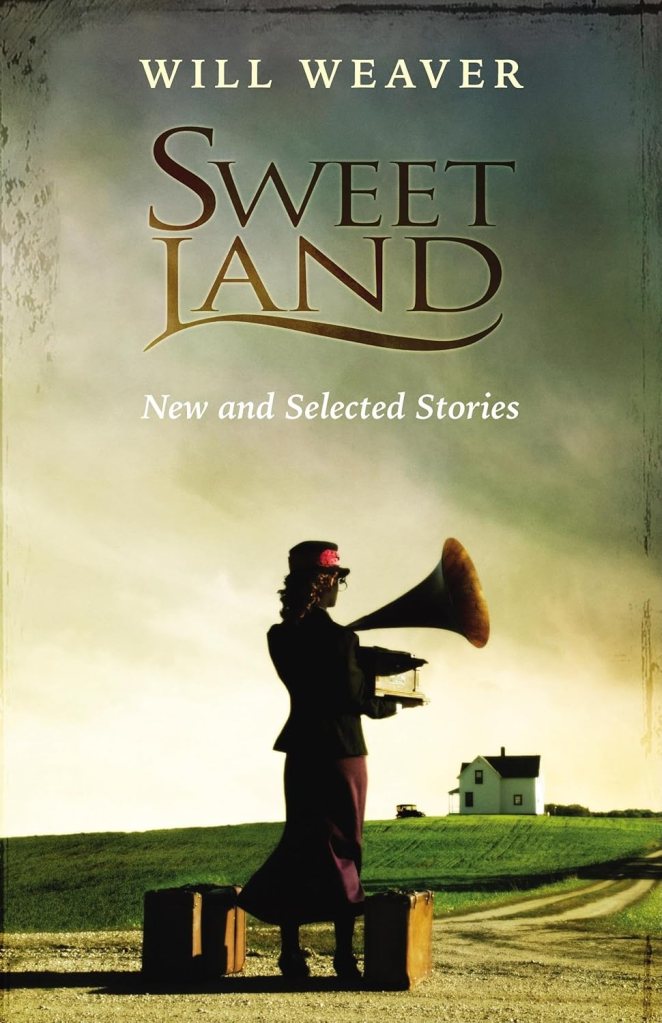
Two stories from Sweetland: New and Selected Stories by Will Weaver (Borealis Books, 2006)

1.“Flax Seed” is the story of a grandfather named Helmer who turns his farm over to his grandson, Kenny. With a handshake, Helmer states the terms of their deal: “Two-thirds, one-third. And no Sunday farming.” Kenny promises. He decides to plant flax, something his grandfather never grew. Farming is difficult. There is a time to sow, and a time to harvest. There is too much rain or too little. Too much heat or not enough. There are pests and diseases, rising and falling prices. There is often a race against time. For Helmer there is God. For Kenny there is the hope of flax and making good as a farmer. Helmer and his God; Kenny and his flax. And a difficult year. It’s a haunting story. Amen.

2. “A Gravestone of Wheat” is the story of Olaf who has loved Inge for forty-five years. They have farmed the land together and raised their son, Einar. They have welcomed grandchildren and great-grandchildren. When Inge dies, Olaf plans to bury her on their farm as Inge wished. But the law has changed: “‘You can’t bury your wife here on the farm,’ the sheriff said. ‘That’s the law.'” Olaf must decide if he will break the law and bury Inge on the farm or if he will bury her in town in the Greenacre Cemetery, knowing she despised the town. Inge has been his devoted wife for forty-five years. As Olaf ponders his choices, he recalls his first meeting with Inge and their unusual courtship, and readers are treated to a beautiful, but pragmatic love story. It’s a wonderful piece of historical fiction.
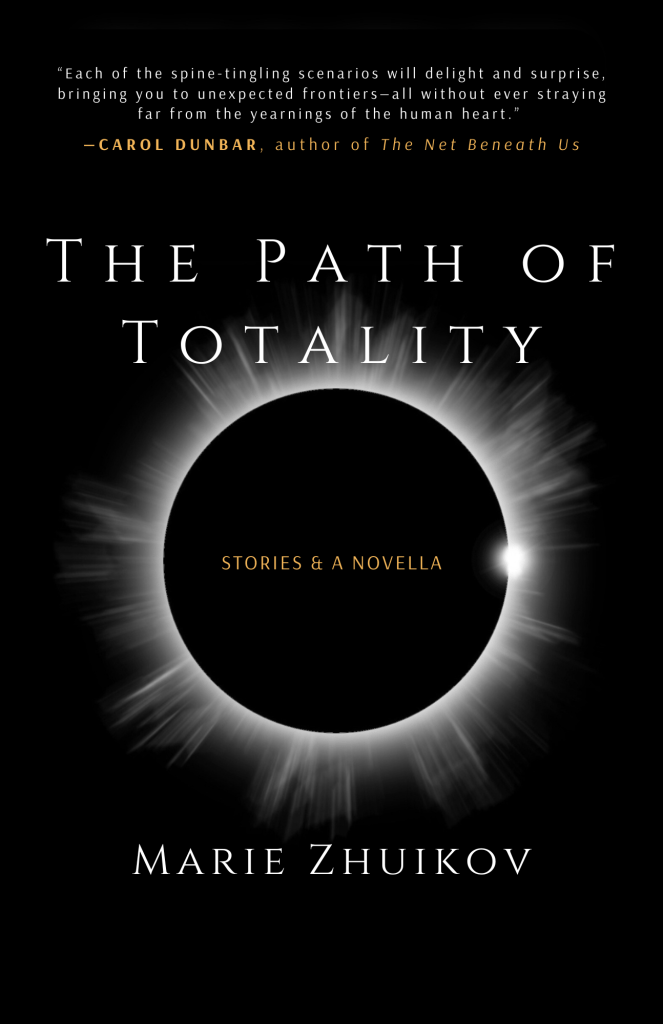
Two stories from The Path of Totality by Marie Zhuikov (Cornerstone Press, to be released February 2025) To pre-order Zhuikov’s book, click here.

1. “The Path of Totality” is the story of Marjorie and Justin, a young married couple, who travel from Medford, Oregon, to Salem, Oregon, to see the total eclipse of the sun. Caught up in a grief that both unites and divides them, the couple each experience the eclipse differently. Marjorie, along with other spectators, sees it all, astounded as the moon covers the sun. “But to Justin, the sun still shone as whole and bright as ever.” With eloquent prose, rich imagery, and well-crafted dialogue, Zhuikov’s story, told from the young husband’s perspective, is spellbinding. From a craft perspective, Zhuikov’s story reminds us that nature and natural events in our world can be powerful metaphors for human experiences.

2. “Bog Boy: A Northern Minnesota Romance” is set in rural Minnesota, where sixteen-year-old Natalie works at the Sax-Zim Bog, a nature preserve. On a spring day, while leading a birding tour, Natalie discovers a mummified teenage boy in the bog, whose remains are determined to be two thousand years old. The well-preserved teenager, with high cheekbones and beautiful hair, is handsome, and Natalie falls in love with him as only a teenage girl can – completely, blindly, devotedly. Because she cannot be without him, she brings the bog boy home to live with her and her father. Darkly humorous, “Bog Boy” combines the realm of speculative fiction with thought-provoking satire that made me laugh out loud at times. I still smile when I think about the story.

Book Reivew: Two States of Single: Essays on Family, Love, and Living Solo by Julie A. Jacob, Revisited

[I reviewed Two States of Single for Wisconsin Writers Association (WWA) almost a year ago. Julie Jacob’s book is a collection of memoir essays. I loved this book the first time around. In October 2024, I met Julie at the WWA writer’s conference in La Crosse. I was an excited fan. It was fun to meet someone whose book gave me such pleasure. When I returned home from the conference, I reread Julie’s book. I’m happy to say, I loved it just as much the second time around, even though I knew how each essay ended. So I’m posting my review that was posted on the WWA website.]

Two States of Single: Essays on Family, Love, and Living Solo by Julie A. Jacob is a collection of well-crafted, engaging essays. In her opening essay, “Anything You Could Want,” readers meet Jacob’s grandparents, aunts, uncles, sister, and parents as she recounts the parties her mom and dad hosted when she was a child and living in southern Wisconsin. With humor and tender nostalgia, Jacob describes her parents working together as a team to provide a bounty of food and love for the guests who would soon arrive. In this essay, Jacob recognizes a credo by which her family lived: “They knew that life was filled with bumps so they enjoyed themselves while they could.” This theme threads its way throughout her book.

Jacob’s essays continue to follow the arc of her life as she describes her years in Chicago; a daring adventure in Brazil; joining sports clubs for young professionals; buying her own condo, then later on a house; taking a chance on love; caring for her aging parents; and losing her parents. Throughout Jacob hopes to marry and have children, but as the years slip by, neither marriage nor children happen for her. However, her desire to find a soulmate does not drive the book. Instead, what shines through in Jacob’s essays are her decisions to live in the present and to explore new roads rather than waiting for something that may never happen.

Vivid writing and crisp dialogue breathe life into Jacob’s essays. Readers will feel they know the people and places she writes about. Her essays are more than just good stories. They resonate because of Jacob’s ability to convey why each story matters, both to her and to her readers. In memoir writing a writer is supposed to do more than tell an anecdote. The essay needs to answer the question, “So why should I, the reader, care about this?” Jacob’s essays impact readers because as she writes about her past, she answers that question every time. As readers discover why each of these moments are important in Jacob’s life, they are given the gift of being able to do the same with the significant events in their lives.

By the time I finished Jacob’s collection of essays, I found myself longing to meet with a group of fellow readers, sip a good latte, and discuss Jacob’s essays. Her book would make a wonderful nonfiction read for a book club.  Because married or single, male or female, we all have stories and insights to share about our choices, careers, loves, family, sorrows, and joys.

Book Reviews: The Brampton Witch Murders by Ellis Blackwood and A Lady’s Guide to Etiquette and Murder by Dianne Freeman

Ziva (l) and Nellie (r), my two favorite dogs, share a seat on a bookstore run.

The winds howl, trees drop leaves, and squirrels, in a frenzy, bury seeds. Halloween decorations are coming down, and Christmas decorations are going up. I wear my down coat and knit hat and sometimes my mittens when walking my dog. It’s the perfect season to enjoy cozy mysteries. I like to tuck them between the more serious books I read.

I enjoy a good cozy mystery, as long as it’s not too cozy. There has to be some close calls, some murder, and some despicable characters. But there also has to be some humor, some quirky characters, and it has to be tame enough to read or listen to before bedtime. Of course, the line between a cozy and a not-so-cozy mystery is subjective, but I know where my line is when I read one.

I have recently discovered two cozy historical mystery series, both set in England, that I like well enough to read the next book in each series.

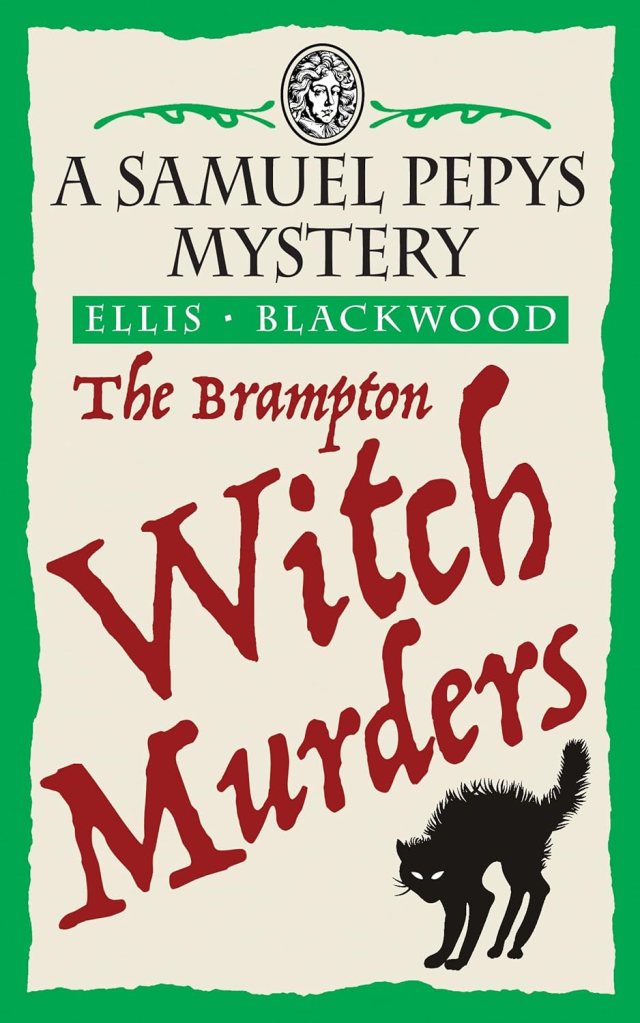
A Samuel Pepys Mystery: The Brampton Witch Murders by Ellis Blackwood

The Brampton Witch Murders is the first book in the Samuel Pepys Mystery series. It’s set in 1666 in England. Samuel Pepys runs an investigating agency in London. He has two inquisitors, Abigail Harcourt and Jacob Standish, who work for him. Pepys learns that his sister, Paulina, has been accused of witchcraft, and Simon Hopkins, a devious, zealous witch hunter has been sent to prosecute her. Pepys dispatches Abigail and Jacob to the village of Brampton, where they are to gather evidence to prove that the charges of witchcraft against Paulina and her friend are false. To complicate matters Paulina and her friend are accused of using witchcraft to commit murder.

[Note: The term inquisitors threw me at first because it made me think of an inquisition. I had to re-read the first few pages to understand that Abigail and Jacob were called inquisitors because it was their job to question other characters in order to uncover facts and evidence that would prove Paulina and the other women in the story were being falsely accused of witchery.]

Why did I like this book?

I liked the historical setting and subject matter of this cozy mystery. It’s scary how many characters in the story are willing to believe in Simon Hopkins and his accusations of witchery against the female characters without any proof. While men were sometimes found guilty and executed as witches, it was mostly women who were convicted and executed. Makes you wonder.

This is a fast-paced story and a quick, easy read. Because the book is small and a lot of the chapters are short, I kept it in my purse, so I could read it should I become stuck somewhere waiting for something or someone. The characters are interesting, the dialogue is good, and there are enough plot twists to keep readers engaged and guessing. And while it’s not thick with historical description, I still felt like I was in another time and place. Its themes of hysteria, greed, zealousness, and small-minded thinking are timeless.

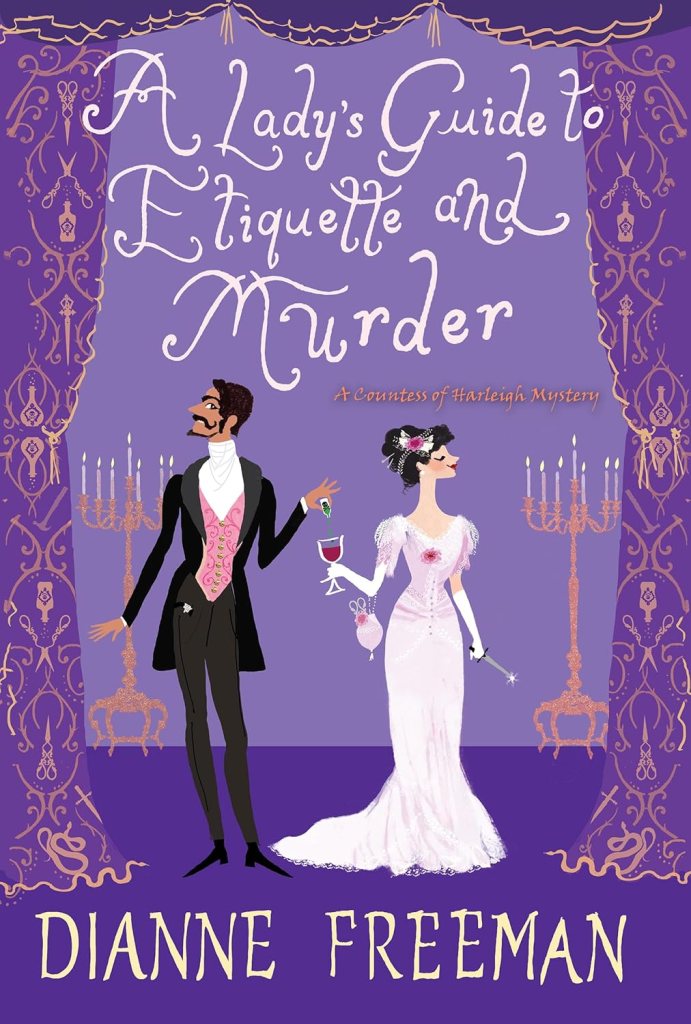
A Lady’s Guide to Etiquette and Murder (A Countess of Harleigh Mystery) by Dianne Freeman

Set in 1899, A Lady’s Guide to Etiquette and Murder is the first book in Dianne Freeman’s series featuring Francis Wynn.

As a young naive woman, Frances was a wealthy American with an ample dowry. In a Downton Abbey move, she married Reggie, an aristocrat with a large crumbling manor and a shrinking bank account. Unlike the marriage between Cora and Robert Crawley, romance does not blossom between Frances and Reggie. After nine years of marriage, Frances’s philandering husband dies of a heart attack while in bed with his mistress. There is a cover-up because scandal among the British upper class is to be avoided at all costs. After a year of mourning, Frances leases a house in London and packs up her daughter and her possessions. She is determined to start a new life.

But life becomes complicated for Frances. A Metropolitan police officer shows up at her new home to inform her that the police are investigating Reggie’s death as a possible murder, and she is a suspect. Her brother-in-law has filed a suit against her and her bank account is frozen. Her sister arrives from America for her first London season. And, someone is stealing expensive items at society parties. On the upside, Frances’s next-door neighbor is handsome, intelligent, and helpful. Joining together, Frances and her friends, along with the Metropolitan police officer, work to solve the mystery of Reggie’s death and the rash of thefts at society gatherings.

Why did I like this book?

Freeman’s book is delightful. It’s narrated by the main character, Frances, who is witty, self-effacing, intelligent, unflappable, and perfectly charming. I enjoyed keeping company with her as she traded her widow’s clothes for amateur sleuthing.

With an undercurrent of humor humming through its pages, Freeman’s book gently pokes fun at the upper crust of British society in 1899. Embracing the bravado and the stiff-upper-lip mindset of the British upper class, Frances, her friends, and the police follow certain protocols and unspoken rules revered by Britain’s high society, even while solving serious crimes like murder and theft. (The rich do live in a different realm of reality, whether it be 1899 or 2024.) Freeman delivers a good mystery with an ending I didn’t see coming, except in hindsight.

I listened to this book on my library app. Sara Zimmerman reads this cozy mystery, expertly giving voice to a wide array of characters. I particularly felt her keep-calm-and-carry-on voice was ideal for the character Frances. I’m already listening to the second book in Freeman’s series.