Book Review: Lady Catherine, the Earl, and the Real Downton Abbey by Fiona Aitken, the 8th Countess of Carnarvon (Hadder & Sloughton, London, 2013)

Why did I read this book?

I was in Edinburgh when I started reading Lady Catherine, the Earl, and the Real Downton Abbey. My sister and I stayed at a hotel called The Resident in Edinburgh’s lovely West End. The hotel has a good-sized lobby with a fireplace, comfortable chairs, and several shelves of books along the back wall. Whether fiction or nonfiction, prose or poetry, the books all seemed to have a connection to the United Kingdom. Set a bookshelf in front of me and I can’t help it: I start perusing spines. Because I loved the Masterpiece series Downton Abbey, the title of Fiona Aitken’s book caught my attention. Aitken, married to the 8th Earl of Carnarvon, is the 8th Countess of Carnarvon.

What is this book about?

Aitken’s book covers the lives of Catherine Wendell, an American beauty, and Henry Herbert Porchester, the 6th Earl of Carnarvon, from the early 1920s through the end of WWII. Readers first meet Catherine and Henry, called Porchey by his friends and family, in 1923 in India where he is stationed with his regiment. Married in 1922, they are still honeymooners and very much in love. Unlike many British lords of the era, who have expensive-to-maintain manor houses with expansive grounds, Lord Porchester has married for love, not for a cash infusion to prop up his estate. Although, shortly after becoming the 6th Earl of Carnarvon, Porchey discovers the finances of his estate are in disarray.

Readers follow Catherine and Porchey throughout their marriage, divorce, and post-divorce years against the backdrop of the Roaring Twenties, the Depression, the rise of fascism and Hitler, King Edward VIII’s abdication, and WWII. The “Epilogue” summarizes what happened to the key people in this book after WWII.

Why did I like this book?

Fiona Aitken’s book is well written. She tells the story of Catherine and Porchey in a narrative form, combing biography and history in a manner that makes it interesting to read. The book is also well researched because living at Highclere Castle as the 8th Countess of Carnarvon gave Aitken access to the archives at Highclere. Also, her title, family connections, and social status meant she was able to interview people who might not otherwise talk to writers.

While I was in Edinburgh, I only read the first seven chapters. I was busy sightseeing during the day, and because I walked miles everyday, I would fall asleep shortly after crawling into bed. Once I returned to the United States, I checked the book out from the library so I could finish it. I liked Aitken’s book so much that I plan to read her first book, Lady Almina and the Real Downton Abbey: The Lost Legacy of Highclere Castle (2011). Lady Almina was married to the 5th Earl of Carnarvon who financed archaeology digs in Egypt, which lead to Howard Carter’s discovery of King Tut’s tomb.

Some concluding thoughts . . .

If you’re a Downton Abbey fan, don’t pick up this book expecting a drama like the TV series; although, a lot of dramatic events happen in the book. However, if you’re a history fan, or an Anglophile, or you like learning about how the wealthy lived in a bygone era, especially during those Downton Abbey years, you’ll enjoy Fiona Aitken’s book.

Connections to the royal family —

Having met as teenagers, the 7th Earl of Carnarvon and Queen Elizabeth II were great friends. He served as her racing manager for years until his death in 2001. Queen Elizabeth was godmother to his son, currently the 8th Earl of Carnarvon. When Queen Elizabeth died, the 8th Earl and Countess made the short list and were invited to the private committal service for the Queen. But they didn’t receive an invitation to the coronation of King Charles in 2023. Charles trimmed the guest list from just over 8,000 who had attended his mother’s coronation to just over 2,000. In my lifetime I’ve seen the popularity of the royal family wax and wane. One of the criticisms people have about the royal family is the amount of money it takes to maintain all that pomp and circumstance. I imagine King Charles shortened the guest list for his coronation because he wants his subjects to know that he too can budget his expenses.

If you want to read the 8th Earl’s comments about not receiving an invite, click on the following article that appeared in Tatler, a British magazine: “Earl of Carnarvon, Queen Elizabeth II’s Godson, Praises ‘Excellent’ King Charles Despite Lack of Coronation Invitation.” It’s all very civilized and polite.

Book Reviews from My To-Be-Read Pile

Haunted by my staggering To-Be-Read pile of books, I’ve been on a bigger reading kick than usual, so I’ve read lots of enjoyable books lately. As I finished each of the books that I review here, I would tell myself I should write a book review. But as soon as I had free time, I hooked up with another book from my T-B-R pile. So, I’m going to write some quick reviews of my recent reads.

Close to a Flame by Colleen Alles (Cornerstone Press, 2025) Colleen Alles is a Michigan writer, which is fitting since I read many of her short stories while visiting my mother in Petoskey, Michigan. Alles’s stories capture the ordinary lives of women as they move through life’s ups and downs. Her stories are often a nod to the importance, strength, and lasting endurance of friendships between women. Six of the stories in her collection follow two characters named Miriam and Jamie. I love how these M & J stories are interspersed throughout the collection. We meet M & J in Alles’s first story “Restoring Notre-Dame” while they are in college. They remain life-long friends. We are treated to their stories as they date, marry, have children, and move into middle age. In Alles’s final story “Christ at Heart’s Door,” Jamie has gone to stay with her aging mother for a week. Miriam is back home, but she’s only a phone call away. Alles’s six M & J stories create a wonderful story arc of their own. Besides the M & J stories, my other favorites were “Loggerhead,” “Cusping,” “Whisper Moment,” and “In Tandem.” These stories connected with me, three of them for their subtle humor and one for its undercurrent of horror. Even though I finished her book over a month ago, many of Alles’s stories have followed me around, especially “Christ at Heart’s Door.” Alles’s book was a well-deserved NIEA Finalist (National Indie Excellence Awards).

The Gales of November: The Untold Story of the Edmund Fitzgerald by John U. Bacon (Liveright Publishing Corporation, a division of W. W. Norton & Company, Inc. 2025) John U. Bacon’s nonfiction book The Gales of November, released in 2025, coincides with the fiftieth anniversary of the sinking of the Edmund Fitzgerald. Even though I was sixteen when the Fitzgerald sank, and I waited with thousands of people hoping there would be survivors, I’d never read a book about the Fitzgerald‘s sinking until I read The Gales of November. When it sank, I was living in Milwaukee, where the Northwestern Mutual Life Insurance Company, owners of the Fitz, is still located. Two years later I moved near Superior where the Fitz had taken on her last load of taconite a day before her sinking. In the early 1980s, I worked at President’s bar, mentioned several times in Bacon’s book. Over the years, I heard many stories about what might have happened to the Fitz. Some from my great-uncle, others from sailors who sailed the Great Lakes, including a couple of sailors who were on the Arthur M. Anderson the night the Fitz sunk. There were no survivors or captain’s logs to corroborate any of the stories. And while I’d read some articles about the Fitz over the years, I’d never read a book about its sinking. Then I read Cait Z’s blog review about Bacon’s book that stated,“This is excellent! What it isn’t is an exploitation of a disaster.” (Click on the quote to read Cait Z’s review.) I went to my local bookstore that day and bought the book. The Gales of November is everything Cait Z. said it would be. Readers learn about the Great Lakes, shipbuilding, the taconite industry, the life of sailors, the weather, a few other shipwrecks, and the families left behind after the Fitz‘s sinking. Bacon’s book is written with care and respect. I waited fifty years to read a book about the Edmund Fitzgerald and I’m glad I did. First, after fifty years and some underwater exploration, experts have more information about the Fitz‘s sinking. Second, I learned so much about the Great Lakes and the shipping industry. Finally, Bacon’s book — well written and well researched — is excellent. And everyone I’ve talked to who has read it agrees.

Montana Matrimonial News by Candace Simar (North Star Press, 2025) Candace Simar’s most recent novel is a group of connected stories about men and women who have come to live in the Dakota Territory as homesteaders in the 1880s. Simar paints a realistic picture of the harsh and lonely lives homesteaders lead as they farm their homesteads for the five years needed to claim the land as their own. Men and sometimes women advertise in the Montana Matrimonial News for a bride or groom. The novel starts with Digger and his brother George, who have been homesteading their claims for four long years, and they wonder if they have the fortitude to make it through their fifth year. They are desperately lonely and wish to marry. In other chapters we meet widowers and widows, some with children. We meet an unwed mother. We meet a pair of sisters who are homesteading separate claims. We meet two Civil War veterans who drink to quash the horrors of the war. And we meet Dr. Gamla, the thread who ties the stories together. She has a way of knowing who needs her medical services without being told. She offers cures for both the physically and emotionally wounded with her well-known catch phrase, “My cures work if you can stand them.” Candace Simar has written a richly detailed historical novel with vibrant, well-developed, distinctive characters who nearly walk off the pages. Her descriptive writing talents took me back to the 1880s in the Dakota Territory to the days of sod houses, prairie thunderstorms and blizzards, and waving oceans of prairie grasses. Her stories came to life in my head. [Note: I read most of Simar’s novel after receiving my COVID shot, which always makes me feel awful for a couple of days. Having her book to read was a soothing balm, making me forget about my discomfort.]

Beginnings: The Homeward Journey of Donovan Manypenny by Thomas D. Peacock (Holy Cow! Press, 2018) Donovan Manypenny, an Ojibwe from Red Cliff, Wisconsin, has had some tragedy and some joy in his life. He’s had some bad luck and some good luck. Left an orphan by his mother’s death, his grandparents have taken him into their home. They are kind and loving, but when Donovan is ten, first his grandmother dies, then his grandfather. Bad luck and good luck continue to follow Donovan for a brief time, with good luck and joy winning out. But Donovan ends up living over a thousand miles away from his Ojibwe people of Red Cliff. With the first sentence of his story, he tells us, “For over forty years I forgot I was native, Anishinaabe Ojibwe . . . .” In Massachusetts he has been content with his life as a teacher, happy in his marriage, and proud of his daughter. Then his daughter pleads with him to attend a Native American event combining Native storytelling and crafts. Something awakens in Donovan and he begins his homeward journey, taking his time along the way to visit places important to his Ojibwe people. Beautifully written, Thomas Peacock’s slender novel is a quiet, contemplative meditation on the meaning of belonging and family and of coming home to the place you were eventually meant to be.

Book Review: McGarr and the P. M. of Belgrave Square by Bartholomew Gill (First Published in the United States by Viking Press, 1983)

I’m back with another update on my quest to read all of the Peter McGarr mysteries by Bartholomew Gill. I just finished McGarr and the P.M. of Belgrave Square, Bartholomew Gill’s fifth Peter McGarr mystery. And I know I said this about Bartholomew’s fourth book, but his fifth book is now my favorite of the series.

What is this book about?

A dead body lies in a water-filled ditch for most of a day. It’s inconceivable to DCI Peter McGarr that the woman in the house overlooking the ditch failed to noticed the dead man. Furthermore, McGarr reckons she must have witnessed the murder.

The dead man is William Craig, an antiques dealer and business man, who until that morning had lived with his wife in the house with the view of the watery ditch.

McGarr quickly gathers a list of suspects: the wife, the son, the business partner, the gardener, the maid, a member of the Irish Republican Army, a former Nazi collaborator. Given the method of the murder, it appears personal. Curiously, considering the many valuable antiques in Craig’s shop, the only item is missing is a valuable painting.

The P.M. of Belgrave Square is a dog (not the Prime Minister), who has retired from the police force. P.M. lives next door to McGarr, and of course they’re friends. In many ways the dog is a canine version of McGarr.

Thoughts about story and character development in Gill’s mystery series . . .

For four books, I wanted to know more about DCI McGarr’s wife, Noreen. I wanted her to do more than cook a few meals for McGarr, drive him around occasionally, and look stunning in clothes that showcase her ginger-colored hair and green eyes. I wonder if Gill ever received fan mail from readers asking for more Noreen because in this book, she has her own story arc, something missing in the first four books. In the earlier books, Noreen was nice enough, but now she’s interesting.

There are still no female detectives. And the female temp with the competent computer skills, who I really liked, is absent from this book, but I hope she still works for the department. There is only one scene at the police station in this book, so it makes sense we don’t see her.

In Gill’s first five books, we learn a lot about the murder suspects and what makes them tick, but not so much about the detectives who investigate them. It’s nice to have interesting suspects with convoluted psyches and complicated motives. But I’ve been raised on police detective stories that also focus on the investigators and what makes them tick. We get a bit more of that in McGarr and the P.M. of Belgrave Square, as Gill gives us some insight into McGarr’s life through Noreen’s perspective on their marriage.

Turns out Noreen is concerned about Peter’s drinking and his smoking. Throughout the first four books, she seemed oblivious to his bad habits. There are cracks in McGarr’s facade, hints that something from his past has left scars, and Noreen is terrified about his willingness to put himself in harm’s way. His position as a DCI means he should be off the streets and at a desk, but Peter likes to be in the thick of an investigation. She believes he has a death wish. I wonder if she will make it as a cop’s wife.

The Irish Republican Army is back. Insinuations of IRA involvement always complicate McGarr’s murder investigations. He seeks justice for the victim or victims at hand, but Special Branch, or some other investigative entity, often wants to bury IRA involvement, either because they simply don’t want to deal with it or because they are deep into an investigation and don’t want their cover blown. McGarr doesn’t give a farthing for either reason — he solves the case in front of him. If that means rattling the IRA or interfering in an ongoing Special Branch investigation, so be it.

Gill’s Peter McGarr mysteries are dark. Set mostly in Ireland, I can’t imagine they would ever be endorsed by an Irish tourism board. McGarr’s Ireland is a land of dismal weather and stormy seas with only brief bouts of sunshine. McGarr’s Dublin is a city of coal dust, simmering class resentments, and political intrigue.

I wonder if I weren’t interested in seeing how Gill develops his characters over the series, if I would still be reading these books. But I think the answer is yes. The novels have just the right amount of darkness. The writing is good. I like the dialogue. The stories are interesting. The books are quick reads. And the pocket book size feels so comfortable in my hands. After I finished this book, I ordered Gill’s next three mysteries from Thrift Books. So, like Noreen is still sticking with Peter McGarr, I’m still sticking with Bartholomew Gill.

[To read my reviews of the first four Peter McGarr mysteries, click here for books one and two and here for book three and here for book four.]

There Was Magic in the Air Last Night

When I returned home from A Midsummer Night’s Dream, a mystical moonscape greeted me.

Last night I went to see a high school production of A Midsummer Night’s Dream. Student actors dressed in colorful, eclectic, whimsical costumes, creating shimmering visions on the stage. They recited Shakespeare’s verse, never stumbling over their words. As the love potion delivered by Puck caused chaos and confusion, the energetic actors made their way on and off the stage, delivering humorous lines, catching the audience up in laughter. All of this on a stage decorated with cut-out trees so enchanting in their color changes, they almost stole the show.

During the quieter moments of the performance. I thought about the many high school and college plays I have seen over the years. All of those young people working together to create a moment of magic on a stage. A moment that would never be the same as the performance that came before, or the one that would come next. I thought about the long hours drama students spend rehearsing, creating sets, lighting the performance, making costumes. How they pass their time together, forging friendships and romances, talking about life and their dreams. Cracking inside jokes that only they understand, the bond of a shared experience. I thought about how young they are, with their whole lives ahead of them. I thought about how once these young thespians leave high school or college, they might never act upon a stage again.

Then I thought about Tom Lake by Ann Patchett, which I recently read and loved. Tom Lake is a story within a story. Lara Nelson, now in her fifties, owns a cherry orchard with her husband. Set in 2020 during the COVID lockdown, Lara’s three adult daughters are staying at the farm with their parents. Because of the pandemic, the family of five works the cherry farm without the usual hired help. Picking cherries is time-consuming, monotonous work. To pass the time, Lara, in a series of flashbacks, recounts the story of her summer in Tom Lake, where as a young woman she performed in a summer stock production of Our Town by Thornton Wilder. Even though Patchett’s novel is set during COVID, it’s not about the pandemic–at all. It’s a beautifully written, heart-wrenching coming of age story.

Last night as I watched the young actors perform, I wondered about their coming-of-age stories. I thought about my own coming-of-age stories.

And that is what good literature does. It slumbers in a corner of your brain, until something in your present world nudges it, and it lives once again in your imagination, giving meaning to both the world that is your life and the world of make believe.

Book Reivew: Two States of Single: Essays on Family, Love, and Living Solo by Julie A. Jacob, Revisited

[I reviewed Two States of Single for Wisconsin Writers Association (WWA) almost a year ago. Julie Jacob’s book is a collection of memoir essays. I loved this book the first time around. In October 2024, I met Julie at the WWA writer’s conference in La Crosse. I was an excited fan. It was fun to meet someone whose book gave me such pleasure. When I returned home from the conference, I reread Julie’s book. I’m happy to say, I loved it just as much the second time around, even though I knew how each essay ended. So I’m posting my review that was posted on the WWA website.]

Two States of Single: Essays on Family, Love, and Living Solo by Julie A. Jacob is a collection of well-crafted, engaging essays. In her opening essay, “Anything You Could Want,” readers meet Jacob’s grandparents, aunts, uncles, sister, and parents as she recounts the parties her mom and dad hosted when she was a child and living in southern Wisconsin. With humor and tender nostalgia, Jacob describes her parents working together as a team to provide a bounty of food and love for the guests who would soon arrive. In this essay, Jacob recognizes a credo by which her family lived: “They knew that life was filled with bumps so they enjoyed themselves while they could.” This theme threads its way throughout her book.

Jacob’s essays continue to follow the arc of her life as she describes her years in Chicago; a daring adventure in Brazil; joining sports clubs for young professionals; buying her own condo, then later on a house; taking a chance on love; caring for her aging parents; and losing her parents. Throughout Jacob hopes to marry and have children, but as the years slip by, neither marriage nor children happen for her. However, her desire to find a soulmate does not drive the book. Instead, what shines through in Jacob’s essays are her decisions to live in the present and to explore new roads rather than waiting for something that may never happen.

Vivid writing and crisp dialogue breathe life into Jacob’s essays. Readers will feel they know the people and places she writes about. Her essays are more than just good stories. They resonate because of Jacob’s ability to convey why each story matters, both to her and to her readers. In memoir writing a writer is supposed to do more than tell an anecdote. The essay needs to answer the question, “So why should I, the reader, care about this?” Jacob’s essays impact readers because as she writes about her past, she answers that question every time. As readers discover why each of these moments are important in Jacob’s life, they are given the gift of being able to do the same with the significant events in their lives.

By the time I finished Jacob’s collection of essays, I found myself longing to meet with a group of fellow readers, sip a good latte, and discuss Jacob’s essays. Her book would make a wonderful nonfiction read for a book club.  Because married or single, male or female, we all have stories and insights to share about our choices, careers, loves, family, sorrows, and joys.

A Mini Five-Pack of Book Reviews: Peter Geye, Matt Goldman, Alfred Lansing, Richard Osman, Kurt Vonnegut

Ever have someone tell you to keep your head down? I interpret that to mean I should put my head in a book. And sometimes a book is the best place to be. I’ve been hanging out in a lot of books lately.

The Ski Jumpers by Peter Geye. I read The Ski Jumpers because I read The Lighthouse Road and Safe from the Sea, both beautifully written novels. Geye writes stories with brooding, flawed characters who are self-reliant and tough, yet vulnerable, which makes me like them and root for them. The vivid landscapes in Geye’s novels become a character that his protagonists must work with and sometimes fight against. In The Ski Jumpers family secrets gather like dust bunnies hiding in the dark, under a heavy, nearly immovable antiquated piece of furniture. Because each family member knows only a part of their family’s secrets, misconceptions develop and resentments grow. Pops Bargaard loves his wife, Bett, but she struggles with her own demons, one of which is her inability to love both of her sons. She dotes on Anton while despising Johannes “Jon.” Pops, an accomplished ski jumper in his youth, introduces his sons to the sport. Ski jumping becomes an escape for Pops and his sons. And as the years go by, ski jumping becomes what Pops and his sons talk about when they are still hiding secrets, when they aren’t ready to talk about their pain, when they are holding on to happier times. One of the joys in Geye’s novel is his detailed, vivid descriptions of ski jumping, which fly off the page, taking me along, letting me ski jump with Johannes and Anton. At some point while reading Geye’s book, I skipped to the “Acknowledgments,” and as I had come to believe, I found that he grew up ski jumping, which explained how he could write so intimately about it.

Still Waters by Matt Goldman. I read Still Waters because I’ve read three of Goldman’s Nils Shapiro detective novels: Gone to Dust, Broken Ice, and The Shallows, and enjoyed them all. Still Waters is one of Goldman’s stand-alone novels. It’s a murder mystery, but one that is solved with the help of ordinary people. Siblings Liv and Gabe, who are estranged, must reunite for their older brother Mack’s funeral in their rural northern Minnesota hometown. Mack’s death has been ruled a medical event, but Liv and Gabe receive emails from their dead brother saying he was murdered. While Liv and Gabe try to make sense of Mack’s email and uncover the truth about his death, someone else dies, and it’s clearly murder. Liv and Gabe discover mysterious letters in a box that belonged to their deceased mother, and they suspect the letters hold the key to Mack’s death and the second murder. This smartly woven mystery with multiple theories and a number of potential suspects kept me guessing. Plus, I could read it before I went to bed and still drift off to sleep without checking under the bed. (I like mysteries without psychopathic serial killers.) Goldman’s mystery does have some scary moments, but only enough to make the heart race a little.

Endurance: Shackleton’s Incredible Voyage by Alfred Lansing. I read Endurance by Lansing because I like reading about shipwrecks. (Click here for proof.) The Endurance isn’t wrecked on a shoal or reef, she isn’t tossed over by a violent storm, and she isn’t irreparably wounded in battle. Instead, she has purposefully sailed into the Weddell Sea filled with ice floes, looking for a place to land on Antarctica. She is stalled by the ice, which sandwiches her in a death grip, squeezing and squeezing until she groans, and parts of her snap like toothpicks. After becoming unseaworthy, her crew have no choice but to abandon her and their mission to be the first to cross the width of Antarctica using sled dogs. Now the twenty-eight men must survive the beyond-bitter cold, the howling winds, and the snow and rain while hoping to rescue themselves. When Alfred Lansing wrote this book, he had access to the daily journals kept by some of the men, and he was able to interview some of the survivors. Lansing took great care to write an accurate and descriptive account of one of the greatest survival stories, and his book is a tribute to the human ability to put one foot in front of the other and to cling to hope. When Endurance was published in 1959, it was a critical success, but not a commercial one. By the time the book became a commercial success in 1986, Lansing was dead. If you read this book curl up with a blanket and a cup of something hot! This book chilled me to the bone!

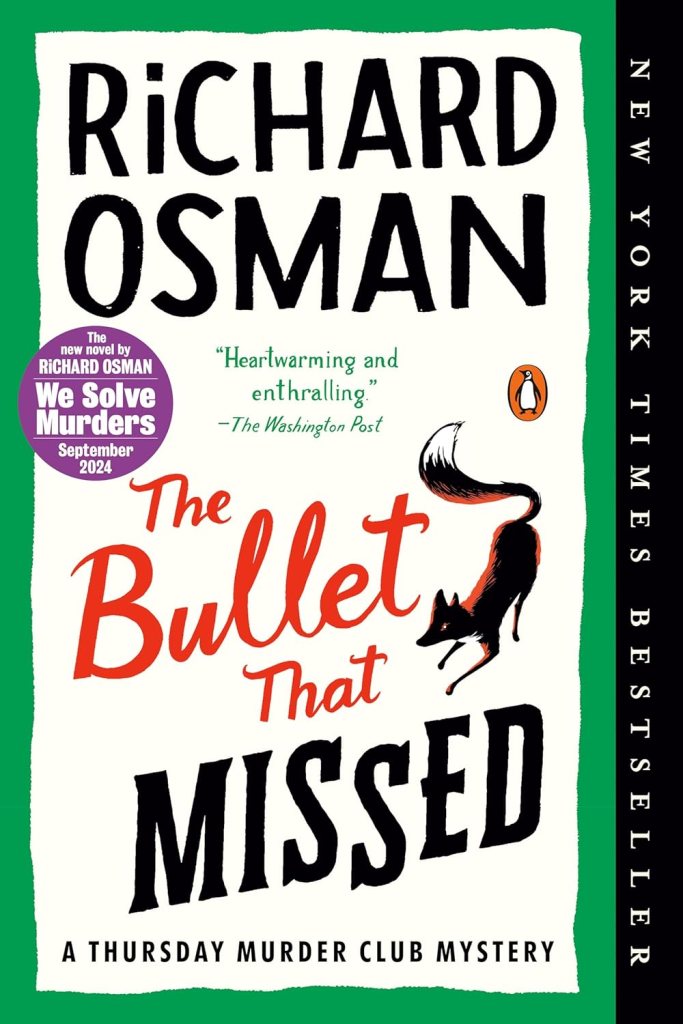
The Bullet that Missed: A Thursday Murder Club Mystery by Richard Osman. I read this book because I read the first two books in the Osman’s series, and they were fun, fun, fun. These murder mysteries are a treat. They are cozy but do have some un-cozy scenes. (And yay! No serial killers, which are so overdone.) Most of the main characters live in a retirement home in the English countryside. While they participate in some of the traditional retirement activities, they have one that’s unusual — they meet on Thursdays to look at cold cases that haven’t been solved. The unsolved murders somehow become entangled in a new murder case, which then also involves the police. One of the characters, Elizabeth, is a former MI-6 agent, and as it turns out, it’s not easy for her to give up the thrills of spying and sleuthing. Her fellow retirees join in the criminal-case-cracking adventures. This mystery series earns top kudos from me for its characters, its dialogue, and its plots. Most of the characters are senior citizens, but that doesn’t mean they have checked out of life. The older characters in the book are presented as people, who all have the same hopes, dreams, desires, and brains as the younger characters, even if the older ones do occasionally battle aches and pains. Osman’s snappy dialogue creates characters that are witty and quick thinking, conversations often drip with verbal irony and humorous understatements. The criminal characters are well-developed, too. They are brilliant and devious, but, of course, never a match for the Thursday Murder Club. While you could read these books out of sequence, I suggest they are best read in order.

Slaughterhouse-Five by Kurt Vonnegut. I read this book because I walked into Apostle Islands Booksellers and saw it prominently displayed on a shelf. I’ve had people say to me, “Have you read Slaughterhouse-Five? No? Well, you should!” I’ve read articles where writers suggest to their readers, “If you haven’t read Slaughterhouse-Five, you should!” And there it was — Vonnegut’s book — on a shelf, looking at me, waiting for me, so I bought it. Slaughterhouse-Five is described as an antiwar book focused on the firebombing of Dresden in 1945. It follows Billy Pilgrim, a WWII veteran, who time travels from his old age to Dresden, to his wedding day, to life with his family, to a veteran’s hospital, to a planet in outer space, to his youth, like a pinball pinging across a fantasy-themed pinball game. I’m not listing Billy Pilgrim’s time travels in the necessarily correct order; besides, as the story unfolds, Billy travels back and forth among these places in time. But Vonnegut clearly had a plan, and as I read the book, it not only made sense to me, it all worked seamlessly. I never felt like I was being yanked around. A book like Slaughterhouse-Five is hard to explain in words. I like it for its satire, its experimentation, its ambiguity and clarity, and its themes. I like Vonnegut’s simple, but powerful sentences. Slaughterhouse-Five is often spoken of as anti-war novel, and that theme runs through it. However, Vonnegut’s slim novel is thematically rich, and there is much more being said than war is terrible. As I read the novel, I sometimes thought about “The Swimmer” by John Cheever. Raymond Carver’s short stories also came to mind.

Time to go keep my head down in a book. The Heaven & Earth Grocery Store by James McBride is waiting for me.

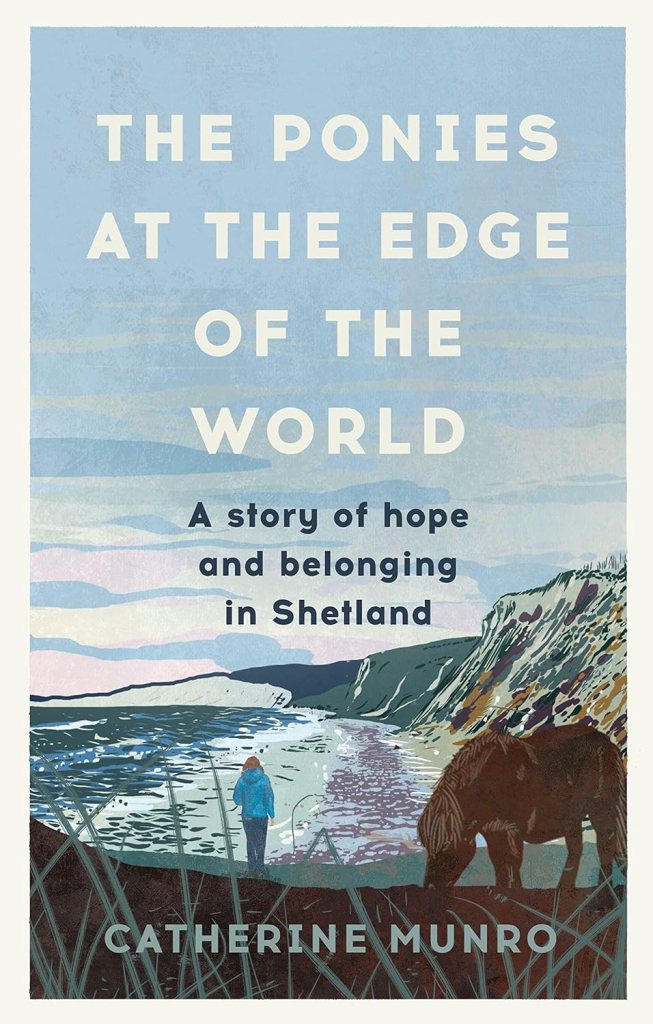
Book Review: The Ponies at the Edge of the World: A Story of Hope and Belonging in Shetland by Catherine Munro

Why did I read this book?

Next year I’m going to Shetland. I’ve been learning as much as I can about the group of islands, which are so far north of Scotland that most maps represent Shetland with an arrow that points north and the words to Shetland. And you have to take their word for it that it’s up there, beyond the edge of the map.

I bought Shetland: Your Essential Travel Guide (2024) by Laurie Goodlad. Her travel guide has a section titled “What to Read before You Arrive” with a list of fiction and nonfiction books. I chose Catherine Munro’s Ponies at the Edge of the World (2022) because where I grew up, we lived next to a farmer who had a small herd of American Shetland ponies, a cross between Shetland ponies and other horses. My sisters and I spent hours petting those ponies and feeding them tall grasses. The farmer who owned them taught us which grasses his ponies liked and how to hold our hands flat while the ponies nibbled their treats from our palms so our fingers wouldn’t get chomped.

What is this book about?

Catherine Munro is an anthropologist who specializes in human-animal relationships. She spent a year in Shetland to study the relationship between humans and Shetland ponies for her PhD. She interviewed people who spent their lives raising and taking care of Shetland ponies. For some Shetlanders, the tradition of caring for the ponies goes back generations.

While Munro’s book focuses on the relationship between Shetland ponies and people, she also describes some of the astonishing wildlife and the mystical landscapes that make the Shetland Islands one of the most unique and beautiful places on earth. She also brings to life the pragmatic and reserved but warm-hearted and community-minded people who live in Shetland.

What did I love about this book?

In her book, Munro describes why human-animal relationships are so important. The bond between the Shetland ponies and the people who raise them, care for them, and love them is fascinating. Shetland ponies developed over thousands of years, adapting to the climate and the terrain of Shetland. These small, thick-coated, hardy ponies became the perfect workmates for crofters who worked the land. Munro talks about the concerns for the survival of Shetland ponies as a distinct breed. She asks us to think about the importance of animals, to see them as our equals, and to understand that a respectful relationship with animals is essential for the survival of all species, including people.

Yesterday I read a blogger’s post stating that the Slender-billed Curlew has been officially declared extinct by scientists, a stark and sad announcement. To read the blog, click here. We need to do better for our earth and the plants and animals that inhabit it.

[You can follow Catherine Munro on Instagram at catherine_m_munro.]