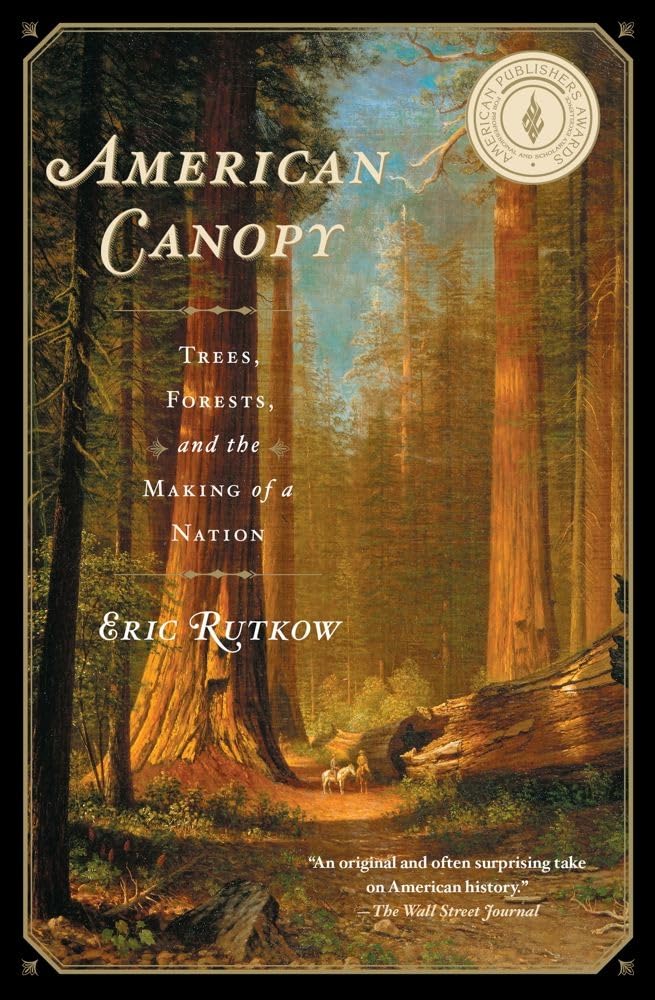
American Canopy by Eric Rutkow takes a unique look at a slice of United States history by focusing on its relationship with its immense forests. When settlers first arrived in North America, forests covered more than half of what would eventually be the forty-eight contiguous states. Rutkow notes that in the United States people will find giant sequoias, the largest trees in the world; coastal redwoods, the tallest trees in the world; bristlecone pines, the oldest trees in the world; and the biggest single living organism in the world, a stand of quaking aspens in Utah.
When the first settlers arrived on the Eastern shores of the New World, they encountered dark, dense forests. Settlers viewed the forests as something to be cleared to make way for farms and towns and as a resource to be used in trade and manufacturing. And with so many extensive forests, people and lumber companies cut down trees as if the supply was endless.
Rutkow’s book is a comprehensive, chronological history of America’s forests and how those forests played an integral role in the building of a nation. Rutkow’s history covers how trees were used to build ships, trains, railroad tracks, and airplanes until other materials like steel and aluminum were developed. And while some new technologies meant a decreased demand for wood, other innovations called for an increased demand. He covers the lumber industry’s devastating impact on forests and the growing movements to save forests in order to protect water and air quality and to mitigate climate change. Readers meet lumber barons, conservation advocates, politicians, botanists, environmentalists, naturalists, and entrepreneurs, among others.
Why I loved this book . . .
It’s well-organized, well-written, and interesting. I learned so much about the history of our forests. I liked this book so much that I bought Eric Rutkow’s book The Longest Line on the Map: The United States, the Pan-American Highway, and the Quest to Link the Americas. But most importantly, at this moment in history when some of our political leaders have turned their backs on our national parks and forests, and hope to sell public lands to private industries, Rutkow’s book informs us why our national parks and forests are vital to our well-being and the health of our planet.
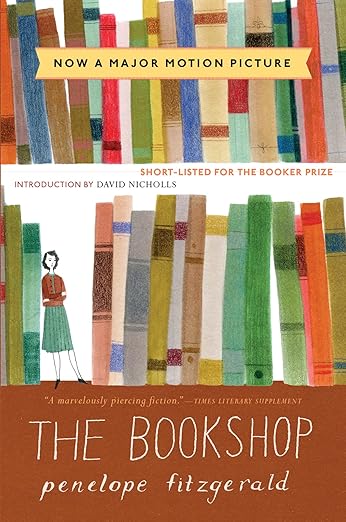
In 1959, Hardborough is a quiet English village on an island between the sea and a river. It’s a town steadily losing bits of itself as the years go by — its sources of income, its land to erosion, its youth to the cities. It’s a town where everyone is intimate with everyone else’s business. If you sneeze over breakfast, by noon people all around town will have asked, “Do you have a cold or is it hay fever?”
Florence Green, a childless widow nearing middle age, decides to open a bookshop. For ten years she has lived in Hardborough. Over the years, she has carefully measured the words and actions of her neighbors against an imaginary yardstick representing the progress of her acceptance in the community. She believes her fellow townspeople will shop in her store.
Florence obtains a loan from the bank and purchases a property referred to as Old House, which has stood empty for many years and is rumored to be haunted. Florence converts the first floor into a bookstore, and having given up her flat, she lives on the second floor.
For the first time, Florence is invited to a party at the Stead by Mrs. Gamart, a woman of status and means in Hardborough. Mrs. Gamart smiles and chats with Florence, appearing to approve of her bookshop. Mrs. Gamart, with all the glib banter of a cobra offering to watch over a nest of eggs, claims she wants to help Florence. However, what Mrs. Gamart really wants is Old House because she wishes to turn it into an arts center. She suggests to Florence that the soon-to-be-empty wet fish shop would be a better place for a bookstore.
But Florence doesn’t want to sell. She has legal title to Old House, which comes with a rumbling ghost, and who doesn’t want a ghost in their bookstore? Especially one that while noisy at times is always standoffish. Although Florence has legal title, Mrs. Gamart has money, status, and connections to influential people. As Florence hires a clerk, stocks the shelves, and wrestles with the question of whether or not to sell Vladimir Nabokov’s new controversial novel Lolita in her store, Mrs. Gamart calls on her connections and forges a devious plan to obtain Old House for an arts center.
It was short-listed for the Booker Prize.
Why I loved this book . . .
The Bookshop is a slim novel that reads like a long literary short story. I love these types of novels, strung together like a pearl necklace with graduated beads. The early scenes start out small, then expand like the pearls in the necklace: perfectly shaped and incrementally growing in size — until the largest moment of the story hangs like the largest pearl in the luminous strand. And at that moment, a truth about people and life resonates. These are the kind of novels that play in my mind for months and years to come.
The title of this book works on so many levels and in so many ways.
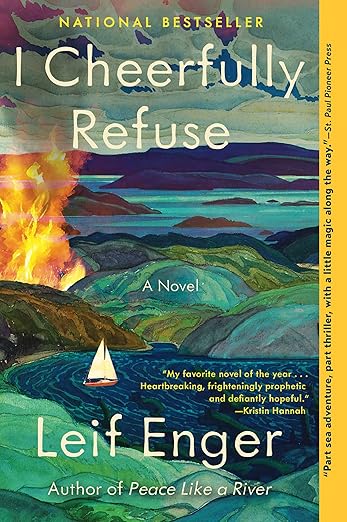
Somewhere in the near future, perhaps twenty or thirty years from now, Leif Enger’s novel takes readers on a journey of magical-dystopian realism along the shores of Lake Superior and out into its waters. His main character Rainy has a happy life. He loves his wife, Lark, who runs a bookstore inside of a bakery shop. He loves to read and to play his bass guitar in a band with his buddies. He has inherited Flower, a small sailboat, which he works to restore because he fancies himself a bit of a sailor.
But readers soon realize that something is wrong with the world in which Rainy lives. Books have nearly disappeared and reading is frowned upon. The climate has changed, and Lake Superior has warmed, creating powerful storms. Lawlessness, mostly unchecked, lurks in places once considered safe. Ominous medicine ships anchored near the shores, seek to cure the youth by breaking their willful behavior and bending their thoughts in a manner deemed acceptable by the wealthy Astronauts, who wish to mold them into compliant, cheaply-paid laborers.
When Kellen, a young man, arrives in town, Rainy and Lark allow him to live in their attic. Kellen himself is not trouble, but trouble is following him. And when that trouble arrives, he is a man called Werryck, leaving Rainy no choice but to flee in his sailboat upon the tempestuous waters of Lake Superior.
Enger’s tale is spellbinding. His lyrical prose hovers above the dark underbelly of a society that has come undone. We experience a world of natural beauty and serenity along Minnesota’s North Shore. Yet, we know something is profoundly wrong because we can feel the pulsating evil that lives beneath Enger’s exquisite prose. Enger doesn’t dwell on how the world in which Rainy lives fell apart. Instead, as we follow Rainy on his journey, Enger trusts us to ponder those possibilities.
From the standpoint of craft . . .
I admire Leif Enger’s rich prose. He uses language to create imagery and metaphors that are fresh, but never out of place or over the top. His descriptions of Lake Superior, the weather, sailing, and playing a bass guitar add realism to his story. Lake Superior and its weather become a character in his novel. His story is tightly woven: A throw-away remark, or an infectious smile, or a benign action may seem to have been randomly tossed into the story, but later I would realize it was a telling moment, making me feel like I’m a smart reader.
Several people who read Enger’s book before I did would say they loved the book, but it was dark. And here is where Enger’s writing shines. Some of his themes are dark, but others are hopeful. Some of what happens in the story is sad and scary, but he tells the story in a way that gives his readers a reason to hope. Enger knows what to tell in a story, what to hint at, and what to leave to a reader’s imagination. If you’re a writer looking for a mentor book with a story told as a hero’s journey, this is a great book to read.
I’ve been reading a lot. Every time I finished one of the books in this six-part review, I thought, “This was wonderful. I should post about it on my blog.” But, dear fellow readers, did I? No. Instead I read another book. However, these books, now stacked next to my computer, kept harrumphing at me, like when my restless grandchildren who’ve been so good finally run out of patience while waiting for me to take them to the park. And so, I placated the books by telling them I would write a short review for each of them. But things got out of hand, and the two- to three-hundred-word reviews I’d envisioned grew and grew. And try as I might, I couldn’t bring myself to cut any words because I loved the books. So I’m posting the reviews in six parts, in alphabetical order by author’s last name.
If you can’t own the painting, read the book!
Girl with a Pearl Earring by Tracy Chevalier, 1999
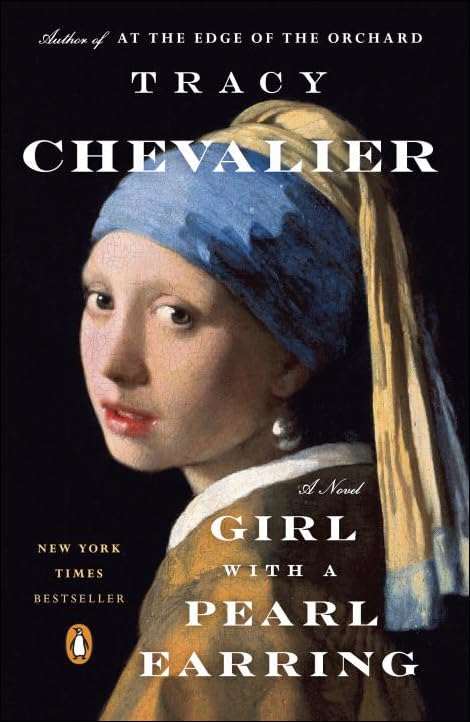
Seventeen-year-old Griet is hired out by her parents as a domestic servant to the household of Johannes Vermeer. From the first pages of the novel, it’s clear that something, although unspoken, has transpired between Griet and Vermeer. Griet’s acceptance in the artist’s home is mixed. She is Protestant and the Vermeers are Catholic. She is distrusted and disliked by Vermeer’s wife, one of his daughters, and the head domestic servant. Life is difficult for Griet until one day when Vermeer insists that she be the only person allowed to clean his studio. A choice his mother-in-law completely supports. Vermeer soon relies on Griet to mix his paints, and he occasionally seeks her advice when setting his scenes.
Tracy Chevalier has written a historical novel as exquisite as Johannes Vermeer’s famous painting for which the book is named. Set in the 1660s in Delft, Netherlands, Chevalier portrays the life and paintings of Vermeer as accurately as she can because not much is known about Vermeer. Girl with a Pearl Earring is considered his masterpiece, but the girl in the painting is a mystery. Chevalier’s prose is as artfully chosen and applied to the page just as Vermeer’s brilliant colors and brushstrokes were applied to his canvases. Her novel paints a captivating fictional story about how Vermeer came to paint the girl.
From the standpoint of craft . . .
As a writer I admire Chevalier’s book for the historical details that make the late 17th Century Netherlands come to life. She puts us in the streets and marketplaces of Delft. She takes us inside Vermeer’s home, and gives us a first-row seat to the domestic life of a financially insecure upper-class family and their servants, with all their petty jealousies, passions, kindnesses, and cruelties. Additionally, Chevalier’s novel is worth studying for the great sense simmering tension she creates between Vermeer and Griet.
McLean & Eakin Booksellers (Lake Street Entrance) is conveniently located next to a coffee and sandwich shop. April 2025
McLean & Eakin Booksellers is located in downtown Petoskey, Michigan, on Lake Street, in what is referred to as the Gaslight District. It’s been a shopping district for over one hundred years. Many of the old gas lamp posts, while now electrified, still remain.
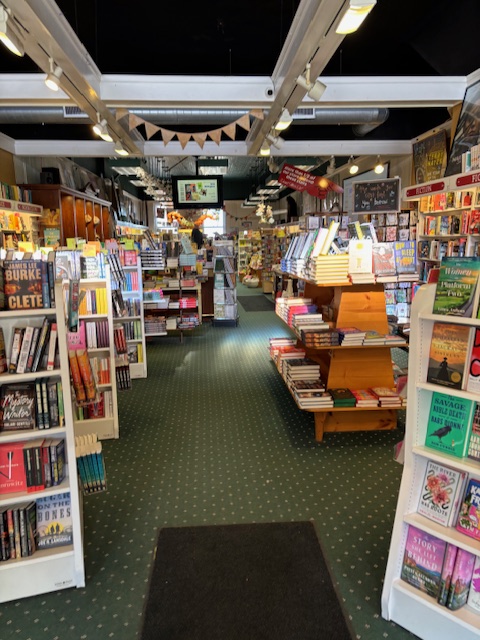
The view from the front of the store, April 2025
McLean & Eakin was established thirty-three years ago in 1992 and has remained in the same family. It’s located in the G & A Building, built in 1907. The initials stand for Guleserian and Altoonjian, two Armenian immigrants who ran a Persian Bazaar on the first floor of the building and rented the second floor to the Petoskey Normal and Business College. It’s fun to imagine all of the people who shopped for goods that would have come from the Middle East and Asia. Perhaps they bought a Persian rug, or a piece of ornate furniture, or an exquisite painting. Over the years other businesses came and went, including a women’s clothing store during the 1950s and 1960s.
“Hey,” I thought, “I’m reading that book!”
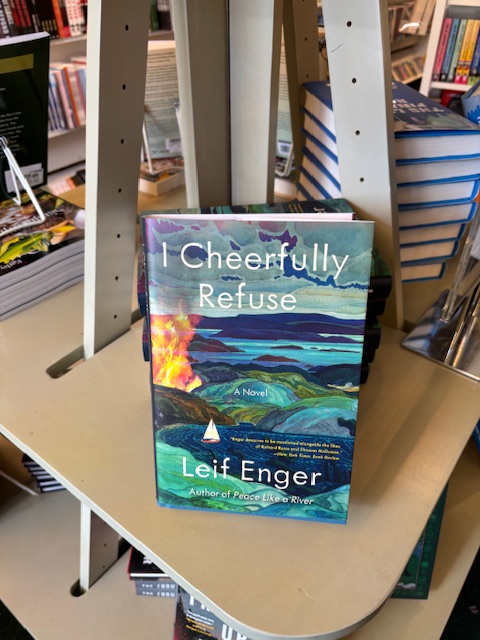
A couple of days ago when I walked into the store, I Cheerfully Refuse by Leif Enger, a book I’m currently reading, welcomed me. At the checkout counter, I discovered a display dedicated to Enger’s novels and an announcement that he would be appearing at an author event in Petoskey. The clerk told me that the owner of McLean & Eakin is a huge Leif Enger fan. I own all of Enger’s novels, so I bought The Frozen River by Ariel Lawhon, which is supposed to be a wonderful historical novel. The story, inspired by a real midwife’s diary, takes place in Maine in 1789.
Leif Enger will be doing an author event in Petoskey on April 23, 2025.
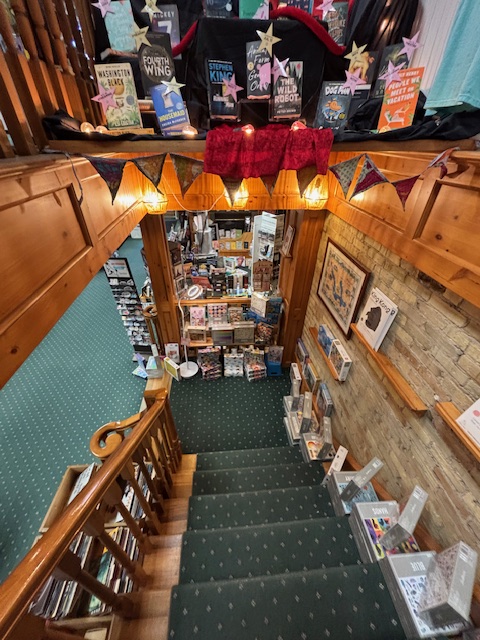
From the outside one might expect McLean & Eakin to be quite small, but it’s two stories, so customers will find plenty of titles. The main entrance is on Lake Street, but if you go around the block to the back of the building, you’ll find another entrance, also at street level but one story lower. The G & A Building, like many structures in Petoskey, was built into a hill.
The staff is always friendly and helpful. On more than one occasion, I’ve watched a clerk function as a human algorithm: A customer feeds the clerk titles of books they’ve enjoyed, and the clerk starts suggesting other books they might like.
McLean & Eakin offers a rewards program, and even though I live over nine hours away, I joined. At first I resisted because I lived so far away. But as I traveled to Petoskey more frequently, and as every trip included at least one visit to the bookstore, I signed up. There is no fee to join the rewards program, and I realized it was financially foolish not to belong. For every $100 dollars I spend, I receive a ten-dollar coupon. On this trip to the bookstore, I earned my third coupon since enrolling in their rewards program.
In addition to books, customers can shop for greeting cards, stationery, writing journals, puzzles, games, candles, stickers, coffee mugs, socks, and other miscellaneous items. At the back of the store on the main level is a charming children’s section.
At one time people could walk into the Persian Bazaar and take home a piece of a faraway world. Today people can walk into McLean & Eakin, buy a book, and read themselves into another world. After I finish I Cheerfully Refuse, which has taken me forward in time to northeastern Minnesota along Lake Superior, I will read The Frozen River, which will take me back to 1789 in Maine.
Its belly wounded, the Italia hangs in the air, brooding over a group of explorers who stand on the frozen, barren Arctic snow. The sun flames between the sky and the ice, perhaps a promise, perhaps an omen. The cover art compelled me to buy the book.
The title, Realm of Ice and Sky, invited me to enter a world ruled by those two endless and formidable expanses and to meet the men who risked their lives, their money, and their reputations in search of fame and glory and discovery as they vied for the North Pole and a place in history.
The subtitle, Triumph, Tragedy, and History’s Greatest Arctic Rescue, promised me a shipwreck story of sorts, and I love nonfiction books about shipwrecks.
Each night I would sit on my cushy couch with a patchwork quilt over my legs and enter the realm of ice and sky. I followed the adventures of Walter Wellman, Roald Amundsen, and Umberto Nobile, who were all driven by an inner desire to venture into a dangerous and largely unknown world, reaching for a sense of immortality.
While Levy’s book isn’t a biography, he does delve into the lives of Wellman, Amundsen, and Nobile just enough to give readers a glimpse of who those men were and what inspired them to leave the comforts of civilization and venture into the hostile and largely unexplored regions of the Arctic. Wellman, Amundsen, and Nobile were all talented, knowledgeable explorers, who, when it arrived, faced adversity and danger with calmness and bravery.
But Levy refrains from portraying these men simply as heroic figures because, although they could be heroic, they also had their faults. In the early 1900s, Polar explorers were a small, tightly-knit group who looked out for one another. However, they could also be aroused by petty jealousies that sometimes became public disputes, which their fans eagerly followed in the newspapers and radio broadcasts of the day.
The beauty of Levy’s book goes far beyond its cover. Levy’s talent for clear descriptive writing lets readers easily imagine the enormity of the airships, marvel at their mechanical intricacies, and hold their breath as the crews battle against the unpredictable Arctic weather of ice, snow, rain, hail, and gale-force winds. Readers can picture the magnificent views from the top of the world: the midnight sun, the blindingly-white snow, and the changing hues of the ice floes and water.
Levy, an award-winning author, deftly weaves together the stories of explorers who conquered the earth’s last frontier, the rise of airships, and the dawn of the golden age of radio. Starting with Wellman, explorers could send messages via radio transmissions to the outside world, giving almost real-time updates of their progress, which then appeared in newspapers and radio broadcasts, feeding a public who hungered for the thrilling news of the Arctic explorations. It’s been almost a hundred years since the airship Italia flew over the North Pole, but stories of daring explorers still fascinate us, especially when told in the capable hands of an author like Buddy Levy. [For more about Levy and his work, click here.]
In addition to a well-written and well-researched story, readers will appreciate the book’s extras. Maps at the beginning of the book track the different flights and give readers a better understanding of the geography of the North Pole and Arctic Circle. The table of contents and index make it easy to find information. At the end of the book, there is a glossary of airship and aviation terms, a list of each expedition and the crew members who participated, and a bibliography. Sixteen pages of wonderful photographs are also included.
I liked this book so much that I plan to read two other books by Levy: Empire of Ice and Stone: The Disastrous and Heroic Voyage of the KarlukandRiver of Darkness: Francisco Orellana and the Deadly First Voyage Through the Amazon.
Shepard’s historical short story takes place in May 1937 aboard the Hindenburg while on its doomed flight from Frankfurt, Germany, to Lakehurst, New Jersey. Among the ninety-seven people aboard the airship are two male crew members who are in love with each other. It’s a powerful story, written with a lyrical heaviness that foreshadows both the impending explosion of the Hindenburg, and the looming disaster of World War II.
Some extra thoughts:
Until I saw this book, I had no idea that dirigibles had been used in Arctic explorations. I knew only two things about these airships. One, that the Hindenburg had exploded in Lakehurst, New Jersey, in 1937, killing thirty-six people. In my high school history class, we watched the newsreel footage of the explosion and fire, while we heard the radio reporter’s poignant utterance, “Oh, the humanity” as the burning airship crashed on the ground. My second experience with airships was watching the Goodyear Blimp fly above arenas in order to provide overhead coverage of sporting events.
After reading Realm of Ice and Sky, I did a little research on dirigibles. Below is a YouTube video about the USS Akron disaster, which had seventy-three fatalities compared to the Hindenburg‘s thirty-six. It’s about ten minutes long and very interesting. [Footage of the Hindenburg disaster is easy to find on YouTube.]
Always some refreshments available Foxes & Fireflies
Bookstores are great because they have books (the best), but many bookstores have a lot of other cool stuff. Bookmarks, jewelry, socks, toys, gadgets, stationery, journals, games, bookmarks, ornaments, pins, coffee mugs, jigsaw puzzles, stickers, candles, stuffed animals, chocolates.
So, if you’re looking for a perfect Valentine’s gift for someone special, and you’re looking for something unique, try a bookstore, even if your someone special isn’t a reader.
If your Valentine is a reader and you know what book they want – good deal, buy a book. If your Valentine is a reader and you don’t know what book they want – buy a gift certificate. If you want to step up your Valentine’s Day game, add another gift to the book or the gift certificate. Scroll for ideas!
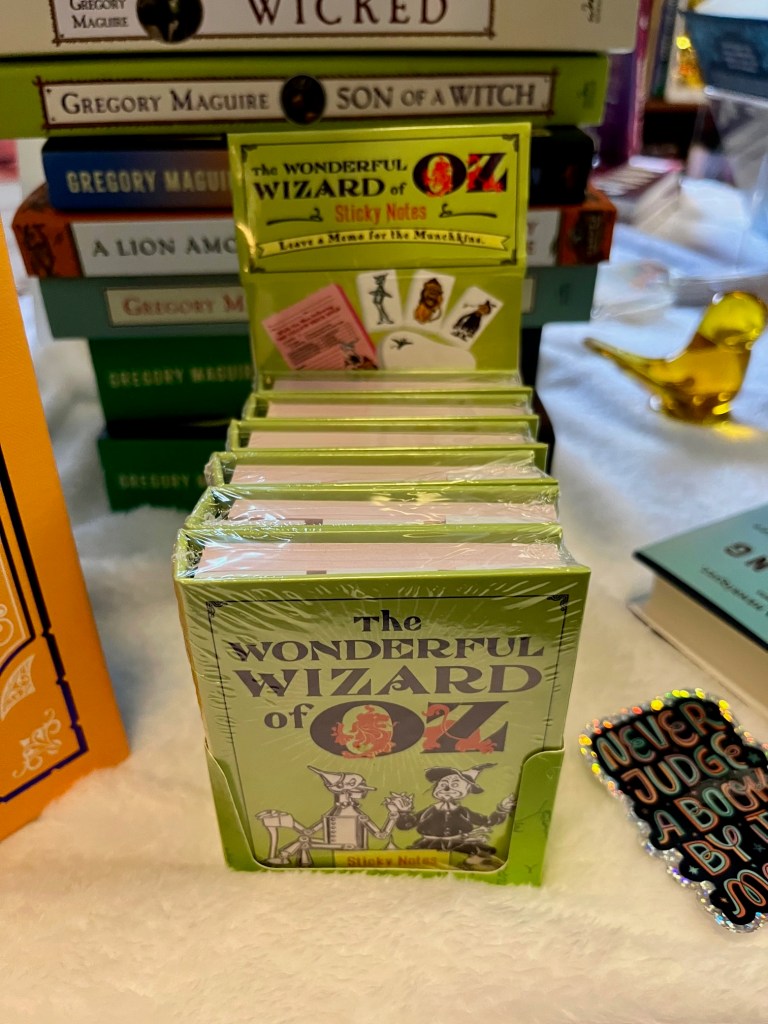
Does your Valentine love sticky notes? Do they love to use them to mark their favorite passages in books? Do they still enjoy a trip down the yellow brick road? This palm-sized book of Wizard of Oz sticky notes is sure to please both good and bad witches!
Little Valentines would love one of these 3-D printed creatures. Their moving parts make them good fidget toys.
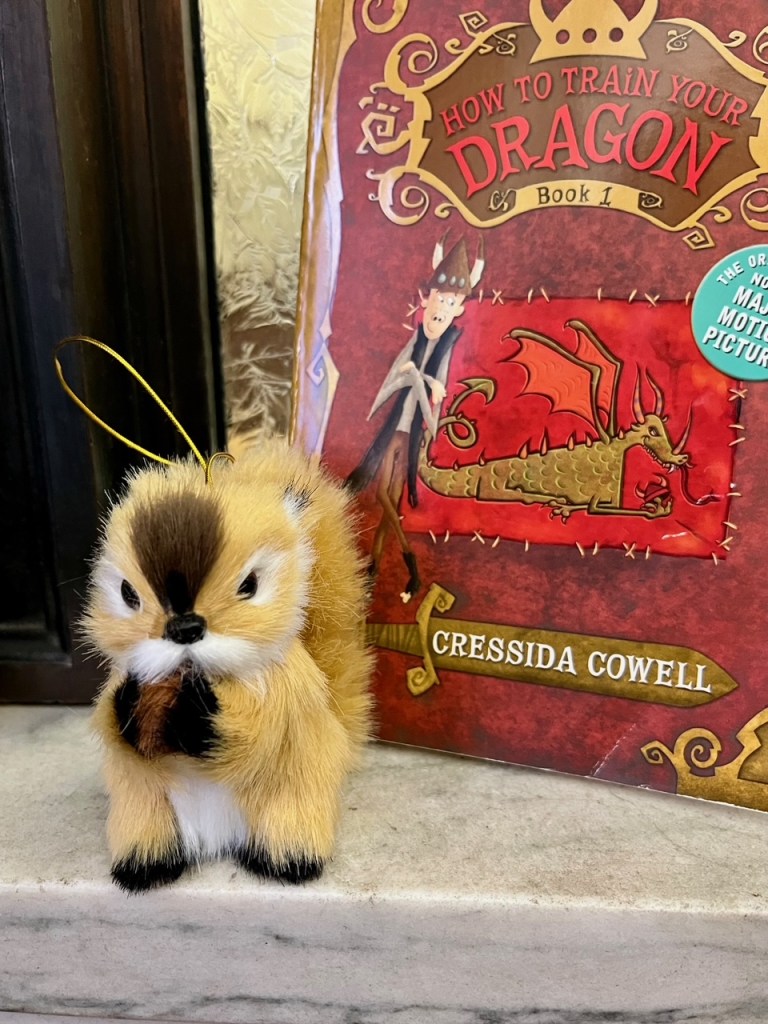
A chipmunk ornament
An Arctic fox ornament
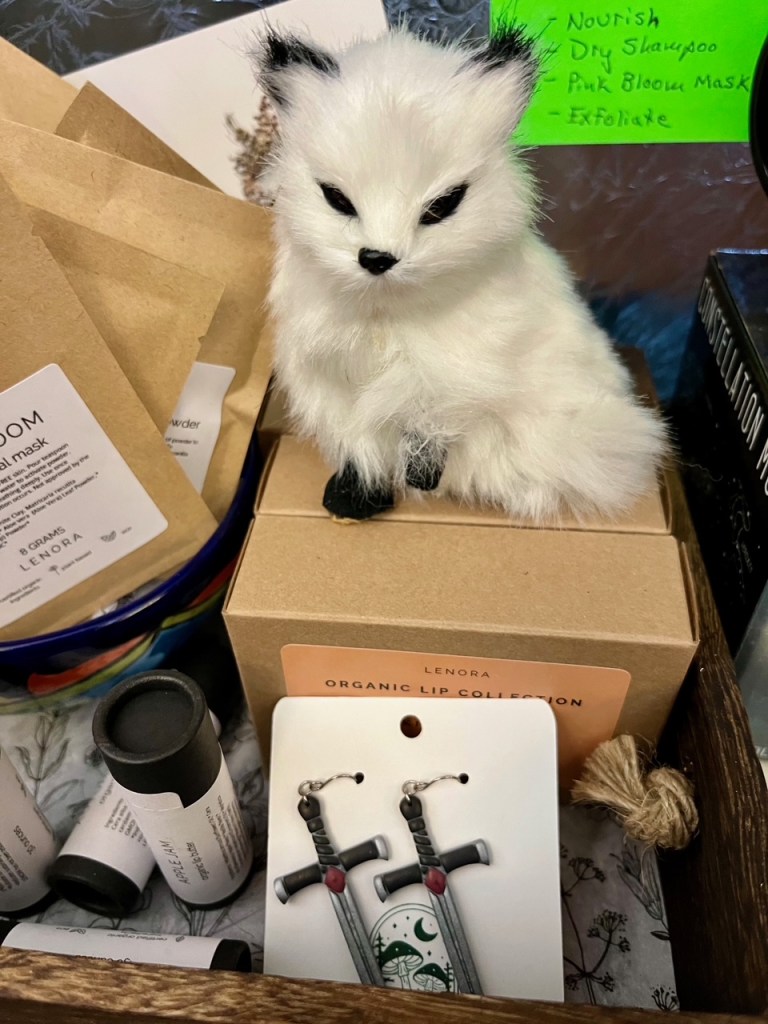
A small fox figure guarding lip balm, facial masks, and earrings
An earnest fox figure, seems to say, “Just keep reading. No need to get up and cook or do the dishes.” As your browse for books, look for the squirrels, foxes, and chipmunks. They are for sale. They make wonderful reading buddies.
These sweet dioramas can be found throughout the store. Does your Valentine like to build models? Kits are available for purchase.
The Foxes & Fireflies mascot is the perfect teddy fox for young Valentines who like to snuggle with a friend during story time.
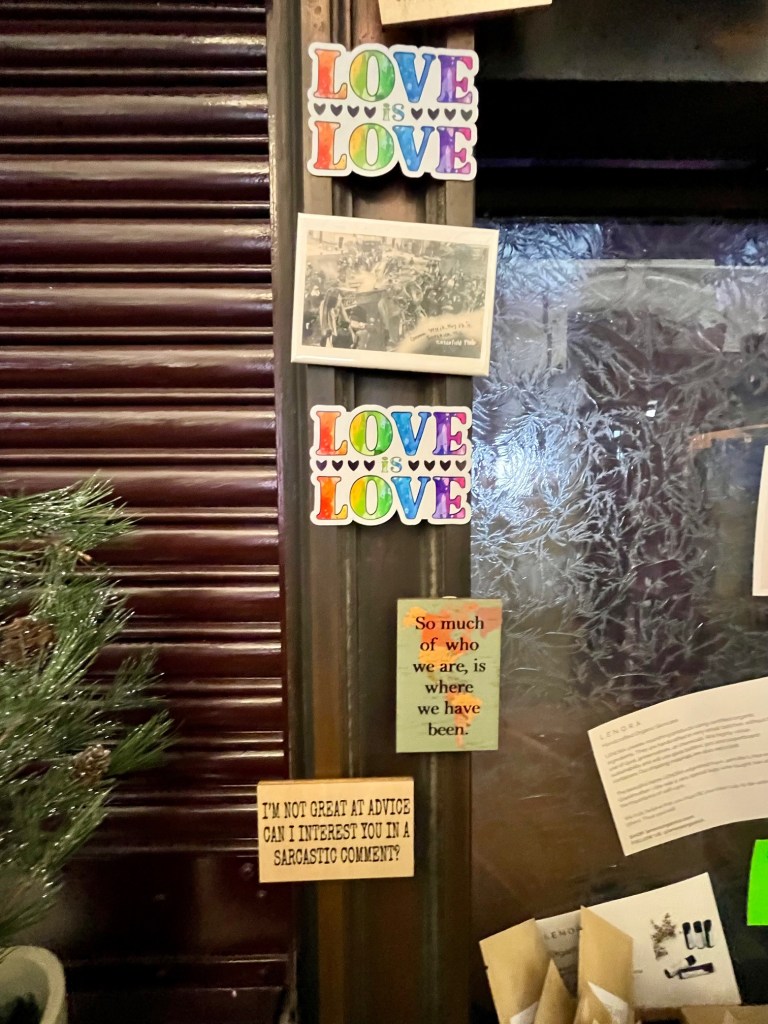
Throughout the store, magnets are on display for sale. Find the words that capture your Valentine’s personality.
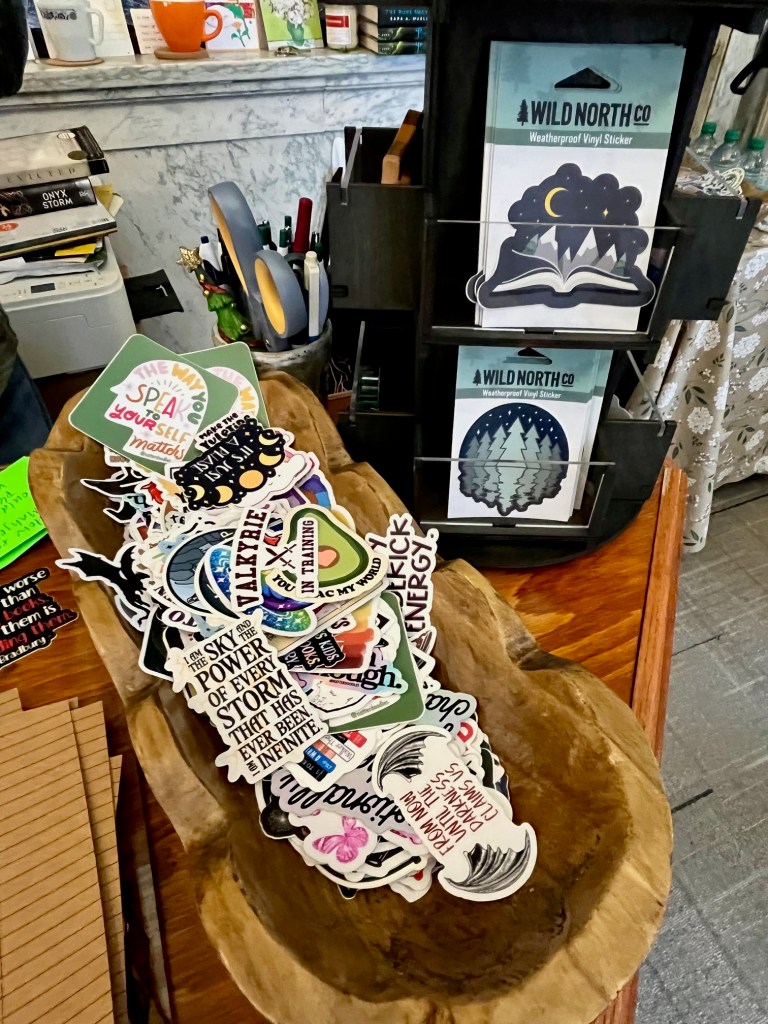
Stickers! Think of these like the Valentines we gave each other in elementary school. People like to put these on travel mugs and computers. I like to put mine on the inside of my writing journals.
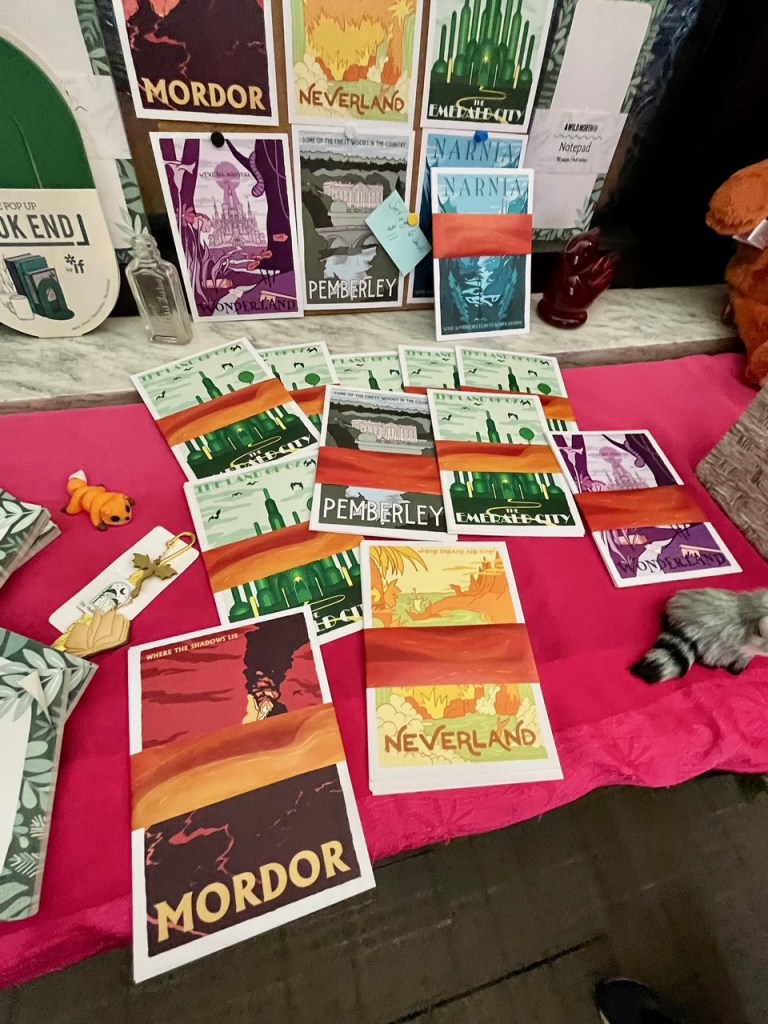
Postcards from your Valentine’s favorite fictional worlds.
Stationery, journals, calendars, and a few Valentine cards. I found the perfect Valentine’s Day card for my husband!
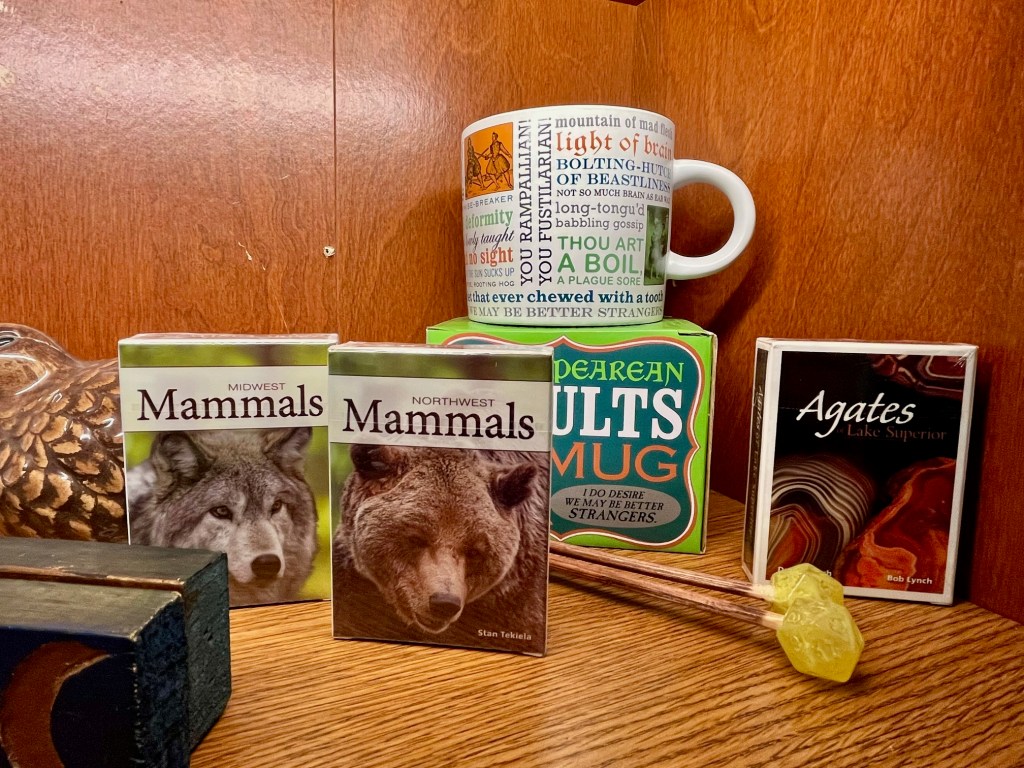
Playing cards and coffee cups. Note, the coffee mug features Shakespearean insults. Should you have a lover’s spat — you can trade first-rate barbs by the bard.
Jigsaw puzzles and crystal hearts
Reading journals formatted for your Valentine reader to record the books they read
Plush and soft, great accessories to go with a book from the children’s section
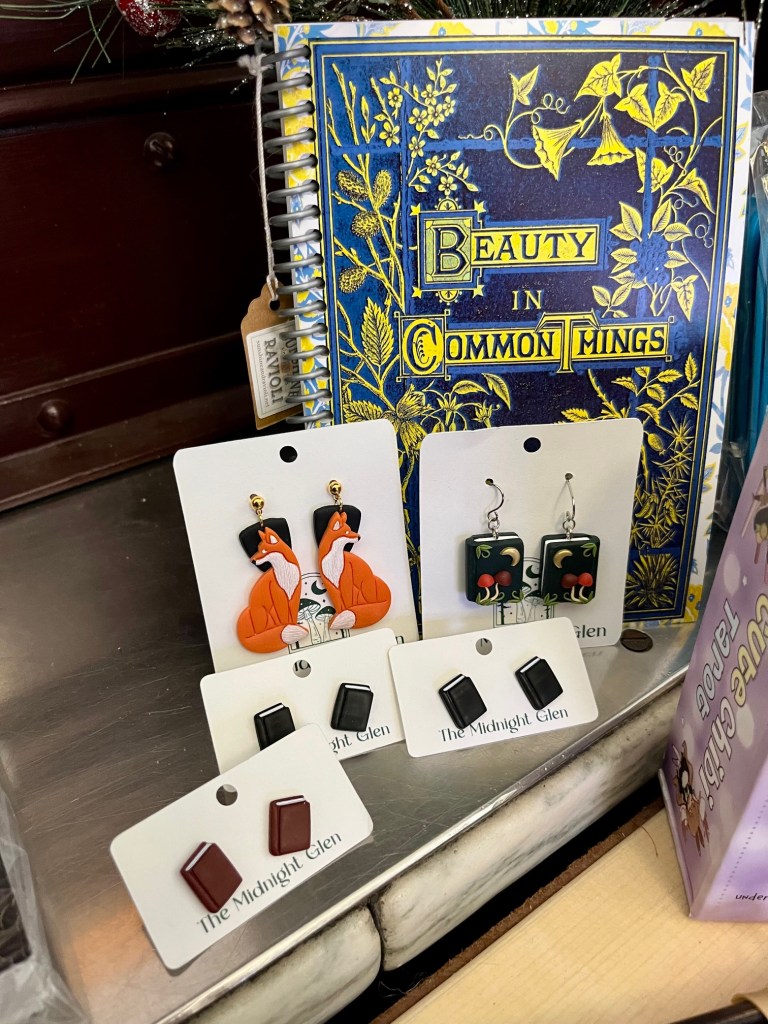
Earrings
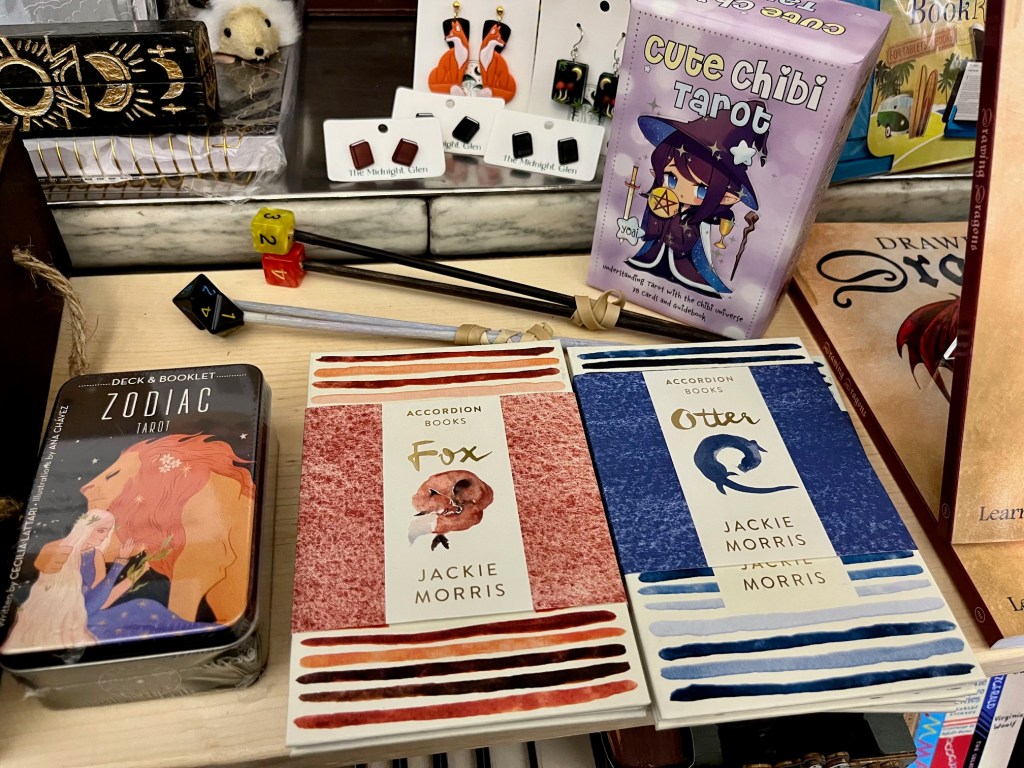
Tarot cards and accordion books
Wooden journals and candles in a jar
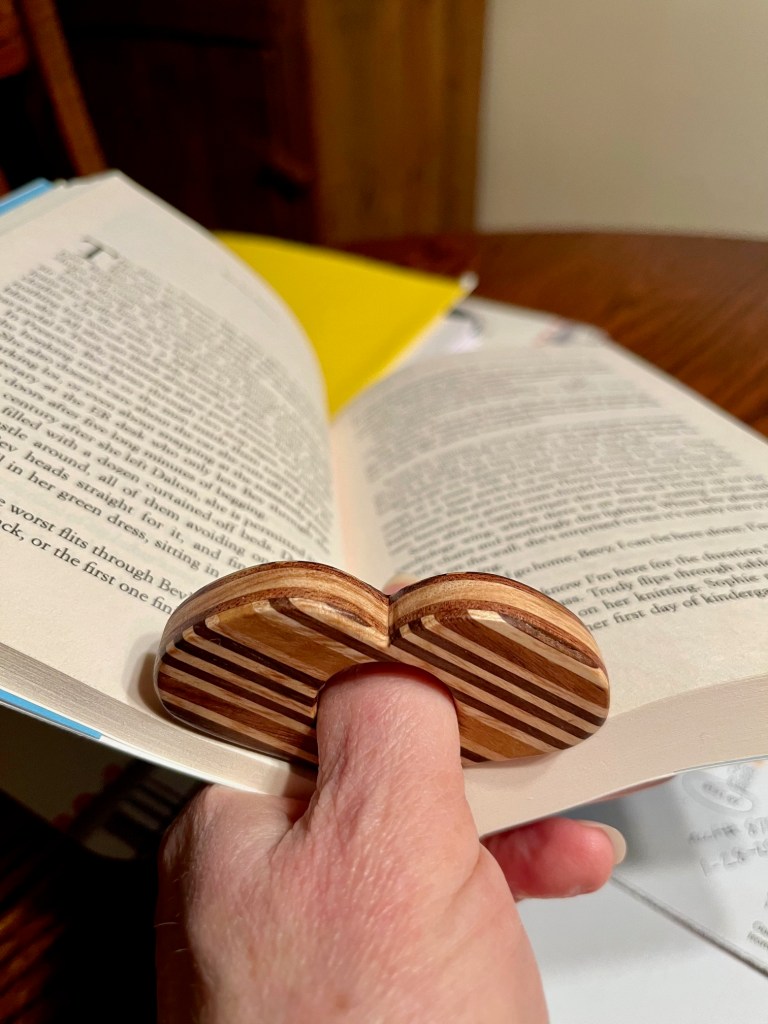
A great gadget that lets
your Valentine read with one hand
comes in wooden and acrylic designs
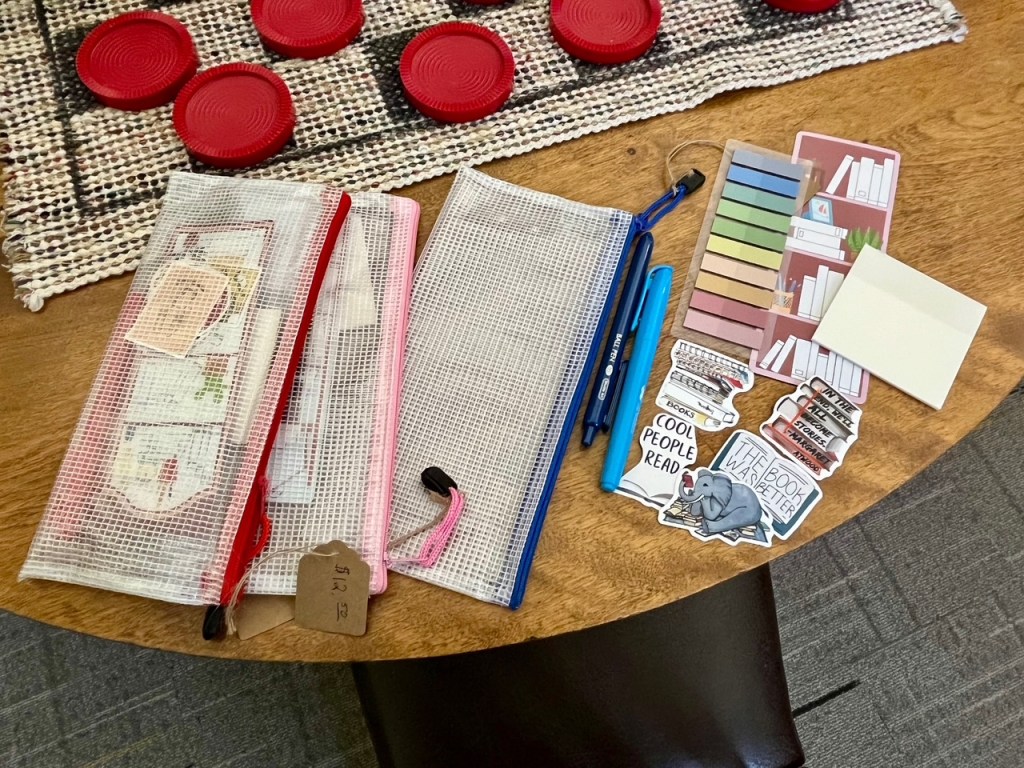
Pencil cases filled with stickers, sticky notes, tabs, a bookmark, a pen, and a highlighter
Wooden keychains and earrings
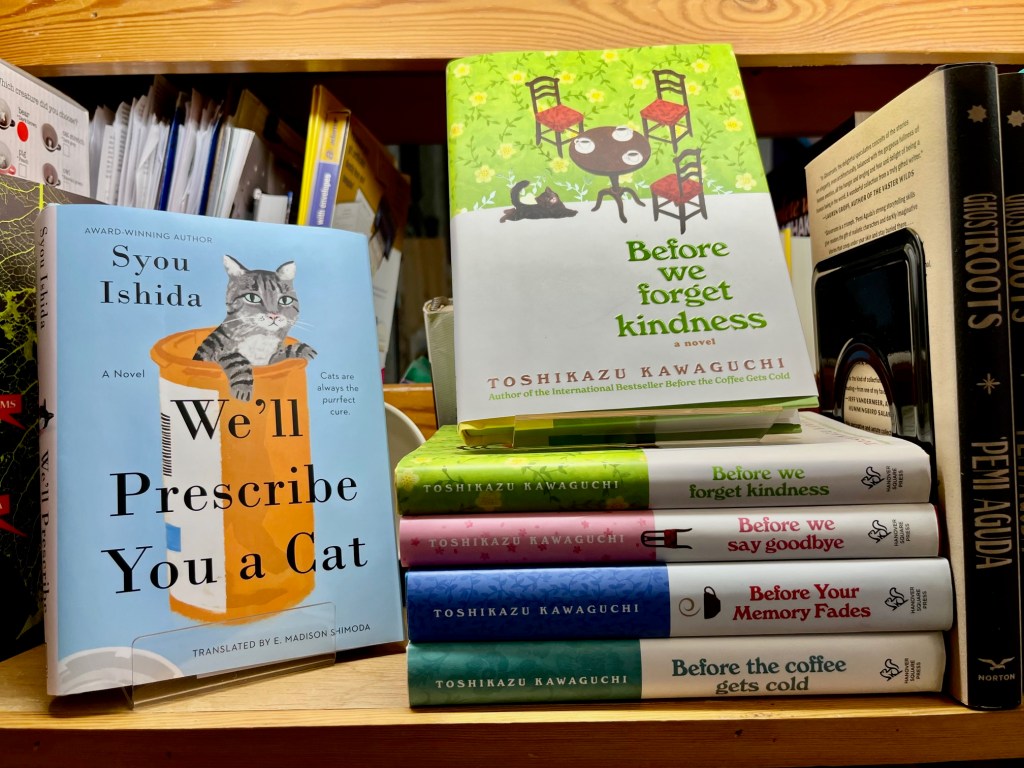
And books! I read Before the Coffee Gets Gold, and loved it. These cozy Japanese novels take readers away to quiet worlds filled with a bit of magical realism. I’ve got my eye on We’ll Prescribe You a Cat.
One look at the book’s magnificent cover art and my heart was pounding out of my chest, like a cartoon character who has taken one look at another cartoon character and fallen hopelessly, immediately, completely in love.
Look at that gorgeous airship, hovering over the frozen landscape.
How had I never heard about an airship and an arctic rescue?
Those of you who read my book reviews know I like to read about shipwrecks. Something you don’t know about me is that I think airships are fascinating. Mind you, I wouldn’t get on an airship, any more than I would get on a ship.
I want the book. But I’m on a book diet right now, which means I stop buying books for two or three weeks while I read some of the books on my TBR stacks. (This doesn’t always stop me from cheating and buying a book anyway.) On Monday, I decided to resist temptation by using my local library. But this book was just released, and my library doesn’t have a copy yet, and copies aren’t available through inter-library loan.
I’m making a deal with myself: (1) read a couple of books from my TBR stacks, (2) wait until at least February, then (3) declare that I need a present for Groundhog’s Day.
When I told my husband I was dedicating my book to him, he said that I should dedicate it to our dog Ziva. She logged a lot of hours with me while I wrote.
In February 2027, my first book, a collection of short stories, will be published by Cornerstone Press, which is run by the University of Wisconsin-Stevens Point. Yay! (Imagine an emoji of happy, dancing feet here.)
I spent five years working on my collection of short stories. Every time I submitted a story to a journal or a contest, I sent a bio. In each bio I started writing: She is currently working on a collection of short stories. Because I wrote this in my bios, I kept writing short stories. After all, I didn’t want people to think my words were fluff. For me writing and submitting to journals was scary enough, but the idea of getting a book published was scarier. So, every time I wrote the words: She is currently working on a collection of short stories, I eased my way through my fears. Putting it in words over and over made it less intimidating and eventually kind of like saying, Yeah, I’m going to get my nails done on Saturday.
I also told myself if I finished enough stories to have a book-length collection, then I would have met my goal. I had done what I said I would do — write a collection. That didn’t mean the stories had to be published. Right? For me, the idea of getting published was terrifying. I worried about everything. Will people like my stories? Will anyone read my book? Will I have book signings and be the only one there? Will anyone buy my book? Will people like me? What if I mess up when signing someone’s book? Can I use an erasable pen? I waffled so much over whether or not to submit my short story collection to publishers that I could have become my own Waffle House franchise.
At the end of 2023, I had enough stories, but not enough courage. Then I discovered the Iowa Short Fiction Award and the Flannery O’Connor Award for Short Fiction sponsored by the University of Georgia Press. These contests are for emerging authors. I entered both of them. I didn’t believe I stood a chance of winning anything, and that made submitting my stories to them less nerve-wracking. But I took each entry seriously. I read all my stories out loud and silently, again and again. I had my readers rank which ten stories they believed were the strongest so I could place them at the beginning, middle, and end of my collection. I didn’t win anything in either contest. But after I sent my collection off to the Iowa contest, I started writing in my bios: She recently completed her first short story collection and is querying publishers.
After receiving rejections from the Iowa and Georgia presses, I waffled some more. I think I might have driven a few people crazy with my waffling. And I’m so grateful that none of them told me to shut up and go away.
I was still waffling away, when I attended the Wisconsin Writers Association Conference in October 2024. While I was there, a few things happened that gave me a shove. First, I met Lan Samantha Chang, a wonderful writer who is also the director of the Iowa Writers’ Workshop. She was one of the guest speakers, and she talked about the scariness of writing and putting one’s work out into the world. And I thought, If Chang, an accomplished writer, can be scared, I can be scared. Next, I listened to a panel of three publishers speak about their presses and submission processes. Afterward, I introduced myself to the publisher of Cornerstone Press. I told him I enjoyed listening to him and the rest of the publishers. Then I said the words, “I have a collection of short stories that I’m going to submit to Cornerstone Press.” To which he said, “I look forward to reading them.”
I had done it. I had said the words out loud. At that point I knew I would have to submit my collection because I didn’t want the publisher to think my words were fluff.
I’m still scared of all that other stuff, but I’m going to take it one fear at a time. I can handle one fear at a time.
I didn’t write my collection of stories in vacuum. I owe a lot of gratitude to so many people and organizations.
I want to thank everyone who spent any amount of time reading my stories and giving me feedback. You were always helpful.
I want to thank the people who follow my blog and would read my stories when I posted a link to where they had been published. Your positive comments meant the world to me.
I want to thank the following organizations: Lake Superior Writers, Red Oak Writing, Wisconsin Writers Association, and Write On, Door County. These organizations were a lifeline during COVID. They pivoted to Zoom classes and gatherings that gave me and others a place to connect and be writers. They are all wonderful organizations for writers who want to learn more about their craft and spend time with other writers.
I want to thank all the writers, famous and not famous, whose works I have read and who have inspired me to be a better writer. There are so many talented writers, most of whom will never be household names.
I write short stories, so I read a lot of short stories. Lots and lots of short stories. Many of which I enjoy immensely. Some stories fade from memory after a few weeks. Others resonate with me for months, while some haunt me for years.
I’ve selected nine stories by five different authors that I read in 2024. I chose these nine out of the dozens I’ve read because as 2025 starts, I still think about these stories. I’ll be doing the dishes, or walking the dog, or standing in line at the grocery store, and one of these stories will pop into my head. These stories have stayed with me, even months after reading them. I’ve listed them in alphabetical order by author. There is no way I can list them in order of preference because each story is both unique and powerful, with beautiful prose, captivating plots, and intriguing characters. Each story is wonderful for its own reasons, making me say, “Gee, I wish I’d written that!” Best of all, these stories give readers plenty to contemplate.
[Click on the authors’ names to learn more about them and their books.]
Two stories from Hunger: A Novella and Storiesby Lan Samantha Chang (25th Anniversary Edition, W. W. Norton & Company, Inc., 2023)
1. “San” is a story about broken dreams and abandonment, and the struggle to survive both. The story is narrated by Caroline, whose parents emigrated from Taiwan before she was born. She tells the story of her father’s inability to claim his piece of the American dream, eventually causing him to desert his family. Caroline recounts the day she watched her father leave, taking her umbrella with him, never to return: “The umbrella had been a present from him. Now I stood and watched it go, bright and ill-fated like so many of his promises.” With stunning metaphors and beautiful prose, Chang creates a shifting setting and vivid characters that tell an ageless story in a new way.
2. “The Unforgetting” is the story of Ming and Sansan Hwang and their young son, Charles, who have emigrated from China and settled in Iowa. They speak Chinese in their home until one day when Charles’s fourth-grade teacher explains that their son’s English vocabulary is below average. The teacher suggests the family speaks only English at home. His parents follow the teacher’s advice, and a rift grows between Charles and his parents. Ming and Sansan never master English, making it difficult for them to express their thoughts and emotions with Charles, who, at the same time, forgets most of his Chinese: “Since they did not test [Charles], Ming never knew how long it took for all of those words to be forgotten.” Language is how people understand their worlds. Chang’s story explores how the stripping of one’s native language is more than a loss of vocabulary.
A story from The Effects of Urban Renewal on Mid-Century America and Other Crime Stories by Jeff Esterholm (Cornerstone Press, 2023)
1. “Long Ago on a Sunday in June” is the story of Patrick, who is almost fifteen. He wakes in the early morning hours on a Sunday to deliver newspapers. In the first paragraph, we learn Patrick won’t be coming home afterward because his body has been found in a field. The rest of the story is told as a flashback. We follow Patrick as he eats his breakfast and begins his paper route. We learn about Patrick and his dreams: “He wanted to get into Mr. Bukoski’s art class when he entered Port Nicollet High in September. That was a given.” He has a crush on his friend’s sister, and he wants a job at a pizza joint. We follow Patrick on the last day of his very ordinary life, and because we know how the story ends, and because Esterholm’s prose is both richly layered and nuanced, we are devastated for the life Patrick will never live.
Two stories from Close Call by Kim Suhr(Cornerstone Press, 2024)
1. “Play-School” is the story of four elementary-aged children who play a game of school. Young Mary plays the teacher, delivering lessons in addition and subtraction. During one of her lessons, she interrupts herself, lowers her voice, and pretends to be the principal as she announces, “It is time to begin our lockdown drill.” Told through the eyes of Willie, a first grader, “Play-School” explores the topic of school shootings and lockdown drills from the point of view of the children. (There are no adults in this story.) Suhr’s use of a child’s point of view, along with her realistic portrayal of elementary-aged children, creates a wallop in a short space. “Play-School” deservedly won first place in the 2024 Jade Ring Contest sponsored by Wisconsin Writers Association.
2. “Eradicated” is a dystopian tale set in the future where artistic creativity, now labeled a disease, needs to be eradicated, a goal that is nearly complete when we meet Dr. Bells, a scientist. Wishing to observe creative artists before the last of them dies out, the doctor visits an artists’ colony where creative people, who are considered to have disturbed minds, have been contained after being extracted from society. He wants “to hang out with people and ask, ‘What’s your medium?’ And say things like, ‘That’s so derivative.'” The themes in “Eradicated” are both timely and timeless. Marvelously written and exquisitely paced, Suhr’s story serves as a cautionary tale against intolerance and mindless conformity.
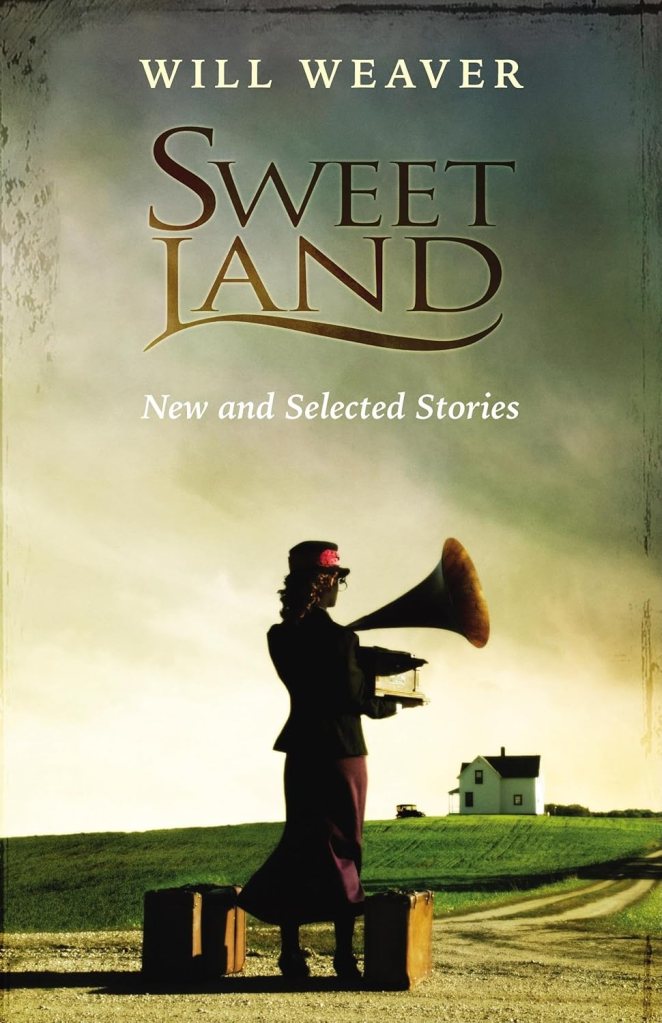
Two stories from Sweetland: New and Selected Stories by Will Weaver (Borealis Books, 2006)
1.“Flax Seed” is the story of a grandfather named Helmer who turns his farm over to his grandson, Kenny. With a handshake, Helmer states the terms of their deal: “Two-thirds, one-third. And no Sunday farming.” Kenny promises. He decides to plant flax, something his grandfather never grew. Farming is difficult. There is a time to sow, and a time to harvest. There is too much rain or too little. Too much heat or not enough. There are pests and diseases, rising and falling prices. There is often a race against time. For Helmer there is God. For Kenny there is the hope of flax and making good as a farmer. Helmer and his God; Kenny and his flax. And a difficult year. It’s a haunting story. Amen.
2. “A Gravestone of Wheat” is the story of Olaf who has loved Inge for forty-five years. They have farmed the land together and raised their son, Einar. They have welcomed grandchildren and great-grandchildren. When Inge dies, Olaf plans to bury her on their farm as Inge wished. But the law has changed: “‘You can’t bury your wife here on the farm,’ the sheriff said. ‘That’s the law.'” Olaf must decide if he will break the law and bury Inge on the farm or if he will bury her in town in the Greenacre Cemetery, knowing she despised the town. Inge has been his devoted wife for forty-five years. As Olaf ponders his choices, he recalls his first meeting with Inge and their unusual courtship, and readers are treated to a beautiful, but pragmatic love story. It’s a wonderful piece of historical fiction.
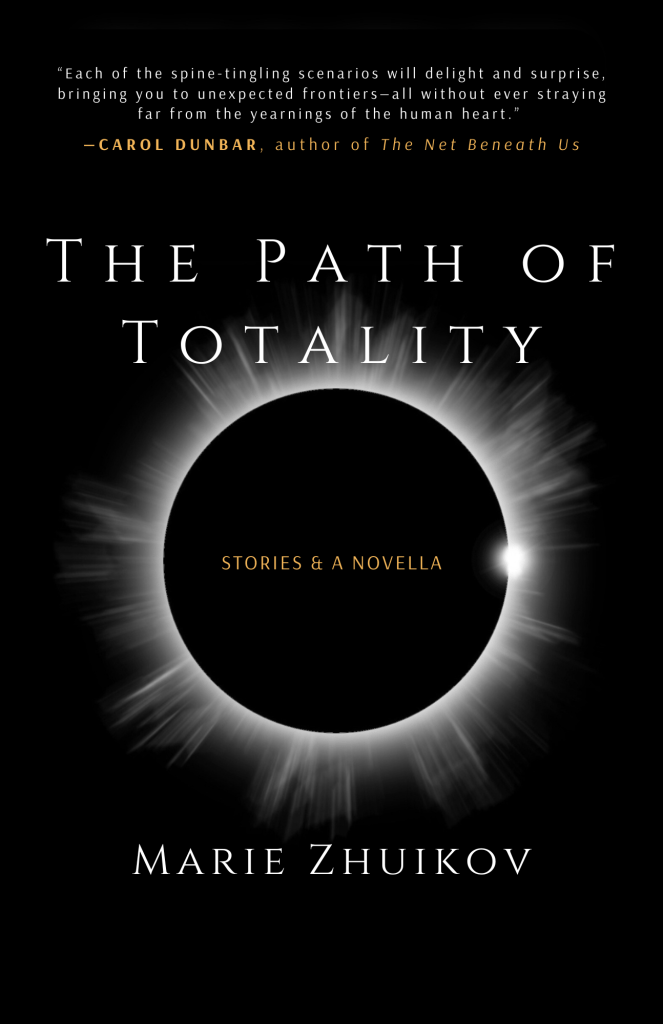
Two stories from The Path of Totality by Marie Zhuikov (Cornerstone Press, to be released February 2025) To pre-order Zhuikov’s book, click here.
1. “The Path of Totality” is the story of Marjorie and Justin, a young married couple, who travel from Medford, Oregon, to Salem, Oregon, to see the total eclipse of the sun. Caught up in a grief that both unites and divides them, the couple each experience the eclipse differently. Marjorie, along with other spectators, sees it all, astounded as the moon covers the sun. “But to Justin, the sun still shone as whole and bright as ever.” With eloquent prose, rich imagery, and well-crafted dialogue, Zhuikov’s story, told from the young husband’s perspective, is spellbinding. From a craft perspective, Zhuikov’s story reminds us that nature and natural events in our world can be powerful metaphors for human experiences.
2. “Bog Boy: A Northern Minnesota Romance” is set in rural Minnesota, where sixteen-year-old Natalie works at the Sax-Zim Bog, a nature preserve. On a spring day, while leading a birding tour, Natalie discovers a mummified teenage boy in the bog, whose remains are determined to be two thousand years old. The well-preserved teenager, with high cheekbones and beautiful hair, is handsome, and Natalie falls in love with him as only a teenage girl can – completely, blindly, devotedly. Because she cannot be without him, she brings the bog boy home to live with her and her father. Darkly humorous, “Bog Boy” combines the realm of speculative fiction with thought-provoking satire that made me laugh out loud at times. I still smile when I think about the story.