

The winds howl, trees drop leaves, and squirrels, in a frenzy, bury seeds. Halloween decorations are coming down, and Christmas decorations are going up. I wear my down coat and knit hat and sometimes my mittens when walking my dog. It’s the perfect season to enjoy cozy mysteries. I like to tuck them between the more serious books I read.
I enjoy a good cozy mystery, as long as it’s not too cozy. There has to be some close calls, some murder, and some despicable characters. But there also has to be some humor, some quirky characters, and it has to be tame enough to read or listen to before bedtime. Of course, the line between a cozy and a not-so-cozy mystery is subjective, but I know where my line is when I read one.
I have recently discovered two cozy historical mystery series, both set in England, that I like well enough to read the next book in each series.
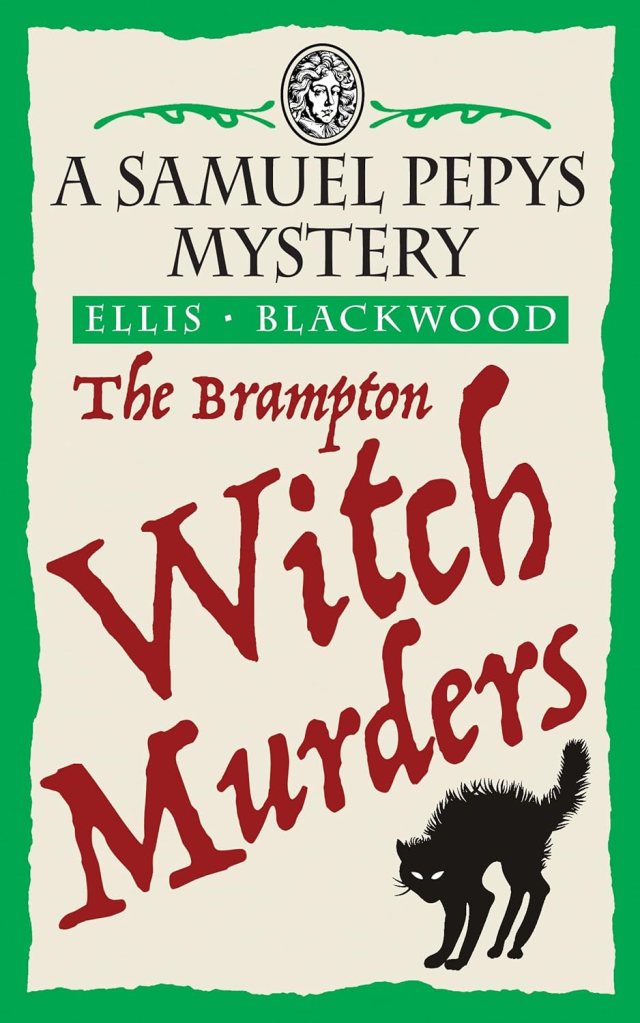
A Samuel Pepys Mystery: The Brampton Witch Murders by Ellis Blackwood
The Brampton Witch Murders is the first book in the Samuel Pepys Mystery series. It’s set in 1666 in England. Samuel Pepys runs an investigating agency in London. He has two inquisitors, Abigail Harcourt and Jacob Standish, who work for him. Pepys learns that his sister, Paulina, has been accused of witchcraft, and Simon Hopkins, a devious, zealous witch hunter has been sent to prosecute her. Pepys dispatches Abigail and Jacob to the village of Brampton, where they are to gather evidence to prove that the charges of witchcraft against Paulina and her friend are false. To complicate matters Paulina and her friend are accused of using witchcraft to commit murder.
[Note: The term inquisitors threw me at first because it made me think of an inquisition. I had to re-read the first few pages to understand that Abigail and Jacob were called inquisitors because it was their job to question other characters in order to uncover facts and evidence that would prove Paulina and the other women in the story were being falsely accused of witchery.]
Why did I like this book?
I liked the historical setting and subject matter of this cozy mystery. It’s scary how many characters in the story are willing to believe in Simon Hopkins and his accusations of witchery against the female characters without any proof. While men were sometimes found guilty and executed as witches, it was mostly women who were convicted and executed. Makes you wonder.
This is a fast-paced story and a quick, easy read. Because the book is small and a lot of the chapters are short, I kept it in my purse, so I could read it should I become stuck somewhere waiting for something or someone. The characters are interesting, the dialogue is good, and there are enough plot twists to keep readers engaged and guessing. And while it’s not thick with historical description, I still felt like I was in another time and place. Its themes of hysteria, greed, zealousness, and small-minded thinking are timeless.
A Lady’s Guide to Etiquette and Murder (A Countess of Harleigh Mystery) by Dianne Freeman
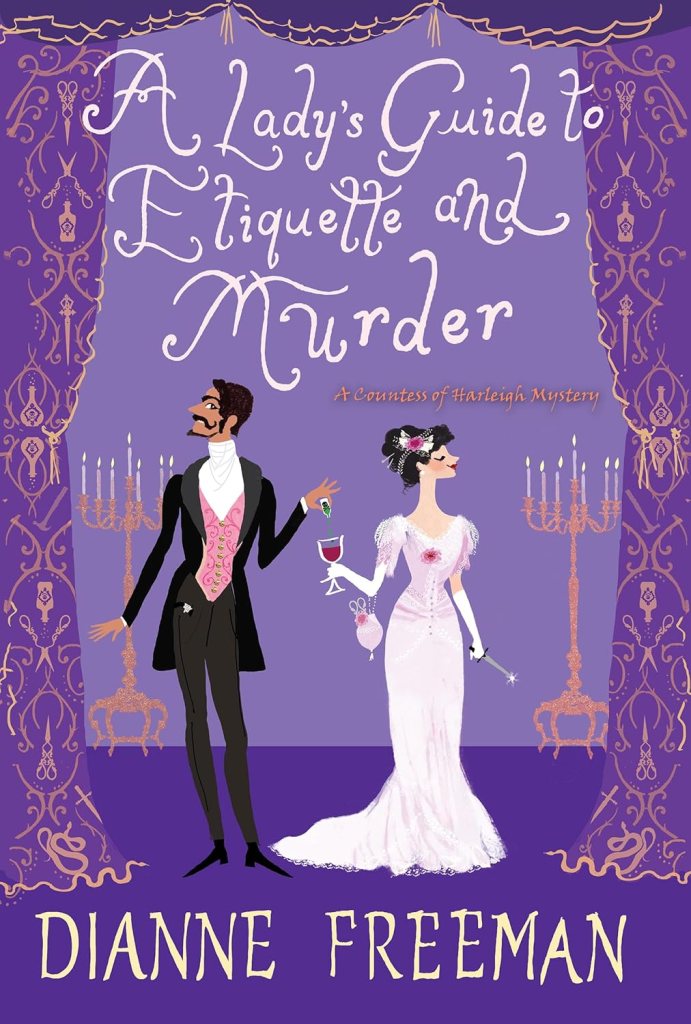
Set in 1899, A Lady’s Guide to Etiquette and Murder is the first book in Dianne Freeman’s series featuring Francis Wynn.
As a young naive woman, Frances was a wealthy American with an ample dowry. In a Downton Abbey move, she married Reggie, an aristocrat with a large crumbling manor and a shrinking bank account. Unlike the marriage between Cora and Robert Crawley, romance does not blossom between Frances and Reggie. After nine years of marriage, Frances’s philandering husband dies of a heart attack while in bed with his mistress. There is a cover-up because scandal among the British upper class is to be avoided at all costs. After a year of mourning, Frances leases a house in London and packs up her daughter and her possessions. She is determined to start a new life.
But life becomes complicated for Frances. A Metropolitan police officer shows up at her new home to inform her that the police are investigating Reggie’s death as a possible murder, and she is a suspect. Her brother-in-law has filed a suit against her and her bank account is frozen. Her sister arrives from America for her first London season. And, someone is stealing expensive items at society parties. On the upside, Frances’s next-door neighbor is handsome, intelligent, and helpful. Joining together, Frances and her friends, along with the Metropolitan police officer, work to solve the mystery of Reggie’s death and the rash of thefts at society gatherings.
Why did I like this book?
Freeman’s book is delightful. It’s narrated by the main character, Frances, who is witty, self-effacing, intelligent, unflappable, and perfectly charming. I enjoyed keeping company with her as she traded her widow’s clothes for amateur sleuthing.
With an undercurrent of humor humming through its pages, Freeman’s book gently pokes fun at the upper crust of British society in 1899. Embracing the bravado and the stiff-upper-lip mindset of the British upper class, Frances, her friends, and the police follow certain protocols and unspoken rules revered by Britain’s high society, even while solving serious crimes like murder and theft. (The rich do live in a different realm of reality, whether it be 1899 or 2024.) Freeman delivers a good mystery with an ending I didn’t see coming, except in hindsight.
I listened to this book on my library app. Sara Zimmerman reads this cozy mystery, expertly giving voice to a wide array of characters. I particularly felt her keep-calm-and-carry-on voice was ideal for the character Frances. I’m already listening to the second book in Freeman’s series.
 Writing Near the Lake