Ziva is pretty much back to her old self this morning.
Ziva loves to be with the grandkids when they visit. March 2024
Yesterday morning Ziva met Dr. F, a new vet, and Ziva loved her immediately, but she loves everyone. I really liked the new vet, too; although, I refrained from leaning my head against the vet’s leg and nuzzling her.
I had been nervous about having a stranger examine Ziva because she already has two other vets, Dr. J. and Dr. M., who treat her. I wanted Ziva to see one of the vets who currently care for her. But now we have three wonderful vets to choose from, which might make it easier to get an appointment when we need one.
From Tuesday, when I made Ziva’s vet appointment, until Thursday, when Ziva saw the vet, she had improved. However, I had videos on my phone to show the vet, so she could see how poorly Ziva had been moving in the previous days. The vet examined Ziva and determined that she most likely had a soft-tissue injury that needed to heal. The vet recommended increasing Ziva’s Librela shots for her osteoarthritis from every four weeks to every three weeks, giving her a three-to-five-day course of an anti-inflammatory medicine, and monitoring her movements.
Monitoring Ziva’s movements is the tricky part. Because when she feels better, she likes to run up the side of the house. She likes to run out to the front yard and prance around while she barks at a squirrel scrambling up a tree or a passing dog or the neighbor who is once again for the zillionth time mowing his lawn. Right now, I cringe when I watch her do these things, so I’ve been taking her outside on her leash. She’s limited to a couple of walks a day, but only around the block, which suits her just fine. And if I take her in the car, I put her on the leash and walk her to the back passenger door, so she can’t dance, prance, and spin in happy circles because she’s excited for a ride.
The reality is that while Ziva’s doing much better, going forward we’ll have to take care with her by limiting her exposure to situations where she could reinjure herself. But we’ll also have to make sure she is living the best life she can. This includes making sure she moves because “move it or loose it” applies to dogs too.
Ziva, cooling her toes in Lake Michigan, September 2023
Yesterday, after her rough morning, Ziva had a slightly better afternoon. She still slept most of the time, but when she did get up, she moved better, slowly and cautiously, but better.
I’ve become an expert at watching Ziva’s movements and her gait. I’ve been doing it for five or six years now. We walk a lot, so I’m able to note how she moves from day to day, week to week, and month to month. In 2017, I read Being Mortal: Medicine and What Matters in the End by Dr. Atul Gawande. He wrote that if doctors know what they are looking at, they can tell a lot about an older person by the way he or she walks. When I worked at a bookstore, medical students sometimes came in with a list of suggested reading (beyond medical texts) given to them by a professor. I always suggested they add Gawande’s Being Mortal to their stack because it deals with aging and death, topics about which they would receive little exposure to in medical school. They usually bought the book because I was able to convince them that geriatric and end-of-life concerns were going to figure in their practice — regardless of their medical specialties. And so, I watch Ziva’s gait and movements. I note the changes over time, and I can describe them to the vet in a manner that impresses her and helps her to treat Ziva. I did the same with Cabela, Ziva’s sister, as she aged.
When my husband and I came home from the grocery store yesterday afternoon, Ziva met us at the door and wagged her tail. I realized how much I take her incessant tail wagging for granted. We made a big fuss over her swirling tail and gave her a treat. It might sound like Ziva gets a lot of treats, and she does. Most days she eats her breakfast and supper too, as long as we doctor it up with good stuff (eggs, boiled chicken, a bit of canned food), what my husband likes to call “frosting.” Ziva isn’t overweight. Rather when we go to the vet’s, I hold my breath and hope she hasn’t lost another half-pound. When she weighs the same as she did the last time, I joyfully exhale.
Around three o’clock, while she appeared to be sound asleep, I whispered to my husband that I was going for a walk. Unbeknownst to me, while I got ready, Ziva got up, walked to the back door, and waited for me. (There is nothing wrong with her hearing or her ability to look like she’s in a deep sleep when she’s actually keeping tabs on her people.) She looked at me with big pleading eyes — the ones that say: You’re surely not going without me?
In the morning we’d agreed that Ziva should have lots of rest. No car rides, no walks, no extended outside time. But she stood at the back door, telling she felt better and wanted to walk. I worried she might tweak her injury if she stumbled. But I kept my comments to myself because she didn’t want to hear about my fears. She had her own. And even though she was hurting, she wanted some say in how she was going to get better. In that moment, I weighed her need for a small outing against the chances she might aggravate her injury. I decided her emotional well-being was important to her healing.
When I was nineteen and living with my grandparents, I got very sick. I was on bed rest for two weeks. Finally, I started to feel better. I wanted to do something other than lay in bed. I hadn’t been out of the house since coming home from the hospital, but I was weak. I called my mother, and I started crying as I explained how I felt. She told me to get out of the house for a bit, that if I felt like going out, it was a sign I was getting better. I called my girlfriend, who said that she and her boyfriend were going to a softball game, and they would come and pick me up, take me to the game, then bring me home. My grandmother and I had a big argument about my going out. Of course, she was worried about me. But I didn’t back down. I finally told her, “I called my mother this morning, and she told me I could go out for a bit.” I felt so much better when I returned home a couple of hours later; although, I did need a nap. My grandmother, noting my happy face, said, “It was so nice of your friends to take you out and bring you back.” I believe she was also relieved I hadn’t overdone it.
While I grabbed Ziva’s harness and fastened it around her, I thought about my grandmother and our argument. I explained the rules to Ziva. We would walk down through the grass instead of down the stairs, and our walk would be slow and short. We walked less than one city block, but Ziva went to the bathroom and sniffed a few of her favorite spots along the way. When I announced it was time to go home, she happily turned around. After we got home, she curled up for a big nap, but she had enjoyed herself. After her nap, she wasn’t any worse for the walk, but she didn’t want her after-dinner walk.
This morning Ziva is moving a little faster and with more confidence, but still carefully. And her tail wagging, while not back to normal, tells me her pain has eased a bit.
A little over a week ago, my dog, Ziva, slipped on the wooden stairs that run along the side of my house. She didn’t just lose her footing, she fell down. When she got back up, she could hardly put any weight on her back left leg. She’s thirteen and a half years old, so injuries are disconcerting.
At the time Ziva fell, we were headed out for a walk with my four grandkids. I thought I’d have to carry Ziva back in the house, but after she took a few steps, her leg worked better, but walking wasn’t easy for her. I figured we’d just walk across the road and let her tinkle, then go back home. But the more she walked, the better her leg worked. She resisted my efforts to turn around and go home, making it clear she wanted to keep walking, just like an athlete shaking off a momentary ache before getting back in the game. We completed our short walk, and Ziva did well for the rest of the day.
Then on Sunday, she must have done something that tweaked her injury. She likes to prance and dance around when she’s excited, especially if she’s outside and we’re getting ready to go for a ride or if she sees a dog walking down the street. She was a little gimpy Sunday evening, but not too bad, and she still insisted we go for her after-dinner walk. When she woke up on Monday, she was back to her old self.
But on Monday afternoon, she tweaked her injury again, probably getting out of the van. Because not long after her ride to the post office with us, she once again struggled to walk around. She was obviously in pain. She ate supper, but she wanted nothing to do with her after-dinner walk. At first I thought she wanted to walk because she stood by the back door. So, I put her leash on, and we walked onto the back deck. But she refused to move more than a few feet beyond the back door. We went back in the house, and she stood in front of the microwave and looked up at her treat dish. Her message to me: I walked a few feet, now I want my treats. Happy that she had an appetite, and that she still enjoyed bossing me around, I gave her a half dozen small crunchy treats. After she realized she wasn’t going to get anymore, she went to sleep on her bed in the family room, where she stayed for the rest of the night.
Tuesday morning when Ziva woke up, she was her cheery, tail-wagging self. Her walking was back to normal, and she was interested in breakfast and her morning walk.
But Tuesday afternoon after prancing and dancing in the yard, Ziva reinjured herself. And this time was worse than the other times. She was in pain. She struggled to walk. Anytime she got up from the floor, she stood still for a couple of minutes, as if waiting to see if she could trust her leg to move forward and keep her upright. She wouldn’t wag her tail.
I called the vet’s office, and because there was a cancellation, I was able to get Ziva an appointment for Thursday morning. I couldn’t believe our good luck. It’s so hard to get a short-notice appointment at my vet’s because they have so many patients and not enough staff. A pet has to be in dire condition, and Ziva’s injury doesn’t meet that standard. Even the emergency veterinary hospital, which is open nights and weekends, wouldn’t want me to bring her in because they wouldn’t consider her critically ill. They would tell me she could be seen by her regular vet. And her regular vet would tell me that I could take her to the ER vet hospital when it opened. It’s a classic Catch-22 moment when this happens. So much so that it gives me pause about getting another dog.
On Tuesday night after her supper, Ziva never asked for a walk or her post-walk treats. After I took her outside to go to the bathroom, she climbed into her large, cushy bed on the family room floor and went to sleep. Throughout the afternoon and evening, she never once wagged her tail. I was glad she had eaten supper and that she drank water, but I wanted to see her poofy tail twirl in the adorable circles it makes when she wags it.
I tried to walk without Ziva. I walked down to the road and started to go left, but that’s usually the way Ziva and I go, which made me sad. Then I discovered I had my T-shirt on inside out, which distressed me. I wondered if anyone would notice because I knew if I went inside the house to turn it right-side out, I wouldn’t come back outside. I decided to walk the other direction, but I couldn’t do that either. I was too sad without Ziva. There are times I have walked without her, but that’s because it was too hot for her or because she was taking a big nap and I didn’t want to wake her. This time was different because she wasn’t able to come with me. I went back inside and turned my T-shirt right-side out. I picked up a book and sat down on the couch. While reading, I kept looking up to watch Ziva as she slept, hoping she was healing.
This morning Ziva was only slightly better. In pain and not trusting her leg, she walked slowly. But before she went outside to the bathroom, she wagged her tail and asked for a treat. My husband and I both gave a small cheer while Ziva ate her treats.
Today there will be no walks or car rides. Ziva won’t go outside unless someone is with her to make sure there is no prancing and dancing. After we see the vet tomorrow, we’ll know more, but continued rest will probably be part of the treatment. We are keeping an eye on her. She can hop up on the couch or the stuffed chair, but when she wants to get down, she looks to one of us for help. As I finish writing this, she is sleeping on her bed in my office. She often joins me when I write. She is a mama’s girl. And she is my Ziva Baby.
Other than this blog, I mostly write short stories and essays, but I had so much fun writing this article. I also took the photos and wrote the captions. One of the highlights of writing this article was interviewing Carol, the co-president of the Lake Superior Rose Society, who was more than generous with her time. She is so knowledgeable about the Rose Garden and its history, plus she knows so much about roses and their history. I learned more from her than I could possibly include in my article, but her willingness to share her knowledge gave me the confidence to write about roses, which I knew so little about.
Our community is lucky to have a publication like Northern Wilds. The articles are well written and cover a variety of topics, such as outdoor activities, artist profiles, nature, ecology, tourist venues, community celebrations, and local restaurants.
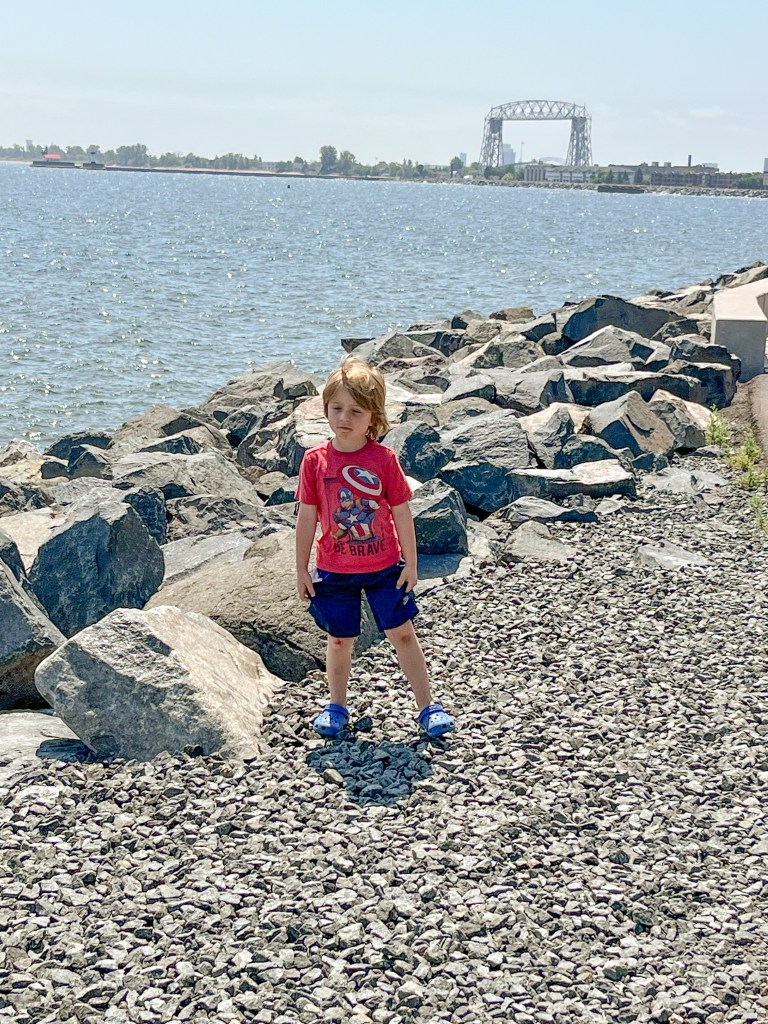
My youngest grandson strikes a pose along the Lakewalk. Check out his knees! That is how mine always looked when I was his age.
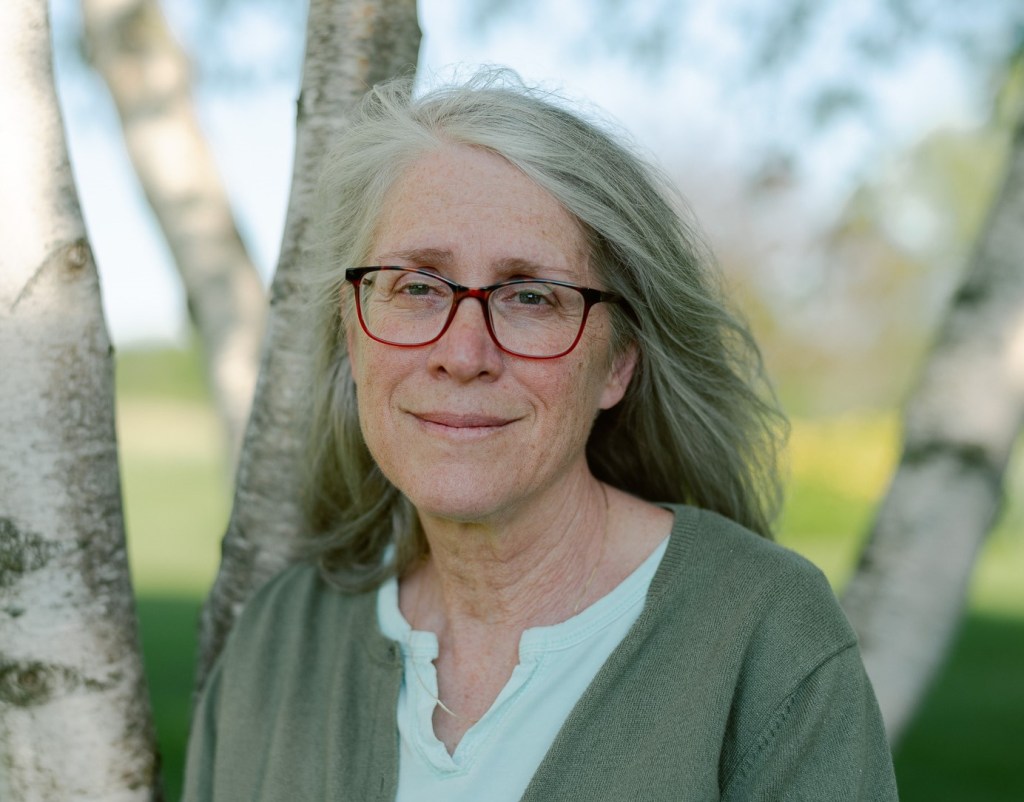
My favorite photo: Ziva and me, Petoskey, Michigan. Photo by Max Youngquist, July 2024
A week ago I wrote a blog titled “Writing and Waiting.” I was inspired to write the blog because a short story of mine was a finalist in the Wisconsin People & Ideas magazine, and I was beyond anxious while waiting to hear if it would win anything. I was so excited and nervous. Over the last few years, I have read many of the awesome short stories that have won or placed in the contest, and to have my story be one of the nine finalists this year was thrilling. And even though I was disappointed not to win anything, I’m so honored that the judges liked my story enough to make it a semi-finalist and then a finalist.
While driving over to my mother’s in Petoskey, Michigan, on July 1, I learned that my story had been chosen as a semi-finalist. And even if it was counting my chickens before they hatched, I worried about having a decent author’s photo, just in case my story won something. Before this I had wanted an updated photo because the photos I have been using for bios are candid photos taken by my husband, a stranger at a writing conference, and my granddaughter.
My nephew, who is a wonderful photographer, was also visiting my mother. So, after I arrived at Mom’s, and after I said hello to everyone and gave everyone a hug, I asked him if he would take some pictures of me after supper. He’s a big supporter of my writing. Shortly after we ate and finished up the dishes, he walked back into the kitchen with his 35mm camera slung around his neck. “Aunt Vickie, are you ready to have your picture taken?” He loves any excuse to take photos.
We went out into my mother’s beautiful yard. The sun, nearing the end of its day, created a magical light. We included my dog Ziva in some of the photos because she wasn’t letting me leave the house without her. She seemed to know she was part of a special moment. Even when my nephew took photos of just me, Ziva stood next to me.
Before the photo session, Max talked about taking more photos of me in different settings around Petoskey. After the photo session, I so loved the photos he had taken that I told him we didn’t need to go anywhere else or take any more photos. I don’t like having my photo taken, and I often feel that photos of me don’t turn out well. So, I felt lucky to have a lot of great photos to choose from. And I reasoned that if Max took more photos, I would have too many choices.
Even though my short story didn’t end up winning or placing in the contest, every time I look at the photograph of Ziva and me, I’m filled with love and peace. It reminds me of my kind and talented nephew Max and my loving and loyal dog, Ziva.
And I’m enjoying a sense of calm now because it’s at least a month or more before I expect to hear from other editors about other stories and essays I submitted this spring. As those deadlines approach, I plan to stay cool, calm, and collected. As if!
Me in Petoskey, Michigan. Ziva is on my right, next to my side. I selected this photo too because I figured it’s good to have one without the family pet. Although Ziva and I agree that having her in the photo with me makes me look better. Photo by Max Youngquist, July 2024
More about the Wisconsin People & Ideas writing contest . . .
I’m looking forward to reading the stories written by the 2024 winners. (Click here for their bios.) I have read the stories of past winners, all of which are wonderful. But there are three stories that stick with me. All three of the stories, besides being beautifully written and thematically rich, have at least one character that is unforgettable. I’ve listed the stories alphabetically by author’s last name because it’s so hard for me to pick a favorite. You can read the stories by clicking on these links:
Walking through Tom’s Logging Camp on Friday was a delightful diversion from waiting.
Children wait a lot. They wait for a parent to come home or to pick them up after a soccer practice or a dance class. They wait for a sermon to end or for Christmas morning to finally arrive. They wait for each birthday, and cherish the moment when they can add the half year to their age because their big day is that much closer. They wait for the bell to ring, dismissing fifth-hour study hall, so they can walk down the hall and hope that today when they encounter the seventh-grade classmate they are hopelessly in love with, their eyes will meet in a moment of magic. Learning to wait when one is a child is good preparation for having to wait as an adult. Because having to wait is not something a child can outgrow.
And writers wait. We wait for an idea to run with. We wait for the next time we can sit down to write. We wait for readers to give us feedback. We wait to hear from editors who will accept or decline our stories, essays, or poems. We wait to learn the results from writing contests. Once our work is accepted, we wait for our pieces to be published. We wait to see if we’ve been accepted for a writer’s residency. We wait for phone calls from our computer techs who tell us we can pick up our computers.
My parents taught me the art of waiting, which is probably how most of us learn to wait.
When I was a child, under the age of eleven, my father kept an airplane at the Hales Corner Airport, in Franklin, Wisconsin. My sisters (one thirteen months younger than me and the other four years younger) and I often went to the airport with my father. He would get the urge to work on his plane or hangout with other pilots, shooting the breeze about flying and planes — much like when I’m compelled to write or when I crave the company of other writers, so I can shoot the breeze about writing and books.
Unless my sisters and I were going on a flight with my father, we weren’t invited into the hangar. He would tell us to wait in the car, that he’d be back soon. It was never soon. He would crank down the windows, but heat stacked up in the car anyway, making us too warm. In addition to being bored beyond belief and hot, we became irritated. Our definition of soon was clearly at odds with his definition. We had a tipping point at which we risked his anger and got out of the car. But we never entered the hangar to ask him when we were going home. By a young age, we had learned this simply wasn’t to be done. This is partly why I can wait for months and months to hear from editors without contacting them, even when they’ve stated, “If you don’t hear from us after six months, please feel free to contact us.” I may never hear from them, and still they will most likely never hear from me. Those editors are in a hangar, and I’m not going in there.
At the airport my father always parked close to a tall metal pole topped with a bright orange windsock. The pole was surrounded by green grass, which was encircled by a ring of rocks, all the size of small dogs curled up for a nap. We would climb over the rocks and sit in the grass and watch the windsock as it shifted above us. The cooler air and freedom from the car helped, but our boredom and irritability soon returned. Eventually, our father would come out of the hangar. He might say a few terse words about us sitting around the pole instead of inside the car, or not. But either way we knew better than to ask him, “What took you so long?”
My ability to wait quietly doesn’t mean that waiting to hear about something I’ve submitted is easy. Far from it. I can pace with the best of the tigers. I perform menial tasks to pass time, but I end up feeling like I’m swimming in a pool filled with Salvador Dalí’s melting watches. As a projected date of a notification nears, I check my email incessantly. One moment, I convince myself that no one will ever be interested in publishing my work again. The next moment, I daydream that I’ve won a contest or that an editor has so loved my work, they gush about it, using bouquets of purple prose and ask, “Can you send us more?” (Yeah, Walter Mitty lives inside of me.)
When I first started submitting my work and received rejections, I was convinced I must be a lousy writer. I contemplated doing something easier — maybe washing windows on tall buildings, even though I’m terrified of heights. Then an editor sent me a rejection saying she had almost selected my flash fiction piece but had decided to hold off. She would keep it on the back burner but probably wouldn’t end up using it. It was an encouraging rejection, so I kept writing. A month later, she notified me that she had decided to print my story after all. Perhaps, I thought, I can write.
I keep submitting and mostly receive rejections. But I get just enough acceptances. So, like my old dog who hangs around the kitchen, hoping at any moment that she will get a treat, I keep checking my email, hoping at any moment I might receive an acceptance.
I get so bad about checking my email that I don’t open it if I’m working at my computer, I leave my phone in another room, and I make deals with myself. If I write for thirty minutes, I can check my email. After I walk the dog, I can check my email. After I finish all the dishes, I can check my email. After I’m done having coffee with a friend, I can check my email. If I go an hour without checking, I pat myself on the back, then hurry to check my email. The only reason I will confess this is because I’ve read essays written by other writers who admit they repeatedly check their email, especially when they know the date of an editor’s announcement is imminent. And if a writer submits enough pieces, there is always an announcement coming soon.
I often think of my mother when I’m waiting for an email from an editor. Before I learned to drive, I relied on my parents to drop me off and pick me up from school events, a job that fell mostly to my mother, who was always late. And there were no cell phones. To ease my worry while I waited, I played little games: If I counted to sixty, then she would come, then maybe one hundred, then perhaps fifty. I alternated that game with a counting-the-cars game: the tenth car on the road would be hers, then maybe the sixth car, then perhaps the eighth car.
For me, to write is to submit, and to submit is to wait. I find the more I submit, the easier waiting becomes because without waiting too long, I can look forward to (or be disappointed by) an email from an editor. But I check my email even more — a random reinforcement schedule is an effective motivator. If I have only a few submissions on the loose, it’s easier to ignore my email — at least until a notification date approaches.
I’m currently a finalist in a writing contest and waiting to hear if I’ve won anything. I have a short story set in 1860 entered in a historical fiction contest. My short story collection, which I entered in a contest, is hopefully being read and passed along to the next round. I’m waiting for an anthology of essays to be published because I have an essay in it. I have a short story under consideration for a British journal, and an essay under consideration for yet another British journal. I have a flash fiction piece entered in a regional contest. I’m hoping to hear about two articles I pitched to a local publication.
And so, I wait. I don’t sit next to a windsock. I don’t count seconds in my head or cars on the road. Instead, I push myself to keep writing. To get out into the world. To read a good book. To hear an author speak. To have coffee with friends. To go to lunch with my husband. To take my grandkids to Tom’s Logging Camp where we can look at old logging tools, feed ravenous trout and goats, and be ignored by an uppity llama who isn’t hungry.
And I silently thank my parents for making me wait around when I was a child.
Today after I post this blog, I’ll check my email. Then after I clean the bathroom, I’ll check my email. I have guests coming for dinner, and after they leave, I’ll check my email. (Perhaps, my parents didn’t make me wait long enough before exiting the hangar or picking me up from school.)
I taught my ten-year-old grandson Michael to play chess about six months ago. We sat at my kitchen table and played lots of games. I won them all. It never crossed my mind to let him win. I enjoyed feeling like a Grandmaster chess player, even if I was beating a ten-year-old child who’d never played before. Chess is a tough game. If he was going to learn to play, he needed to pay attention to the whole board and think beyond his current move, something I knew he would eventually do better than I ever could.
But a Grandmaster I’m not. I liked chess as a child, but I stopped playing when I was about thirteen. I was no good at the game because I could never think beyond a couple of moves. I never learned the higher-level strategies. I never thought or talked about the board in terms of numbers and letters. When I played against my sister or neighborhood friends, I won occasionally, but as I got older, my game didn’t mature, and I lost a lot of games. For me chess was no longer fun. I hung up my pieces and moved on.
So, when I sat at the kitchen table six months ago, beating my grandson in game after game, I enjoyed it because I knew it wouldn’t last. He is good at puzzles and games. He can read diagrams and build three-dimensional objects from many types of building sets. He can skip the directions and design his own creations. He watches YouTube videos to learn how to do things.
My grandson is eleven now. He has been playing chess with friends and watching friends play chess. He has learned some strategies. He thinks about his moves before he makes them. He thinks two or three moves ahead. I’ve started playing chess with him again.
We play in the front living room. He sets the chess board up on the coffee table and pulls up the ottoman. I sit opposite him on the couch.
Words between us are few. Chess is a quiet game. We watch each other contemplate moves. We think about our next moves. We work on seeing the whole board. There is no room for small talk. Sometimes one of my younger grandsons will come up to us and start talking. I put my hand up and say, “Michael and I are playing chess, and it takes all of our concentration. We can’t talk and think about the game at the same time.” They stop mid-sentence and back away, but in five minutes or less, one of them will forget and try to talk to us again.
My chess-playing grandson and I are evenly matched, for now. Our games last around twenty minutes. It’s a coin toss as to who will win. I give the game my all, but I don’t care if I win or lose because the victories are never lopsided. But I suspect in another year or two, my grandson will have upped his game again. My only strategy against him might be that I have no strategy, thereby creating chaos on the board.
My favorite part of playing chess with my grandson is the quiet camaraderie we share as we stare at the pieces and the board, each of us trying our best to win. And with four grandkids in the house, it gives me the perfect excuse to be left in peace and quiet for twenty minutes in the afternoon. I tell the other grandkids that barring an emergency, I’m not to be disturbed. And if they try, I hold up my hand and repeat, “Michael and I are playing chess.”
Memories don’t always have to be filled with words.
Photo: Max Youngquist, 2024 Instagram@maxyoungquist
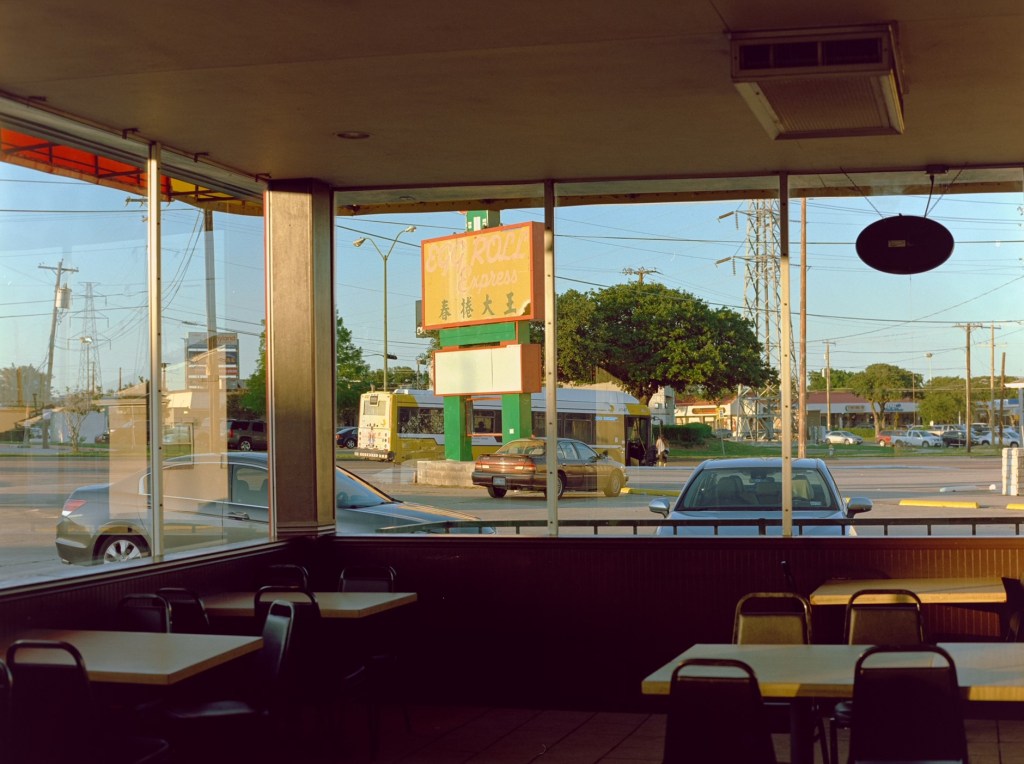
My nephew took this picture. He said that at first he wasn’t very impressed with the photo, but after looking at it for a while, he started to think it wasn’t bad.
I fell in love with his photo from the moment I saw it. “This photo,” I told him, “is full of stories.”
Some photos capture the beauty of a bird on the wing, or a sunset over an ocean, or a flower in the breeze, or a Japanese tea set at rest on an oak table. Those photos can be works of art, and we love them for their composition, study of light, and subject matter, but they are not a story in themselves, though they may evoke one.
My nephew’s photo is a story — even more than that — it’s a collection of stories. “This” I said, “is the kind of a picture a photojournalist takes because he or she is telling a story about a place or event or people.” Then I told him about all the stories I saw in the photo.
My nephew is a wonderful photographer. I love his work. I love to listen to him talk about his digital and film cameras. He develops both black-and-white and color film. He speaks of camera settings, film speeds, and film brands. Focus, depth of field, and lighting. And I understand enough of it because I took art photography and photojournalism classes in college, enough of them to minor in photography, if I’d only been willing to take an art history class. I loved photography, but not enough to make it a passion or career. Today my camera phone is all I need. But my nephew’s eyes are lens, always framing a shot. He has developing fluid coursing through his veins. And like a true artist, he experiments.
And with this photo, he has inspired me. I’m composing a story set inside of this moment he captured.
Photograph as a collection of stories. Tales about inside and outside, darkness and light, illumination and shadow. Stories of three cars pointed toward different journeys, a bus releasing and corralling commuters. Glassed reflections recounting illusions, faded signs whispering of past triumphs and failures. Photo by Max Youngquist
[Max asked me to write a blurb about his photo to post on Instagram. What I wrote is in the photo’s caption. You can see Max’s work on Instagram @maxyoungquist]
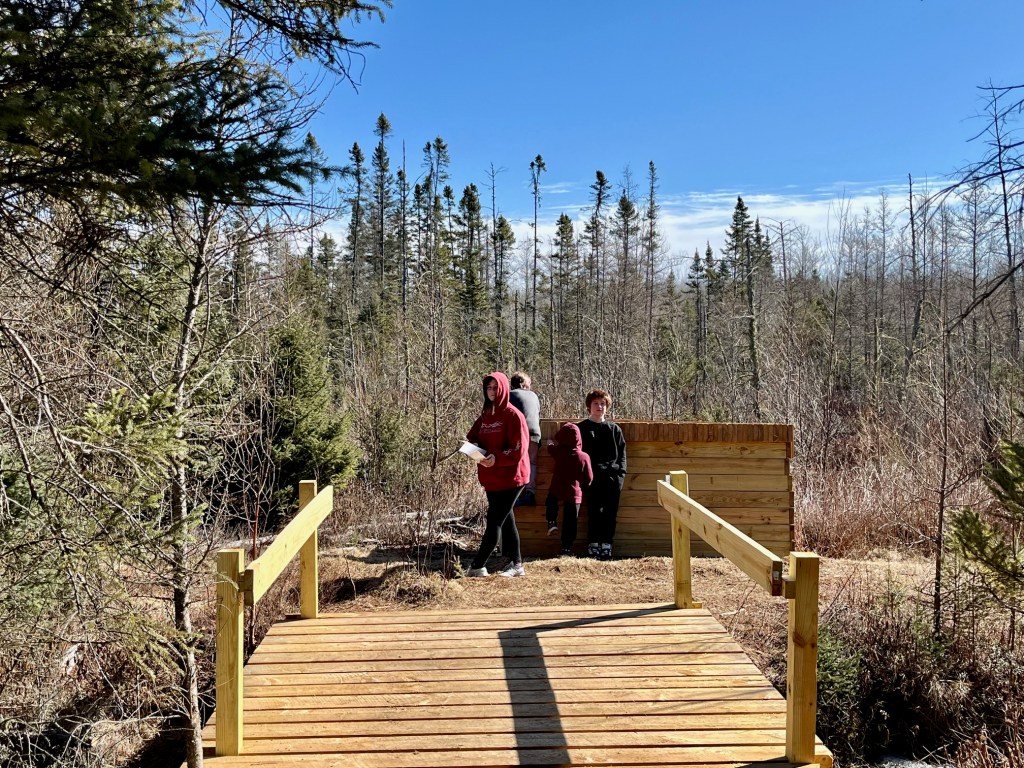
The John C. Gale Boardwalk, part of the Taiga Boardwalk built in autumn 2023
Last week I took my four grandkids to the Sax-Zim Bog in Toivola, Minnesota, appropriately located on Owl Avenue. (It’s a good place to see northern owls.) The drive from my house was one hour and four minutes. (Thank you, GPS.) The grandkids brought library books and their adventure bags, which are filled with postcards, maps, compasses, binoculars, auto bingo, bird books, and other adventuresome stuff. We weren’t one minute from my house when the three youngest grandkids took up an intense game of auto bingo, searching for cows, horses, ambulances, no parking signs, and billboards. However, by the time we were far enough out of the city to see cows and horses, the bingo game had blown over.
Of course, there is always one grandkid who wants to know: How far? How many more miles? Are we halfway there yet? Have you ever been here before?
We arrived at the bog’s parking lot about eleven o’clock. It was 52 degrees and sunny, with a slight breeze — perfect weather for walking through an old bog. But we were glad we’d worn sweatshirts over our T-shirts.
The Sax-Zim Welcome Center was closed, but we met a volunteer coming out of the building who looked like part of an illustration from a Jan Brett book. He kindly answered my questions about the trails because we wanted to walk on the new Taiga Boardwalk built last autumn.
Grandkids on the Taiga Boardwalk
Shortly after we started down the trail, a loud clattering commenced. I wondered, “What kind of bird is that?” Then I discovered two chattering squirrels chasing each other up and down tree trunks and across fallen logs at breakneck speeds like a pair of NASCAR racers. “Those are fox squirrels,” Michael, 10, said. “My grandma has them at her house.” His other grandparents live in rural central Minnesota. But, according to a post on the Friends of Sax-Zim Bog Facebook page, we most likely saw Red Squirrels. They are highly territorial, and one of them probably invaded the other’s space, which would explain their loud scolding sounds and serious chasing behavior. Whether fox squirrels or red squirrels, they were fun to watch.
As we walked through the bog’s forest, I thought about The Hidden Life of Trees by Peter Wohlleben, a book I recently finished reading. I learned a lot about trees and forests. True forests are diverse and interconnected in an amazing cycle of life and death, filled with competitiveness and cooperation, and home to a large variety of insects, animals, and other plants. Forests grown for harvesting are nothing of the sort.
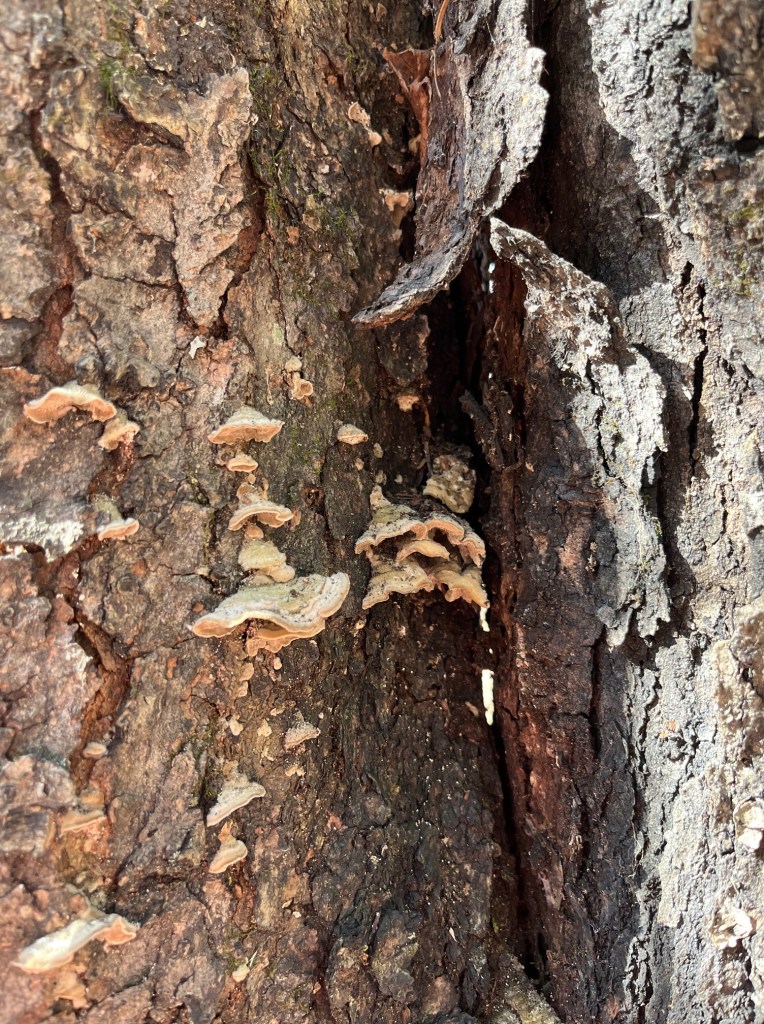
A tree near the end of its standing lifeClose up of same tree: the fungi have arrived
Walking along the trails of the bog, we saw different species of trees. New trees, only inches tall, grew under the branches of old trees. Unless the old tree dies, most, or perhaps all, of the baby trees we saw won’t make it to adulthood. Some standing trees looked nearly dead, waiting for their turn to fall to the forest floor. Tree trunks that had already fallen lay on the ground in different stages of decay, providing habitat for other creatures.
Steeped in tranquility, the breathless silence of the bog held no traffic or city noise. No planes droned overhead. Occasionally, the peaceful quiet was accompanied by the chirps and calls of birds and squirrels, which like the silence, belonged to the forest.
The Taiga Boardwalk loop is short, but it’s not meant for serious hiking. It’s a trail where visitors take their time, stopping to look for birds and animals who are masters at blending into the forest. When we finished the Taiga trail, we weren’t ready to leave the bog, so we walked a different, smaller loop. We still didn’t wanted to leave, so we walked the Taiga again.
On our second trip around the Taiga trail, Evan, 7, got down on his hands and knees, peered through the slats on the boardwalk, and said, “I see why they built this. There is water down there.” I’d told them the boardwalk was built to help keep people’s feet dry.
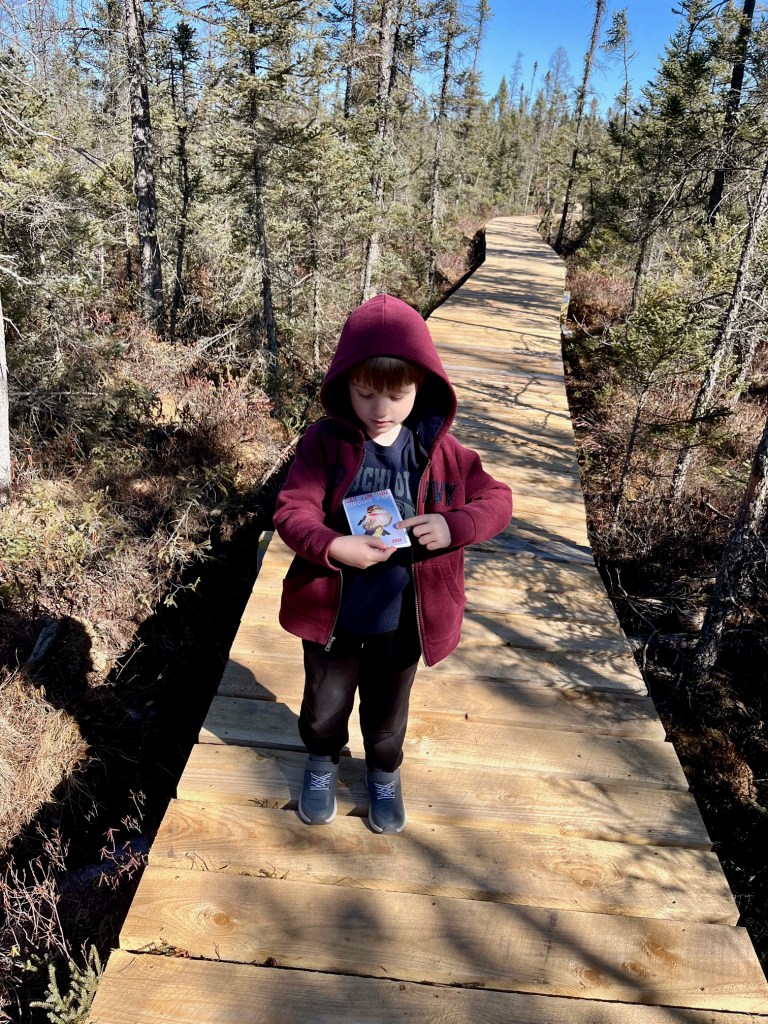
Charlie points at the common redpoll on the cover of his trail map. He said he just saw one, and he might have. Before we left the bog, another volunteer told us a redpoll had been spotted that morning.
We didn’t see any owls, but in addition to the red (or fox) squirrels, we saw chickadees, and Clara,12, spotted a black-back woodpecker.
After we finished walking the trails, my youngest grandson Charlie, 5, gave me a hug. “Do you know why I gave you a hug?” he asked. He didn’t wait for an answer. “I gave you a hug because you brought me to this bog.” I think Charlie felt what I felt: a pervasive peacefulness. As I walked through the bog, I felt a sense of increasing serenity. In The Hidden Life of Trees, the author mentions studies that show people have reduced stress levels after walking through old-growth forests. I have no data to prove that is what happened to me, but I certainly felt calmer than when I’d arrived.
Holding our trail maps, Sax-Zim Bog calendars, and warm memories, we got in the van and buckled up. I was about to start the engine when Clara pointed out her window and said, “There’s a butterfly in the parking lot.”
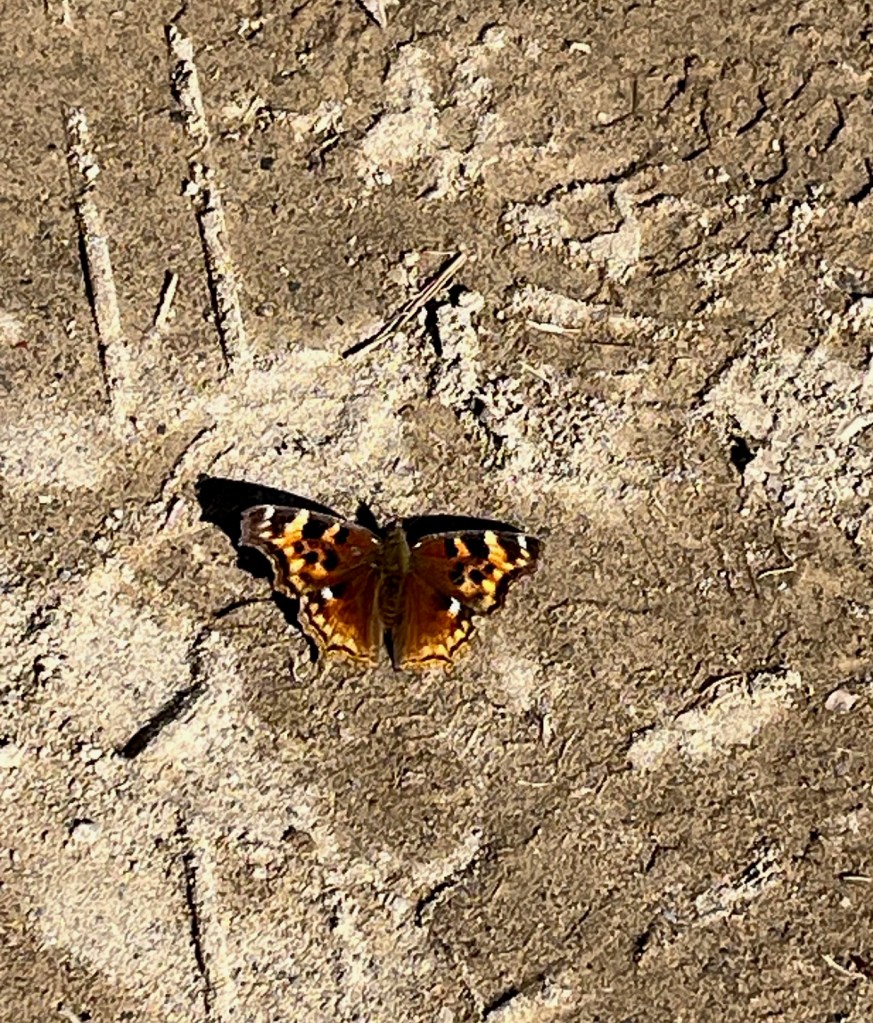
The butterfly, a Compton Tortoiseshell, sunning itself before the pickup entered the lot.
Having recently finished reading Bicycling with Butterflies by Sara Dykman, I had to get out of the van and have a look. As I was snapping pictures of the butterfly, which wasn’t moving much, a red pickup truck pulled into the lot. The only open space for the truck to park happened to be where the butterfly was resting, and the driver wouldn’t have been able to see it. Squashed butterfly, I thought. I walked toward it, and it fluttered a few feet, but in the wrong direction. Coming from another angle, I walked toward it again, and it flew another few feet, but this time it landed out of harm’s way.
The red truck parked without crushing the butterfly. Perhaps it wouldn’t have needed me to save it. Maybe it wouldn’t have been run over, and it would have flown away from the truck instead of into it. But I’m glad I didn’t leave the butterfly’s destiny to fate.
The grandkids and I left the bog and headed back to the city. As I drove down the county roads, they flipped through their calendars, enjoying pictures of the beautiful wildlife who make their homes, for at least part of the year, at the Sax-Zim Bog.
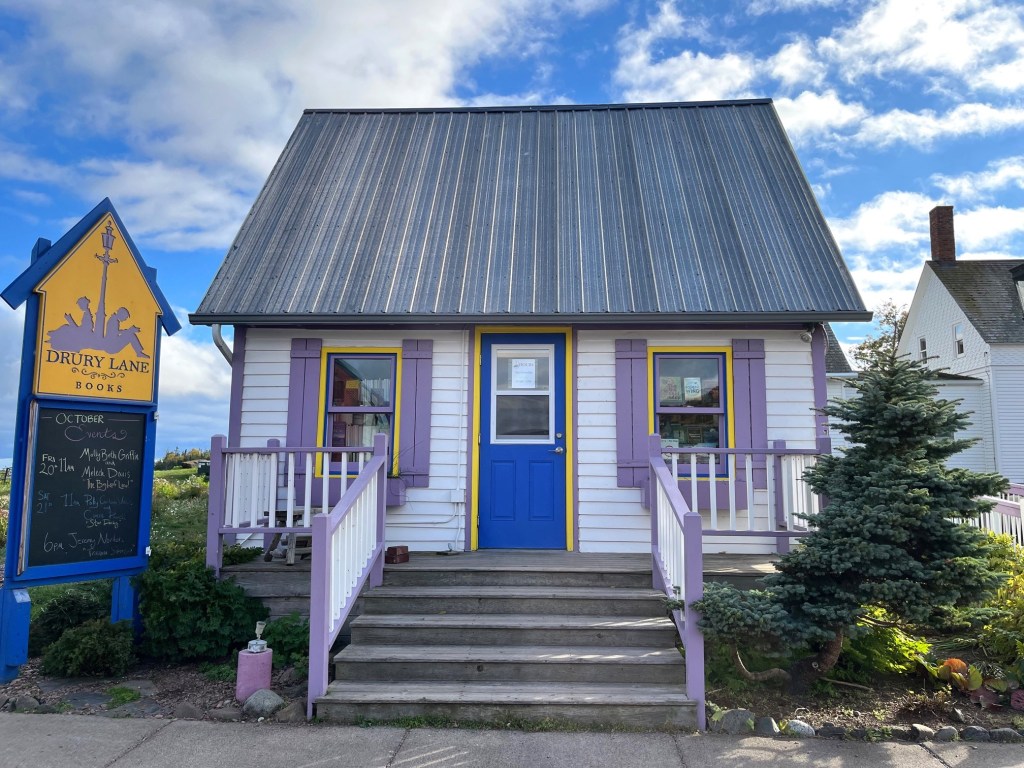
The entrance to Drury Lane: to the left is Lake Superior, to the right is a donut shop
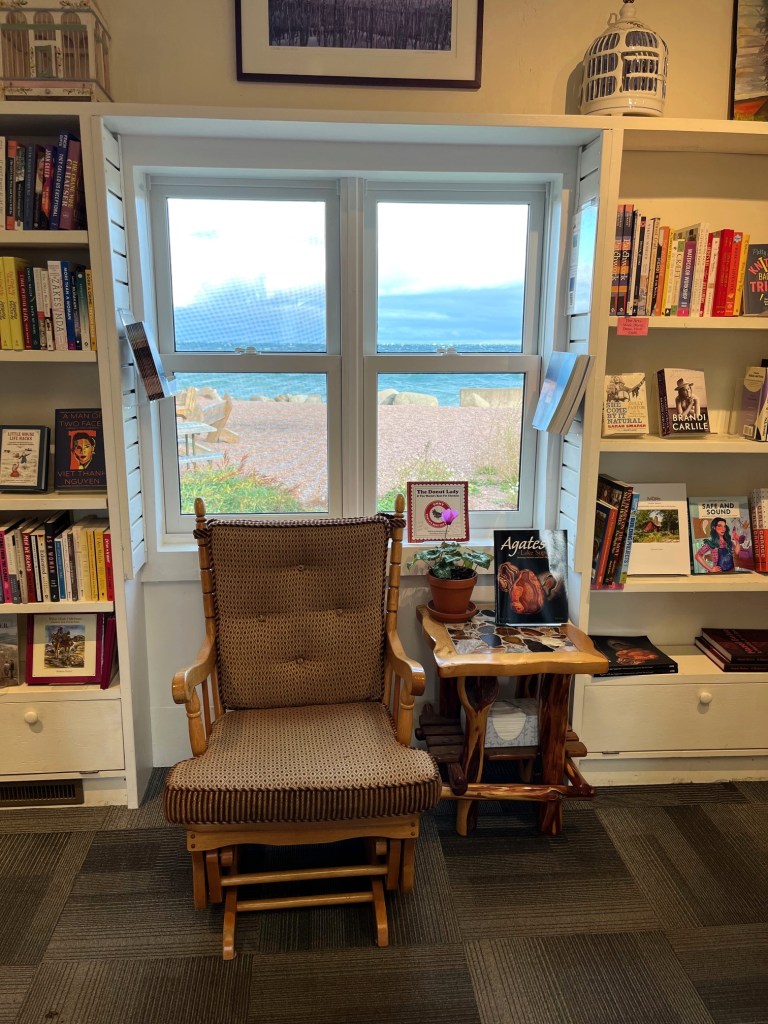
On the shore of Lake Superior, there is a small independent bookstore in Grand Marais, Minnesota, called Drury Lane Books. It’s my happy place. When I feel tired, sad, angry, or bored, I conjure up an image of the charming store, then I walk inside and sit in the window seat lined with a bright-blue cushion. In my hands I hold the perfect book, pulled from a glossy-white shelf. And I fall hopelessly in love with the characters and their stories. It’s Zen.
A cozy nook inside of Drury Lane
Last October my sister and I actually visited Drury Lane three times in one weekend. (I bought a collection of short stories and two novels.) During our first visit, the churning waves on Lake Superior roared so loudly that conversation outside the bookstore was difficult, unless we wanted to shout. And while we could have sat in the wooden chairs on the beach and read our new books, the cold, strong-fisted winds would have ripped pages from our hands. The next day the winds abated, but it was still chilly. So, we read our books in a local coffeehouse while sipping hot mugs of tea and coffee.
Drury Lane dreaming puts a smile on my face.
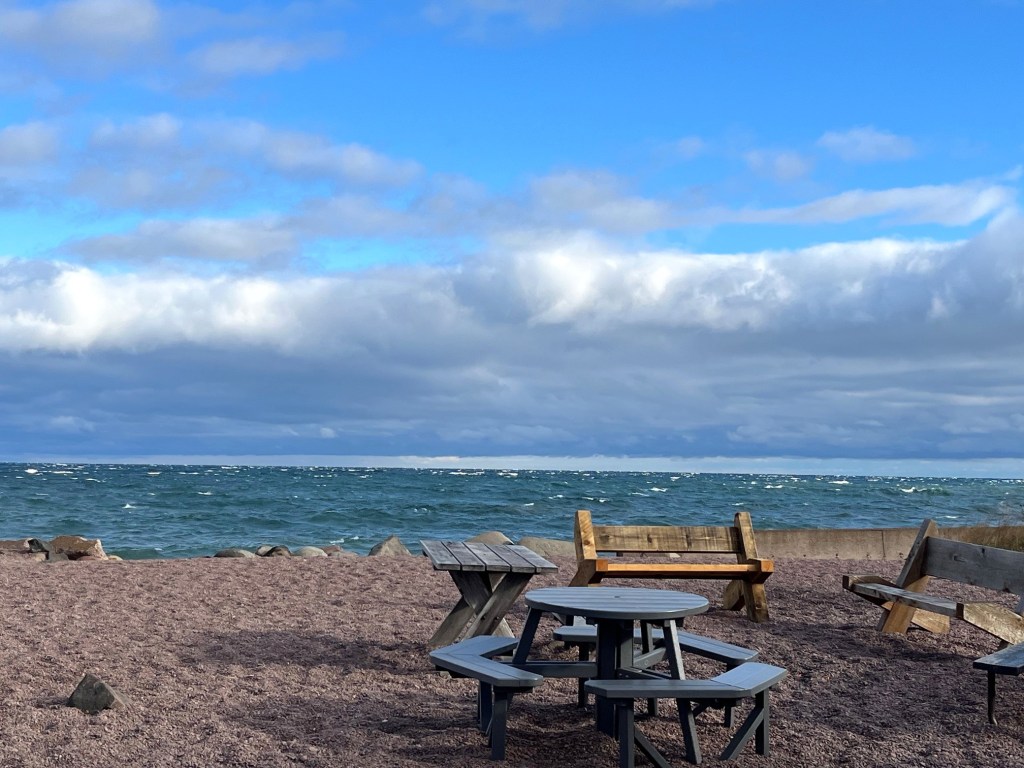
A great place to read a book, as long as Lake Superior is behaving










 Writing Near the Lake