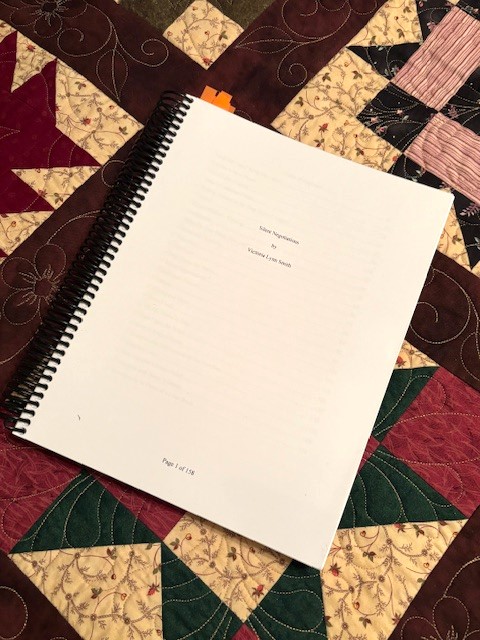
In the fall of 2024, I sent Silent Negotiations, my collection of short stories, to Cornerstone Press at the University of Wisconsin-Stevens Point. In December of the same year, the editors at Cornerstone notified me they wanted to publish my book, and the publication date would be February 2027. It was the best Christmas present! And for a few weeks, I walked around in a euphoric bubble. But the publication date was over two years away, so I settled into a calmer mode of waiting. At times I’d forget about my upcoming book for a couple of days. With a publication date in a faraway galaxy, there wasn’t much for me to do. Then suddenly, because objects are closer than they appear, I’d fret about the book and think, “Will anyone want to read my stories? Is there something I should be doing right now? Where will I have my book launch, and will anyone come?” Then sometimes I’d get excited all over again, thrilled that my stories, which took me five years to write, will have a home together in a book.
On January 23, after I’d spent several days reading my stories one more time, I emailed my manuscript to Cornerstone Press. Don’t worry. I didn’t fiddle with them. I’ve heard other writers warn against overworking one’s stories. Besides, I’m happy with them. Instead, I looked for typos and questioned commas. I read out loud, listening for the awkward sentence, a word choice that wasn’t working, an ambiguous pronoun. I double checked stories to make sure they were coherent with correct timelines. I changed very little, but I’m glad I read them one more time.
At this point in time, I’ve made the stories the best I can make them. I think I’ve found all the errors that can escape an author’s eye, even after many readings. Because I know what my stories are about and what my sentences are supposed to say, I often read past mistakes — reading what I believe is on the page and not what is actually there. Of course, to help with this, I’ve had numerous people read my stories. It’s always a good idea to have someone read your story, essay, poem, article, or book before sending it out into the world.
I want to thank all the people who read my works in progress. Your input made my writing better. Each of you brought a unique perspective to my stories, and often found problems other readers didn’t. Now, I’m looking forward to working with the wonderful editors at Cornerstone. And I’m excited to see what the graphic design team puts together for the book’s cover!
Below, in alphabetical order by authors’ last names, is a list of short story collections published by Cornerstone that I’ve read and enjoyed! To check out these books and other short story, poetry, and memoir books published by Cornerstone, click here.
Colleen Alles, Close to a Flame
Jeff Esterholm, The Effects of Urban Renewal on Mid-Century America and Other Crimes
Steve Fox, Sometimes Creek
Nikki Kallio, Finding the Bones
Kim Suhr, Nothing to Lose
Kim Suhr, Close Call
Marie Zhuikov, The Path of Totality
Author photo for my book: Ziva and Me! I sent my final manuscript to Cornerstone on Ziva’s fifteenth birthday. Photo credit: Max Youngquist
Say Nothing by Patrick Radden Keefe is nonfiction. Published in 2018, it tells the story of The Troubles in Northern Ireland between Catholics and Protestants during the 1970s, and its aftermath during the 1980s through the early 2000s.
McGarr and the Method of Descartes by Bartholomew Gill is fiction. Published in 1984, it tells the story of Detective Chief Inspector Peter McGarr who strives to prevent the assassination of a Loyalist Protestant he loathes in order to prevent yet another cycle of violence between Catholics and Irish Protestants.
Both books tell stories involving the Irish Republican Army, the British Army, the Loyalist and Catholic paramilitaries, the informants, and the civilians who are swept up into tragic violence. In both books people are blown up, shot, executed, arrested, imprisoned, tortured, beaten, and burned out of their homes. Gill’s book is fiction, but it mirrors much of what happens in the real world of Keefe’s book.
I started out reading both books at the same time, sometimes reading a bit of each in a day, and other times reading them every other day. I’ve done this before with books. However, I stopped toggling back and forth after I repeated an episode from Gill’s fictional story to someone as if it had been a real episode from Keefe’s book. But in a sense it was real because the episode in Gill’s book was a fictionalized account of numerous real events that Keefe reported about in his book. Switch names and change some of the fictionalized details, and Gill’s event would be real. Gill captures the realism of the events and the emotional trauma that Keefe so deftly writes about in his nonfiction book.
Say Nothing by Patrick Radden Keefe
Keefe’s book starts with the kidnapping and murder of thirty-eight-year-old Jean McConville, a widow and mother of ten children ranging in age from twenty to six. The IRA accuses McConville of being an informant for the British Army in Belfast, Northern Ireland. Without a trial of any sort, she was abducted from her home in Belfast, driven across the border into the Republic of Ireland, shot to death, then buried in an unmarked, secret grave.
Keefe’s book is highly engaging, well organized, and clearly written — important because he covers a slice of history that is complex and involves dozens of key people. He uses McConville’s abduction as a starting point to tell the story of The Troubles in Northern Ireland, but Say Nothing covers more than McConville’s disappearance and murder. As readers learn about The Troubles during the 1970s, Keefe leaves them with an understanding of the history behind The Troubles, the trauma caused by the conflict, and the negotiated peace that somehow feels tenuous.
I read Say Nothing on the advice of a nonfiction writer, Rachel Hanel, whom I admire. She recently reread and recommended it in her newsletter, stating, “It’s still my favorite nonfiction book of the past 10 years.” Keefe’s book was made into a limited TV series that can be watched on HULU. I have not watched it, but other people have told me it’s very good.
McGarr and the Method of Descartes by Bartholomew Gill
During the investigation of a murder, DCI Peter McGarr and his investigators uncover a plot to assassinate Ian Paisley, a bigoted, loud-spoken, but charismatic Protestant minister beloved by many Irish Protestants. (By the way, Ian Paisley was a real person who was all these things.) McGarr abhors Paisley, but he also detests the IRA, the British Army, all paramilitary groups, and anyone else who conspires to use violence in order to push Ireland and Northern Ireland back into the nightmarish times of The Troubles during the 1970s. Racing against the clock and up against a group of formidable foes steeped in a long tradition of deception and intimidation, McGarr and his team work to prevent Paisley’s assassination.
I read McGarr and the Method of Descartes because I liked the first five books in Gill’s series, which he published from the late 1970s through the early 2000s. I’m intrigued to see how Gill’s characters and stories will evolve in the series. I want to learn more about Noreen, and McGarr’s past, and if women are going to become an integral part of the police force. In Gill’s sixth book McGarr’s wife, Noreen, has a minuscule role, unlike the fifth book where she has her own story arc. But after a debate with McGarr and a sleepless night, she delivers the best lines in the book to her husband before he leaves their house to try and stop Paisley’s assassination.
The female computer expert, Ruth Bresnahan, is back in her biggest role since she joined the squad. The men on McGarr’s team know she is smart and rarely wrong, and they are intimidated by her. But McGarr isn’t bothered by her smarts. He respects her intelligence, doggedness, and energy. He believes in a way she is “worth two of any of the men on the staff.” He has her read into the case and takes time to mentor her. She plays a key part in helping McGarr and the team as they attempt to save Paisley’s life.
Bartholomew Gill’s sixth Peter McGarr book is excellent. It is his darkest story yet. But The Troubles in Northern Ireland was a dark time. I’m glad I read most of Keefe’s nonfiction book along with Gill’s novel. The talents of each writer made me appreciate the other’s book. Reading Keefe’s book gave me a great appreciation for the world Gill developed while fictionalizing actual events in Ireland that were barely dry behind the ears. On the flip side, Gill’s book gave me a great appreciation for Keefe’s ability to capture the human emotion and the tragic toll The Troubles wreaked upon generations of Irish people, both Protestant and Catholic.
A point both books make . . .
Colonialism and imperialism inflict a lasting impact on people who have been subjected to outsiders invading their lands and stripping their rights. The trauma of the oppressed and the entitlement of the oppressors are passed down from generation to generation.
On one side, children of the conquered sit at the knees of their parents and grandparents and learn about the atrocities their people have endured and the acts of heroic resistance they have performed.
On the other side, children of the conquerors sit at the knees of their parents and grandparents and learn about their superiority over other people and their imperial destiny.
Conditions become untenable, things fall apart. Childhoods vanish. Neighborhoods sunder. People die.
Playbill from Anne of Green Gables adapted for the stage by Peter DeLaurier
On Sunday I took my fourteen-year-old grandchild to see a play based on the children’s novel Anne of Green Gables by L. M. Montgomery.
Montgomery’s novel about a determined, outspoken, red-headed orphan is one of my favorites. I’ve read it twice.
I went to see the play for two reasons: first, to meet up with my old fictional friend Anne Shirley of Avonlea, Prince Edward Island, and, second to introduce my grandchild to Anne’s story. Judging by the large crowd of people at the play, who ranged from senior citizens to young children, Anne Shirley is still loved by old friends and still being introduced to new friends.
Montgomery wrote Anne of Green Gables in 1905. At first her book was rejected by publishers. Montgomery set her novel aside for a while, but in 1907 she sent it to L.C. Page in Boston. It was accepted and published in 1908. Within five months she sold over 19,000 copies, and it was reprinted numerous times in its first year. Since its publication over fifty million copies have been sold, and it has been translated into over thirty-six languages.
What makes the novel so popular and timeless? Most definitely, it’s the main character, Anne Shirley, who wins our hearts. Set in the late 1800s, we meet Anne when she is eleven years old. She is an orphan who has lived in both foster homes and the orphanage. Her life changes when Marilla Cuthbert and her brother Matthew Cuthbert decide they need someone to help the aging Matthew with his farm chores. Marilla writes to the orphanage to request a boy be sent to them, but there is a mix up, and Anne is sent instead.
Anne has been an orphan since she was a baby. She longs for a family and a home to call her own. She has red hair and freckles, and she believes this makes her ugly. She is outspoken, talkative, and a daydreamer. In a time when girls were to be ladylike and sweet, her candid manner is labeled impertinent and disgraceful. At first Marilla is adamant that Anne should be returned to the orphanage, but Matthew doesn’t agree. Anne’s spirit touches him, and he convinces Marilla to give Anne a chance.
Why have readers for over a hundred years loved Anne of Green Gables? Because Anne wants what we all want — a home, a family, and to be loved for who she is. She doesn’t want people to make fun of her red hair and freckles. She doesn’t want people to silence her outgoing personality or tell her daydreaming is frivolous. We cheer for Anne. She is our hero, not because she is always good or perfect, but because she is so human. When she makes mistakes, she learns from them while remaining true to herself. Anne’s willingness to be true to who she is as she grows up, changes the people around her, and they become more accepting and open minded.
Over a hundred years after its publication, Montgomery’s story still invites readers to be compassionate and accepting of people’s differences. Furthermore, without moralizing, her novel delivers this message with humor; tenderness; and richly drawn characters, such as the unforgettable, irrepressible Anne Shirley.
The play I saw on Sunday was wonderful. The actor who played Anne Shirley was outstanding. She captured the essence of Anne and brought her to life on stage. The supporting cast were also excellent; after all, there are no small parts. The play was creatively staged on a well-designed set, and the costumes were charming. (I found myself wishing I could wear some of them!) The play remained true to Montgomery’s story, and I loved being able to say to myself over and over, “Yes, I remember that from the book!”
Best of all, my fourteen-year-old grandchild loved the play. Teenage years can be difficult. Young people can be filled with self-doubt and feel as though everyone is judging them as they work to discover who they are and what they want out of life. The characters in Anne of Green Gables remind us that acceptance, kindness, and love are timeless and important for both the young and old. This message feels even more important today. In a world where some people want to divide us, we need to remember we are more alike than different. To forget this is to put our humanity at risk.
My story collection has a title! I’ll debut the cover when that is done.
In February 2027, the University of Wisconsin-Stevens Point will publish my collection of short stories through Cornerstone Press, their university press. I’m excited, and nervous, and grateful. This is my first book, and like a first-time parent, I’m not sure what to expect, so I gather information. I talk to other writers who have published books. I attend book launches and author talks. I read blogs and articles and attend seminars about how to nurture a book in the world.
When Cornerstone accepted my manuscript, my publication date was more than two years away. But now it’s about fifteen months away, and if there is one thing I know about time — it’s how quickly it flies. I need to promote my book, and for that it needs a title.
When I submitted my collection in November 2024, it was called Fishing Around in the Dog Days of Summer, after one of the stories in the book. I chose the title for a couple of reasons. First, I really like its eponymous story about two young sisters with a tenuous relationship who go crayfishing on a hot, humid August day. Second, all the characters in my short story collection are fishing around for something they want. They each dip a line in the murky waters of their lives during their own dog days, hoping to catch something they long for.
But as much as I liked my original title, I began to feel it was too long and would be hard for people to remember. And I worried if the cover depicted a fishing scene along with the title, potential readers might think all my stories were about fishing.
I looked at my table of contents and considered other story titles. “Silent Negotiations” jumped out at me. It’s short and easy to remember, and it’s another story I really like. In 2020, it won second place in the Hal Prize Fiction Contest. (So, I feel the title has good mojo.) In the story a couple who have been married over forty years renegotiate the parameters of their marriage during a disagreement. Each spouse speaks their mind, but only to a point. The rest of their negotiations are silent, yet significant. The characters in my other stories are like the old married couple in “Silent Negotiations.” They all want something. They all talk to each other, but they leave things unsaid. And what is left unsaid, changes who they are with one another and themselves.
After I decided to change my title to Silent Negotiations, I asked my writing friends and readers what they thought. They had all read my stories several times, so I knew they would be good judges as to whether or not the new title would be a good fit for the collection. They all loved Silent Negotiations.
Last weekend I attended the Wisconsin Writers Association Conference in Stevens Point. The Cornerstone Press editors were there too. I talked to Dr. Ross Tangedal about using Silent Negotiations as my title. He liked it too, and so did his student editors.
My book has an official title!
Now, I’m excited to see some cover designs. Before I know it, Silent Negotiations will be out in the world.
I’m hoping to use this picture for my author photo. Photo credit: Max Youngquist
I’m back with another update on my quest to read all of the Peter McGarr mysteries by Bartholomew Gill. I just finished McGarr and the P.M. of Belgrave Square, Bartholomew Gill’s fifth Peter McGarr mystery. And I know I said this about Bartholomew’s fourth book, but his fifth book is now my favorite of the series.
What is this book about?
A dead body lies in a water-filled ditch for most of a day. It’s inconceivable to DCI Peter McGarr that the woman in the house overlooking the ditch failed to noticed the dead man. Furthermore, McGarr reckons she must have witnessed the murder.
The dead man is William Craig, an antiques dealer and business man, who until that morning had lived with his wife in the house with the view of the watery ditch.
McGarr quickly gathers a list of suspects: the wife, the son, the business partner, the gardener, the maid, a member of the Irish Republican Army, a former Nazi collaborator. Given the method of the murder, it appears personal. Curiously, considering the many valuable antiques in Craig’s shop, the only item is missing is a valuable painting.
The P.M. of Belgrave Square is a dog (not the Prime Minister), who has retired from the police force. P.M. lives next door to McGarr, and of course they’re friends. In many ways the dog is a canine version of McGarr.
Thoughts about story and character development in Gill’s mystery series . . .
For four books, I wanted to know more about DCI McGarr’s wife, Noreen. I wanted her to do more than cook a few meals for McGarr, drive him around occasionally, and look stunning in clothes that showcase her ginger-colored hair and green eyes. I wonder if Gill ever received fan mail from readers asking for more Noreen because in this book, she has her own story arc, something missing in the first four books. In the earlier books, Noreen was nice enough, but now she’s interesting.
There are still no female detectives. And the female temp with the competent computer skills, who I really liked, is absent from this book, but I hope she still works for the department. There is only one scene at the police station in this book, so it makes sense we don’t see her.
In Gill’s first five books, we learn a lot about the murder suspects and what makes them tick, but not so much about the detectives who investigate them. It’s nice to have interesting suspects with convoluted psyches and complicated motives. But I’ve been raised on police detective stories that also focus on the investigators and what makes them tick. We get a bit more of that in McGarr and the P.M. of Belgrave Square, as Gill gives us some insight into McGarr’s life through Noreen’s perspective on their marriage.
Turns out Noreen is concerned about Peter’s drinking and his smoking. Throughout the first four books, she seemed oblivious to his bad habits. There are cracks in McGarr’s facade, hints that something from his past has left scars, and Noreen is terrified about his willingness to put himself in harm’s way. His position as a DCI means he should be off the streets and at a desk, but Peter likes to be in the thick of an investigation. She believes he has a death wish. I wonder if she will make it as a cop’s wife.
The Irish Republican Army is back. Insinuations of IRA involvement always complicate McGarr’s murder investigations. He seeks justice for the victim or victims at hand, but Special Branch, or some other investigative entity, often wants to bury IRA involvement, either because they simply don’t want to deal with it or because they are deep into an investigation and don’t want their cover blown. McGarr doesn’t give a farthing for either reason — he solves the case in front of him. If that means rattling the IRA or interfering in an ongoing Special Branch investigation, so be it.
Gill’s Peter McGarr mysteries are dark. Set mostly in Ireland, I can’t imagine they would ever be endorsed by an Irish tourism board. McGarr’s Ireland is a land of dismal weather and stormy seas with only brief bouts of sunshine. McGarr’s Dublin is a city of coal dust, simmering class resentments, and political intrigue.
I wonder if I weren’t interested in seeing how Gill develops his characters over the series, if I would still be reading these books. But I think the answer is yes. The novels have just the right amount of darkness. The writing is good. I like the dialogue. The stories are interesting. The books are quick reads. And the pocket book size feels so comfortable in my hands. After I finished this book, I ordered Gill’s next three mysteries from Thrift Books. So, like Noreen is still sticking with Peter McGarr, I’m still sticking with Bartholomew Gill.
I’m back with an update on my quest to read all of the Peter McGarr mysteries by Bartholomew Gill. I just finished The Death of an Irish Tradition, Bartholomew Gill’s fourth Peter McGarr mystery. So far, this one is my favorite. (And I really liked the first three.)
What is this book about?
It’s 1979, maybe a year earlier, in Dublin, Ireland. A sixty-five-year-old woman is murdered, starting a concentric ripple that encompasses the Irish Republican Army, one of McGarr’s childhood friends, a priest, a young and gifted pianist, a young drug addict, and a landed gentleman. Over the years, among these people, hate, greed, lust, revenge, snobbery, envy, jealousy, bigotry, and secrecy have combined and simmered like a Dublin coddle left to stew in a hot oven. But unlike the coddle stew, which can be pulled from the heat before burning in its own juices, there is no reprieve from the emotions that consume the characters in Gill’s fourth novel. Peter McGarr and his constabulary must sort through the tangled lives and motives of the characters, hoping to solve one murder and attempting to prevent others. The story culminates at the Dublin Horse Show, a long-standing tradition with ties to the hated British aristocracy and their rule of Ireland, which has left it a divided country.
Why did I like this book?
I love the dialogue. Gill knows when to let his characters speak and when to have them shut up. Sometimes what’s left unsaid resounds like a clap of thunder before a battering storm arrives. I find Gill’s characters interesting. And while his stories are far from rosy, I like to think that all officers everywhere, represented by the likes of McGarr and his constabulary, are doing their best to provide justice. Gill’s mysteries aren’t cozy, but they’re also not graphically violent, which I know is a relative statement depending on one’s view about what is and isn’t too violent. If it helps, I don’t like drawn out visceral violence, but I also don’t like overly cozy mysteries. I’d place Gill’s books in the middle of the visceral-to-cozy scale. (But that’s relative too.)
The murders in Gill’s books don’t always directly involve members of the Irish Republican Army; nevertheless, the IRA’s presence and its role in The Troubles of the 1960s and 70s form an undertow in Gill’s novels, whether in the background or the forefront. The IRA is shrouded in secrecy and so woven into the fabric of Irish life that McGarr approaches each murder as if it could be connected to the IRA and The Troubles in Northern Ireland, which also spills into the Republic of Ireland. It’s mostly an unspoken theme, but when reading McGarr’s books, I’m struck by the deep and lasting damage that imperialism and colonialism inflict on societies.
I think, in part, I’m intrigued by Gill’s novels because I remember the turmoil in which his stories are set. During the 1970s, I was a pre-teen and teenager, and I watched the violence in Northern Ireland play out on the TV news. I read about it in Time and Newsweek, which came to our house in the mail. I remember the bombs and the deaths of children, women, and men, along with the deaths of British Army and Irish Republican Army members. Reporters talked about Irish Catholics, Irish Protestants, self-rule, spies and traitors, and the English who’d lived for generations in Belfast but identified as British instead of Irish. When I was seventeen, I traveled to London and read signs on buses and the Underground, cautioning people not to touch unattended packages and to immediately report them to the conductor. The IRA had been setting off bombs in England. At the time, I thought the violence would never end because each death brought about a retribution.
Reading Gill’s novels has sparked my curiosity, and I want to learn more about the time of The Troubles. While reading The Death of an Irish Tradition, I received Rachael Hanel’s latest newsletter. [Hanel is a wonderful nonfiction author. To read about her and her books, click here.] Hanel recently spent time in Belfast, and she recommended some books covering The Troubles. I want to read at least one of these books before I read the next Peter McGarr mystery:
More thoughts about Gill’s books from a standpoint of craft . . .
Part of my interest in Gill’s mysteries is to see if and how he will develop his characters and their storylines as his series progresses. I hope Gill will present a broader view of his detectives that includes more of their personal lives. I appreciate a writer whose crime-solving characters develop and change throughout a series of books. To me it’s as important as a good plot. It becomes the mystery of a detective’s life set within the mystery of the crime.
You might remember I mentioned there was so much drinking in Gill’s first three books that I worried I’d wake up with a hangover. I questioned how Peter McGarr could even function, let alone solve crimes, considering the amounts of whiskey and beer he drank. In this book, while McGarr hasn’t come close to being a teetotaler, he drinks less. I wonder if Gill came under criticism from readers about his portrayal of the Irish as heavy drinkers.
There are still no female detectives. However, a woman has been hired as an office temp, and unlike the detectives, she knows her way around the new-fangled computers, which are starting to be used by police departments to access databases to help them gather pertinent information to assist in solving crimes. None of the male police officers in the department are interested in learning the new technology, but they all appreciate the new woman’s computer skills and her ability to quickly supply them with useful information.
McGarr’s wife, Noreen, is back, but her role in this story is small, like in the previous books. Noreen has one telling scene that gives readers a hint as to McGarr’s feelings for his petite, intelligent, beautiful, feisty wife. And I want more Noreen in the stories.
[For a Dublin Coddle recipe,click here. This stew has a cameo appearance in the book.]
[If you’re interested in the tangled story of the Irish and the British, I recommend the following novels: Trinity by Leon Uris, published in 1976, and In This Bright Future: A DC Smith Investigation, published in 2021. While these have mostly fictional characters and some fictionalized story lines, there is a lot of history in both of them. I read Trinity, a sweeping epic work that follows the Irish-British conflict during the late 1800s and early 1900s. I read it in the early 1990s, and some of its characters still haunt me. About a year ago, I listened to In This Bright Future. It’s an engaging story that takes the aging DC Smith back to Belfast, compelling him to solve a decades’ old mystery, while reliving his days in the British Army when he was stationed in Belfast and working undercover to infiltrate the Irish Republican Army. By the way, I recommend any of Grainger’s DC Smith mysteries. Also, Exodus and Armageddon by Uris are excellent.]
[I love it when I’m reading one book, and it makes me think of another book. For example, I’m listening to Jeeves and the Wedding Bells: An Homage to P. G. Wodehouse by Sebastian Faulks, which is set in England. At one point a character refers to another character as being judged like a horse at an Irish Horse Show — in other words: scrupulously and critically. I smiled because after reading Gill’s The Death of an Irish Tradition, I understood the reference on a deeper level.]
Penguin Books edition, 1982. I love the pocketbook edition. It’s been well loved over the last forty-three years. Sometimes as I read it, bits of the aged cover flaked away, and I imagined all the other hands that held this book.
I’m back with a quick review of the third mystery in the Peter McGarr series by Bartholomew Gill. I said I’d keep you updated about how Gill’s series progresses. [To read my thoughts about Gill’s first two novels, click here.]
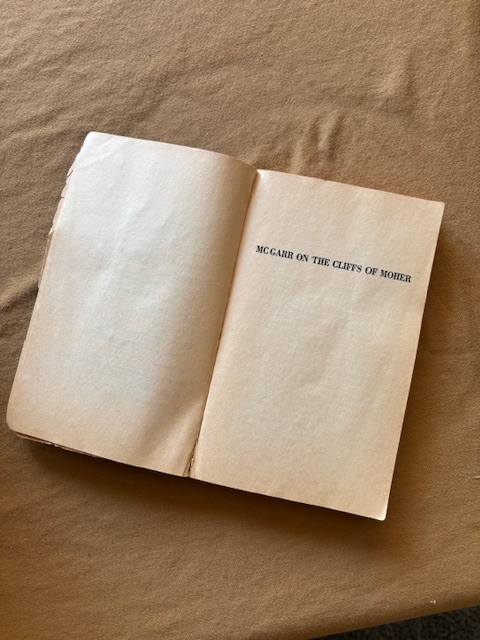
McGarr on the Cliffs of Moher debuted forty-seven years ago. I believe it’s out of print because Amazon sells only used copies. I bought well-worn copies of Gill’s first three books from ThriftBooks. In my review of Gill’s first two McGarr mysteries, I said if I liked the third book, I would buy a couple more. Well, when I finished reading The Cliffs of Moher, I bought Gill’s fourth and fifth mysteries, once again from ThriftBooks.
What’s McGarr on the Cliffs of Moher about?
Shortly after traveling from America to visit her parents in Ireland, May Quirk is found dead in a pasture near the Cliffs of Moher. She has been run through the chest with a pitchfork. May was born and raised in Ireland, but shortly after becoming a young woman, she left Ireland for New York City, partly to follow a young man whom she loved and partly to seek opportunity and adventures not available to her in Ireland. In New York her romance with the young man falters, but they remain friendly. May finds success as a well-respected journalist.
CID Peter McGarr has a list of suspects, each with a motivation worthy of murderous intent. Did the man she originally left Ireland with kill her in a jealous rage? He had returned to Ireland about the same time she did. Did the country farmer down the road from her parents kill her? The farmer has been obsessed with May for years, believing God intended them to be together. Did the man who discovered May’s body in the field kill her? He doesn’t seem to have a motive, but he was so drunk on the night of May’s murder he can’t remember passing out next to her body. Did someone in the Irish Republican Army have her killed? If threatened, the IRA is capable of swift and cruel violence. Did May’s current lover, who is married, kill her? He wanted to marry her, but he’s an Irish Catholic with a passel of children, and May seemed uninterested in becoming anyone’s wife.
Why did I like this book?
It’s a page-turner. Once I start reading one of Gill’s books, I don’t want to put it down. The dialogue is snappy, with just the right amount of levity. I like the rivulets of sarcasm permeating McGarr’s conversations with suspects or other people who try to get in the way of his investigation. So far Gill’s books have interesting plots, and I’m kept guessing about whodunit. Finally, McGarr’s books are quick reads with well-written prose that often sparkles, but they don’t require deep thought on my part. And for this reason, while I enjoy them, they don’t rank as high as some other detective series that I have read.
Back to my thoughts about Gill’s books from a standpoint of craft . . .
You might remember I mentioned there was so much drinking in Gill’s first two books that I often felt like I’d wake up with a hangover in the morning. The consumption of alcohol in this book surpasses anything found in the previous two, partly because a lot of scenes are set in pubs in Ireland and New York. I don’t know how some of the characters can drink so much and still walk, talk, and think, let alone commit crimes or try to solve them. I have moved beyond the idea I might be vicariously hungover in the morning to seriously thinking I might need a vicarious twelve-step program after reading the series. I wonder if McGarr can keep up his pace of drinking throughout the series.
I’m still waiting for McGarr to have some sort of crisis of the soul. We don’t learn much about him in this book either. It’s mentioned again that he grew up in poverty, but that doesn’t seem to have affected him in any visible way. But where does all that drinking come from? Is Gill perpetuating a stereotype about the Irish love of whiskey and beer? In Gill’s stories there is a fine — but uncommented upon — line between McGarr and other characters, some of whom seem to be able to drink without getting drunk, and others who cannot hold their liquor. McGarr is one of the characters who can hold his liquor and solve crimes.
I’m waiting to see if female detectives will become part of the Irish constabulary landscape. However, it’s still the 1970s in McGarr’s world, and it’s a male dominated society.
McGarr’s marriage is another curiosity. His wife, Noreen, is twenty-one years younger than him. He married late in life because he considered himself a confirmed bachelor. In this book we learn why he married, but I’ll let you discover the reason for his marriage. It’s tossed in as a single sentence, but the sentence is striking and not easily missed. I always like to discover these little gems in a story for myself, rather than being told. The McGarr marriage could become an interesting side story. There are many ways Gill could play it.
The pages have mellowed into a yellow brown. It’s hard to imagine they were ever white.
So, I bought the next two books because I’m still curious to see if and how Gill develops his characters. In the meantime, his crime mysteries are entertaining reads just as they are.
The Death of an Irish Politician and The Death of an Irish Consul by Bartholomew Gill
Book 1 and Book 2. The three books I bought are pocket books. When I toss one in my Mary Poppins purse, it nearly disappears!
Recently, someone in something I read suggested that Bartholomew Gill’s Peter McGarr police detective mysteries set in Ireland were a wonderful read, so I looked them up. Bartholomew Gill was the nom-de-plume of Mark C. McGarrity (1943-2002), an Irish-American crime and mystery novelist. McGarrity’s first Peter McGarr mystery was published in 1977 and set in Dublin, Ireland. The summary mentioned something about a crime at a marina, a beautiful woman, an ambitious politician, the Irish Republican Army, and the conflict between the British and the Irish over Northern Ireland. I came of age in the 1970s during some of the worst violence in Ireland, I’m part Irish, and I like police detective mysteries, so I bought the first three books in the series from ThriftBooks. I’ve read the first two.
When Gill’s series begins, his fictional character Peter McGarr, has recently returned from continental Europe to accept the coveted position of chief inspector of detectives with the Dublin police department. McGarr, known for his leadership, brilliance, cunning, and successful arrest rate, has had an exemplary career with INTERPOL before returning to Ireland. The officers under his command respect him. He’s clever, likable, and incorruptible.
I enjoyed Gill’s first two McGarr books. CID McGarr is an interesting character. He doesn’t come across as deeply flawed or deeply troubled by demons of the past. He’s usually a half step ahead of the criminals, and he can smell when something is rotten in Denmark. Gill doesn’t spend a lot of time in McGarr’s head, so readers don’t get a lot of that internality that often comes with detectives in newer stories. (Which, depending on one’s preference, could be good or bad.) What readers do get are interesting plots, conspiracies, double and triple crosses, great dialogue, and wry humor. The novels mix murder, politics, and business together, exploring themes of political corruption, corporate greed, and personal ambition. (Some things in this world never change.)
McGarr’s wife, who is about fifteen years his junior, is a good cook. She’s also bright and loves to discuss his cases with him, but she’s had a minor role so far. There are no women detectives in the first two books. Women who appear in the novels are of the femme fatale variety. It’s the 1970s, and it’s a man’s world. There is a lot of drinking in these two books. Not the hard-hitting-sit-at-the-bar-until-you-pass-out-on-it kind, but rather the steady-throughout-the-day-as-you-go kind. CID McGarr rarely turns down a drink — doesn’t matter if he’s on duty or not. The police station has beer on hand for the detectives and the suspects. Although, officers prudently strive to keep the suspects from getting drunk to avoid having their statements tossed by the courts as unreliable. Sometimes at night when I read one of these books, I was afraid I’d wake up in the morning with a hangover!
I liked these books. They were an easy read and interesting — a nice escape at the end of my day. I’ll read the third one soon. If I like that one, which I hope I will, I’ll buy the next two or three because I’m intrigued to see if Gill’s character changes over time. Does his wife stay with him? (A brief moment in the second book gave me pause.) Does he have to curtail his drinking or get sober? (McGarr mentions a line in the sand, which if he crosses, would mean he’s an alcoholic. But has he ever heard the phrase functioning alcoholic?) Will past demons surface?
Gill’s last McGarr mystery was published in 2002. By that time, I would hope to meet women detectives in his novels. I would think that drinking on the job is forbidden and that suspects aren’t offered anything stronger than water during an interrogation. I would expect to find that McGarr has changed as a person. Of course, all this depends on whether or not Gill continued to set his novels in the 1970s and 80s, or if he sets them in the times in which he wrote them. I’ll keep you posted.
I write short stories, so I read a lot of short stories. Lots and lots of short stories. Many of which I enjoy immensely. Some stories fade from memory after a few weeks. Others resonate with me for months, while some haunt me for years.
I’ve selected nine stories by five different authors that I read in 2024. I chose these nine out of the dozens I’ve read because as 2025 starts, I still think about these stories. I’ll be doing the dishes, or walking the dog, or standing in line at the grocery store, and one of these stories will pop into my head. These stories have stayed with me, even months after reading them. I’ve listed them in alphabetical order by author. There is no way I can list them in order of preference because each story is both unique and powerful, with beautiful prose, captivating plots, and intriguing characters. Each story is wonderful for its own reasons, making me say, “Gee, I wish I’d written that!” Best of all, these stories give readers plenty to contemplate.
[Click on the authors’ names to learn more about them and their books.]
Two stories from Hunger: A Novella and Storiesby Lan Samantha Chang (25th Anniversary Edition, W. W. Norton & Company, Inc., 2023)
1. “San” is a story about broken dreams and abandonment, and the struggle to survive both. The story is narrated by Caroline, whose parents emigrated from Taiwan before she was born. She tells the story of her father’s inability to claim his piece of the American dream, eventually causing him to desert his family. Caroline recounts the day she watched her father leave, taking her umbrella with him, never to return: “The umbrella had been a present from him. Now I stood and watched it go, bright and ill-fated like so many of his promises.” With stunning metaphors and beautiful prose, Chang creates a shifting setting and vivid characters that tell an ageless story in a new way.
2. “The Unforgetting” is the story of Ming and Sansan Hwang and their young son, Charles, who have emigrated from China and settled in Iowa. They speak Chinese in their home until one day when Charles’s fourth-grade teacher explains that their son’s English vocabulary is below average. The teacher suggests the family speaks only English at home. His parents follow the teacher’s advice, and a rift grows between Charles and his parents. Ming and Sansan never master English, making it difficult for them to express their thoughts and emotions with Charles, who, at the same time, forgets most of his Chinese: “Since they did not test [Charles], Ming never knew how long it took for all of those words to be forgotten.” Language is how people understand their worlds. Chang’s story explores how the stripping of one’s native language is more than a loss of vocabulary.
A story from The Effects of Urban Renewal on Mid-Century America and Other Crime Stories by Jeff Esterholm (Cornerstone Press, 2023)
1. “Long Ago on a Sunday in June” is the story of Patrick, who is almost fifteen. He wakes in the early morning hours on a Sunday to deliver newspapers. In the first paragraph, we learn Patrick won’t be coming home afterward because his body has been found in a field. The rest of the story is told as a flashback. We follow Patrick as he eats his breakfast and begins his paper route. We learn about Patrick and his dreams: “He wanted to get into Mr. Bukoski’s art class when he entered Port Nicollet High in September. That was a given.” He has a crush on his friend’s sister, and he wants a job at a pizza joint. We follow Patrick on the last day of his very ordinary life, and because we know how the story ends, and because Esterholm’s prose is both richly layered and nuanced, we are devastated for the life Patrick will never live.
Two stories from Close Call by Kim Suhr(Cornerstone Press, 2024)
1. “Play-School” is the story of four elementary-aged children who play a game of school. Young Mary plays the teacher, delivering lessons in addition and subtraction. During one of her lessons, she interrupts herself, lowers her voice, and pretends to be the principal as she announces, “It is time to begin our lockdown drill.” Told through the eyes of Willie, a first grader, “Play-School” explores the topic of school shootings and lockdown drills from the point of view of the children. (There are no adults in this story.) Suhr’s use of a child’s point of view, along with her realistic portrayal of elementary-aged children, creates a wallop in a short space. “Play-School” deservedly won first place in the 2024 Jade Ring Contest sponsored by Wisconsin Writers Association.
2. “Eradicated” is a dystopian tale set in the future where artistic creativity, now labeled a disease, needs to be eradicated, a goal that is nearly complete when we meet Dr. Bells, a scientist. Wishing to observe creative artists before the last of them dies out, the doctor visits an artists’ colony where creative people, who are considered to have disturbed minds, have been contained after being extracted from society. He wants “to hang out with people and ask, ‘What’s your medium?’ And say things like, ‘That’s so derivative.'” The themes in “Eradicated” are both timely and timeless. Marvelously written and exquisitely paced, Suhr’s story serves as a cautionary tale against intolerance and mindless conformity.
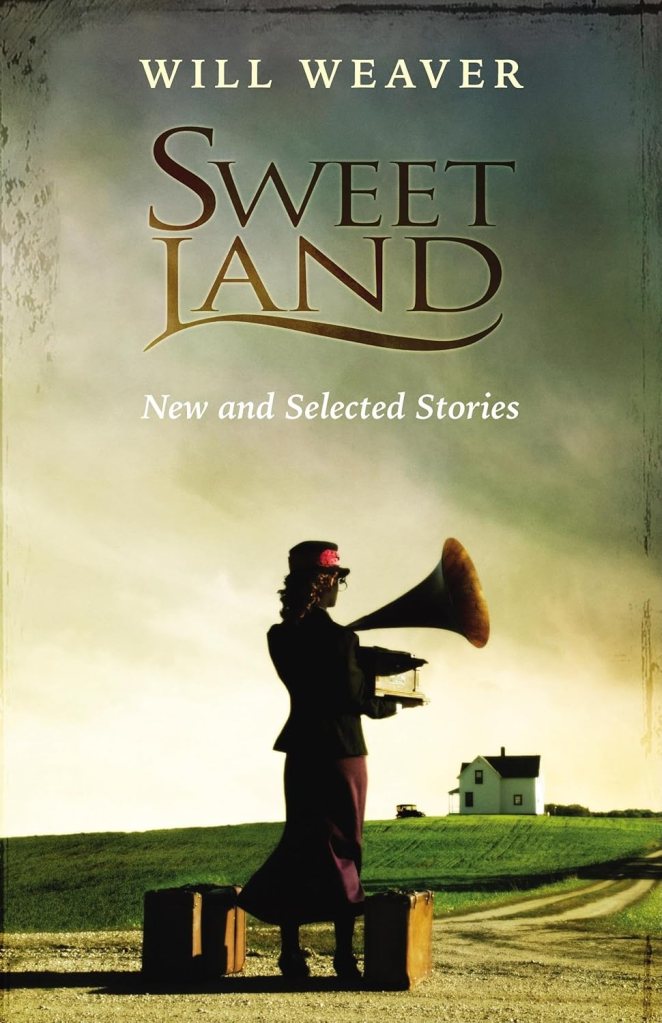
Two stories from Sweetland: New and Selected Stories by Will Weaver (Borealis Books, 2006)
1.“Flax Seed” is the story of a grandfather named Helmer who turns his farm over to his grandson, Kenny. With a handshake, Helmer states the terms of their deal: “Two-thirds, one-third. And no Sunday farming.” Kenny promises. He decides to plant flax, something his grandfather never grew. Farming is difficult. There is a time to sow, and a time to harvest. There is too much rain or too little. Too much heat or not enough. There are pests and diseases, rising and falling prices. There is often a race against time. For Helmer there is God. For Kenny there is the hope of flax and making good as a farmer. Helmer and his God; Kenny and his flax. And a difficult year. It’s a haunting story. Amen.
2. “A Gravestone of Wheat” is the story of Olaf who has loved Inge for forty-five years. They have farmed the land together and raised their son, Einar. They have welcomed grandchildren and great-grandchildren. When Inge dies, Olaf plans to bury her on their farm as Inge wished. But the law has changed: “‘You can’t bury your wife here on the farm,’ the sheriff said. ‘That’s the law.'” Olaf must decide if he will break the law and bury Inge on the farm or if he will bury her in town in the Greenacre Cemetery, knowing she despised the town. Inge has been his devoted wife for forty-five years. As Olaf ponders his choices, he recalls his first meeting with Inge and their unusual courtship, and readers are treated to a beautiful, but pragmatic love story. It’s a wonderful piece of historical fiction.
Two stories from The Path of Totality by Marie Zhuikov (Cornerstone Press, to be released February 2025) To pre-order Zhuikov’s book, click here.
1. “The Path of Totality” is the story of Marjorie and Justin, a young married couple, who travel from Medford, Oregon, to Salem, Oregon, to see the total eclipse of the sun. Caught up in a grief that both unites and divides them, the couple each experience the eclipse differently. Marjorie, along with other spectators, sees it all, astounded as the moon covers the sun. “But to Justin, the sun still shone as whole and bright as ever.” With eloquent prose, rich imagery, and well-crafted dialogue, Zhuikov’s story, told from the young husband’s perspective, is spellbinding. From a craft perspective, Zhuikov’s story reminds us that nature and natural events in our world can be powerful metaphors for human experiences.
2. “Bog Boy: A Northern Minnesota Romance” is set in rural Minnesota, where sixteen-year-old Natalie works at the Sax-Zim Bog, a nature preserve. On a spring day, while leading a birding tour, Natalie discovers a mummified teenage boy in the bog, whose remains are determined to be two thousand years old. The well-preserved teenager, with high cheekbones and beautiful hair, is handsome, and Natalie falls in love with him as only a teenage girl can – completely, blindly, devotedly. Because she cannot be without him, she brings the bog boy home to live with her and her father. Darkly humorous, “Bog Boy” combines the realm of speculative fiction with thought-provoking satire that made me laugh out loud at times. I still smile when I think about the story.
When I returned home from A Midsummer Night’s Dream, a mystical moonscape greeted me.
Last night I went to see a high school production of A Midsummer Night’s Dream. Student actors dressed in colorful, eclectic, whimsical costumes, creating shimmering visions on the stage. They recited Shakespeare’s verse, never stumbling over their words. As the love potion delivered by Puck caused chaos and confusion, the energetic actors made their way on and off the stage, delivering humorous lines, catching the audience up in laughter. All of this on a stage decorated with cut-out trees so enchanting in their color changes, they almost stole the show.
During the quieter moments of the performance. I thought about the many high school and college plays I have seen over the years. All of those young people working together to create a moment of magic on a stage. A moment that would never be the same as the performance that came before, or the one that would come next. I thought about the long hours drama students spend rehearsing, creating sets, lighting the performance, making costumes. How they pass their time together, forging friendships and romances, talking about life and their dreams. Cracking inside jokes that only they understand, the bond of a shared experience. I thought about how young they are, with their whole lives ahead of them. I thought about how once these young thespians leave high school or college, they might never act upon a stage again.
Then I thought about Tom Lake by Ann Patchett, which I recently read and loved. Tom Lake is a story within a story. Lara Nelson, now in her fifties, owns a cherry orchard with her husband. Set in 2020 during the COVID lockdown, Lara’s three adult daughters are staying at the farm with their parents. Because of the pandemic, the family of five works the cherry farm without the usual hired help. Picking cherries is time-consuming, monotonous work. To pass the time, Lara, in a series of flashbacks, recounts the story of her summer in Tom Lake, where as a young woman she performed in a summer stock production of Our Town by Thornton Wilder. Even though Patchett’s novel is set during COVID, it’s not about the pandemic–at all. It’s a beautifully written, heart-wrenching coming of age story.
Last night as I watched the young actors perform, I wondered about their coming-of-age stories. I thought about my own coming-of-age stories.
And that is what good literature does. It slumbers in a corner of your brain, until something in your present world nudges it, and it lives once again in your imagination, giving meaning to both the world that is your life and the world of make believe.









 Writing Near the Lake