Book Review: Close Call by Kim Suhr

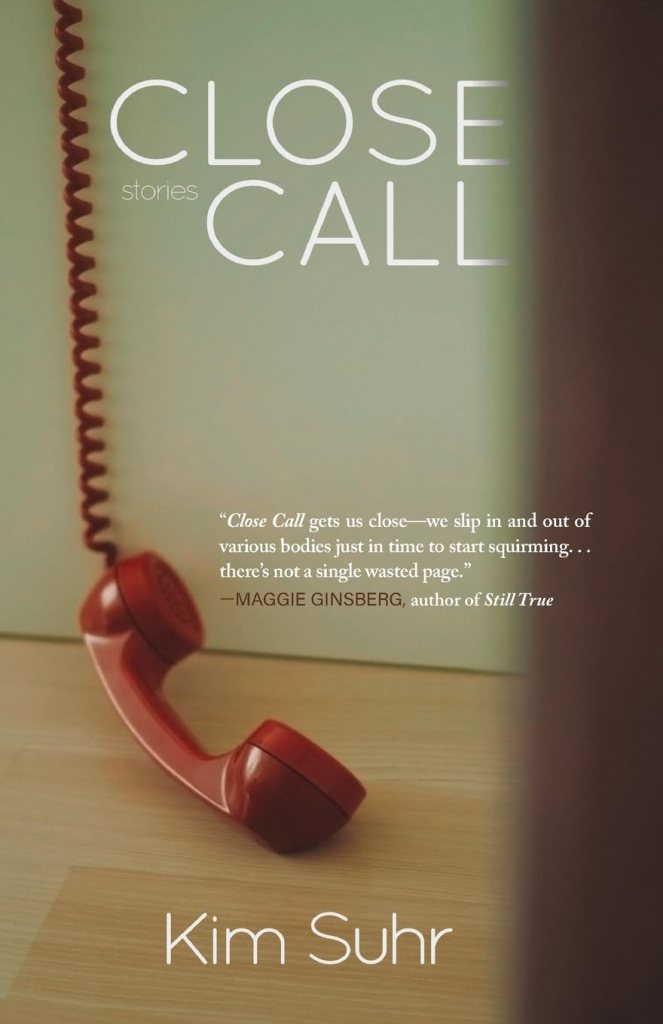
Cover design by Ellen Suhr

[Close Call, a collection of short stories, is currently avaible for pre-sale. Published by Connerstone Press, it will be released October 1, 2024.]

Why did I read this book?

I read Nothing to Lose, Kim Suhr’s first collection of short stories, and loved it. So when Wisconsin Writers Association asked me to review Close Call, her second collection, I jumped at the chance to get an advanced copy so I could read her new collection without having to wait until October 1, 2024.

What is this book about?

Suhr serves up slices of life with intriguing, thought-provoking characters who face conundrums that will either be their undoing or their salvation. Carol, a young girl, works to save her parents’ marriage after a traveling salesman comes calling on her mother. A young married man experiences a new twist on the seven-year itch. Mrs. Morrison, once an artist but now a wife and mother, has lost her sense of self inside a calendar. Allan, an illusionist, has an unusual gift beyond ordinary magic tricks. Deena’s struggles, from childhood to adulthood, are revealed through a series of phone conversations that take place at significant moments in her life. Keith, a DMV employee, has a special talent with a camera. Isabelle, a newlywed, reconsiders her relationship with God after a tragic accident. Willie, a first-grader, gets caught up in a terrifying game of pretend. Dean, a young hockey player, meets Arnie, an old rink rat, who lives for the game of hockey.

At the end of her collection, Suhr gives us two longer stories to savor, “The Dip” and “Eradicated.” “The Dip” is about four women who have known each other since childhood. Now in their fifties, they struggle to maintain their friendship. The story is written through a series of DMs, emails, a Google doc, texts, a poem, scripts, online chat room comments, and an obituary. It takes superb writing skills to pull off this type of story, and Suhr’s talent as a writer shines through. She never lets the experimental techniques be the story, but rather she uses them to create a highly-engaging and cohesive narrative, giving us a lot to contemplate long after we finish reading it.

With “Eradicated,” Suhr presents the perfect dish to round out her collection. This dystopian tale is set in the future where artistic creativity, now labeled a disease, needs to be eradicated, a goal that is nearly complete when we meet Dr. Bells, a scientist. Wishing to observe creative artists before the last of them dies out, the doctor visits an artists’ colony where creative people, who are considered to have “disturbed minds,” have been contained after being extracted from society. Because the themes in “Eradicated” are both timely and timeless, the story sends chills up and down our spines.

What makes this book so good?

Close Call hooks us with one look. The stunning cover art features a red telephone receiver, untethered from its cradle and dropped at the end of its cord. Abandoned, the receiver rests on the floor near a dark shadow, setting the tone for the tales that follow. Stories about close calls, narrow misses, inevitable disappointments, and unavoidable failures. The cover compels us to pick up Close Call and open it, but from the first sentence, it’s Suhr’s vivid writing and intelligent, masterful storytelling that seal the deal and keep us turning the pages. Suhr promises us her collection will be exquisitely crafted, with every word, turn of phrase, and sentence essential in creating her nuanced characters and the thorny situations they face. And she delivers.

Each of Suhr’s stories in Close Call presents a fresh take on love, hate, jealousy, faith, loss, fear, conformity, and disappointment. Her ability to tell stories with unique characters, interesting plots, and captivating complications gives us a look at human nature in a different way, and as we read our way through her stories we hunger for the next one. And Suhr’s stories are a literary treat.

[To visit Kim Suhr’s website, click here.]

Book Review: Djinn Patrol on the Purple Line, a Novel, by Deepa Anappara

Published in 2020, Random House

Why did I read this book?

A friend of mine suggested I might like to read Djinn Patrol on the Purple Line. Not only did she love the story, she liked how Deepa Anappara structured the novel. And my friend enjoyed how many of the chapter titles were also the beginning of the first sentence in a chapter. For example:

THREE WEEKS AGO I WAS ONLY A SCHOOLKID BUT–

–now I’m a detective and also a tea-shop boy.

(And what a great sentence it is.)

What is this book about?

Nine-year-old Jai lives in India in a poor, crowded neighborhood referred to as a basti. Bordered by a smoldering rubbish dump and enveloped by an unrelenting gray smog, Jai’s life in the basti is hemmed in by poverty, garbage, pollution, and classism. The wealthy lifestyle of the hi-fi residents who live in luxurious skyscrapers separated by a high wall from his basti is beyond his reach. He lives with his older sister Runi-Didi and his Ma and Papa. His best friends are Faiz and Pari, who are also classmates.

The story opens with the disappearance of Bahadur, a quiet and unassuming boy who others rarely notice. When Bahadur doesn’t turn up, his parents and other concerned adults from the basti beg the local police to investigate. But the police refuse to take Bahadur’s disappearance seriously, and instead they threaten to have the basti bulldozed if its residents insist on causing trouble over Bahadur’s disappearance.

In answer to the indifference of the police, Jai, Faiz, and Pari declare themselves detectives. Jai, who loves to watch detective and crime shows on TV, fancies himself as the head detective. The three friends wander through their basti and the Bhoot Bazaar, asking people if they’ve seen Bahadur. They even take the Purple Line train to a neighboring city on a hunch that Bahadur may have run away or been kidnapped and taken to that city.

Soon other basti children go missing, and fear, like the pervasive smog, engulfs the basti residents. Jai, Faiz, and Pari are forbidden to leave home without an adult. But they defy their parents, and while continuing to look for Bahadur, they make inquiries about the other children who have gone missing.

What makes this book so good?

Deepa Anappara was born in India and worked as a journalist in her home country from 1997 to 2008, where she wrote about education. There is no doubt that Anappara’s personal and professional connections to India enabled her to create the realistic world in which her impoverished and marginalized characters live. Although her characters are fictional, Anappara’s portrayal of their joys, fears, hopes, and disappointments are heartbreakingly real. And most importantly, Anappara takes care not to sensationalize or diminish her characters’ stories. Instead, she has written a literary novel about the worst kind of crime. Her beautiful writing along with her measured restraint carries readers through the difficult scenes.

During her years as a journalist, Anappara interviewed many disadvantaged children, whom she found to be full of “humor, sarcasm, and energy.” While working as a journalist she learned that children from poor families disappeared at a higher rate than children from families in better circumstances. These abductions rarely made the news unless a kidnapper was caught or the details of a kidnapping were particularly gruesome. It upset Anappara that the stories of the missing children “were nowhere to be found.”

When Anappara first tried to write Djinn Patrol, she labeled her attempt a failure. In 2016, she returned to her novel. This time when she thought about the children she had interviewed in India, she remembered “their determination to survive in a society that often willfully neglected them” and she knew the story must be told from the perspective of the children. She found a way into her story, and after reading her novel, I can’t imagine it being told any other way. The story is told mostly in first person by Jai, who is at turns earnest, careless, unselfish, jealous, kind, and churlish, but who, despite his faults and missteps, captured my heart. Other times the story is told in third person through the point of view of other children.

I have to return the borrowed book to my friend. But I ordered my own copy to keep on my bookshelf. In part because like my friend, I admire Anappara’s amazing use of voice, point of view, and structure. Perhaps, I won’t read the book again, or maybe I’ll only read parts of it. Regardless, I couldn’t bear the thought of being separated from Jai, Faiz, and Pari and their dreams. And that’s the other part.

Book Review: The Family Chao, a Novel, by Lan Samantha Chang

Published in 2022 by W. W. Norton & Company

Why did I read this book?

I’m a member of the Wisconsin Writers Association (WWA), and I will be attending their 2024 Writers Conference this fall. Because Lan Samantha Chang is one of the keynote speakers, WWA recently hosted a book talk about The Family Chao with Chang. So, I wanted to read the book before attending the book talk, just to avoid any spoilers.

What is this book about?

Leo Chao and his wife, Winnie, have run a successful Americanized Chinese restaurant for thirty-five years in Haven, Wisconsin, where they settled as young immigrants in a mostly white community. Their goals were to serve high-quality food and to make sure their three sons became well educated and successful. Winnie has recently left her mean-spirited, philandering husband and the family business and moved into a religious sanctuary. For years Leo Chao has been a bad husband to his wife and a bad father to his three sons, who have come to loathe and fear him, yet still seek his approval.

Dagou, their oldest, left college to help his father run the family restaurant when his mother became ill. After his mother recovered, Dagou, an excellent chef, remained based on a promise from his father that the restaurant would one day be his. Dagou is engaged to one woman but in love with another one, and he needs money to impress the new woman. When Dagou asks his father to honor his promise regarding the restaurant, his father denies the promise exists and threatens to fire Dagou.

Ming, the middle child, is a successful businessman who lives in New York City, but as a first-generation Chinese-American, he struggles with his identity. Bullied when he attended the mostly white Haven public schools and continually embarrassed by his parents, especially his father, Ming avoids his Chinese heritage and rarely returns home to Haven.

Nineteen years old, James, the youngest son, plans to become a doctor. On his way home for the Christmas holidays, he tries to save a man who suffers a medical episode in the train station. The man dies, leaving James shaken and in possession of the man’s bag, which is destined to play a part in the Chao family drama. The three brothers don’t always get along, but they rally in support of their mother and each other when the need arises.

The Chao family appears to have put aside their differences in order to unite for the yearly Christmas dinner. The next day, Leo Chang is found dead. After an investigation, one of the brothers is arrested, but the other two brothers aren’t sure their sibling killed their father, and they keep searching for the truth. As they search, they uncover other truths that have been hidden.

What makes this book so good and important?

Chang’s beautiful writing, strong plot, and richly-drawn characters pulled me into the story. Her novel reads like a Greek tragedy — with the characters’ current sorrows rooted in past transgressions committed by themselves or others. As the story unfurls, readers watch characters struggle to escape their destinies, which are perhaps not of their own choosing or their own making. On one level, Chang’s novel explores dysfunctional families and guilt and regret. But on a deeper level, she delves into how community prejudice adds to the troubles of the Chao family and to the other Asian American families in Haven, Wisconsin.

In a world of thirty-second sound bites about immigration and stereotypes, Chang’s novel provides a deep, long look at the consequences of prejudices and misunderstandings between cultures. It’s the best kind of novel — one written to make readers think and to expand their understanding of the world, all while serving up a superbly written story.

I showed up early to appointments just so I could sit and read Chang’s book without being distracted by interruptions at home.

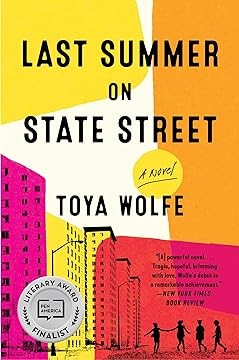
Book Review: Last Summer on State Street by Toya Wolfe

[William Morrow, An Imprint of HarperCollins Publishers, 2022.]

What is this book about?

Last Summer on State Street by Toya Wolfe is both a historical and coming-of-age novel. Set in 1999, the story follows four 12-year-old girls through a tumultuous summer of change. Set during the real-life demolition of Chicago’s Robert Taylor Homes by the Chicago Housing Authority, most of the story takes place in or around building 4950, which will soon be torn down. Twelve-year-old Felicia “Fe Fe” Stevens lives in 4950, along with her mother and teenage brother. Fe Fe and her friends, Precious and Stacia, spend their days going to school, jumping rope, and hanging out. When Fe Fe befriends Tonya, a skinny, forlorn girl with a drug addicted mother, and invites her into their circle of friends, Precious and Stacia aren’t happy.

As the summer temperatures scorch their neighborhood, trouble brews and spills into the streets. Gang wars erupt and residents endure gang shootouts and indiscriminate police violence. Fe Fe’s brother, who has managed to avoid gang life, is wrongly arrested and taken to jail. As Tonya’s beauty becomes more apparent, she can’t escape the unwanted attention of older boys. When the dynamics of Fe Fe, Precious, and Stacia’s relationships change, Fe Fe faces difficult questions about friendship and self-preservation. And as demolition day nears, Fe Fe worries about where her family will be allowed to live.

What makes this book so good?

From the first page, Wolfe’s style of prose, story-telling skills, and well-rounded characters combine to create a gripping and powerful series of events that draws the reader in and holds them throughout the book. Wolfe’s characters face crucial moments in their lives, forcing them to make tough choices in an environment that offers few options. And as her novel unfolds readers come to understand that Wolfe’s characters are complex and evolving.

Fe Fe, who narrates the story, is an adult looking back at her twelve-year-old self and her summer of seismic shifts. Wolfe creates a compelling, believable, and seamless voice for Fe Fe, who tells us a pivotal story from her youth as an adult, but at the same time as if she were still that child. I loved this weaving of Fe Fe’s voice, both young and innocent, but at the same time layered with reflection and maturity. If you’re a writer, thinking about writing a book where a character looks back at an event from their childhood, Last Summer on State Street provides an excellent model for the technique.

Why is this book important?

Wolfe’s beautifully written novel illustrates the consequences of racism and segregation against African Americans. A gripping story, skillfully told in first-person POV by Fe Fe Stevens, Wolfe’s debut novel is filled with sadness and joy, broken dreams and hope. And most importantly, it’s a book that can start conversations and encourage understanding among diverse people. Wolfe’s novel tells the story of segregated neighborhoods, poverty, fear, violence, stripped opportunities, and forced displacement. We live in a political climate where some people want to sanitize history, supposedly to spare white people uncomfortableness. But books like Wolfe’s have a much greater power to build bridges of understanding, hopefully fostering amends and shattering stereotypes.

[PEN Open Book Award finalist; Chicago Writers Association Book of the Year Award winner; Stephen Curry Underrated Literati Book Club Pick; Named a Best Book of Summer by Good Housekeeping, Chicago Magazine, The St. Louis Post Dispatch, Chicago Tribune, Veranda, The Milwaukee Sentinel, Publisher’s Weekly, among others.]

Reading a Raymond Carver Story Saves My Relationship with a Troublesome Story of My Own

Lake Michigan, the eastern side

I recently finished a short story, and for the past few weeks, I’ve been reading and rereading it and sending it to my favorite readers for feedback. After minor revisions and edits, I think it’s done. I’m happy with the story now. But I almost ditched it because I’d spent months (on and off) trying to figure out how to write this particular story. As proof, I have multiple handwritten versions in a journal and several other attempts saved on my computer. None of those drafts were salvageable.

I had decided to use present tense and third-person point of view. But I couldn’t find a way into the story — each draft lacked a beating heart. The real problem? My third-person narrator desperately needed a voice, and I couldn’t find one. I kept putting the story aside and working on other writing. And I kept reading: fiction, nonfiction, and short stories.

It would be a short story written by Raymond Carver that gave me an idea.

Although, if you read the Carver story, you might not see its connection to my story because our styles and voices are so different, plus his story uses past tense and first-person point of view. So, what was it about the Carver story that inspired me? Narrative distance. Carver’s first-person narrator tells his story from the distance of years gone by, even though there are some closeups. As I read Carver’s story, I became giddy. A hundred-watt light bulb lit up over my head. I’d found a way to tell my story. I needed to keep my narrator at a distance.

I began my short story anew — on a blank page, without even a glance at the other drafts. I did keep the present tense and third-person point of view, but I created narrative distance. It worked. That distance gave my narrator a voice, which in turn gave my story a heartbeat.

And I’m grateful because something about the story wouldn’t let me go. It kept pleading, “Just give me one more chance.”

Experienced writers tell beginning writers to write, write, write. They also tell beginners to read, read, read. I used to think if I read while I was writing, I would end up writing like the author I was reading. But that just doesn’t happen. Instead, I’m inspired. I pay attention to how an author crafts her story, from sentence to paragraph, from beginning to end. And sometimes (thank you, Raymond Carver), I come across a technique that I can apply to something I’m currently writing.

Book Reviews for December

During December you can shop or you can read books. Or better yet, you can shop for books! Recently, I learned about a delightful Icelandic tradition called Jolabokaflod, which loosely translates into Christmas book flood. Every November the Icelandic book trade publishes a catalog of new releases, which is mailed to every household in Iceland. People buy books for their family and friends as Christmas gifts. On Christmas Eve after gifts are opened, everyone is encouraged to start reading their books right away. Imagine the peace and quiet and magic as each person slips into the pages of a book and into another time and place. Perhaps, one of these books will help you start your own family Jolabokaflod.

A Highland Christmas by M. C. Beaton (Mysterious Press by Warner Books, Inc., 1999)

Hamish Macbeth, the usually unflappable town constable of Lochdubh, a small village located in the Highlands of Scotland, is out of sorts. Christmas is fast approaching, and Hamish is disappointed because he cannot spend the holidays with his mother, father, and six siblings, who have gone to Florida for the holidays. Hamish must tend to his beat in Lochdubh and to another constable’s beat in nearby Cnothan.

Author M. C. Beaton (1936-2019) wrote a series of cozy mysteries featuring Hamish Macbeth who uses his intelligence, keen observation, and intuition to solve murders, showing up his superior officers. But it’s Christmas and in the spirit of peace and goodwill, Beaton’s A Highland Christmas is a very, very cozy mystery — skipping the murder.

However, Hamish’s pre-Christmas days are filled with small mysteries. Mrs. Gallagher, a detested, ill-willed spinster, rings up the police station to report her cat is missing and demands that Hamish find it. He also wants to discover why Mrs. Gallagher is a nasty-tempered old woman who bars and bolts her door and seldom leaves her home. Meanwhile, in Cnothan someone has stolen the town’s Christmas lights and tree, and Hamish is called to solve the Grinch-like crime. Hamish also wonders how he can convince a little girl’s Calvinist parents, who view Christmas as a heathen celebration, that their daughter should have gifts for Christmas, like the other children in her school.

A Highland Christmas is a warm-hearted novella filled with interesting characters who discover kindness is the best Christmas gift of all.

[If you wish to read this book, you will need to buy a used copy, make a visit to your local library, or listen to a digital copy because it’s out of print. I have listened to it twice as an audio book. It’s become part of my Christmas tradition, like watching A Christmas Carol. This year I bought a used hardcover version and was delighted to find that it has charming illustrations. I don’t know if the paperback version is illustrated.]

Beware of Cat and Other Encounters of a Letter Carrier by Vincent Wyckoff (Borealis Books, imprint of the Minnesota Historical Society Press, 2007)

Most of us are familiar with the letter carrier’s motto: “Neither snow, nor rain, nor heat, nor gloom of night stays these couriers from the swift completion of their appointed rounds.” We know letter carriers sizzle under the hot summer sun, get wet in the rain, trudge through snow, and freeze on sub-zero winter days. But we don’t necessarily know about the rest of “their appointed rounds.

Wyckoff’s collection of stories about his job as a letter carrier made me smile, laugh, cringe, and cry. For over fifteen years, Wyckoff delivered mail in a neighborhood in South Minneapolis. He came to know the people on his route, most of whom were kind, although some could be difficult. Wyckoff is a wonderful storyteller and a very good writer. His stories entertain, enlighten, and educate. He encounters an attack cat, biting dogs, cranky customers, lost pets, and on one particular day, a young child waiting for his mother who isn’t showing up. He writes about people on his route who became his friends, sometimes inviting him to be part of their family milestones. Ever wonder how a letter carrier’s day starts or what happens when he has to deliver a registered letter? Wyckoff offers up a well-rounded, well-written, informative, and heart-warming collection of stories about his career as a letter carrier. As a bonus, readers come away with a better understanding of what it takes to deliver the mail.

I liked this book so much that when I couldn’t find any other way to let Vincent Wyckoff know, I mailed a letter to him in care of his publisher. [Vincent Wyckoff also writes mysteries. For more information, click here.]

Mr. Chartwell by Rebecca Hunt (The Dial Press, imprint of the Random House Publishing Group, 2010)

After my mother-in-law died, my father-in-law invited me to look through her books and take what I wanted. I found Mr. Chartwell on her bookshelf. The cover caught my attention. I turned the book over and one of the blurbs mentioned Winston Churchill and his “black dog of melancholy.” I knew Churchill suffered from bouts of depression. Intrigued, I placed Mr. Chartwell on the pile of books I wanted.

Mr. Chartwell, Rebecca Hunt’s debut novel, deals with depression — a heavy subject. (The cover art, which caught my eye, belies the book’s seriousness.) However, Hunt combines sardonic wit with verbal and situational irony, creating moments of comic relief that are at turns dry, surreal, and dark, but which also lighten the story’s somber mood.

Hunt’s story is set in England and takes place in 1964, from July 22 through July 27. Winston Churchill will soon retire from public service, and he isn’t happy about it. Mr. Chartwell, a large black dog, who has spent a lot of time with Churchill throughout his life, returns to keep him company. Churchill isn’t happy about that either because Chartwell is the black dog of depression. Hunt personifies depression through Chartwell who is a very large, intrusive black dog and who alternates between beating around the bush or cruel bluntness when speaking. Esther Hammerhans, a young widow of two years, advertises for a boarder, and Chartwell answers her ad. She is shocked when she meets Chartwell at her door because the big black dog speaks to her while extending his huge paw for a shake. Chartwell convinces Esther to let him move in, so he splits his time between Churchill’s estate and Esther’s house.

Hunt’s use of figurative language is often quirky and elbows a reader’s sensibilities off kilter, which mimics what depression can do to a person. Her use of unusual metaphors made me groan a few times, but overall, I admired and enjoyed her fearless approach to creating a unique narrator’s voice. Her striking prose invites readers to slow down, read each sentence carefully, and absorb the intricate range of emotions Churchill and Esther experience when confronted by Chartwell. Hunt deftly juxtaposes Churchill’s long-standing battle with Mr. Chartwell against Esther’s beginning struggles with the black dog.