Lake Superior Gives Us the Cold Shoulder but Warms Our Hearts

[Author’s note: In 2019, my grandkids and I celebrated the first day of summer with a day trip to Two Harbors. Originally published on Perfect Duluth Day Blog on May 11, 2020.]

At 7:30 a.m., my daughter-in-law launches three-over-the-moon-excited explorers into my house. My grandkids and I eat a hardy voyagers’ breakfast of eggs, sausage, and fruit. After cleaning the kitchen, I prepare to leave home with them for a day-long jaunt. I stow hats, jackets, and spare clothes in a canvas bag and drape Evan’s blanket across the top. Almost three years old, it’s his first adventure with us, but he’s not going without his fluffy fleece blankie.

Two Harbors Lighthouse

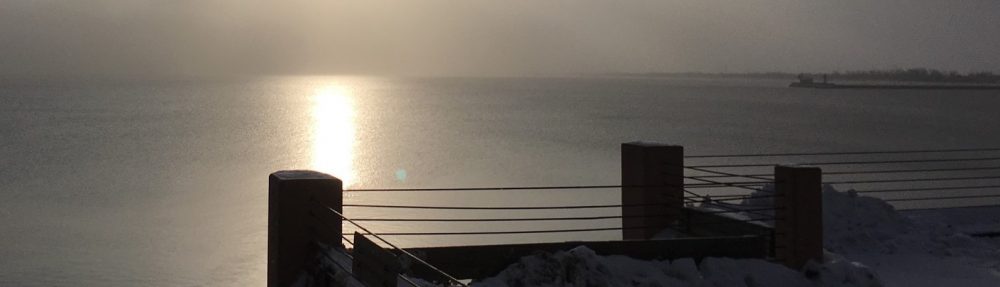
It’s the first day of summer. Warm spring days near the shores of Lake Superior were scarce this year, and even though the first day of summer delivers sunshine, it’s miserly with warmth. I live four city blocks from Lake Superior, and while I can imagine living closer to it, I can’t imagine living farther from it. Most adventure days with my grandkids involve the lake, even if it only provides scenic backdrop.

“Can we bring our adventure bags?” Michael asks. He’s six, a seasoned explorer like his sister Clara, almost eight.

“Can I have a ’venture bag?” Evan asks.

“Sure,” I say. He beams. If his siblings have it, he wants it.

Clara’s and Michael’s bags are too big for Evan, so I fetch a small cloth bag. I sift through postcards and choose some Minnesota ones. I add a toy and a book and present the bag to Evan. He slips one handle over his left shoulder and the other handle over his right shoulder. The bag rests against his chest, like a breastplate of medieval armor worn by a knight.

“I have a ’venture bag,” he crows. He belongs.

“Yes, you do.” I validate his initiation into our group of explorers. He doesn’t know his bag lacks plastic binoculars, a cheap compass-whistle gadget, auto bingo, and maps.

We arrive just before the Two Harbors Lighthouse Museum opens. It’s easier to shepherd three excited children through thin crowds.

To reach the lighthouse grounds, we pass through the gift shop. My grandkids scout toys and trinkets while I buy our tickets.

Beyond the gift shop, we enter a pilothouse that once perched atop the Frontenac. Built in 1923, the iron ore boat was wrecked in 1979 during a blinding snowstorm when she hit a reef near Pellet Island. The pilothouse overlooks Lake Superior, but she’s anchored to land and keeps watch over the same expanse of lake day after day, year after year. She witnesses Lake Superior’s moods, from calm ripples lit by clear skies to crashing waves darkened by angry churning clouds.

My grandkids take turns at the wooden wheel and steer a nonexistent boat to nowhere, but they covet the wheel more than anything else in the pilothouse. When it’s not their turn at the wheel, they each stare at the radar screen, which no longer sends or receives signals. Artifact by artifact they circle inside the pilothouse, and wait for another turn at the helm. I don’t come from a family of sailors, so I’ve never waited for a ship to return safely to harbor. But as my grandkids explore the pilothouse, my thoughts are with sailors who work dangerous jobs. State-of-the-art communications, radar, and forecasting make their jobs safer, but Lake Superior is a daunting adversary when storms crisscross her waters.
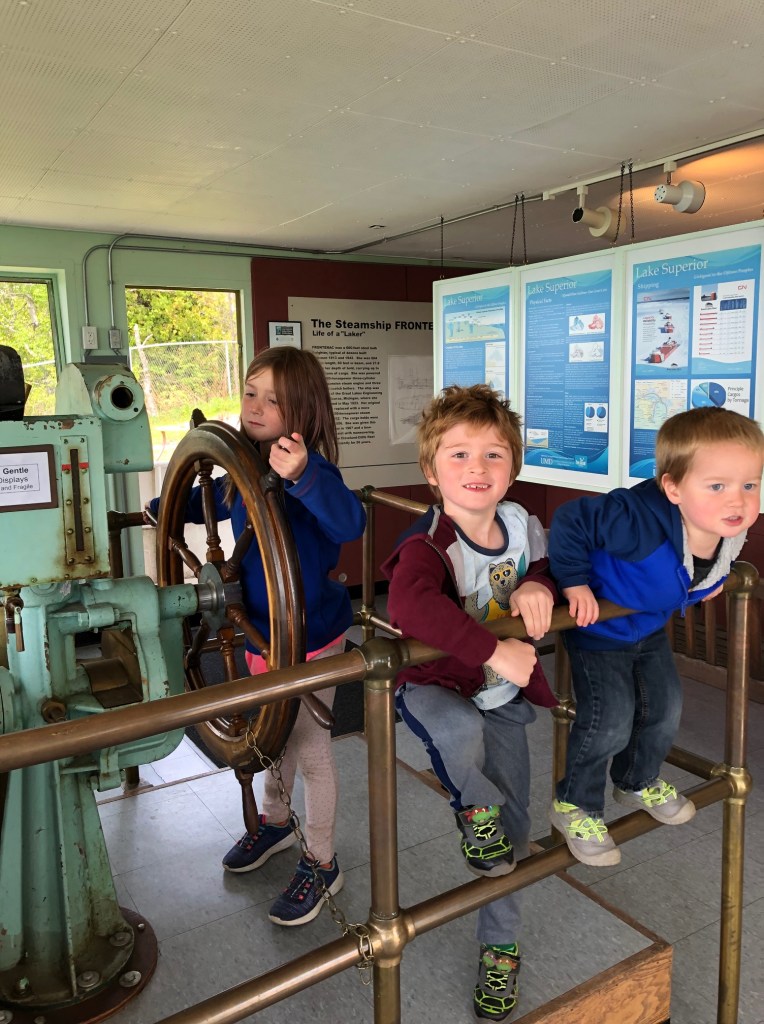
Frontenac’s Pilothouse

While my little seafaring urchins quibble about whose turn it is to steer, I envision the crew who used the equipment in this pilothouse for the last time. I see them alternating between reading instruments and watching a swirling snowstorm. Today the wheel is chained to a brass rail, so young sailors, like mine, can’t go wild at the helm. In 1979, the wheel turned freely, but that didn’t help the crew keep the Frontenac from slamming onto a rocky reef, making her hull howl and shudder as it buckled.

Lake Superior is a boneyard of vessels and sailors. Clear across the lake to the east lies the Edmund Fitzgerald. She was seized by waves, which broke her. She sank with her crew. Up the shore is Pellet Island near Silver Bay where the Frontenac struck a reef. She met her demise, but her crew survived. She’d landed on rocks, which held her up.

“Who wants to see the lighthouse?” I ask. I’m answered by a chorus of “me, me, me.”

We trek up the slope and climb the gray wooden steps to the lighthouse. Clara and Michael scale the tower stairs, more interested in looking out the slit windows than at the displays. When they reach the ladder gallery, the porthole windows give them a bird’s-eye view of the green, gently sloping grounds. “Can we play outside?” they ask. The inside of the lighthouse doesn’t capture their fancy like the inside of the pilothouse did.

The small wooden steps curving along the tower wall are perfectly sized for children, and Evan confidently ascends placing one foot above the other. After reaching the top, he triumphantly descends by sitting on his butt, scooching to the edge of each step, and lowering himself to the next step. At the bottom of the stairs, he raises his hands above his head, then slaps them on his thighs and says, “Again!” He’s enamored with the pint-sized stairs, but it doesn’t take much to coax him outside.

My grandkids scamper up and down the grassy slope, and I’m grateful for the combination of wrought iron and chain-link fencing surrounding the grounds. The sun sits higher in the sky, and we’re no longer alone. I suggest we toss rocks into the lake.

We amble down the trail to smooth rock formations hugging the shore. Like nimble-footed mountain goats, Clara and Michael climb the formations and pitch rocks into Lake Superior. They gather rocks for Evan, who stands close to me. He throws them, but most fall short of the lake. For a quarter-hour, my grandkids toss rocks into a lake that will spit them back up during her next temper tantrum. I worry one of them will slip and fall off the rocky mounds.

“Who wants to go to Burlington Beach?

“I do,” says Clara.

“Me too,” says Michael.

“Me too,” echoes Evan. If his siblings are going, he’s going.

Burlington Beach has a gentle slope to the water’s edge.

In the time it takes to drive to Burlington Beach, which is under a quarter-hour, Lake Superior changes her mind. She pulls a shade of gray over the morning’s blue sky and dials up the wind machine. The four of us stand on layers of pebbles and stones. The wind infiltrates my clothing, and I wonder how long I’ll have to stand on this beach and freeze while my grandkids toss stones. Michael’s teeth are chattering. And Evan, tilting forward, braces himself against the wind, which has carried off his voice. Clara burrows her hands into her jacket pockets and speaks for them, “Nana, it’s really cold.

Back in the van, they ask about our picnic lunch. The gray skies and gnawing wind don’t speak of picnics.

“We’ll have a picnic in the van,” I say.

“Yay, yay, yay,” they cheer.

I drive to the big white rooster that welcomed us to Two Harbors several hours ago and park the van. We eat and talk about the day’s adventure. The cold temperatures and gusty winds have clipped our plans, but our memories of today are already warm.

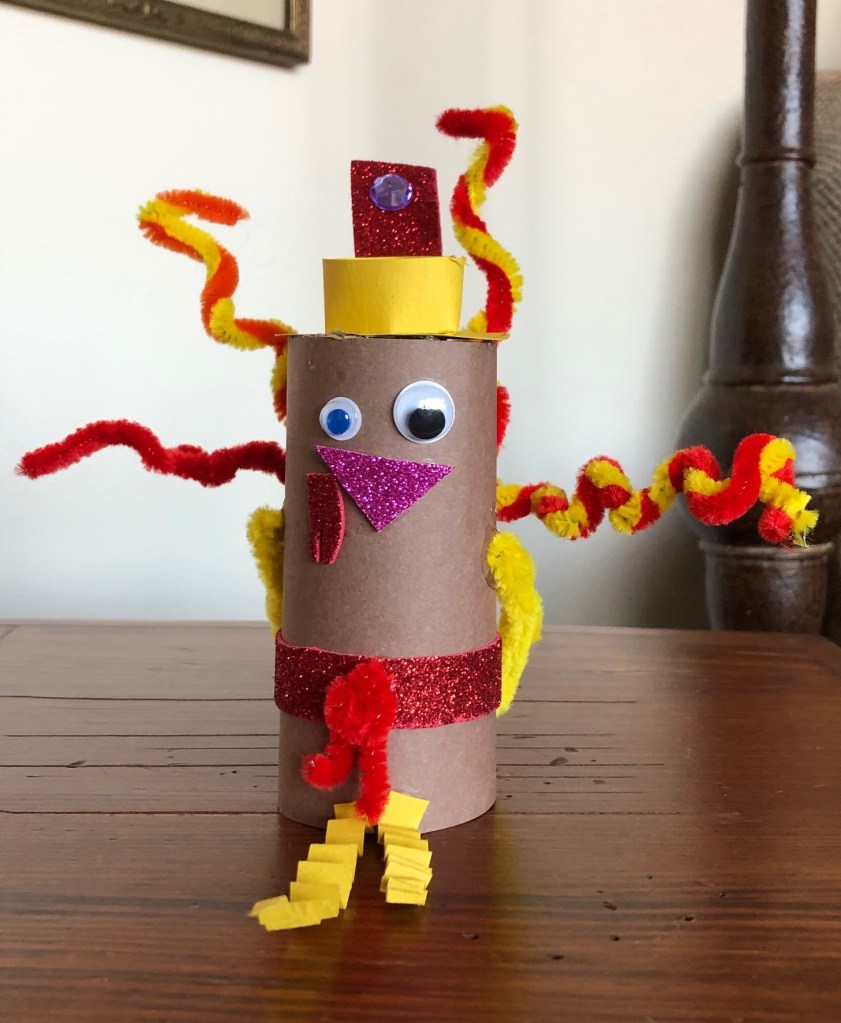
Turkeys on Parade

“Practicing an art, no matter how well or badly, is a way to make your soul grow, for heaven’s sake. Sing in the shower. Dance to the radio. Tell stories. Write a poem to a friend, even a lousy poem. Do it as well as you possibly can. You will get an enormous reward. You will have created something.”
 Kurt Vonnegut

Because of the pandemic, I provide daycare three days a week for my grandchildren, ages nine, seven, four, and two. In addition, I serve up homeschool lessons for the oldest two and a dash of preschool curriculum for the four-year-old. My favorite lessons involve artwork. It’s their favorite too.

Many of our art projects are prompted by ideas from the internet. But Thanksgiving and childhood memories about bringing toilet paper rolls to school for art class inspire our latest project: Toilet Paper Roll Turkeys.

My turkey–he may be plain, but he inspired fanciful creations.

In art-teacher mode, I whip up a model paper roll turkey to inspire my three oldest grandchildren. (Two-year-old Charlie will be happy to play on the floor with an empty roll.) With pride, I text pictures of my model turkey to family and friends. They ooh and aah appropriately, much in the manner of a proud parent attaching a child’s work to the front of the refrigerator.

Before the grandchildren decorate their turkeys, I cover each roll with brown construction paper. On the day of our class, I sprinkle the table with scissors, glue, pipe cleaners, googly eyes, construction paper, stick-on faux gems, glitter foam sheets, popsicle sticks, and stickers. They eye the smorgasbord of craft supplies, eagerly waiting for permission to dig in.

I place my turkey on the table. “You can use this as a model, but decorate your turkeys any way you want. If you want to add googly eyes or something heavier, like pipe cleaners, to your turkey, I’ll hot glue it on so it stays.” My glue gun is heating up on the kitchen counter.

“I know,” Clara says. She’s nine years old and likes me to know that she already knows plenty. She also loves arts and crafts.

Michael, the seven-year-old, digs through the supplies and grabs a sheet of Caribbean-blue glitter foam.

“I don’t want to make a turkey,” Evan says. “Can I just cut and glue paper?”

“Sure,” I say. Evan’s four, and today decorating a paper roll to look like a turkey isn’t his thing.

Charlie is playing on the living room floor with his plain paper roll and toy cars.

Clara and Michael sift through the craft supplies searching for the perfect ingredients to bring their turkey visions to life. Clara chatters about her plans, sharing every artistic decision out loud. Michael’s hands do his talking as he grabs a pair of scissors, uncaps the glue, and adorns his paper roll. Evan cuts and glues random chunks of colored construction paper, but he’s stealing glances of Clara and Michael dressing their turkeys.

Evan yields to temptation. “Can I make a turkey?”

“Sure,” I answer, handing him the third brown-papered roll. He reaches into the supplies and gathers his fixings. I hand him a box of sparkly stickers because his little hands can manage them. He’s smitten with the googly eyes and amasses them in different colors.

Meanwhile, I’m slinging my hot glue gun, attaching googly eyes and wings and tail feathers fashioned out of pipe cleaners for Clara and Michael.

Evan’s ready to have his turkey’s eyes glued on. He points to a spot; I glue on an eye. He gets another eye, points to another spot, I glue. This cycle is repeated five times, and he’s on his way for a sixth eye. “Enough eyes,” I say. Past experience with four-year-old children and art supplies tells me if I let him, he’ll have dozens of eyes on his turkey. It will be creepy, but even scarier our googly-eye stock will be seriously diminished. “It’s time to decorate your turkey with some other art supplies.”

Charlie appears, his tiny fingers clutching the table. His eyes, barely rising above the table’s edge, scan the goods. He says, “Nana,” which covers a lot of ground. I hand him another plain paper roll and he scurries back to the living room floor.

After the turkeys are complete, I’m amazed by the personality of each one. The spiced-up creations made by my grandchildren eclipse my bland turkey.

Clara’s turkey is attired for Mardi Gras. Its twirled red, orange, and yellow pipe-cleaner tail and wings are combined with a sparkling red belt and a yellow hat topped with a red glittery foam feather embellished with a faux lilac-colored gem. Her turkey is ready to strut down Bourbon Street.

Clara’s turkey–heading out to Bourbon Street after the holidays.

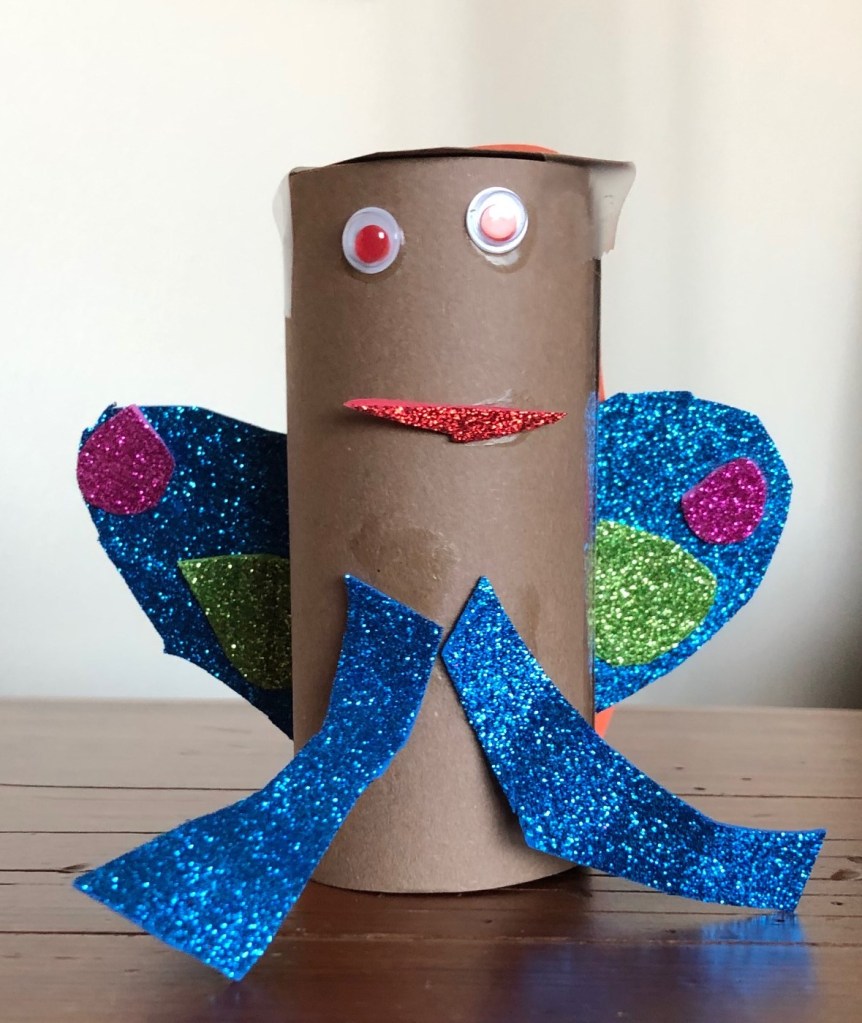
Michael’s turkey, with glittery blue wings sporting shimmering purple and neon green spots and glittery blue legs, looks like a butterfly. “Very nice,” I tell him. I don’t question his color choices. I imagine his turkey as a butterkey or a turkfly wanting to flit from clover to clover. Perhaps it’s masquerading to avoid the axe and being placed on a platter at the dinner table.

Michael’s turkey–incognito until after the Thanksgiving meal.

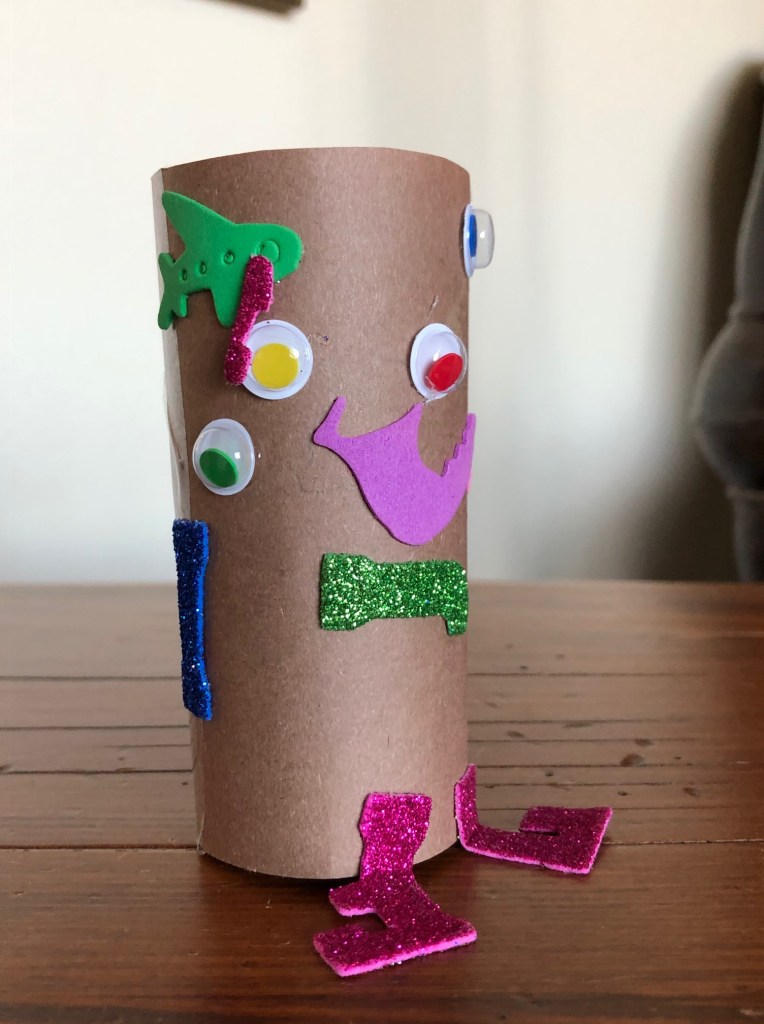
Evan’s turkey is the most unique, in the way only a four-year-old can interpret a turkey. Asymmetrical, it’s a Picasso turkey. Its eyes look up and down, left and right, none of them aligned. Both its wings protrude from the right side, something Evan insisted on when I asked him if he was sure. A green foam airplane sticker flies from the left of its forehead to the right. Its beak is a mauve foam saxophone sticker. Its mouth is a glittery green J and its feet are two sparkling raspberry-colored F’s. Evan has channeled Picasso, whom he knows nothing about. But maybe Picasso channeled four-year-old artists.

Evan’s turkey–a work of artistic interpretation.

As each turkey is finished, I place it on the ledge of my kitchen window. The turkeys, including mine, strike impressive poses. Throughout the day, as the grandchildren wander through the kitchen, one of them will stop and admire the turkeys, always with special attention paid to his or her own creation. Evan asks, more than once, “Can I hold my turkey?” I hand it to him, he holds it, then hands it back to be returned to the flock on the ledge.

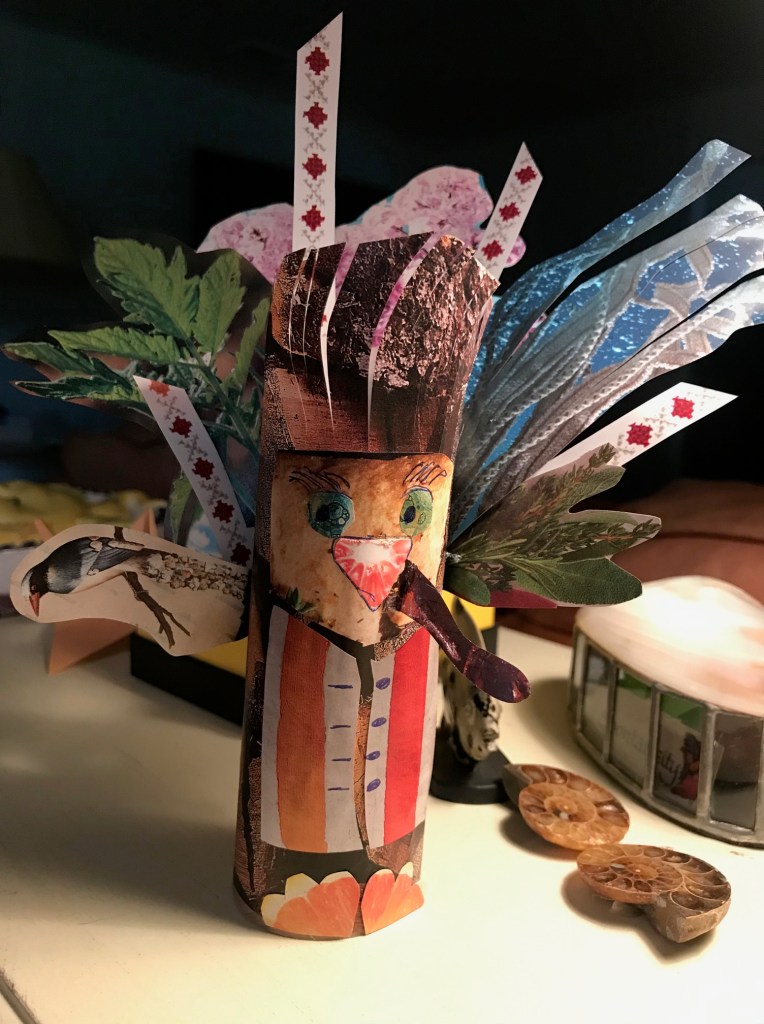
My sister, who lives in Dallas, was inspired. Using her imagination for inspiration, she adorned her paper roll turkey with foliage and cut up magazine pages.

Vonnegut’s advice, “Practicing an art, no matter how well or badly, is a way to make your soul grow,” rings true. And his conclusion, “You will get an enormous reward. You will have created something,” shines on the faces of my grandchildren. They’ve created something.

I look at my turkey and remember the peace I felt while making it. And even though it’s ordinary next to my grandchildren’s turkeys, I feel joy because Vonnegut is right—I’ve created something.

It’s a good time to practice an art.

Writing (or Not Writing) and Daycare for Grandkids

[“Writing (or Not Writing) and Daycare for Grandkids” appeared on Lake Superior Writers’ Blog on September 8, 2020.]

The synapses in my brain zing snarky impulses from neuron to neuron, causing my mind to fire on all cylinders with crankiness and snarl, feed me serotonin.

I have to write because that’s what the old gray mass wants. At this point, my brain is past accepting substitutes—walking, chocolate, reading, or cleaning won’t short-circuit the cranky electrical impulses as my brain begs, write, you know you want to; write, you know you need to; just bloody hell write.

***

I’m retired and days should be my own, but my grandkids need daycare, and being the only available option, I’ve been babysitting now for two-and-a-half months.

Most weekdays my four grandkids fill the house with the discordant sound of a young orchestra struggling to play on key and in time. I love them, but by the end of the day, their continuous, overlapping voices and sounds of play erode my energy, leaving my mind worn down like a piece of driftwood partly buried in sand.

Writing saves me from feeling like a clunker that’s been dropped into a car crusher, being pushed into itself on all sides. It’s been days since I’ve attempted any writing, and the front and rear bumpers of my soul are almost rubbing together.

Each morning I’ve grand plans to write after my grandkids go home. But after they leave, I descend into a stuffed chair, stretch my legs over its ottoman, and muster up what I need to get through the few hours I’ve left before going to bed. Writing rarely makes the cut.

My weekends are grandchild-free, but I’m spending them working on a sizeable editing job for a client. The work is stimulating, and the client’s writing is enjoyable, but it’s not the same as doing my own writing.

Because I’ve the reserves for escapism but not the stamina to write, I hide from writing, pretending I’m being productive by reading a novel for my book club, embroidering dishtowels for friends, and watching British police dramas with tortured detectives, hence phrases like bloody hell slinking into my speech. (In one police drama, the storyline featured a detective winning third place in a prestigious writing contest. It was the character’s last episode, and with no explanation for his exit, I’m assuming he left the force to pursue a rewarding writing career. I decided the show was mocking me. But I still watch it.)

***

Today, mercifully, my 22-month-old grandson falls asleep on the daily car ride my grandkids and I take after lunch. I carry him into the house and place him on the couch. He curls up like an armadillo and slips back into a deep slumber. If he follows his routine, he’ll sleep about two hours. His older siblings migrate to the rec room to play with a marble run and building blocks. An enticing silence replaces the din of chatter, constant questions, and chirps of “Nana.”

I brush aside plans to catch up on housework and slip into my writing hole. I ease in by organizing a few items on my desk. Next, I slide a little deeper by doing some research for an article I’m writing. Finally, I burrow in and start writing this essay about how hard it is to write after caring for grandkids all day.

***

A friend of mine often tells me I’m doing an important job (the babysitting not the writing). I agree with her that caring for children is important, but I don’t say that for me, it’s not enough.

Writing isn’t my hobby, but it’s not my job either. I started writing after I retired, and I grapple with its place in my life, but if I ignore writing, it picks and prods at me. If I don’t write, writing finds me, invading my thoughts, diverting them from the world around me. I start composing in my head and later find I’ve driven to the end of my day, but don’t remember the scenery along the way.

***

After more than two hours at my desk, except for quick breaks to check on my grandkids, my brain is swimming in a pool of serotonin. So, when my sleeping grandson awakes calling, “Nana,” I know I can handle whatever he tosses at me for the afternoon. We meet halfway between the living room and family room. He reaches up for me and I reach down for him, scooping him up in a big hug.

At six o’clock my son picks up his children, and I write for another half-hour, but I’m tired because it’s been a ten-hour day. I take a break to eat, but I don’t want to leave my writing world, so when I join my husband in the family room where he’s watching TV, I read a book about writing essays. The book, a bit academic, isn’t what I thought it would be, but the writer’s prose is wonderful and I find myself lulled by the rhythm of his sentences, enjoying his contemplations about essays. I’ve entered a Zen-like calm. It’s the best I’ve felt in days.

Even if it’s just in snippets of time, I resolve to write more, to read more about the craft of writing, and to sign up for writing classes. If I don’t, my brain will hunt me down, nip at my heels, and bite me in the behind. And, having started writing after retirement, behind is what I feel. At sixty-one, I don’t see unending days and years stretching ahead of me, like I did when I was twenty and thirty. It’s harder to say, I’ll write when life settles down, because that doesn’t happen. Life pushes in, but with keyboard at fingertips, I need to push back.