Book Reviews from My To-Be-Read Pile

Haunted by my staggering To-Be-Read pile of books, I’ve been on a bigger reading kick than usual, so I’ve read lots of enjoyable books lately. As I finished each of the books that I review here, I would tell myself I should write a book review. But as soon as I had free time, I hooked up with another book from my T-B-R pile. So, I’m going to write some quick reviews of my recent reads.

Close to a Flame by Colleen Alles (Cornerstone Press, 2025) Colleen Alles is a Michigan writer, which is fitting since I read many of her short stories while visiting my mother in Petoskey, Michigan. Alles’s stories capture the ordinary lives of women as they move through life’s ups and downs. Her stories are often a nod to the importance, strength, and lasting endurance of friendships between women. Six of the stories in her collection follow two characters named Miriam and Jamie. I love how these M & J stories are interspersed throughout the collection. We meet M & J in Alles’s first story “Restoring Notre-Dame” while they are in college. They remain life-long friends. We are treated to their stories as they date, marry, have children, and move into middle age. In Alles’s final story “Christ at Heart’s Door,” Jamie has gone to stay with her aging mother for a week. Miriam is back home, but she’s only a phone call away. Alles’s six M & J stories create a wonderful story arc of their own. Besides the M & J stories, my other favorites were “Loggerhead,” “Cusping,” “Whisper Moment,” and “In Tandem.” These stories connected with me, three of them for their subtle humor and one for its undercurrent of horror. Even though I finished her book over a month ago, many of Alles’s stories have followed me around, especially “Christ at Heart’s Door.” Alles’s book was a well-deserved NIEA Finalist (National Indie Excellence Awards).

The Gales of November: The Untold Story of the Edmund Fitzgeraldby John U. Bacon (Liveright Publishing Corporation, a division of W. W. Norton & Company, Inc. 2025) John U. Bacon’s nonfiction book The Gales of November, released in 2025, coincides with the fiftieth anniversary of the sinking of the Edmund Fitzgerald. Even though I was sixteen when the Fitzgerald sank, and I waited with thousands of people hoping there would be survivors, I’d never read a book about the Fitzgerald‘s sinking until I read The Gales of November. When it sank, I was living in Milwaukee, where the Northwestern Mutual Life Insurance Company, owners of the Fitz, is still located. Two years later I moved near Superior where the Fitz had taken on her last load of taconite a day before her sinking. In the early 1980s, I worked at President’s bar, mentioned several times in Bacon’s book. Over the years, I heard many stories about what might have happened to the Fitz. Some from my great-uncle, others from sailors who sailed the Great Lakes, including a couple of sailors who were on the Arthur M. Anderson the night the Fitz sunk. There were no survivors or captain’s logs to corroborate any of the stories. And while I’d read some articles about the Fitz over the years, I’d never read a book about its sinking. Then I read Cait Z’s blog review about Bacon’s book that stated,“This is excellent! What it isn’t is an exploitation of a disaster.” (Click on the quote to read Cait Z’s review.) I went to my local bookstore that day and bought the book. The Gales of November is everything Cait Z. said it would be. Readers learn about the Great Lakes, shipbuilding, the taconite industry, the life of sailors, the weather, a few other shipwrecks, and the families left behind after the Fitz‘s sinking. Bacon’s book is written with care and respect. I waited fifty years to read a book about the Edmund Fitzgerald and I’m glad I did. First, after fifty years and some underwater exploration, experts have more information about the Fitz‘s sinking. Second, I learned so much about the Great Lakes and the shipping industry. Finally, Bacon’s book — well written and well researched — is excellent. And everyone I’ve talked to who has read it agrees.

Montana Matrimonial News by Candace Simar (North Star Press, 2025) Candace Simar’s most recent novel is a group of connected stories about men and women who have come to live in the Dakota Territory as homesteaders in the 1880s. Simar paints a realistic picture of the harsh and lonely lives homesteaders lead as they farm their homesteads for the five years needed to claim the land as their own. Men and sometimes women advertise in the Montana Matrimonial News for a bride or groom. The novel starts with Digger and his brother George, who have been homesteading their claims for four long years, and they wonder if they have the fortitude to make it through their fifth year. They are desperately lonely and wish to marry. In other chapters we meet widowers and widows, some with children. We meet an unwed mother. We meet a pair of sisters who are homesteading separate claims. We meet two Civil War veterans who drink to quash the horrors of the war. And we meet Dr. Gamla, the thread who ties the stories together. She has a way of knowing who needs her medical services without being told. She offers cures for both the physically and emotionally wounded with her well-known catch phrase, “My cures work if you can stand them.” Candace Simar has written a richly detailed historical novel with vibrant, well-developed, distinctive characters who nearly walk off the pages. Her descriptive writing talents took me back to the 1880s in the Dakota Territory to the days of sod houses, prairie thunderstorms and blizzards, and waving oceans of prairie grasses. Her stories came to life in my head. [Note: I read most of Simar’s novel after receiving my COVID shot, which always makes me feel awful for a couple of days. Having her book to read was a soothing balm, making me forget about my discomfort.]

Beginnings: The Homeward Journey of Donovan Manypenny by Thomas D. Peacock (Holy Cow! Press, 2018) Donovan Manypenny, an Ojibwe from Red Cliff, Wisconsin, has had some tragedy and some joy in his life. He’s had some bad luck and some good luck. Left an orphan by his mother’s death, his grandparents have taken him into their home. They are kind and loving, but when Donovan is ten, first his grandmother dies, then his grandfather. Bad luck and good luck continue to follow Donovan for a brief time, with good luck and joy winning out. But Donovan ends up living over a thousand miles away from his Ojibwe people of Red Cliff. With the first sentence of his story, he tells us, “For over forty years I forgot I was native, Anishinaabe Ojibwe . . . .” In Massachusetts he has been content with his life as a teacher, happy in his marriage, and proud of his daughter. Then his daughter pleads with him to attend a Native American event combining Native storytelling and crafts. Something awakens in Donovan and he begins his homeward journey, taking his time along the way to visit places important to his Ojibwe people. Beautifully written, Thomas Peacock’s slender novel is a quiet, contemplative meditation on the meaning of belonging and family and of coming home to the place you were eventually meant to be.

Book Reviews of My Latest Reading Accomplishments, Part 1 of 6: Girl with a Pearl Earring by Tracy Chevalier

I’ve been reading a lot. Every time I finished one of the books in this six-part review, I thought, “This was wonderful. I should post about it on my blog.” But, dear fellow readers, did I? No. Instead I read another book. However, these books, now stacked next to my computer, kept harrumphing at me, like when my restless grandchildren who’ve been so good finally run out of patience while waiting for me to take them to the park. And so, I placated the books by telling them I would write a short review for each of them. But things got out of hand, and the two- to three-hundred-word reviews I’d envisioned grew and grew. And try as I might, I couldn’t bring myself to cut any words because I loved the books. So I’m posting the reviews in six parts, in alphabetical order by author’s last name.

If you can’t own the painting, read the book!

Girl with a Pearl Earring by Tracy Chevalier, 1999

Seventeen-year-old Griet is hired out by her parents as a domestic servant to the household of Johannes Vermeer. From the first pages of the novel, it’s clear that something, although unspoken, has transpired between Griet and Vermeer. Griet’s acceptance in the artist’s home is mixed. She is Protestant and the Vermeers are Catholic. She is distrusted and disliked by Vermeer’s wife, one of his daughters, and the head domestic servant. Life is difficult for Griet until one day when Vermeer insists that she be the only person allowed to clean his studio. A choice his mother-in-law completely supports. Vermeer soon relies on Griet to mix his paints, and he occasionally seeks her advice when setting his scenes.

Tracy Chevalier has written a historical novel as exquisite as Johannes Vermeer’s famous painting for which the book is named. Set in the 1660s in Delft, Netherlands, Chevalier portrays the life and paintings of Vermeer as accurately as she can because not much is known about Vermeer. Girl with a Pearl Earring is considered his masterpiece, but the girl in the painting is a mystery. Chevalier’s prose is as artfully chosen and applied to the page just as Vermeer’s brilliant colors and brushstrokes were applied to his canvases. Her novel paints a captivating fictional story about how Vermeer came to paint the girl.

From the standpoint of craft . . .

As a writer I admire Chevalier’s book for the historical details that make the late 17th Century Netherlands come to life. She puts us in the streets and marketplaces of Delft. She takes us inside Vermeer’s home, and gives us a first-row seat to the domestic life of a financially insecure upper-class family and their servants, with all their petty jealousies, passions, kindnesses, and cruelties. Additionally, Chevalier’s novel is worth studying for the great sense simmering tension she creates between Vermeer and Griet.

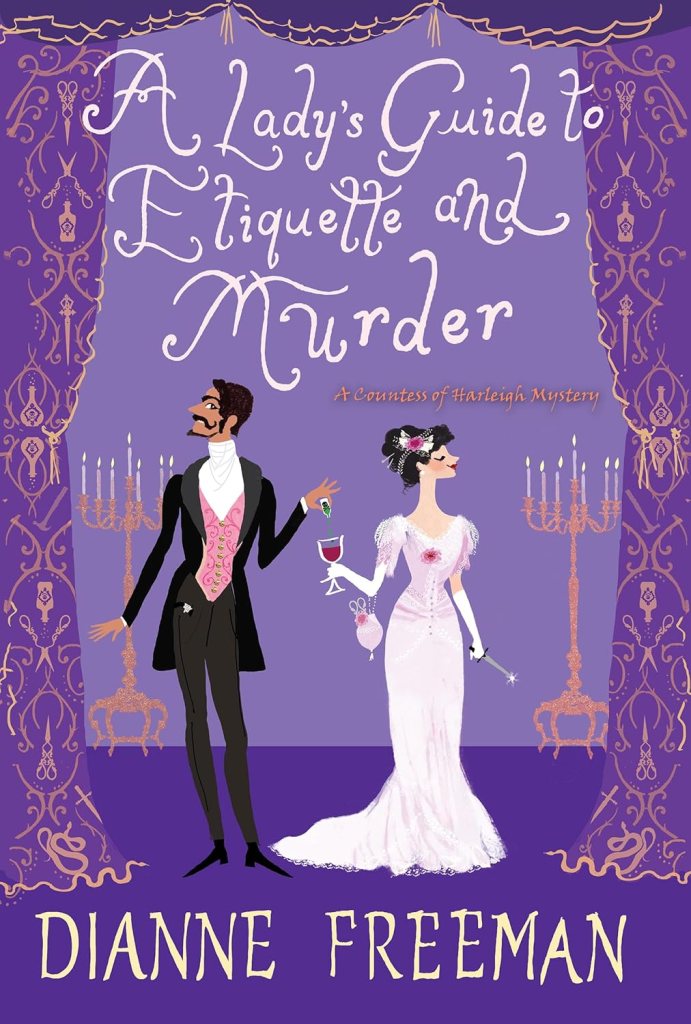
Book Reviews: The Brampton Witch Murders by Ellis Blackwood and A Lady’s Guide to Etiquette and Murder by Dianne Freeman

Ziva (l) and Nellie (r), my two favorite dogs, share a seat on a bookstore run.

The winds howl, trees drop leaves, and squirrels, in a frenzy, bury seeds. Halloween decorations are coming down, and Christmas decorations are going up. I wear my down coat and knit hat and sometimes my mittens when walking my dog. It’s the perfect season to enjoy cozy mysteries. I like to tuck them between the more serious books I read.

I enjoy a good cozy mystery, as long as it’s not too cozy. There has to be some close calls, some murder, and some despicable characters. But there also has to be some humor, some quirky characters, and it has to be tame enough to read or listen to before bedtime. Of course, the line between a cozy and a not-so-cozy mystery is subjective, but I know where my line is when I read one.

I have recently discovered two cozy historical mystery series, both set in England, that I like well enough to read the next book in each series.

A Samuel Pepys Mystery: The Brampton Witch Murders by Ellis Blackwood

The Brampton Witch Murders is the first book in the Samuel Pepys Mystery series. It’s set in 1666 in England. Samuel Pepys runs an investigating agency in London. He has two inquisitors, Abigail Harcourt and Jacob Standish, who work for him. Pepys learns that his sister, Paulina, has been accused of witchcraft, and Simon Hopkins, a devious, zealous witch hunter has been sent to prosecute her. Pepys dispatches Abigail and Jacob to the village of Brampton, where they are to gather evidence to prove that the charges of witchcraft against Paulina and her friend are false. To complicate matters Paulina and her friend are accused of using witchcraft to commit murder.

[Note: The term inquisitors threw me at first because it made me think of an inquisition. I had to re-read the first few pages to understand that Abigail and Jacob were called inquisitors because it was their job to question other characters in order to uncover facts and evidence that would prove Paulina and the other women in the story were being falsely accused of witchery.]

Why did I like this book?

I liked the historical setting and subject matter of this cozy mystery. It’s scary how many characters in the story are willing to believe in Simon Hopkins and his accusations of witchery against the female characters without any proof. While men were sometimes found guilty and executed as witches, it was mostly women who were convicted and executed. Makes you wonder.

This is a fast-paced story and a quick, easy read. Because the book is small and a lot of the chapters are short, I kept it in my purse, so I could read it should I become stuck somewhere waiting for something or someone. The characters are interesting, the dialogue is good, and there are enough plot twists to keep readers engaged and guessing. And while it’s not thick with historical description, I still felt like I was in another time and place. Its themes of hysteria, greed, zealousness, and small-minded thinking are timeless.

A Lady’s Guide to Etiquette and Murder (A Countess of Harleigh Mystery) by Dianne Freeman

Set in 1899, A Lady’s Guide to Etiquette and Murder is the first book in Dianne Freeman’s series featuring Francis Wynn.

As a young naive woman, Frances was a wealthy American with an ample dowry. In a Downton Abbey move, she married Reggie, an aristocrat with a large crumbling manor and a shrinking bank account. Unlike the marriage between Cora and Robert Crawley, romance does not blossom between Frances and Reggie. After nine years of marriage, Frances’s philandering husband dies of a heart attack while in bed with his mistress. There is a cover-up because scandal among the British upper class is to be avoided at all costs. After a year of mourning, Frances leases a house in London and packs up her daughter and her possessions. She is determined to start a new life.

But life becomes complicated for Frances. A Metropolitan police officer shows up at her new home to inform her that the police are investigating Reggie’s death as a possible murder, and she is a suspect. Her brother-in-law has filed a suit against her and her bank account is frozen. Her sister arrives from America for her first London season. And, someone is stealing expensive items at society parties. On the upside, Frances’s next-door neighbor is handsome, intelligent, and helpful. Joining together, Frances and her friends, along with the Metropolitan police officer, work to solve the mystery of Reggie’s death and the rash of thefts at society gatherings.

Why did I like this book?

Freeman’s book is delightful. It’s narrated by the main character, Frances, who is witty, self-effacing, intelligent, unflappable, and perfectly charming. I enjoyed keeping company with her as she traded her widow’s clothes for amateur sleuthing.

With an undercurrent of humor humming through its pages, Freeman’s book gently pokes fun at the upper crust of British society in 1899. Embracing the bravado and the stiff-upper-lip mindset of the British upper class, Frances, her friends, and the police follow certain protocols and unspoken rules revered by Britain’s high society, even while solving serious crimes like murder and theft. (The rich do live in a different realm of reality, whether it be 1899 or 2024.) Freeman delivers a good mystery with an ending I didn’t see coming, except in hindsight.

I listened to this book on my library app. Sara Zimmerman reads this cozy mystery, expertly giving voice to a wide array of characters. I particularly felt her keep-calm-and-carry-on voice was ideal for the character Frances. I’m already listening to the second book in Freeman’s series.

Book Review: The Curse of Pietro Houdini, a Novel, by Derek B. Miller

Why did I read this book?

The cover’s obscured artwork hints at ancient mythology, which is filled with tales of love, courage, tragedy, jealousy, joy, betrayal, and vengeance. Stories that are repeated by mortals again and again. Stories that repeat themselves in Italy in 1943-44 during WWII.

I bought this book on Indie Bookstore Day at the last bookstore I visited. I’d already purchased books from the other stores, but it was Indie Bookstore Day, so that meant I needed to buy at least two books from each store. (It’s an etiquette thing, like not refusing a second slice of pie when you visit your dear grandmother after she so nicely baked a strawberry-rhubarb pie for you.)

First, the book jacket caught my eye. The cover art is stunning. Next, the name Houdini stood out. When I was a child, I loved the Tony Curtis movie Houdini, loosely based on real-life magician and escape artist Harry Houdini. Then, the synopsis on the flap intrigued me: WWII, Nazis, Italy, an ancient abbey high on a hill. A young teenage orphan; a charismatic but secretive middle-aged man on a mission to save three priceless paintings; a pair of young lovers; a mysterious Italian nurse; a kind-hearted German soldier; an unusual monk; a war-broken woman; and Ferrari, a faithful mule. Finally, I read the first paragraph of the book. And this sentence sealed the deal: “I stole three paintings from the Nazis who were stealing them from the monks.” This one sentence contained intrigue, danger, irony, — and humor, a quiet, but incisive humor that works well in a story filled with sadness, destruction, and loss. I bought the book.

What is this book about?

It’s late summer, August 1943. The Allies are pushing into Italy to liberate it from the Germans. Massimo, a young teenager, has been orphaned during a recent American bombing of Rome and is heading toward Naples. Pietro Houdini, who is in his fifties, finds Massimo in a ditch. He convinces Massimo to accompany him to Montecassino Abbey, where he intends to catalogue and restore art. Massimo is smart, and as an only child, used to conversing with adults. Pietro is in his fifties and well educated. He is a cynical man who is capable of duplicity and murder to achieve his goals, yet hope, kindness, and loyalty linger inside him.

Pietro knows the Germans will come for the artwork at Montecassino. With the help of Massimo, he plans to steal three priceless paintings and a bag of ancient Greek gold. Soon it becomes evident to Pietro that the Americans will bomb Montecassino because they believe the Germans are using the abbey as part of their war strategy to thwart an Allied invasion of Italy. Time is running out to save the paintings, so Pietro revises his plans to include other people who have been living at the abbey and to use a different route of escape.

What makes this book good?

I’d never heard of Derek B. Miller, and my reasons for buying his book were impulsive (and perhaps frivolous) but I soon discovered Miller’s book has it all — richly drawn characters, a captivating plot, beautiful language, dry humor, and important themes.

The center of the story is the relationship between Pietro and Massimo. Massimo, recently orphaned, is walking to Naples, when a group of boys attack. Pietro, who is walking to Montecassino Abbey, interrupts the beating, pulls Massimo from the ditch, and convinces Massimo to go with him to Montecassino. It’s Pietro and Massimo’s growing friendship and singleness of purpose which draws readers into the story. Miller’s secondary characters, even the ones who appear briefly, will also live in readers’ imaginations, stirring emotions and raising questions about the horrors of war, which can never be answered. During a war, one thinks more about the randomness of life, the unlikely friendships people form, and the bonds that transcend both terror and time. Miller weaves the stories of his characters together, into an intricate tapestry, surprising his readers as the threads become a richly textured image.

Miller’s language and imagery create a reflective solemnity, revealing Montecassino’s mystical character. The abbey is more than ancient stone. It lives and breathes. It tells its stories to those who listen. When characters leave the abbey and enter the world of fascism and Nazis, Miller’s words paint scenes of dread and tragedy. But his descriptions of war and its brutality are sparsely, succinctly, and briefly told; so, it’s the stories of the civilians swept up in war that command center stage.

Miller uses humor throughout his novel, but The Curse of Pietro Houdini is not a comedy, and Miller’s humor is not slapstick or wordplay. It’s steeped in irony. Early in the novel, a line spoken by Pietro to Brother Tobias, regarding the treasure trove of art in the abbey, took my breath away. I read the sentence several times before moving on. I thought about quoting the sentence here, but I would rather other readers have the joy of discovering it. (If you read the book, the sentence is on page 44, almost halfway down the page. Don’t peek before you get there.)

Miller’s WWII novel explores the themes of war through the eyes of ordinary civilians whose lives have been forever altered or destroyed. While the Allied and Axis powers wage war on the battlefield, the characters face their own horrors away from the frontlines. There is much destruction in a war: felled buildings, mindless cruelty, the dead and the broken. Miller’s book tells these tales of war, but it also tells the stories of love, kindness, loyalty, bravery, and survival because these are also the stories of war.

A connection to the present . . .

After reading Miller’s book, I took a road trip. I drove east across Upper Michigan, and over a couple of hours, I met three different convoys of military vehicles heading west. The long lines of gigantic trucks in the military colors of desert tan, army green, and dark blue rumbled like beasts over the scenic tree-lined highway. I’ve passed convoys before, never feeling uneasy, never thinking of them as beasts. But I’d just finished reading Miller’s book, and because it’s set in WWII with fascists and Hitler and Mussolini, a chill cut through me each time another line of military vehicles passed by. I tried to imagine what the Italians felt during WWII as German, American, and Allied war machinery lumbered over their roads and into their cities. I thought about Hitler’s tanks and artillery guns and goose-stepping soldiers marching down streets, a show of military power meant to strike fear in his European neighbors and his own people.

Miller’s book is set in 1943-1944, but sadly dictators, invading armies, and war are timeless.

[Published by Avid Reader Press, an imprint of Simon & Schuster, Inc., 2024]

Book Launch of Sister Lumberjack by Candace Simar (Release Date April 16, 2024)

Sister Lumberjack, release date April 16, 2024

On St. Patrick’s Day, I drove two hours and ten minutes to Brainerd, Minnesota, to attend a book launch for Sister Lumberjack, Candace Simar’s newest historical novel. My daughter-in-law agreed to go with me, even though she hadn’t read any of Simar’s books yet. But she loves to read, so she’s always willing to do book things with me.

I was intrigued by the story and its characters. The year is 1893, Minnesota winter is approaching, and lumberjacks are returning to the camps. Solveig Rognaldson, sixty years old and recently widowed, hopes to hire on as a cook in a lumberjack camp. Cooks earn high wages, and she needs the money to pay the mortgage on her beloved farm, or the bank will repossess it. However, logging companies don’t hire women. Nels Jensen, a young man struggling with the drink, knows he needs to grow up. He plans to work in the camps again, but he discovers he has been blacklisted. Sister Magdalena, a young, atypical nun, sells hospital tickets to lumberjacks as a form of insurance, should they get injured and need medical care. These three people come to know one another at Starkweather Timber, a logging camp where nothing runs smoothly.

Fun fact: There was a real nun who lived in Minnesota and sold hospital tickets to lumberjacks. When Simar discovered this golden nugget, she was inspired to write her book, which she said is a fictionalized account of that nun. I have to say, the idea of a nun traveling from one logging camp to another, sometimes while wearing snowshoes, captured my imagination. I was all in for a book launch in Brainerd.

Does this make me a historical fiction groupie? Perhaps! Author Candace Simar couldn’t believe that my daughter-in-law and I traveled more than two hours to come to her book launch. Several times Simar asked, “You really came all that way for my book launch?”

Yep, we did. But I explained to Simar that my daughter-in-law and I also made a day of it. We went to Christmas Point, a large, lovely gift shop, where we had a tasty lunch. Then to kill more time, we went to Target. If any of the local bookstores had been open, we would have gone to one of them instead. But it was Sunday, and I’m guessing the booksellers were all at home reading.

So, how did I become a devoted Candace Simar fan? Well, historical fiction is one of my favorite genres, and I read Simar’s historical novel Shelterbelts, which is set in Minnesota at the end of World War II, and I loved it. The novel, set in a small town, follows a cast of interesting characters as they adjust to life after the end of the war. Simar’s dedication to research, and her ability to use that research to create realistic characters and settings, took me back in time, immersing me in a beautifully written, well-told story.

Because I attended Simar’s book launch, I was able to buy a copy of Sister Lumberjack a month early. Simar’s publisher printed a run of seventy-five books, which were offered for sale. After asking Simar to sign my copy of Shelterbelts, I bought Sister Lumberjack and had her sign that too.

Candace Simar, March 17, 2024

My daughter-in-law and I helped ourselves to cookies and punch, then settled in at a table to read. I handed my copy of Shelterbelts to my daughter-in-law, and I cracked open Sister Lumberjack. We read for a bit before a couple of other Simar fans asked if they could sit with us. By this time the room was crowded with people who had come to buy a book, have it signed, and hear Simar read. We had a nice chat with the women, but soon my daughter-in-law and I drifted back to our books. I was already hooked on Sister Lumberjack, and my daughter-in-law took my copy of Shelterbelts home with her.

In a packed room, filled with attentive fans, Simar read two passages from her book, one featuring Widow Solveig and the other featuring Sister Magdalena. When she finished, the audience saluted her with a well-deserved, hearty round of applause.

I’m on “Chapter 10” in Sister Lumberjack. Once again, Simar has transported me back in time. I’m performing farm chores with Solveig, squirming when Nels takes a job with an undertaker, laughing at Sister Magdalena’s mishaps in the kitchen. And I’m learning lumberjack lingo. Best of all, Simar’s novel Sister Lumberjack is every bit as good as Shelterbelts.

Candace Simar, signing books before her reading

Book Review: Hotel on the Corner of Bitter and Sweet by Jamie Ford

[Published in 2009 by Random House Publishing Group, Ford’s novel was a New York Times Bestseller.]

Why did I read this book?

First, the catchy title and the cover art intrigued me. Then, I read the synopsis on the back cover, and learned the novel was historical fiction, another plus. Next, I read the first page of the book, and I liked what I read. Finally, the cost of the book sealed the deal. It was $3.00. I was in a local hospital gift shop where they sell used books. Any time I go to either one of the local hospitals where I live, I stop in their gift stores. They have the loveliest gifts, and they sell used books, where I’ve purchased some wonderful books over the years. Hotel on the Corner of Bitter and Sweet is one of them.

What is this book about?

The story, set in Seattle, opens in 1986 in front of the Panama Hotel, a place that holds both bitter and sweet memories for Henry Lee, a Chinese American citizen, who is in his mid-fifties and has recently lost his wife, Ethel, to cancer. Since his wife’s death, Henry’s relationship with his adult son, Marty, has become even more strained because Ethel played go-between for the father and son. The story switches back and forth between 1986 and 1942. The chapters set in 1942 reveal twelve-year-old Henry’s childhood difficulties with his father; his friendships with Sheldon, an African-American jazz-playing saxophonist, and Mrs. Beatty, a cranky school cook; and his love for Keiko Okabe, a Japanese American girl who attends school with him.

An entrepreneur who recently bought the Panama Hotel has discovered suitcases and boxes of stashed possessions stored there for safekeeping by Japanese Americans in 1942 before they were transported to internment camps. But over the last forty-some years, no one has ever returned to claim their belongings. As Henry stands in front of the Panama Hotel, memories of his childhood sweetheart, Keiko, who was rounded up with her family in 1942 and sent to an internment camp, bubble to the surface. He decides to find an item that had special meaning to both of them, a symbol of their love for one another and their shared passion for jazz. He believes the item is somewhere among the hordes of forgotten objects in the basement of the hotel. Alone the search would overwhelm him, so he enlists the help of his son and his son’s girlfriend.

What makes this book memorable?

Jamie Ford’s novel has richly drawn characters and a finely crafted storyline that is, in turns, compelling, suspenseful, heartbreaking, and hopeful. This coming-of-age story about first love and forging one’s own way in the world, even against a parent’s wishes, is set against a backdrop of prejudice and misguided patriotism that rises to a crescendo after the bombing of Pearl Harbor in 1942. It’s also the story of immigrants who come to the United States, hoping for a better life for themselves and their children. But the parents and their children often clash as the older generation clings to the ways of the old country and their children adapt to the ways of the new country. The universal themes in Ford’s novel, told in a fresh way and set during a reprehensible episode in American history, are as relevant today as they were in 1942.

[To learn more about Jamie Ford and his other novels, click here. To learn more about the Panama Hotel, which was a real place and still exists, click here. To buy a copy of Ford’s novel, click here.]