The Women of Lockerbie, a Play by Deborah Brevoort

Playbill for the Women of Lockerbie

If you get a chance to see the play The Women of Lockerbie by Deborah Brevoort, by all means go.

I went to see The Women of Lockerbie because I remember when Pan Am 103 exploded over Lockerbie, Scotland, on December 21, 1988, killing 259 people on the plane and eleven people on the ground.

And I went to see The Women of Lockerbie because the advertisement said the play was styled after a Greek tragedy with a Greek-like chorus. I loved my ancient Greek theater class in college.

As we entered the small experimental theater, a sign alerted us there would be no intermission, and if we left the theater during the 75-minute play, we would not be allowed to return. The play needs to be seen without interruption.

The set for The Women of Lockerbie at University of Minnesota-Duluth

The stark stage washed in a pale-blue light held two props, four painted panels, and a fabric river dividing everything in two: the land, people, emotions, needs.

When the play starts, it’s seven years after the tragic bombing of Pan Am 103, and many loved ones of the victims have come to participate in the dedication of a memorial.

We meet a married couple who lost their only child in the bombing: a wife overwhelmed by grief and a husband who hides from it. We meet a callous American official who is to oversee the destruction of the personal property that once belonged to the people on Pan Am Flight 103. We meet the women of Lockerbie who witnessed the tragedy, suffered their own losses, and struggle to heal. The women of Lockerbie who want to wash, iron, and fold the clothes of the bombing victims and return them to their surviving families.

Grief in all its forms: raw, stuffed, converted, unacknowledged, motionless, haunted, and rage-filled, permeates the story. But so do love, compassion, and forgiveness.

At one point in the play, the set goes black. Not a whisper, not a sigh, not a breath is heard. In the darkness. The audience is moved to absolute silence. Tears spill from my eyes. I make no move to dig for a tissue in my purse. I cannot break the moment with sound.

No one from the audience left the theater during the play. And for 75 minutes in a small intimate theater, a group of outstanding college actors held us spellbound by the depth of their performance.

If you ever have a chance to see the play, by all means go.

Book Review: Lady Catherine, the Earl, and the Real Downton Abbey by Fiona Aitken, the 8th Countess of Carnarvon (Hadder & Sloughton, London, 2013)

Why did I read this book?

I was in Edinburgh when I started reading Lady Catherine, the Earl, and the Real Downton Abbey. My sister and I stayed at a hotel called The Resident in Edinburgh’s lovely West End. The hotel has a good-sized lobby with a fireplace, comfortable chairs, and several shelves of books along the back wall. Whether fiction or nonfiction, prose or poetry, the books all seemed to have a connection to the United Kingdom. Set a bookshelf in front of me and I can’t help it: I start perusing spines. Because I loved the Masterpiece series Downton Abbey, the title of Fiona Aitken’s book caught my attention. Aitken, married to the 8th Earl of Carnarvon, is the 8th Countess of Carnarvon.

What is this book about?

Aitken’s book covers the lives of Catherine Wendell, an American beauty, and Henry Herbert Porchester, the 6th Earl of Carnarvon, from the early 1920s through the end of WWII. Readers first meet Catherine and Henry, called Porchey by his friends and family, in 1923 in India where he is stationed with his regiment. Married in 1922, they are still honeymooners and very much in love. Unlike many British lords of the era, who have expensive-to-maintain manor houses with expansive grounds, Lord Porchester has married for love, not for a cash infusion to prop up his estate. Although, shortly after becoming the 6th Earl of Carnarvon, Porchey discovers the finances of his estate are in disarray.

Readers follow Catherine and Porchey throughout their marriage, divorce, and post-divorce years against the backdrop of the Roaring Twenties, the Depression, the rise of fascism and Hitler, King Edward VIII’s abdication, and WWII. The “Epilogue” summarizes what happened to the key people in this book after WWII.

Why did I like this book?

Fiona Aitken’s book is well written. She tells the story of Catherine and Porchey in a narrative form, combing biography and history in a manner that makes it interesting to read. The book is also well researched because living at Highclere Castle as the 8th Countess of Carnarvon gave Aitken access to the archives at Highclere. Also, her title, family connections, and social status meant she was able to interview people who might not otherwise talk to writers.

While I was in Edinburgh, I only read the first seven chapters. I was busy sightseeing during the day, and because I walked miles everyday, I would fall asleep shortly after crawling into bed. Once I returned to the United States, I checked the book out from the library so I could finish it. I liked Aitken’s book so much that I plan to read her first book, Lady Almina and the Real Downton Abbey: The Lost Legacy of Highclere Castle (2011). Lady Almina was married to the 5th Earl of Carnarvon who financed archaeology digs in Egypt, which lead to Howard Carter’s discovery of King Tut’s tomb.

Some concluding thoughts . . .

If you’re a Downton Abbey fan, don’t pick up this book expecting a drama like the TV series; although, a lot of dramatic events happen in the book. However, if you’re a history fan, or an Anglophile, or you like learning about how the wealthy lived in a bygone era, especially during those Downton Abbey years, you’ll enjoy Fiona Aitken’s book.

Connections to the royal family —

Having met as teenagers, the 7th Earl of Carnarvon and Queen Elizabeth II were great friends. He served as her racing manager for years until his death in 2001. Queen Elizabeth was godmother to his son, currently the 8th Earl of Carnarvon. When Queen Elizabeth died, the 8th Earl and Countess made the short list and were invited to the private committal service for the Queen. But they didn’t receive an invitation to the coronation of King Charles in 2023. Charles trimmed the guest list from just over 8,000 who had attended his mother’s coronation to just over 2,000. In my lifetime I’ve seen the popularity of the royal family wax and wane. One of the criticisms people have about the royal family is the amount of money it takes to maintain all that pomp and circumstance. I imagine King Charles shortened the guest list for his coronation because he wants his subjects to know that he too can budget his expenses.

If you want to read the 8th Earl’s comments about not receiving an invite, click on the following article that appeared in Tatler, a British magazine: “Earl of Carnarvon, Queen Elizabeth II’s Godson, Praises ‘Excellent’ King Charles Despite Lack of Coronation Invitation.” It’s all very civilized and polite.

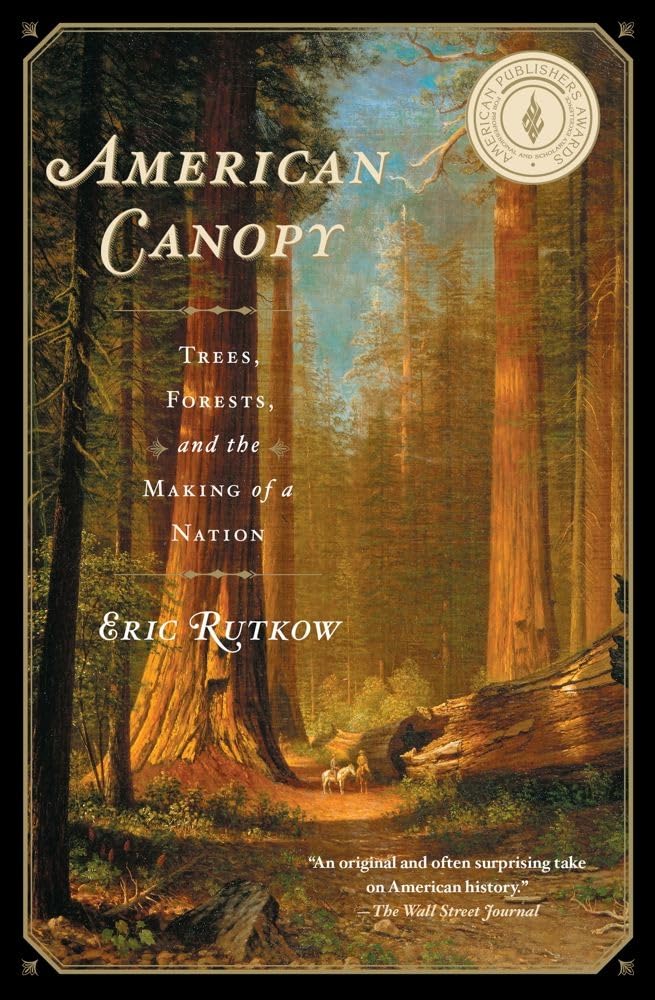
Book Reviews of My Latest Reading Accomplishments, Part 5 of 6: American Canopy: Trees, Forests, and the Making of a Nation by Eric Rutkow

[To read Part 1, click here. To read Part 2, click here. To read Part 3, click here. To read Part 4, click here.]

American Canopy by Eric Rutkow takes a unique look at a slice of United States history by focusing on its relationship with its immense forests. When settlers first arrived in North America, forests covered more than half of what would eventually be the forty-eight contiguous states. Rutkow notes that in the United States people will find giant sequoias, the largest trees in the world; coastal redwoods, the tallest trees in the world; bristlecone pines, the oldest trees in the world; and the biggest single living organism in the world, a stand of quaking aspens in Utah.

When the first settlers arrived on the Eastern shores of the New World, they encountered dark, dense forests. Settlers viewed the forests as something to be cleared to make way for farms and towns and as a resource to be used in trade and manufacturing. And with so many extensive forests, people and lumber companies cut down trees as if the supply was endless.

Rutkow’s book is a comprehensive, chronological history of America’s forests and how those forests played an integral role in the building of a nation. Rutkow’s history covers how trees were used to build ships, trains, railroad tracks, and airplanes until other materials like steel and aluminum were developed. And while some new technologies meant a decreased demand for wood, other innovations called for an increased demand. He covers the lumber industry’s devastating impact on forests and the growing movements to save forests in order to protect water and air quality and to mitigate climate change. Readers meet lumber barons, conservation advocates, politicians, botanists, environmentalists, naturalists, and entrepreneurs, among others.

Why I loved this book . . .

It’s well-organized, well-written, and interesting. I learned so much about the history of our forests. I liked this book so much that I bought Eric Rutkow’s book The Longest Line on the Map: The United States, the Pan-American Highway, and the Quest to Link the Americas. But most importantly, at this moment in history when some of our political leaders have turned their backs on our national parks and forests, and hope to sell public lands to private industries, Rutkow’s book informs us why our national parks and forests are vital to our well-being and the health of our planet.