

The Games Children Play

On St. Patrick’s Day, I went to the public library to listen to author Naomi Helen Yaeger read from her book Blooming Hollyhocks: Tales of Joy During Hard Times. Yaeger’s book is a warmhearted biography about her mother’s childhood in Avoca, Minnesota, during the Great Depression and World War II. [To read my review of Yaeger’s book, click here.]

One of the selections Yaeger read was about St. Patrick’s Day. The small town of Avoca had a mix of Protestants and Catholics. The Irish Catholic children celebrated the day by wearing green to school. Yaeger’s mother Janette, and her family were Methodist and not Irish, and so Janette didn’t wear green to school on St. Patrick’s Day. Her classmates who wore green teased her, telling her they could pinch her because she wasn’t wearing green. Janette, who didn’t want to be pinched, told them, “You stay away from me.”
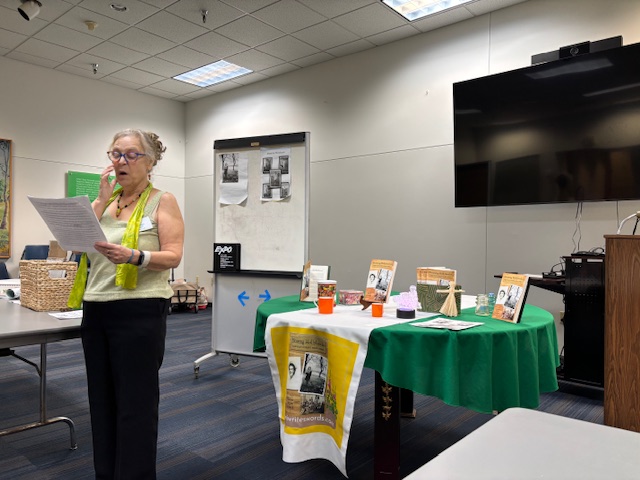
Author Naomi Helen Yaeger reads a selection from her book, March 17, 2026

As I listened to Yaeger read this selection, I remembered wearing green to school on St. Patrick’s Day. My great-great-grandfather was Irish. But I couldn’t recall anything about the pinching of classmates who didn’t wear green. Later, I called my sister who is four years younger than me, and I asked her if she remembered the game of pinching classmates who didn’t wear green on St. Patrick’s Day. She did, very clearly. Ironically, she had just jokingly reminded her daughter, who is thirty-something, to wear green on St. Patrick’s Day so she didn’t get pinched. Long past her school days, her daughter laughed and shrugged off the advice.

A few days later, I asked my other sister who is a year younger than me if she remembered the pinching tradition, and she did. So why don’t I remember it? Someone suggested that if I always wore green, I wouldn’t have been pinched, so I might not remember the game. And I know I wouldn’t have pinched anyone who didn’t wear green. I was often teased and called names when I was in elementary school, and it was hurtful. I made a point to avoid certain classmates and to behave kindly to the rest — pinching someone wouldn’t have been okay with me.

This seemingly harmless childhood tradition upset Yaeger’s mother when she was a child. It probably wouldn’t have occurred to me when I was young, but as an adult listening to Yaeger read her mother’s words, “You stay away from me,” I thought about the darker side of games like these. (My oldest grandchild confirmed being pinched for not wearing green is still a thing.) I don’t think children see it as a statement about being Protestant or Catholic, British or Irish. Nor do I think children know anything about the history of the British occupation of Ireland and its brutal consequences. But the St. Patrick’s Day pinching tradition pits one group of children against another group of children based on the color of one’s clothes on a certain date. Perhaps, one could argue it’s a small thing, a fun game played for one day a year. But it also singles out a group of children who, for whatever reason, don’t wear green on March 17.

Of course, to escape the fate of being pinched, a child could simply wear green to school on St. Patrick’s Day. But that’s not harmless either, compelling someone to either fit in or get pinched. Some youngsters probably had fun with this — chasing each other and laughing — like it was a game of tag. But other children probably felt like Janette: “You stay away from me.”

I wonder at all the subtle and not so subtle “seemingly harmless” ways children are taught to marginalize others who are not like them. I like that Yaeger included this story in her mother’s biography. It’s a story that takes us back to the days of our youth, while at the same time making us think about something differently as grownups.

[To read the reviews of both a nonfiction and a fiction book dealing with the Time of Troubles in Ireland, click here.]

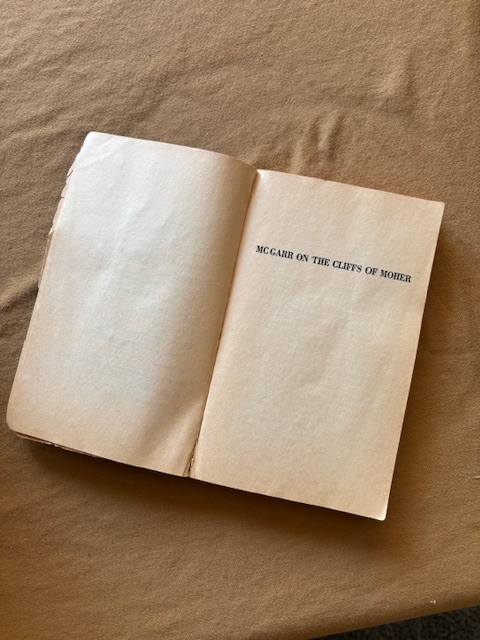
Book Review: McGarr on the Cliffs of Moher by Bartholomew Gill (Also published as The Death of an Irish Lass), Charles Scribner’s Sons, 1978

Penguin Books edition, 1982. I love the pocketbook edition. It’s been well loved over the last forty-three years. Sometimes as I read it, bits of the aged cover flaked away, and I imagined all the other hands that held this book.

I’m back with a quick review of the third mystery in the Peter McGarr series by Bartholomew Gill. I said I’d keep you updated about how Gill’s series progresses. [To read my thoughts about Gill’s first two novels, click here.]

McGarr on the Cliffs of Moher debuted forty-seven years ago. I believe it’s out of print because Amazon sells only used copies. I bought well-worn copies of Gill’s first three books from ThriftBooks. In my review of Gill’s first two McGarr mysteries, I said if I liked the third book, I would buy a couple more. Well, when I finished reading The Cliffs of Moher, I bought Gill’s fourth and fifth mysteries, once again from ThriftBooks.

What’s McGarr on the Cliffs of Moher about?

Shortly after traveling from America to visit her parents in Ireland, May Quirk is found dead in a pasture near the Cliffs of Moher. She has been run through the chest with a pitchfork. May was born and raised in Ireland, but shortly after becoming a young woman, she left Ireland for New York City, partly to follow a young man whom she loved and partly to seek opportunity and adventures not available to her in Ireland. In New York her romance with the young man falters, but they remain friendly. May finds success as a well-respected journalist.

CID Peter McGarr has a list of suspects, each with a motivation worthy of murderous intent. Did the man she originally left Ireland with kill her in a jealous rage? He had returned to Ireland about the same time she did. Did the country farmer down the road from her parents kill her? The farmer has been obsessed with May for years, believing God intended them to be together. Did the man who discovered May’s body in the field kill her? He doesn’t seem to have a motive, but he was so drunk on the night of May’s murder he can’t remember passing out next to her body. Did someone in the Irish Republican Army have her killed? If threatened, the IRA is capable of swift and cruel violence. Did May’s current lover, who is married, kill her? He wanted to marry her, but he’s an Irish Catholic with a passel of children, and May seemed uninterested in becoming anyone’s wife.

Why did I like this book?

It’s a page-turner. Once I start reading one of Gill’s books, I don’t want to put it down. The dialogue is snappy, with just the right amount of levity. I like the rivulets of sarcasm permeating McGarr’s conversations with suspects or other people who try to get in the way of his investigation. So far Gill’s books have interesting plots, and I’m kept guessing about whodunit. Finally, McGarr’s books are quick reads with well-written prose that often sparkles, but they don’t require deep thought on my part. And for this reason, while I enjoy them, they don’t rank as high as some other detective series that I have read.

Back to my thoughts about Gill’s books from a standpoint of craft . . .

You might remember I mentioned there was so much drinking in Gill’s first two books that I often felt like I’d wake up with a hangover in the morning. The consumption of alcohol in this book surpasses anything found in the previous two, partly because a lot of scenes are set in pubs in Ireland and New York. I don’t know how some of the characters can drink so much and still walk, talk, and think, let alone commit crimes or try to solve them. I have moved beyond the idea I might be vicariously hungover in the morning to seriously thinking I might need a vicarious twelve-step program after reading the series. I wonder if McGarr can keep up his pace of drinking throughout the series.

I’m still waiting for McGarr to have some sort of crisis of the soul. We don’t learn much about him in this book either. It’s mentioned again that he grew up in poverty, but that doesn’t seem to have affected him in any visible way. But where does all that drinking come from? Is Gill perpetuating a stereotype about the Irish love of whiskey and beer? In Gill’s stories there is a fine — but uncommented upon — line between McGarr and other characters, some of whom seem to be able to drink without getting drunk, and others who cannot hold their liquor. McGarr is one of the characters who can hold his liquor and solve crimes.

I’m waiting to see if female detectives will become part of the Irish constabulary landscape. However, it’s still the 1970s in McGarr’s world, and it’s a male dominated society.

McGarr’s marriage is another curiosity. His wife, Noreen, is twenty-one years younger than him. He married late in life because he considered himself a confirmed bachelor. In this book we learn why he married, but I’ll let you discover the reason for his marriage. It’s tossed in as a single sentence, but the sentence is striking and not easily missed. I always like to discover these little gems in a story for myself, rather than being told. The McGarr marriage could become an interesting side story. There are many ways Gill could play it.

The pages have mellowed into a yellow brown. It’s hard to imagine they were ever white.

So, I bought the next two books because I’m still curious to see if and how Gill develops his characters. In the meantime, his crime mysteries are entertaining reads just as they are.