Book Reviews of My Latest Reading Accomplishments, Part 6 of 6: Where Rivers Part: A Story of My Mother’s Life

[To read Part 1, click here. To read Part 2, click here. To read Part 3, click here. To read Part 4, click here. To read Part 5, click here.]

Why is this book important?

Because reading books like Where Rivers Part by Kao Kalia Yang, reminds us that we are all people, that we have a shared humanity, and that understanding and kindness should always be the most important things. It warns us that war and dictators take a devastating toll on that humanity.

Why did I read this book?

Where Rivers Part is the One Book Northland 2025 selection for the area where I live, so I decided to buy Yang’s book and read it. Yang came to the Northland to talk about her book, and I’m sorry I missed a chance to hear her speak in person. But I did listen to Kerri Miller from Minnesota Public Radio interview Yang. You can listen here: Big Books & Bold Ideas.

What is this book about?

Where Rivers Part is really two stories bound together. First, it’s the story of Tswb, an ordinary Hmong girl, who is born in 1961 to parents living in the lush mountainous region of Laos. Everything in Tswb’s life is plentiful: her large extended family, the love that nurtures her, and the bountiful food that nourishes her. She attends school and excels; she wants to be a teacher. She experiences the loss of her beloved father. She grows up and falls in love. Leaving her mother and family behind, she begins a new life with her husband, Npis, and his family. She has children. She experiences the ups and downs of marriage and parenthood and aging.

But the story of Tswb’s ordinary life is overshadowed by another story: the war in Vietnam, which escalates as she grows up. Laos and Vietnam share a border that is 1,343 miles long, and after the U.S. pulls out of Vietnam, the communists enter Laos to hunt down and kill Hmong people as traitors because many of them helped the U.S. during the war. Tswb is a young teenager when her family leaves their mountain village home and hides in the jungle. At seventeen Tswb falls in love with Npis, a young Hmong man who comes from another village, and she marries him. As is the custom, she leaves her family and becomes part of Npis’s family. They continue to hide in the jungles of Laos from the Vietnamese soldiers. Finally, because the Vietnamese are closing in, Npis’s family decides to escape to Thailand, where they live in a refugee camp before immigrating to America.

In the United States, Tswb and Npis work jobs that take a toll on their bodies. They live in neighborhoods that are dangerous, in homes that are dilapidated and filled with lead and mold. They face racism and discrimination because they are Hmong and immigrants, but they work hard to improve their lives and to give their children a brighter future.

What makes this book so good?

Yang’s writing is beautiful, compelling, and detailed. As the story shifts from place to place, Yang brings the lush mountain village of her mother’s youth and the dense jungles of her mother’s teen years to life. She captures the hopelessness, filth, and stagnation of the refugee camp in Thailand. And once her family has immigrated to the U.S., Yang captures the hope, fear, joy, and frustration as her parents move from home to home and from job to job, inching their way up the ladder of the American dream.

When Yang asked her mother if she could write the story of her remarkable life, her mother replied that she didn’t think her story was remarkable, and that no one would be interested in reading about her life. I imagine that is because Tswb’s life was filled with many people who lived lives similar to hers. Lives interrupted by war, time spent in refugee camps, separations from family, and emigration from their homelands. But to Yang, her mother’s story is extraordinary. And readers will agree, the story of Tswb’s life is a story worth telling.

From the standpoint of craft . . . Yang’s book uses an interesting point of view.

Yang’s book is a biography of her mother’s life. However, Yang has written her mother’s biography in the form of a first-person point of view memoir. So, when we read Yang’s book, we must remember that she has adopted her mother’s voice and she is telling the story as if she were her mother. In the prologue of her book, Yang carefully explains how and why she has done this. If you like to skip prologues, this is one you should not gloss over.

Yang tried to write the story of her mother’s life in third-person point of view like a biography, and she tried to write it in second-person point of view. Both of those attempts felt awkward to her. Yang kept returning to the idea of using first-person point of view because as strange as it seemed to write her mother’s life story that way, Yang believed it worked. She wanted her mother’s “strong and certain voice” to rise up off the page. And it does.

There’s probably a general rule against this technique, but like so many writing rules, there comes a time when it’s okay to break one. It works for Yang for several reasons. First, before she began the book, she was intimately familiar with her mother’s way of speaking and her stories. Second, Yang’s mother was an enthusiastic participant in the telling of her story. Third, as Yang wrote the book, she spent hours and hours interviewing her mother. Finally, Yang had her mother read the finished draft for accuracy.

And so, I took a leap of faith with Yang. After I turned the last page of the prologue, I put aside the idea of Yang as the narrator. As I began the first chapter in the book, I listened to Tswb tell her story through her daughter. For the first few pages, it was a little disorienting, but I quickly found myself immersed in Tswb’s life. Yang’s book is wonderful and her bold move works. I can’t imagine Yang writing her mother’s story in any other way.
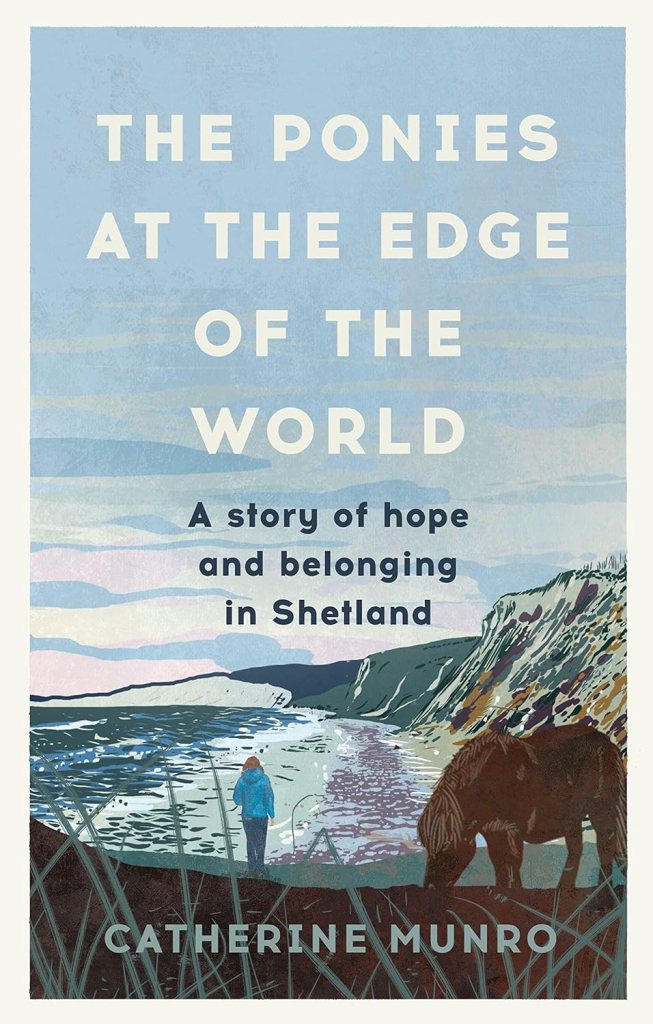
Book Review: The Ponies at the Edge of the World: A Story of Hope and Belonging in Shetland by Catherine Munro

Why did I read this book?

Next year I’m going to Shetland. I’ve been learning as much as I can about the group of islands, which are so far north of Scotland that most maps represent Shetland with an arrow that points north and the words to Shetland. And you have to take their word for it that it’s up there, beyond the edge of the map.

I bought Shetland: Your Essential Travel Guide (2024) by Laurie Goodlad. Her travel guide has a section titled “What to Read before You Arrive” with a list of fiction and nonfiction books. I chose Catherine Munro’s Ponies at the Edge of the World (2022) because where I grew up, we lived next to a farmer who had a small herd of American Shetland ponies, a cross between Shetland ponies and other horses. My sisters and I spent hours petting those ponies and feeding them tall grasses. The farmer who owned them taught us which grasses his ponies liked and how to hold our hands flat while the ponies nibbled their treats from our palms so our fingers wouldn’t get chomped.

What is this book about?

Catherine Munro is an anthropologist who specializes in human-animal relationships. She spent a year in Shetland to study the relationship between humans and Shetland ponies for her PhD. She interviewed people who spent their lives raising and taking care of Shetland ponies. For some Shetlanders, the tradition of caring for the ponies goes back generations.

While Munro’s book focuses on the relationship between Shetland ponies and people, she also describes some of the astonishing wildlife and the mystical landscapes that make the Shetland Islands one of the most unique and beautiful places on earth. She also brings to life the pragmatic and reserved but warm-hearted and community-minded people who live in Shetland.

What did I love about this book?

In her book, Munro describes why human-animal relationships are so important. The bond between the Shetland ponies and the people who raise them, care for them, and love them is fascinating. Shetland ponies developed over thousands of years, adapting to the climate and the terrain of Shetland. These small, thick-coated, hardy ponies became the perfect workmates for crofters who worked the land. Munro talks about the concerns for the survival of Shetland ponies as a distinct breed. She asks us to think about the importance of animals, to see them as our equals, and to understand that a respectful relationship with animals is essential for the survival of all species, including people.

Yesterday I read a blogger’s post stating that the Slender-billed Curlew has been officially declared extinct by scientists, a stark and sad announcement. To read the blog, click here. We need to do better for our earth and the plants and animals that inhabit it.

[You can follow Catherine Munro on Instagram at catherine_m_munro.]

Book Reviews for December

During December you can shop or you can read books. Or better yet, you can shop for books! Recently, I learned about a delightful Icelandic tradition called Jolabokaflod, which loosely translates into Christmas book flood. Every November the Icelandic book trade publishes a catalog of new releases, which is mailed to every household in Iceland. People buy books for their family and friends as Christmas gifts. On Christmas Eve after gifts are opened, everyone is encouraged to start reading their books right away. Imagine the peace and quiet and magic as each person slips into the pages of a book and into another time and place. Perhaps, one of these books will help you start your own family Jolabokaflod.

A Highland Christmas by M. C. Beaton (Mysterious Press by Warner Books, Inc., 1999)

Hamish Macbeth, the usually unflappable town constable of Lochdubh, a small village located in the Highlands of Scotland, is out of sorts. Christmas is fast approaching, and Hamish is disappointed because he cannot spend the holidays with his mother, father, and six siblings, who have gone to Florida for the holidays. Hamish must tend to his beat in Lochdubh and to another constable’s beat in nearby Cnothan.

Author M. C. Beaton (1936-2019) wrote a series of cozy mysteries featuring Hamish Macbeth who uses his intelligence, keen observation, and intuition to solve murders, showing up his superior officers. But it’s Christmas and in the spirit of peace and goodwill, Beaton’s A Highland Christmas is a very, very cozy mystery — skipping the murder.

However, Hamish’s pre-Christmas days are filled with small mysteries. Mrs. Gallagher, a detested, ill-willed spinster, rings up the police station to report her cat is missing and demands that Hamish find it. He also wants to discover why Mrs. Gallagher is a nasty-tempered old woman who bars and bolts her door and seldom leaves her home. Meanwhile, in Cnothan someone has stolen the town’s Christmas lights and tree, and Hamish is called to solve the Grinch-like crime. Hamish also wonders how he can convince a little girl’s Calvinist parents, who view Christmas as a heathen celebration, that their daughter should have gifts for Christmas, like the other children in her school.

A Highland Christmas is a warm-hearted novella filled with interesting characters who discover kindness is the best Christmas gift of all.

[If you wish to read this book, you will need to buy a used copy, make a visit to your local library, or listen to a digital copy because it’s out of print. I have listened to it twice as an audio book. It’s become part of my Christmas tradition, like watching A Christmas Carol. This year I bought a used hardcover version and was delighted to find that it has charming illustrations. I don’t know if the paperback version is illustrated.]

Beware of Cat and Other Encounters of a Letter Carrier by Vincent Wyckoff (Borealis Books, imprint of the Minnesota Historical Society Press, 2007)

Most of us are familiar with the letter carrier’s motto: “Neither snow, nor rain, nor heat, nor gloom of night stays these couriers from the swift completion of their appointed rounds.” We know letter carriers sizzle under the hot summer sun, get wet in the rain, trudge through snow, and freeze on sub-zero winter days. But we don’t necessarily know about the rest of “their appointed rounds.

Wyckoff’s collection of stories about his job as a letter carrier made me smile, laugh, cringe, and cry. For over fifteen years, Wyckoff delivered mail in a neighborhood in South Minneapolis. He came to know the people on his route, most of whom were kind, although some could be difficult. Wyckoff is a wonderful storyteller and a very good writer. His stories entertain, enlighten, and educate. He encounters an attack cat, biting dogs, cranky customers, lost pets, and on one particular day, a young child waiting for his mother who isn’t showing up. He writes about people on his route who became his friends, sometimes inviting him to be part of their family milestones. Ever wonder how a letter carrier’s day starts or what happens when he has to deliver a registered letter? Wyckoff offers up a well-rounded, well-written, informative, and heart-warming collection of stories about his career as a letter carrier. As a bonus, readers come away with a better understanding of what it takes to deliver the mail.

I liked this book so much that when I couldn’t find any other way to let Vincent Wyckoff know, I mailed a letter to him in care of his publisher. [Vincent Wyckoff also writes mysteries. For more information, click here.]

Mr. Chartwell by Rebecca Hunt (The Dial Press, imprint of the Random House Publishing Group, 2010)

After my mother-in-law died, my father-in-law invited me to look through her books and take what I wanted. I found Mr. Chartwell on her bookshelf. The cover caught my attention. I turned the book over and one of the blurbs mentioned Winston Churchill and his “black dog of melancholy.” I knew Churchill suffered from bouts of depression. Intrigued, I placed Mr. Chartwell on the pile of books I wanted.

Mr. Chartwell, Rebecca Hunt’s debut novel, deals with depression — a heavy subject. (The cover art, which caught my eye, belies the book’s seriousness.) However, Hunt combines sardonic wit with verbal and situational irony, creating moments of comic relief that are at turns dry, surreal, and dark, but which also lighten the story’s somber mood.

Hunt’s story is set in England and takes place in 1964, from July 22 through July 27. Winston Churchill will soon retire from public service, and he isn’t happy about it. Mr. Chartwell, a large black dog, who has spent a lot of time with Churchill throughout his life, returns to keep him company. Churchill isn’t happy about that either because Chartwell is the black dog of depression. Hunt personifies depression through Chartwell who is a very large, intrusive black dog and who alternates between beating around the bush or cruel bluntness when speaking. Esther Hammerhans, a young widow of two years, advertises for a boarder, and Chartwell answers her ad. She is shocked when she meets Chartwell at her door because the big black dog speaks to her while extending his huge paw for a shake. Chartwell convinces Esther to let him move in, so he splits his time between Churchill’s estate and Esther’s house.

Hunt’s use of figurative language is often quirky and elbows a reader’s sensibilities off kilter, which mimics what depression can do to a person. Her use of unusual metaphors made me groan a few times, but overall, I admired and enjoyed her fearless approach to creating a unique narrator’s voice. Her striking prose invites readers to slow down, read each sentence carefully, and absorb the intricate range of emotions Churchill and Esther experience when confronted by Chartwell. Hunt deftly juxtaposes Churchill’s long-standing battle with Mr. Chartwell against Esther’s beginning struggles with the black dog.