Book Review: McGarr and the P. M. of Belgrave Square by Bartholomew Gill (First Published in the United States by Viking Press, 1983)

I’m back with another update on my quest to read all of the Peter McGarr mysteries by Bartholomew Gill. I just finished McGarr and the P.M. of Belgrave Square, Bartholomew Gill’s fifth Peter McGarr mystery. And I know I said this about Bartholomew’s fourth book, but his fifth book is now my favorite of the series.

What is this book about?

A dead body lies in a water-filled ditch for most of a day. It’s inconceivable to DCI Peter McGarr that the woman in the house overlooking the ditch failed to noticed the dead man. Furthermore, McGarr reckons she must have witnessed the murder.

The dead man is William Craig, an antiques dealer and business man, who until that morning had lived with his wife in the house with the view of the watery ditch.

McGarr quickly gathers a list of suspects: the wife, the son, the business partner, the gardener, the maid, a member of the Irish Republican Army, a former Nazi collaborator. Given the method of the murder, it appears personal. Curiously, considering the many valuable antiques in Craig’s shop, the only item is missing is a valuable painting.

The P.M. of Belgrave Square is a dog (not the Prime Minister), who has retired from the police force. P.M. lives next door to McGarr, and of course they’re friends. In many ways the dog is a canine version of McGarr.

Thoughts about story and character development in Gill’s mystery series . . .

For four books, I wanted to know more about DCI McGarr’s wife, Noreen. I wanted her to do more than cook a few meals for McGarr, drive him around occasionally, and look stunning in clothes that showcase her ginger-colored hair and green eyes. I wonder if Gill ever received fan mail from readers asking for more Noreen because in this book, she has her own story arc, something missing in the first four books. In the earlier books, Noreen was nice enough, but now she’s interesting.

There are still no female detectives. And the female temp with the competent computer skills, who I really liked, is absent from this book, but I hope she still works for the department. There is only one scene at the police station in this book, so it makes sense we don’t see her.

In Gill’s first five books, we learn a lot about the murder suspects and what makes them tick, but not so much about the detectives who investigate them. It’s nice to have interesting suspects with convoluted psyches and complicated motives. But I’ve been raised on police detective stories that also focus on the investigators and what makes them tick. We get a bit more of that in McGarr and the P.M. of Belgrave Square, as Gill gives us some insight into McGarr’s life through Noreen’s perspective on their marriage.

Turns out Noreen is concerned about Peter’s drinking and his smoking. Throughout the first four books, she seemed oblivious to his bad habits. There are cracks in McGarr’s facade, hints that something from his past has left scars, and Noreen is terrified about his willingness to put himself in harm’s way. His position as a DCI means he should be off the streets and at a desk, but Peter likes to be in the thick of an investigation. She believes he has a death wish. I wonder if she will make it as a cop’s wife.

The Irish Republican Army is back. Insinuations of IRA involvement always complicate McGarr’s murder investigations. He seeks justice for the victim or victims at hand, but Special Branch, or some other investigative entity, often wants to bury IRA involvement, either because they simply don’t want to deal with it or because they are deep into an investigation and don’t want their cover blown. McGarr doesn’t give a farthing for either reason — he solves the case in front of him. If that means rattling the IRA or interfering in an ongoing Special Branch investigation, so be it.

Gill’s Peter McGarr mysteries are dark. Set mostly in Ireland, I can’t imagine they would ever be endorsed by an Irish tourism board. McGarr’s Ireland is a land of dismal weather and stormy seas with only brief bouts of sunshine. McGarr’s Dublin is a city of coal dust, simmering class resentments, and political intrigue.

I wonder if I weren’t interested in seeing how Gill develops his characters over the series, if I would still be reading these books. But I think the answer is yes. The novels have just the right amount of darkness. The writing is good. I like the dialogue. The stories are interesting. The books are quick reads. And the pocket book size feels so comfortable in my hands. After I finished this book, I ordered Gill’s next three mysteries from Thrift Books. So, like Noreen is still sticking with Peter McGarr, I’m still sticking with Bartholomew Gill.

[To read my reviews of the first four Peter McGarr mysteries, click here for books one and two and here for book three and here for book four.]

Book Review: McGarr on the Cliffs of Moher by Bartholomew Gill (Also published as The Death of an Irish Lass), Charles Scribner’s Sons, 1978

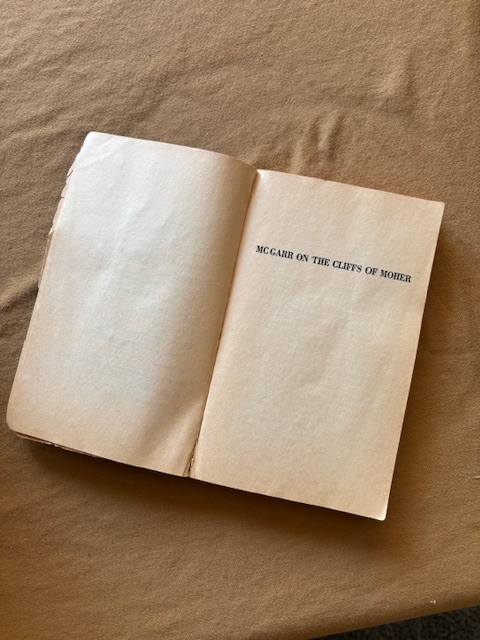
Penguin Books edition, 1982. I love the pocketbook edition. It’s been well loved over the last forty-three years. Sometimes as I read it, bits of the aged cover flaked away, and I imagined all the other hands that held this book.

I’m back with a quick review of the third mystery in the Peter McGarr series by Bartholomew Gill. I said I’d keep you updated about how Gill’s series progresses. [To read my thoughts about Gill’s first two novels, click here.]

McGarr on the Cliffs of Moher debuted forty-seven years ago. I believe it’s out of print because Amazon sells only used copies. I bought well-worn copies of Gill’s first three books from ThriftBooks. In my review of Gill’s first two McGarr mysteries, I said if I liked the third book, I would buy a couple more. Well, when I finished reading The Cliffs of Moher, I bought Gill’s fourth and fifth mysteries, once again from ThriftBooks.

What’s McGarr on the Cliffs of Moher about?

Shortly after traveling from America to visit her parents in Ireland, May Quirk is found dead in a pasture near the Cliffs of Moher. She has been run through the chest with a pitchfork. May was born and raised in Ireland, but shortly after becoming a young woman, she left Ireland for New York City, partly to follow a young man whom she loved and partly to seek opportunity and adventures not available to her in Ireland. In New York her romance with the young man falters, but they remain friendly. May finds success as a well-respected journalist.

CID Peter McGarr has a list of suspects, each with a motivation worthy of murderous intent. Did the man she originally left Ireland with kill her in a jealous rage? He had returned to Ireland about the same time she did. Did the country farmer down the road from her parents kill her? The farmer has been obsessed with May for years, believing God intended them to be together. Did the man who discovered May’s body in the field kill her? He doesn’t seem to have a motive, but he was so drunk on the night of May’s murder he can’t remember passing out next to her body. Did someone in the Irish Republican Army have her killed? If threatened, the IRA is capable of swift and cruel violence. Did May’s current lover, who is married, kill her? He wanted to marry her, but he’s an Irish Catholic with a passel of children, and May seemed uninterested in becoming anyone’s wife.

Why did I like this book?

It’s a page-turner. Once I start reading one of Gill’s books, I don’t want to put it down. The dialogue is snappy, with just the right amount of levity. I like the rivulets of sarcasm permeating McGarr’s conversations with suspects or other people who try to get in the way of his investigation. So far Gill’s books have interesting plots, and I’m kept guessing about whodunit. Finally, McGarr’s books are quick reads with well-written prose that often sparkles, but they don’t require deep thought on my part. And for this reason, while I enjoy them, they don’t rank as high as some other detective series that I have read.

Back to my thoughts about Gill’s books from a standpoint of craft . . .

You might remember I mentioned there was so much drinking in Gill’s first two books that I often felt like I’d wake up with a hangover in the morning. The consumption of alcohol in this book surpasses anything found in the previous two, partly because a lot of scenes are set in pubs in Ireland and New York. I don’t know how some of the characters can drink so much and still walk, talk, and think, let alone commit crimes or try to solve them. I have moved beyond the idea I might be vicariously hungover in the morning to seriously thinking I might need a vicarious twelve-step program after reading the series. I wonder if McGarr can keep up his pace of drinking throughout the series.

I’m still waiting for McGarr to have some sort of crisis of the soul. We don’t learn much about him in this book either. It’s mentioned again that he grew up in poverty, but that doesn’t seem to have affected him in any visible way. But where does all that drinking come from? Is Gill perpetuating a stereotype about the Irish love of whiskey and beer? In Gill’s stories there is a fine — but uncommented upon — line between McGarr and other characters, some of whom seem to be able to drink without getting drunk, and others who cannot hold their liquor. McGarr is one of the characters who can hold his liquor and solve crimes.

I’m waiting to see if female detectives will become part of the Irish constabulary landscape. However, it’s still the 1970s in McGarr’s world, and it’s a male dominated society.

McGarr’s marriage is another curiosity. His wife, Noreen, is twenty-one years younger than him. He married late in life because he considered himself a confirmed bachelor. In this book we learn why he married, but I’ll let you discover the reason for his marriage. It’s tossed in as a single sentence, but the sentence is striking and not easily missed. I always like to discover these little gems in a story for myself, rather than being told. The McGarr marriage could become an interesting side story. There are many ways Gill could play it.

The pages have mellowed into a yellow brown. It’s hard to imagine they were ever white.

So, I bought the next two books because I’m still curious to see if and how Gill develops his characters. In the meantime, his crime mysteries are entertaining reads just as they are.