If you buy thebook, make sure you get the one with the green cover, the photo edition. Released in 2022, it’s the newest edition.
Why did I buy this book?
This book was recommended by Gwen, the manager of Drury Lane Books in Grand Marais, Minnesota, one of my favorite bookstores. (Although, I have to say any independent bookstore I go into becomes one of my favorites! And, once I’m inside a bookstore, I don’t like to leave.)
What is this book about?
Backyard Almanac: 365 Days of Northern Nature covers plants, insects, and animals that can be found in northern Minnesota and northern Wisconsin. One day and one page at a time, readers can learn about birds, butterflies, mosses, mushrooms, berries, wild flowers, amphibians, and trees, among other amazing plants and creatures.
What do I love about this book?
I started reading this book on October 10 because that is when I bought it. I read one page a day, so today I will read the entry for November 6, titled “Jiggly Jelly Fungi of Fall.” I love that I can read about nature one page a day, and it only takes a few minutes. It satisfies my urge to learn about the natural world around me, and it leaves me with time to read other books.
Each page is beautifully laid out. Larry Weber writes clear, concise descriptions with interesting details about each plant, insect, or animal. Photographer Sparky Stensaas provides beautiful photographs and informative captions. And illustrator Judy Gibbs’s enchanting sketches grace every page. It’s fascinating how much life can be found on the forest floor, in low-growing vegetation, and in trees if a person knows where to look.
At the end of each month’s section, is a blank page where a person can record notes about nature. An index at the back of the book makes it easy to look up entries. Because of the book’s thick, glossy, high-quality paper, the photographs are sharp with great color reproduction. Also, the book is heavy — good for doing some arm-toning reps, which I actually do if no one is watching.
What makes this book important?
The more people understand about nature and its interconnectedness, the more they will respect and treasure all of its plants, insects, and animals.
Other than this blog, I mostly write short stories and essays, but I had so much fun writing this article. I also took the photos and wrote the captions. One of the highlights of writing this article was interviewing Carol, the co-president of the Lake Superior Rose Society, who was more than generous with her time. She is so knowledgeable about the Rose Garden and its history, plus she knows so much about roses and their history. I learned more from her than I could possibly include in my article, but her willingness to share her knowledge gave me the confidence to write about roses, which I knew so little about.
Our community is lucky to have a publication like Northern Wilds. The articles are well written and cover a variety of topics, such as outdoor activities, artist profiles, nature, ecology, tourist venues, community celebrations, and local restaurants.
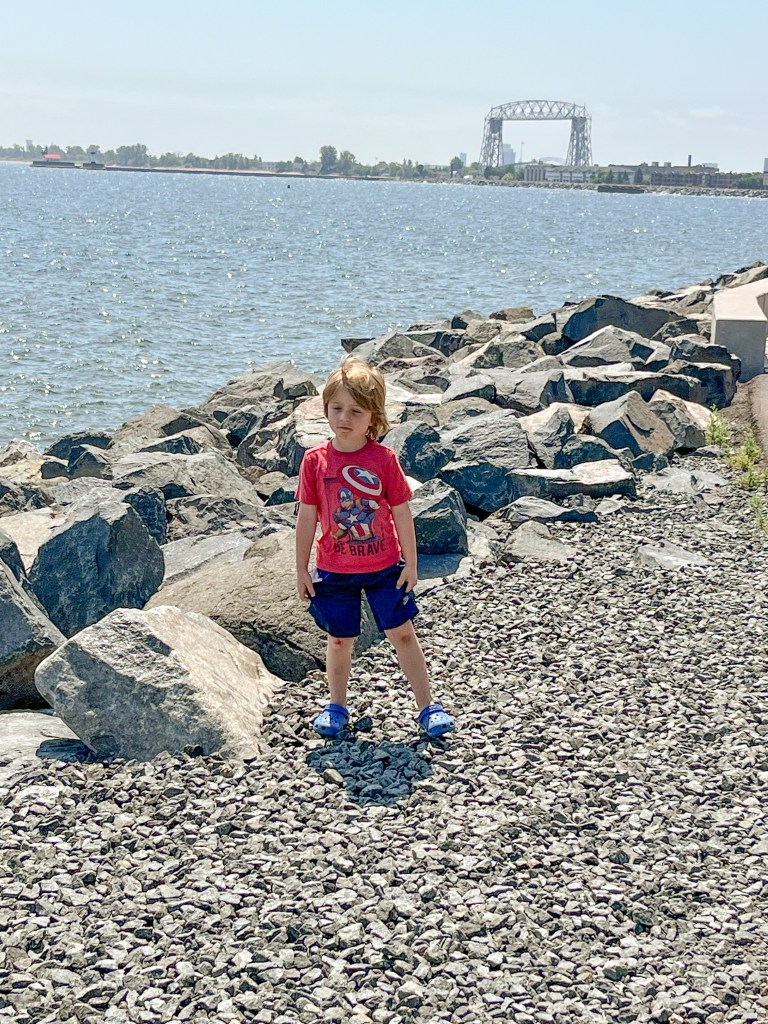
My youngest grandson strikes a pose along the Lakewalk. Check out his knees! That is how mine always looked when I was his age.
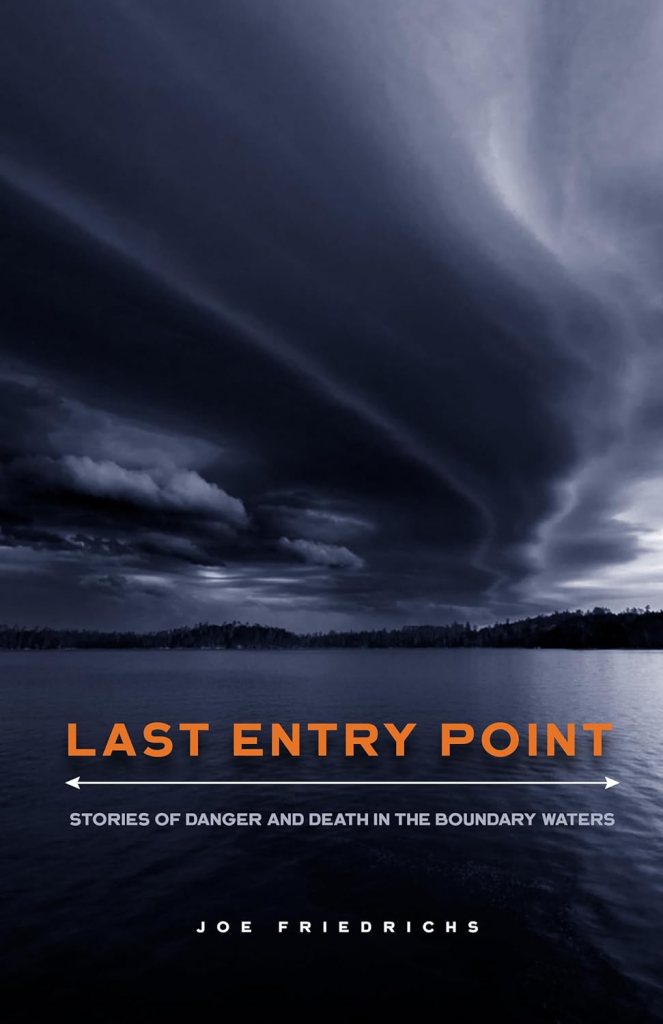
Published by Minnesota Historical Society Press, April 2024
Why did I read this book?
I went to the Boundary Waters Canoe Area (BWCA) in May 1982 for several days. And although I’ve never returned, I was curious to read Joe Friedrichs’s book because it’s about a place that I once visited and found beautiful beyond words, mysteriously ancient, and intensely wild.
But because Friedrichs tells the stories of people who have died or nearly died in the Boundary Waters, I hesitated to buy his book. I wondered how he would approach his topic. Then I read a review that stated Friedrich didn’t sensationalize the stories of death, but rather treated the deceased people and their loved ones with compassion. So I bought the book, and once I started reading it, I was glad I had.
What is this book about?
Friedrichs covers stories about people who have died or almost died in the Boundary Waters due to lightning, drowning, fire, cold, and falling trees. He also tells about a couple of people who entered the BWCA, disappeared, and were never seen again. While the majority of Friedrichs’s book covers tragic and near-tragic events, he also writes about other topics connected to the BWCA.
As Friedrichs vividly describes the many lakes, rivers, portages, and trails, readers are immersed in the beauty of the nearly untouched primitive wilderness that draws so many people to the Boundary Waters. He covers some of the history about how the area became a designated wilderness, and he discusses the role of fire in the life of a forest. Readers learn about the St. Louis County Rescue Squad, the Cook County Sheriff’s Department, and other rescue teams who all work together to find and rescue people who are in trouble. Or sadly, when someone has died, who work together to recover the person’s body.
What makes this book so good?
Even though Friedrichs writes about people who have died in the BWCA, he tells those stories respectfully and compassionately. He makes sure that each person he writes about is more than just the story of their death, more than just a statistic. During the research for his book, Friedrichs talked to the loved ones of those who had died in the BWCA, even traveling to other states to speak with their family and friends.
People who visit the Boundary Waters have a love of the outdoors and a passion for canoeing, kayaking, hiking, and fishing. Friedrichs, after making his first trip to the BWCA, fell in love with the untamed wilderness and moved to Minnesota, making his home near the edge of the BWCA. He has made many trips to the BWCA, and his knowledge about the area and his understanding about the type of people who find both peace and adventure there add immeasurably to his book.
While people can certainly learn from Friedrichs’s book that one needs to be prepared and practice safety when going into the wilderness, his book isn’t a how-not-to-do-things book. Because almost every single person in his book who died or almost died was prepared, experienced, and serious about safety. Instead, some unforeseen, powerful event, usually weather-related, overtook a person or people, and then no matter how much planning had been done or safety had been practiced, it all came down to luck. Humans like to believe they can control and prepare for every outcome, and that if they do, disaster will be averted. But this isn’t always true.
Finally, Friedrichs is a wonderful writer who crafted a well-organized, thoughtful, and engaging account about a one-of-a-kind place on Earth.
Reflections about my one and only Boundary Waters trip after reading Last Point of Entry . . .
When I went to the Boundary waters in May 1982, there were five of us on the trip. We were all in our early twenties. We parked our vehicles near the lake we entered and paddled to our campsite, where we stayed for the next few days. We didn’t have to portage our canoes or supplies. I was the only person who’d never been there before, and I had almost zero experience in a canoe. But I put on my life jacket every time I stepped into the canoe. I knew this would be important to help keep me afloat should we capsize. What I didn’t know, until I read Friedrichs’s book, was how fast hypothermia might have claimed my life if I had gone into the water, even with my life jacket securely buckled around my chest. He points out that May and October are popular months for people to visit the BWCA, but those months have the highest number of drownings, not because people don’t wear life jackets, but because the water is so cold and the weather is more volatile. But people like those months because there are fewer bugs. That’s why the group I was with chose May for our camping and fishing trip.
It drizzled every day we were in the BWCA, and it was cold, above freezing, but cold. We didn’t have to worry about bugs. During the day we fished on the lake by our campsite. Even in a layer of drizzle and chilled air, the scenery was incredibly beautiful. I understood that I was among something old and pristine, a wild and natural forest carved with clear lakes and rivers. Something vast that people hadn’t managed to ruin.
While our weather was cold and rainy, we didn’t experience any intense storms, so we didn’t have to worry about our canoes being swamped, trees falling on our tents, or lightning striking us. But all that came down to luck. We didn’t catch any fish either. We ate food, including steaks, that we’d brought with us. I’ve never been back to the Boundary Waters. But not because I didn’t enjoy my trip. Even in the drizzle and cold, it was amazing. But I’m not big on camping or fishing. Still, I’m glad I was able to experience the BWCA, and I understand why other people love to enter its unspoiled wilderness.
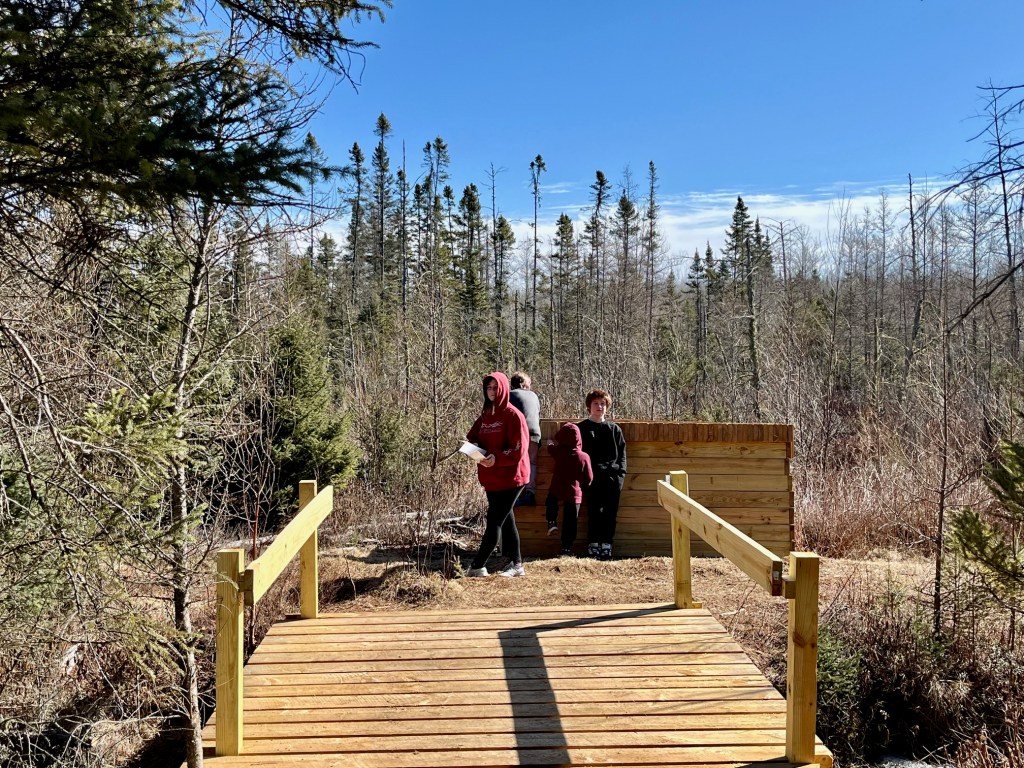
The John C. Gale Boardwalk, part of the Taiga Boardwalk built in autumn 2023
Last week I took my four grandkids to the Sax-Zim Bog in Toivola, Minnesota, appropriately located on Owl Avenue. (It’s a good place to see northern owls.) The drive from my house was one hour and four minutes. (Thank you, GPS.) The grandkids brought library books and their adventure bags, which are filled with postcards, maps, compasses, binoculars, auto bingo, bird books, and other adventuresome stuff. We weren’t one minute from my house when the three youngest grandkids took up an intense game of auto bingo, searching for cows, horses, ambulances, no parking signs, and billboards. However, by the time we were far enough out of the city to see cows and horses, the bingo game had blown over.
Of course, there is always one grandkid who wants to know: How far? How many more miles? Are we halfway there yet? Have you ever been here before?
We arrived at the bog’s parking lot about eleven o’clock. It was 52 degrees and sunny, with a slight breeze — perfect weather for walking through an old bog. But we were glad we’d worn sweatshirts over our T-shirts.
The Sax-Zim Welcome Center was closed, but we met a volunteer coming out of the building who looked like part of an illustration from a Jan Brett book. He kindly answered my questions about the trails because we wanted to walk on the new Taiga Boardwalk built last autumn.
Grandkids on the Taiga Boardwalk
Shortly after we started down the trail, a loud clattering commenced. I wondered, “What kind of bird is that?” Then I discovered two chattering squirrels chasing each other up and down tree trunks and across fallen logs at breakneck speeds like a pair of NASCAR racers. “Those are fox squirrels,” Michael, 10, said. “My grandma has them at her house.” His other grandparents live in rural central Minnesota. But, according to a post on the Friends of Sax-Zim Bog Facebook page, we most likely saw Red Squirrels. They are highly territorial, and one of them probably invaded the other’s space, which would explain their loud scolding sounds and serious chasing behavior. Whether fox squirrels or red squirrels, they were fun to watch.
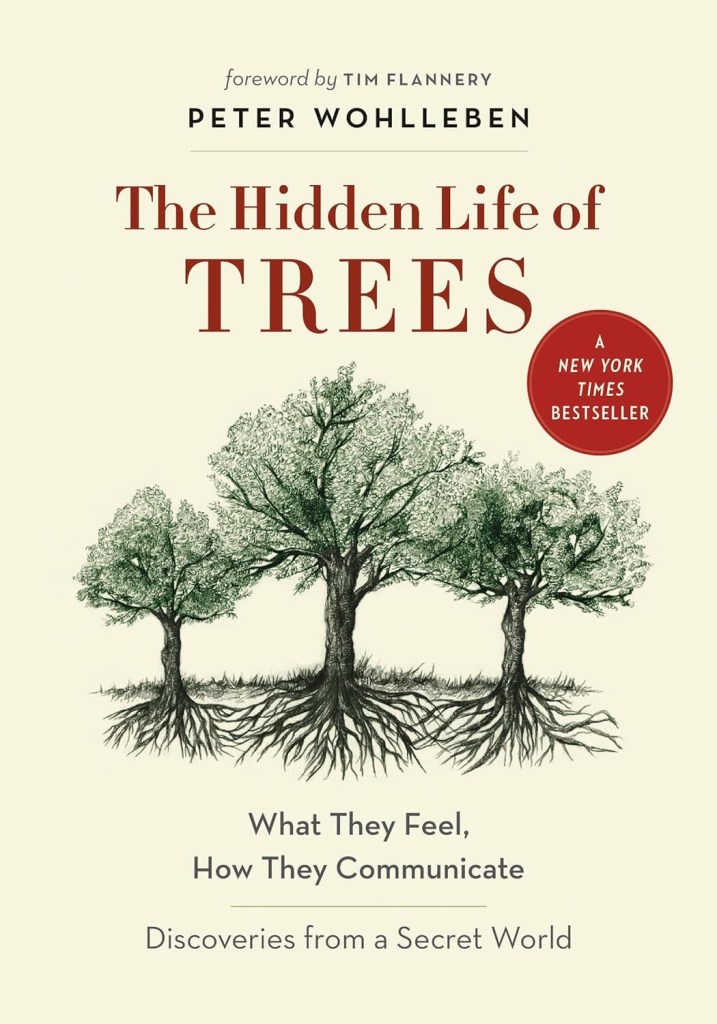
As we walked through the bog’s forest, I thought about The Hidden Life of Trees by Peter Wohlleben, a book I recently finished reading. I learned a lot about trees and forests. True forests are diverse and interconnected in an amazing cycle of life and death, filled with competitiveness and cooperation, and home to a large variety of insects, animals, and other plants. Forests grown for harvesting are nothing of the sort.
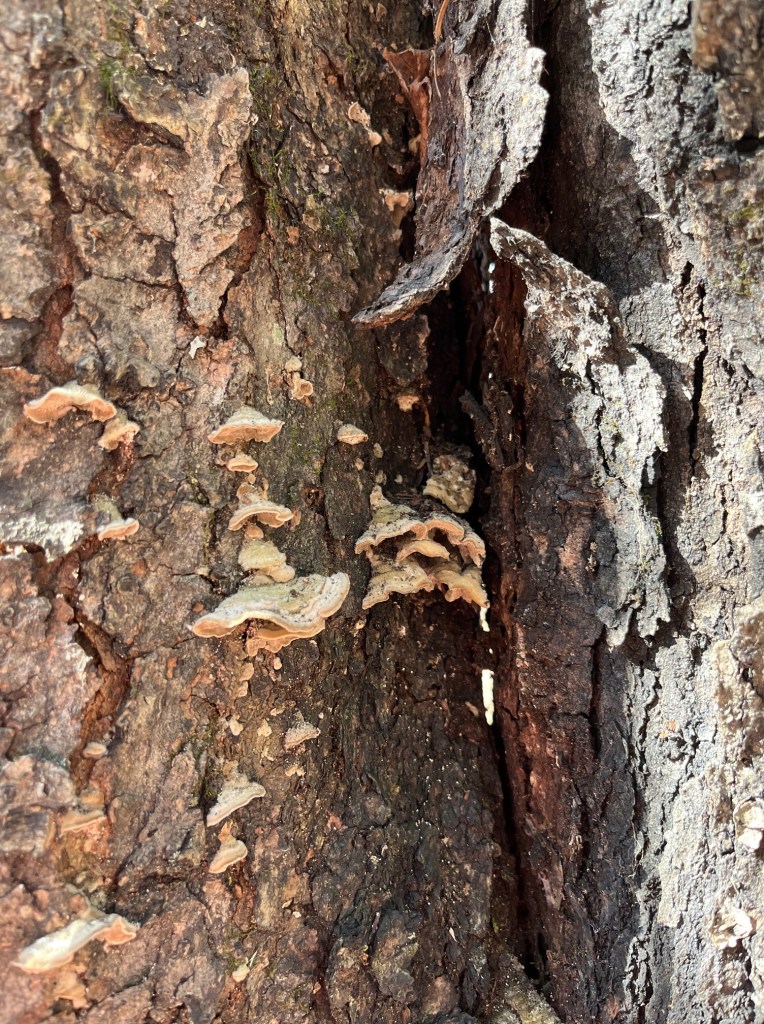
A tree near the end of its standing lifeClose up of same tree: the fungi have arrived
Walking along the trails of the bog, we saw different species of trees. New trees, only inches tall, grew under the branches of old trees. Unless the old tree dies, most, or perhaps all, of the baby trees we saw won’t make it to adulthood. Some standing trees looked nearly dead, waiting for their turn to fall to the forest floor. Tree trunks that had already fallen lay on the ground in different stages of decay, providing habitat for other creatures.
Steeped in tranquility, the breathless silence of the bog held no traffic or city noise. No planes droned overhead. Occasionally, the peaceful quiet was accompanied by the chirps and calls of birds and squirrels, which like the silence, belonged to the forest.
The Taiga Boardwalk loop is short, but it’s not meant for serious hiking. It’s a trail where visitors take their time, stopping to look for birds and animals who are masters at blending into the forest. When we finished the Taiga trail, we weren’t ready to leave the bog, so we walked a different, smaller loop. We still didn’t wanted to leave, so we walked the Taiga again.
On our second trip around the Taiga trail, Evan, 7, got down on his hands and knees, peered through the slats on the boardwalk, and said, “I see why they built this. There is water down there.” I’d told them the boardwalk was built to help keep people’s feet dry.
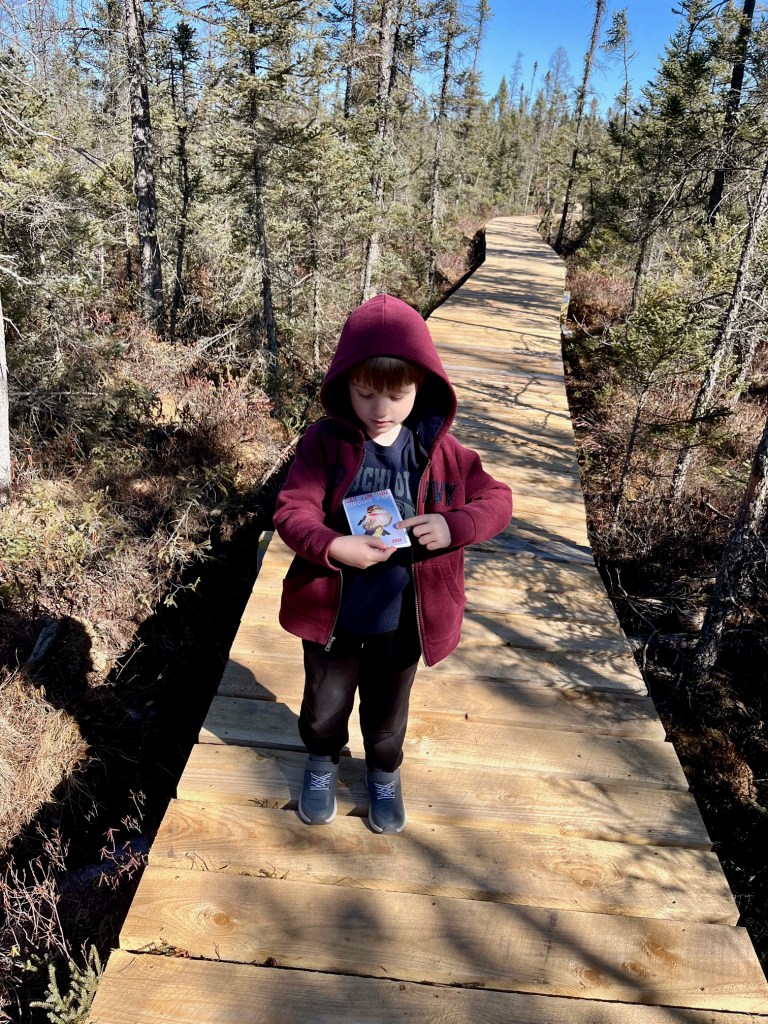
Charlie points at the common redpoll on the cover of his trail map. He said he just saw one, and he might have. Before we left the bog, another volunteer told us a redpoll had been spotted that morning.
We didn’t see any owls, but in addition to the red (or fox) squirrels, we saw chickadees, and Clara,12, spotted a black-back woodpecker.
After we finished walking the trails, my youngest grandson Charlie, 5, gave me a hug. “Do you know why I gave you a hug?” he asked. He didn’t wait for an answer. “I gave you a hug because you brought me to this bog.” I think Charlie felt what I felt: a pervasive peacefulness. As I walked through the bog, I felt a sense of increasing serenity. In The Hidden Life of Trees, the author mentions studies that show people have reduced stress levels after walking through old-growth forests. I have no data to prove that is what happened to me, but I certainly felt calmer than when I’d arrived.
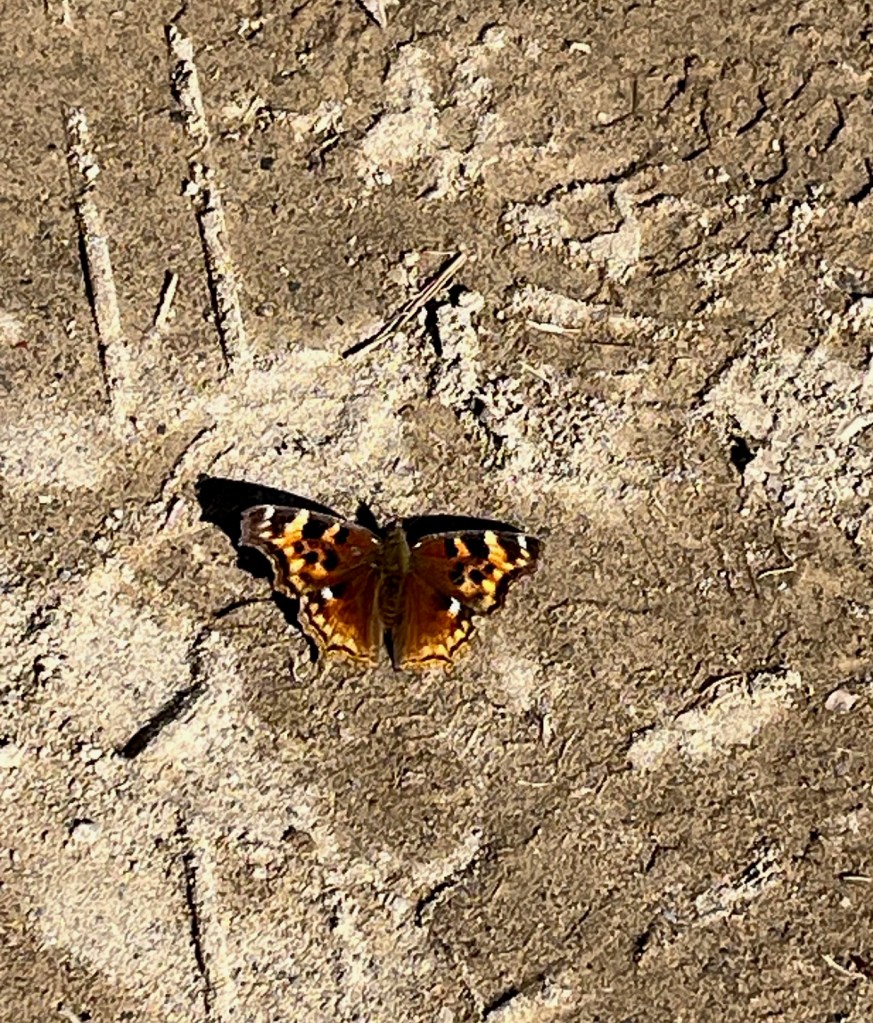
Holding our trail maps, Sax-Zim Bog calendars, and warm memories, we got in the van and buckled up. I was about to start the engine when Clara pointed out her window and said, “There’s a butterfly in the parking lot.”
The butterfly, a Compton Tortoiseshell, sunning itself before the pickup entered the lot.
Having recently finished reading Bicycling with Butterflies by Sara Dykman, I had to get out of the van and have a look. As I was snapping pictures of the butterfly, which wasn’t moving much, a red pickup truck pulled into the lot. The only open space for the truck to park happened to be where the butterfly was resting, and the driver wouldn’t have been able to see it. Squashed butterfly, I thought. I walked toward it, and it fluttered a few feet, but in the wrong direction. Coming from another angle, I walked toward it again, and it flew another few feet, but this time it landed out of harm’s way.
The red truck parked without crushing the butterfly. Perhaps it wouldn’t have needed me to save it. Maybe it wouldn’t have been run over, and it would have flown away from the truck instead of into it. But I’m glad I didn’t leave the butterfly’s destiny to fate.
The grandkids and I left the bog and headed back to the city. As I drove down the county roads, they flipped through their calendars, enjoying pictures of the beautiful wildlife who make their homes, for at least part of the year, at the Sax-Zim Bog.
My husband and I walked into the grocery store on Sunday morning, and while he bought his weekly lottery ticket, I walked toward the deli. I never hang around while the clerk at the service counter tells him that he hasn’t won anything. And I hope if he does win something, it will only be a small comfortable amount, enough to pad the savings account a bit, with some left over for a reasonable amount of fun, like a car trip to Maine instead of a first-class world cruise.
Before shoppers can reach the deli counter, they are tempted by a large oval salad bar, filled with leafy greens, hot and mild peppers, shredded cheeses, tomatoes, sliced eggs, julienned carrots, olives, and loads of other assorted toppings. I never buy anything from the salad bar. It’s expensive, so I slice and dice my own salad goods. Also, while I’m not too worried about germs, I draw the line at eating food that has been sitting in the open, and crammed with serving utensils that have been handled by lots of other people. But I always look at the salad bar because it’s big and strategically placed.
As I neared the salad bar, I spotted a gleeful chickadee pecking at some salad fixings. I thought about the chickadees in my yard who visited the bird feeder and had to eat ordinary black sunflower seeds. I stood and watched the audacious little bird who had invaded the grocery store. I should have been grossed out, but I was amused. Humans take so much wildlife habitat that I had to admire the plucky little fellow who had somehow found his way into a large grocery store and was helping himself to the salad bar without using tongs.
I wasn’t the only human who noticed the black-capped bird enjoying a spread so big he must have felt he had won the lottery. A deli clerk hustled up to the salad bar and tried to shoo the bird away, but chickadees aren’t that intimidated by humans, and he refused to move. The food was too good. The clerk reached for him with both of her hands, and I think she could have managed to cup the feasting bird in her palms. But just as she was about to try, she hesitated and pulled her hands back. She went to the deli and came back with two plastic containers. She tried to capture the bird between the two containers, but at the last moment the bird zipped to the other end of the salad bar and kept eating, after all it was a smorgasbord.
The clerk rounded the counter. “Get away from my salad bar,” she said, waving her hands at the bird who took flight and landed among a gathering of grapes. The grapes were all packaged, so he headed to the tomato stand. When the clerk approached, he decided to check out the watermelon. She followed him, and he took off again. He flew to the meat department and landed at the back of a shelf filled with trays of chicken. Two more clerks arrived and the three of them stood in front of the meat section, discussing how to catch the chickadee. But the little Houdini escaped again. This time he soared to the ceiling, where he could evade capture and have a bird’s-eye view of the store while waiting for a second chance at the salad bar.
My husband and I finished our shopping without seeing the chickadee again. After we paid for our groceries, I turned to head back to the deli. I wanted to ask if they had caught the chickadee. But I stopped. If they had hurt or killed it while trying to catch it, I didn’t want to know. I had been tickled by the little bird who had invaded the grocery store and grazed at the birdfeeder of his dreams. And, I worried the little fellow’s bold adventure would end badly. I felt guilty that I had taken joy from a situation that had put the wee bird in peril.
Ziva slept while I wrote, and the birds and the squirrel visited the feeder.
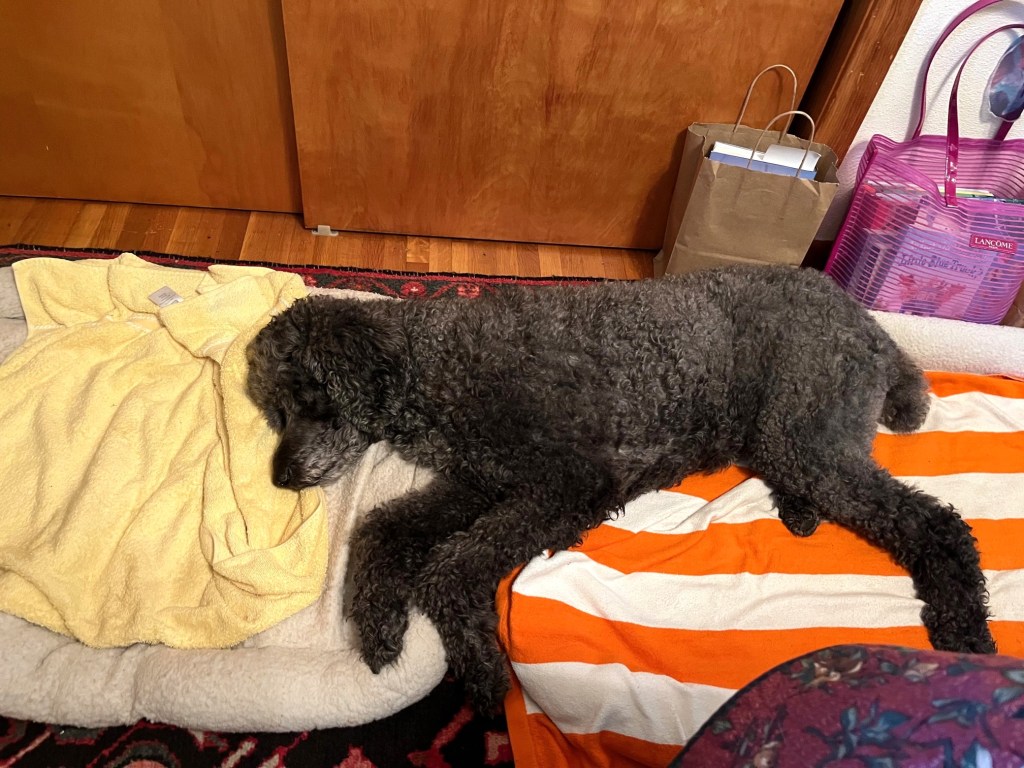
Today while I was writing, Ziva, my twelve-year-old standard poodle, slept on her dog bed in my office. She doesn’t take my writing seriously. She takes a nap. And when she is bored with napping, she will get up and jab my right elbow with her nose. This means she wants a walk, because when we return she knows she will get a treat. She’s very good with cause and effect. If I ignore her first jab, she will jab again and again, until I say, “Okay, just let me finish this sentence.” It’s difficult to type when my elbow is suddenly tossed into the air by Ziva’s snout. But, today we walked before I started writing, so she was content to sleep instead of interrupting my stuttering flow of creative whatever.
Today’s big distraction took place outside my office window. Nuthatches, chickadees, house finches, a downy woodpecker, and a squirrel showed up at the bird feeder that hangs in the pine tree. It was a comic opera of dance, birdsongs, and slapstick.
The nuthatches and chickadees were happy to take turns at the feeder, but when a pair of house finches arrived, the other birds backed off and lit upon nearby branches in the pine tree. The house finches parked themselves on the feeder and ate, and ate. House finches are about the same size as the nuthatches and chickadees, but they obviously have an unsavory reputation in their small-bird community.
Occasionally, a chickadee attempted to fly in and snitch a seed, but the finches refused to yield. The chickadee, chickening out at the last second, would furiously flap its wings, nearly come to a screeching halt, then hover a moment before veering off to the left or right, returning to a branch in the tree. One chickadee flew up to the feeder, and one of the house finches turned its head, making a motion like a dog barking to defend its dish of food. The chickadee made a hasty retreat.
For the most part, the nuthatches made do with eating insects they found on the bark of the pine tree. But occasionally, one of them, craving a tasty sunflower seed, bravely approached the feeder. The house finches weren’t intimidated by them either.
During all this comedic drama, a squirrel arrived. His fluffed-out, bad-ass, tail-twitching demeanor made all the birds, including the house finches, seek higher branches. I chuckled because my bird feeder is squirrel proof. Many squirrels have tried, and all have failed. In a scene of choreographed comedic buffoonery, I watched the squirrel walk back and forth on the branch, eyeing the feeder. Next, he climbed on top of the feeder and stretched a paw downward toward the opening filled with sunflower seeds. Maybe, I thought, this one will figure out how to nab a seed from the squirrel-proof feeder. But no. He was only providing that moment in a story when we think a character will get what she wants, which made the next moment funnier because the squirrel fell off the feeder and onto the ground. My laughter startled Ziva, who lifted her head. The birds, however, wasted no time guffawing. They vied for position at the feeder.
And the squirrel was fine. He climbed back up the tree and sat a couple of branches above the feeder. He made a big show of licking his paws then smoothing the fur around his face and ears. Finally, he fluffed his tail with his tiny claws then gave it a swish, swish through the air. His rendition of a human tripping, picking herself up, looking around to see if anyone saw her fall, then smoothing out her clothes, before moving along like nothing happened. The squirrel made no second attempt at the feeder. The house finches came and went a few times, and each time they departed the chickadees and nuthatches rejoiced.
A downy woodpecker joined the troupe, an extra without a speaking role, relegating herself to the background while she pecked at the branches and trunk of the pine tree. Downy woodpeckers like to chum with chickadees and nuthatches, maybe because they take turns at the feeder, and downy woodpeckers like sunflower seeds. But today she was above jostling for seed, maybe she didn’t like house finches either.
I was supposed to be writing, but all the drama at the bird feeder was as good as a rousing, twisting, turning period drama on Masterpiece Theatre. Cooperation, backstabbing, greed, ingenuity, snobbery, high drama, and comic relief all outside my window. All potential themes and plot twists for a future story I might write.
So I’m reposting my blog about the American Dagger moth which originally posted September 24, 2021. In addition to being an important part of the food chain, moths are important pollinators too. To read more about why they should be respected and protected read: Bees Get the Glory, But Moths Are Also Key Pollinators, Study Says
To read about my discovery of an American Dagger Caterpillar in my front yard, click below.
I’m reposting this blog about Mayflies because it continues to be read. Last summer and this summer it has received occasional views from people in North America, Europe, and Asia. Perhaps it’s just bots finding the article, but I like to think that an actual person has searched “mayflies” and found my blog. I enjoy writing about backyard nature, and I’m often inspired by the animals, insects, and plants I find in my yard or as I walk down my city streets. It’s my hope that if people understand the importance of the critters and plant life in their yards, they will skip the pesticides and chemicals used to make the “perfect lawn.”
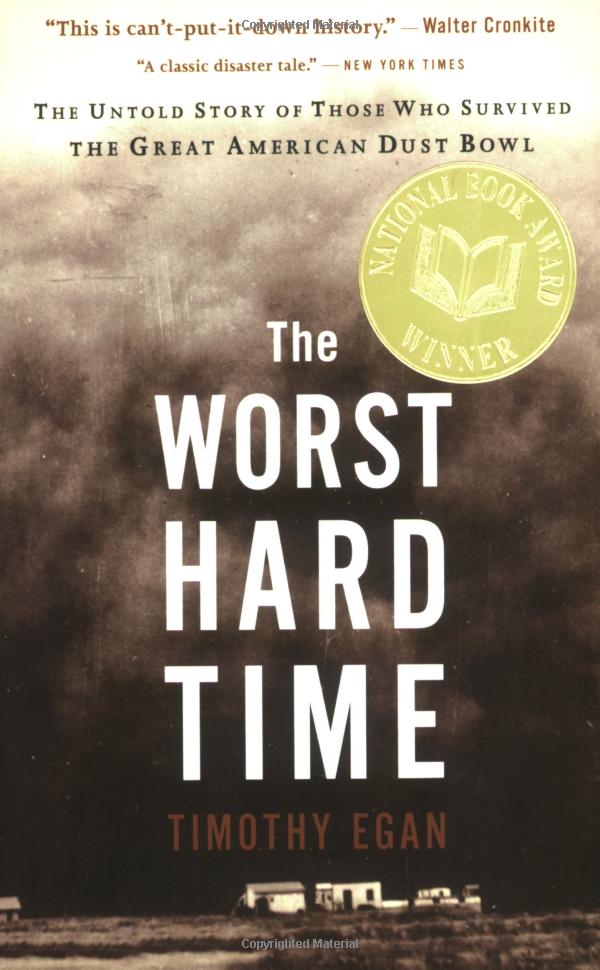
The Worst Hard Time by Timothy Egan is about the Dust Bowl of the 1930s. It tells the story of an ecological disaster of epic proportions caused by greed triumphing over reasonable behavior.
Before white people arrived on the American High Plains (the setting of Egan’s book) the tall grasses and buffalo had thrived for centuries upon centuries in a symbiotic-type relationship that allowed them to survive bitter cold, searing heat, and cycles of rain and drought. Then white people drove Native Americans off the plains and killed buffalo by the millions to ensure Native Americans wouldn’t have a food source.
Next came ranchers who raised cattle on the grasslands where the buffalo once roamed. But cattle, unlike buffalo, struggled to survive the extreme heat, cold, and drought. And when the prices of beef dropped or weather killed their cattle, many ranchers went bankrupt.
Then came farmers who believed they could grow wheat on the High Plains. At first there was enough rain and the price of wheat was high, so farmers borrowed more money and tore up more grassland, chasing higher and higher profits. But like a pyramid scheme, their dreams of wealth tumbled when wheat prices dropped precipitously and drought wrapped its hands around the neck of the High Plains and refused to let go. Wheat died in the fields, and farmers couldn’t pay their bank loans.
Ranchers and agricultural specialists warned against the unchecked removal of the grasslands because they understood the temperamental moods of the High Plains. The prairie is a place of wind, and so the winds, drought, and bare fields whirled like a dog chasing its tail, wearing itself out, completely spent. In a couple of decades, American farmers destroyed an ecosystem that had thrived for thousands of years.
Most of Egan’s book describes the horrific dust storms that raged over the plains, lifting millions of tons of topsoil and depositing it hundreds of miles away. He interviewed people who lived through the fierce, stinging storms. He retells their harrowing stories of survival, despite displaced dirt that filled their nostrils, mouths, and eyes, buried their possessions, killed their loved ones, and destroyed their livelihoods and communities.
Why is this book important?
People have changed the earth’s temperature, and they can’t just say, “It’s cyclical. It’s a phase.” Human behavior is accelerating the warming of the earth. During the Dust Bowl, many people blamed the ecological collapse of the High Plains on the drought. They refused to believe their stripping of the grasslands was the real issue. But other people knew better because droughts had come and gone many times and the grasses held the soil in place, just how nature designed it to work.
Yesterday the air quality where I live registered 182 on the AQ Index. That’s in the red zone, labeled unhealthy. And a thirty-acre wildfire started burning in the Boundary Waters Canoe Area Wilderness in northern Minnesota. It’s the first wildfire in the beginning of what appears to be a season of drought in Minnesota. We had lots of snow this winter, but the spring rains haven’t come. And there will be more fires. But the smoke that tanked our air quality yesterday came from one of the Canadian fires.
A smoky haze filled the sky, and the acrid smell stung my nostrils. I kept the windows and doors closed, but I could still smell the smoke in my house. I canceled plans to take my grandkids to a big outdoor park in a neighboring town. Physical activity is not advised when the AQ Index is in the red zone. We went to the library instead, but I could smell smoke inside the library too.
I thought about families who lived during the Dust Bowl. The babies and children and the young and old who died of dust pneumonia. How people and animals caught in a dust blizzard sometimes suffocated on dirt. How everyday women and men tried to defeat mounds of dust, shoveling it out of their homes, barns, driveways, and roads. How they covered every crack in their houses with tape or paper and hung damp sheets and blankets over windows and doorways to stop the dust. But each night while they slept, dust seeped into the house and cloaked them in grime.
Yesterday when I looked at the skies hemmed in with brown smoke, I felt claustrophobic, and my sinuses hurt. I wondered how people coped day after day, month after month, year after year with tons and tons of dirt. Of course, not all of them did. Some left, some died, and some lost their minds. I don’t think I could have handled the Dust Bowl.
Today the AQ Index dropped out of the red zone, through the orange and yellow zones, and by the afternoon entered the good green zone. But what will happen as the earth continues to heat up? There will be more wildfires. Will the air be filled with brown smoke every day?
If anyone has any doubt about how quickly greedy, ignorant humans can destroy a habitat, read The Worst Hard Time. It’s a well-written, well-researched book. And although it’s sad to read about the disaster of the Southern Great Plains and its tragic impact on the people who lived there, it’s an important story.
I have about one hundred pages of the book left to read, so I don’t know how it ends yet. It’s 1935, five years into the story, and drought still strangles the High Plains. Black Sunday, the worst storm of the Dust Bowl, has just occurred. And finally, the politicians in Washington, D.C. have decided they need to act. I don’t know how people worked to solve the Dust Bowl disaster, but I’m optimistic there was a workable solution. I hope to finish Egan’s book tonight.
I’m not so optimistic about today’s politicians in Washington, D.C., and their willingness to handle climate change.
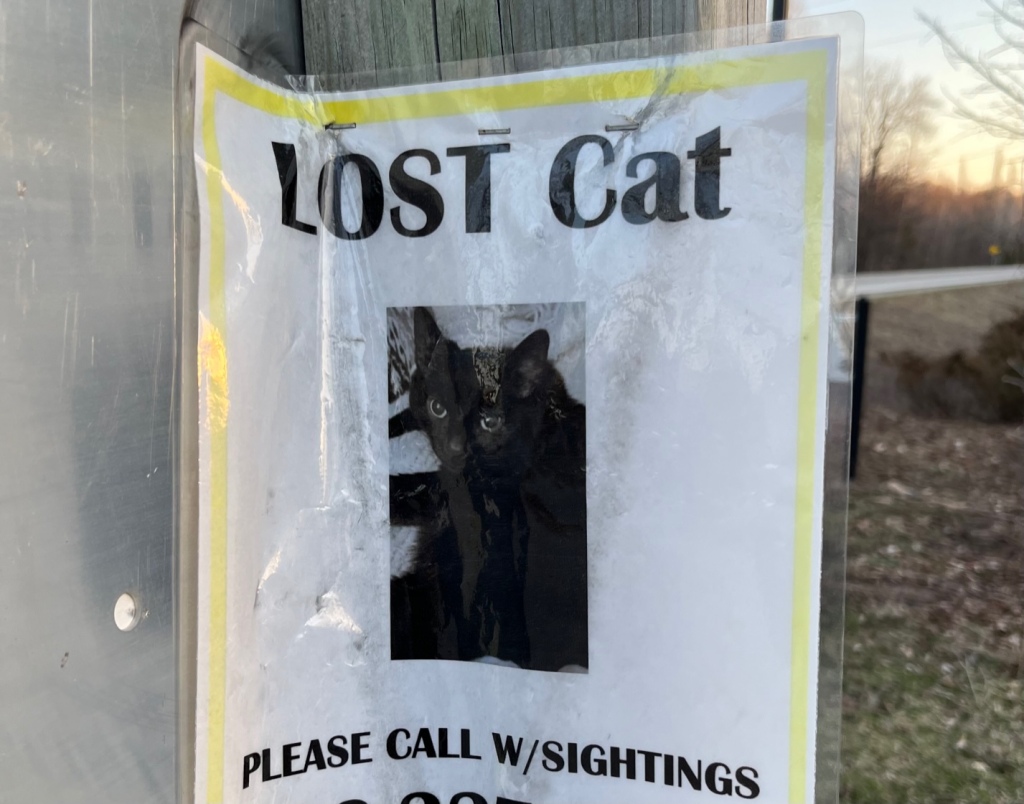
I’m away from home, and I’ve been taking lots of walks. On day two of my amblings, I noticed a couple of signs had been posted with a picture of a black cat and the words: Lost Cat Please Call w/Sightings. There is, of course, a phone number.
When I’m walking, I look for the cat, but all I’ve seen are deer, woodpeckers, crows, small birds, rabbits, geese, ducks, turkey vultures, and two foxes frolicking in a farmer’s field. But I haven’t seen the black cat, so I haven’t used the phone number.
Several days have passed and the notices are still up, so the cat is probably still missing. I like to think if the cat had been found, the owner would have removed the signs. I leave for home tomorrow, but I expect to see the signs on my morning walk before I go. I hope the owners find their pet, but the longer the cat is gone, the less likely it will return.
Something might have killed the cat. It also might have found a new home. Cats have been known to do that. I had a good friend who gained a gray cat that way when it showed up at her house. While she tried to find its owner, she fed it and took care of it, and the confident cat made itself right at home. Then the cat disappeared for a couple of days. Then it returned, only to disappear and reappear again over several weeks. Finally, she discovered the cat lived across the alley and down a few houses. The cat, like a bigamist, had been keeping two families. Plenty of jokes were cracked about its behavior, and both of the cat’s families kept in contact in order to keep tabs on their mutual pet. Eventually, the cat dumped the other family and settled in with my friend. She felt badly and kept asking the owners if they would like their cat back. Sure, but only if the cat wanted to come home. They were pragmatic about the situation because it turned out that was how the cat had come to live with them the year before.
But that’s not much comfort to the owners of the missing black cat because they wouldn’t know if their pet was safe.
We had a black cat when I was ten years old. My mother brought it home. I’m not sure if it was because my siblings and I wanted it or if she wanted it. She didn’t need much prompting to bring home animals, and what little kid doesn’t want a playful kitten with a soft, rumbly purr.
My father wasn’t happy when he came home and was introduced to a black kitten named Lucifer. He claimed he didn’t like cats. Lucifer, sensing my father was his enemy, joined ranks with him. That cat greeted my father when he came home from work, sat on his lap when he read the newspaper at the kitchen counter, and curled up with him when he fell asleep on the couch. My father grew fond of Lucifer, the cat with a name that belied his personality. Dad had a soft spot for animals too.
Lucifer was full grown but less than a year old when he died. No one noticed that he was missing because he hadn’t been gone long enough. One of my siblings discovered his body floating in our above ground pool in the backyard. The sides of the pool were four feet off the ground, but cats have leaping superpowers. However, once he’d gotten in the pool, he was unable to get out.
We were all upset about Lucifer, especially Dad.
A few months later, the pool, too, would have a sort of death. My father flew skydivers, and one weekend afternoon, Dad and some of the jumpers thought it would be fun if a couple of them were to land in our pool. Boredom was probably the mother of this crazy idea because the skydivers normally aimed for a small metal disk in the middle of much larger circle of pea gravel back at the airport. I can picture the scales in their adventurous brains as they weighed their options: Same gray pea gravel, again? Or a Caribbean-blue pool filled with chlorinated water? Tipping the scale was the much smaller size of the pool, twenty-five feet in diameter, making it a more challenging target. The skydivers were thrill junkies. Besides, the pool’s water was only three feet deep. No one was going to be in over his head.
We lived out in the country on two-point-two acres, and our land was surrounded by sprawling fields of tall grass. So, if the skydivers missed their target, they had plenty of grass to land on. Also, my father had a certain reputation in the neighborhood, and if someone saw a couple of guys with parachutes drifting toward earth in our backyard, well, that kind of thing was business as normal at our house.
But like many good ideas hatched in the heat of a Saturday summer afternoon, this one was a near miss or a near hit, depending on your point of view about the half-a-glass-of-water personality test. One of the skydivers didn’t land outside the pool or inside the pool. He landed on the edge, crumpling the side. Skydivers don’t float like dandelion seeds landing gently on terra firma. They come down a bit fast, so part of their ground school training covers proper techniques for landing to avoid injuries.
The skydiver wasn’t hurt, but he took some ribbing for “riding the fence.” The pool was totaled because once metal is bent that badly, there is no unbending it, so my father dismantled it and took it to the dump. That fall we got another cat, a Siamese kitten we named Cleopatra but called Cleo. A few months later, sadly, she was run over by a car. We didn’t get another cat for several years, and we never got another swimming pool. My father kept flying skydivers, but there were no more landings in our backyard.
I hope someone finds the cat on the poster, and it returns home. And if not, I hope the cat finds a nice second home. I’d like to think of the cat as keeping someone’s lap warm.







 Writing Near the Lake