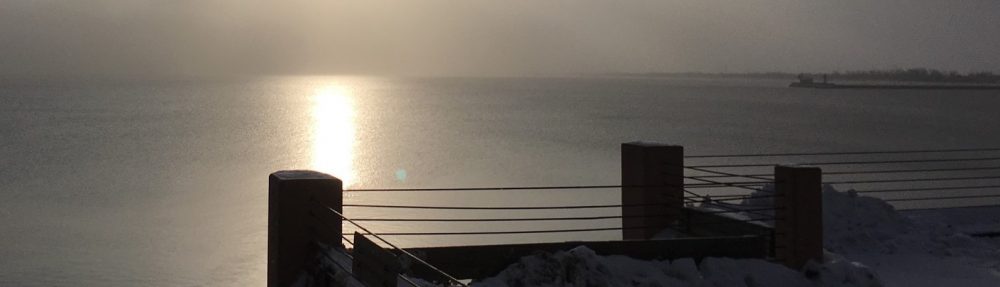
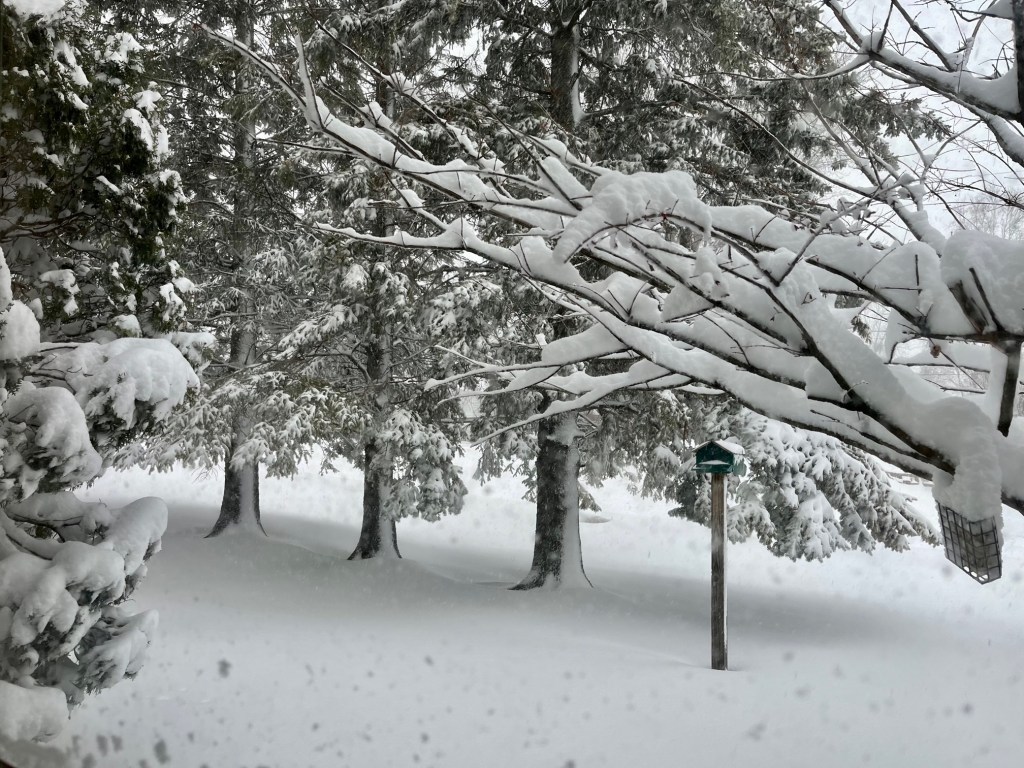
I think of these mornings as Ansel Adams mornings, when overnight the snow has fallen wet and heavy, clinging to branches, railings, and the sides of houses. The sky is tinted with the blue-gray of first light, and sunrise is moments away. It’s a world captured in gray and black and white.
Aiming my phone out the window, I take color photos, but they come through as black and white. Later when I apply the noir setting to them, the difference between the original and edited photos is nearly nonexistent, so I discard the changes.
Adams, one of my favorite photographers, captured the American West in black-and-white images, and his landscape photos featuring snow are among my favorites. I learned about Adams in a college photography class that I enrolled in because friends were taking the class for their art requirement. Having taken a ceramics class that summer, I didn’t need anymore art classes, but I signed up anyway because the class met on Monday nights when we all went country swing dancing at a local bar. If I was at class with them, it would be easier for us to carpool to the bar. I miss those days of whimsical logic.
That autumn I had a marvelous fling with country swing dancing, but I fell in love with the photography class. My friends spent just enough time completing assignments to earn what we called Charity C’s. But I spent hours photographing people, architecture, nature, and landscapes. And I spent hours and hours in the photo lab developing negatives and printing pictures, experimenting with different papers and exposures. I saved up money and bought my own 35 mm camera, playing with the f-stop, shutter speed, and film speed. I took four more photography classes over the next two years.
I thought about a career in photography, but I was more in love with taking pictures than the idea of earning a living by taking pictures. After I married and had children, my manual 35 found a shelf on a closet and retired. My husband bought me one of those instamatic 35 mm, a point and click camera that used 35 mm film. I used it for years, until I bought a digital camera with an SD card. But now my camera is a smart phone. And I can be a photojournalist wherever I travel or from the inside of my house.
Today, March came in like a lion. The winds were 20 mph, and the gusts were a whole lot gustier. We were supposed to get one to three inches of snow, but at least six inches blew in off Lake Superior, and flurries are still coming and going. Around two o’clock this afternoon, a light pole fell over onto the Bong Bridge and blocked traffic from Duluth to Superior. Fortunately, it didn’t fall on a vehicle.
In my yard the snow piled up on existing drifts, turning hills into mountains. I will need a Sherpa, oxygen, and snowshoes to walk around my yard. When I opened my back door, I pushed it slowly, using it as a plow to move a drift just enough so I could reach around and grab the shovel. I cleared a path across the deck for the dogs, who unfortunately need to go potty outside, and do other stuff, like walk around the house to smell for bunnies. They come back inside looking like four-legged abominable snowmen, and I have to towel dry them and dig ice balls out of their feet.
I worked this morning, which left my afternoon wide open for cooking — something I feel compelled to do during a snowstorm. Perhaps it’s a primal instinct, meant to ensure I survive the brutal winter elements while I’m inside my house with central heating, electricity, and running water. First, I made taco soup in the crockpot. Nice and simple. This gave me time to make naan bread.
frying the bread
Why did I decide to make naan bread? Reading made me do it. I’ve read Behind the Lens and Double Exposure written by Jeannée Sacken. Her novels are about the adventures of photojournalist Annie Hawkins, who travels to Afghanistan. They are page-turning adventures with twists and turns and danger and romance, but they are also filled with the sounds, smells, and tastes of Afghan food, and naan bread is mentioned often. After reading the second book a few months ago, I decided I needed to make naan bread. On Sunday, I bought the ingredients.
sort of six-inch circles
I made bread once before when I was sixteen and babysitting for my younger cousins. And it turned out perfect. It was so good — just the right color and height and texture and taste — that I never made bread again. I figured I had nowhere to go but down. My next loaf of bread would have surely been a brick. But naan bread is mostly flat, so I was encouraged. The naan bread could be dipped in the taco soup or torn into bits and dropped into the soup.
My first attempt at activating the yeast was a failure. My water was warm enough, but when I put that warm water into a cool metal bowl, the water temperature dropped, and the yeast fizzled instead of bubbling. I had to throw it out. After some internet research, I tried again. This time I used my Pyrex measuring cup. I warmed it up with warm water, then I put warm water in the cup with the yeast. It bubbled up and doubled in volume, just like it was supposed to do. I mixed the other ingredients in and kneaded the dough on the pastry mat. I covered the dough and let it rise for an hour and a half, while I attended a Zoom write-in.
Triple play: soup cooking in the crockpot and dough rising in a bowl under a dish towel while I write.
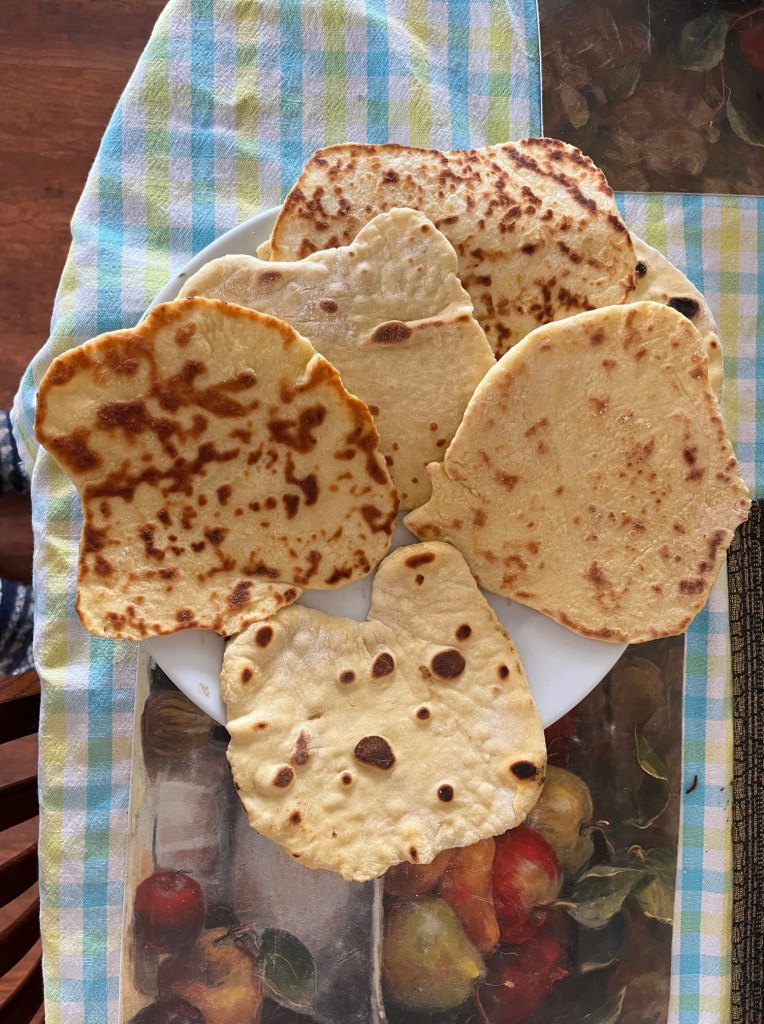
After the naan bread dough finished rising, I divided it into eight sections, rolled each one into a flat six-inch circle — more or less — and fried each piece. I set off the smoke alarm, but only once. I made a mess out of my kitchen. When I finished there were dishes all over the countertops and stove, and I found flour on the floor. I don’t know how I can cook something and make so many dirty dishes and create such a mess. I guess it’s a gift.
When my husband came home, there was no evidence of my afternoon cooking spree. The kitchen was clean and the dishes were done. (I even managed to read a bit and take a nap.) He looked at the plate of naan bread on the counter and asked, “What are those?”
“That’s naan bread. I made it this afternoon.”
“Yeah, right. You went to the grocery store and bought it,” he said.
“Nope,” I said, “I even took out the rolling pin and pastry mat and put them in the dish rack, so you would think I made them from scratch.”
He looked at the dish rack overflowing with bowls, pans, and measuring cups, and he laughed. He knew I’d been cooking and baking. He also doesn’t understand how I can cook something and make so many dishes and such a mess. Some talents are inexplicable. But he liked the naan bread and soup, happy to have a hot home-cooked meal after snow blowing.
[Bloganuary is hosted by WordPress. A new topic is presented each day during January. The words in quotes are from “I Wandered Lonely as a Cloud” by William Wordsworth. I first read this poem in college, and loved it. It’s still my favorite poem.]
What Brings Me Joy
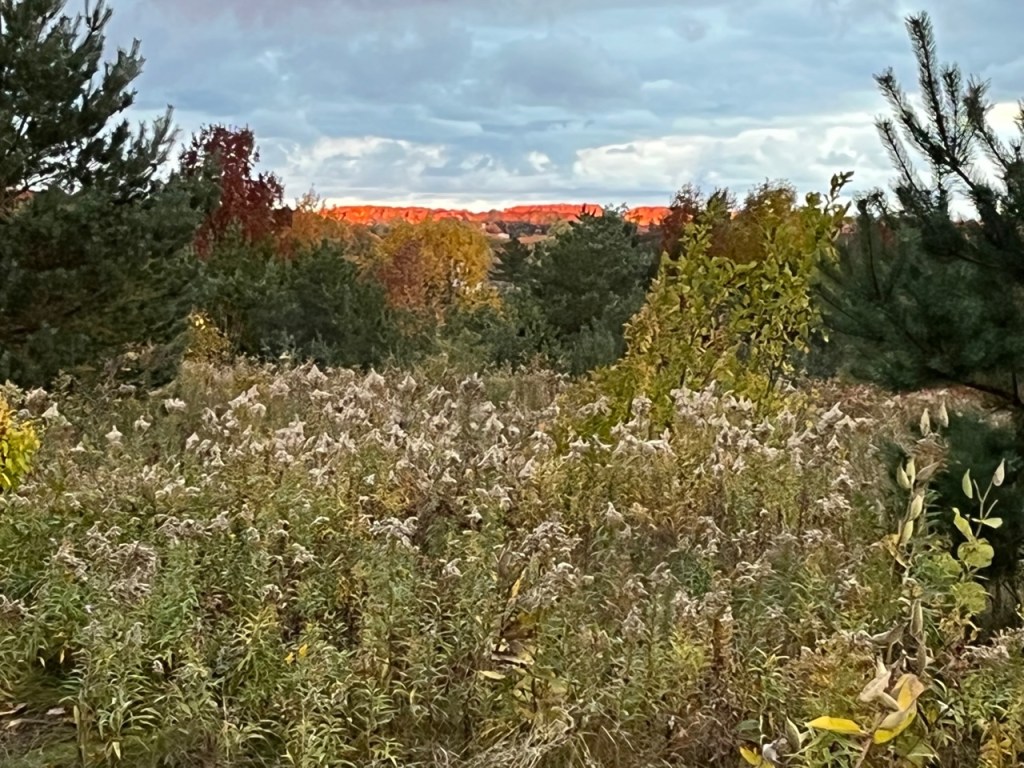
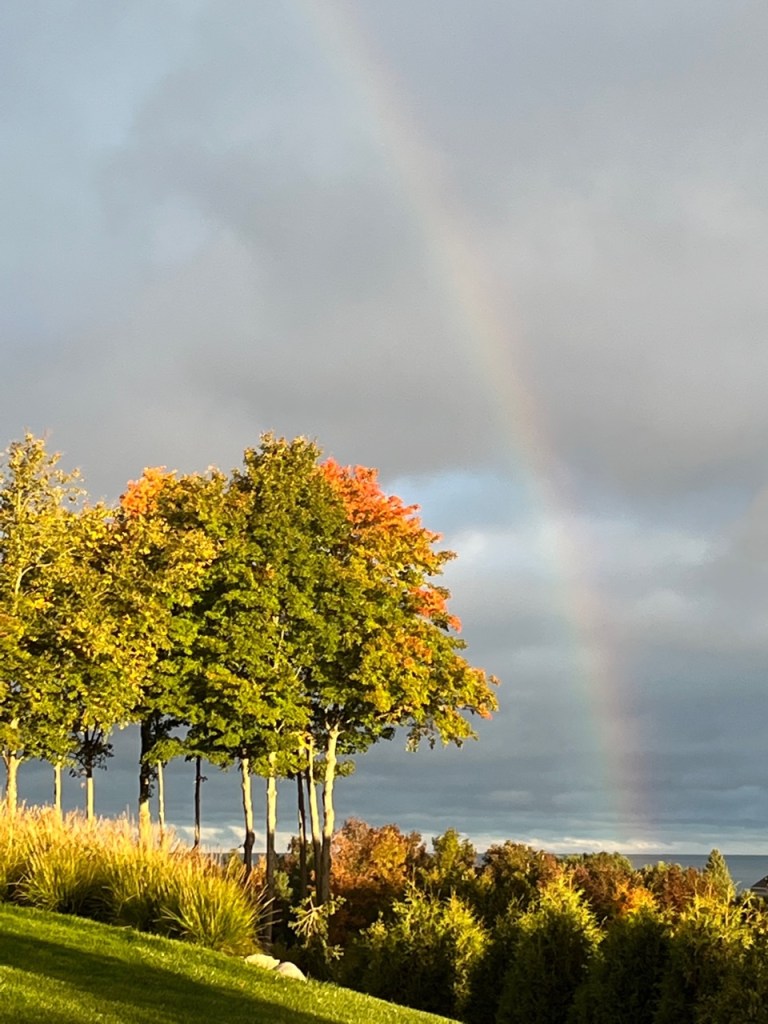
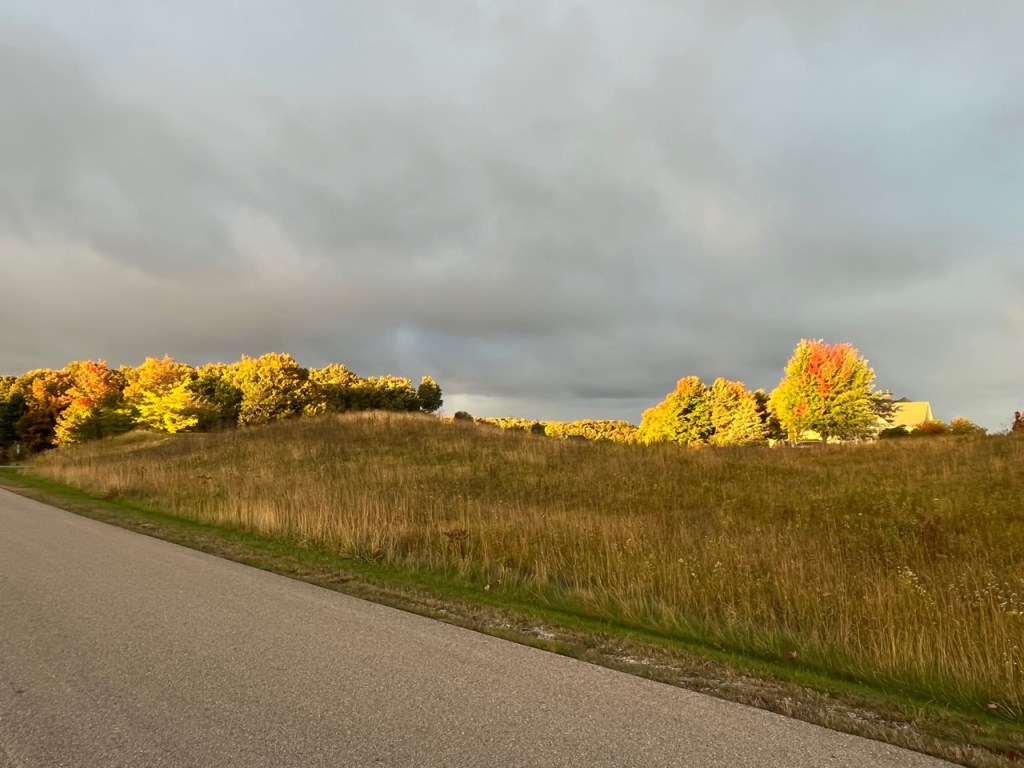
Fields filled with swaying grasses, splashed with wild flowers, and hugged by trees are my joy. I wandered through those kinds of fields as a child when I lived in southern Wisconsin. And now, I wander along those kinds of fields when I visit my mother in Michigan and walk her dog.
Those fields are to me what William Wordsworth’s “host of golden Daffodils” were to him.
For even when I am absent from those fields, they can “flash upon that inward eye / Which is the bliss of solitude, / And then my heart with pleasure fills, / And dances [not] with the Daffodils,” for those belong to Wordsworth. My heart dances with the swaying grasses, for those belong to me.
[To read “I Wandered Lonely as a Cloud” click here. To view the slideshow below, click on the square on either side of the picture.]
I’m in Petoskey, Michigan, just thirty miles south of the Mackinac Bridge. We came over on Wednesday, threading the needle between stormy weather in northern Wisconsin and stormy weather across the Upper Peninsula. It was a smart choice. We had nice driving weather for our nine-and-a-half-hour trip. It was, however, bitter cold, which my dogs didn’t appreciate during their potty breaks.
On Thursday the temperature in Petoskey rose to 35°, the sun shone, and the Lake Michigan winds kept their breezy nature tucked away. My husband and I took my mom out for a drive in the morning because she wanted to do some shopping. After we dropped her off, my husband and I went to lunch and did some shopping, buying gifts for her, a bread pan for me, and caramel corn for him. Although a winter’s day, it was beautiful for walking in and out of shops in downtown Petoskey. I reminded my husband about the last time we had such beautiful weather for pre-Christmas shopping in Petoskey. Shortly after nightfall, temperatures sank; thick, wet snow blanketed trees, power lines, and the ground; and winds whipped into gale force strength. We lost power at 2:30 in the morning.
Cabela
Once again, the nice weather we had on Thursday was the calm before the storm. By 7:00 p.m., the wind revved up its motor, the temperature dipped fifteen degrees, and the snow flew in horizontally off Lake Michigan. Fortunately, we haven’t lost power, but the water in the toilets sloshes back and forth and side to side like we’re on a ship in rough seas.
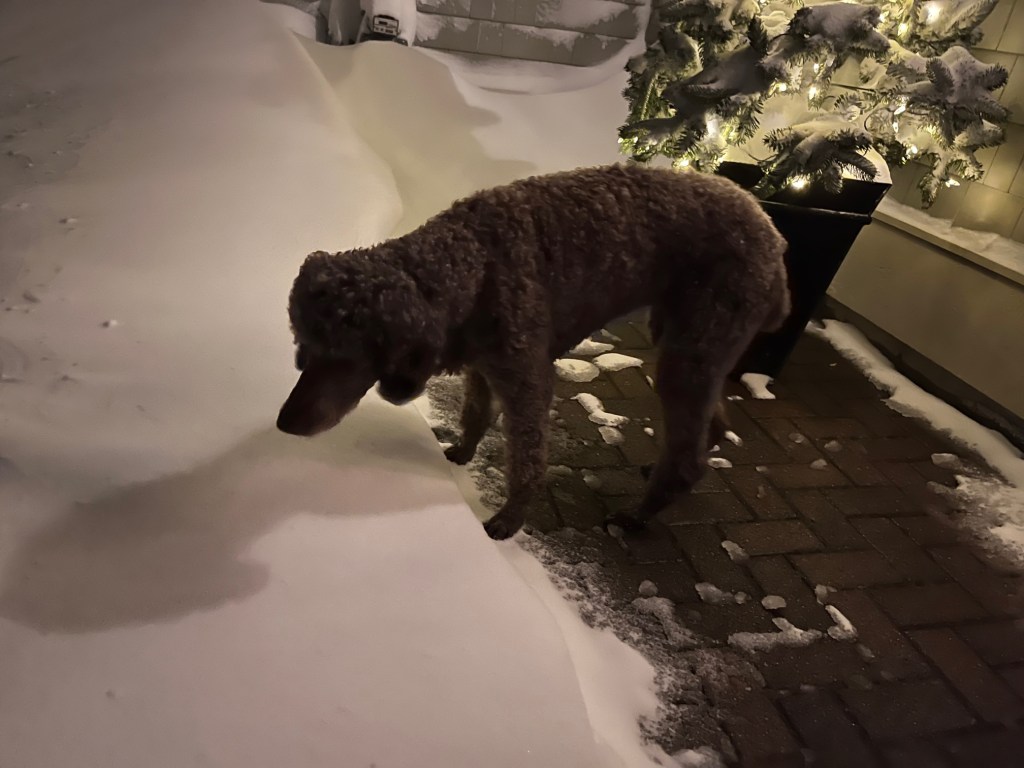
Each time I take the dogs outside, including walking my mom’s poodle, Bogey, I bundle up from head to toe–hat, goggles, down coat, long underwear, and boots. Yesterday morning I walked Bogey, and we had to trudge through knee-high snowdrifts. He likes to walk to the cul-de-sac to poo. He has a favorite spot. Sometimes as we walked the wind would gust, stopping me in my tracks and shoving me a step or two backwards. Later in the evening after dark, we repeated our trek through knee-high snow drifts, the wind pushing us around again. I thought about Jack London’s story “To Build a Fire.” I have a fine sense of the dramatic. But mostly, I wondered why anyone would set out for a long walk in subzero temperatures or blowing blizzards. I wasn’t going any place where I couldn’t see house lights.
Ziva
The snowstorm bellowed all through the night, and the winds blew harder. This morning the snow is lighter, but the winds continue to roar off Lake Michigan. This weather front isn’t forecasted to loosen its grip until after Christmas Day.
So, it’s inside entertainment. I’ve watched a little bit of football, lost two games of cribbage, finished a five-hundred piece jigsaw puzzle, and I’ve done some reading and writing. Last night my mom and I watched Flawless, a movie starring Demi Moore and Michael Caine, which we both liked a lot. Today I wrote this blog while sitting in a second-story window seat, watching the white caps on Lake Michigan, listening to the whooshing winds, and being chilled by the cold air leaking through the windows. The winds are gusting at 45 mph. The snow is still falling. And because I’m very cold now, this blog must be done. I need a cup of hot cocoa with whipped cream.
Last week a snowstorm moved through our area, and school was cancelled three days in a row. I took care of my youngest two grandsons for two of the days, which included a sleepover.
After the first day of the storm, there was a lull in the evening before part two of the storm hit. So, on a beautiful, warm winter evening dressed in fresh snow, my grandsons bundled up in their outerwear, and my husband gave them headlamps to strap around their hats. I leashed the dogs, and we went for a walk.
My happy grandsons ran down the sidewalk, mesmerized by the bouncing lights shining from their headlamps. They laughed and played games as they ran. My dogs and I trailed behind. The dogs ignored their antics, but I remembered my sisters and I as young children and our fascination with flashlights. We’d heist a flashlight from the kitchen junk drawer and hide it in our bedroom. After dark, we used it to create animals with our fingers on the walls of our bedroom. We had such fun–until my father, days or weeks later, opened the junk drawer to find his flashlight missing when he needed it.
My father’s voice would boom: “Where’s my damn flashlight?” My sisters and I would exchange glances, then fetch it from the bedroom and place it in his hand.
“I can’t have a damn thing around this house!” he’d spout. My father, a master of hyperbole, turned every problem that impacted him into an all-or-nothing event.
In reality, there were only two things my father couldn’t have around the house–flashlights and tape measures. Considering he was a mechanic with an amazing array of tools in his garage and a junk drawer full of household tools, he could’ve fared worse. My father’s booming voice didn’t deter us. Eventually, we’d hijack the flashlight again, always with a plan to return it before he noticed it was missing, a plan that usually failed.
At some point we discovered tape measures were fun, not because we measured stuff, but because the metal tape could be pulled out and locked in place, then with a flick of a finger, unlocked. And ZING, twenty feet of metal tape would dash into its case with satisfying speed and a snappy sounding CHING. Of course, we often forgot to return the tape measure.
One day, one of us, I think it was me, pulled the metal tape out too far. Nothing we tried would fix it. Next time my father boomed, “Where’s my damn tape measure?” we wouldn’t be able to retrieve it and put it in his hand, unless we handed it to him with its innards spilling onto the floor.
We did the only sensible thing we could think of–we placed the broken tape measure in a paper bag and carried it into the field of tall grass behind our backyard. We left it there, hoping no one would find it.
I don’t remember if my father or mother ever found the bag. And I don’t remember what happened the next time my father boomed, “Where the hell is my tape measure?” I asked my sisters and they didn’t remember the event, although they were part of the caper and cover up.
Sometimes I think I have a vague memory of it being discovered, but that my father made no bigger deal out of it than to repeat his usual “I can’t have a damn thing around here” lament, a tirade that probably lasted only a minute or two because being a busy guy, he had other things to do. He also had tape measures in his garage.
My father could at best be described as a curmudgeon, but for all his bluster, he was sentimental. Once we all grew up and moved out, I wonder if he ever went to his junk drawer and felt a bit sad to find both his flashlight and tape measure undisturbed.
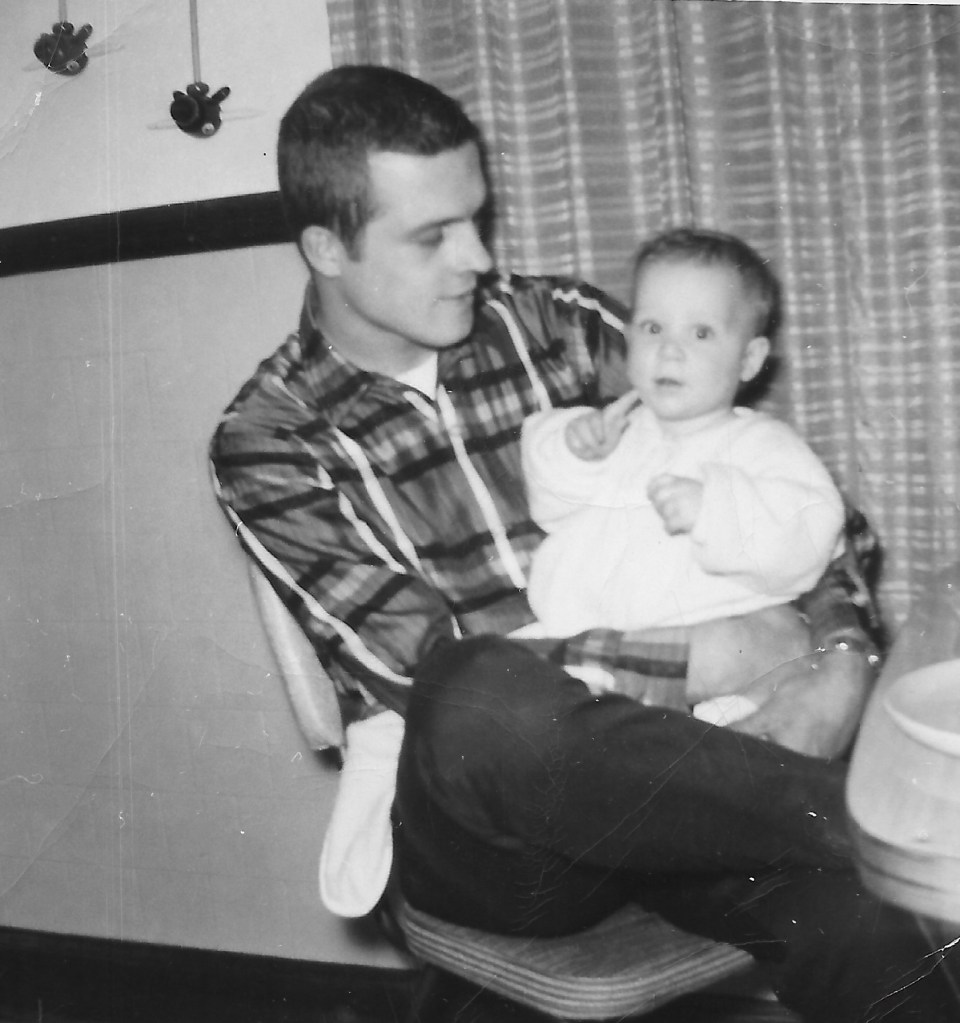
Dad and me, before I started playing with his flashlights and tape measures. Dad was 22 years old, and I was ten months old.
Watching my joyful grandsons with mini flashlights strapped to their heads made me smile, and I offered up some words to my father who passed away six years ago. Dad, I know our love of your flashlights and tape measures drove you crazy, but thanks for being a good sport about it–in your own way. And I told him that my grandsons are crazy about flashlights and tape measures, and if they lived with him, he’d find those things going missing once again.
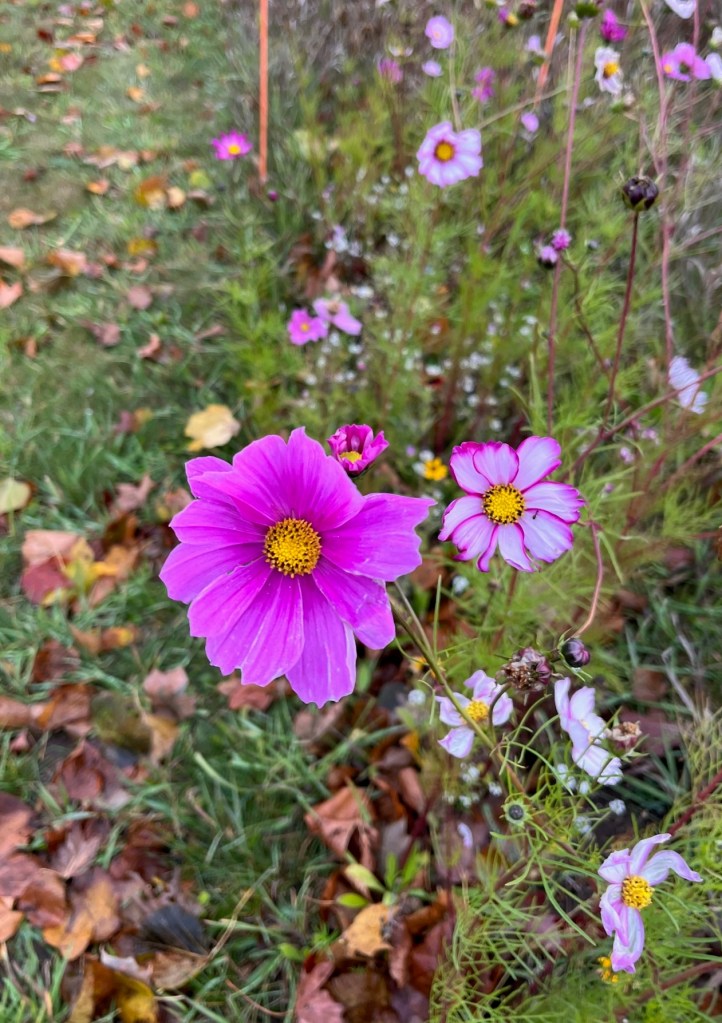
Feeding monarch, October 8, 2022 My camera phone captured a brighter color, but to my naked eyes, the monarch wings were very dark brown.
On a cold, windy morning in early October while walking in Petoskey, Michigan, I spotted a monarch butterfly tucked inside a pink garden cosmos, also known as a Mexican aster. As I neared the flower, the monarch ignored me, letting me sidle up while snapping photos with my camera phone. I had never seen a butterfly behave this way. Normally, they flit away before I get within a few feet.
I wondered about the motionless monarch. Was it dead but held in place by its feet? The bottom segments of a butterfly’s legs are called tarsi, plural for tarsus, and they are used to grip leaves and flowers and to taste potential food. If the butterfly was dead, would rigor mortis cause the tarsi to adhere to the flower? And was the nearly dark-brown color on the ventral side of its wings also a sign of death? (Nature show idea: Insect CSI—because there is a CSI for everything.) After some research, I learned that at the end of its life, a butterfly’s colors fade and its wings often look tattered. This butterfly was neither pale nor shabby. Perhaps the overcast sky made the tightly closed wings appear darker.
My next theory involved the weather. Was the monarch using the flower as shelter from the sharp winds and biting cold? It was 38 degrees with 20-mph winds. If I hadn’t been wearing my stocking cap, mittens, and winter coat, I might have nudged the butterfly and crawled inside the flower next to it. However, if the butterfly wanted shelter, the nearby bushes, trees, and tall grasses would have provided better sanctuaries. Monarchs like to hide under drooping foliage, in hollow trees, at the bottom of tall grasses, or underneath rocky outcroppings.
Finally, I wondered if the monarch was guzzling nectar for its upcoming flight to Mexico. Back home the squirrels in my yard were stashing food, digging tiny holes in the lawn to bury tasty tidbits and pilfering sunflower seeds from my birdfeeders, competing with chickadees, nuthatches, goldfinches, and cardinals—all bulking up for winter. I sympathized. The onset of cold weather changes my appetite. I want to ditch salads and veggies and eat hot soups accompanied by slices of a crusty flax-and-sunflower-seed bread made at a local bakery.
While I took pictures, the garden cosmos waved in the wind, but the monarch, whether dead or alive, remained motionless. Once more, I thought it was dead and stuck to the florets at the center of the flower. I didn’t touch the monarch because if it was alive, I didn’t want to disturb it or harm it. Touching a butterfly’s wings damages them. The colored “dust” that appears on your fingers is actually scales from the wings. Touching the wings might not kill the butterfly immediately, but the scales dislodged by human fingers won’t grow back, and that shortens a butterfly’s life. I continued my morning walk and juggled my theories. On my return, the motionless butterfly still clung to the pink cosmos that whirled in the unfriendly wind under a cantankerous sky.
Pink Garden Cosmos, also known as a Mexican Aster
On my afternoon walk, I stopped by the flower again, but it was empty. I scanned the ground, but found no corpse. I decided to research monarch migration.
There are four generations of monarchs every year. In the fall, generation-four monarchs need to consume loads of nectar—bacchanalian style—because they must build up a layer of fat, as most of them migrate to Mexico. When a butterfly finds a suitable flower, it uncoils its long hollow tongue, inserts it in the flower, and siphons up the nectar. The swilling monarch, whose picture I took on October 8, was most likely a generation-four monarch.
Biologically different than its previous three generations, generation-four monarchs will live eight to nine months. Hatched in September and October, they migrate to Mexico shortly after emerging from their chrysalises. Monarchs west of the Rockies migrate to coastal California. A limited number of generation-three monarchs will also migrate, but generations one and two have a lifespan of only two to five weeks and never migrate south.
In the late winter, generation-four monarchs return to the United States but only into the southern regions where they lay eggs then die. Those eggs become generation-one monarchs that fly into the southern Midwest region and lay eggs that become generation-two monarchs, which fly into the northern United States and southern Canada, laying eggs that become generation-three monarchs. Then generation three lays the eggs of generation-four monarchs that will migrate to Mexico. What a glorious cycle!
My curiosity about a sluggish monarch slurping nectar in a pink cosmos led me to discover that my knowledge about monarch migration had been incomplete.
My big discovery? Not all monarchs migrate to Mexico, and those that do only return partway in the spring.
And the monarch butterfly I saw in October? It was probably hungry, bulking up for its migration to Mexico. It was a cold morning, 38 degrees, and it needs to be 55 degrees before monarchs will fly. Also, monarchs move slowly when it’s cold because the chemical reactions in their muscles slow down, which explains why the monarch I saw let me get so close.
Later that afternoon the temperatures were in the low 50s, maybe higher in the bright sunlight in my mother’s neighborhood. I don’t know if the weather warmed up enough for the monarch to fly away, but because it was gone and I didn’t find it on the ground, I assumed it took flight. A bird could have tried to eat it, but birds usually release a monarch once they taste its poisonous chemicals, and they learn to avoid monarchs. Fortunately, a monarch usually survives a bird’s bite. If you see a monarch with a section of its wing missing, chances are it was bitten then released by a bird. A monarch’s large wings help ensure it will be able to fly even with a missing piece.
Hopefully, the monarch I saw made a successful trip to Mexico and is clustered in trees with millions of other monarchs, keeping each other warm, enjoying a rest before the northward migration begins in the spring.
The people who live across from this field planted these flowers. I like to believe they did it for the butterflies.
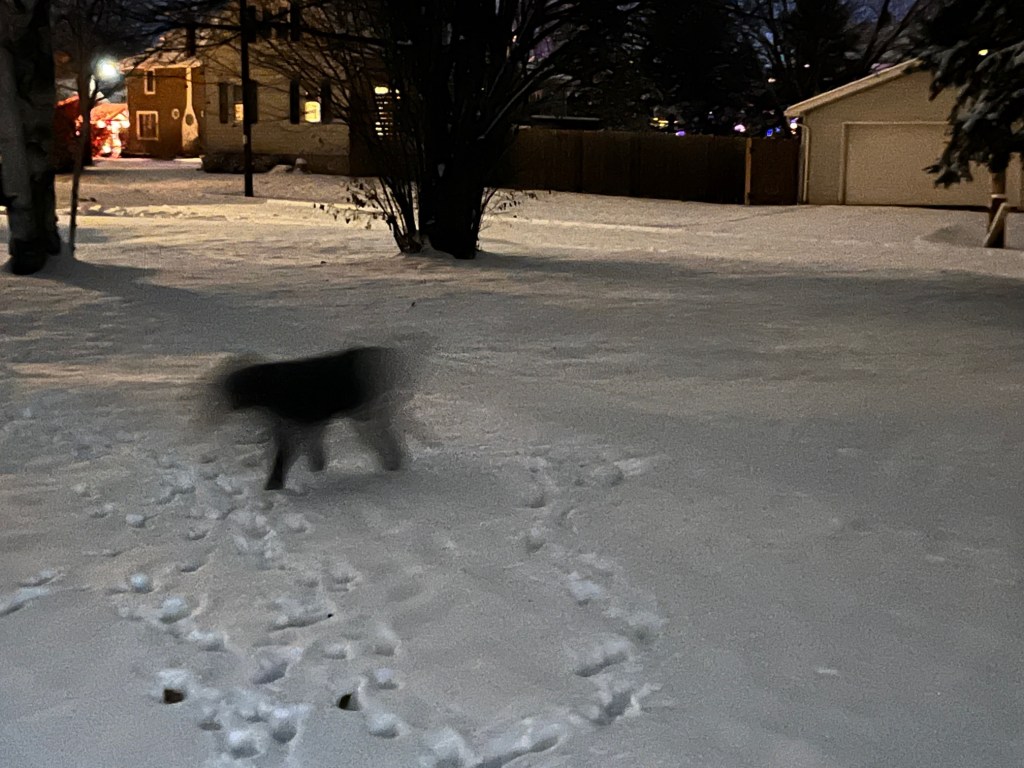
Ziva, November 29, 2022, home after our evening walk
Snow began falling around 8:00 a.m. today. The forecast predicted a trace to one inch, but it snowed all day, and four fluffy inches covered the ground, roads, trees, and cars. Snow can be that way, making weather forecasters look foolish.
This isn’t the first snow of the year, but today’s snow has a good chance of staying on the ground, making it a white Christmas. That’s why I call it the first real snow of the year.
I loved snow as a child, and I haven’t grown old enough yet to resent or fear it. The first real snowfall of the year evokes childhood memories of snowballs, snowmen, snow forts, and sledding. Swaddled in snow pants, jackets, hats, scarves, and mittens, our joyful shouts, squeals, and laughter bounced off the trees and houses.
I love to walk my dogs, Ziva and Cabela, in the evening after a fresh snowfall when the air is still. My dogs love the first real snow too. They prance. They stuff their noses in the snow, tossing it in the air or eating it. Sometimes the snow tickles their noses, and they sneeze. Even Cabela, who’s now fourteen-and-a-half, becomes youthful. When they were puppies, the first snowfall of the year gave them the crazies. They pounced and dashed and rolled in it, creating doggie snow angels. They reminded me of a gaggle of children unleashed into the first good snow of the year.
Perhaps snow sparks something primal in my dogs and myself, something that lights up ancient places in our brains, something that is more complex than our happy memories of youthful frolics in the snow.
Yesterday, my dog Ziva and I walked a different direction, not to seek adventure but to find warmth. Every block we put between us and Lake Superior meant more houses to deflect the wind coming off the lake. It helped, but not much. When a cold wind rumbles off the lake, it finds you.
On our walk I saw a long-stemmed rose, and my first impulse was to smell it. Because you should stop to smell the roses, even when it’s 28 degrees and overcast and the sky is sprinkling snowflakes like salt from a shaker. The rose smelled sweet, like the roses my nana grew in the front of her 900-square-foot home, the smallest house by far on her street. Nana prized her roses and tended them with great care. They signaled that she, too, was a lady, even in her tiny home. Her long-stemmed, red roses announced that she had left behind her childhood of deep poverty and great difficulties.
My next impulse was to take a picture of the rose, which looked remarkably good. Amazing because this week’s basket of weather contained strong winds, drenching rains, and even some snow.
But sometimes survival is about luck.
This rose was blessed because its owners planted it in front of their house which works as a shelterbelt, saving it from the worst of the icy winds and horizontal rains that blow off the lake. It was fortunate because it bloomed at the end of a long stem, keeping it off the ground where colder air settles. It was spared because this week’s snow was light and melted quickly, postponing it’s red, velvety petals from freezing and turning brown.
It’s 23 degrees this morning, so the rose’s good fortune won’t hold much longer. But with care and some luck, new roses will bloom again next year.
I can name many of the birds that show up at my feeders, but not all of them. Chickadees, goldfinches, red-breasted nuthatches, blue jays, cardinals, and house finches are easy.
But some sparrows, other finches, woodpeckers, and a variety of different black-colored birds throw me for a loop because they look so much alike that I’m reminded about how I tried to distinguish between the identical Martin twins who attended Pleasant View Elementary with me.
Sometimes I look up a bird online and manage to identify it after learning what distinguishes it from its near twin. But the next time the bird shows up, I’ve already forgotten about the distinction, much like my attempts to keep the Martin twins straight.
A few days ago, I read a poem by M. Soledad Caballero, “Someday I Will Visit Hawk Mountain,” which captures both my lofty dream to be an informed birder and my failure to do so.
[To read or listen to Caballero’s poem, click here: On Being.]
Recognizing Their Voices
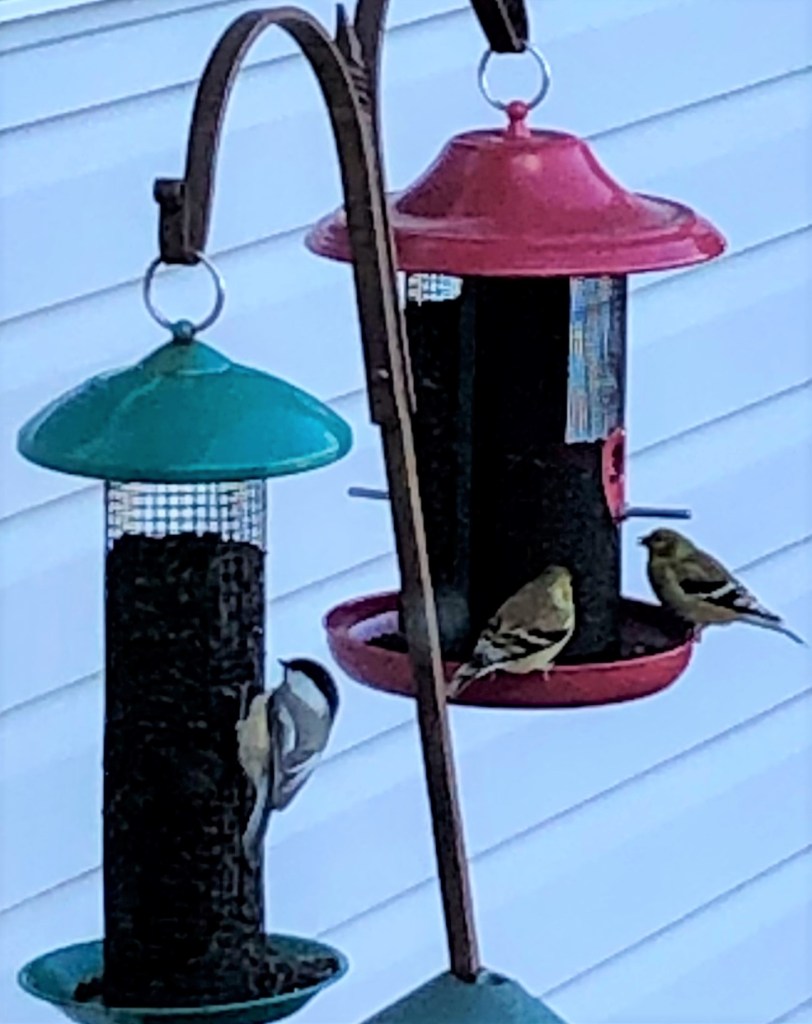
Chickadee and a pair of goldfinches. A goldfinch’s bright yellow color fades after summer expires.
Chickadees are handsome birds dressed in an eye-catching array of feathers, ready for an evening at a gala while singing lyrical tunes worthy of their attire.
Red-breasted nuthatches are elegant birds, striking art deco poses along branches and tree trunks. Then they open their beaks and belt out a whiny, nasal yenk, yenk, yenk. And I imagine them drunk on rum and singing a sea shanty off-key. But last week, when I heard a nuthatch yenk, yenk, yenk in my yard, I smiled, listening joyfully because I knew two bird calls!
[To see pictures of a chickadee and red-breasted nuthatch and hear their songs, click here: Audubon.]
The Interlopers
Squirrels show up at the feeders. I don’t invite them, but neither do I circle the feeders with a wall and barbed wire. I like to think of our agreement as “everybody has a fighting chance.” I buy sturdy feeders and hang them where the squirrels must invest time and ingenuity to get a meal. If a squirrel figures out how to climb, jump, or hang upside down to get seed, he’s earned a snack. There are still plenty of seeds left for the birds.
Last week I bought a new feeder to hang in the pine tree outside the window in my writing office. A few hours later, a squirrel arrived. He stretched his empty paw toward the feeder but couldn’t reach it. He lost his balance and fell off the branch, landing on the ground. Over the next couple of days, he tried different techniques, hoping to hang on the feeder, but each time he had to scramble back to the tree to avoid falling. However, failure rolled off his back like a bad dream disappearing at dawn. The squirrel, maybe after being bitten by a radioactive bat or using his bat intelligence or perhaps because he’s from a cave on Krypton, became Bat Squirrel, able to hang by his toes, poke his mouth into the mesh, and munch seeds.
During one of Bat’s visits to the feeder, a chickadee perched on a branch above him and waited patiently for him to finish eating. But after a few seconds, the chickadee flew off because that’s a chickadee’s idea of patience.
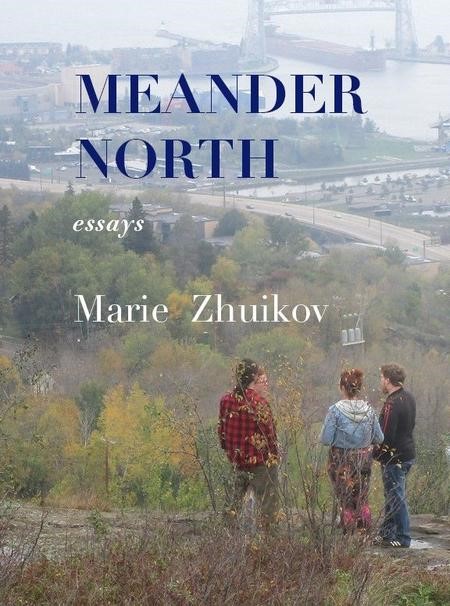
Marie Zhuikov’s newest book, Meander North, is a collection of essays, many from her blog Marie’s Meanderings, which she started writing in 2013. I look forward to each new post by Zhuikov, so when I had a chance to read Meander North, I was excited. Zhuikov selected some of her favorite blogs, then added essays, some of which have appeared in other publications.
Many of Zhuikov’s selections are about getting outdoors and enjoying nature. In her humorous essay “How X-C Ski Starvation Can Lead to Impaired Judgment,” she writes about one of her first cross-country skiing adventures of the season: “I . . . desperately needed to do something to break out of my winter slothfulness and raise my heart rate above seventy beats per minute.” Even though a mist turns into raindrops, Zhuikov slips on her skis and heads out on the icy trails. With caution and strategic moves, she completes her first cross-country ski of the season, and while she does, we hold our breath, admire her tenacity, and think about some of our own foolish escapades.
Zhuikov’s essays about her adventures are so enjoyable because they’re relatable. Her love of the outdoors and her ability to maneuver through nature shines through in her writing. But she is with us, inviting us along, never making us feel left behind. She makes us believe we can get out in nature and be adventurous too. That we can lower ourselves into a canoe or a whitewater raft, or that we can stand along a river and learn to fly fish.
Zhuikov’s essays connect with us because she is not afraid to let us peek at the moments when her life doesn’t go smoothly. Sometimes the outcomes are humorous, like in her story “Just Your Average Winter’s Day Walk and Squirrel Attack” about a walk with her wonderful eighty-pound dog, Buddy, that turns into a comedy of misadventures. Other times the outcomes are poignant, like in “An Evening Dog Walk” about a romance that didn’t work out. Occasionally, she shares heartbreak, like in “The Lake, It Is Said, Never Gives Up Her Dead.”
Zhuikov rounds out her collection of nature essays with an eclectic selection of entertaining and informative writings that cover a wide range of topics. Some cover Zhuikov’s adventures as a citizen of Duluth, such as, “Marie Versus the Post Office” and “My Neighborhood Rezoning Zombie Apocalypse Saga.” Other heart-warming essays like “I Saw Three Ships on Christmas Day” or “Kissing in the Coat Room in First Grade” are about her family or youth. She wraps up her book with a section titled Bookish Adventures where we get a taste of Zhuikov’s life as a writer and a reader, and where she introduces us to the wonderful poet Louis Jenkins.
Winter is coming so grab a copy of Marie Zhuikov’s Meander North, curl up in a cozy chair with a glass or mug filled with your favorite beverage, and start by reading “Cold as a Cage,” the first essay in her collection. And for those of you who live through winter every year, nod in agreement and laugh hopelessly as you read: “The cold defines our movements. Northern Minnesotans walk with shoulders hunched and hands in pockets, limiting our time outside to the bare minimum for the task at hand.” But know that you are a survivor because you are inside where it’s warm, ready to smile and laugh and shed a few tears as you join Zhuikov on her meanders through life.





















 Writing Near the Lake