Review of Two Books: Say Nothing: A True Story of Murder and Memory in Northern Ireland by Patrick Radden Keefe (2018) & McGarr and the Method of Descartes by Bartholomew Gill (1984)

Say Nothing by Patrick Radden Keefe is nonfiction. Published in 2018, it tells the story of The Troubles in Northern Ireland between Catholics and Protestants during the 1970s, and its aftermath during the 1980s through the early 2000s.

McGarr and the Method of Descartes by Bartholomew Gill is fiction. Published in 1984, it tells the story of Detective Chief Inspector Peter McGarr who strives to prevent the assassination of a Loyalist Protestant he loathes in order to prevent yet another cycle of violence between Catholics and Irish Protestants.

Both books tell stories involving the Irish Republican Army, the British Army, the Loyalist and Catholic paramilitaries, the informants, and the civilians who are swept up into tragic violence. In both books people are blown up, shot, executed, arrested, imprisoned, tortured, beaten, and burned out of their homes. Gill’s book is fiction, but it mirrors much of what happens in the real world of Keefe’s book.

I started out reading both books at the same time, sometimes reading a bit of each in a day, and other times reading them every other day. I’ve done this before with books. However, I stopped toggling back and forth after I repeated an episode from Gill’s fictional story to someone as if it had been a real episode from Keefe’s book. But in a sense it was real because the episode in Gill’s book was a fictionalized account of numerous real events that Keefe reported about in his book. Switch names and change some of the fictionalized details, and Gill’s event would be real. Gill captures the realism of the events and the emotional trauma that Keefe so deftly writes about in his nonfiction book.

Say Nothing by Patrick Radden Keefe

Keefe’s book starts with the kidnapping and murder of thirty-eight-year-old Jean McConville, a widow and mother of ten children ranging in age from twenty to six. The IRA accuses McConville of being an informant for the British Army in Belfast, Northern Ireland. Without a trial of any sort, she was abducted from her home in Belfast, driven across the border into the Republic of Ireland, shot to death, then buried in an unmarked, secret grave.

Keefe’s book is highly engaging, well organized, and clearly written — important because he covers a slice of history that is complex and involves dozens of key people. He uses McConville’s abduction as a starting point to tell the story of The Troubles in Northern Ireland, but Say Nothing covers more than McConville’s disappearance and murder. As readers learn about The Troubles during the 1970s, Keefe leaves them with an understanding of the history behind The Troubles, the trauma caused by the conflict, and the negotiated peace that somehow feels tenuous.

I read Say Nothing on the advice of a nonfiction writer, Rachel Hanel, whom I admire. She recently reread and recommended it in her newsletter, stating, “It’s still my favorite nonfiction book of the past 10 years.” Keefe’s book was made into a limited TV series that can be watched on HULU. I have not watched it, but other people have told me it’s very good.

McGarr and the Method of Descartes by Bartholomew Gill

During the investigation of a murder, DCI Peter McGarr and his investigators uncover a plot to assassinate Ian Paisley, a bigoted, loud-spoken, but charismatic Protestant minister beloved by many Irish Protestants. (By the way, Ian Paisley was a real person who was all these things.) McGarr abhors Paisley, but he also detests the IRA, the British Army, all paramilitary groups, and anyone else who conspires to use violence in order to push Ireland and Northern Ireland back into the nightmarish times of The Troubles during the 1970s. Racing against the clock and up against a group of formidable foes steeped in a long tradition of deception and intimidation, McGarr and his team work to prevent Paisley’s assassination.

I read McGarr and the Method of Descartes because I liked the first five books in Gill’s series, which he published from the late 1970s through the early 2000s. I’m intrigued to see how Gill’s characters and stories will evolve in the series. I want to learn more about Noreen, and McGarr’s past, and if women are going to become an integral part of the police force. In Gill’s sixth book McGarr’s wife, Noreen, has a minuscule role, unlike the fifth book where she has her own story arc. But after a debate with McGarr and a sleepless night, she delivers the best lines in the book to her husband before he leaves their house to try and stop Paisley’s assassination.

The female computer expert, Ruth Bresnahan, is back in her biggest role since she joined the squad. The men on McGarr’s team know she is smart and rarely wrong, and they are intimidated by her. But McGarr isn’t bothered by her smarts. He respects her intelligence, doggedness, and energy. He believes in a way she is “worth two of any of the men on the staff.” He has her read into the case and takes time to mentor her. She plays a key part in helping McGarr and the team as they attempt to save Paisley’s life.

Bartholomew Gill’s sixth Peter McGarr book is excellent. It is his darkest story yet. But The Troubles in Northern Ireland was a dark time. I’m glad I read most of Keefe’s nonfiction book along with Gill’s novel. The talents of each writer made me appreciate the other’s book. Reading Keefe’s book gave me a great appreciation for the world Gill developed while fictionalizing actual events in Ireland that were barely dry behind the ears. On the flip side, Gill’s book gave me a great appreciation for Keefe’s ability to capture the human emotion and the tragic toll The Troubles wreaked upon generations of Irish people, both Protestant and Catholic.

A point both books make . . .

Colonialism and imperialism inflict a lasting impact on people who have been subjected to outsiders invading their lands and stripping their rights. The trauma of the oppressed and the entitlement of the oppressors are passed down from generation to generation.

On one side, children of the conquered sit at the knees of their parents and grandparents and learn about the atrocities their people have endured and the acts of heroic resistance they have performed.

On the other side, children of the conquerors sit at the knees of their parents and grandparents and learn about their superiority over other people and their imperial destiny.

Conditions become untenable, things fall apart. Childhoods vanish. Neighborhoods sunder. People die.

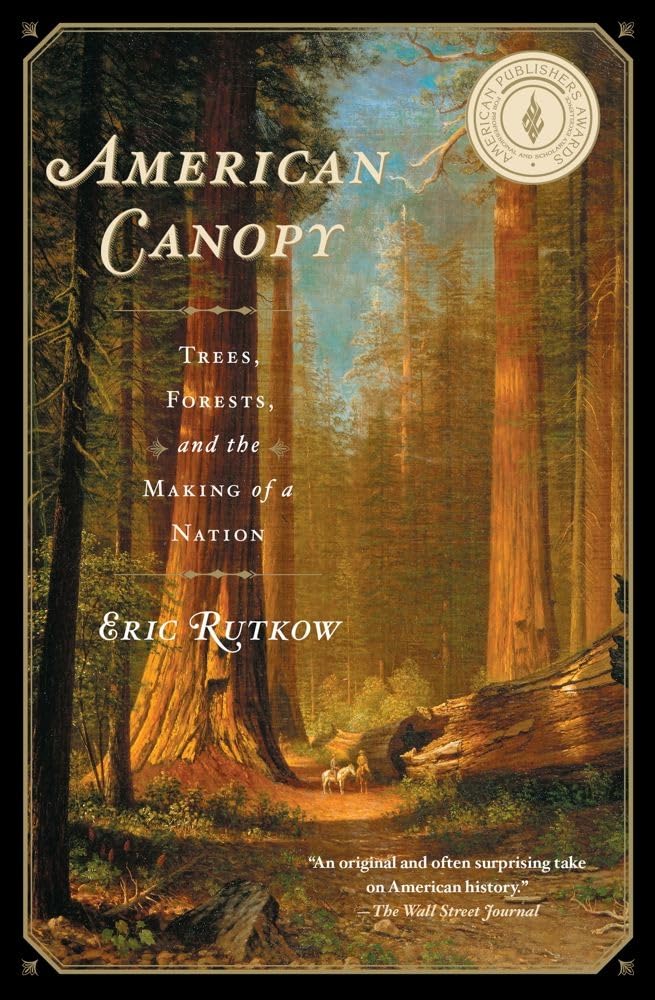
Book Reviews of My Latest Reading Accomplishments, Part 5 of 6: American Canopy: Trees, Forests, and the Making of a Nation by Eric Rutkow

[To read Part 1, click here. To read Part 2, click here. To read Part 3, click here. To read Part 4, click here.]

American Canopy by Eric Rutkow takes a unique look at a slice of United States history by focusing on its relationship with its immense forests. When settlers first arrived in North America, forests covered more than half of what would eventually be the forty-eight contiguous states. Rutkow notes that in the United States people will find giant sequoias, the largest trees in the world; coastal redwoods, the tallest trees in the world; bristlecone pines, the oldest trees in the world; and the biggest single living organism in the world, a stand of quaking aspens in Utah.

When the first settlers arrived on the Eastern shores of the New World, they encountered dark, dense forests. Settlers viewed the forests as something to be cleared to make way for farms and towns and as a resource to be used in trade and manufacturing. And with so many extensive forests, people and lumber companies cut down trees as if the supply was endless.

Rutkow’s book is a comprehensive, chronological history of America’s forests and how those forests played an integral role in the building of a nation. Rutkow’s history covers how trees were used to build ships, trains, railroad tracks, and airplanes until other materials like steel and aluminum were developed. And while some new technologies meant a decreased demand for wood, other innovations called for an increased demand. He covers the lumber industry’s devastating impact on forests and the growing movements to save forests in order to protect water and air quality and to mitigate climate change. Readers meet lumber barons, conservation advocates, politicians, botanists, environmentalists, naturalists, and entrepreneurs, among others.

Why I loved this book . . .

It’s well-organized, well-written, and interesting. I learned so much about the history of our forests. I liked this book so much that I bought Eric Rutkow’s book The Longest Line on the Map: The United States, the Pan-American Highway, and the Quest to Link the Americas. But most importantly, at this moment in history when some of our political leaders have turned their backs on our national parks and forests, and hope to sell public lands to private industries, Rutkow’s book informs us why our national parks and forests are vital to our well-being and the health of our planet.

Book Reivew: Two States of Single: Essays on Family, Love, and Living Solo by Julie A. Jacob, Revisited

[I reviewed Two States of Single for Wisconsin Writers Association (WWA) almost a year ago. Julie Jacob’s book is a collection of memoir essays. I loved this book the first time around. In October 2024, I met Julie at the WWA writer’s conference in La Crosse. I was an excited fan. It was fun to meet someone whose book gave me such pleasure. When I returned home from the conference, I reread Julie’s book. I’m happy to say, I loved it just as much the second time around, even though I knew how each essay ended. So I’m posting my review that was posted on the WWA website.]

Two States of Single: Essays on Family, Love, and Living Solo by Julie A. Jacob is a collection of well-crafted, engaging essays. In her opening essay, “Anything You Could Want,” readers meet Jacob’s grandparents, aunts, uncles, sister, and parents as she recounts the parties her mom and dad hosted when she was a child and living in southern Wisconsin. With humor and tender nostalgia, Jacob describes her parents working together as a team to provide a bounty of food and love for the guests who would soon arrive. In this essay, Jacob recognizes a credo by which her family lived: “They knew that life was filled with bumps so they enjoyed themselves while they could.” This theme threads its way throughout her book.

Jacob’s essays continue to follow the arc of her life as she describes her years in Chicago; a daring adventure in Brazil; joining sports clubs for young professionals; buying her own condo, then later on a house; taking a chance on love; caring for her aging parents; and losing her parents. Throughout Jacob hopes to marry and have children, but as the years slip by, neither marriage nor children happen for her. However, her desire to find a soulmate does not drive the book. Instead, what shines through in Jacob’s essays are her decisions to live in the present and to explore new roads rather than waiting for something that may never happen.

Vivid writing and crisp dialogue breathe life into Jacob’s essays. Readers will feel they know the people and places she writes about. Her essays are more than just good stories. They resonate because of Jacob’s ability to convey why each story matters, both to her and to her readers. In memoir writing a writer is supposed to do more than tell an anecdote. The essay needs to answer the question, “So why should I, the reader, care about this?” Jacob’s essays impact readers because as she writes about her past, she answers that question every time. As readers discover why each of these moments are important in Jacob’s life, they are given the gift of being able to do the same with the significant events in their lives.

By the time I finished Jacob’s collection of essays, I found myself longing to meet with a group of fellow readers, sip a good latte, and discuss Jacob’s essays. Her book would make a wonderful nonfiction read for a book club.  Because married or single, male or female, we all have stories and insights to share about our choices, careers, loves, family, sorrows, and joys.

A Mini Five-Pack of Book Reviews: Peter Geye, Matt Goldman, Alfred Lansing, Richard Osman, Kurt Vonnegut

Ever have someone tell you to keep your head down? I interpret that to mean I should put my head in a book. And sometimes a book is the best place to be. I’ve been hanging out in a lot of books lately.

The Ski Jumpers by Peter Geye. I read The Ski Jumpers because I read The Lighthouse Road and Safe from the Sea, both beautifully written novels. Geye writes stories with brooding, flawed characters who are self-reliant and tough, yet vulnerable, which makes me like them and root for them. The vivid landscapes in Geye’s novels become a character that his protagonists must work with and sometimes fight against. In The Ski Jumpers family secrets gather like dust bunnies hiding in the dark, under a heavy, nearly immovable antiquated piece of furniture. Because each family member knows only a part of their family’s secrets, misconceptions develop and resentments grow. Pops Bargaard loves his wife, Bett, but she struggles with her own demons, one of which is her inability to love both of her sons. She dotes on Anton while despising Johannes “Jon.” Pops, an accomplished ski jumper in his youth, introduces his sons to the sport. Ski jumping becomes an escape for Pops and his sons. And as the years go by, ski jumping becomes what Pops and his sons talk about when they are still hiding secrets, when they aren’t ready to talk about their pain, when they are holding on to happier times. One of the joys in Geye’s novel is his detailed, vivid descriptions of ski jumping, which fly off the page, taking me along, letting me ski jump with Johannes and Anton. At some point while reading Geye’s book, I skipped to the “Acknowledgments,” and as I had come to believe, I found that he grew up ski jumping, which explained how he could write so intimately about it.

Still Waters by Matt Goldman. I read Still Waters because I’ve read three of Goldman’s Nils Shapiro detective novels: Gone to Dust, Broken Ice, and The Shallows, and enjoyed them all. Still Waters is one of Goldman’s stand-alone novels. It’s a murder mystery, but one that is solved with the help of ordinary people. Siblings Liv and Gabe, who are estranged, must reunite for their older brother Mack’s funeral in their rural northern Minnesota hometown. Mack’s death has been ruled a medical event, but Liv and Gabe receive emails from their dead brother saying he was murdered. While Liv and Gabe try to make sense of Mack’s email and uncover the truth about his death, someone else dies, and it’s clearly murder. Liv and Gabe discover mysterious letters in a box that belonged to their deceased mother, and they suspect the letters hold the key to Mack’s death and the second murder. This smartly woven mystery with multiple theories and a number of potential suspects kept me guessing. Plus, I could read it before I went to bed and still drift off to sleep without checking under the bed. (I like mysteries without psychopathic serial killers.) Goldman’s mystery does have some scary moments, but only enough to make the heart race a little.

Endurance: Shackleton’s Incredible Voyage by Alfred Lansing. I read Endurance by Lansing because I like reading about shipwrecks. (Click here for proof.) The Endurance isn’t wrecked on a shoal or reef, she isn’t tossed over by a violent storm, and she isn’t irreparably wounded in battle. Instead, she has purposefully sailed into the Weddell Sea filled with ice floes, looking for a place to land on Antarctica. She is stalled by the ice, which sandwiches her in a death grip, squeezing and squeezing until she groans, and parts of her snap like toothpicks. After becoming unseaworthy, her crew have no choice but to abandon her and their mission to be the first to cross the width of Antarctica using sled dogs. Now the twenty-eight men must survive the beyond-bitter cold, the howling winds, and the snow and rain while hoping to rescue themselves. When Alfred Lansing wrote this book, he had access to the daily journals kept by some of the men, and he was able to interview some of the survivors. Lansing took great care to write an accurate and descriptive account of one of the greatest survival stories, and his book is a tribute to the human ability to put one foot in front of the other and to cling to hope. When Endurance was published in 1959, it was a critical success, but not a commercial one. By the time the book became a commercial success in 1986, Lansing was dead. If you read this book curl up with a blanket and a cup of something hot! This book chilled me to the bone!

The Bullet that Missed: A Thursday Murder Club Mystery by Richard Osman. I read this book because I read the first two books in the Osman’s series, and they were fun, fun, fun. These murder mysteries are a treat. They are cozy but do have some un-cozy scenes. (And yay! No serial killers, which are so overdone.) Most of the main characters live in a retirement home in the English countryside. While they participate in some of the traditional retirement activities, they have one that’s unusual — they meet on Thursdays to look at cold cases that haven’t been solved. The unsolved murders somehow become entangled in a new murder case, which then also involves the police. One of the characters, Elizabeth, is a former MI-6 agent, and as it turns out, it’s not easy for her to give up the thrills of spying and sleuthing. Her fellow retirees join in the criminal-case-cracking adventures. This mystery series earns top kudos from me for its characters, its dialogue, and its plots. Most of the characters are senior citizens, but that doesn’t mean they have checked out of life. The older characters in the book are presented as people, who all have the same hopes, dreams, desires, and brains as the younger characters, even if the older ones do occasionally battle aches and pains. Osman’s snappy dialogue creates characters that are witty and quick thinking, conversations often drip with verbal irony and humorous understatements. The criminal characters are well-developed, too. They are brilliant and devious, but, of course, never a match for the Thursday Murder Club. While you could read these books out of sequence, I suggest they are best read in order.

Slaughterhouse-Five by Kurt Vonnegut. I read this book because I walked into Apostle Islands Booksellers and saw it prominently displayed on a shelf. I’ve had people say to me, “Have you read Slaughterhouse-Five? No? Well, you should!” I’ve read articles where writers suggest to their readers, “If you haven’t read Slaughterhouse-Five, you should!” And there it was — Vonnegut’s book — on a shelf, looking at me, waiting for me, so I bought it. Slaughterhouse-Five is described as an antiwar book focused on the firebombing of Dresden in 1945. It follows Billy Pilgrim, a WWII veteran, who time travels from his old age to Dresden, to his wedding day, to life with his family, to a veteran’s hospital, to a planet in outer space, to his youth, like a pinball pinging across a fantasy-themed pinball game. I’m not listing Billy Pilgrim’s time travels in the necessarily correct order; besides, as the story unfolds, Billy travels back and forth among these places in time. But Vonnegut clearly had a plan, and as I read the book, it not only made sense to me, it all worked seamlessly. I never felt like I was being yanked around. A book like Slaughterhouse-Five is hard to explain in words. I like it for its satire, its experimentation, its ambiguity and clarity, and its themes. I like Vonnegut’s simple, but powerful sentences. Slaughterhouse-Five is often spoken of as anti-war novel, and that theme runs through it. However, Vonnegut’s slim novel is thematically rich, and there is much more being said than war is terrible. As I read the novel, I sometimes thought about “The Swimmer” by John Cheever. Raymond Carver’s short stories also came to mind.

Time to go keep my head down in a book. The Heaven & Earth Grocery Store by James McBride is waiting for me.

Book Review: The Wager: A Tale of Shipwreck, Mutiny and Murder by David Grann

Doubleday, a division of Penguin Random House, 2023

Why did I read this book?

I read a lot of novels; short stories; and nonfiction about history, people, and nature. But every now and then, I love a good book about a real shipwreck. (I’ve read at least nine over the years.) True stories about tumultuous weather, dangerous waterways, towering icebergs, or deadly torpedoes that cause a ship to falter upon rocky coastlines or to sink into dark, deep oceans keep me reading late into the night. Stranded sailors, whether they be in a lifeboat or marooned on uninhabited and untamed land, appeal to me. Both dastardly and brave deeds among the captains, officers, crew, and passengers pull me into a world of drowning, scurvy, starvation, dehydration, desperation, intrigue, cruelty, selflessness, fortitude, and perseverance. I’m not sure why I enjoy these stories so much — or what this says about me.

What is this book about?

In 1740, the Wager, a British ship, left England on a secret mission to seize a Spanish galleon loaded with treasure. Britain and Spain were at war, and wars are expensive. By capturing the Spanish treasure, Britain could fill its war chest while depleting Spain’s. British officers and sailors alike knew this was a dangerous mission.

In pursuit of its quest, the Wager sailed around the tip of South America, perhaps the most perilous stretch of water in the world, then wrecked itself on a deserted island off the coast of Patagonia. The men were able to salvage supplies from the wrecked ship, but they were stranded for months. As the threat of starvation grew, the men decided to build a makeshift watercraft and leave the island. They sailed back to safety and were welcomed home as heroes. However, six months later three more of the stranded sailors returned home, and they accused the first group of sailors of mutiny. Accusations of rebellion, murder, and treachery between the first and second groups of survivors resulted in an investigation followed by a court martial.

What makes this book so good?

David Grann writes a highly engaging and well-researched history about a risky sea mission driven by greed and glory that goes awry. Almost three hundred years later, Grann was able to access the ship’s logs and the transcripts from the ensuing court martial.

A captain and other officers aboard a ship were expected to keep meticulous records. When a ship returned to port in England, all logs were turned over to the Admiralty, who used the information to learn more about weather patterns, sailing routes, and faraway lands. Additionally, if something went wrong aboard a ship, the events and the measures taken to remedy the calamity were to be objectively and completely documented. Logs kept by officers and mates were supposed to be detailed and succinct without emotional slants. However, as things worsened on the Wager‘s journey and after its wreck, it became clear that each officer who kept a log recorded the events in a manner to put himself and his actions in the best light. As to which accounts might be accurate and which might be embellished, Grann smartly doesn’t take sides but simply presents the information.

Grann’s vivid descriptions of bad weather, inhospitable lands, and tempestuous seas recreate the backdrop in which the egotistical, short-tempered, avaricious officers strived to chase down the treasure-filled Spanish galleon that would have made them wealthy and famous.

It’s a rollicking read filled with courage, double-dealing, and foolishness. For 257 pages, I joined the adventure from the safety of my couch, and wondered, Why — before modern ships and navigational equipment — did anyone ever leave the shores of their homeland, especially for a voyage around the tip of South America that had only a slim chance of success? And perhaps that’s what draws me to books about shipwrecks: A group of people get on a small vessel and head across a broad expanse of water, trusting they will arrive on the other side. Often they do, but when they don’t — there’s a story in that. I’m glad Grann thought so too.

Want to read some other good books about shipwrecks?

  1. A Night to Remember by Walter Lord
  2. Dead Wake: The Last Crossing of the Lusitania by Erik Larson
  3. Icebound: Shipwrecked at the Edge of the World by Andrea Pitzer
  4. In the Heart of the Sea: The Tragedy of the Whaleship Essex by Nathaniel Philbrick
  5. Over the Edge of the World: Magellan’s Terrifying Circumnavigation of the Globe by Laurence Bergreen
  6. “The Open Boat” by Stephan Crane (This short story is a semi-autobiographical and fictionalized account based on Crane’s surviving a shipwreck and enduring over thirty hours in a lifeboat.)

In addition to the list above, I’ve read other books about shipwrecks, but I can’t remember their titles. I read two other books about the Titanic and the Lusitania, a book about the collision between the Andrea Doria and the Stockholm off Nantucket Island, and a book about a mutiny in the Caribbean in the 1800s. Endurance: Shackleton’s Incredible Voyage is on my to-be-read pile of books. On my list of books to get and read in the near future are Left for Dead: Shipwreck, Treachery, and Survival at the Edge of the World and The Wide Wide Sea: Imperial Ambition, First Contact and the Fateful Final Voyage of Captain James Cook.

Something Published: How I Became My Own Dudley Do-Right

Today Red Rose Thorns published my essay “How I Became My Own Dudley Do-Right.” The editors were wonderful to work with, and I’m glad that my essay spoke to them.

I hear writers say that if a story keeps hounding you, you need to write about it. And so I kept trying to write this essay, but it took me a long time to get it right. I would start to write it, but when I read it, it always fell flat. Then one day I decided to write my essay as a letter, and it clicked.

Trigger warning: This story is about a guy who pulled my tube top down in public, leaving me exposed in front of our group of friends. It’s also the story of me becoming my own hero!

To read my essay, click here: “How I Became My Own Dudley Do-Right”

Book Review: Last Entry Point: Stories of Danger and Death in the Boundary Waters by Joe Friedrichs

Published by Minnesota Historical Society Press, April 2024

Why did I read this book?

I went to the Boundary Waters Canoe Area (BWCA) in May 1982 for several days. And although I’ve never returned, I was curious to read Joe Friedrichs’s book because it’s about a place that I once visited and found beautiful beyond words, mysteriously ancient, and intensely wild.

But because Friedrichs tells the stories of people who have died or nearly died in the Boundary Waters, I hesitated to buy his book. I wondered how he would approach his topic. Then I read a review that stated Friedrich didn’t sensationalize the stories of death, but rather treated the deceased people and their loved ones with compassion. So I bought the book, and once I started reading it, I was glad I had.

What is this book about?

Friedrichs covers stories about people who have died or almost died in the Boundary Waters due to lightning, drowning, fire, cold, and falling trees. He also tells about a couple of people who entered the BWCA, disappeared, and were never seen again. While the majority of Friedrichs’s book covers tragic and near-tragic events, he also writes about other topics connected to the BWCA.

As Friedrichs vividly describes the many lakes, rivers, portages, and trails, readers are immersed in the beauty of the nearly untouched primitive wilderness that draws so many people to the Boundary Waters. He covers some of the history about how the area became a designated wilderness, and he discusses the role of fire in the life of a forest. Readers learn about the St. Louis County Rescue Squad, the Cook County Sheriff’s Department, and other rescue teams who all work together to find and rescue people who are in trouble. Or sadly, when someone has died, who work together to recover the person’s body.

What makes this book so good?

Even though Friedrichs writes about people who have died in the BWCA, he tells those stories respectfully and compassionately. He makes sure that each person he writes about is more than just the story of their death, more than just a statistic. During the research for his book, Friedrichs talked to the loved ones of those who had died in the BWCA, even traveling to other states to speak with their family and friends.

People who visit the Boundary Waters have a love of the outdoors and a passion for canoeing, kayaking, hiking, and fishing. Friedrichs, after making his first trip to the BWCA, fell in love with the untamed wilderness and moved to Minnesota, making his home near the edge of the BWCA. He has made many trips to the BWCA, and his knowledge about the area and his understanding about the type of people who find both peace and adventure there add immeasurably to his book.

While people can certainly learn from Friedrichs’s book that one needs to be prepared and practice safety when going into the wilderness, his book isn’t a how-not-to-do-things book. Because almost every single person in his book who died or almost died was prepared, experienced, and serious about safety. Instead, some unforeseen, powerful event, usually weather-related, overtook a person or people, and then no matter how much planning had been done or safety had been practiced, it all came down to luck. Humans like to believe they can control and prepare for every outcome, and that if they do, disaster will be averted. But this isn’t always true.

Finally, Friedrichs is a wonderful writer who crafted a well-organized, thoughtful, and engaging account about a one-of-a-kind place on Earth.

Reflections about my one and only Boundary Waters trip after reading Last Point of Entry . . .

When I went to the Boundary waters in May 1982, there were five of us on the trip. We were all in our early twenties. We parked our vehicles near the lake we entered and paddled to our campsite, where we stayed for the next few days. We didn’t have to portage our canoes or supplies. I was the only person who’d never been there before, and I had almost zero experience in a canoe. But I put on my life jacket every time I stepped into the canoe. I knew this would be important to help keep me afloat should we capsize. What I didn’t know, until I read Friedrichs’s book, was how fast hypothermia might have claimed my life if I had gone into the water, even with my life jacket securely buckled around my chest. He points out that May and October are popular months for people to visit the BWCA, but those months have the highest number of drownings, not because people don’t wear life jackets, but because the water is so cold and the weather is more volatile. But people like those months because there are fewer bugs. That’s why the group I was with chose May for our camping and fishing trip.

It drizzled every day we were in the BWCA, and it was cold, above freezing, but cold. We didn’t have to worry about bugs. During the day we fished on the lake by our campsite. Even in a layer of drizzle and chilled air, the scenery was incredibly beautiful. I understood that I was among something old and pristine, a wild and natural forest carved with clear lakes and rivers. Something vast that people hadn’t managed to ruin.

While our weather was cold and rainy, we didn’t experience any intense storms, so we didn’t have to worry about our canoes being swamped, trees falling on our tents, or lightning striking us. But all that came down to luck. We didn’t catch any fish either. We ate food, including steaks, that we’d brought with us. I’ve never been back to the Boundary Waters. But not because I didn’t enjoy my trip. Even in the drizzle and cold, it was amazing. But I’m not big on camping or fishing. Still, I’m glad I was able to experience the BWCA, and I understand why other people love to enter its unspoiled wilderness.

Want to Buy the Book?

It’s available at Minnesota Historical Society Press.