Cold-Weather Book Buying during a Pandemic

Superior, WI, Monday, February 8, 2021, 7:00 p.m., -5˚F, Windchill -15˚

Cabela, 77 in human years, nestles on the right side of the couch. Ziva, 66 in human years, nestles on the left side. I’m 61, yep, in human years, and sitting at my desk, joining a virtual author chat hosted by Honest Dog Books in Bayfield, Wisconsin, an hour-and-a-half away.
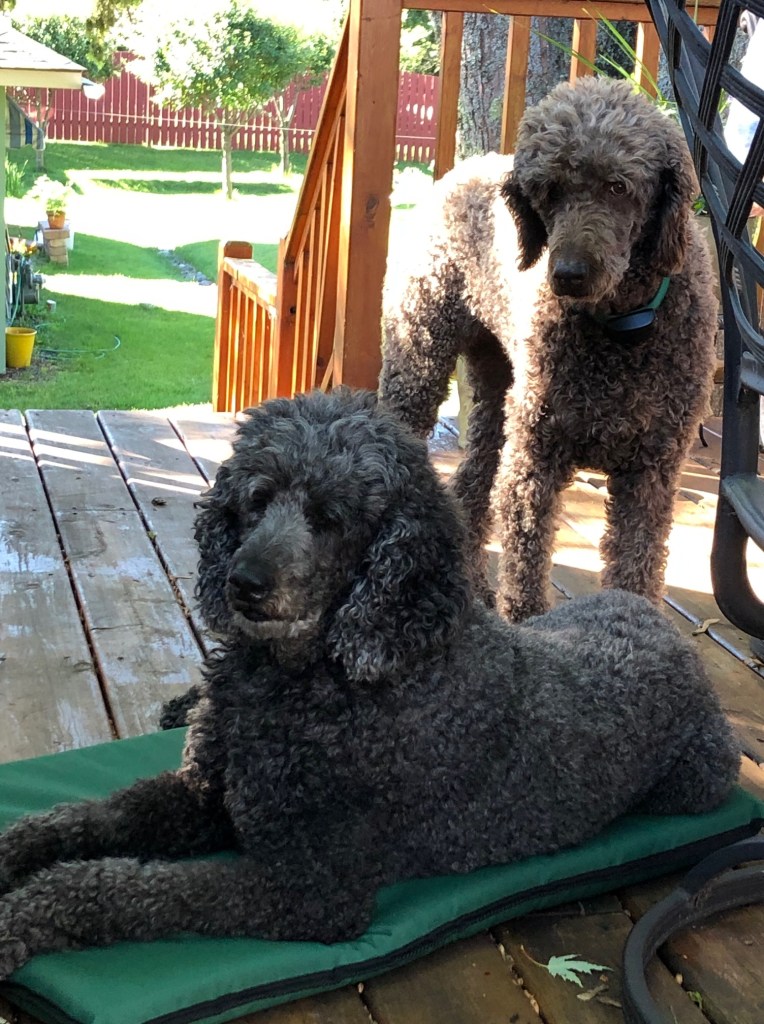
Ziva (in front) and Cabela on a warm summer day in 2020.

It’s excessively cold outside, which explains why the dogs and I aren’t going for a walk. At our combined age of 204 years, our enthusiasm for walking at night in subzero temperatures has ebbed, so this evening we’re opting for warm intellectual stimulation.

We’re going to listen to two authors talk about their books set in immensely cold parts of the world, places that make the western tip of Lake Superior feel like a tropical vacation destination, even in winter. Miniature snowballs of marshmallows bob in a cup of hot cocoa warming my hands. On the couch the dogs remain curled up in heat-conserving positions. While other attendees join the author chat, I leave my seat to slip on a pair of thick wool socks over my flimsy book-themed socks.

Andrea Pitzer (Icebound: Shipwrecked at the Edge of the World) lives in Washington, D.C., and Blair Braverman (Welcome to the Goddamn Ice Cube) lives in northeastern Wisconsin. Around another 140 people join the event. Miles and even time zones apart, we’re all together this evening listening to Pitzer talk about her narrative nonfiction book and Braverman talk about her memoir. Because both authors and the audience are having a good time, the authors, along with most of the audience, stay another fifteen minutes or so before calling it a night.

Superior, WI, Tuesday, February 9, 2021, 1:00 p.m., 3˚, Windchill -14˚

The polar vortex, having parked its big-mass front over much of the country, intends to overstay its welcome for at least another eight or nine days. In search of relief, I make plans to call Honest Dog Books and order both deep-freeze books from last night’s talk. (Books always make me feel better.) During this arctic cold front, I could read books set in warm locations, but I decide it takes daring to read books set in the Arctic where winter submerges itself in darkness. I’ll also need more hot cocoa, another pair of wool socks, and a flannel-backed quilt.

I could order the books via Honest Dog’s website, but I miss going into bookstores. I bypass technology, which allowed last night’s virtual gathering, considered futuristic when I was in high school, and call the bookstore.

“Is it okay if I order books by phone instead of using your website?” I ask.

“Oh yes, certainly,” the clerk answers.

I miss perusing locally-owned bookstores, places where the books I pile on the counter to buy become catalysts for conversation, places where clerks are as thrilled to talk about books as I am.

I order Icebound. And we discuss Pitzer’s research methods.

I order Ice Cube. It’s one of the clerk’s favorites.

I order The Graveyard Book by Neil Gaiman. He wasn’t at last night’s author chat, but I’ve heard him talk about his book (another online experience). I don’t usually read young-adult novels, and I don’t read fantasy novels. But my pandemic-mode response to life has been to be more adventurous.

I order first one, then two, then three Valentine-themed packages of chocolates. The clerk and I chuckle each time I increase my chocolate order. (Chocolate also makes me feel better.)

The clerk and I talk for seventeen minutes. More than half our conversation is about books. After I hang up, I feel like I’ve had a near-small-bookstore experience. I smile.

Superior, WI, Thursday, February 11, 2021, 3:30 p.m., -1˚, Windchill -13˚

At three o’clock the mail arrives, and my nine-year-old granddaughter retrieves it.

“Nana,” she says, dashing up the stairs, “you got a package.”

My four grandkids, ages two-and-a-half to nine, know boxes arriving in the mail have potential.

As soon as I say, my books, the older grandkids lose interest.

I lift the books from the box and lay them on the kitchen table. The two-and-a-half-year-old, with the speed and dexterity of the Artful Dodger, seizes one and runs into the living room.

“This my book, Nana, this my book,” he says, with the cadence of a parrot.

“That’s Nana’s book,” I say.

“No, Nana, this my book. This my book, Nana.” He sits on the couch and looks at the cover.

He’s grabbed Welcome to the Goddamn Ice Cube. I’m certainly not telling him the name of the book. In my mind I can hear his parrot-like repetition of the title. I can hear his parents ask me, What did you say to Charlie?

“That book doesn’t have pictures,” I say.

The mention of pictures redirects his attention, and he exchanges my book for a children’s book on the coffee table.

I retrieve my book and place it on my bookshelf. By six o’clock the grandkids will be gone. By seven o’clock, I’m planning on hot cocoa, a quilt, one of those deep-freeze books, and at least one piece of the Valentine-themed chocolates from my hidden stash.

[Check out Honest Dog’s upcoming author chats at http://honestdogbooks.com/events/]
Do Drop a Line

“Sometimes a letter is better than a phone call. It’s nice to get something besides bills and junk mail.” –A wise woman, age 95

Texting and emailing are fast, but let’s write someone a letter. If we text and don’t get an immediate response, we believe we’re being ignored.

If we email and don’t get a nearly immediate response, we believe we’re being ignored.

If we write a letter and don’t get a reasonably-timed response, we think the other person is busy. It takes time to write a letter, address an envelope, put a stamp on it, and drop it in a mailbox—it might be weeks before we believe we’re being ignored.

Let’s write someone a letter. We’ll write to someone we don’t see because of the pandemic. Or someone we haven’t talked to in a long time. Or someone who lives down the block but we don’t see because of the pandemic. Or someone who lives in assisted living or a nursing home whom we’re not allowed to see because of the pandemic.

The pandemic has shrunk our worlds. Maybe we don’t have much to say in a letter. Yet, we can say something, almost anything. Remember our 95-year-old wise woman, It’s nice to get something besides bills and junk mail.

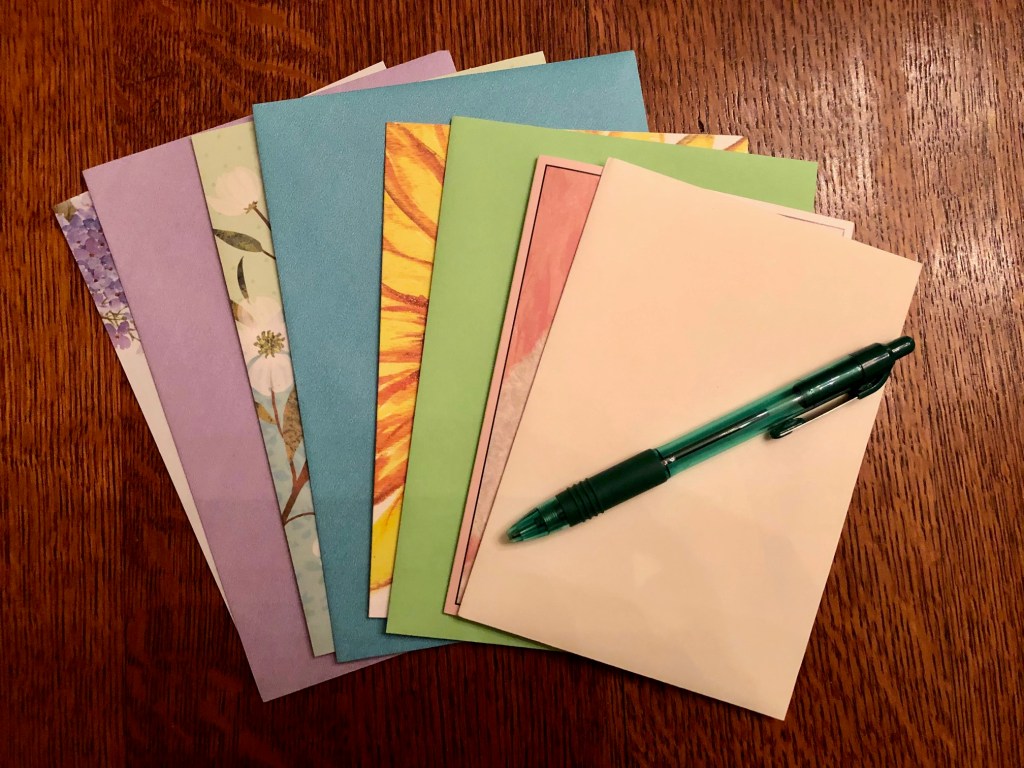
On the table, our blank piece of stationery resembles a wide-open prairie unbroken by forests or mountains. We grab a pen and write words, our tracks across our prairie. Perhaps our minds become as blank as the endless prairie sky on a still day. We need to look down, think small, see the individual prairie grasses and flowers.

We can write about

  • our dog who scratches its back on the cedar bush when it’s outside.
  • our cat who’s playing with our pen while we’re writing.
  • the green beans growing in our garden.
  • the rabbits who ate our tulip blossoms.
  • rearranging our furniture. (This counts as an indoor workout during the pandemic.)
  • our four-year-old grandson who told his mother, “Well, if you don’t look in my room, it’s nice and tidy,” when she asked him if it was clean.
  • the book we read, the TV show we watched, the movie we streamed. (But we’ll play nice and avoid spoiler alerts.)
  • unexpected objects we found when cleaning our drawers and closets. (Eventually, we’re all bored enough to pandemic clean.)
  • finishing the sweater we started knitting five years ago.
  • the 1,000-piece jigsaw we completed in a week.
  • the spicy chili we made that makes our eyes water but clears our sinuses.
  • our winning streak at Yahtzee.
  • our favorite sports team.

We can grumble about

  • the weather. It’s expected. We want to know if it’s hot, cold, rainy, snowy, windy, or foggy. Honestly, we do. (It gives us permission to fill up some of our prairie land on our paper with our weather report.)
  • work, spouses, children, parents, pets, anything. We want to know we aren’t the only ones who don’t have a Brady Bunch life. Thankfully, handwritten letters don’t live in cyberspace.
  • the upcoming forecast. If we still have space on our page to fill, we can end with more weather. (It’s not the same as complaining about our current weather because this is forecasted weather.)
  • our favorite sports team.

We can describe the setting in which we’re writing our letter:

  • the waning daylight or the full moon shining outside our window,
  • the sleeping children down the hall or the dog curled up by our side,
  • the falling snow or the drenching rain,
  • the orchid that bloomed yesterday or the Christmas cactus that’s fading,
  • the Irish folk music or Madam Butterfly springing from our radio.

In our letter we can thank

  • a parent, a sibling, a child, a relative for some kindness, past or present.
  • a friend who’s always there for us.
  • the former neighbors who welcomed us into their homes when we were children.
  • our eleventh-grade teacher who believed we could write.

If our letters aren’t that interesting, we’ll take comfort because even if we’re boring someone paragraph by paragraph, they can’t interrupt us. But they’ll read our letters because they came from us, and we wrote to them. Our ho-hum letters ease the pressure on them to entertain us with subtle wit and scintillating stories. And we’ll read their letters because they wrote to us and answered our letters.

We’ll write letters because we’ve run out of drawers, cupboards, and closets to clean.

[This essay was inspired by my friend, Phyllis, who turned 95 years old on January 31, 2021. She also inspired the title. I send her cards and letters, and when she thanked me the day after her birthday, she said, “Sometimes a letter is better than a phone call. It’s nice to get something besides bills and junk mail.”]

Christmas Lights in the Time of COVID-19

In 2015, I named this evergreen The Twinkling Tree because some of the lights gently winked while the rest burned steady. When I took my dogs for a walk, I’d say, “Let’s go see The Twinkling Tree.”

Almost every night I take my dogs for a second walk, sometime between the end of Wheel of Fortune and nine o’clock. During our winter walks, the cold air is warmed by Christmas lights strung on houses, trees, and bushes. I never tire of seeing the lights sparkle on a cold winter’s evening. From a house with a single lit wreath to a house with strings of lights illuminating every possible structure, tree, and shrub, I love them all.

This year, because of the pandemic, I expected to see fewer Christmas lights. I based this on my experience around Halloween, having noticed fewer Halloween lights and decorations, in keeping with fewer trick-or-treaters.

Christmas lights remind me of my childhood Christmases in the 1960s and 70s. Our house was a busy place. Both my parents worked and had four children born within eight years. But at Christmas my mother created magic in our living room and dining room, which flowed together as one long rectangle.

She strung multicolored C7 lights and hung old fashioned ornaments on a Christmas tree she chose for its perfect shape, fullness, and generous size. She stopped using tinsel sometime before I was old enough to remember, but I have a picture of my sister and I sitting in front of a Christmas tree festooned in the silver stuff. My mother said with a dog and two toddlers, tinsel was everywhere.

She framed the big picture window in the living room with a string of pastel lights sheathed in plastic opaque icicles. In the corner of the dining room, we had a built-in, floor-to-ceiling hutch. She created a winter wonderland on the part of the hutch meant for serving trays, first laying out fresh boughs of pine, then weaving twinkle lights through the boughs, and finally spraying the arrangement with canned snow.

The lights made the rooms glow because before she decorated, she cleaned and polished every surface. Humble and old, those rooms in our 1907 farmhouse shone with warmth and welcome.

And when the schools closed for Christmas vacation, my siblings and I spent many hours in those rooms. We played a version of twenty questions in front of the Christmas tree. Taking turns, one of us would silently pick an ornament, and the rest of us would start asking questions, trying to guess the ornament. We lifted wrapped presents from under the tree, shaking them, attempting to guess what our faraway relatives had sent us.

At twilight we sat on the couch in the sparkle of the pastel icicles, staring out the picture window into a farmer’s field and the woods beyond, talking about we wanted Santa to bring. When my mom bought a used upright piano and put it along a bare wall in the dining room, I played Christmas carols and my siblings and I sung, our small voices combing as one rejoicing sound.

On Christmas night my siblings and I sat around the dining room table, playing with board games and art supplies we received every year. Christmas lights shimmered and music played on the stereo. The relatives, who’d joined us for dinner, had all gone home, and the dishes had been washed and put away.

I remember those Christmas-light days as peaceful and other worldly, a respite from our hectic childhood days. Twinkling lights on a tree or a house or a city light post carry me back to the magic my mother created.

Although I expected to see fewer Christmas lights this year, I was amazed by the number of people who decorated their homes for the holidays. Walking my dogs up and down the streets has turned into a warm hug from Christmas Past, a wonderful gift in this year of uncertainty and anxiety.

Old Love Inspires Me to Write Again

[When COVID-19 caused dangerous spikes and lockdowns in April and May, I became too anxious to write. I’d only been writing over a year, and this was my first serious bout with writer’s block. But I needed a creative outlet, so I turned to a cherished hobby. “Old Love Inspires Me to Write Again” appeared on Lake Superior Writers’ Blog on June 17, 2020.]

COVID-19. Schools are closed; nonessential businesses are closed. But I worry about my husband, an essential worker, getting sick. I fret about my 79-year-old mother living alone in Michigan. I miss my children and grandchildren. I think about death.

And, I can’t write.

Fellow writers describe their new writing routines. Breathlessly, like excited young lovers, they talk about the hours they spend writing. I flutter between cleaning, cooking, walking dogs, and checking email. I’m not admitting I can’t write. Scariest thought racing through my head: Do I ever want to write again?

A writer writes, even in tough times. I wonder, Am I a real writer? I have ideas, but my concentration has jilted me. Then I read an essay by another writer who says that it’s okay to not write at this time. Validation. Perhaps I need a break.

I turn to an old love—quilting.

A stack of my son’s hockey T-shirts, which I’d cut and ironed to fusible interfacing months ago, squat on the dining room table.

I look at the T-shirt blocks and freeze. I’ve no pattern, and it takes precise measuring to create one. The blocks taunt me, much like my writing when I’m away from my desk. At this point, both are unrequited lovers.

Just start the quilt. Or write. Make a choice.

I begin surrounding each block with a black border, difficult because each block is a different size. I abandon the quilt and mop the kitchen floor.

Stop it. Start sewing. Make a mistake? Use a seam ripper—the delete button of sewing.

I return to sewing borders around each block until I come to the black T-shirt. Dilemma. A black border along the black T-shirt lacks contrast. I delve into my fabric stash. I find a gray print with a hint of pattern, which compliments the black T-shirt. Audition time. I place the black T-shirt on the gray fabric and return it to the other blocks. It screams, “Look at me!”

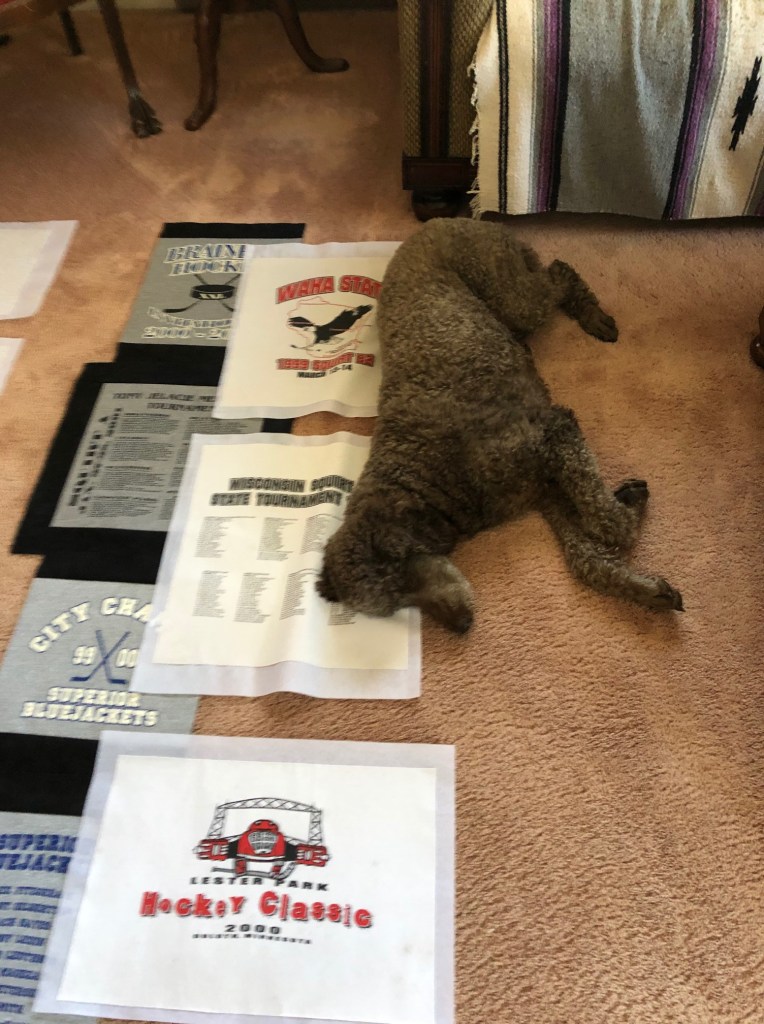
Cabela, our standard poodle, helps with the layout.

Egad, it’s a little darling. I kill it by replacing the gray border with the same black border I used on the other blocks. It no longer causes a scene and it works. Harmony returns to the quilt. Yes, the little darling had to go.

I arrange blocks on the floor. Blocks are sentences. Rows are paragraphs.I move blocks around. I exchange one row with another row. Reordering my “sentences” and “paragraphs” until the quilt reveals its best version.

I stitch the blocks together in vertical rows. Time to add narrow strips of bold color between each row. I select fabrics of blue, green, and red to enhance the bright colors in the final border. But the quilt is already bigger than I expected. I could cut a row, but each row tells a story about my son’s hockey days as a player. I study the T-shirt blocks on the floor. They float on the black background. Separating each row with a color would be superfluous: “words” that don’t belong. I stitch the rows together without colored strips. My son’s quilt is ready to go to the machine quilter.

The finished quilt top before it went to the machine quilter, who quilted it with a pattern of hockey sticks and pucks. My son now has the quilt to keep him warm this winter.

I escaped the pressure to write by quilting. My hunger for creativity was satisfied, and my pursuit of serenity was realized. But writing followed me throughout the composing and editing my son’s quilt. As I pieced the quilt, I wrote the rough draft of this essay, first in my head then at my desk. Quilting calmed me and gave me space to think about writing. It carried me back to my desk.

I’m writing again. But when I become too antsy, I throw myself into the arms of another quilting project.

From Journal Entry to Flash Essay

[Below is my journal entry from May 8, 2020, after discovering bunnies had eaten all my tulip buds but one. The journal entry was published by Passenger Journal’s Pandemic Diaries on May 12, 2020. I later developed the journal entry into a flash essay called “Tulips Beheaded.”]


Journal Entry May 8

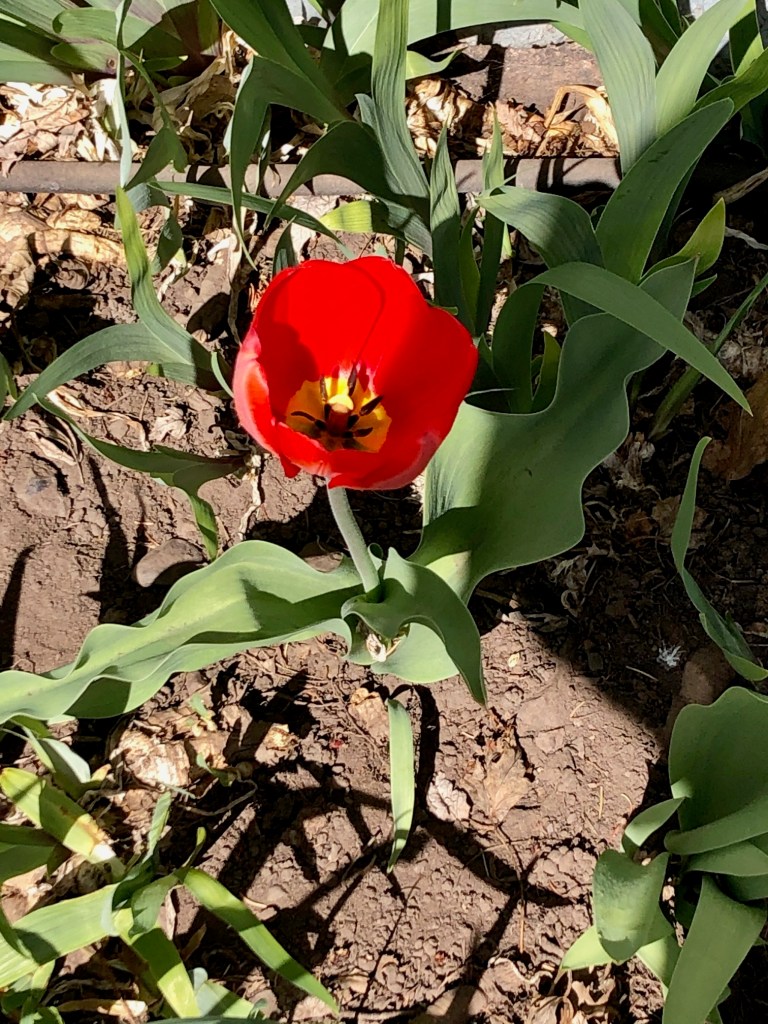
Only two daffodils bloomed, but the tulips showed great hope. Yesterday I counted nine tulip buds that were ready to burst open in red. This morning I walked to the back garden and found one red tulip with its petals fully opened to the sun. It caught my eye with its vibrant red. I looked at the other buds to see how close to blooming they were. Gone. All. Gone. Sheared off by some animal’s guillotine teeth. Probably some overly cute bunny. This has happened in past years, and this year we have lots and lots of bunnies in the neighborhood, so I wasn’t surprised to see my tulips decimated. What’s different is that I wanted to have a good, wailing cry. But I stuffed my tears because if I started, I wondered if I’d stop. 

Tulips Beheaded

Only two daffodils have bloomed, but the tulips show great promise. I count nine tulip buds ready to open and reveal their dressy reds, the color of tunics worn by the Queen’s Guard at Buckingham Palace. My tulips will stand watch in a humble stretch of garden nestled behind my house, allowing them to avoid cold spring winds advancing from Lake Superior. Because of the coronavirus and stay-at-home orders, I await the triumphant return of my tulips with enthusiasm.

The Lone Survivor

The following afternoon I return to my garden. A solitary red tulip, its petals open to the sun, stands at attention. I look toward the other tulip buds to see if they will soon join their companion. Gone. All gone. Only eight headless stems remain, each encircled by pointed leaves that failed to protect them, their buds sheared off by some animal’s guillotine teeth, most likely one of the hordes of rabbits pillaging the neighborhood.

I want to have a wailing cry. But I stuff my tears because decapitated tulips are nothing to cry about during a pandemic that has caused so much havoc. If I start crying, I wonder if I’ll stop.

An image of Elmer Fudd singing, kill the rabbit, kill the rabbit, from the cartoon parody of a tragic opera interrupts my thoughts. Fudd, performing an aria about killing his prey, sings what I feel. I sing with him, kill the rabbit, kill the rabbit. But Fudd is lampooning tragic opera. The parody strikes a chord with me because rabbits will not die by my hand. Tragic opera is about fatal flaws, vengeance, and remorse, and I can do without the remorse.

With kill the rabbit still echoing in my head, my brain retrieves the song “Circle of Life” from my memory bank. The tunes spar in my head. I smile at my dark humor, but the rabbits have won. Spring has been late in coming, and the rabbits are hungry.

I hope they enjoyed their fillet of tulip buds.

Elmer Fudd pops back into my head, singing, kill the COVID, kill the COVID.