
[To read Part 1, click here. To read Part 2, click here. To read Part 3, click here.]
The Bookshop by Penelope Fitzgerald, 1978
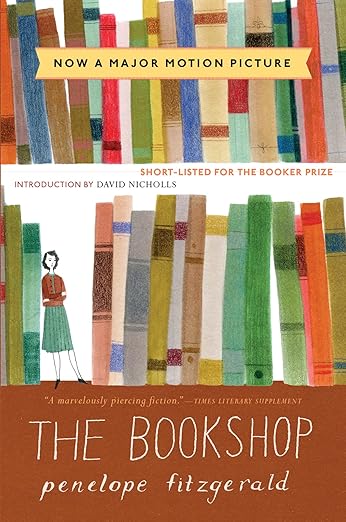
In 1959, Hardborough is a quiet English village on an island between the sea and a river. It’s a town steadily losing bits of itself as the years go by — its sources of income, its land to erosion, its youth to the cities. It’s a town where everyone is intimate with everyone else’s business. If you sneeze over breakfast, by noon people all around town will have asked, “Do you have a cold or is it hay fever?”
Florence Green, a childless widow nearing middle age, decides to open a bookshop. For ten years she has lived in Hardborough. Over the years, she has carefully measured the words and actions of her neighbors against an imaginary yardstick representing the progress of her acceptance in the community. She believes her fellow townspeople will shop in her store.
Florence obtains a loan from the bank and purchases a property referred to as Old House, which has stood empty for many years and is rumored to be haunted. Florence converts the first floor into a bookstore, and having given up her flat, she lives on the second floor.
For the first time, Florence is invited to a party at the Stead by Mrs. Gamart, a woman of status and means in Hardborough. Mrs. Gamart smiles and chats with Florence, appearing to approve of her bookshop. Mrs. Gamart, with all the glib banter of a cobra offering to watch over a nest of eggs, claims she wants to help Florence. However, what Mrs. Gamart really wants is Old House because she wishes to turn it into an arts center. She suggests to Florence that the soon-to-be-empty wet fish shop would be a better place for a bookstore.
But Florence doesn’t want to sell. She has legal title to Old House, which comes with a rumbling ghost, and who doesn’t want a ghost in their bookstore? Especially one that while noisy at times is always standoffish. Although Florence has legal title, Mrs. Gamart has money, status, and connections to influential people. As Florence hires a clerk, stocks the shelves, and wrestles with the question of whether or not to sell Vladimir Nabokov’s new controversial novel Lolita in her store, Mrs. Gamart calls on her connections and forges a devious plan to obtain Old House for an arts center.
It was short-listed for the Booker Prize.
Why I loved this book . . .
The Bookshop is a slim novel that reads like a long literary short story. I love these types of novels, strung together like a pearl necklace with graduated beads. The early scenes start out small, then expand like the pearls in the necklace: perfectly shaped and incrementally growing in size — until the largest moment of the story hangs like the largest pearl in the luminous strand. And at that moment, a truth about people and life resonates. These are the kind of novels that play in my mind for months and years to come.
 Writing Near the Lake