

Say Nothing by Patrick Radden Keefe is nonfiction. Published in 2018, it tells the story of The Troubles in Northern Ireland between Catholics and Protestants during the 1970s, and its aftermath during the 1980s through the early 2000s.
McGarr and the Method of Descartes by Bartholomew Gill is fiction. Published in 1984, it tells the story of Detective Chief Inspector Peter McGarr who strives to prevent the assassination of a Loyalist Protestant he loathes in order to prevent yet another cycle of violence between Catholics and Irish Protestants.
Both books tell stories involving the Irish Republican Army, the British Army, the Loyalist and Catholic paramilitaries, the informants, and the civilians who are swept up into tragic violence. In both books people are blown up, shot, executed, arrested, imprisoned, tortured, beaten, and burned out of their homes. Gill’s book is fiction, but it mirrors much of what happens in the real world of Keefe’s book.

I started out reading both books at the same time, sometimes reading a bit of each in a day, and other times reading them every other day. I’ve done this before with books. However, I stopped toggling back and forth after I repeated an episode from Gill’s fictional story to someone as if it had been a real episode from Keefe’s book. But in a sense it was real because the episode in Gill’s book was a fictionalized account of numerous real events that Keefe reported about in his book. Switch names and change some of the fictionalized details, and Gill’s event would be real. Gill captures the realism of the events and the emotional trauma that Keefe so deftly writes about in his nonfiction book.
Say Nothing by Patrick Radden Keefe
Keefe’s book starts with the kidnapping and murder of thirty-eight-year-old Jean McConville, a widow and mother of ten children ranging in age from twenty to six. The IRA accuses McConville of being an informant for the British Army in Belfast, Northern Ireland. Without a trial of any sort, she was abducted from her home in Belfast, driven across the border into the Republic of Ireland, shot to death, then buried in an unmarked, secret grave.
Keefe’s book is highly engaging, well organized, and clearly written — important because he covers a slice of history that is complex and involves dozens of key people. He uses McConville’s abduction as a starting point to tell the story of The Troubles in Northern Ireland, but Say Nothing covers more than McConville’s disappearance and murder. As readers learn about The Troubles during the 1970s, Keefe leaves them with an understanding of the history behind The Troubles, the trauma caused by the conflict, and the negotiated peace that somehow feels tenuous.
I read Say Nothing on the advice of a nonfiction writer, Rachel Hanel, whom I admire. She recently reread and recommended it in her newsletter, stating, “It’s still my favorite nonfiction book of the past 10 years.” Keefe’s book was made into a limited TV series that can be watched on HULU. I have not watched it, but other people have told me it’s very good.
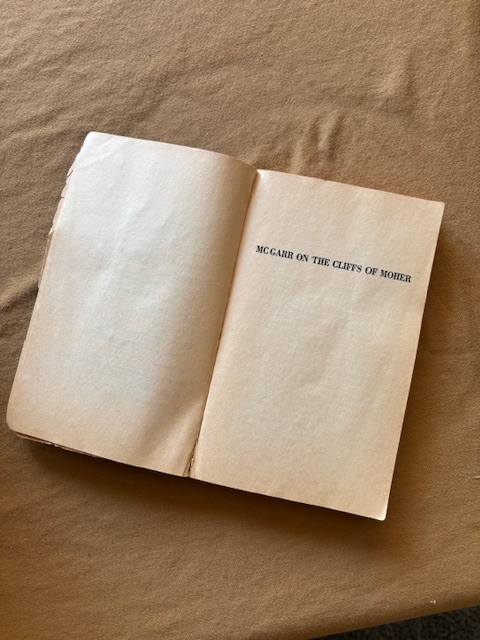
McGarr and the Method of Descartes by Bartholomew Gill
During the investigation of a murder, DCI Peter McGarr and his investigators uncover a plot to assassinate Ian Paisley, a bigoted, loud-spoken, but charismatic Protestant minister beloved by many Irish Protestants. (By the way, Ian Paisley was a real person who was all these things.) McGarr abhors Paisley, but he also detests the IRA, the British Army, all paramilitary groups, and anyone else who conspires to use violence in order to push Ireland and Northern Ireland back into the nightmarish times of The Troubles during the 1970s. Racing against the clock and up against a group of formidable foes steeped in a long tradition of deception and intimidation, McGarr and his team work to prevent Paisley’s assassination.
I read McGarr and the Method of Descartes because I liked the first five books in Gill’s series, which he published from the late 1970s through the early 2000s. I’m intrigued to see how Gill’s characters and stories will evolve in the series. I want to learn more about Noreen, and McGarr’s past, and if women are going to become an integral part of the police force. In Gill’s sixth book McGarr’s wife, Noreen, has a minuscule role, unlike the fifth book where she has her own story arc. But after a debate with McGarr and a sleepless night, she delivers the best lines in the book to her husband before he leaves their house to try and stop Paisley’s assassination.
The female computer expert, Ruth Bresnahan, is back in her biggest role since she joined the squad. The men on McGarr’s team know she is smart and rarely wrong, and they are intimidated by her. But McGarr isn’t bothered by her smarts. He respects her intelligence, doggedness, and energy. He believes in a way she is “worth two of any of the men on the staff.” He has her read into the case and takes time to mentor her. She plays a key part in helping McGarr and the team as they attempt to save Paisley’s life.
Bartholomew Gill’s sixth Peter McGarr book is excellent. It is his darkest story yet. But The Troubles in Northern Ireland was a dark time. I’m glad I read most of Keefe’s nonfiction book along with Gill’s novel. The talents of each writer made me appreciate the other’s book. Reading Keefe’s book gave me a great appreciation for the world Gill developed while fictionalizing actual events in Ireland that were barely dry behind the ears. On the flip side, Gill’s book gave me a great appreciation for Keefe’s ability to capture the human emotion and the tragic toll The Troubles wreaked upon generations of Irish people, both Protestant and Catholic.
A point both books make . . .
Colonialism and imperialism inflict a lasting impact on people who have been subjected to outsiders invading their lands and stripping their rights. The trauma of the oppressed and the entitlement of the oppressors are passed down from generation to generation.
On one side, children of the conquered sit at the knees of their parents and grandparents and learn about the atrocities their people have endured and the acts of heroic resistance they have performed.
On the other side, children of the conquerors sit at the knees of their parents and grandparents and learn about their superiority over other people and their imperial destiny.
Conditions become untenable, things fall apart. Childhoods vanish. Neighborhoods sunder. People die.


 Writing Near the Lake