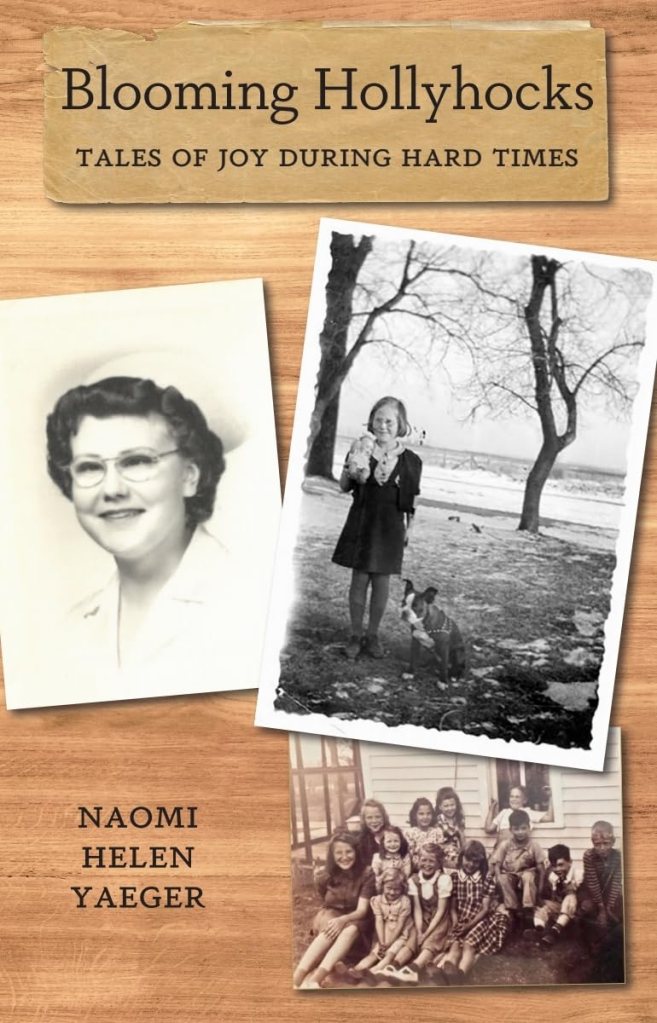
Naomi Helen Yaeger, in a delightfully engaging biography, tells the story of her mother Janette Yaeger (née Minehart) who grew up in Avoca, Minnesota. Yaeger spent hours interviewing her mother before her mother died. In her book, Yaeger lovingly recounts the stories of Janette and her siblings, parents, and extended family. Most of the book concentrates on Janette’s life from toddlerhood through young adulthood. However, toward the end of the book, Yaeger summarizes the key highlights of Janette’s and her family’s lives as they moved through adulthood. I’m glad Yaeger did this because after reading about the early lives of Janette and her family, I wanted to know what happened to them as adults.
Yaeger’s book invites readers into a bygone era. We learn about the history, culture, and lives of ordinary people who lived through the depression, WWII, and the Korean War. We read about their daily joys, disappointments, and sorrows. Usually, the history we are taught in school focuses on major events and well-known people. But I find the daily lives of people and how they lived while major historical events happened around them fascinating. And I learned a few things that I didn’t know before reading the book.
As I read Blooming Hollyhocks, I laughed and I cried. I felt connected to my own relatives who grew up in the same era as Yaeger’s. And I remembered the stories they had told me, often similar to the stories Janette Yaeger shared with her daughter Naomi. As I finished Yaeger’s book and closed it for the last time, I was already missing the Mineharts, their relatives, and their friends.
[When I attended Naomi Yaeger’s book launch, someone mentioned that Yaeger’s book would make a great present. After finishing her book, I wholeheartedly agree. If you know someone who lived through this time or grew up listening to the stories of relatives who lived through this time, I believe they would enjoy Yaeger’s book as much as I did.]
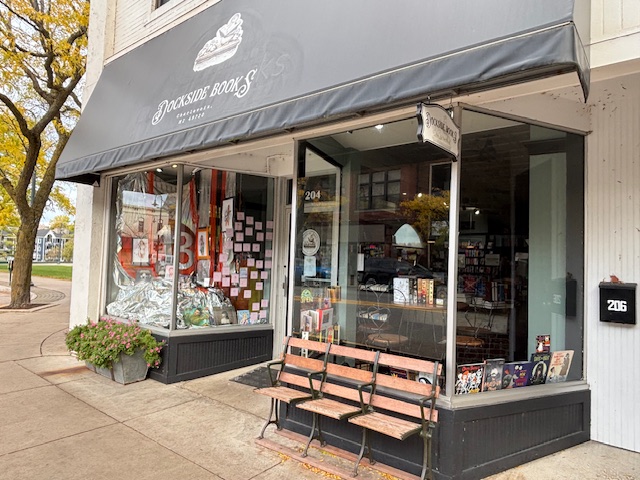
Dockside Books on Bridge Street in Charlevoix, Michigan
There’s a new bookstore in Charlevoix, Michigan, called Dockside Books. It’s appropriately named because water abounds in Charlevoix. From the bookstore if you look to the west, you see Lake Michigan and the Round Lake Channel, which leads into Round Lake. If you look to the east, you see Round Lake, which leads into Lake Charlevoix.
The friendly clerk who helped me pick out a book
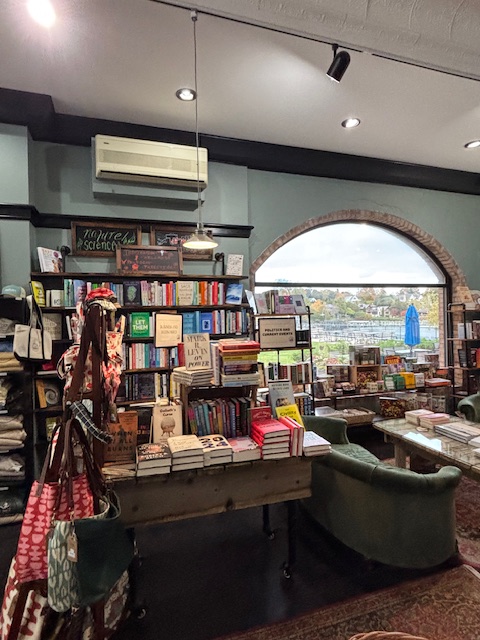
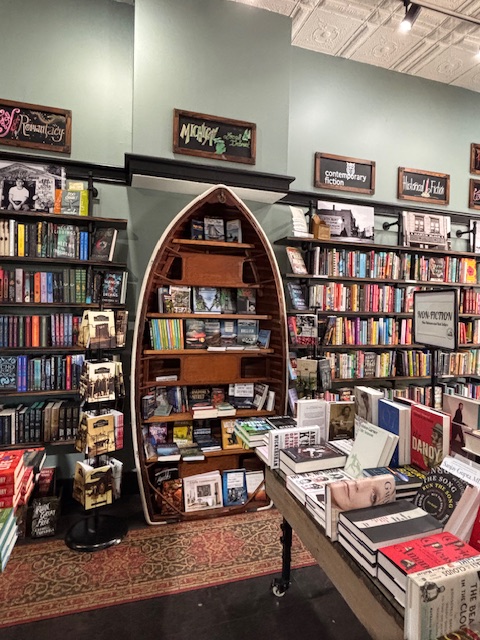
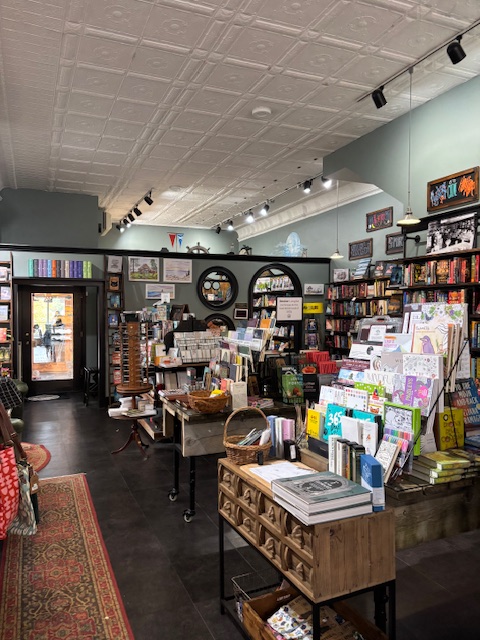
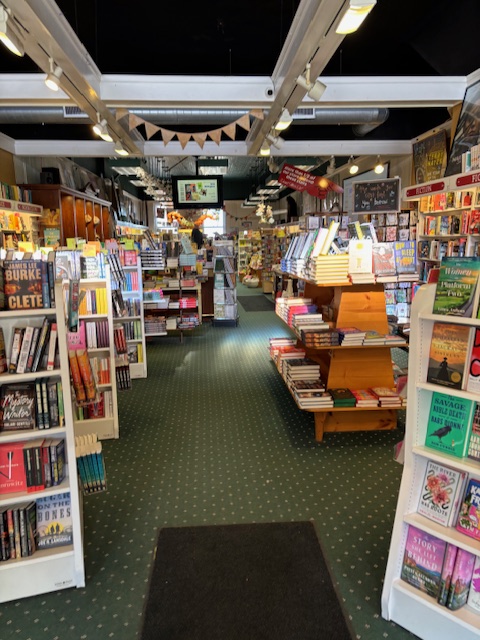
Dockside is a charming bookstore. Depending on the light, the color painted on the walls sometimes looks sea green or stormy blue. Changeable like Lake Michigan. A rowboat standing on end serves as a bookshelf. In addition to a wonderful selection of books in all genres, customers can shop for book bags, stationery, bookmarks, and journals. There is a nice sitting area where you can try out a book before you buy it.
I wanted to buy a book to be supportive of the new store. But I wasn’t sure what to get because I’d recently bought other books on my wish list. So, I asked the clerk what her favorite genre was and she said she likes them all (a diplomat!), but she added she loves historical fiction. I asked, “Do you have a new historical fiction book you could recommend?” She did. 33 Place Brugmann by Alice Austen. The story, set in Brussels in a small apartment building, begins with the Nazi occupation of Belgium. I bought the book because I like historical fiction and because the clerk enthusiastically recommended it. Also, I find that reading about World War II, Nazis, and fascism, which I’ve been doing a lot lately, is somehow less scary than reading today’s news. Sometimes, however, the parallels between the past and the present are frightening. I haven’t read the book yet, but if I like it, I promise I’ll post a book review.
I didn’t have long to visit the bookstore because I had two dogs in my car waiting for their promised walk. So I’m looking forward to spending more time in Dockside when I return to Michigan this winter. I also need to read 33 Place Brugmann before I return to the store because I promised the clerk I’d tell her what I thought of the book.
The locals like to say if you keep a big enough boat on Lake Charlevoix, you can go anywhere in the world you want. Sail into Lake Michigan, navigate through a few more Great Lakes and some rivers, and voilà you will sail into the Atlantic Ocean. And from there the world awaits.
Or you can do what I did and visit Dockside Books, buy a book, and go anywhere in the world and anywhere in time without getting seasick. Soon I’ll be traveling back in time to Brussels as World War II begins and the lives of ordinary people are upended because of Hitler.
To see interior pictures of Dockside, scroll through the slideshow below.
My story collection has a title! I’ll debut the cover when that is done.
In February 2027, the University of Wisconsin-Stevens Point will publish my collection of short stories through Cornerstone Press, their university press. I’m excited, and nervous, and grateful. This is my first book, and like a first-time parent, I’m not sure what to expect, so I gather information. I talk to other writers who have published books. I attend book launches and author talks. I read blogs and articles and attend seminars about how to nurture a book in the world.
When Cornerstone accepted my manuscript, my publication date was more than two years away. But now it’s about fifteen months away, and if there is one thing I know about time — it’s how quickly it flies. I need to promote my book, and for that it needs a title.
When I submitted my collection in November 2024, it was called Fishing Around in the Dog Days of Summer, after one of the stories in the book. I chose the title for a couple of reasons. First, I really like its eponymous story about two young sisters with a tenuous relationship who go crayfishing on a hot, humid August day. Second, all the characters in my short story collection are fishing around for something they want. They each dip a line in the murky waters of their lives during their own dog days, hoping to catch something they long for.
But as much as I liked my original title, I began to feel it was too long and would be hard for people to remember. And I worried if the cover depicted a fishing scene along with the title, potential readers might think all my stories were about fishing.
I looked at my table of contents and considered other story titles. “Silent Negotiations” jumped out at me. It’s short and easy to remember, and it’s another story I really like. In 2020, it won second place in the Hal Prize Fiction Contest. (So, I feel the title has good mojo.) In the story a couple who have been married over forty years renegotiate the parameters of their marriage during a disagreement. Each spouse speaks their mind, but only to a point. The rest of their negotiations are silent, yet significant. The characters in my other stories are like the old married couple in “Silent Negotiations.” They all want something. They all talk to each other, but they leave things unsaid. And what is left unsaid, changes who they are with one another and themselves.
After I decided to change my title to Silent Negotiations, I asked my writing friends and readers what they thought. They had all read my stories several times, so I knew they would be good judges as to whether or not the new title would be a good fit for the collection. They all loved Silent Negotiations.
Last weekend I attended the Wisconsin Writers Association Conference in Stevens Point. The Cornerstone Press editors were there too. I talked to Dr. Ross Tangedal about using Silent Negotiations as my title. He liked it too, and so did his student editors.
My book has an official title!
Now, I’m excited to see some cover designs. Before I know it, Silent Negotiations will be out in the world.
I’m hoping to use this picture for my author photo. Photo credit: Max Youngquist
The title of this book works on so many levels and in so many ways.
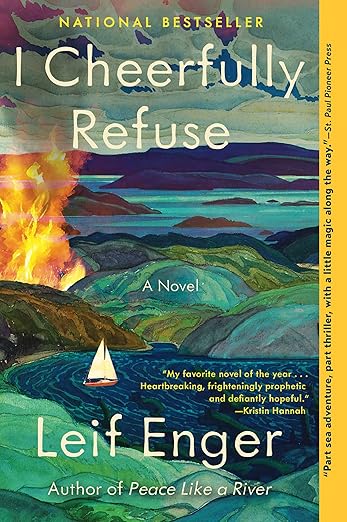
Somewhere in the near future, perhaps twenty or thirty years from now, Leif Enger’s novel takes readers on a journey of magical-dystopian realism along the shores of Lake Superior and out into its waters. His main character Rainy has a happy life. He loves his wife, Lark, who runs a bookstore inside of a bakery shop. He loves to read and to play his bass guitar in a band with his buddies. He has inherited Flower, a small sailboat, which he works to restore because he fancies himself a bit of a sailor.
But readers soon realize that something is wrong with the world in which Rainy lives. Books have nearly disappeared and reading is frowned upon. The climate has changed, and Lake Superior has warmed, creating powerful storms. Lawlessness, mostly unchecked, lurks in places once considered safe. Ominous medicine ships anchored near the shores, seek to cure the youth by breaking their willful behavior and bending their thoughts in a manner deemed acceptable by the wealthy Astronauts, who wish to mold them into compliant, cheaply-paid laborers.
When Kellen, a young man, arrives in town, Rainy and Lark allow him to live in their attic. Kellen himself is not trouble, but trouble is following him. And when that trouble arrives, he is a man called Werryck, leaving Rainy no choice but to flee in his sailboat upon the tempestuous waters of Lake Superior.
Enger’s tale is spellbinding. His lyrical prose hovers above the dark underbelly of a society that has come undone. We experience a world of natural beauty and serenity along Minnesota’s North Shore. Yet, we know something is profoundly wrong because we can feel the pulsating evil that lives beneath Enger’s exquisite prose. Enger doesn’t dwell on how the world in which Rainy lives fell apart. Instead, as we follow Rainy on his journey, Enger trusts us to ponder those possibilities.
From the standpoint of craft . . .
I admire Leif Enger’s rich prose. He uses language to create imagery and metaphors that are fresh, but never out of place or over the top. His descriptions of Lake Superior, the weather, sailing, and playing a bass guitar add realism to his story. Lake Superior and its weather become a character in his novel. His story is tightly woven: A throw-away remark, or an infectious smile, or a benign action may seem to have been randomly tossed into the story, but later I would realize it was a telling moment, making me feel like I’m a smart reader.
Several people who read Enger’s book before I did would say they loved the book, but it was dark. And here is where Enger’s writing shines. Some of his themes are dark, but others are hopeful. Some of what happens in the story is sad and scary, but he tells the story in a way that gives his readers a reason to hope. Enger knows what to tell in a story, what to hint at, and what to leave to a reader’s imagination. If you’re a writer looking for a mentor book with a story told as a hero’s journey, this is a great book to read.
McLean & Eakin Booksellers (Lake Street Entrance) is conveniently located next to a coffee and sandwich shop. April 2025
McLean & Eakin Booksellers is located in downtown Petoskey, Michigan, on Lake Street, in what is referred to as the Gaslight District. It’s been a shopping district for over one hundred years. Many of the old gas lamp posts, while now electrified, still remain.
The view from the front of the store, April 2025
McLean & Eakin was established thirty-three years ago in 1992 and has remained in the same family. It’s located in the G & A Building, built in 1907. The initials stand for Guleserian and Altoonjian, two Armenian immigrants who ran a Persian Bazaar on the first floor of the building and rented the second floor to the Petoskey Normal and Business College. It’s fun to imagine all of the people who shopped for goods that would have come from the Middle East and Asia. Perhaps they bought a Persian rug, or a piece of ornate furniture, or an exquisite painting. Over the years other businesses came and went, including a women’s clothing store during the 1950s and 1960s.
“Hey,” I thought, “I’m reading that book!”
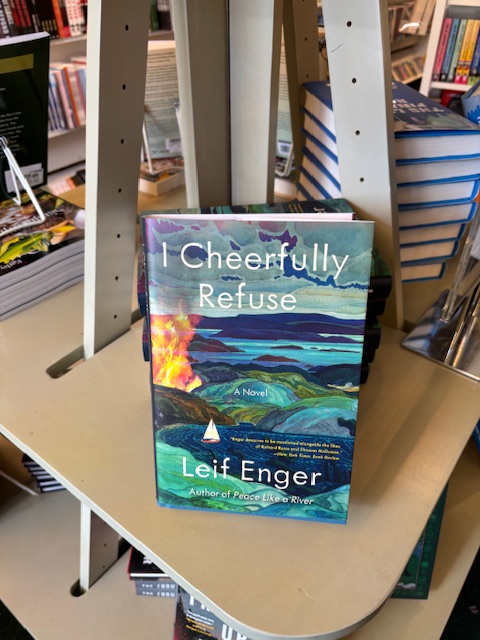
A couple of days ago when I walked into the store, I Cheerfully Refuse by Leif Enger, a book I’m currently reading, welcomed me. At the checkout counter, I discovered a display dedicated to Enger’s novels and an announcement that he would be appearing at an author event in Petoskey. The clerk told me that the owner of McLean & Eakin is a huge Leif Enger fan. I own all of Enger’s novels, so I bought The Frozen River by Ariel Lawhon, which is supposed to be a wonderful historical novel. The story, inspired by a real midwife’s diary, takes place in Maine in 1789.
Leif Enger will be doing an author event in Petoskey on April 23, 2025.
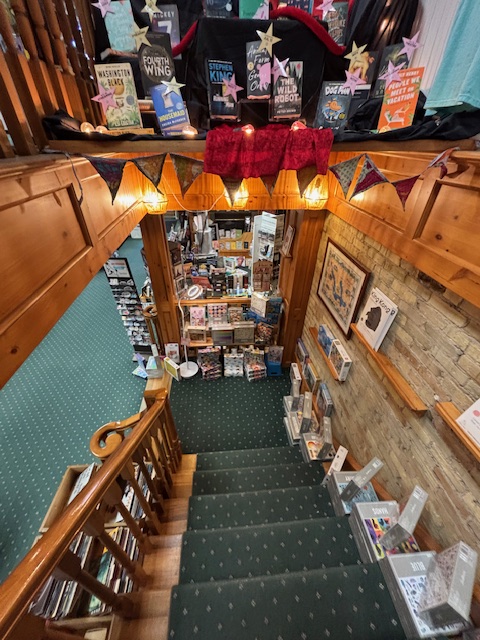
From the outside one might expect McLean & Eakin to be quite small, but it’s two stories, so customers will find plenty of titles. The main entrance is on Lake Street, but if you go around the block to the back of the building, you’ll find another entrance, also at street level but one story lower. The G & A Building, like many structures in Petoskey, was built into a hill.
The staff is always friendly and helpful. On more than one occasion, I’ve watched a clerk function as a human algorithm: A customer feeds the clerk titles of books they’ve enjoyed, and the clerk starts suggesting other books they might like.
McLean & Eakin offers a rewards program, and even though I live over nine hours away, I joined. At first I resisted because I lived so far away. But as I traveled to Petoskey more frequently, and as every trip included at least one visit to the bookstore, I signed up. There is no fee to join the rewards program, and I realized it was financially foolish not to belong. For every $100 dollars I spend, I receive a ten-dollar coupon. On this trip to the bookstore, I earned my third coupon since enrolling in their rewards program.
In addition to books, customers can shop for greeting cards, stationery, writing journals, puzzles, games, candles, stickers, coffee mugs, socks, and other miscellaneous items. At the back of the store on the main level is a charming children’s section.
At one time people could walk into the Persian Bazaar and take home a piece of a faraway world. Today people can walk into McLean & Eakin, buy a book, and read themselves into another world. After I finish I Cheerfully Refuse, which has taken me forward in time to northeastern Minnesota along Lake Superior, I will read The Frozen River, which will take me back to 1789 in Maine.
One look at the book’s magnificent cover art and my heart was pounding out of my chest, like a cartoon character who has taken one look at another cartoon character and fallen hopelessly, immediately, completely in love.
Look at that gorgeous airship, hovering over the frozen landscape.
How had I never heard about an airship and an arctic rescue?
Those of you who read my book reviews know I like to read about shipwrecks. Something you don’t know about me is that I think airships are fascinating. Mind you, I wouldn’t get on an airship, any more than I would get on a ship.
I want the book. But I’m on a book diet right now, which means I stop buying books for two or three weeks while I read some of the books on my TBR stacks. (This doesn’t always stop me from cheating and buying a book anyway.) On Monday, I decided to resist temptation by using my local library. But this book was just released, and my library doesn’t have a copy yet, and copies aren’t available through inter-library loan.
I’m making a deal with myself: (1) read a couple of books from my TBR stacks, (2) wait until at least February, then (3) declare that I need a present for Groundhog’s Day.
I write short stories, so I read a lot of short stories. Lots and lots of short stories. Many of which I enjoy immensely. Some stories fade from memory after a few weeks. Others resonate with me for months, while some haunt me for years.
I’ve selected nine stories by five different authors that I read in 2024. I chose these nine out of the dozens I’ve read because as 2025 starts, I still think about these stories. I’ll be doing the dishes, or walking the dog, or standing in line at the grocery store, and one of these stories will pop into my head. These stories have stayed with me, even months after reading them. I’ve listed them in alphabetical order by author. There is no way I can list them in order of preference because each story is both unique and powerful, with beautiful prose, captivating plots, and intriguing characters. Each story is wonderful for its own reasons, making me say, “Gee, I wish I’d written that!” Best of all, these stories give readers plenty to contemplate.
[Click on the authors’ names to learn more about them and their books.]
Two stories from Hunger: A Novella and Storiesby Lan Samantha Chang (25th Anniversary Edition, W. W. Norton & Company, Inc., 2023)
1. “San” is a story about broken dreams and abandonment, and the struggle to survive both. The story is narrated by Caroline, whose parents emigrated from Taiwan before she was born. She tells the story of her father’s inability to claim his piece of the American dream, eventually causing him to desert his family. Caroline recounts the day she watched her father leave, taking her umbrella with him, never to return: “The umbrella had been a present from him. Now I stood and watched it go, bright and ill-fated like so many of his promises.” With stunning metaphors and beautiful prose, Chang creates a shifting setting and vivid characters that tell an ageless story in a new way.
2. “The Unforgetting” is the story of Ming and Sansan Hwang and their young son, Charles, who have emigrated from China and settled in Iowa. They speak Chinese in their home until one day when Charles’s fourth-grade teacher explains that their son’s English vocabulary is below average. The teacher suggests the family speaks only English at home. His parents follow the teacher’s advice, and a rift grows between Charles and his parents. Ming and Sansan never master English, making it difficult for them to express their thoughts and emotions with Charles, who, at the same time, forgets most of his Chinese: “Since they did not test [Charles], Ming never knew how long it took for all of those words to be forgotten.” Language is how people understand their worlds. Chang’s story explores how the stripping of one’s native language is more than a loss of vocabulary.
A story from The Effects of Urban Renewal on Mid-Century America and Other Crime Stories by Jeff Esterholm (Cornerstone Press, 2023)
1. “Long Ago on a Sunday in June” is the story of Patrick, who is almost fifteen. He wakes in the early morning hours on a Sunday to deliver newspapers. In the first paragraph, we learn Patrick won’t be coming home afterward because his body has been found in a field. The rest of the story is told as a flashback. We follow Patrick as he eats his breakfast and begins his paper route. We learn about Patrick and his dreams: “He wanted to get into Mr. Bukoski’s art class when he entered Port Nicollet High in September. That was a given.” He has a crush on his friend’s sister, and he wants a job at a pizza joint. We follow Patrick on the last day of his very ordinary life, and because we know how the story ends, and because Esterholm’s prose is both richly layered and nuanced, we are devastated for the life Patrick will never live.
Two stories from Close Call by Kim Suhr(Cornerstone Press, 2024)
1. “Play-School” is the story of four elementary-aged children who play a game of school. Young Mary plays the teacher, delivering lessons in addition and subtraction. During one of her lessons, she interrupts herself, lowers her voice, and pretends to be the principal as she announces, “It is time to begin our lockdown drill.” Told through the eyes of Willie, a first grader, “Play-School” explores the topic of school shootings and lockdown drills from the point of view of the children. (There are no adults in this story.) Suhr’s use of a child’s point of view, along with her realistic portrayal of elementary-aged children, creates a wallop in a short space. “Play-School” deservedly won first place in the 2024 Jade Ring Contest sponsored by Wisconsin Writers Association.
2. “Eradicated” is a dystopian tale set in the future where artistic creativity, now labeled a disease, needs to be eradicated, a goal that is nearly complete when we meet Dr. Bells, a scientist. Wishing to observe creative artists before the last of them dies out, the doctor visits an artists’ colony where creative people, who are considered to have disturbed minds, have been contained after being extracted from society. He wants “to hang out with people and ask, ‘What’s your medium?’ And say things like, ‘That’s so derivative.'” The themes in “Eradicated” are both timely and timeless. Marvelously written and exquisitely paced, Suhr’s story serves as a cautionary tale against intolerance and mindless conformity.
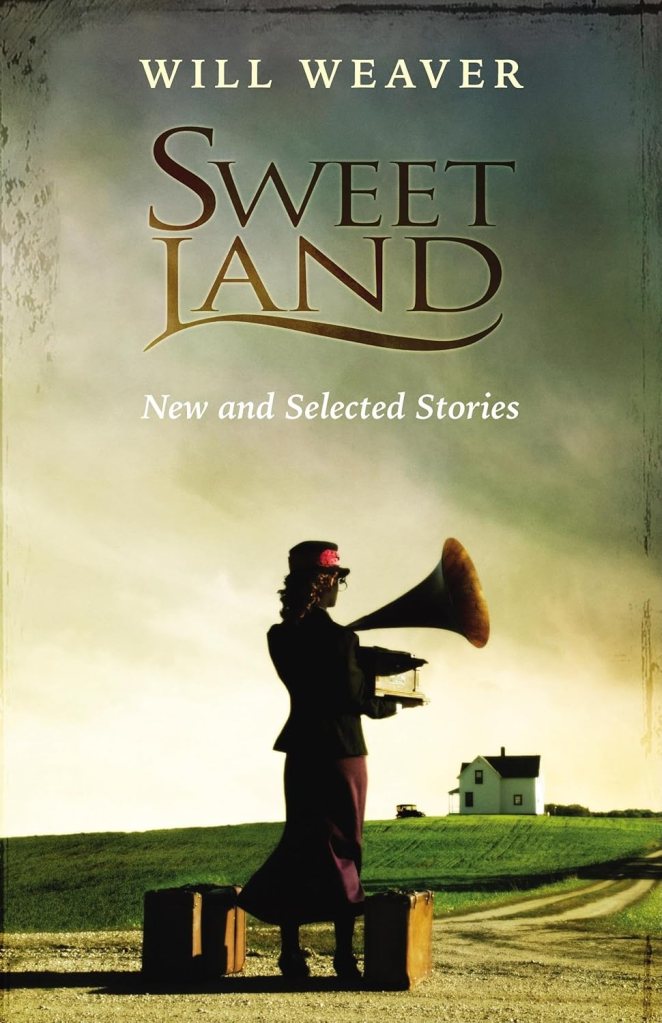
Two stories from Sweetland: New and Selected Stories by Will Weaver (Borealis Books, 2006)
1.“Flax Seed” is the story of a grandfather named Helmer who turns his farm over to his grandson, Kenny. With a handshake, Helmer states the terms of their deal: “Two-thirds, one-third. And no Sunday farming.” Kenny promises. He decides to plant flax, something his grandfather never grew. Farming is difficult. There is a time to sow, and a time to harvest. There is too much rain or too little. Too much heat or not enough. There are pests and diseases, rising and falling prices. There is often a race against time. For Helmer there is God. For Kenny there is the hope of flax and making good as a farmer. Helmer and his God; Kenny and his flax. And a difficult year. It’s a haunting story. Amen.
2. “A Gravestone of Wheat” is the story of Olaf who has loved Inge for forty-five years. They have farmed the land together and raised their son, Einar. They have welcomed grandchildren and great-grandchildren. When Inge dies, Olaf plans to bury her on their farm as Inge wished. But the law has changed: “‘You can’t bury your wife here on the farm,’ the sheriff said. ‘That’s the law.'” Olaf must decide if he will break the law and bury Inge on the farm or if he will bury her in town in the Greenacre Cemetery, knowing she despised the town. Inge has been his devoted wife for forty-five years. As Olaf ponders his choices, he recalls his first meeting with Inge and their unusual courtship, and readers are treated to a beautiful, but pragmatic love story. It’s a wonderful piece of historical fiction.
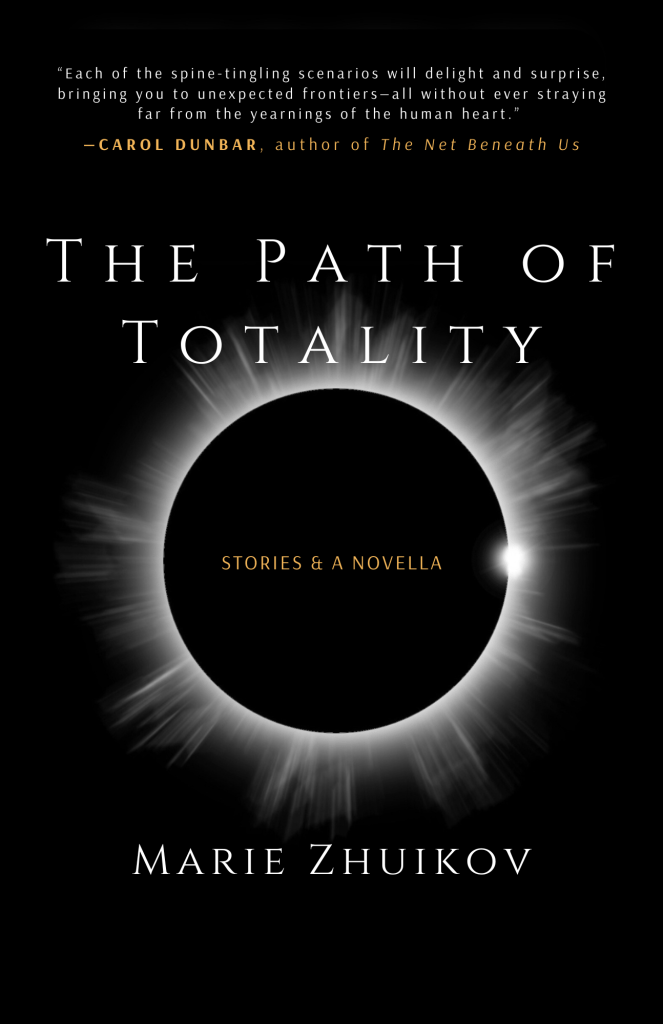
Two stories from The Path of Totality by Marie Zhuikov (Cornerstone Press, to be released February 2025) To pre-order Zhuikov’s book, click here.
1. “The Path of Totality” is the story of Marjorie and Justin, a young married couple, who travel from Medford, Oregon, to Salem, Oregon, to see the total eclipse of the sun. Caught up in a grief that both unites and divides them, the couple each experience the eclipse differently. Marjorie, along with other spectators, sees it all, astounded as the moon covers the sun. “But to Justin, the sun still shone as whole and bright as ever.” With eloquent prose, rich imagery, and well-crafted dialogue, Zhuikov’s story, told from the young husband’s perspective, is spellbinding. From a craft perspective, Zhuikov’s story reminds us that nature and natural events in our world can be powerful metaphors for human experiences.
2. “Bog Boy: A Northern Minnesota Romance” is set in rural Minnesota, where sixteen-year-old Natalie works at the Sax-Zim Bog, a nature preserve. On a spring day, while leading a birding tour, Natalie discovers a mummified teenage boy in the bog, whose remains are determined to be two thousand years old. The well-preserved teenager, with high cheekbones and beautiful hair, is handsome, and Natalie falls in love with him as only a teenage girl can – completely, blindly, devotedly. Because she cannot be without him, she brings the bog boy home to live with her and her father. Darkly humorous, “Bog Boy” combines the realm of speculative fiction with thought-provoking satire that made me laugh out loud at times. I still smile when I think about the story.
Nellie “Bly” ponders an important question regarding investigative journalism: “Isn’t it time for lunch?”
On October 10, my grand-dog Nellie, whom I like to refer to as Nellie “Bly,” went on assignment with me. I was working on an article for Northern Wilds magazine. Our mission was to interview one bookstore owner in Two Harbors, Minnesota, and one bookstore manager in Grand Marais, Minnesota, and to take photos. Nellie Bly was game. (Although, if she had been given a choice, she would have rather chased small game instead of facts.)
Going on a reporting job with a dog is fun, but it requires more time. We were gone for over six hours. In addition to doing interviews and snapping photos, our assignment included four walks, a lunch break, and a supper break.
Nellie waited in the van while I did the hard-boiled investigative work inside the bookstores, asking the managers about the history of each bookstore and which books they anticipated would be hot for the holidays. Good investigative journalism means I had to ask the tough questions too, such as “What is your favorite holiday book? and “Do you have any holiday traditions involving books?” Of course, in the name of gathering evidence, I bought some books at each store.
Nellie got paid in food and treats. However, when I ate my Happy Meal for lunch, she made it clear that she wanted to exchange her bowl of dried kibble for my cheeseburger. And when I had my six-inch sub for supper, she again made it clear she wanted to swap her bowl of kibble for my sandwich. There were no trades. I told her life in the field as a reporter is filled with sacrifices.
Perhaps, if this article goes over well, it will lead to a TV series, where I travel the country, reporting on independent bookstores, asking probing questions about each bookstore’s origins and what’s selling well, all while spending my writing paycheck on books. Maybe Nellie Bly would like to be my assistant. We could travel in a RV with a driver so I could read and she could look out the window. I can hear Nellie now — trying to negotiate a better meal deal and asking for top billing in the credits. With her good looks, she would be the star of the show in no time anyway.
[To read my article click here: Northern Wilds, pages 14-15.]
Ever have someone tell you to keep your head down? I interpret that to mean I should put my head in a book. And sometimes a book is the best place to be. I’ve been hanging out in a lot of books lately.
The Ski Jumpers by Peter Geye. I read The Ski Jumpers because I read The Lighthouse Road and Safe from the Sea, both beautifully written novels. Geye writes stories with brooding, flawed characters who are self-reliant and tough, yet vulnerable, which makes me like them and root for them. The vivid landscapes in Geye’s novels become a character that his protagonists must work with and sometimes fight against. In The Ski Jumpers family secrets gather like dust bunnies hiding in the dark, under a heavy, nearly immovable antiquated piece of furniture. Because each family member knows only a part of their family’s secrets, misconceptions develop and resentments grow. Pops Bargaard loves his wife, Bett, but she struggles with her own demons, one of which is her inability to love both of her sons. She dotes on Anton while despising Johannes “Jon.” Pops, an accomplished ski jumper in his youth, introduces his sons to the sport. Ski jumping becomes an escape for Pops and his sons. And as the years go by, ski jumping becomes what Pops and his sons talk about when they are still hiding secrets, when they aren’t ready to talk about their pain, when they are holding on to happier times. One of the joys in Geye’s novel is his detailed, vivid descriptions of ski jumping, which fly off the page, taking me along, letting me ski jump with Johannes and Anton. At some point while reading Geye’s book, I skipped to the “Acknowledgments,” and as I had come to believe, I found that he grew up ski jumping, which explained how he could write so intimately about it.
Still Waters by Matt Goldman. I read Still Waters because I’ve read three of Goldman’s Nils Shapiro detective novels: Gone to Dust, Broken Ice, and The Shallows, and enjoyed them all. Still Waters is one of Goldman’s stand-alone novels. It’s a murder mystery, but one that is solved with the help of ordinary people. Siblings Liv and Gabe, who are estranged, must reunite for their older brother Mack’s funeral in their rural northern Minnesota hometown. Mack’s death has been ruled a medical event, but Liv and Gabe receive emails from their dead brother saying he was murdered. While Liv and Gabe try to make sense of Mack’s email and uncover the truth about his death, someone else dies, and it’s clearly murder. Liv and Gabe discover mysterious letters in a box that belonged to their deceased mother, and they suspect the letters hold the key to Mack’s death and the second murder. This smartly woven mystery with multiple theories and a number of potential suspects kept me guessing. Plus, I could read it before I went to bed and still drift off to sleep without checking under the bed. (I like mysteries without psychopathic serial killers.) Goldman’s mystery does have some scary moments, but only enough to make the heart race a little.
Endurance: Shackleton’s Incredible Voyage by Alfred Lansing. I read Endurance by Lansing because I like reading about shipwrecks. (Click here for proof.) The Endurance isn’t wrecked on a shoal or reef, she isn’t tossed over by a violent storm, and she isn’t irreparably wounded in battle. Instead, she has purposefully sailed into the Weddell Sea filled with ice floes, looking for a place to land on Antarctica. She is stalled by the ice, which sandwiches her in a death grip, squeezing and squeezing until she groans, and parts of her snap like toothpicks. After becoming unseaworthy, her crew have no choice but to abandon her and their mission to be the first to cross the width of Antarctica using sled dogs. Now the twenty-eight men must survive the beyond-bitter cold, the howling winds, and the snow and rain while hoping to rescue themselves. When Alfred Lansing wrote this book, he had access to the daily journals kept by some of the men, and he was able to interview some of the survivors. Lansing took great care to write an accurate and descriptive account of one of the greatest survival stories, and his book is a tribute to the human ability to put one foot in front of the other and to cling to hope. When Endurance was published in 1959, it was a critical success, but not a commercial one. By the time the book became a commercial success in 1986, Lansing was dead. If you read this book curl up with a blanket and a cup of something hot! This book chilled me to the bone!
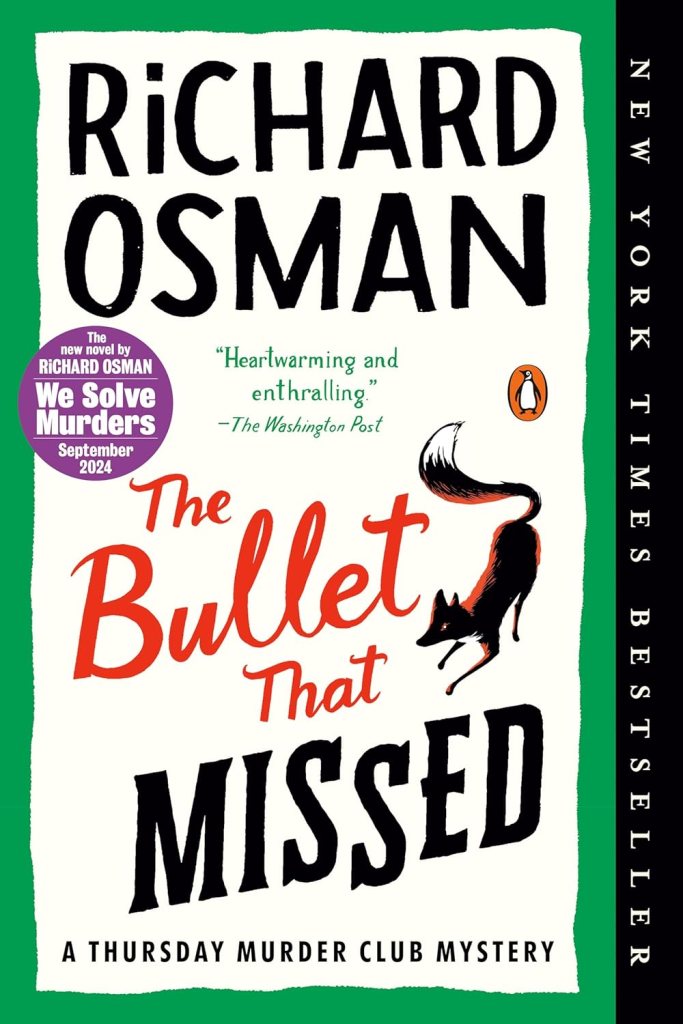
The Bullet that Missed: A Thursday Murder Club Mystery by Richard Osman. I read this book because I read the first two books in the Osman’s series, and they were fun, fun, fun. These murder mysteries are a treat. They are cozy but do have some un-cozy scenes. (And yay! No serial killers, which are so overdone.) Most of the main characters live in a retirement home in the English countryside. While they participate in some of the traditional retirement activities, they have one that’s unusual — they meet on Thursdays to look at cold cases that haven’t been solved. The unsolved murders somehow become entangled in a new murder case, which then also involves the police. One of the characters, Elizabeth, is a former MI-6 agent, and as it turns out, it’s not easy for her to give up the thrills of spying and sleuthing. Her fellow retirees join in the criminal-case-cracking adventures. This mystery series earns top kudos from me for its characters, its dialogue, and its plots. Most of the characters are senior citizens, but that doesn’t mean they have checked out of life. The older characters in the book are presented as people, who all have the same hopes, dreams, desires, and brains as the younger characters, even if the older ones do occasionally battle aches and pains. Osman’s snappy dialogue creates characters that are witty and quick thinking, conversations often drip with verbal irony and humorous understatements. The criminal characters are well-developed, too. They are brilliant and devious, but, of course, never a match for the Thursday Murder Club. While you could read these books out of sequence, I suggest they are best read in order.
Slaughterhouse-Five by Kurt Vonnegut. I read this book because I walked into Apostle Islands Booksellers and saw it prominently displayed on a shelf. I’ve had people say to me, “Have you read Slaughterhouse-Five? No? Well, you should!” I’ve read articles where writers suggest to their readers, “If you haven’t read Slaughterhouse-Five, you should!” And there it was — Vonnegut’s book — on a shelf, looking at me, waiting for me, so I bought it. Slaughterhouse-Five is described as an antiwar book focused on the firebombing of Dresden in 1945. It follows Billy Pilgrim, a WWII veteran, who time travels from his old age to Dresden, to his wedding day, to life with his family, to a veteran’s hospital, to a planet in outer space, to his youth, like a pinball pinging across a fantasy-themed pinball game. I’m not listing Billy Pilgrim’s time travels in the necessarily correct order; besides, as the story unfolds, Billy travels back and forth among these places in time. But Vonnegut clearly had a plan, and as I read the book, it not only made sense to me, it all worked seamlessly. I never felt like I was being yanked around. A book like Slaughterhouse-Five is hard to explain in words. I like it for its satire, its experimentation, its ambiguity and clarity, and its themes. I like Vonnegut’s simple, but powerful sentences. Slaughterhouse-Five is often spoken of as anti-war novel, and that theme runs through it. However, Vonnegut’s slim novel is thematically rich, and there is much more being said than war is terrible. As I read the novel, I sometimes thought about “The Swimmer” by John Cheever. Raymond Carver’s short stories also came to mind.
Time to go keep my head down in a book. The Heaven & Earth Grocery Store by James McBride is waiting for me.
















 Writing Near the Lake