If you get a chance to see the play The Women of Lockerbie by Deborah Brevoort, by all means go.
I went to see The Women of Lockerbie because I remember when Pan Am 103 exploded over Lockerbie, Scotland, on December 21, 1988, killing 259 people on the plane and eleven people on the ground.
And I went to see The Women of Lockerbie because the advertisement said the play was styled after a Greek tragedy with a Greek-like chorus. I loved my ancient Greek theater class in college.
As we entered the small experimental theater, a sign alerted us there would be no intermission, and if we left the theater during the 75-minute play, we would not be allowed to return. The play needs to be seen without interruption.
The set for The Women of Lockerbie at University of Minnesota-Duluth
The stark stage washed in a pale-blue light held two props, four painted panels, and a fabric river dividing everything in two: the land, people, emotions, needs.
When the play starts, it’s seven years after the tragic bombing of Pan Am 103, and many loved ones of the victims have come to participate in the dedication of a memorial.
We meet a married couple who lost their only child in the bombing: a wife overwhelmed by grief and a husband who hides from it. We meet a callous American official who is to oversee the destruction of the personal property that once belonged to the people on Pan Am Flight 103. We meet the women of Lockerbie who witnessed the tragedy, suffered their own losses, and struggle to heal. The women of Lockerbie who want to wash, iron, and fold the clothes of the bombing victims and return them to their surviving families.
Grief in all its forms: raw, stuffed, converted, unacknowledged, motionless, haunted, and rage-filled, permeates the story. But so do love, compassion, and forgiveness.
At one point in the play, the set goes black. Not a whisper, not a sigh, not a breath is heard. In the darkness. The audience is moved to absolute silence. Tears spill from my eyes. I make no move to dig for a tissue in my purse. I cannot break the moment with sound.
No one from the audience left the theater during the play. And for 75 minutes in a small intimate theater, a group of outstanding college actors held us spellbound by the depth of their performance.
If you ever have a chance to see the play, by all means go.
I write short stories, so I read a lot of short stories. Lots and lots of short stories. Many of which I enjoy immensely. Some stories fade from memory after a few weeks. Others resonate with me for months, while some haunt me for years.
I’ve selected nine stories by five different authors that I read in 2024. I chose these nine out of the dozens I’ve read because as 2025 starts, I still think about these stories. I’ll be doing the dishes, or walking the dog, or standing in line at the grocery store, and one of these stories will pop into my head. These stories have stayed with me, even months after reading them. I’ve listed them in alphabetical order by author. There is no way I can list them in order of preference because each story is both unique and powerful, with beautiful prose, captivating plots, and intriguing characters. Each story is wonderful for its own reasons, making me say, “Gee, I wish I’d written that!” Best of all, these stories give readers plenty to contemplate.
[Click on the authors’ names to learn more about them and their books.]
Two stories from Hunger: A Novella and Storiesby Lan Samantha Chang (25th Anniversary Edition, W. W. Norton & Company, Inc., 2023)
1. “San” is a story about broken dreams and abandonment, and the struggle to survive both. The story is narrated by Caroline, whose parents emigrated from Taiwan before she was born. She tells the story of her father’s inability to claim his piece of the American dream, eventually causing him to desert his family. Caroline recounts the day she watched her father leave, taking her umbrella with him, never to return: “The umbrella had been a present from him. Now I stood and watched it go, bright and ill-fated like so many of his promises.” With stunning metaphors and beautiful prose, Chang creates a shifting setting and vivid characters that tell an ageless story in a new way.
2. “The Unforgetting” is the story of Ming and Sansan Hwang and their young son, Charles, who have emigrated from China and settled in Iowa. They speak Chinese in their home until one day when Charles’s fourth-grade teacher explains that their son’s English vocabulary is below average. The teacher suggests the family speaks only English at home. His parents follow the teacher’s advice, and a rift grows between Charles and his parents. Ming and Sansan never master English, making it difficult for them to express their thoughts and emotions with Charles, who, at the same time, forgets most of his Chinese: “Since they did not test [Charles], Ming never knew how long it took for all of those words to be forgotten.” Language is how people understand their worlds. Chang’s story explores how the stripping of one’s native language is more than a loss of vocabulary.
A story from The Effects of Urban Renewal on Mid-Century America and Other Crime Stories by Jeff Esterholm (Cornerstone Press, 2023)
1. “Long Ago on a Sunday in June” is the story of Patrick, who is almost fifteen. He wakes in the early morning hours on a Sunday to deliver newspapers. In the first paragraph, we learn Patrick won’t be coming home afterward because his body has been found in a field. The rest of the story is told as a flashback. We follow Patrick as he eats his breakfast and begins his paper route. We learn about Patrick and his dreams: “He wanted to get into Mr. Bukoski’s art class when he entered Port Nicollet High in September. That was a given.” He has a crush on his friend’s sister, and he wants a job at a pizza joint. We follow Patrick on the last day of his very ordinary life, and because we know how the story ends, and because Esterholm’s prose is both richly layered and nuanced, we are devastated for the life Patrick will never live.
Two stories from Close Call by Kim Suhr(Cornerstone Press, 2024)
1. “Play-School” is the story of four elementary-aged children who play a game of school. Young Mary plays the teacher, delivering lessons in addition and subtraction. During one of her lessons, she interrupts herself, lowers her voice, and pretends to be the principal as she announces, “It is time to begin our lockdown drill.” Told through the eyes of Willie, a first grader, “Play-School” explores the topic of school shootings and lockdown drills from the point of view of the children. (There are no adults in this story.) Suhr’s use of a child’s point of view, along with her realistic portrayal of elementary-aged children, creates a wallop in a short space. “Play-School” deservedly won first place in the 2024 Jade Ring Contest sponsored by Wisconsin Writers Association.
2. “Eradicated” is a dystopian tale set in the future where artistic creativity, now labeled a disease, needs to be eradicated, a goal that is nearly complete when we meet Dr. Bells, a scientist. Wishing to observe creative artists before the last of them dies out, the doctor visits an artists’ colony where creative people, who are considered to have disturbed minds, have been contained after being extracted from society. He wants “to hang out with people and ask, ‘What’s your medium?’ And say things like, ‘That’s so derivative.'” The themes in “Eradicated” are both timely and timeless. Marvelously written and exquisitely paced, Suhr’s story serves as a cautionary tale against intolerance and mindless conformity.
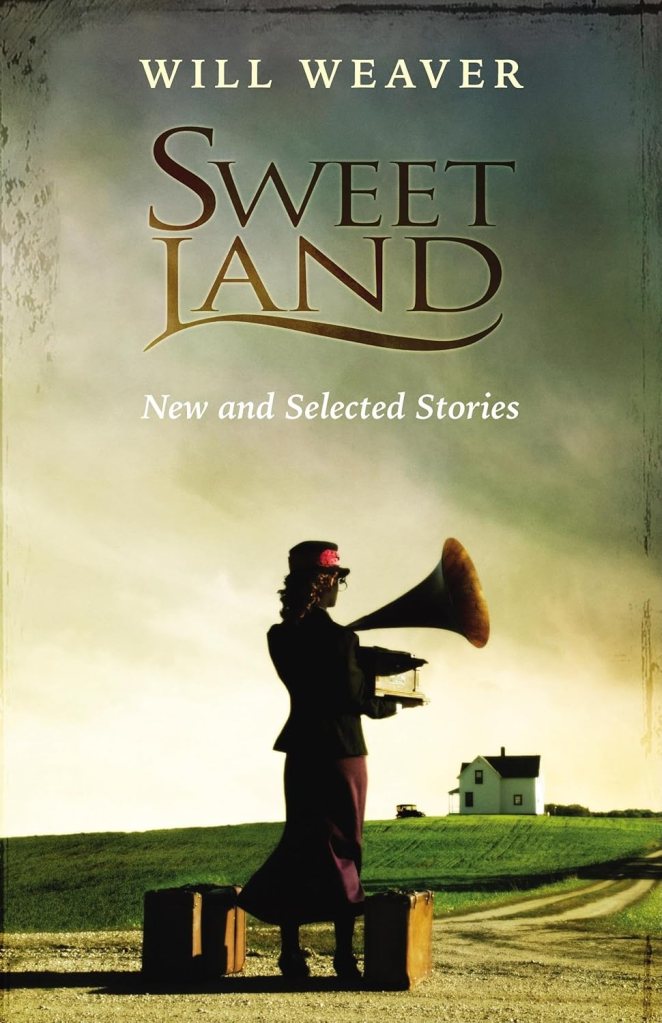
Two stories from Sweetland: New and Selected Stories by Will Weaver (Borealis Books, 2006)
1.“Flax Seed” is the story of a grandfather named Helmer who turns his farm over to his grandson, Kenny. With a handshake, Helmer states the terms of their deal: “Two-thirds, one-third. And no Sunday farming.” Kenny promises. He decides to plant flax, something his grandfather never grew. Farming is difficult. There is a time to sow, and a time to harvest. There is too much rain or too little. Too much heat or not enough. There are pests and diseases, rising and falling prices. There is often a race against time. For Helmer there is God. For Kenny there is the hope of flax and making good as a farmer. Helmer and his God; Kenny and his flax. And a difficult year. It’s a haunting story. Amen.
2. “A Gravestone of Wheat” is the story of Olaf who has loved Inge for forty-five years. They have farmed the land together and raised their son, Einar. They have welcomed grandchildren and great-grandchildren. When Inge dies, Olaf plans to bury her on their farm as Inge wished. But the law has changed: “‘You can’t bury your wife here on the farm,’ the sheriff said. ‘That’s the law.'” Olaf must decide if he will break the law and bury Inge on the farm or if he will bury her in town in the Greenacre Cemetery, knowing she despised the town. Inge has been his devoted wife for forty-five years. As Olaf ponders his choices, he recalls his first meeting with Inge and their unusual courtship, and readers are treated to a beautiful, but pragmatic love story. It’s a wonderful piece of historical fiction.
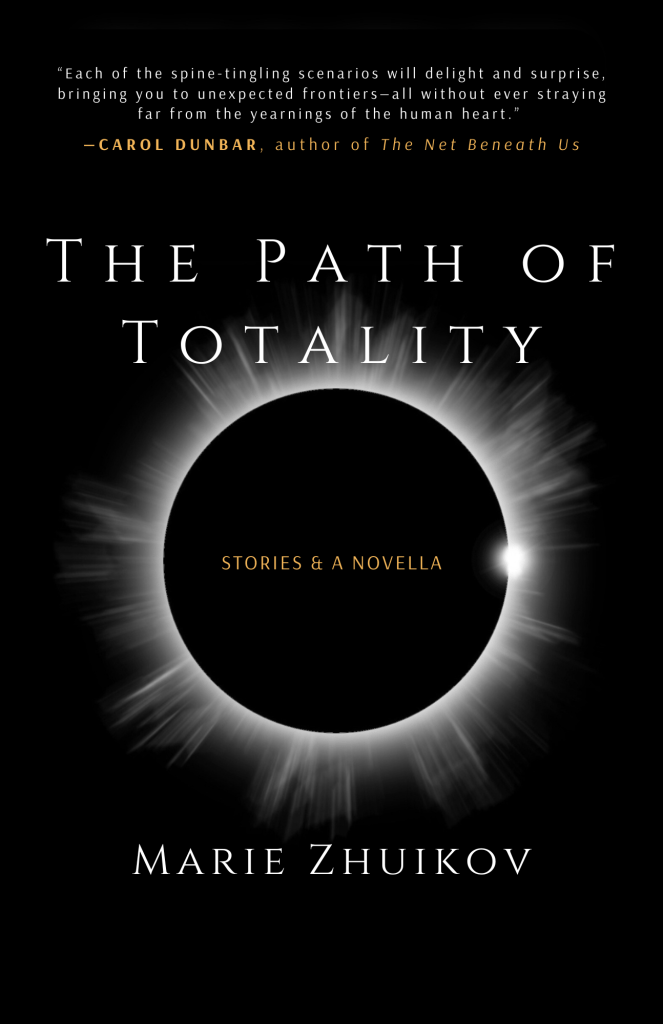
Two stories from The Path of Totality by Marie Zhuikov (Cornerstone Press, to be released February 2025) To pre-order Zhuikov’s book, click here.
1. “The Path of Totality” is the story of Marjorie and Justin, a young married couple, who travel from Medford, Oregon, to Salem, Oregon, to see the total eclipse of the sun. Caught up in a grief that both unites and divides them, the couple each experience the eclipse differently. Marjorie, along with other spectators, sees it all, astounded as the moon covers the sun. “But to Justin, the sun still shone as whole and bright as ever.” With eloquent prose, rich imagery, and well-crafted dialogue, Zhuikov’s story, told from the young husband’s perspective, is spellbinding. From a craft perspective, Zhuikov’s story reminds us that nature and natural events in our world can be powerful metaphors for human experiences.
2. “Bog Boy: A Northern Minnesota Romance” is set in rural Minnesota, where sixteen-year-old Natalie works at the Sax-Zim Bog, a nature preserve. On a spring day, while leading a birding tour, Natalie discovers a mummified teenage boy in the bog, whose remains are determined to be two thousand years old. The well-preserved teenager, with high cheekbones and beautiful hair, is handsome, and Natalie falls in love with him as only a teenage girl can – completely, blindly, devotedly. Because she cannot be without him, she brings the bog boy home to live with her and her father. Darkly humorous, “Bog Boy” combines the realm of speculative fiction with thought-provoking satire that made me laugh out loud at times. I still smile when I think about the story.





 Writing Near the Lake