My mini essay “Sometimes You Need to Trust a Stranger” appears in the February issue of Northern Wilds Magazine as part of their “Winter Mishaps” theme pages.
To read my short essay, click here! Scroll down until you get to the fourth story. Enjoy the rest of the “Winter Mishaps” stories byErin Altemus, Joe Shead, Naomi Yaeger, and Chris Pascone.
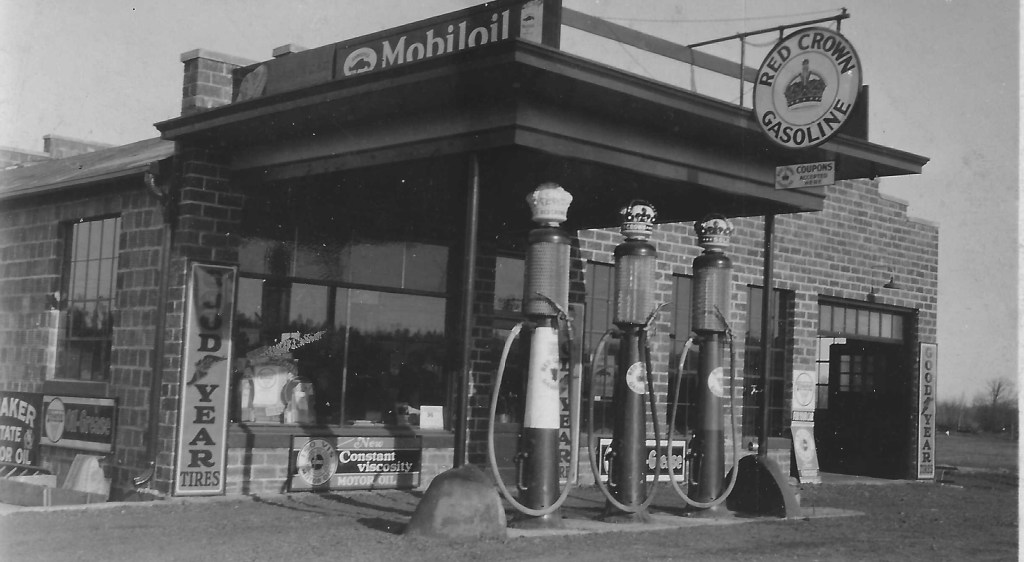
My Grandpa George’s gas station and garage, circa 1930. Grandpa George helped a lot of people over the years.
Some of you may remember that after I went sledding with my two youngest grandkids a few weeks ago, I made a New Year’s resolution to behave like a child more often. I’m still working on it, unlike resolutions of the past, which I’d have tossed into the trash bin by now.
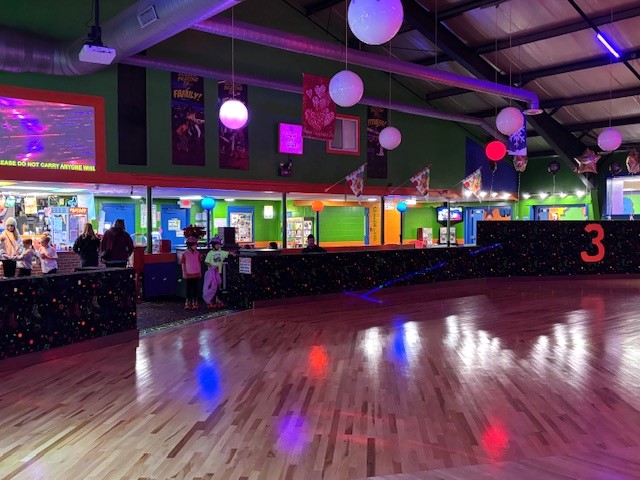
On January 20, I went roller skating with all four of my grandkids. I was sixteen years old the first time I went — still a child then — so this counts as behaving like a child now. The last time I went I was in college, and probably about twenty-three.
I fell a lot the first time I went roller skating. I’m sure the seat of my blue jeans kept a good part of the roller rink floor buffed and shiny. But despite all the falling, I loved it, so I went skating once or twice a week. My skills improved, and I rarely fell.
Before my skate date with my grandkids, I made the mistake of telling someone, “Yes, I’m going to skate too,” while my husband was in earshot. Afterward, he asked, “Do you really think that’s a good idea?”
“I used to roller skate a lot in high school and college,” I said. (A lot is a relative phrase.)
“That was decades ago,” he said. (Ouch!)
“It’ll all come back, like riding a bicycle,” I assured him. (It didn’t all come back, unless I compare it to the first time I went roller skating.)
“You’re going to fall and get hurt, maybe break something,” he said.
“I’m not going to fall. I passed that stage years ago,” I said. (I fell seven times. Five of the falls were gentle with soft landings; the other two smarted and then some, one left a respectable bruise on my forearm. Good man that he is, my husband never asked how many times I fell.)
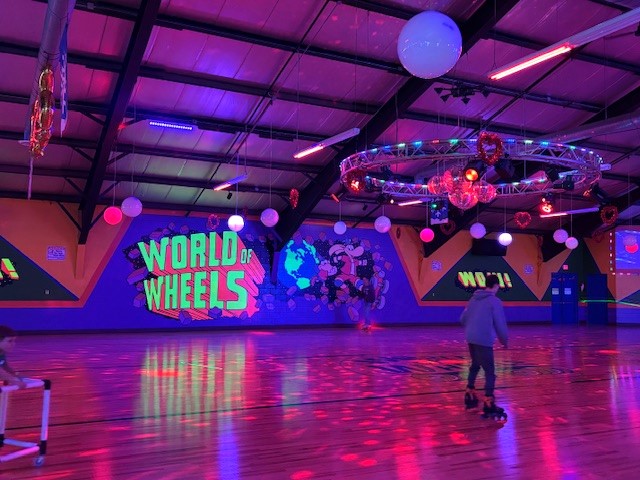
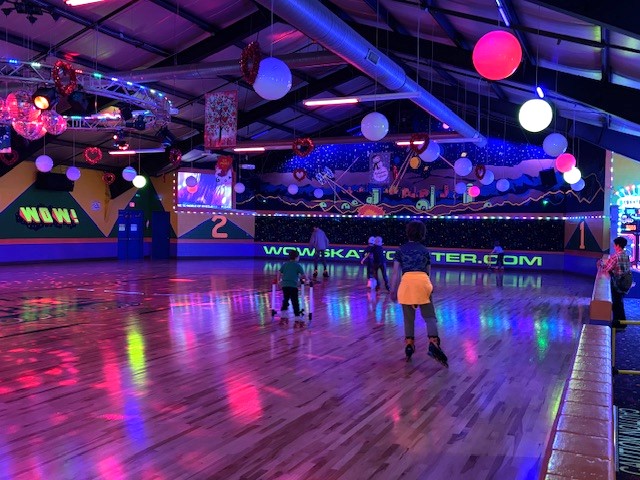
Walking into the roller rink was kind of like a trip back in time. It’s the same rink where I skated with my college friends, but the inside has been refurbished and updated. The walls and ceiling surrounding the rink feature bold graphic art scenes painted in vibrant colors that glow under black lights. The old bumpy greenish-blue floor was recently replaced with a beautiful, smooth wooden surface. There are new booths, benches, and carpeting, but the layout is still the same. I have no idea if the roller rink I frequented in Milwaukee County when I was in high school still exists, and I don’t remember its name.
“Are you going to skate with us?” This question was repeatedly asked by my two youngest grandkids, even as I paid for five skaters, picked up my skates at the counter, then laced them up while seated on the bench with my grandkids. I don’t know if they worried about me being too old, or if they kept thinking I’d change my mind. I like to think they were amazed Nana could skate. Well, sort of — after watching me fall.
The moment I stepped on the rink, I realized my return to roller skating wasn’t going to be smooth. At first, I spent all of my time concentrating on maintaining my balance, waiting for the memory in my leg muscles to wake up and recall how to skate. When I didn’t stay upright, getting off the floor was a challenge. Trying to stand on a slick floor while wearing wheels on your feet is the stuff slapstick comedy is made of. Once I fell too far away from the wall and struggled to stand, so I began crawling toward the wall. My oldest grandchild skated up and gave me a hand.
I’d forgotten how heavy roller skates are. Lifting my leg up to do a crossover or to push off, felt like pumping iron. Resistance training. Good for the bones. My doctor wants me to do more resistance exercises because while my bone density test wasn’t bad, it wasn’t great. She’d be proud of me, I thought — skating around the rink with the equivalent of ankle weights laced to my feet. Then again, she might have something to say about me breaking a bone. She’d probably be Team Husband.
After twenty minutes, I felt more confident, and as I slowly, cautiously, precariously skated around the rink, my mind wandered back to my high school skating days and a boy named Mark, who I had a crush on through most of my junior year.
School crushes are funny things. Some of my infatuations were all consuming. I daydreamed about those boys from the moment I slid out of bed in the morning, until sleep swept away my romantic fancies at night. Like Randy in seventh grade, whom I never worked up the nerve to speak to, but whose name filled the pages of my diary, and whose image occupied my nearly every waking moment. Sometimes I had crushes on boys at the same time: one at school, one in my neighborhood, and one at work. Some crushes expired faster than an egg salad sandwich left out in the summer sun. My crush on Mark started in our American literature class during our junior year and carried over to the roller rink, but I didn’t particularly pine after him when he was out of sight. He was funny and talkative. We were school and skating friends.
I was out of Mark’s league. He was handsome, tall, and muscular. He had thick blond hair nearly touching his shoulders and cut like a rock star’s. I don’t remember the color of his eyes, but they were often filled with mirth. His sense of humor ranged from puns to bawdy, from slapstick to stand-up. He smiled constantly and laughed easily. In a category for “Student Most Likely to Become a Comedian,” Mark would’ve won.
I’m not sure how I started roller skating, but I never had a date at the roller rink. Instead, lots of kids from my high school and surrounding schools would show up on the evenings designated for teenagers. It was one big group date. Mark never came with a date either, but on almost every teenage skate night, he was there. Sometimes during the day at school, he would ask me if I was going to the rink that night.
We often skated side by side, making small talk. Rock ‘n’ roll from the 1960s and 70s pulsated through the air. The mirrored disco ball tossed flashes of color across the rink. Sometimes there was a couples’ skate, and he would take my hand. For the length of a slow song, I’d imagine we were boyfriend and girlfriend. Other times, he’d ask another girl he happened to be skating next to when the DJ called for a couples’ skate. Mark was kind to everyone. Of course, I was disappointed when he didn’t ask me every time because it meant he didn’t have a crush on me.
During the summer, after my junior year, I went to Europe for a month, and my family moved. When I returned home, I settled into a new home, a new school, and a new town. I developed two crushes, one on a boy across the street and one on a boy at school. I never saw Mark again.
In the late 1990s, I learned Mark had died of cancer in 1995 at the age of thirty-six. One of my high school classmates, who’d become a dental hygienist, told my sister, whose teeth she was cleaning, to let me know. She knew that Mark and I’d been buddies. Did she know that I’d had a crush on him? Did she think he had one on me? I’d rarely thought about Mark after I moved, but I was sad when I heard he’d died. He’d been so full of life. He’d married and had children.
Over the years, I’d occasionally think about Mark. Something would spark a memory that reminded me of my junior American lit class or the roller rink. For example, I can’t hear or read about A Raisin in the Sun without thinking about Mark and a play he wrote for a class assignment, which featured me and some of our classmates. Of course, Mark being Mark, the play was humorous, but in a kind way, a gentle satire that kept us all in stitches.
A few months ago, I was looking through my junior yearbook — nothing to do with Mark — and I came across a long entry penned by him. I was stunned by what I read both on the page and between the lines. His words were an unabashed admission of affection and love, but at the end of his heartfelt reveal, he’d sandwiched the word lies in parentheses as if shrugging off the whole letter as a joke, giving himself enough plausible deniability to save face if I didn’t return his feelings. Why had I missed his declaration of romantic affection? Probably because I was convinced that he’d never be interested in dating me. Turns out he felt I’d never be interested in dating him. Why had I thought he was joking? Probably because he never flirted with me, and he was always joking. What about his writing “I love you” and “I’ll miss you if you move”? Lots of my yearbook entries were filled with words of love and miss-you-over-the-summer sentiments, from both my male and female friends. I have several yearbooks filled with gushy prose to prove how sappy my classmates got when signing yearbooks. Some things are easier to write than say.
I kept skating, mostly upright now. “Y.M.C.A.” played, fast-paced and upbeat, the kind of music that would’ve sent me zipping around the rink when I was a teenager, but not anymore. I skated as if I were keeping time with Perry Como’s rendition of “Moon River.” When we left the rink, I told my grandkids, who had a blast, that we would come back in February and March on their school breaks. I plan to skate again, so I hope my legs won’t develop amnesia. I don’t know what my husband will say, but I know what my father would’ve said, “Old enough to know better, but young enough to do it anyway.” Hopefully, I’ll stay off the floor.
I will think about Mark again, and his life cut short by illness. I will smile at the thought that he had an unrequited crush on me too, but Mark and I were never destined to be together. We weren’t each other’s one that got away. If we had dated during our junior year, we most likely would’ve spoiled a fun friendship. School crushes are funny things. They’re often ignited by a physical trait: a dimpled cheek, sky-blue eyes, a smattering of freckles across a nose, luxurious wavy hair, a lopsided melt-your-heart grin. They consume our lives for a moment, but like a match, once struck, they often burn out quickly.
I remember Mark fondly because we were friends who laughed, and talked, and roller skated together. He’d be pleased to know that I still think about him now and then. How I sometimes tell the story about a boy from my American lit class who climbed out of a classroom window on a warm spring day, joyfully followed by me and most of the class. (No, we didn’t get into trouble. Teachers were also charmed by Mark.)
It’s what we want when we’re gone, that people will remember us and tell our stories.
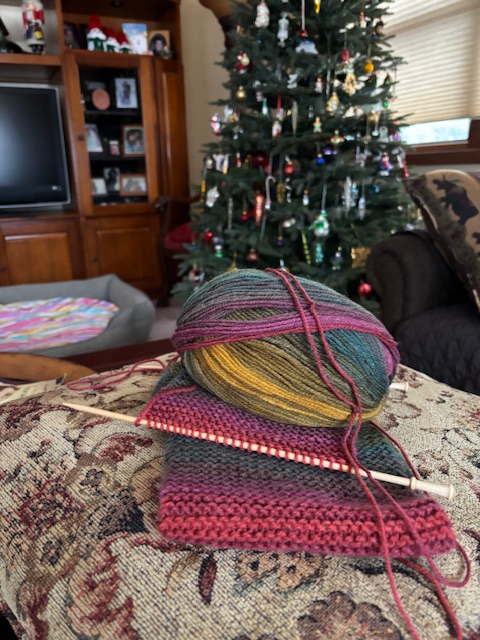
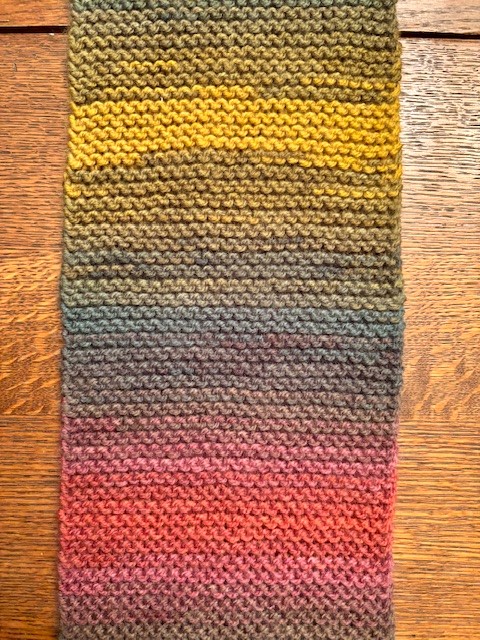
My Shetland yarn, 80% acrylic and 20% wool, is soft, warm, and gorgeous. I’m using the knit stitch for every row, which gives a simple knit, purl design that allows the beauty of the yarn’s color gradations to steal the show.
Last September when I traveled to Shetland, I bought some yarn at Loose Ends and Anderson & Co., both shops in Lerwick.
Shetland is known for its yarn shops, knitted goods, and expert knitters. I was in Shetland September 15 – 20. If I’d gone eight days later, I could’ve taken part in Shetland Wool Week, an annual event, which runs in late September/early October. But having never been to Shetland before, I went to experience its natural beauty, so I spent lots of time outdoors. According to the guide books, the month of September is a quieter part of Shetland’s tourist season. The weather is more unpredictable, and the puffins, a popular attraction, have flown to warmer climates for the winter. But fewer tourists mean less congestion, and that appeals to me.
In late September/early October, Shetland’s weather begins to turn, and it becomes a place of cold temperatures, gale-force winds, sideways rains, and thick gray skies, so sight-seeing tourists shy away. It’s a great time of year to have a knitting conference filled with indoor gatherings. Of course, stormy weather can show up anytime in Shetland, but it becomes more prevalent as September runs into October and winter settles in. Shetland winters are perfect for knitting, as demonstrated by the large quantities of knitted goods to be found in shops, museums, and heritage centers throughout Shetland. After all, I bought four skeins of yarn with the idea that I would knit scarves during northern Wisconsin’s upcoming winter. I also bought three wool sweaters in Scotland because I’m never going to knit a sweater.
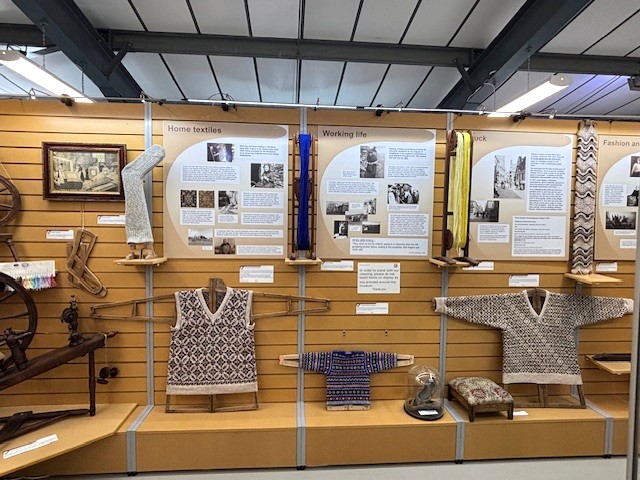
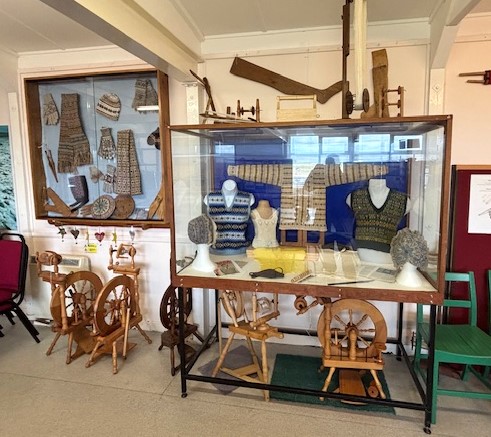
Home textiles display in Scalloway Museum, Shetland. As a cottage industry, woolen goods have been and still are an important source of extra income for many Shetlanders.
I knit beautiful scarves, as long as the pattern is simple and repetitive, and there are no cables involved. Or lacy-like patterns. Or miniature figures or graphic designs prancing across the scarf. Also, no increasing and decreasing stitches. But otherwise, I make nice scarves because I select pretty yarn.
I don’t knit sweaters, slippers, or hats. Only scarves. Although, in the past I have knitted a few dishcloths. But that’s like knitting a miniature square scarf.
Long ago, I tried to knit something more complicated. When I was a senior in high school, I signed up for a community ed class so I could learn how to knit something other than scarves. I selected a pattern for a simple pair of slippers. Because the class was in the fall, I decided I would give the slippers as a Christmas gift to some lucky family member. I went to class and learned how to read a knitting pattern, how to increase and decrease, and how to gauge stitches — in theory. By the end of the class, I had two forest-green slippers — in two different sizes. Since none of my family members have mismatched feet, I couldn’t give the slippers to anyone. Eventually, I threw them away.
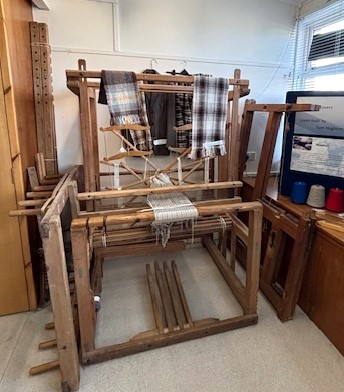
Unst Heritage Center, Shetland. Some woolen goods, like these scarves, are still made on a handloom and can be found for sale in shops throughout Shetland. I bought a rose-colored lambswool tartan scarf in Edinburgh. Mine was made on a factory loom by Lochcarron in Scotland.
I never again tried to knit anything that required I gauge my stitches so the left side of something would match the right side of something. I gave up after one try. I’m like that with some things: I’ll quickly throw in the “mismatched slippers” and call it a day.
I took one year of high school math. I studied hard, but I struggled and I hated it. Thankfully, at that time the state and my high school only required one year of math. As sophomore I took German instead of geometry. I did the same with downhill skiing. I tried it once. I fell every time I went down the slope, and I nearly broke my arm while using the tow rope. I never went downhill skiing again. My attempts at cake decorating, shorthand, sewing clothes, woodworking, and agility training with my dog Ziva met the same fate.
But I can be tenacious. My younger sister learned how to ride a bicycle before I did. I couldn’t get the feel for balancing my body on the bike. But I wanted freedom from training wheels, so I spent hours practicing in our driveway. The first time I went roller skating, I fell again and again. But during the moments I managed to remain upright, I loved it. So, I kept going. The same for cross-country skiing. I kept falling and getting up, wondering if I’d ever maintain my balance on the skinny skis, but I loved it. So, I kept getting up. For years bicycling, roller skating, and cross-country skiing were some of my favorite pastimes.
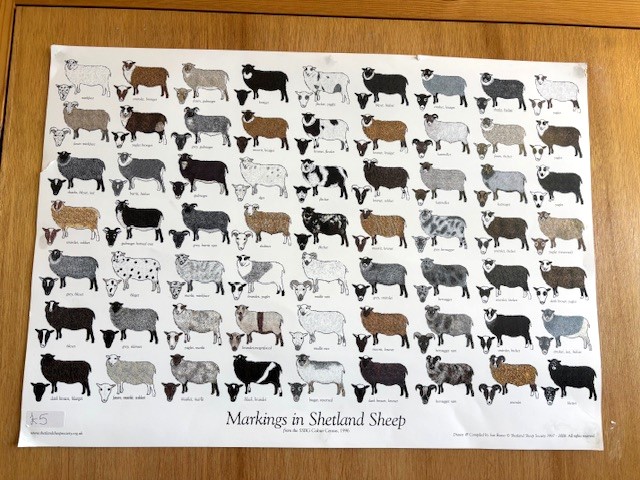
There are almost 300,000 sheep in Shetland, and about 23,000 people! We saw sheep everywhere. This guide to sheep markings is displayed in the Unst Heritage Center.
I took three years of Spanish in high school. Although I sometimes struggled with pronunciation and didn’t grasp the verb tenses, I took Spanish in college because I loved learning a language. I still remember the day, when the Spanish verb-tense thing clicked for me. Professor Stevenson stood in front of an antiquated blackboard in Old Main delivering a lesson about verb tenses. He wore a pair of dress trousers, a white shirt, and a bow tie. I sat in a modern desk, taking notes. I wore a pair of faded, patched blue jeans and a pale-yellow T-shirt with the rainbow-colored word Adidas printed on the front. I’m sure my face lit up like a light bulb. At the same time, I realized that was how verb tenses worked in English. I was giddy with Spanish and English grammar knowledge for the rest of the day. I enrolled in Spanish II the following year.
Unst Heritage Center. While some of the woolen goods in the museum are for display only, the Unst Heritage Center does sell pieces that are handmade by local crafters. The woman working in the museum on the day we visited was busy knitting.
So, what makes the difference between something I’m willing to keep working at and something I give up on? It depends on the amount of joy I experience in between my feelings of frustration and inadequacy. If there is something I love about the new activity I’m learning, I keep going, even if I look foolish while others are quickly grasping the skills. I don’t care about becoming an expert. I just enjoy my level of competence. I never learned to roller skate backwards or do spins. I never became a fast cross-country skier. I’m not fluent in Spanish. I’ve never again attempted to knit anything other than a scarf, but I love knitting them. I’ve made them for my grandmothers, mother and mother-in-law, sisters, nephews, nieces, grandkids, and friends. I love the meditative, mindless, repetitive movements of combining purl and knit stitches as I watch the colors and patterns meld together.
My scarf: I’ve never seen yarn with a gradation like this. It’s stunning. I love how the colors change — not all at once, but rather slowly and as if they can’t quite make up their minds.
I’ve never regretted giving up on high school math classes or advanced knitting or downhill skiing or any of the other endeavors I tried briefly then ditched. But we’re taught to try and try again. If at first you don’t succeed, try again. The only failure is giving up. Give 110%. If you’re not failing, you’re not trying. Fall down eight times, get up nine.
But sometimes failure teaches us when it’s time to cut bait and walk away. To stop banging our head against the wall. To stop throwing good money after bad. To stop turning the other check, only to have that one slapped too.
Failure is normal, and sometimes we have to keep at it, and in the end, we’re glad we persevered. But failure can be a way of telling us that maybe we aren’t suited to something. That sometimes it’s okay to give up, and knit scarves.
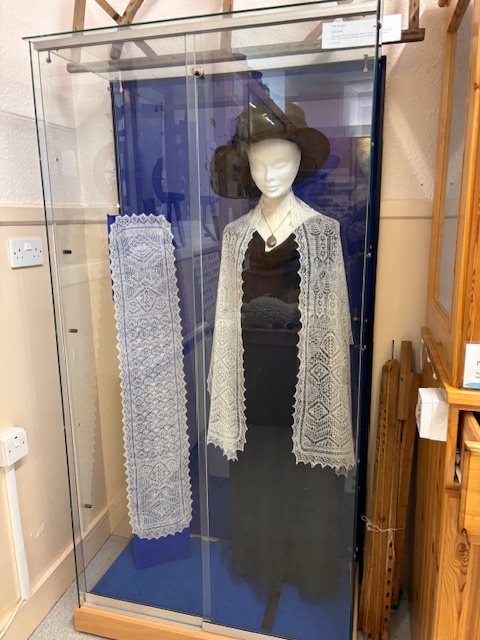
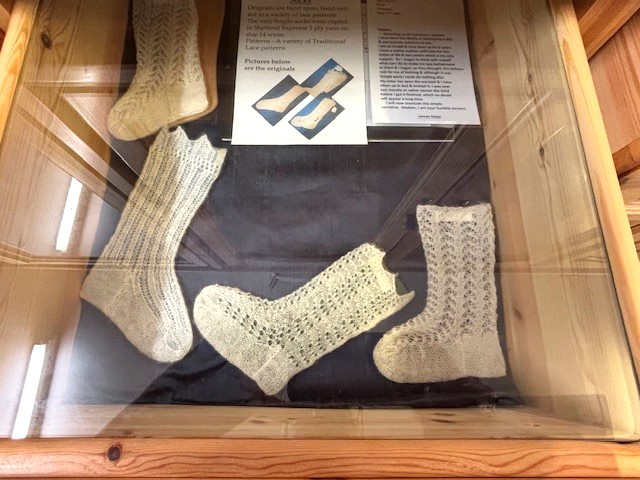
[The pieces below are knitted with a very fine wool. They take a crazy amount of hours to complete. The delicate scarves, shawls, and baby garments are used for life’s special occasions, such as weddings and baptisms. Whether made by a family member or purchased in a shop, these pieces are treasured and passed down through generations. I saw some exquisite lacy shawls and baptism gowns for sale in local shops in Shetland. They cost two to three times more than wool Shetland sweaters, reflecting the time and skill needed to produce them. And I’d bet the artisans are still woefully underpaid.]
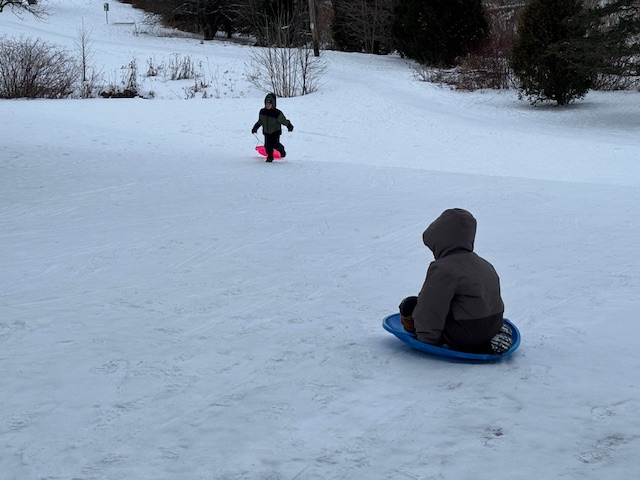
Evan coming up the hill and Charlie going down the hill. Because the weather was about 15 degrees colder than the day before, we had the hill to ourselves.
On Monday and Tuesday, both warm winter days, my grandkids and I drove by Central Park numerous times while running errands. Not the famous 843-acre Central Park in New York City, but the Central Park in my hometown, around ten acres in size. Each time we drove by, we saw children sledding down the hills at the western side of the park.
“Can we go sledding there?” Evan, the nine-year-old, asked each time we passed it.
“If you bring your snow pants with you tomorrow, I’ll take you sledding,” I said. “But it’s supposed to be below zero in the morning.”
On Wednesday, the grandkids came with their snow pants, and the morning temperature was actually fourteen degrees, so after breakfast we stowed the sleds in my van and went sledding. I wore long underwear under my jeans, thick wool socks inside my boots, and a wool sweater under my down coat. To complete my winter ensemble, I donned a thick stocking cap, slipped my hands into a pair of lined mittens, and wrapped a scarf around my neck. But I knew it wouldn’t be enough, and that I would be cold while standing on the hill in the park as the wind circled around me.
“What if they have sleds there we can use?” Evan asked as we drove to the park.
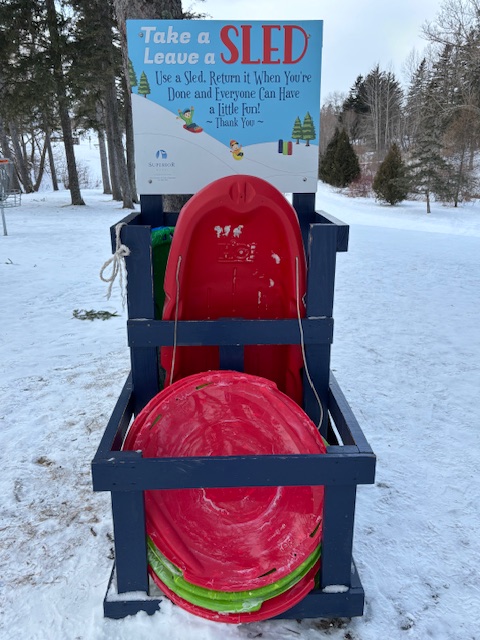
The parks & rec department in my town does a wonderful job.
“I don’t think so,” I said. I didn’t believe the city would spend money to provide sleds, only to worry about them being pilfered or broken. But when we arrived at the hill, there was a rack filled with sleds and topped with a tiny poem: “Use a Sled, Return it When You’re Done and Everyone Can Have a Little Fun!”
I’d been the one with the jaded heart, but my city’s parks & rec department had faith in its young citizens. “Look, Evan,” I said, pointing at the sign, “you were right.” My grandsons mostly used their own sleds, but occasionally borrowed one of the saucer sleds from the rack.
Peals of laughter and shouts of joy filled the air as they sped down the hill. I pulled my phone from my pocket to take some pictures and to look at the time — only five minutes had passed and I was already freezing. At that moment, as if to mock me, Old Man Winter exhaled a powerful gust of frigid air. I huddled next to a pine tree, but the narrow trunk did nothing to protect me from the wind’s icy breath. I wanted to go home, but anything less than a solid thirty minutes on the hill, and my grandkids would be disappointed. They were having a great time.
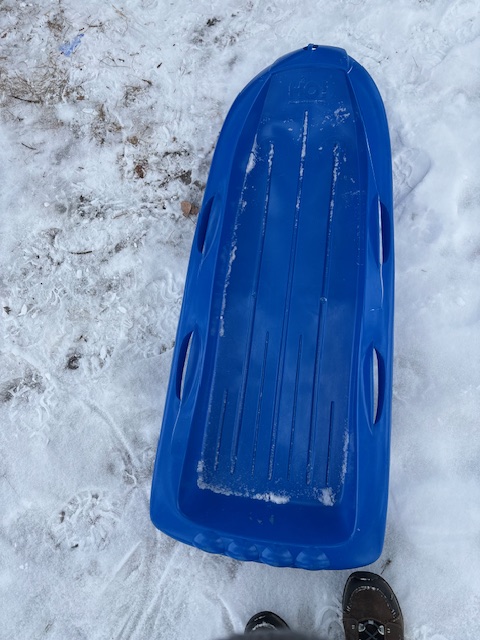
My chariot of fun!
I decided I had two choices. I could stand on the hill and freeze, or I could hit the slopes. I placed a blue sled at the top of the hill and looked down at it.
“Nana, are you going to sled down the hill?” one of the grandkids asked.
“Yes,” I answered. I gazed at the sled and remembered how much I loved sledding when I was young. Plus, there were no adults around (like my husband) to ask, “Do you think that’s a good idea at your age?”
With grins on their faces and anticipation in their hearts, my grandsons waited to see Nana “bomb” down the hill. They knew I could do it.
Successfully, but not too gracefully, I lowered myself into the sled. I pushed off with my hands and raced down the hill, bobbing up and down on the slightly uneven terrain. By the time I used my feet as brakes to stop the sled before reaching a line of trees along a frozen creek, I felt much warmer.
Was it the thrill of the ride that pumped blood through my veins and warmed my body? Or was it the memory of getting a toboggan for Christmas as a girl and using it to sled at Whitnall Park throughout my childhood and teenage years? Either way I was ecstatic as I walked back up the hill with my sled in tow. I wasn’t cold anymore. The key to being outside in winter is to keep moving and have fun.
I went down the hill many times. I felt ageless, still capable of doing something I did when I was young. Dopamine filled my brain, and I was over-the-moon happy.
We stayed for forty minutes. On our way back to the car, Evan asked if we could come back in the afternoon.
“Sure,” I said, and I meant it. I wasn’t just saying it in the moment, figuring I’d find a way to back out later on. Sometimes we do that as adults. But like my grandkids, I wanted to go sledding again, even if it meant the dishes didn’t get done or supper would be late.
I fed the boys lunch then took them to the library for a kids’ craft hour. I went to the grocery store for ingredients so I could make chicken enchiladas after our second round of sledding.
We returned to Central Park just before three o’clock, and stayed for more than a half hour. This time I didn’t wait to get cold. I grabbed a sled immediately and began zooming down the hill, loving the speed and the winter’s air that filled my lungs, caressed my face, and returned me to my youth.
Sledding with my grandkids was the most fun I’d had in a very long time.
I made a New Year’s resolution to behave like a child more often.
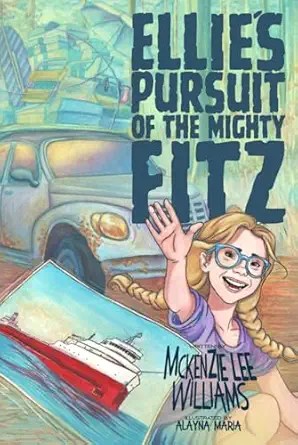
Published in hard cover, Williams’s book is durable and easy to wipe clean, making it perfect for young hands.
What is this book about?
It’s the day before spring break at Great Lakes Grade School. All of Ellie’s fifth grade classmates have travel plans. Her best friend, Mike, is going to London with his family to see Big Ben. Ellie worries her friends will return after spring break with wonderful objects and stories for their last fifth-grade show-and-tell, and she will have nothing to share because she isn’t going anywhere. She hopes her father will surprise her with a last-minute trip. But, Ellie’s only surprise is that Grandma Gigi is spending the week because her father has to go on a business trip.
While riding home after school with her father, Ellie hears Gordon Lightfoot’s song “The Wreck of the Edmund Fitzgerald” for the first time. After listening to the song, she has lots of questions about the Fitzgerald. Later she talks to Grandma Gigi about the Fitz and her recently deceased Grandpa Loren, who also sailed the Great Lakes, and even knew some of the sailors from the Fitzgerald. Ellie and her grandma decide to drive from Superior, Wisconsin, to the Great Lakes Shipwreck Museum on Whitefish Point in Michigan. They want to see the bronze bell from the Fitzgerald and to learn more about the ship and its sinking. Perhaps Ellie will have something special to share at her last show-and-tell as a fifth grader.
What makes this book special?
Delightfully written by Mckenzie Lee Williams and beautifully illustrated by Alayna Maria, this chapter book will appeal to children ages eight to twelve years old. I really enjoyed this story, and I read it in one evening. Ellie, the main character and narrator, captured my heart. She is enthusiastic, adventurous, curious, and kind. She loves learning and writing in her journal, and if you’re a writer, you’ve got to love a journal-toting character. Told with tenderness and gentle humor, this chapter book explores themes of disappointment, grief, remembrance, and resilience. Young readers will enjoy taking a road trip with Ellie and Grandma Gigi. Along the way they will learn about the Edmund Fitzgerald, the Great Lakes, and the enduring power of love. Now, I want to visit the Great Lakes Shipwreck Museum on Whitefish Point.
A special note about the author, Mckenzie Lee Williams. . .
Mckenzie Lee Williams died in a motorcycle accident in June 2024. She was twenty-three years old, a recent college graduate, and a writer. She was inspired to write Ellie’s Pursuit of the Mighty Fitzgerald when she worked at a bookstore. Customers would inquire about books regarding the Fitz for children, but there was little available. So, Williams decided to write a chapter book. After her death, her mother discovered Williams’s draft of Ellie’s Pursuit. With love and dedication, Williams’s family and friends edited and illustrated her manuscript. Like the bronze bell from the Fitzgerald, Williams’s book is a symbol of spirit, dedication, and love.
I never met Williams but she and I both had work published in the 2024 Nemadji Review at the University of Wisconsin-Superior. I was saddened when I heard about her death. Ellie’s Pursuit of the Mighty Fitzgerald is a lasting tribute to Williams and her talents as a writer.
My story collection has a title! I’ll debut the cover when that is done.
In February 2027, the University of Wisconsin-Stevens Point will publish my collection of short stories through Cornerstone Press, their university press. I’m excited, and nervous, and grateful. This is my first book, and like a first-time parent, I’m not sure what to expect, so I gather information. I talk to other writers who have published books. I attend book launches and author talks. I read blogs and articles and attend seminars about how to nurture a book in the world.
When Cornerstone accepted my manuscript, my publication date was more than two years away. But now it’s about fifteen months away, and if there is one thing I know about time — it’s how quickly it flies. I need to promote my book, and for that it needs a title.
When I submitted my collection in November 2024, it was called Fishing Around in the Dog Days of Summer, after one of the stories in the book. I chose the title for a couple of reasons. First, I really like its eponymous story about two young sisters with a tenuous relationship who go crayfishing on a hot, humid August day. Second, all the characters in my short story collection are fishing around for something they want. They each dip a line in the murky waters of their lives during their own dog days, hoping to catch something they long for.
But as much as I liked my original title, I began to feel it was too long and would be hard for people to remember. And I worried if the cover depicted a fishing scene along with the title, potential readers might think all my stories were about fishing.
I looked at my table of contents and considered other story titles. “Silent Negotiations” jumped out at me. It’s short and easy to remember, and it’s another story I really like. In 2020, it won second place in the Hal Prize Fiction Contest. (So, I feel the title has good mojo.) In the story a couple who have been married over forty years renegotiate the parameters of their marriage during a disagreement. Each spouse speaks their mind, but only to a point. The rest of their negotiations are silent, yet significant. The characters in my other stories are like the old married couple in “Silent Negotiations.” They all want something. They all talk to each other, but they leave things unsaid. And what is left unsaid, changes who they are with one another and themselves.
After I decided to change my title to Silent Negotiations, I asked my writing friends and readers what they thought. They had all read my stories several times, so I knew they would be good judges as to whether or not the new title would be a good fit for the collection. They all loved Silent Negotiations.
Last weekend I attended the Wisconsin Writers Association Conference in Stevens Point. The Cornerstone Press editors were there too. I talked to Dr. Ross Tangedal about using Silent Negotiations as my title. He liked it too, and so did his student editors.
My book has an official title!
Now, I’m excited to see some cover designs. Before I know it, Silent Negotiations will be out in the world.
I’m hoping to use this picture for my author photo. Photo credit: Max Youngquist
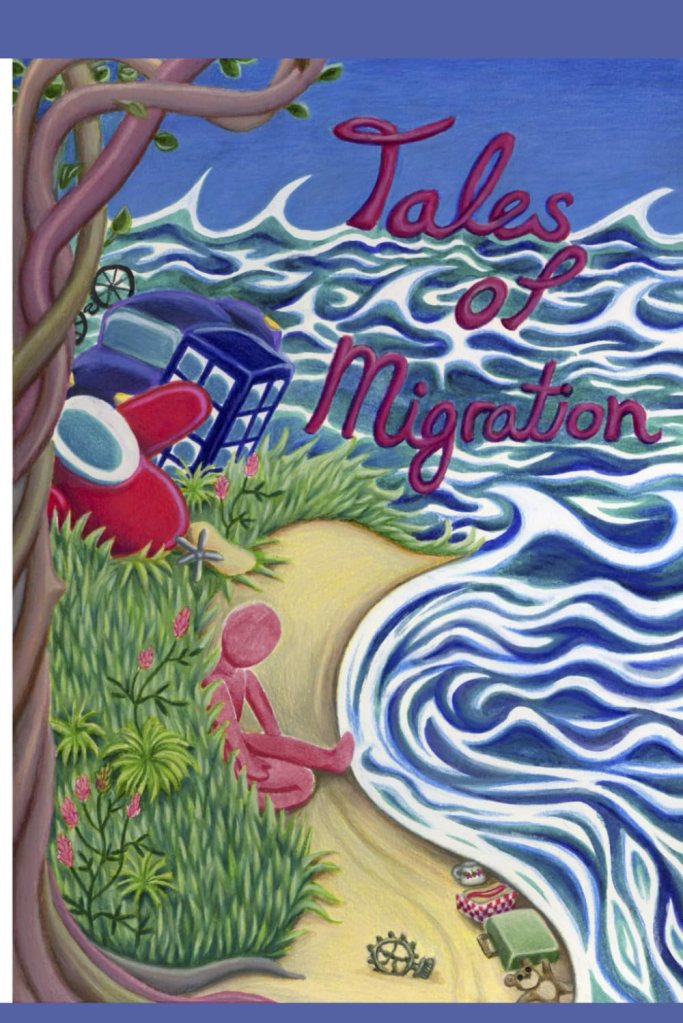
My essay “A Journey with Monarchs” was recently published inTales of Migration by Duluth Publishing Project. Professor David Beard (University of Minnesota-Duluth) and a group of his students spearheaded this project, from the call for submissions to the finished project. This is the second time I’ve had an essay selected for one of their anthology projects. I appreciate the hard work and dedication of Beard and his students, who all strive to make the experience memorable for their writers. In the spring after the selections are made, they always host a reading, and invite the writers to read their pieces. It’s a wonderful time. I enjoy meeting the other contributing writers, and listening to them read their work.
The inspiration for my essay
My essay was inspired by a monarch I saw in Petoskey, Michigan, on a chilly October day. The monarch clutched a pink cosmos flower, and it didn’t move when I approached it. Its behavior so intrigued me that I began to research monarchs and their migration habits. My essay is a creative nonfiction piece of nature writing. For the nonfiction part, I carefully researched all of the information by reading books and online articles from reliable sources. For the creative part, I used some literary devices that I hoped would make the essay enjoyable for people to read while learning about the wondrous migration of monarchs.
[The Tales of Migration anthology is available on Amazon. For more information, click here.]
I’ll never forget the reading for Tales of Migration because I got lost . . .
After this year’s reading, I struck up a conversation with one of the poets whose work appears in Tales of Migration. I had met her the year before when we both read our pieces from Tales of Travel. We left the meeting together and kept visiting. We had parked in different lots, but I kept walking with her because I enjoyed her company and conversation. I figured I would just walk around the outside of the buildings and return to my car. After all, it was a nice sunny evening, the UMD campus wasn’t that big, and I hadn’t gone that far out of my way.
Ha! It didn’t work out as I planned. After I exited the building with the poet, she walked off to her parking lot. I turned the opposite direction and walked off to my car. But I couldn’t find the lot in which I had parked. I walked around buildings. I set the GPS on my phone to walk mode, but it was no help. It was around 7:00 on a weeknight and the campus was devoid of students.
I walked in circles for almost twenty minutes. If it had been dark, I would have been panicked. But the skies were a bright, beautiful blue and considering what spring can be in Duluth, it was fairly warm. I have such a poor sense of direction to begin with, and faced with a random placement of large buildings connected by a maze of passageways, I began to feel stupid and frustrated. I felt trapped inside a bad episode of The Twilight Zone.
I decided I needed to reenter the doors I had exited from with the poet. I retraced my steps back through the liberal arts building and to the room where I had done my reading. From there I felt I could find the engineering building that I had walked through on my way to the liberal arts building before my reading.
But it wasn’t that easy. I had gotten so turned around and addled that I had a hard time remembering how I had originally come through the buildings, which were connected by long and meandering hallways. And to complicate matters, the floor levels in one building don’t always match up to the floor levels in the next building.
I asked a student if he could give me directions to the engineering building. He shook his head and said, “I don’t know. I’m a liberal arts major.”
“I was a liberal arts major, too,” I said, as if that explained why I was lost. He was not the only person to apologize about not being able to direct me to the engineering building. Perhaps liberal arts majors aren’t hardwired to locate engineering departments. On a large campus, many students may never need to visit certain buildings. I went to a small college, and I had classes in every building on campus.
Finally, someone was able to help me. Once I found my way into the engineering building on the correct level, I recognized where I was and located the right exit. My car was where I had left it. Dusk was descending, and I was relieved. It’s not fun being misplaced.
I had known all along where I was, and yet I had been so lost and turned around at the same time. I thought about the irony. I had just read for Tales of Migration, filled with poems and essays about moving from one place to another, sometimes covering thousands of miles. I thought about migrating people all over the world who would know the names of their new homes, yet still be lost and turned around, arriving in a land they had never been before, whose culture they had never experienced. They would have mazes and passageways to navigate, all of which would play out over years, instead of the thirty minutes in which I had been lost.
A happy pollinator on the first flowers we encountered
Two years ago I took my four grandkids to a rose garden. We smelled the roses, walked along Lake Superior, ate ice cream, and tossed rocks in the water. Then we did it again last year. So, of course, we had to do it again this year. It’s a tradition now. When my grandkids are grown up and old, they will say to each other, “Remember when Nana took us to the rose garden every summer, and we’d get ice cream then throw rocks in the lake?” Just like I recall my nana taking us to George Webb, Sherman Park, and Capital Drive, and letting us use her galvanized steel wash tubs as swimming pools on hot days.
Can you find the pollinator in the rose?
We arrived at the rose garden, which also has other flowers. We spotted bees slurping nectar. My oldest grandchild took photos of the bees and roses. I took photos of the bees and roses. My other three grandkids watched the bees and smelled the roses. We all love the flowers and bees. I like to refer to bees as pollinators, like it’s a royal title and the bees belong to a noble class. Watching pollinators feed on flowers gives me hope for the world. If you want to help create hope, plant something pollinators like, and make sure it’s pesticide free.
As we smelled the roses, we took care to look for bees before sniffing. We didn’t want our noses stung, or egads, to inhale a bee. We visited the rose garden a couple of weeks later than we normally do, so we missed the peak bloom. But the roses that had waited for us didn’t disappoint.
My grandkids love the functioning water fountain, a focal point in the garden. I handed out pennies for wishes. They splashed their hands in the water. One of them found a small, round, flat stone painted with the message Make a Wish. I think more than one of them would have liked to climb into the fountain. Kids and water just go together. The summer I was twelve, my siblings and I spent three weeks with our grandma Olive. Every day we begged her to take us to Bluegill Lake so we could swim. The fountain in the rose garden was originally located in a different part of the city, where it supplied fresh water for horses in the days before automobiles. Everything changes.
After spending time with the roses, we headed down the Lakewalk, and enjoyed the views of Lake Superior. Later, on our way back, my youngest grandchild stopped at several of the park benches and assessed the views, commenting on each one. Perhaps, he is a budding travel writer.
On our walk from the gardens to the ice cream shop, we always stop at a large stone stage. Flanked with two stout turrets, it has a castle vibe. My grandkids ran across the stage and through the hidden passageways behind it, then suddenly appeared once again. Their laughter and excited shouts to one another rang through the air. I thought about Shakespeare’s famous line, “All the world’s a stage,” followed by his musings about the “seven ages” of life from infancy to old age. I stood on the stage with my grandkids, yet apart from them, separated by several “ages” of life.
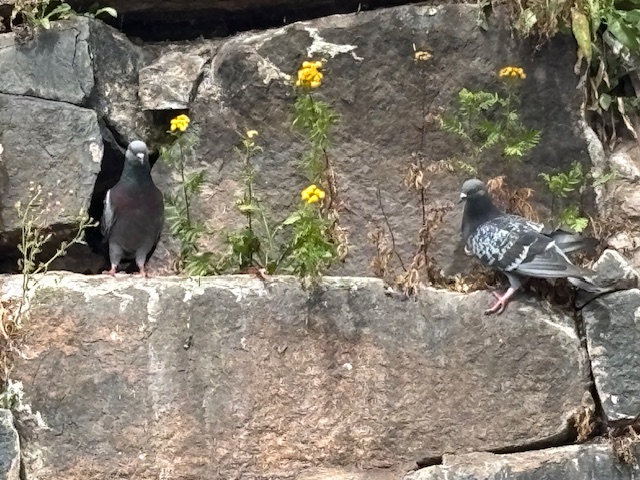
Peaceful pigeons
The cooing sounds of pigeons who nest in the nooks of a stone wall along the railroad tracks captured the attention of my grandkids. One grandchild was impressed by the range of their colors and the variety of their markings. And the other three started a cooing conversation with the pigeons. I have to say, the cooing sounds my grandkids made were impressive, but finally I said, “What if the pigeons hear your coos as a battle cry and attack?” Yes, you got it, I was thinking about Alfred Hitchcock’s The Birds. I saw the movie once, years ago, and I’m still miffed Hitchcock killed off Suzanne Pleshette’s character in the movie! She was one of my favorite actors.
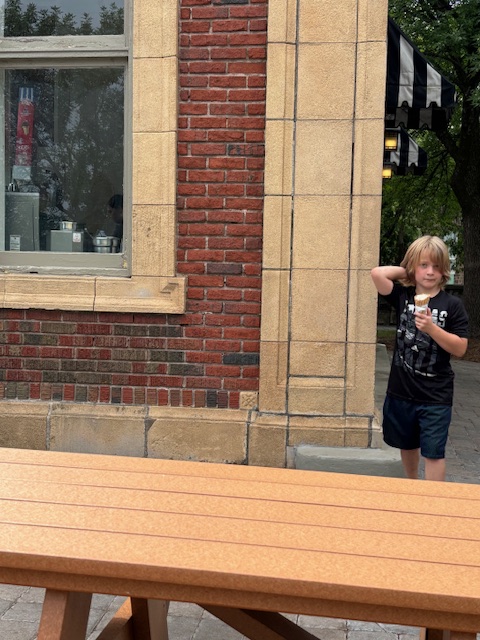
If you asked my grandkids what they liked best about our adventure, they would probably say the ice cream. It’s what I would have said when I was their age. The picnic tables at the ice cream shop were new and so was the chocolate mint ice cream used to make my malt. For thirty years I’ve been ordering chocolate mint malts, made with the same minty ice cream filled with thin, flat pieces of dark chocolate. This year the ice cream was a little too minty and the thin, flat pieces of chocolate were replaced by mini chocolate chips. It was good, but not as good as it used to be. Next year I’m going to order a different flavored malt. Maybe I will find a new favorite. The clerk at the shop said they could no longer get the same kind of chocolate mint ice cream. All things change. But don’t ask me to say change is good when it comes to my ice cream. Some wasps hung out with us while we ate our treats. None of us panicked, but neither did we share our ice cream with them.
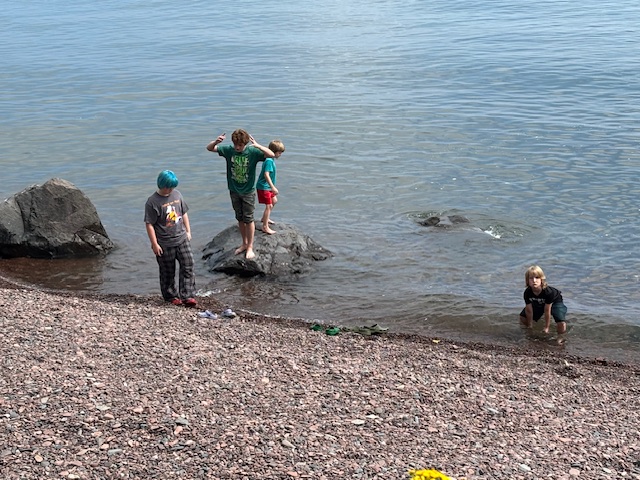
Our next stop was the lakeshore filled with rocks waiting for my grandkids to toss them back into the water. Now that they are older, they try to skip the rocks across the water instead of just throwing them. I planned to let them stay ten minutes, maybe fifteen, but they were having so much fun with each other. I watched them toss rocks, look for agates and beach glass, and play with driftwood, and suddenly I could see my siblings and myself on the sandy shores of Bluegill Lake seining for minnows, building sand castles, and floating on inner tubes in the water. I marveled at how long ago that was and yet how quickly the years had passed — in the snap of a finger. We stayed for more than a half hour. This was the best part of my day. Because while my grandkids on the beach had no idea how quickly time would slip by, I did.
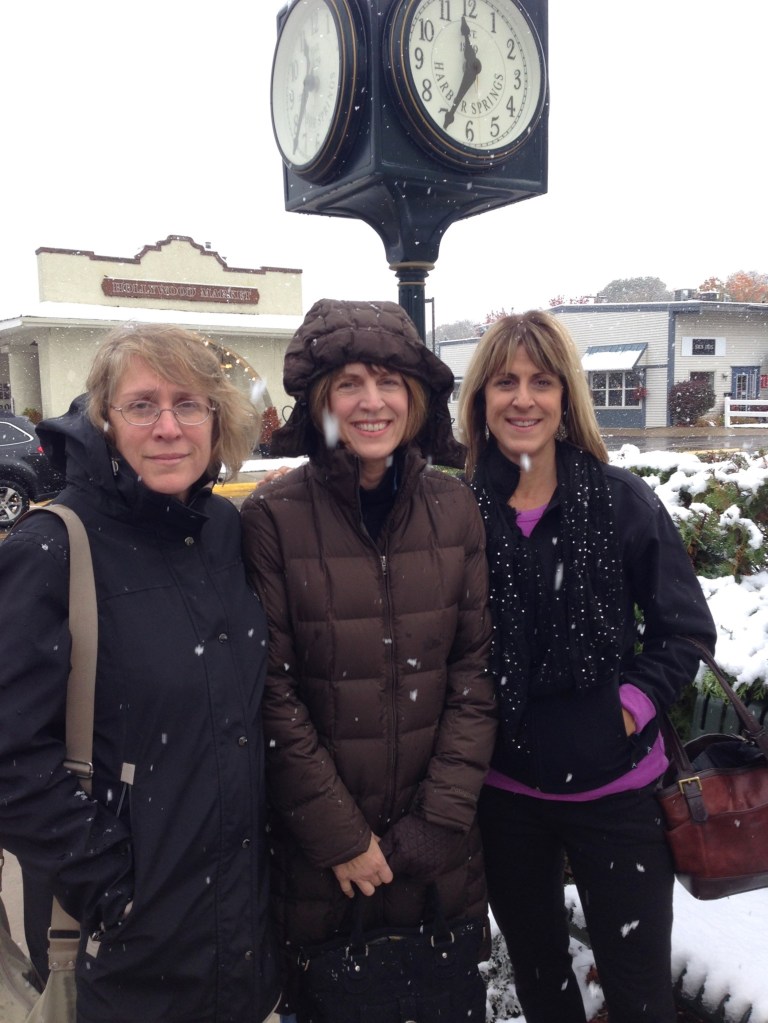
My sisters and I — three backyard campers all grown up. I wish I had a picture of the three of us camping in the backyard. But we didn’t do anything picture-worthy — like catch a fish. (This photo was taken in October 2015 at a farmers market in Harbor Springs, Michigan. And yes, the white stuff is snow!)
I write for Northern Wilds, a local magazine based in Grand Marais, Minnesota. A couple of months ago, the editor put out a call for the magazine’s contributing writers to submit mini essays about camping traditions. I wrote one about my backyard camping trips, the only kind I ever took as a kid.
My essay was published in the August issue of Northern Wilds. To read my essay in the web format, click here and scroll down. To read it in the magazine format, click here, and click to pages 20-21.
And whichever way you choose to read it, I hope you enjoy the camping essays written by my fellow writers.
On the first day of my grandkids’ summer break, I took them to a local coffee shop. I ordered them fancy fizzy soda concoctions and let them each pick out a piece of bakery. I ordered myself a small latte and no bakery. The time with my grandkids — priceless. The cost of the trip to the coffeehouse — more than five happy meals at McDonald’s. I had sticker shock when the clerk gave me the total, but I acted like I spent that much in coffee shops all the time.
I handed the clerk my credit card and refused to think about the cost. Afterall, the soda concoctions were works of performance art served in 16-ounce glasses, mixed with fun flavors like watermelon, pineapple, cherry, coconut, and strawberry and topped with whipped foam. I almost wished I had ordered a fancy fizzy soda. As the clerk handed the first soda to one of my grandkids, she said, “Stir the soda very gently with the straw a few times. If you stir it too fast, it will overflow the glass. Then drink a little bit of the soda, and mix it some more.”
We were five minutes into sipping, noshing, and gabbing when out of the corner of my eye, I noticed a slightly built, older man walk into the shop. Dressed from head to toe in dark colors, he carried a small black grip, which he placed on a chair. He picked up a large dinner-plate-sized planter filled with succulents and moved it to a table where a younger man sat eating a bowl of food. This didn’t bother the younger man, who wore headphones and watched his computer screen.
The older man removed his black jacket and slipped on a whitecoat, the type doctors wear. I stopped paying attention to him because the grandkids and I were tasting each other’s sodas. Thankfully, they didn’t ask to try my latte; although, I would have been a good sport about it.
A short while later, the man in the white coat appeared at our table. The name Dr. Twist was stitched above his left pocket. In his hand he held a purple dog made of balloons. He gave the balloon dog to my six-year-old grandson. He twisted up more balloons, making a green crown with an alien’s face, a yellow crown with a funny face, and a brown monkey, which he gave to my other three grandkids. He made a balloon flower for me, which I took home and put in a crystal vase. Besides being good with balloons, Dr. Twist had a great table-side manner, cracking deadpan jokes and making us laugh.
I don’t think Dr. Twist was a planned event at the coffee shop. I got the impression the balloon doctor was a free spirit, showing up on a whim, twisting up fun, then leaving smiles and laughter in his wake.
After we finished our treats, we bussed our table, and balloons in hand, we thanked Dr. Twist again.
It was a windy, blustery Winnie-the-Pooh day, so as we left the coffee shop, I warned the grandkids, “Hang on tight to your balloons or the wind will take them.” We’d made it to the van and were almost inside — when a sudden gust of wind snatched the yellow crown balloon with the funny face from my eight-year-old grandson’s hand.
As one, and without a spoken plan, we secured the rest of the balloons in the van and gave chase. The untethered balloon swirled up and down alongside the building in the wind. A couple of times we came close to catching it, but at the last second, the wind, in a game of keep away, would lift it high into the air. Finally, the wind carried it into the busy street.
Released from the updrafts surrounding the building, the balloon dropped to the pavement. We watched as a semi-truck approached, sure the balloon would burst beneath its large tires. Miraculously, the yellow crown with the funny face survived. The wind gently ushered it onto a quiet side street, where it came to rest against a curb.
When the balloon stopped moving, I ran across the busy street, hoping to grab it. Don’t worry, I exercised plenty of caution. I understood it would not be a good look to be hit by a vehicle while rescuing a balloon. I thought about the online news articles reporting on a dim-witted nana who was run over by a car while trying to catch her grandson’s balloon. I imagined being trolled by online commentators, who would all come to the same consensus: “Yeah, that lady was stupid” and “Darwin’s theory in action.”
So, I waited for traffic to clear, then I ran across the street. In that moment I suffered a pang of vanity, and I wondered just how strange I looked while dashing madly through the crosswalk. But I assured myself that anyone who may have taken notice of me had surely seen stranger things than someone’s nana chasing a balloon. Then, I wondered if anyone was taking a video of me to post on TikTok, perhaps titling it “How Not to Cross the Street.”
The balloon had waited for me on the side street, and as I reached for it, I hoped the wind wouldn’t snatch it away again. But the wind had finished messing with me. I grabbed the yellow crown, and when it was safe, I strode back across the street, all while singing in my head, My superpower is chasing balloons.
I handed the balloon back to my grandson. I thought he’d smile or tell me I was amazing. But he just looked at me — like he was trying to figure something out. I didn’t ask him what he was thinking. But I was thinking.
We all got back into the van.
“Hey,” I asked my grandkids, “Nana didn’t look funny running across the street after a balloon, did she?”
From the third-row seat came the voice of clarity. It was my oldest grandkid who reassured me, “Actually, Nana, you looked really funny.”
We all laughed.
I was glad I hadn’t let the cost of the sodas, and latte, and baked goods upset me. Because in the end, the amount of money I spent on the one-time visit to the coffeehouse wasn’t going to impact my financial security. There are plenty of disasters in life that could possibly do that, and I try not to dwell on those either.
Instead we have a happy memory, which will remain long after the air seeps out of the balloons.







 Writing Near the Lake