Other than this blog, I mostly write short stories and essays, but I had so much fun writing this article. I also took the photos and wrote the captions. One of the highlights of writing this article was interviewing Carol, the co-president of the Lake Superior Rose Society, who was more than generous with her time. She is so knowledgeable about the Rose Garden and its history, plus she knows so much about roses and their history. I learned more from her than I could possibly include in my article, but her willingness to share her knowledge gave me the confidence to write about roses, which I knew so little about.
Our community is lucky to have a publication like Northern Wilds. The articles are well written and cover a variety of topics, such as outdoor activities, artist profiles, nature, ecology, tourist venues, community celebrations, and local restaurants.
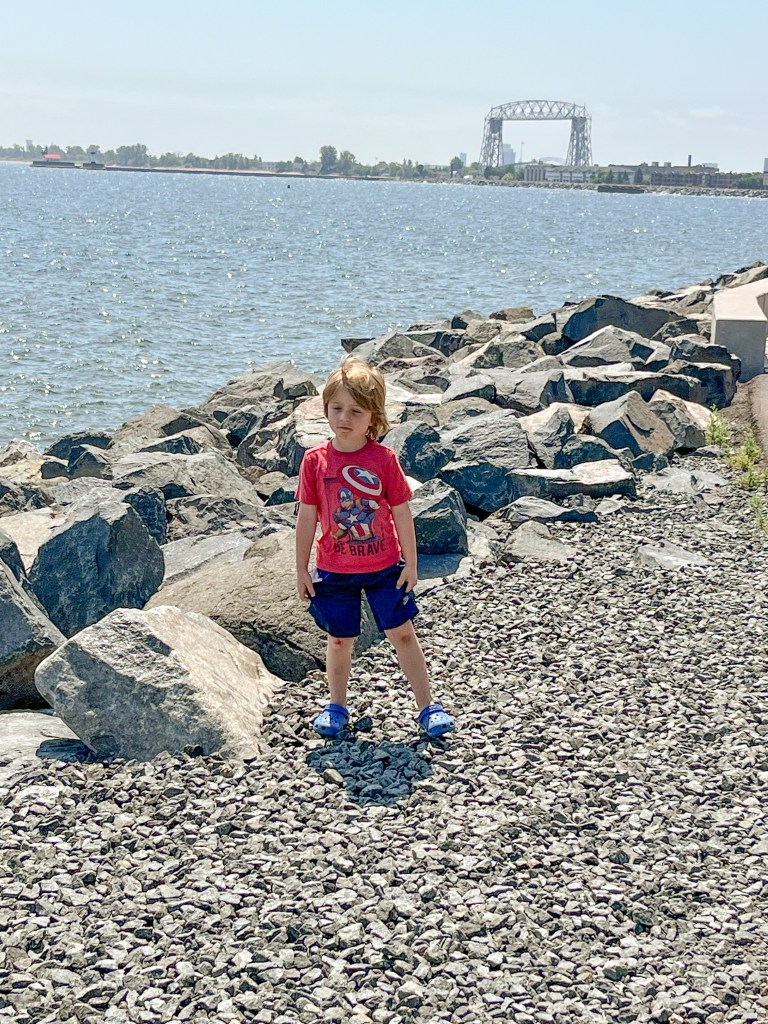
My youngest grandson strikes a pose along the Lakewalk. Check out his knees! That is how mine always looked when I was his age.
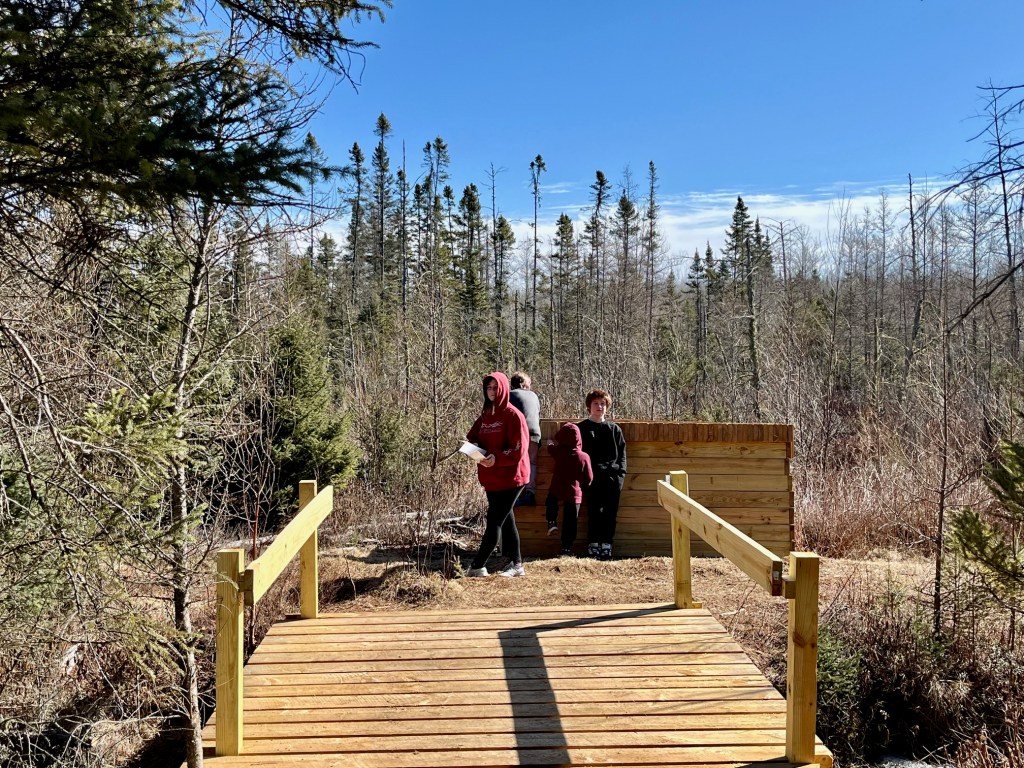
The John C. Gale Boardwalk, part of the Taiga Boardwalk built in autumn 2023
Last week I took my four grandkids to the Sax-Zim Bog in Toivola, Minnesota, appropriately located on Owl Avenue. (It’s a good place to see northern owls.) The drive from my house was one hour and four minutes. (Thank you, GPS.) The grandkids brought library books and their adventure bags, which are filled with postcards, maps, compasses, binoculars, auto bingo, bird books, and other adventuresome stuff. We weren’t one minute from my house when the three youngest grandkids took up an intense game of auto bingo, searching for cows, horses, ambulances, no parking signs, and billboards. However, by the time we were far enough out of the city to see cows and horses, the bingo game had blown over.
Of course, there is always one grandkid who wants to know: How far? How many more miles? Are we halfway there yet? Have you ever been here before?
We arrived at the bog’s parking lot about eleven o’clock. It was 52 degrees and sunny, with a slight breeze — perfect weather for walking through an old bog. But we were glad we’d worn sweatshirts over our T-shirts.
The Sax-Zim Welcome Center was closed, but we met a volunteer coming out of the building who looked like part of an illustration from a Jan Brett book. He kindly answered my questions about the trails because we wanted to walk on the new Taiga Boardwalk built last autumn.
Grandkids on the Taiga Boardwalk
Shortly after we started down the trail, a loud clattering commenced. I wondered, “What kind of bird is that?” Then I discovered two chattering squirrels chasing each other up and down tree trunks and across fallen logs at breakneck speeds like a pair of NASCAR racers. “Those are fox squirrels,” Michael, 10, said. “My grandma has them at her house.” His other grandparents live in rural central Minnesota. But, according to a post on the Friends of Sax-Zim Bog Facebook page, we most likely saw Red Squirrels. They are highly territorial, and one of them probably invaded the other’s space, which would explain their loud scolding sounds and serious chasing behavior. Whether fox squirrels or red squirrels, they were fun to watch.
As we walked through the bog’s forest, I thought about The Hidden Life of Trees by Peter Wohlleben, a book I recently finished reading. I learned a lot about trees and forests. True forests are diverse and interconnected in an amazing cycle of life and death, filled with competitiveness and cooperation, and home to a large variety of insects, animals, and other plants. Forests grown for harvesting are nothing of the sort.
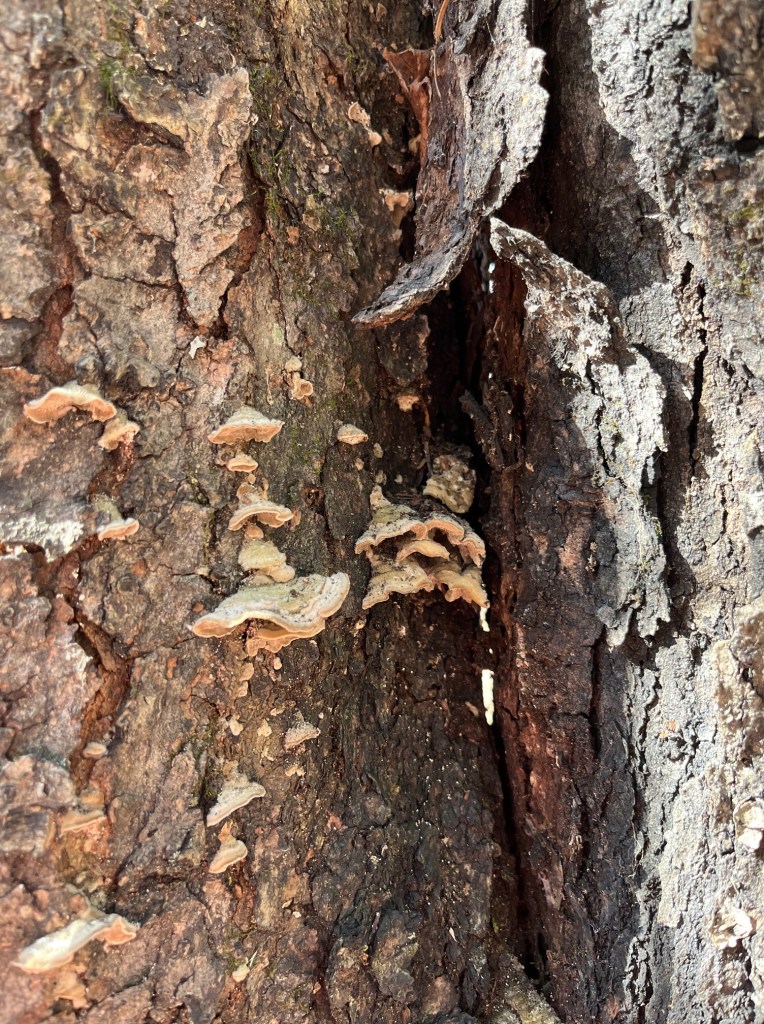
A tree near the end of its standing lifeClose up of same tree: the fungi have arrived
Walking along the trails of the bog, we saw different species of trees. New trees, only inches tall, grew under the branches of old trees. Unless the old tree dies, most, or perhaps all, of the baby trees we saw won’t make it to adulthood. Some standing trees looked nearly dead, waiting for their turn to fall to the forest floor. Tree trunks that had already fallen lay on the ground in different stages of decay, providing habitat for other creatures.
Steeped in tranquility, the breathless silence of the bog held no traffic or city noise. No planes droned overhead. Occasionally, the peaceful quiet was accompanied by the chirps and calls of birds and squirrels, which like the silence, belonged to the forest.
The Taiga Boardwalk loop is short, but it’s not meant for serious hiking. It’s a trail where visitors take their time, stopping to look for birds and animals who are masters at blending into the forest. When we finished the Taiga trail, we weren’t ready to leave the bog, so we walked a different, smaller loop. We still didn’t wanted to leave, so we walked the Taiga again.
On our second trip around the Taiga trail, Evan, 7, got down on his hands and knees, peered through the slats on the boardwalk, and said, “I see why they built this. There is water down there.” I’d told them the boardwalk was built to help keep people’s feet dry.
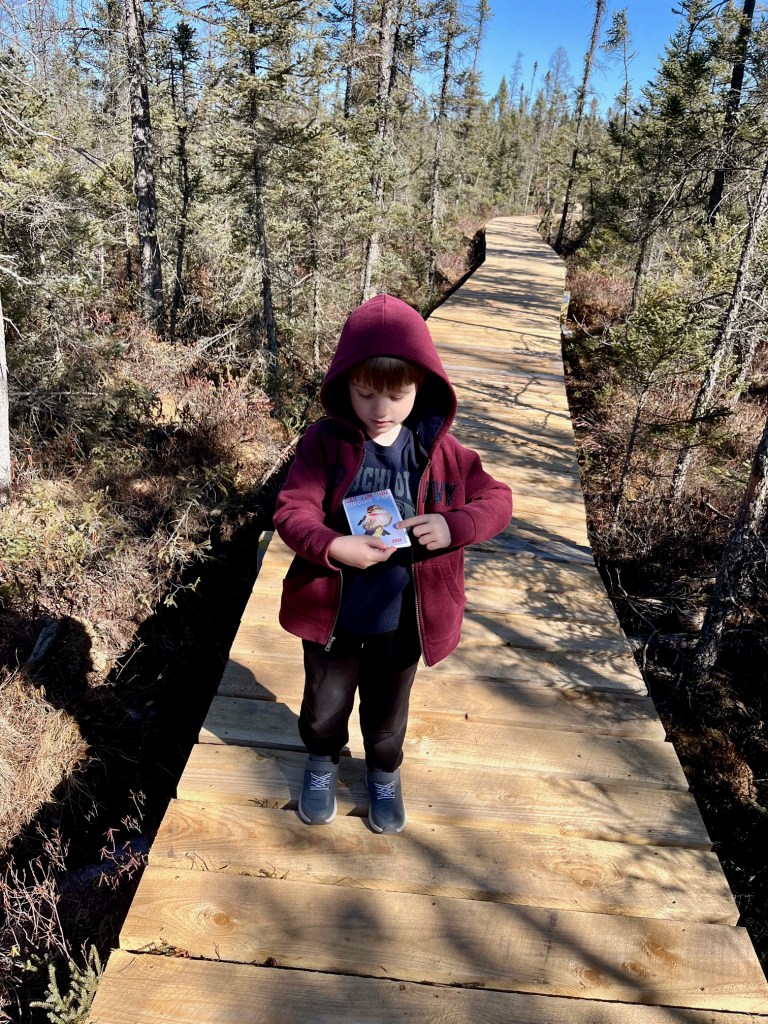
Charlie points at the common redpoll on the cover of his trail map. He said he just saw one, and he might have. Before we left the bog, another volunteer told us a redpoll had been spotted that morning.
We didn’t see any owls, but in addition to the red (or fox) squirrels, we saw chickadees, and Clara,12, spotted a black-back woodpecker.
After we finished walking the trails, my youngest grandson Charlie, 5, gave me a hug. “Do you know why I gave you a hug?” he asked. He didn’t wait for an answer. “I gave you a hug because you brought me to this bog.” I think Charlie felt what I felt: a pervasive peacefulness. As I walked through the bog, I felt a sense of increasing serenity. In The Hidden Life of Trees, the author mentions studies that show people have reduced stress levels after walking through old-growth forests. I have no data to prove that is what happened to me, but I certainly felt calmer than when I’d arrived.
Holding our trail maps, Sax-Zim Bog calendars, and warm memories, we got in the van and buckled up. I was about to start the engine when Clara pointed out her window and said, “There’s a butterfly in the parking lot.”
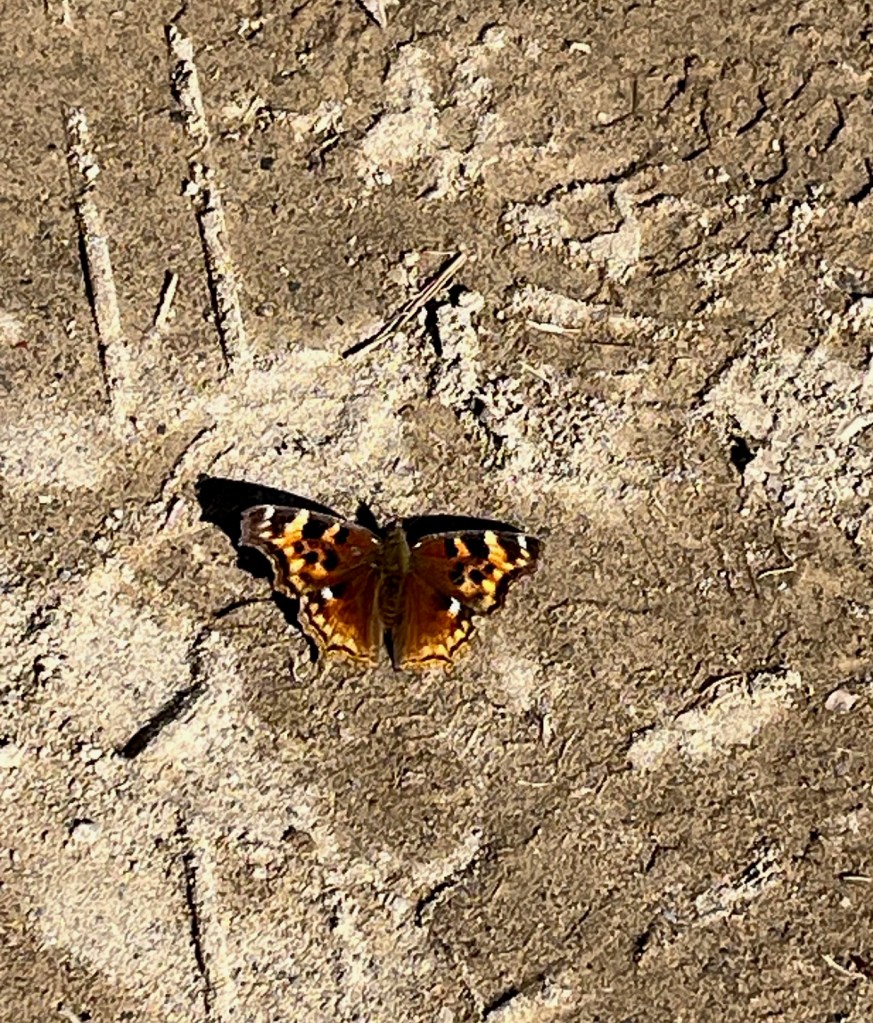
The butterfly, a Compton Tortoiseshell, sunning itself before the pickup entered the lot.
Having recently finished reading Bicycling with Butterflies by Sara Dykman, I had to get out of the van and have a look. As I was snapping pictures of the butterfly, which wasn’t moving much, a red pickup truck pulled into the lot. The only open space for the truck to park happened to be where the butterfly was resting, and the driver wouldn’t have been able to see it. Squashed butterfly, I thought. I walked toward it, and it fluttered a few feet, but in the wrong direction. Coming from another angle, I walked toward it again, and it flew another few feet, but this time it landed out of harm’s way.
The red truck parked without crushing the butterfly. Perhaps it wouldn’t have needed me to save it. Maybe it wouldn’t have been run over, and it would have flown away from the truck instead of into it. But I’m glad I didn’t leave the butterfly’s destiny to fate.
The grandkids and I left the bog and headed back to the city. As I drove down the county roads, they flipped through their calendars, enjoying pictures of the beautiful wildlife who make their homes, for at least part of the year, at the Sax-Zim Bog.
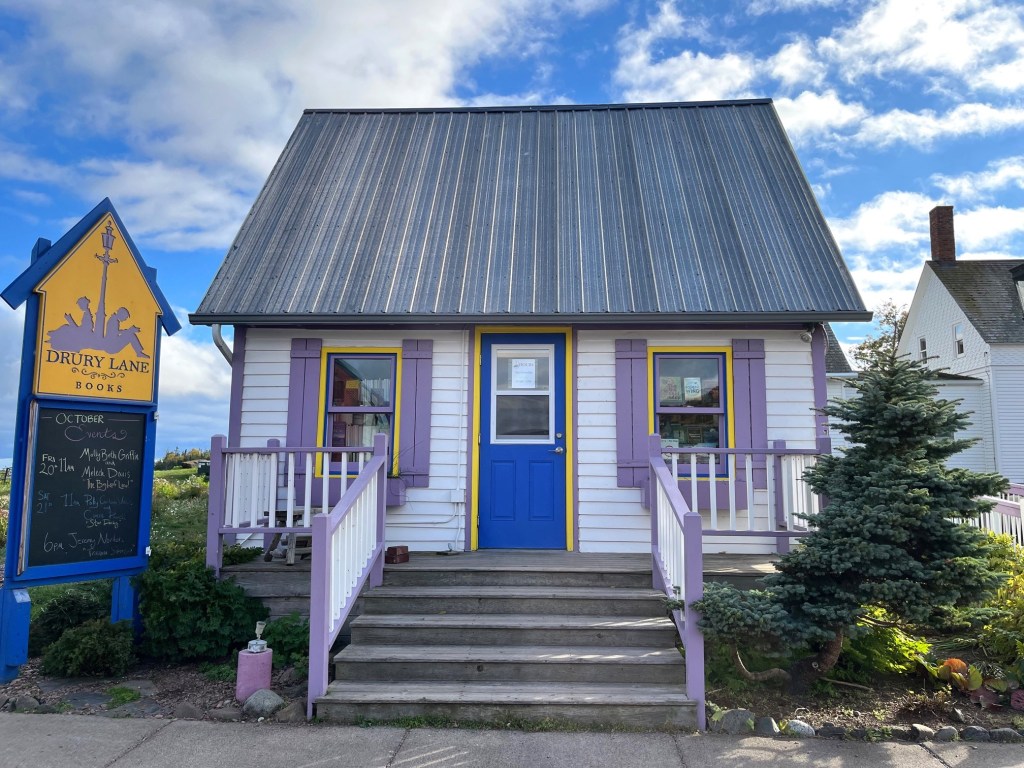
The entrance to Drury Lane: to the left is Lake Superior, to the right is a donut shop
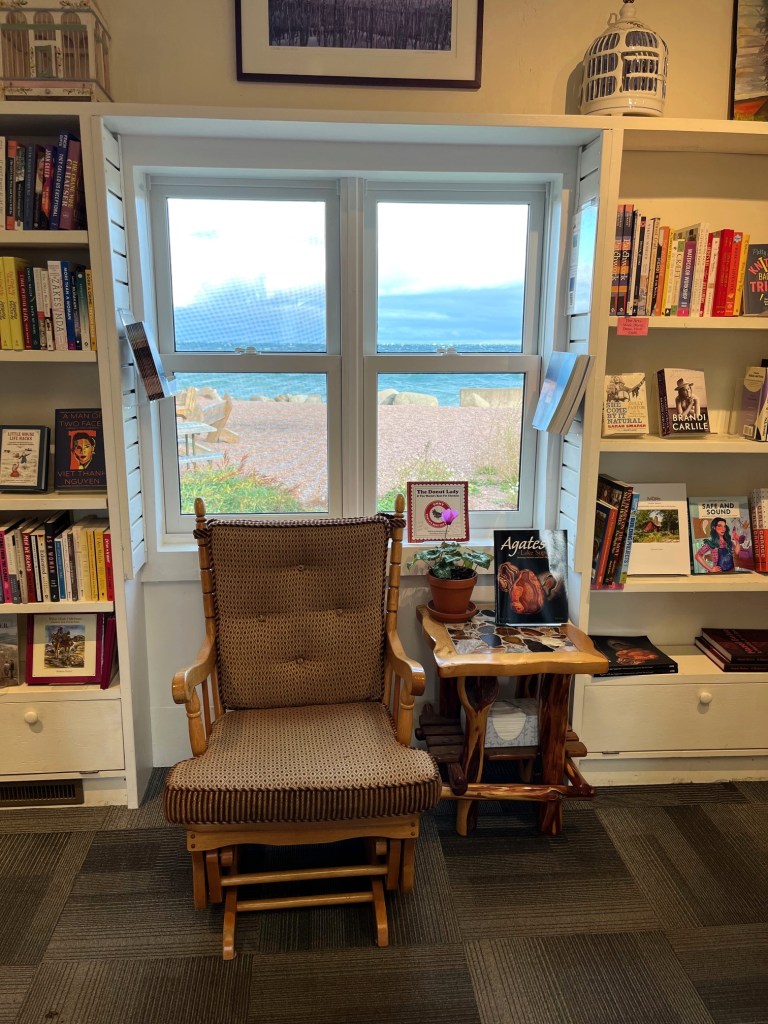
On the shore of Lake Superior, there is a small independent bookstore in Grand Marais, Minnesota, called Drury Lane Books. It’s my happy place. When I feel tired, sad, angry, or bored, I conjure up an image of the charming store, then I walk inside and sit in the window seat lined with a bright-blue cushion. In my hands I hold the perfect book, pulled from a glossy-white shelf. And I fall hopelessly in love with the characters and their stories. It’s Zen.
A cozy nook inside of Drury Lane
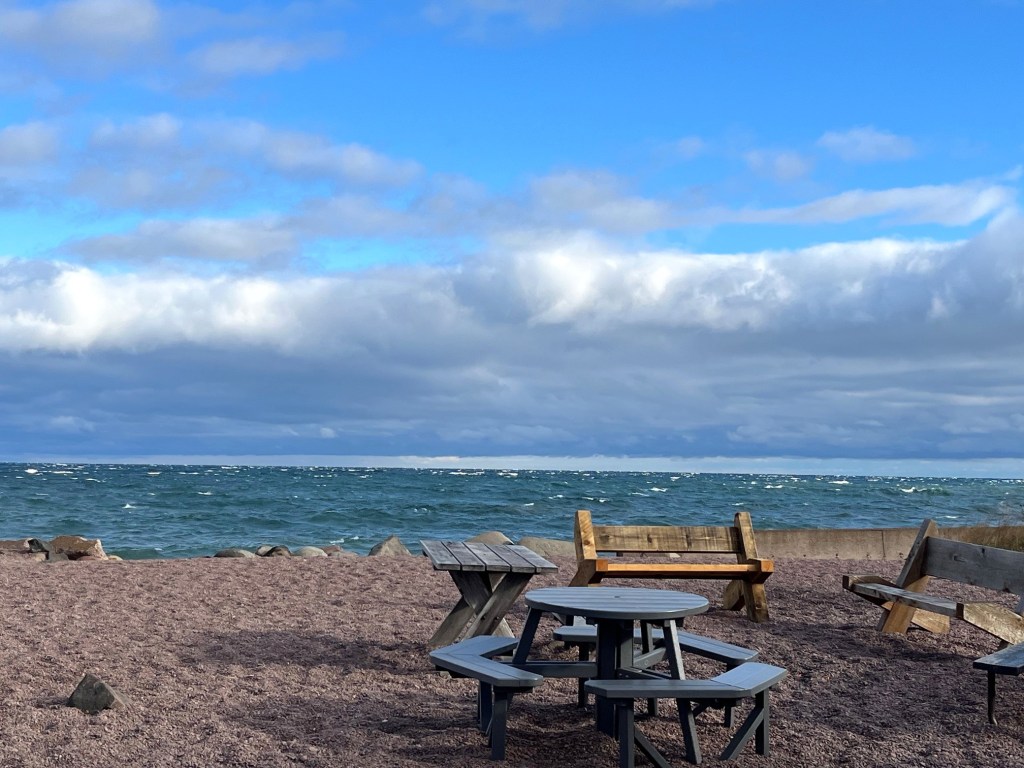
Last October my sister and I actually visited Drury Lane three times in one weekend. (I bought a collection of short stories and two novels.) During our first visit, the churning waves on Lake Superior roared so loudly that conversation outside the bookstore was difficult, unless we wanted to shout. And while we could have sat in the wooden chairs on the beach and read our new books, the cold, strong-fisted winds would have ripped pages from our hands. The next day the winds abated, but it was still chilly. So, we read our books in a local coffeehouse while sipping hot mugs of tea and coffee.
Drury Lane dreaming puts a smile on my face.
A great place to read a book, as long as Lake Superior is behaving
My husband and I walked into the grocery store on Sunday morning, and while he bought his weekly lottery ticket, I walked toward the deli. I never hang around while the clerk at the service counter tells him that he hasn’t won anything. And I hope if he does win something, it will only be a small comfortable amount, enough to pad the savings account a bit, with some left over for a reasonable amount of fun, like a car trip to Maine instead of a first-class world cruise.
Before shoppers can reach the deli counter, they are tempted by a large oval salad bar, filled with leafy greens, hot and mild peppers, shredded cheeses, tomatoes, sliced eggs, julienned carrots, olives, and loads of other assorted toppings. I never buy anything from the salad bar. It’s expensive, so I slice and dice my own salad goods. Also, while I’m not too worried about germs, I draw the line at eating food that has been sitting in the open, and crammed with serving utensils that have been handled by lots of other people. But I always look at the salad bar because it’s big and strategically placed.
As I neared the salad bar, I spotted a gleeful chickadee pecking at some salad fixings. I thought about the chickadees in my yard who visited the bird feeder and had to eat ordinary black sunflower seeds. I stood and watched the audacious little bird who had invaded the grocery store. I should have been grossed out, but I was amused. Humans take so much wildlife habitat that I had to admire the plucky little fellow who had somehow found his way into a large grocery store and was helping himself to the salad bar without using tongs.
I wasn’t the only human who noticed the black-capped bird enjoying a spread so big he must have felt he had won the lottery. A deli clerk hustled up to the salad bar and tried to shoo the bird away, but chickadees aren’t that intimidated by humans, and he refused to move. The food was too good. The clerk reached for him with both of her hands, and I think she could have managed to cup the feasting bird in her palms. But just as she was about to try, she hesitated and pulled her hands back. She went to the deli and came back with two plastic containers. She tried to capture the bird between the two containers, but at the last moment the bird zipped to the other end of the salad bar and kept eating, after all it was a smorgasbord.
The clerk rounded the counter. “Get away from my salad bar,” she said, waving her hands at the bird who took flight and landed among a gathering of grapes. The grapes were all packaged, so he headed to the tomato stand. When the clerk approached, he decided to check out the watermelon. She followed him, and he took off again. He flew to the meat department and landed at the back of a shelf filled with trays of chicken. Two more clerks arrived and the three of them stood in front of the meat section, discussing how to catch the chickadee. But the little Houdini escaped again. This time he soared to the ceiling, where he could evade capture and have a bird’s-eye view of the store while waiting for a second chance at the salad bar.
My husband and I finished our shopping without seeing the chickadee again. After we paid for our groceries, I turned to head back to the deli. I wanted to ask if they had caught the chickadee. But I stopped. If they had hurt or killed it while trying to catch it, I didn’t want to know. I had been tickled by the little bird who had invaded the grocery store and grazed at the birdfeeder of his dreams. And, I worried the little fellow’s bold adventure would end badly. I felt guilty that I had taken joy from a situation that had put the wee bird in peril.
It’s late afternoon on August 18, 2018. My friend Sandi and I have escaped her pre-fab house and her unstable caretaker, who is out running errands, but we cannot escape her stage IV cancer. That sits with us in the car. Sandi fancies we are the movie friends Thelma and Louise, trying to outrun it all.
Fifteen minutes earlier, I’d come to show her the quilts I’d finished piecing before taking them to the machine quilter. She’d started them for her son and grandson but was too sick to finish them. As I was leaving, she said, “Wait, I’m coming with you.”
A dazzling sun hangs in a spacious cloudless sky. I wear sunglasses because the tinted windows in my van aren’t dark enough to subdue the afternoon’s harsh glare. I don’t ask if I’m Thelma or Louise – I’ve never seen the movie – but my sunglasses are similar to the ones Louise wears in the promotion stills. The movie is one of Sandi’s favorites.
Sixteen days from now Sandi will die, but today she’s full of mischief and life, if one doesn’t look too closely. She refused more chemo, so she has hair. She’s thinner, but far from frail. She’s quick with a smile and a laugh, but moves slowly.
During the drive, we joke and laugh, making light of our escape from the caretaker, whom we call Nurse Ratched.
My friend taps her perfectly manicured and sparkly-red painted nails on the console between our seats and says, “I wish I could take you with me.”
I stop talking. Silence mingles with the cold air blowing from the vents on the dash.
I have no words. But within one beat of my heart, I know that her words are the most profound expression of love I’ve ever received. And, I have no words.
She speaks first. “But your husband wouldn’t like it.”
Still, no words.
We both know she doesn’t want me to die.
I truly believe she has said this to no one else. Yet, I have no words.
Ordinary chitchat begins again.
After dropping off her quilts, we return to her home. The caretaker is back, silently seething. We left her a note, but that didn’t matter. The caretaker believes if she controls all of Sandi’s end-of-life decisions, Sandi will live longer.
My friend settles into her easy chair. I kiss her cheek and whisper in her good ear, “I’m going to go.” The caretaker, a dark cloud, will become a thunderhead if I stay.
“That’s probably best.” Sandi whispers too.
I kiss her cheek again, and murmur, “I love you. I’ll see you tomorrow.”
“I love you too,” she says.
I tell myself I’ll watch Thelma and Louise after Sandi is gone, but I don’t believe I ever will. Thelma and Louise drove off a cliff together. In sixteen days, Sandi will leave without me, a Thelma without her Louise. Or perhaps a Louise without her Thelma.
I never asked her, “Which one am I?”
[This flash essay was originally published by Persimmon Tree in their “Short Takes” section in Summer 2023. I’ve posted it here because while I think about Sandi everyday, there are certain times of the year when she plays in my memories throughout the whole day. ]
“Hey, boys,” comes a lively greeting from a tall, white-haired man, whose cheery voice emanates from an equally upbeat face that gives the impression it has spent a lifetime brimming with friendliness. The man, who is at least as old as I am, is dressed in a pair of jean shorts and a casual blue shirt that matches the color of his fun-loving, twinkling eyes.
My six- and four-year-old grandsons have just entered the assistant lighthouse keeper’s home in Two Harbors, Minnesota. The jovial man, however, isn’t the assistant keeper. He is a tourist, like us, visiting the lighthouse grounds, which are now a museum.
He points toward the corner of what would’ve been a small sitting room. “What’s that, boys?” he asks my grandsons. I haven’t crossed the threshold yet, so I can’t see what he points at.
Without skipping a beat, my six-year-old grandson answers, “That’s a typewriter.”
“Wow,” the man says, now looking at me. “Most kids don’t know that!” He reminds me of my father who would’ve put this kind of question to anyone, young or old, in a museum, hoping the person wouldn’t know the answer, giving him the opportunity to burst into a history lesson. In the absence of strangers, my father would quiz me, “Do you know what this is?”
I smile at the man, and as an explanation, I say, “Their nana is a writer.” But this isn’t why my grandson knows a typewriter when he sees one. None of my grandchildren have seen me use one. I do my writing on a laptop. Although I wrote plenty of college papers on a typewriter, I can’t say I miss it. I made too many mistakes and smeared thick globs of whiteout on typos, which resembled miniature frescos when they dried, but without any artistic flair.
I’m not sure why I blurt out, “Their nana is a writer,” but something in the tall man’s happy manner makes me happy, so I say it because writing makes me happy. I’m already thinking about our encounter as something to write about.
So, why does my six-year-old grandson know that the machine with rows of letters is a typewriter? Because I like to take my grandkids to small museums. A month ago we visited the Old Firehouse and Police Museum. On the second floor in an old office displayed with artifacts, he pointed to a typewriter sitting on a wooden desk and asked, “What’s that?” I explained what it was and how it worked, and that the fire chief used it to type reports about the fires they fought.
The white-haired man moves on to another room in the assistant keeper’s house turned museum. My grandsons and I look at the typewriter. “Can I touch it?” one of them asks. My first impulse is to say no. Instead, I look at the typewriter. I don’t see a do-not-touch sign. If I had, I would’ve said no. In my family there are two kinds of people: those who can’t ignore signs and those who feel they are merely suggestions. But I’m flirting with a technicality because I know museum curators don’t want visitors touching artifacts.
I think back to the mid-1990s when I took my father and my two sons to the same fire and police museum that I recently visited with my grandkids. Inside the museum was an old fire truck, with a hand crank used to start its engine. I came upon my father turning the crank, which was located right below a sign that said: DO NOT TURN THE HAND CRANK.
“Dad,” I said, “you can’t do that. Look at the sign.” I wondered if he thought the engine might roar to life.
“Well, they left the crank here,” my father said, as if the presence of the crank negated the command: DO NOT TURN THE HAND CRANK. The old hand-crank fire truck was still there when I took my grandkids, but the sign was gone and so was the hand crank. I don’t think my father was the only person who turned that crank. He was a mechanic nearly all of his life, and the urge to tinker with mechanical objects never left him.
My grandsons and I are still staring at the typewriter. I think about my father and his belief that signs weren’t meant for him. He routinely ignored handicapped parking and speed limit signs. When he taught me to drive, he said that I could take curves at twenty miles over the posted limit. I stare at the typewriter, thinking about the fingers from the past that pushed its keys, sending thin metal bars with raised letters clacking to an inked ribbon, leaving black words on white paper. My grandsons stare at the typewriter as if it’s a mystical object, but I have no idea what they are thinking.
“You may touch it,” I say, “but very gently, like this.” And, I brush my fingers like feathers across a few keys. There is no one to tell me, “You can’t do that.” There is no one I can answer back to by saying, “Well, there isn’t a sign.”
I add, “Do not push down on the letters.”
Each grandson takes a turn, stroking a few keys softly, like they are a newborn’s forehead. Sensing they’ve been granted a special privilege, they are silent. Neither of them pushes down on a key. But I imagine they think about what it would feel like and how the typewriter would react if they did.
Suddenly, I understand something about my father and the old fire truck and its hand crank. He wanted to feel that crank turn. Perhaps, because he’d never had the opportunity. By the time he was born in 1937, hand-crank cars were a thing of the past. But his father, who opened a gas station and repair shop in 1920, would’ve worked on cars with hand cranks. Perhaps, my father wanted to touch something that linked him back in time to his father.
After all, I enjoyed touching the typewriter keys and wondering about the lighthouse keepers and the documents they typed. Perhaps, in their off-hours, they wrote novels or stories or poems about the solitary life of lighthouse keepers and the stormy moods of Lake Superior.
We move on from the typewriter, looking at a way of life from the early 1900s. An old stove waits for someone to start a fire in it and cook a meal in cast iron pots. Old dishes sit on a scarred table, waiting for a meal to be served upon them. An ancient washing machine waits for someone to load it with soiled clothes. Oil lamps wait to be lit after the sun sets, and an old stuffed chair waits to be filled by a weary person at the end of the day.
Over and over my grandsons ask, “What’s this?” And I explain. Over and over their hands reach to touch an object, and I say, “Don’t touch.” I point to the signs saying, Please, Do Not Touch, which had been absent by the typewriter, but are now everywhere. And each time they withdraw their hands. I can’t ignore an actual sign asking, Please Do Not Touch.
But I’m glad there wasn’t a sign by the typewriter, and I wonder if my dad would’ve pushed the keys.
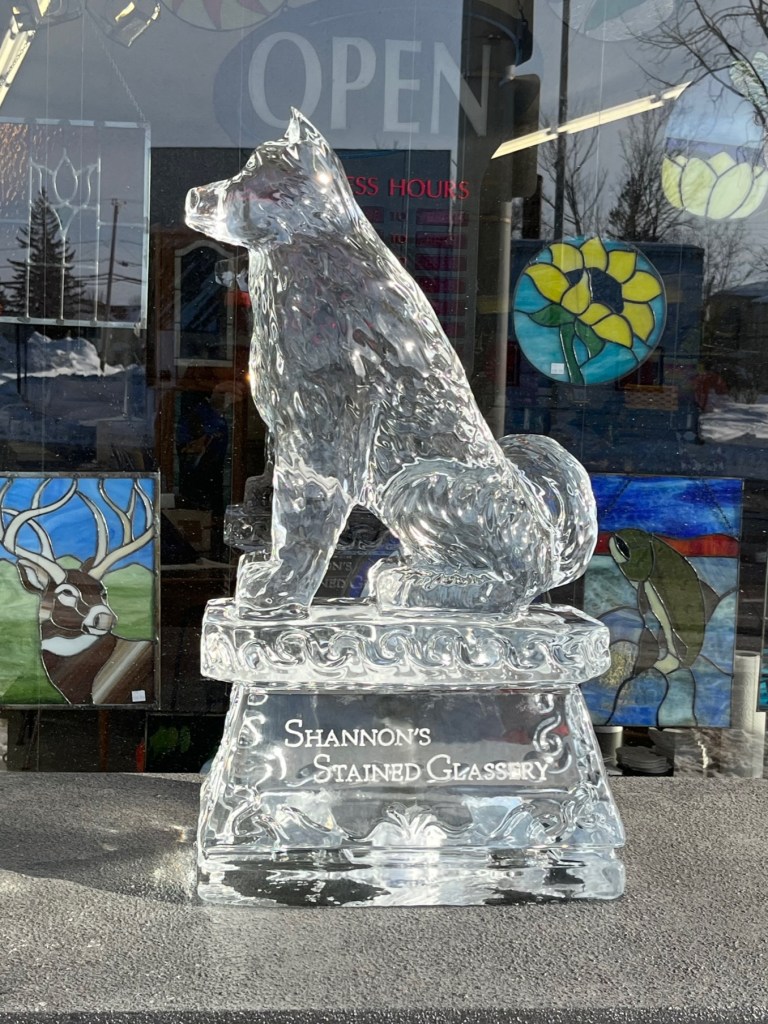
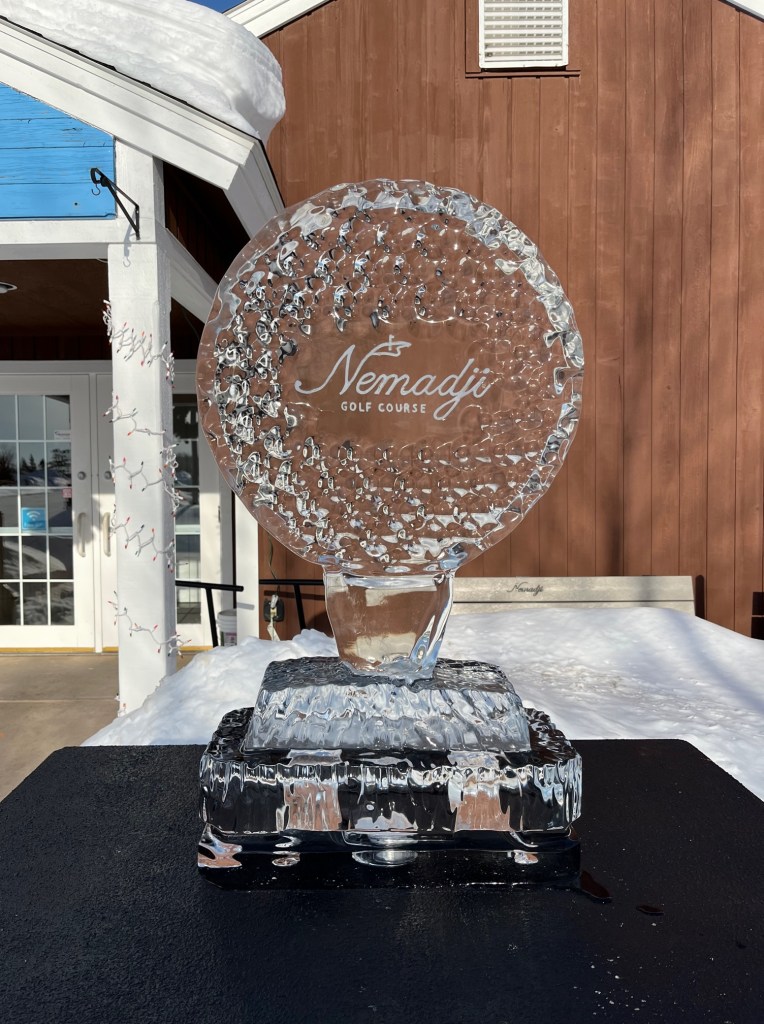
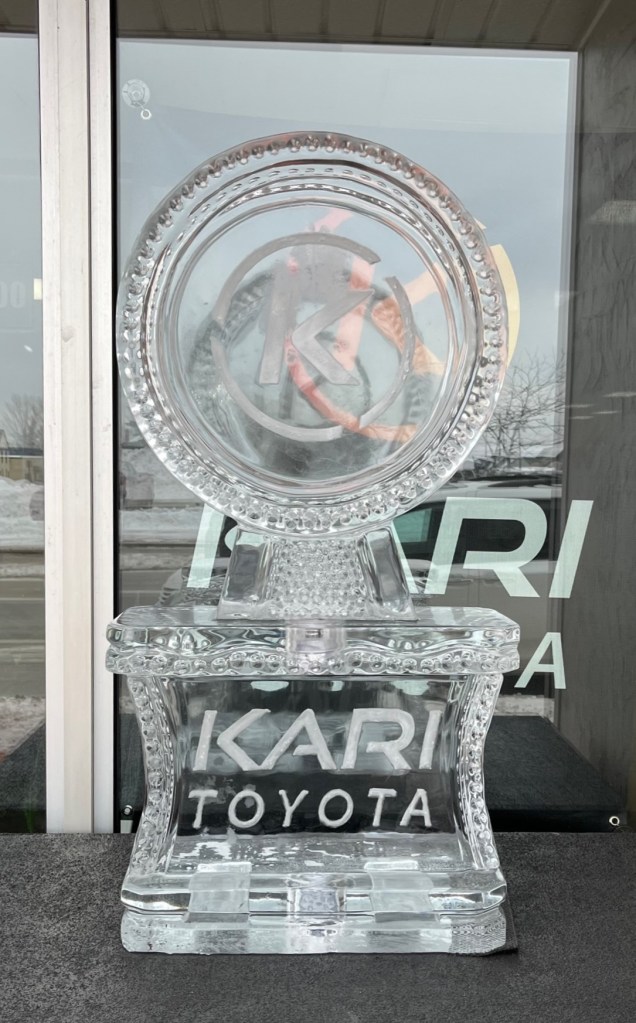
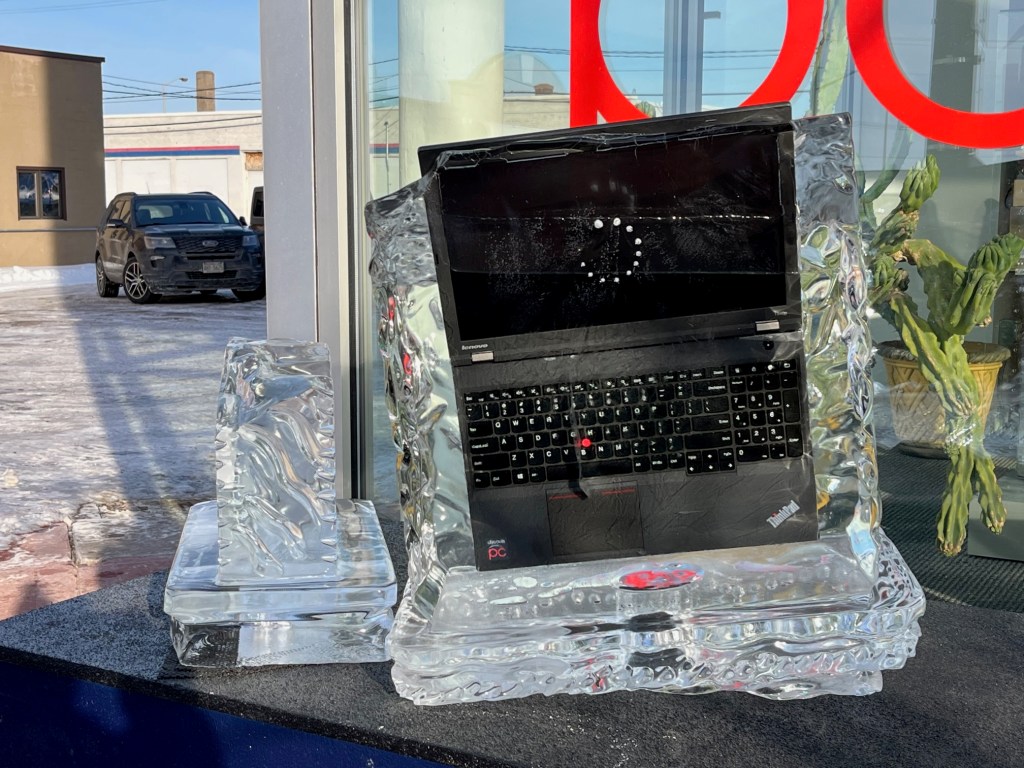
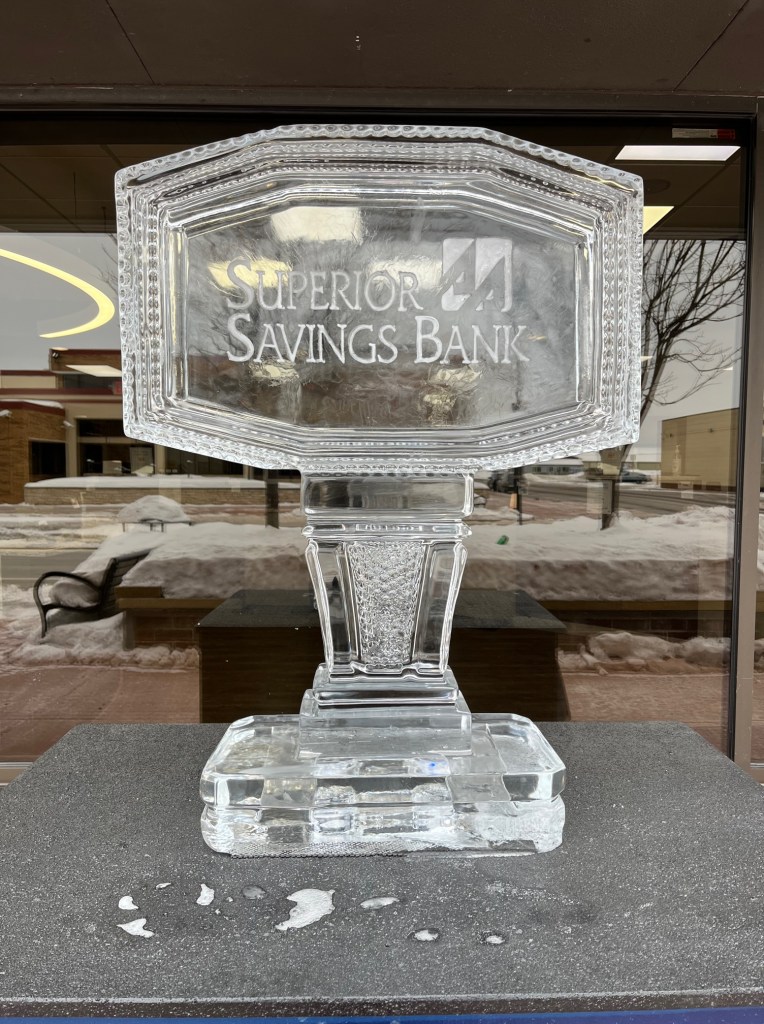
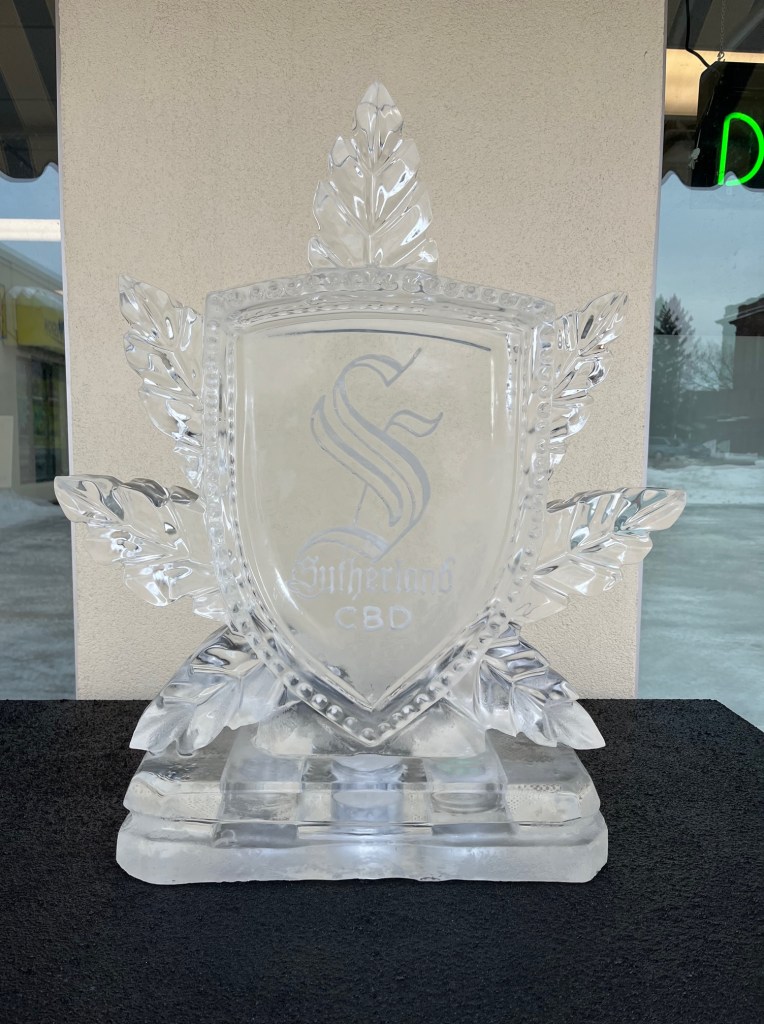
On the last weekend of January, my city celebrates winter with an Ice Festival, and as part of that celebration, small ice sculptures crop up around town. This year right before the festival weekend, an arctic front showed up carrying a couple of bags of windchill and settled in for a week like our town was an Airbnb.
I wasn’t bothered that Mr. Arctic Front crashed the festival because I never attend the outdoor tribute to winter. It’s not because I don’t like snow and cold, but I embrace it differently. I honor winter by reading, writing, walking my dogs, feeding the birds, baking, and marching briskly from my car to whatever building I’m entering. But on Saturday night, I enjoyed the festival’s closing fireworks, watching them from my kitchen window while sipping raspberry hibiscus tea with honey.
After the Ice Festival was over Mr. A. Front stayed on for the week. Each day his mood descended into a deeper frigid funk, deep enough by Friday morning to cause scads of school districts to either delay their start by two hours or completely cancel classes. The next day Mr. Front stuffed the windchill back into his bags and left town. The temperature rose to a glorious balmy 25°, and I got an itch to have some fun, which brings me back to the ice sculptures. I decided I needed to photograph each one.
I found the list of businesses that sponsored the sculptures, grabbed my phone, and set out on a mission. It was like a treasure hunt, but without the stupid clues. I’m no good at puzzlers or clues or those math problems with trains leaving stations at different times, going different speeds, and heading different directions. I always wanted to shout, “Take the damn bus or drive or fly!”
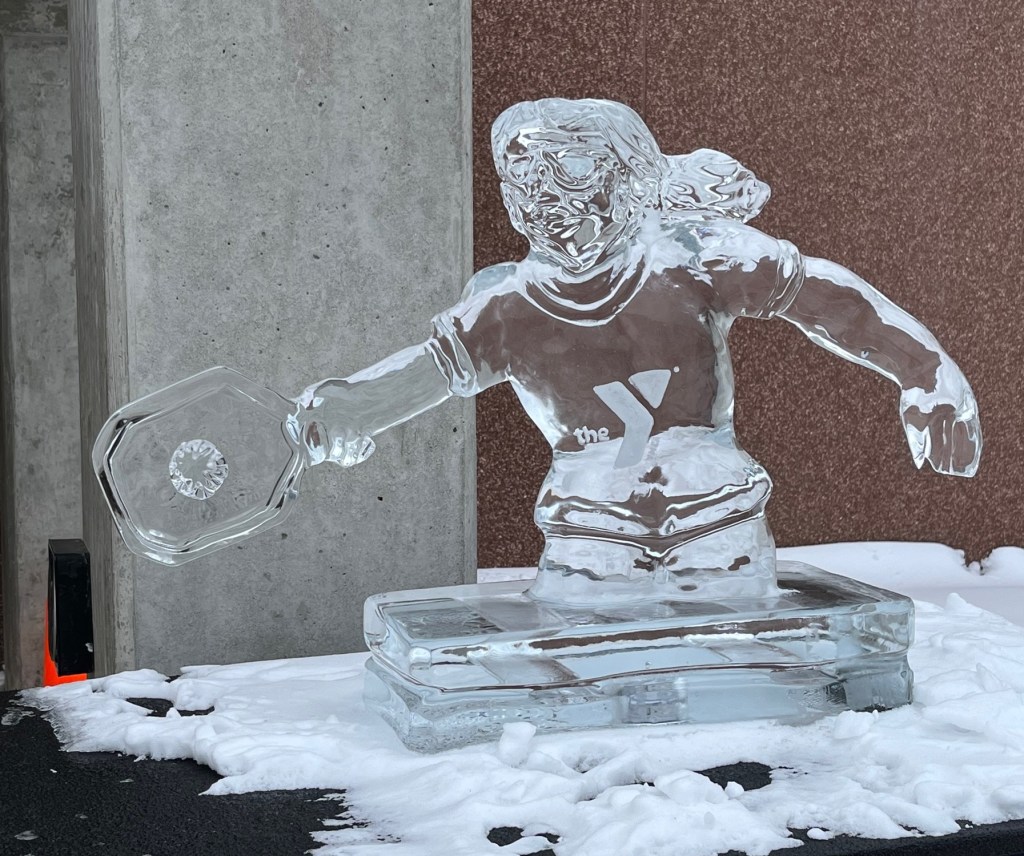
Pretending my phone was a righteous 35mm with a telephoto lens of phallic proportions, I fancied myself a photojournalist. (Hey, it’s my Walter Mitty fantasy.) I started my ice sculpture treasure hunt with some coin in the bank because I had already photographed the icy racquetball player in front of the YMCA when I dropped my grandson off at his 3K school on Wednesday, and I had snapped a picture of the sculpture in front of the vet’s when I dropped off a urine sample for Cabela on Friday. Years ago, I played many racquetball games with a college friend at the Y. The vet who takes care of my dogs was a former student of mine, and she has cared for all of our dogs accept the first one my husband and I had. My ice safari would turn out to be a trip down memory lane.
YMCAVet’s Office
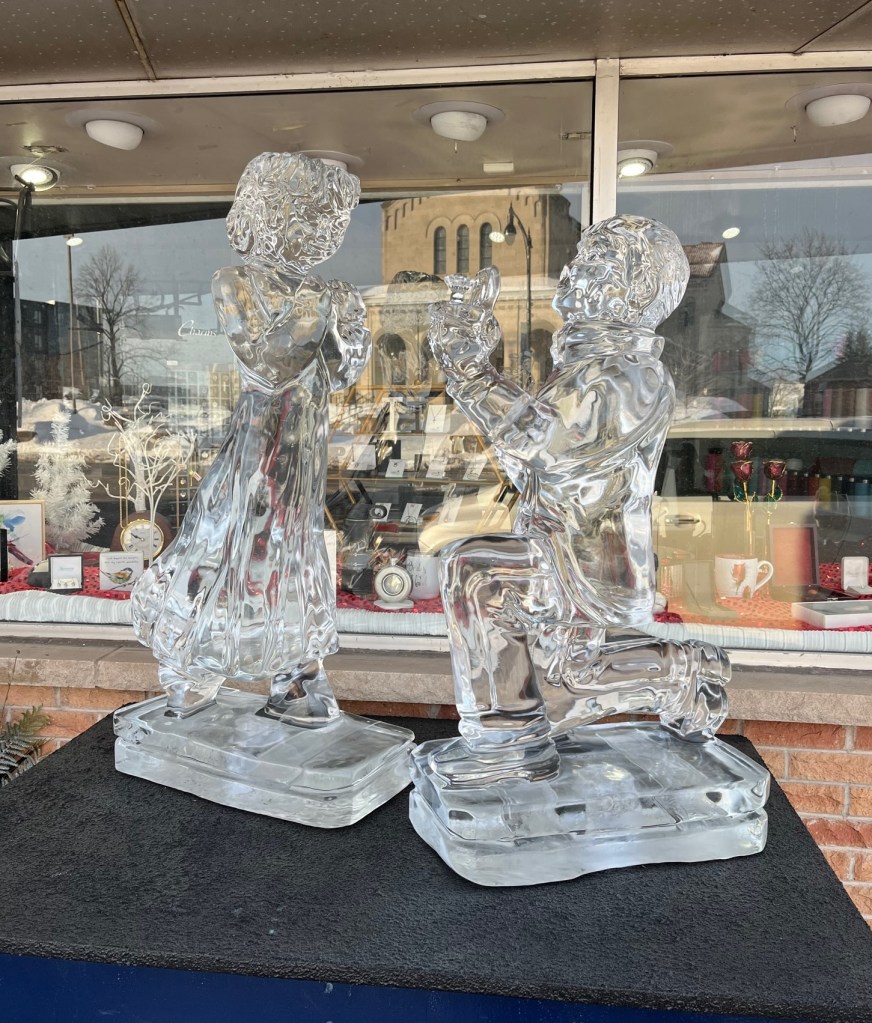
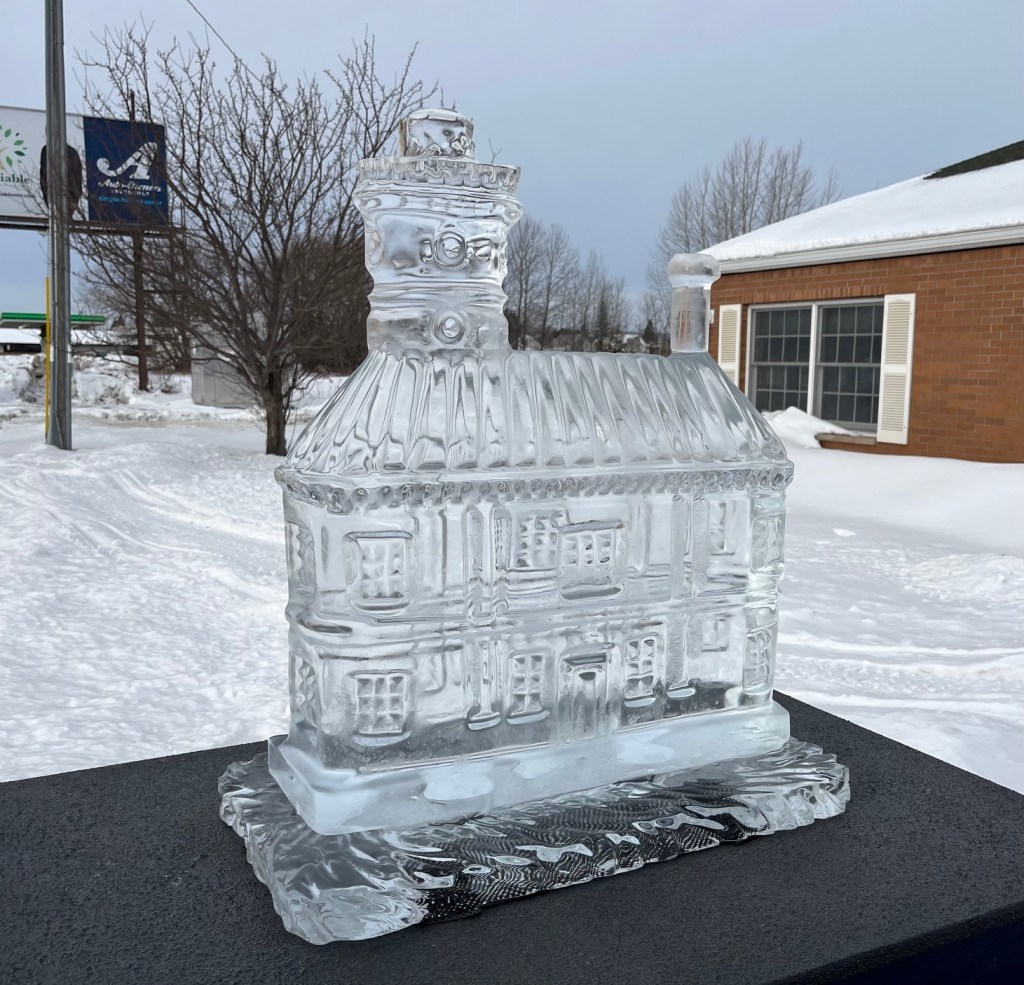
I photographed the tender proposal in front of the jewelry store where my husband and I bought our wedding rings in 1985. The Victorian house was captured in front of the chamber of commerce. It represents Fairlawn Mansion built by Martin Pattison, a lumber and mining baron. After Pattison’s death, his wife Grace donated Fairlawn to be used as a children’s home. Two of my uncles lived there for a brief time after they became orphans.
The ProposalFairlawn Museum
The cool Tramp wooed the adorable Lady while sharing a sparkly, silver noodle made from a pipe cleaner in front of Vintage Italian Pizza (VIP). A couple of days ago when I ordered a pizza to be delivered, I told the young person who took our order that my husband and I have been ordering pizza from VIP for almost thirty years. “Wow,” he said, “I’ve only been working here for five months.” He didn’t sound old enough to have been doing anything for thirty years. “Don’t worry,” I told him, “you’ll get there soon enough.”
My favorite coffee shop sponsored a frozen hot coffee with chilled steam rising out of the mug. I took a break from my self-imposed photojournalism assignment and went inside to order a decaf latte with a shot of raspberry. Sometimes when I write I get cagey, so I pack up my computer and go to the coffeehouse and write. There’s always at least one other person plunking on a keyboard. We never speak because we don’t know each other, but I feel a sense of community.
VIP PizzaMy Other Writing Office
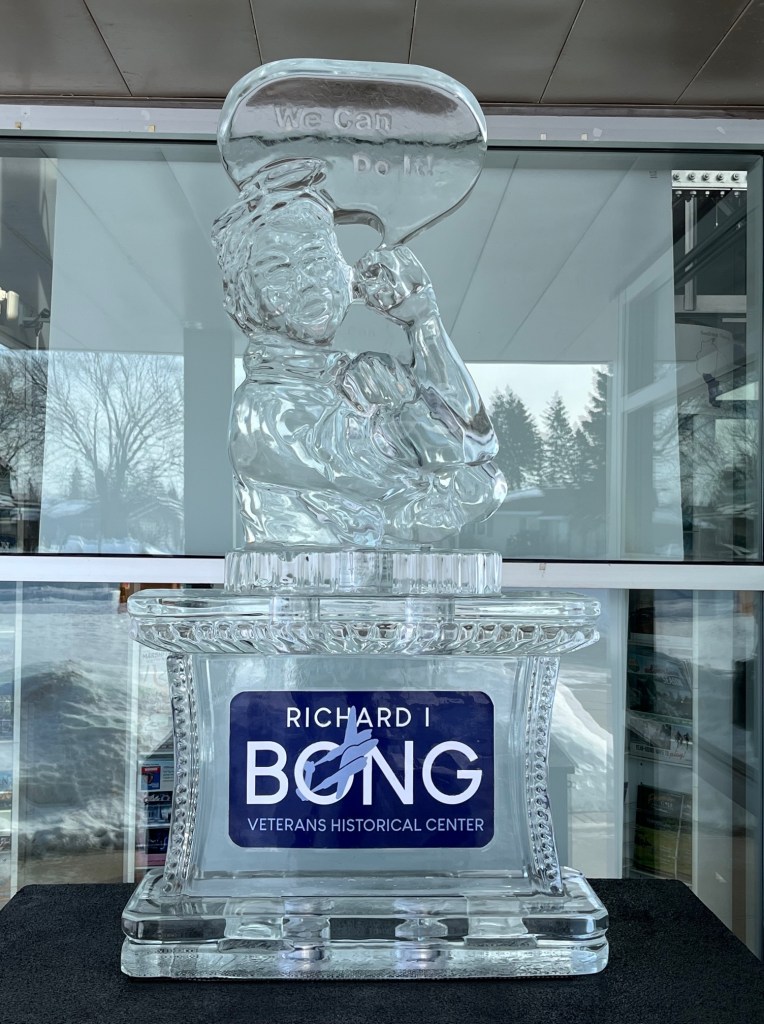
Richard Bong, a WWII flying ace, flew many missions and shot down many enemy planes. However, he didn’t die in battle, but while working as a test pilot in California.
The Richard Bong Center chose Rosie the Riveter to represent their museum honoring American veterans. My mother-in-law would have loved the cool-as-ice Rosie because she believed women were smart, capable, and strong.
My grandpa Howard served in the U.S. Army during WWII from January 1941 until August 1945. In 1943, he was wounded in Italy and received the Purple Heart. My sister, one of her sons, and I paid tribute to Howard through the Flag of Honor program started by American Legion Post 435 at the Bong Center. The American flag presented to Howard’s family at his funeral was raised during a short ceremony to commemorate his service in WWII
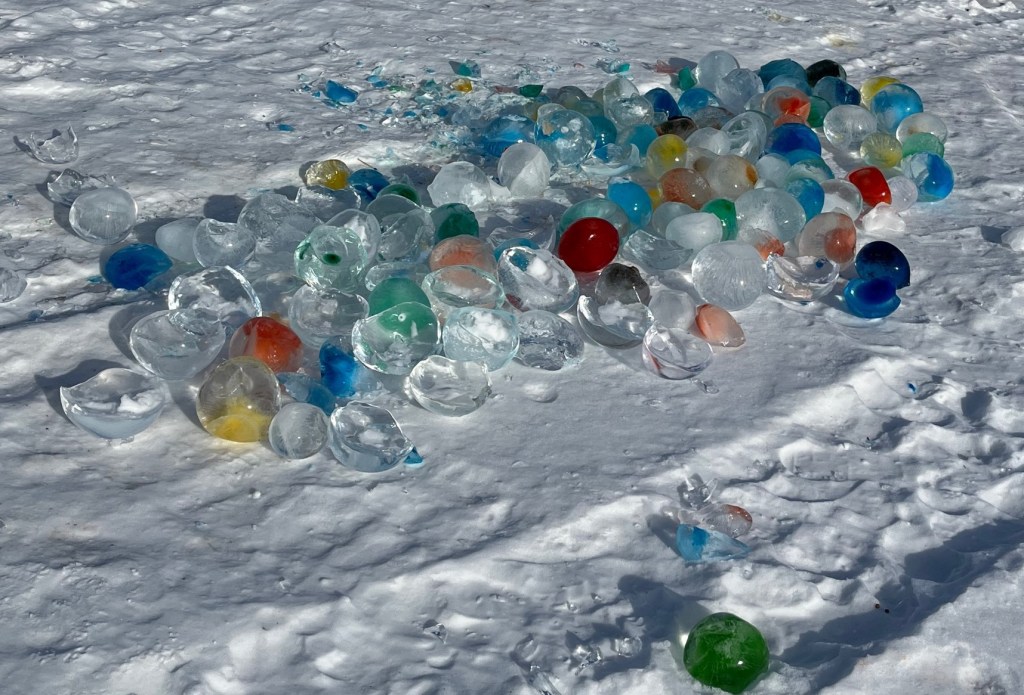
After photographing the ice sculptures downtown, I headed for Barker’s Island, the site of the festival, to track down more sculptures. When I parked the car, I spotted a large pile of misshaped ice marbles. They were part of the winter festival, but I’m not sure how. I liked thinking about them as giant marbles left behind by Paul Bunyan. I loved playing marbles when I was in second grade, and I could beat all the boys. In fifth grade I played Babe the Blue Ox in a play. I made my own costume by cutting out the silhouette of an ox from cardboard and painting it blue. When I was on stage, I was always behind the cardboard ox, and I had no lines, so I didn’t discover I had stage fright until I played the Wizard in the Wizard of Oz in seventh grade.
Paul Bunyan’s marblesZiva, my safari assistant
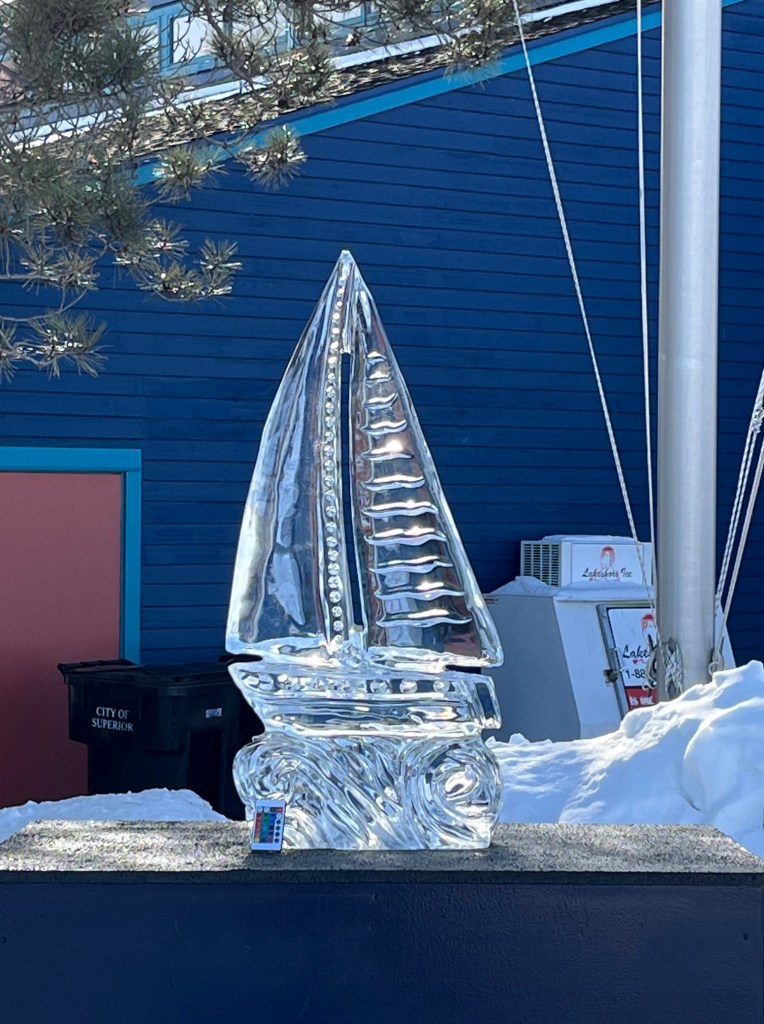
Across from Paul Bunyan’s abandoned marbles, were two of the prettiest ice sculptures. I don’t know what they symbolize, but I imagine they have a connection to sailors and ships and open waters. In the left photo in the background is the Seaman’s Memorial, a statue dedicated to sailors who have lost their lives on Lake Superior.
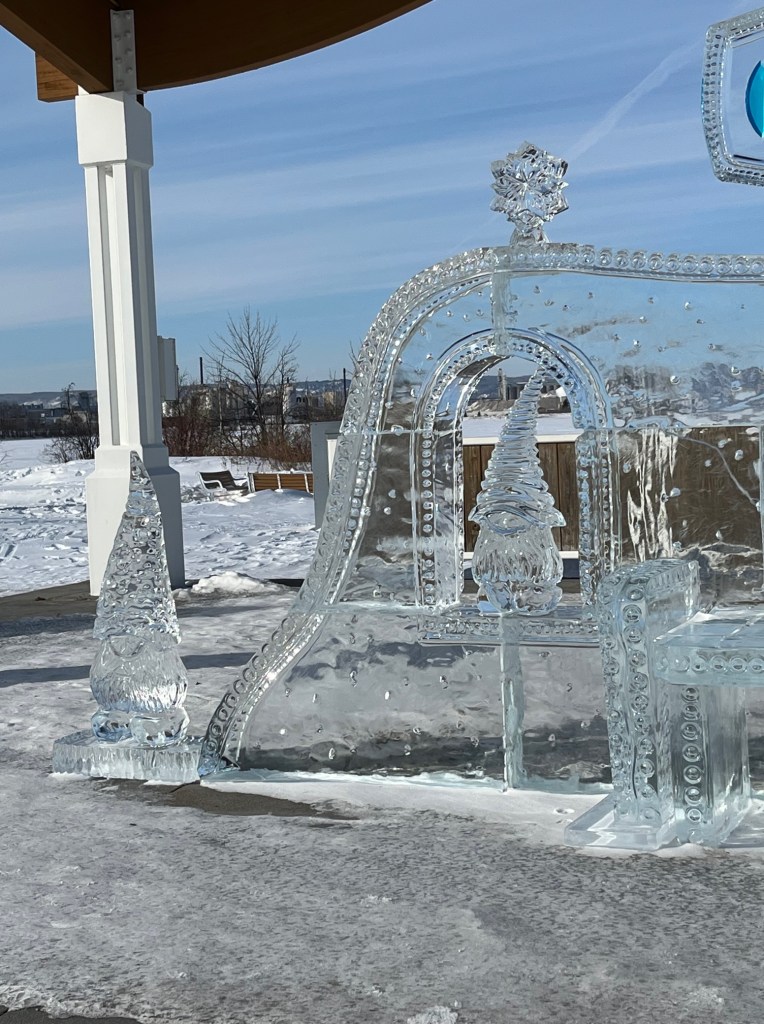
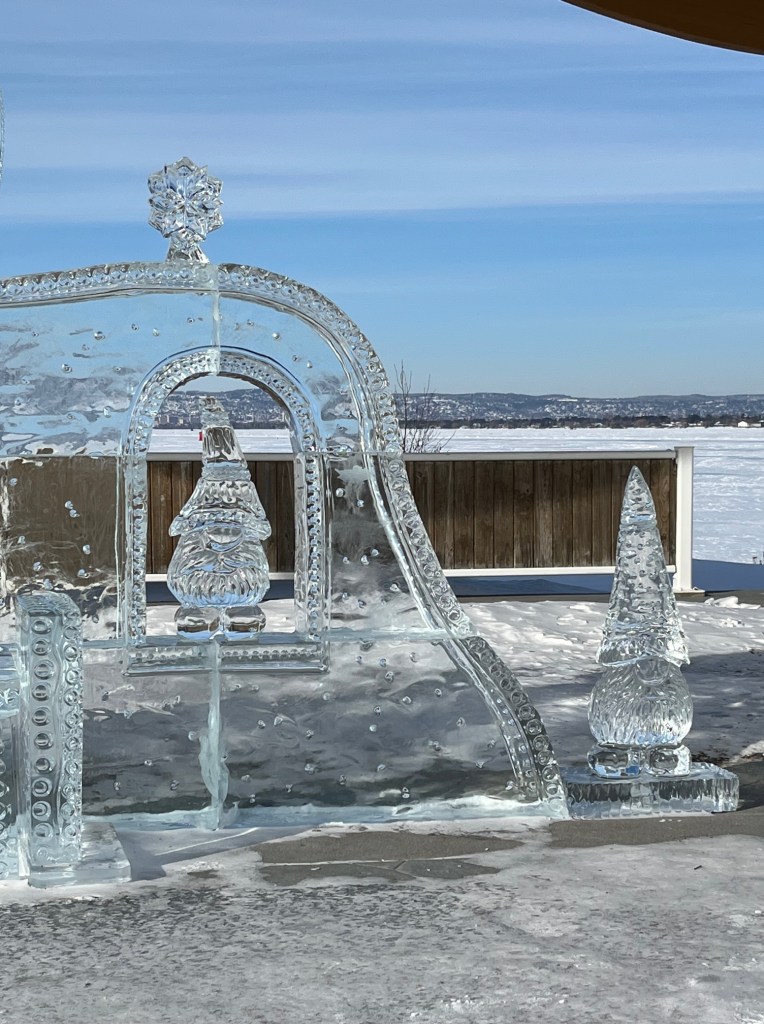
And the Ice Festival throne . . . heavy is the head that wears the crown and frozen is the butt that sits upon this throne.
Gnomes in waiting,the throne,and more gnomes
The Superior Refinery sponsored an ice sculpture. On April 26, 2018, an explosion and fire rocked the refinery, which was owned by another company at the time. Luckily no one was killed at the refinery, and even luckier the explosion wasn’t as bad as it could have been. Because if it had been, everyone within a twenty-five mile radius from the refinery would probably not be around to tell their stories. There was a large-scale evacuation. My mother-in-law, who was suffering from heart failure was in the hospital that evening in a neighboring city, which was less than fifteen miles away, and her husband was with her. It was their 66th wedding anniversary. My husband and I visited them at the hospital. Less than a month later my mother-in-law passed away. But on that night, she had her humor with her, and she quipped, “Well, I won’t ever forget the date of the explosion.”
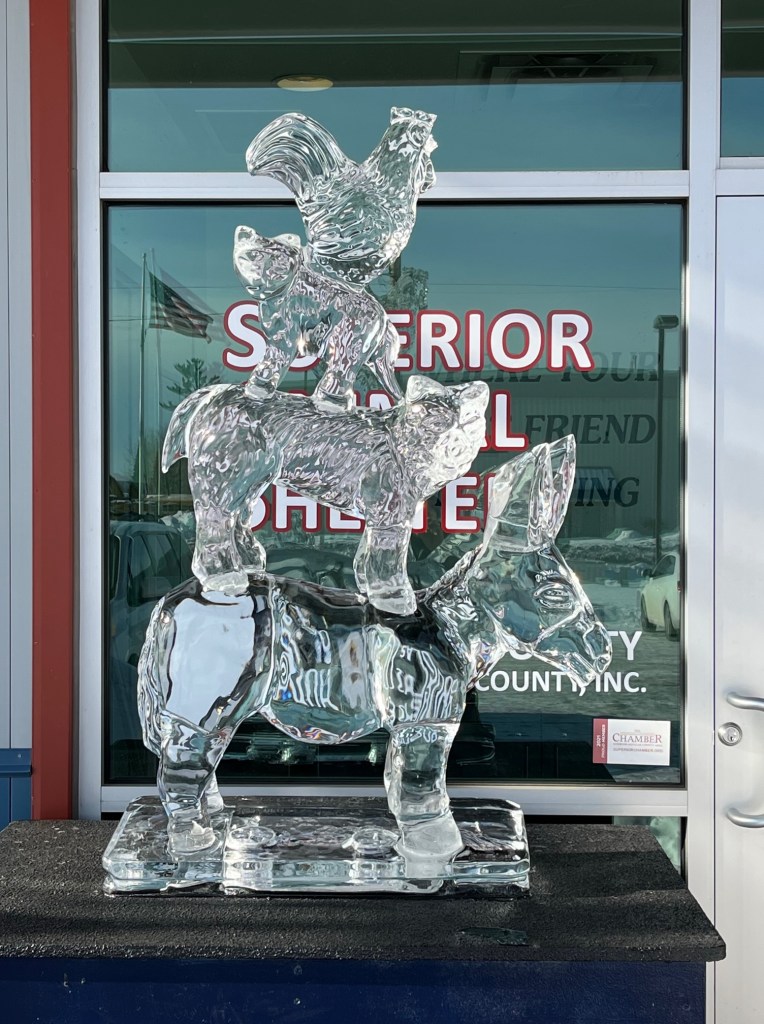
And on a happier note, my favorite ice sculpture, “The Town Musicians of Bremen,” was sponsored by the animal shelter. As a child, the story by the Brothers Grimm was one of my favorites. Turns out the four famous animal musicians have statues of themselves in Bremen, Germany, the Lynden Sculpture Garden in Milwaukee, and in front of some veterinary schools in Germany. (You can listen to the story here.)
The refinery is expected to begin operations again in 2023.The Bremen Musicians
And the rest of the sculptures . . . Click on the side arrows to move through the slideshow.
Marie Zhuikov’s newest book, Meander North, is a collection of essays, many from her blog Marie’s Meanderings, which she started writing in 2013. I look forward to each new post by Zhuikov, so when I had a chance to read Meander North, I was excited. Zhuikov selected some of her favorite blogs, then added essays, some of which have appeared in other publications.
Many of Zhuikov’s selections are about getting outdoors and enjoying nature. In her humorous essay “How X-C Ski Starvation Can Lead to Impaired Judgment,” she writes about one of her first cross-country skiing adventures of the season: “I . . . desperately needed to do something to break out of my winter slothfulness and raise my heart rate above seventy beats per minute.” Even though a mist turns into raindrops, Zhuikov slips on her skis and heads out on the icy trails. With caution and strategic moves, she completes her first cross-country ski of the season, and while she does, we hold our breath, admire her tenacity, and think about some of our own foolish escapades.
Zhuikov’s essays about her adventures are so enjoyable because they’re relatable. Her love of the outdoors and her ability to maneuver through nature shines through in her writing. But she is with us, inviting us along, never making us feel left behind. She makes us believe we can get out in nature and be adventurous too. That we can lower ourselves into a canoe or a whitewater raft, or that we can stand along a river and learn to fly fish.
Zhuikov’s essays connect with us because she is not afraid to let us peek at the moments when her life doesn’t go smoothly. Sometimes the outcomes are humorous, like in her story “Just Your Average Winter’s Day Walk and Squirrel Attack” about a walk with her wonderful eighty-pound dog, Buddy, that turns into a comedy of misadventures. Other times the outcomes are poignant, like in “An Evening Dog Walk” about a romance that didn’t work out. Occasionally, she shares heartbreak, like in “The Lake, It Is Said, Never Gives Up Her Dead.”
Zhuikov rounds out her collection of nature essays with an eclectic selection of entertaining and informative writings that cover a wide range of topics. Some cover Zhuikov’s adventures as a citizen of Duluth, such as, “Marie Versus the Post Office” and “My Neighborhood Rezoning Zombie Apocalypse Saga.” Other heart-warming essays like “I Saw Three Ships on Christmas Day” or “Kissing in the Coat Room in First Grade” are about her family or youth. She wraps up her book with a section titled Bookish Adventures where we get a taste of Zhuikov’s life as a writer and a reader, and where she introduces us to the wonderful poet Louis Jenkins.
Winter is coming so grab a copy of Marie Zhuikov’s Meander North, curl up in a cozy chair with a glass or mug filled with your favorite beverage, and start by reading “Cold as a Cage,” the first essay in her collection. And for those of you who live through winter every year, nod in agreement and laugh hopelessly as you read: “The cold defines our movements. Northern Minnesotans walk with shoulders hunched and hands in pockets, limiting our time outside to the bare minimum for the task at hand.” But know that you are a survivor because you are inside where it’s warm, ready to smile and laugh and shed a few tears as you join Zhuikov on her meanders through life.
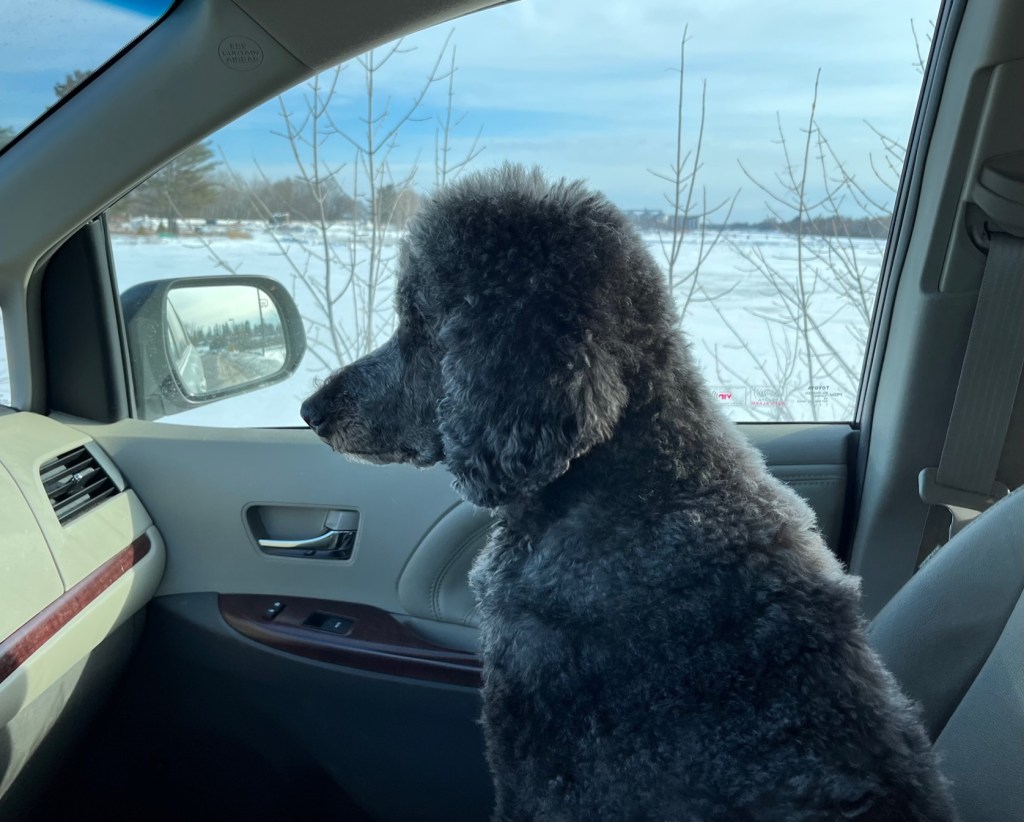
Bogey, my mother’s dog, loves Lake Michigan, so this afternoon I took him to Harbor Springs, a small summer town snuggled up along the eastern shore of the lake. It’s Bogey’s favorite place to walk. He knows when he is going to Harbor. The only place he loves more is a pet store, where he tries to shoplift anything he can fit into his mouth.
First, we stopped at his favorite clothing store. He got lots of hugs from a woman who works there, but she was out of dog treats. He kept holding up his paw and pleading, but only received another hug and another apology. He was clearly disappointed, reminding me of a little boy who tells his great-aunt, “But I wanted a toy train, not fuzzy footie pajamas.”
After we left the store, Bogey enjoyed his water-view walk. He sniffed the grass, did his business, and watched a pair of ducks swim along a beach. Dogs get over disappointment quickly.
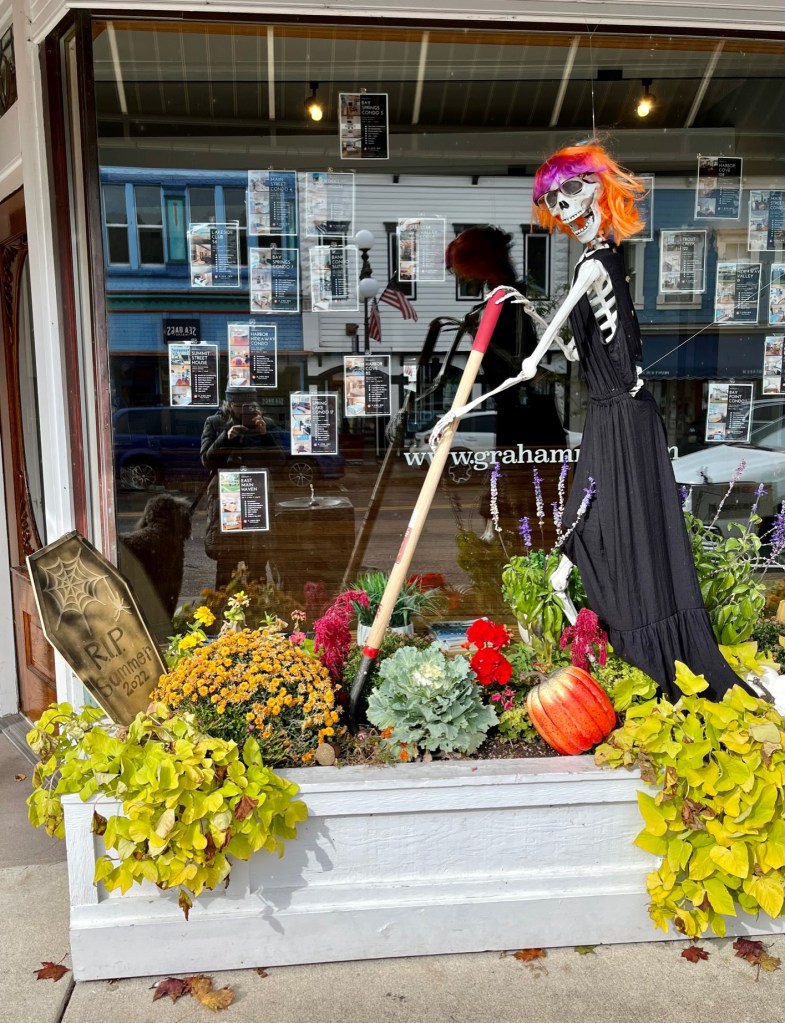
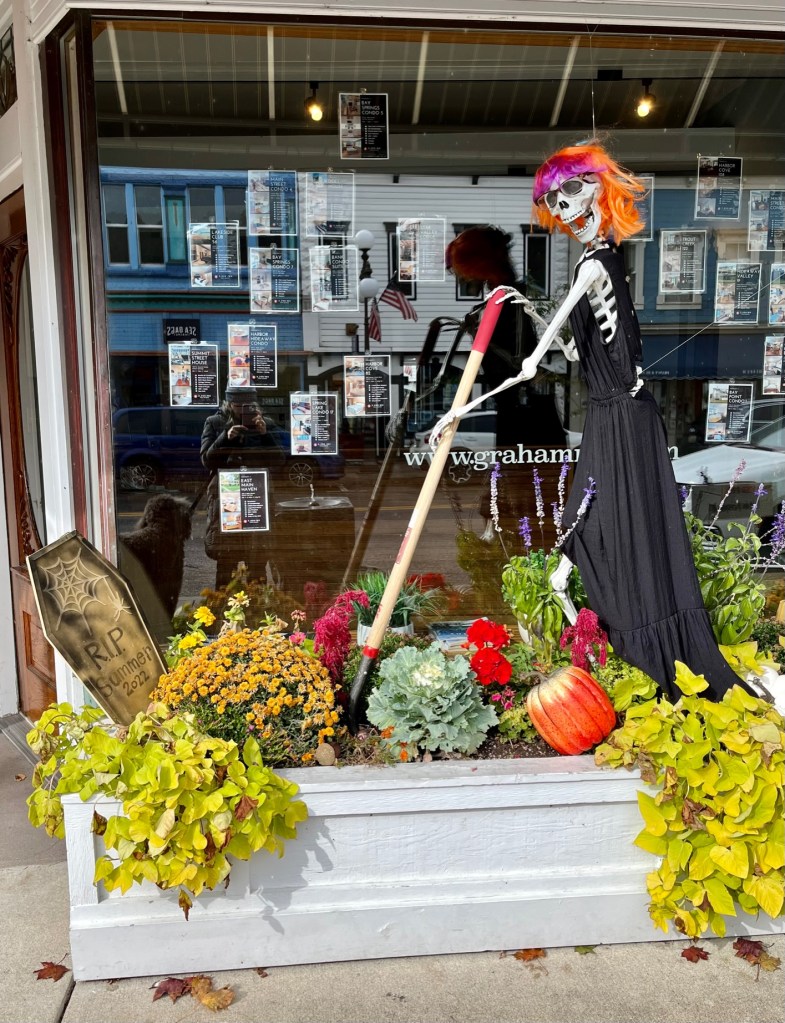
My favorite! The headstone reads: RIP Summer 2022
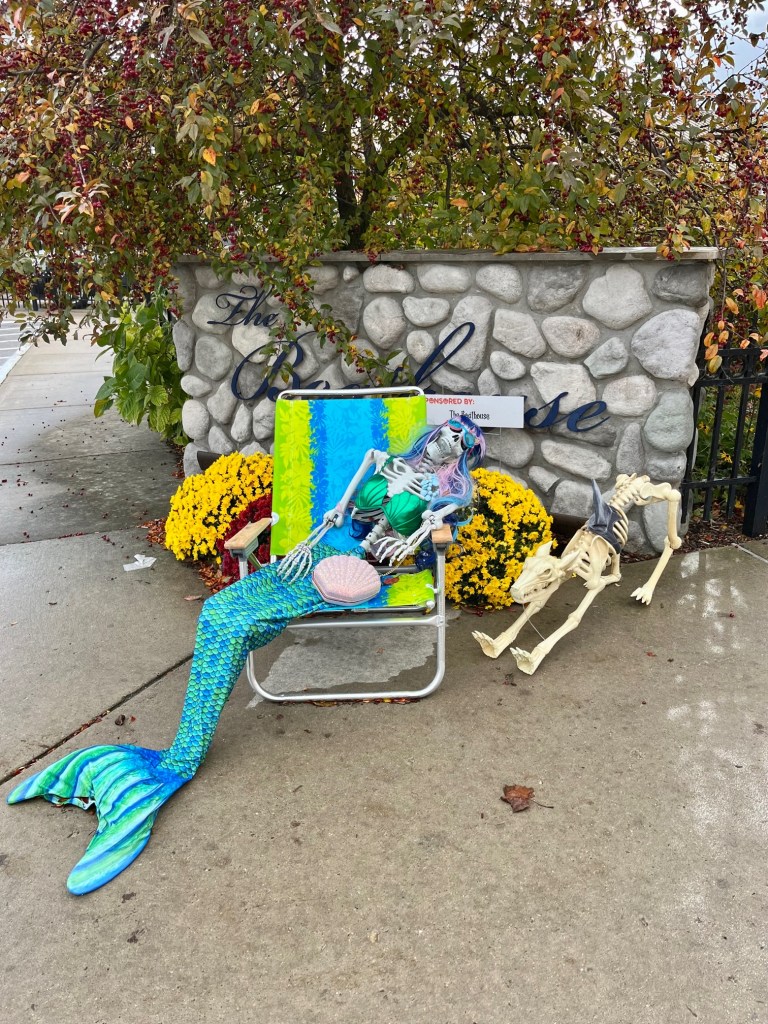
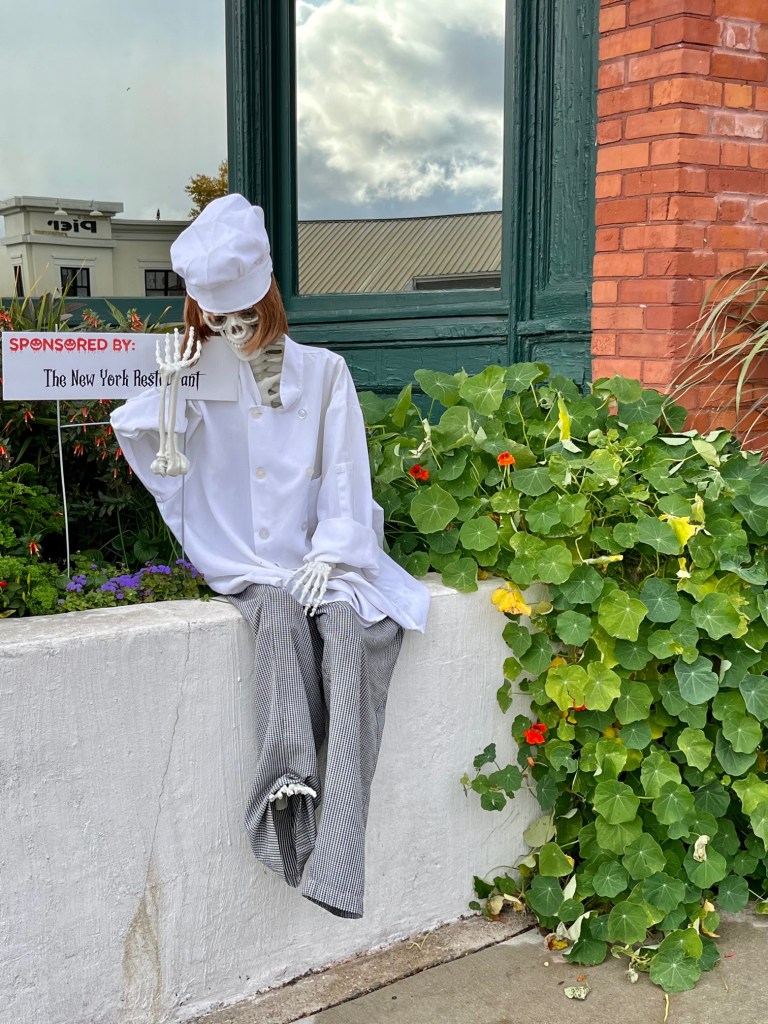
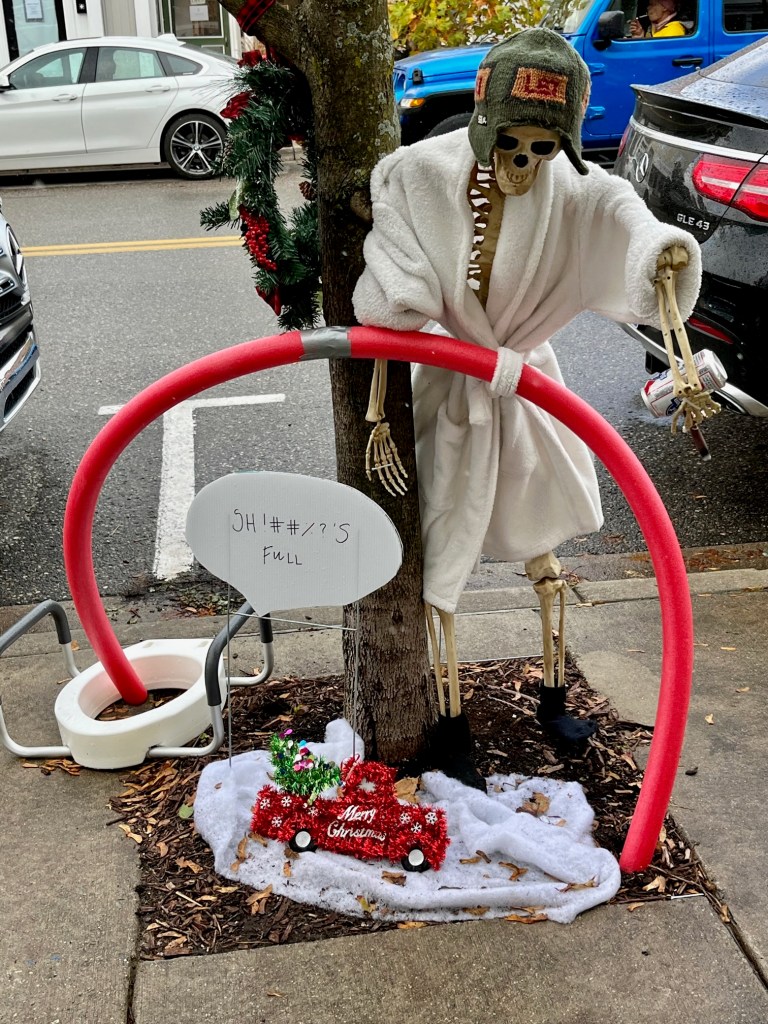
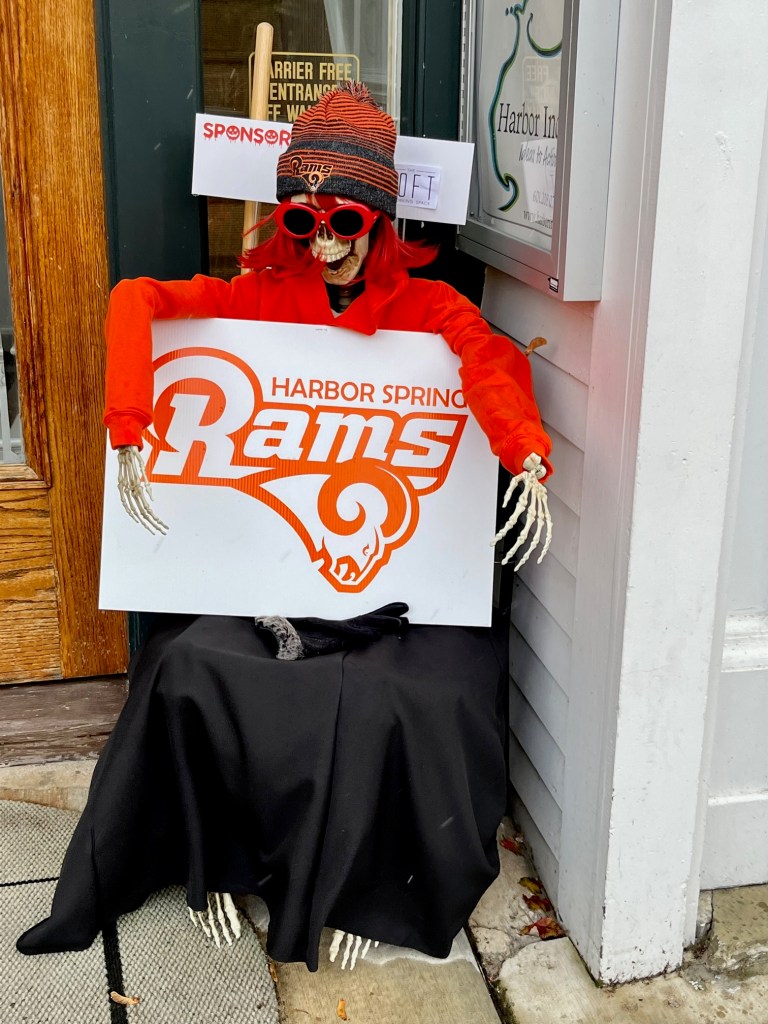
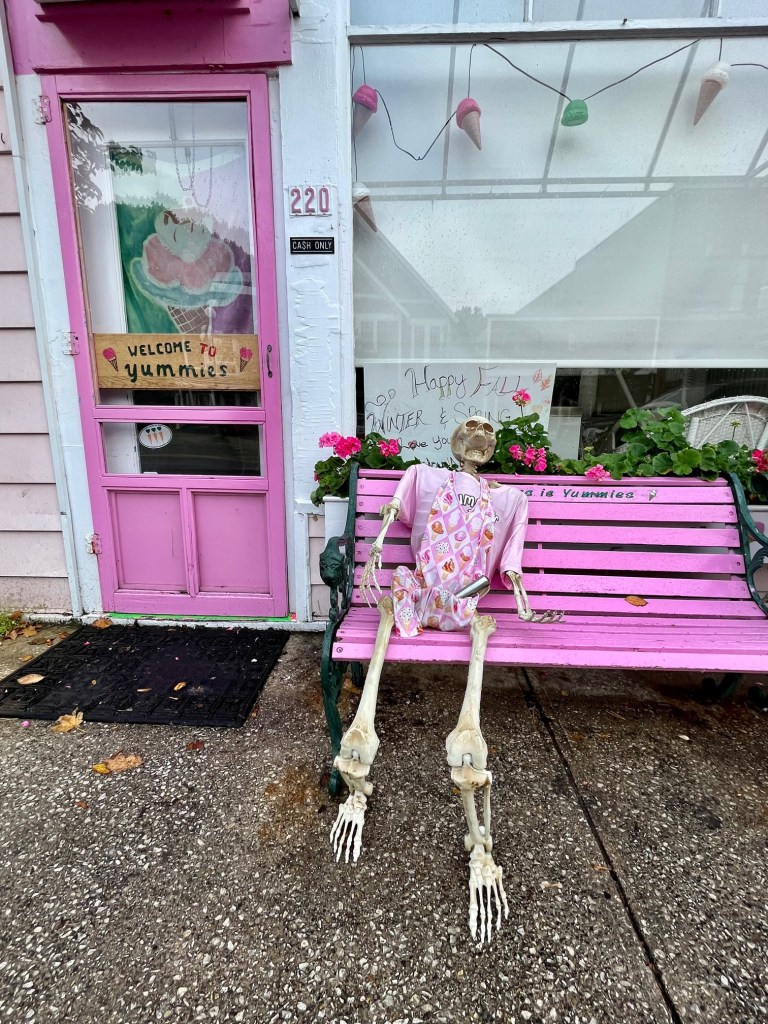
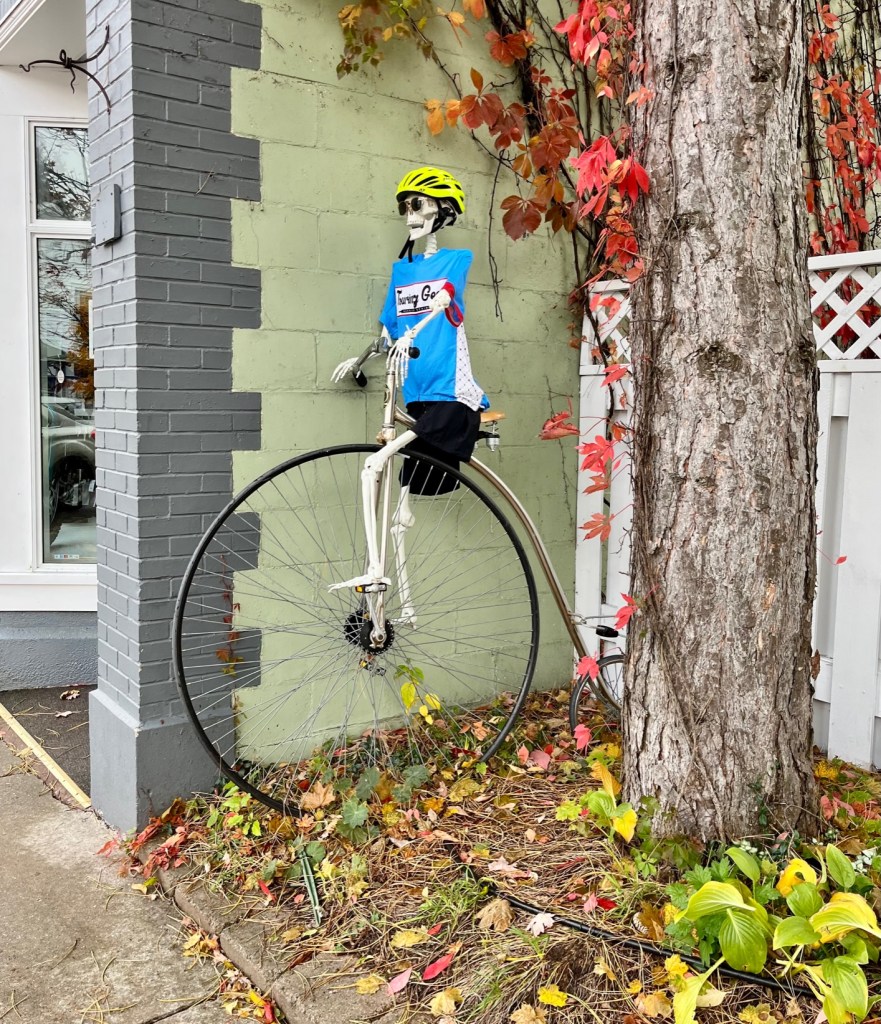
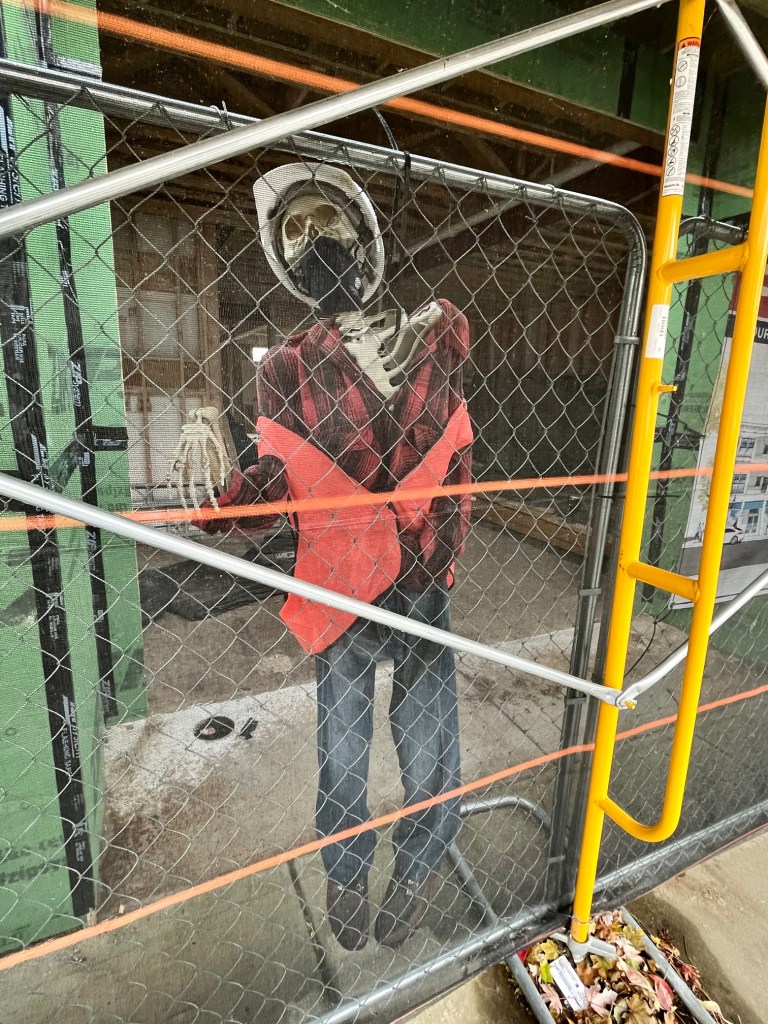
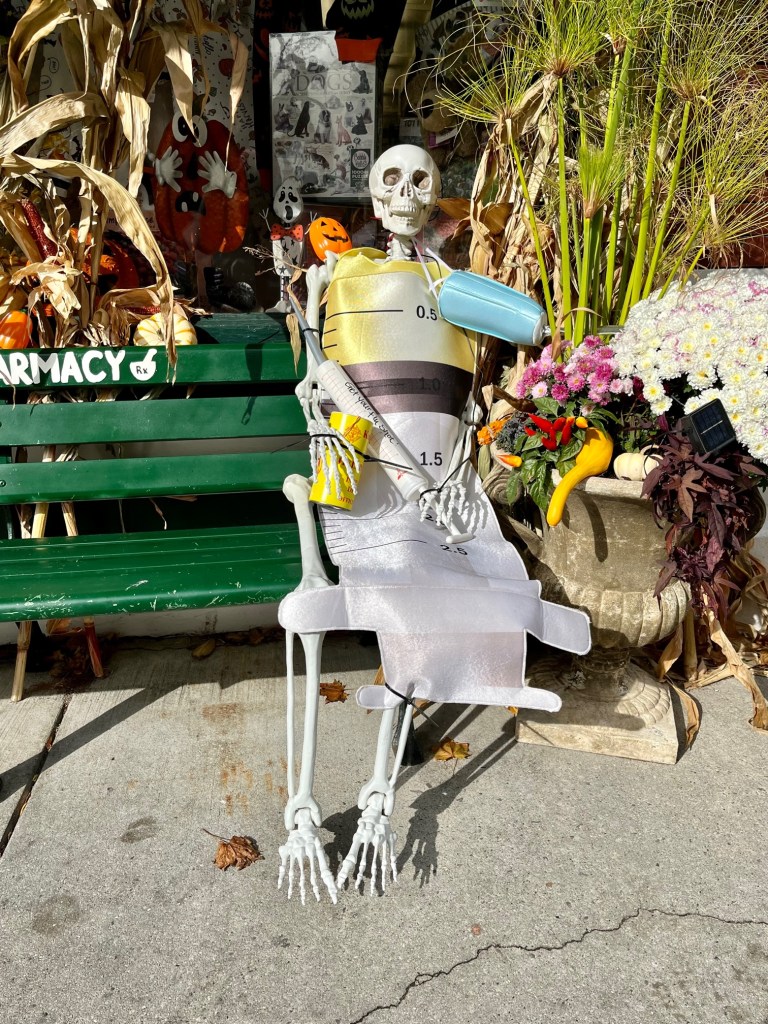
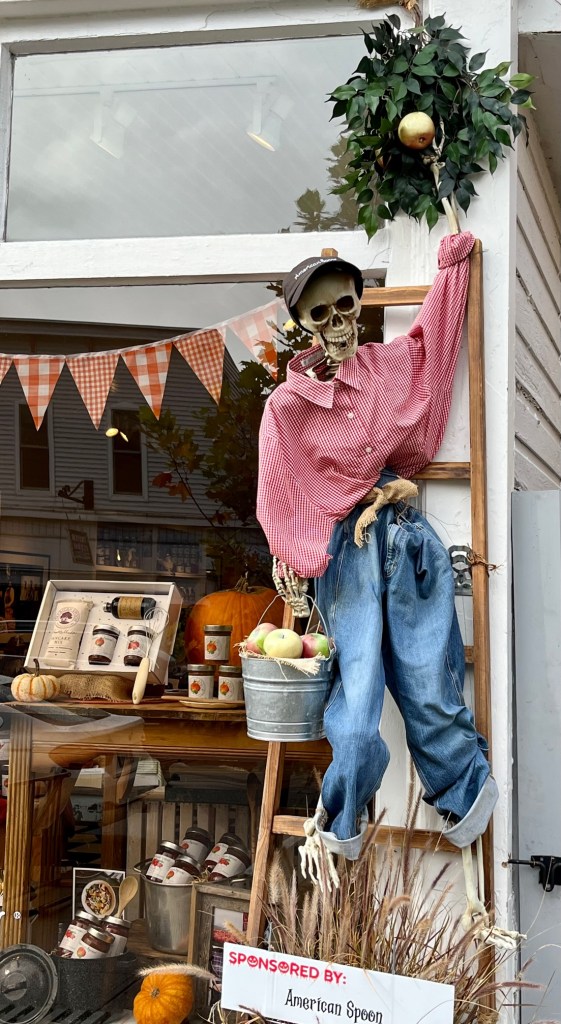
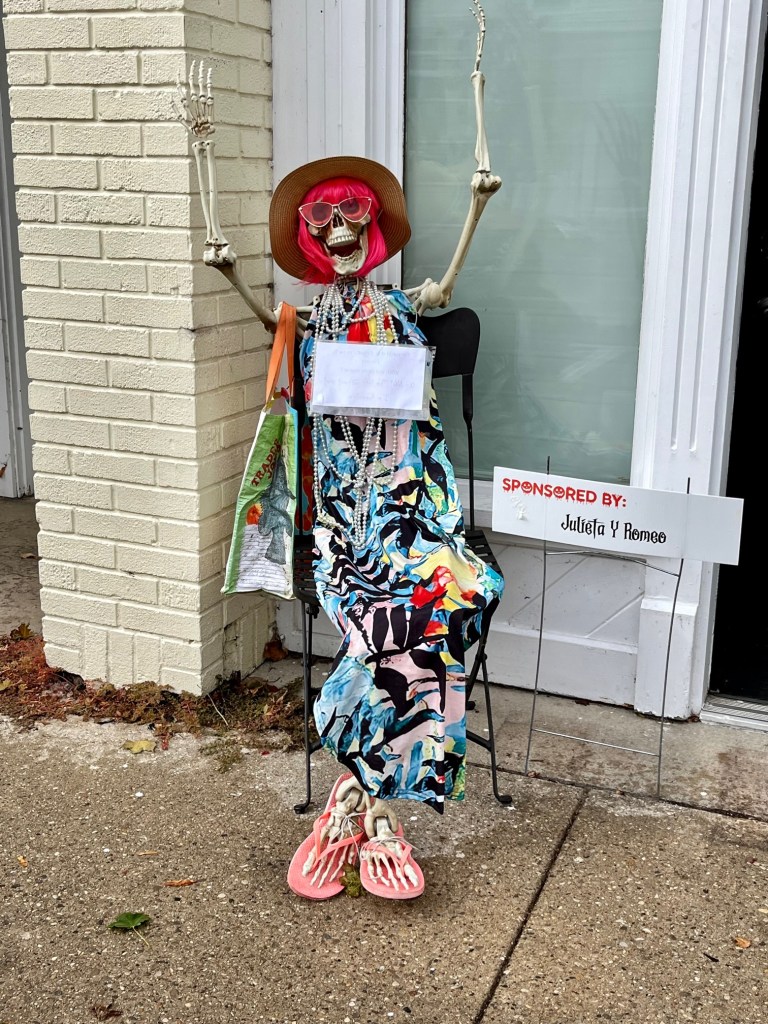
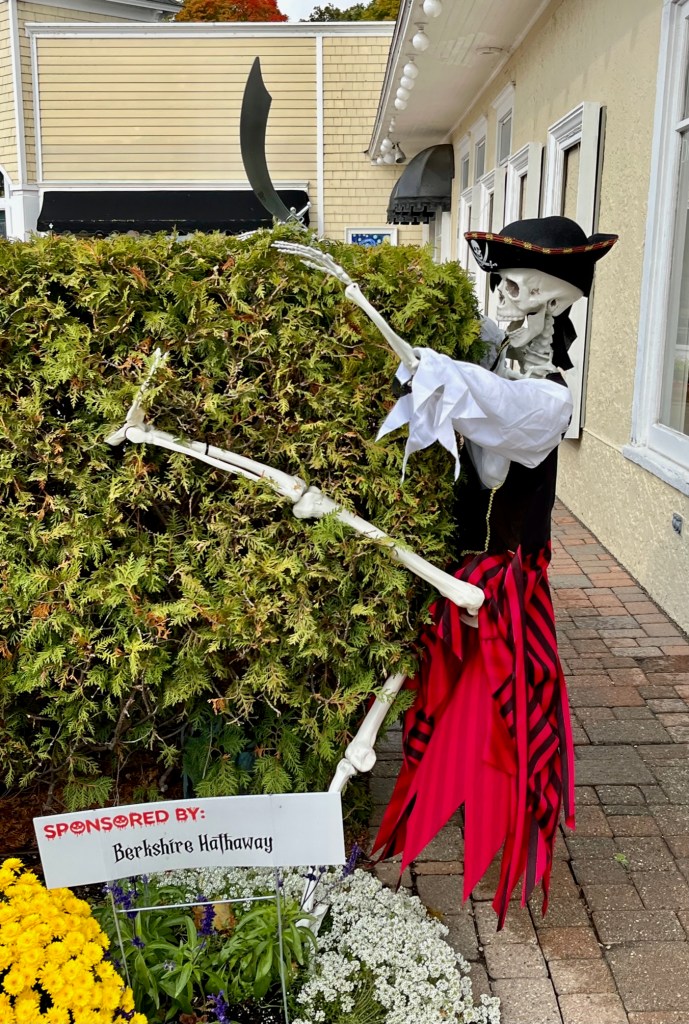
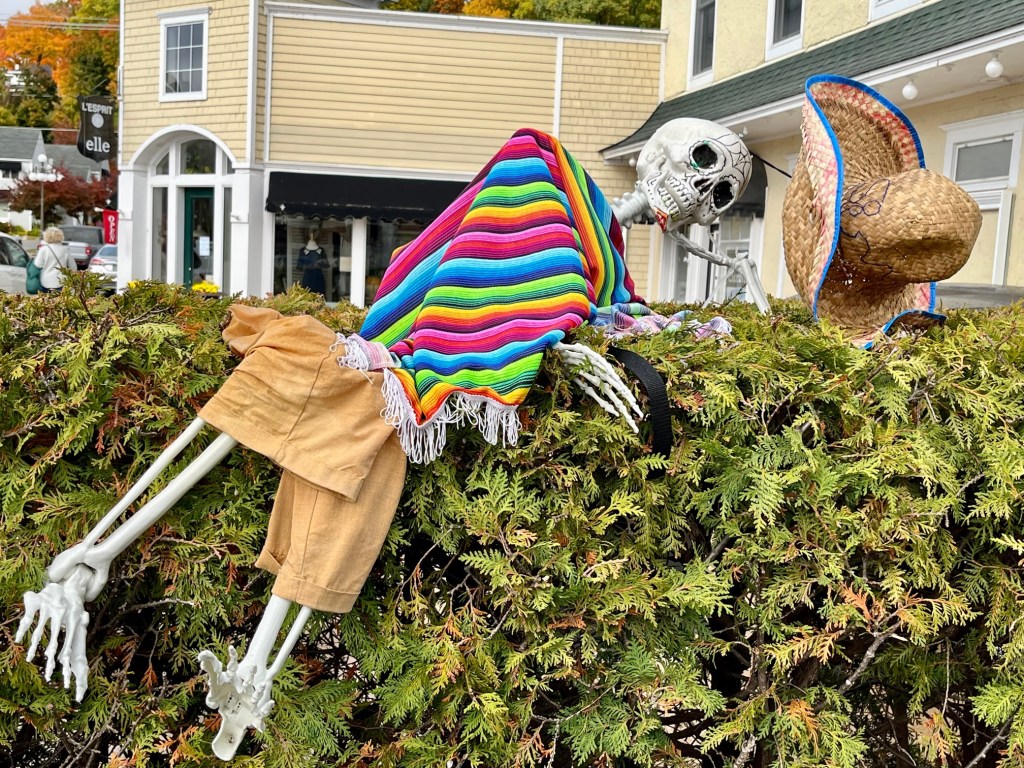
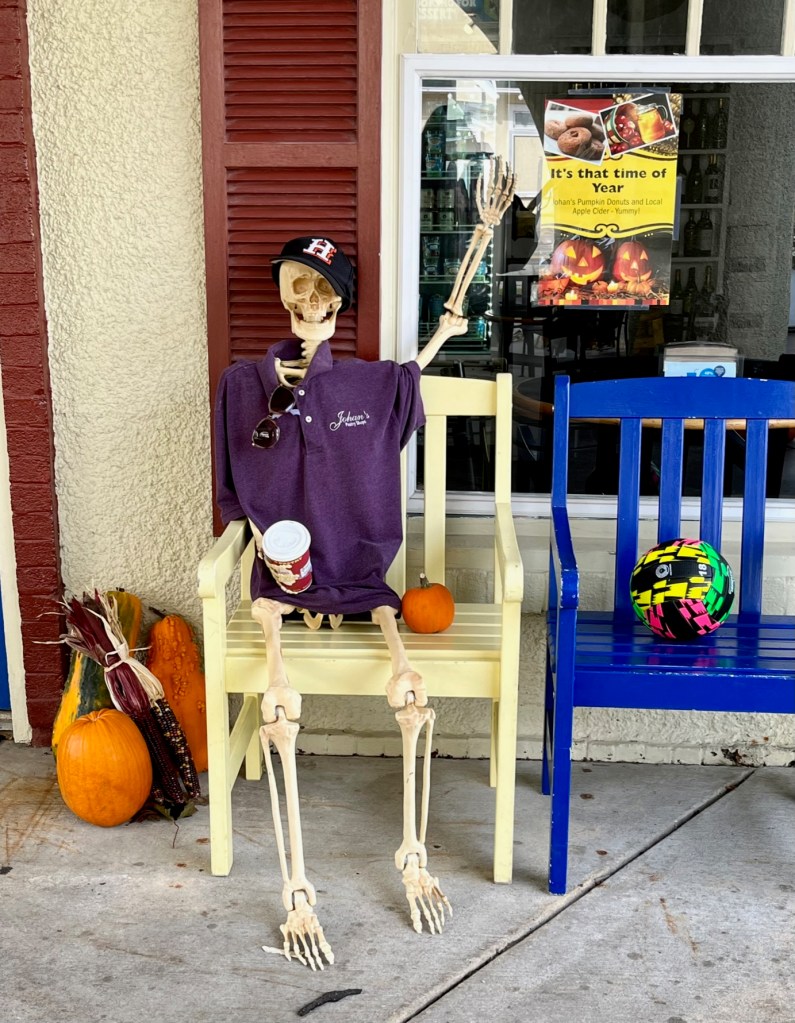
Next, we headed back to Main Street, where I noticed boney visitors who’d stopped by Harbor Springs dressed for Halloween. Bogey had to wait for me while I walked up and down the sidewalks and photographed twenty-seven snappily-dressed skeletons. I know I didn’t get pictures of all the skeletons, but I had fun trying to find as many as I could. Excitement lurked on every block and around every corner. Costumed skeletons have become a Harbor Springs Halloween tradition. And this year there are seventy-five skeletons creaking about.
Tonight the wind howls off Lake Michigan, and it’s raining in spurts. In the hours before dawn, snow is expected before turning back to rain. The National Weather Service has issued a wind advisory. And I wonder how the skeletons will stay warm in all this weather–they don’t have any meat on their bones.






























 Writing Near the Lake