I taught my ten-year-old grandson Michael to play chess about six months ago. We sat at my kitchen table and played lots of games. I won them all. It never crossed my mind to let him win. I enjoyed feeling like a Grandmaster chess player, even if I was beating a ten-year-old child who’d never played before. Chess is a tough game. If he was going to learn to play, he needed to pay attention to the whole board and think beyond his current move, something I knew he would eventually do better than I ever could.
But a Grandmaster I’m not. I liked chess as a child, but I stopped playing when I was about thirteen. I was no good at the game because I could never think beyond a couple of moves. I never learned the higher-level strategies. I never thought or talked about the board in terms of numbers and letters. When I played against my sister or neighborhood friends, I won occasionally, but as I got older, my game didn’t mature, and I lost a lot of games. For me chess was no longer fun. I hung up my pieces and moved on.
So, when I sat at the kitchen table six months ago, beating my grandson in game after game, I enjoyed it because I knew it wouldn’t last. He is good at puzzles and games. He can read diagrams and build three-dimensional objects from many types of building sets. He can skip the directions and design his own creations. He watches YouTube videos to learn how to do things.
My grandson is eleven now. He has been playing chess with friends and watching friends play chess. He has learned some strategies. He thinks about his moves before he makes them. He thinks two or three moves ahead. I’ve started playing chess with him again.
We play in the front living room. He sets the chess board up on the coffee table and pulls up the ottoman. I sit opposite him on the couch.
Words between us are few. Chess is a quiet game. We watch each other contemplate moves. We think about our next moves. We work on seeing the whole board. There is no room for small talk. Sometimes one of my younger grandsons will come up to us and start talking. I put my hand up and say, “Michael and I are playing chess, and it takes all of our concentration. We can’t talk and think about the game at the same time.” They stop mid-sentence and back away, but in five minutes or less, one of them will forget and try to talk to us again.
My chess-playing grandson and I are evenly matched, for now. Our games last around twenty minutes. It’s a coin toss as to who will win. I give the game my all, but I don’t care if I win or lose because the victories are never lopsided. But I suspect in another year or two, my grandson will have upped his game again. My only strategy against him might be that I have no strategy, thereby creating chaos on the board.
My favorite part of playing chess with my grandson is the quiet camaraderie we share as we stare at the pieces and the board, each of us trying our best to win. And with four grandkids in the house, it gives me the perfect excuse to be left in peace and quiet for twenty minutes in the afternoon. I tell the other grandkids that barring an emergency, I’m not to be disturbed. And if they try, I hold up my hand and repeat, “Michael and I are playing chess.”
Memories don’t always have to be filled with words.
This past week I had the pleasure to sit and color with some five- and six-year-old children. We sat in small chairs at a short-legged table. Scattered along the table were boldly colored plastic travel containers meant to hold bars of soap, but which instead held crayons, both broken and whole.
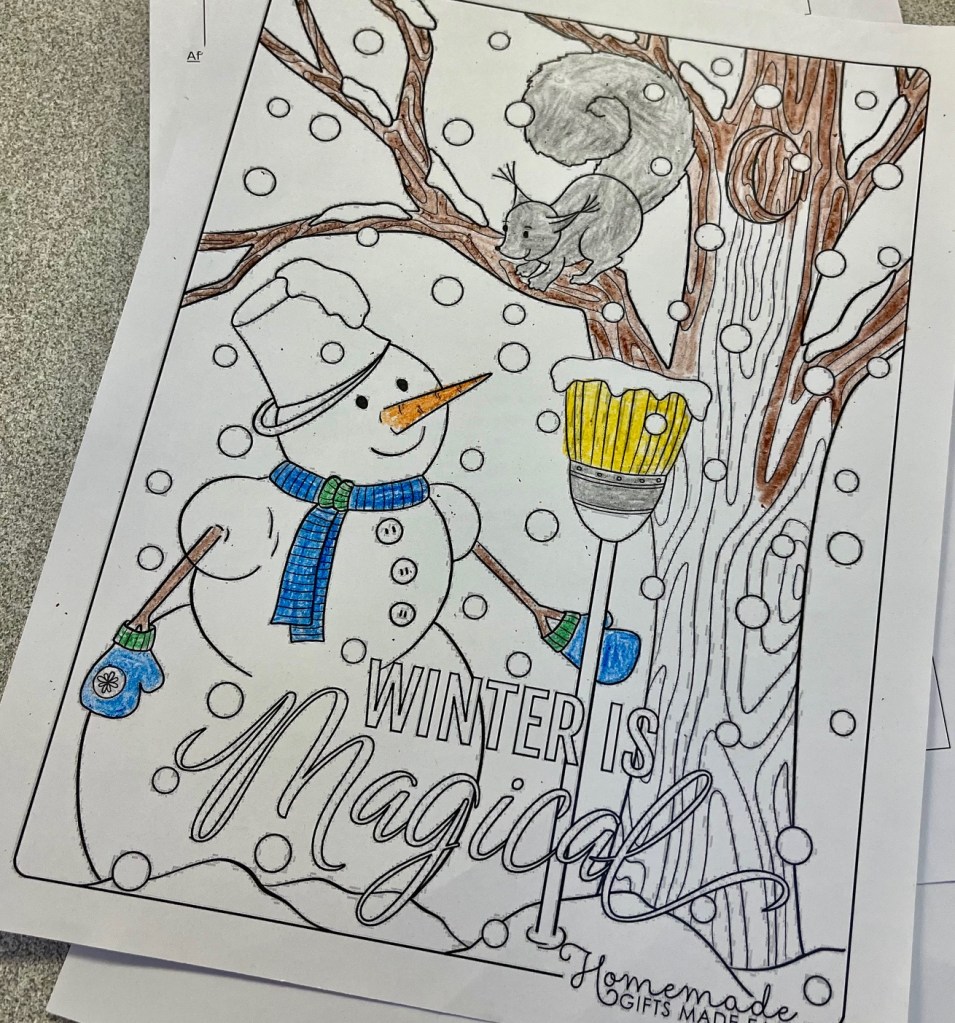
Our coloring sheets were all winter themed. Snowmen, mittens, penguins in stocking caps, penguins ice skating, a snow globe filled with miniature log cabins.
We chose our colors carefully and kept our eyes on our papers because we each had a vision for our piece. But, of course, we talked — we were, after all, a community of coloring companions.
Inspired by the picture of mittens, we talked about gloves and mittens. They’re the same thing, said one child. Actually, I said, with mittens all your fingers stay together, and with gloves each finger goes in a separate finger. The child kept coloring her mittens, and said, Yes, but they’re the same thing. I let it go. She will learn about the differences between gloves and mittens soon enough. No need to rush these things.
We talked about our artwork. Do you like my rainbow mittens? Look at my penguin’s hat, isn’t it pretty? Do you like my picture? The children weren’t shy about crowing or asking for compliments. At five and six, they’re so unabashed — Look what I made, don’t you love it? I answered each one of them — Yes, so colorful! Such a pretty green hat! So lovely!
It won’t stay that way. Soon they’ll learn: Don’t boast, don’t brag, don’t fish for compliments. And for a moment, as I looked at their proud, happy faces, I wondered if there couldn’t be something in-between.
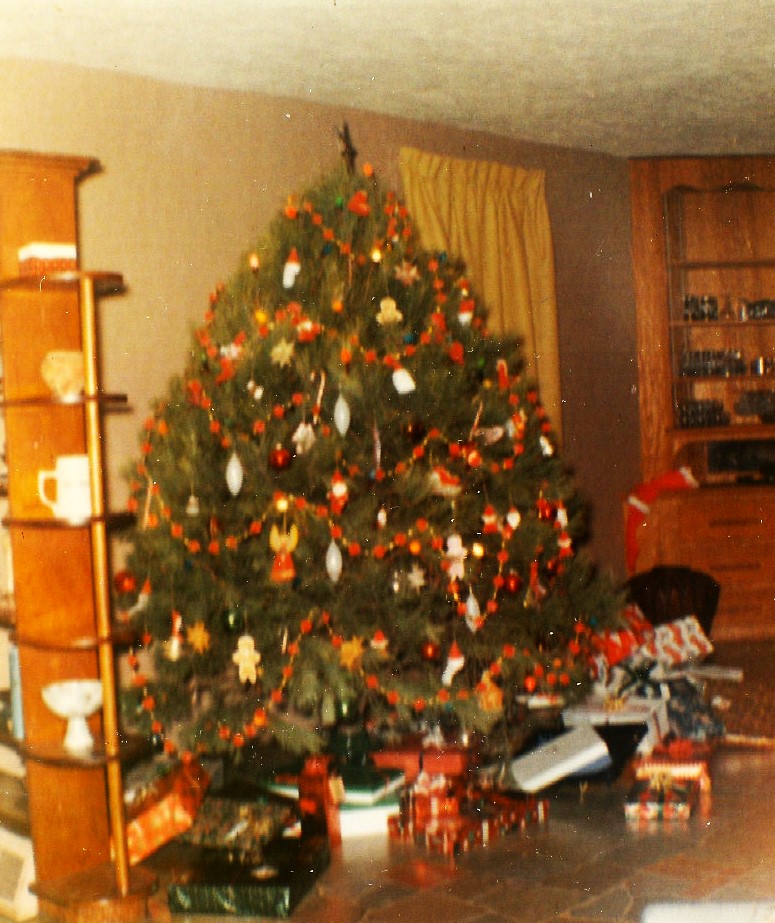
One of mom’s trees before she started putting them in front of the mirrored wall in the living room. Unfortunately, I have no pictures of the later Christmas trees.
At Christmas time when I was a child, my mother transformed our old farmhouse into a magical place. Fresh boughs of evergreen, sprayed with canned snow and trimmed with white twinkle lights, nestled on the mid-shelf of the corner hutch in the dining room. The soft glow of pastel-colored icicle lights outlined the large picture window in the living room. A tall, portly Christmas tree festooned with old fashioned ornaments and C7 lights stood in front of a mirrored wall, which made it appear as if we had two trees. Mom always bought a real tree. She would ask the attendant to hold tree after tree, while she walked around each one. The tree had to look good from all sides, and the trunk had to be straight. Once she sent my father to pick out the tree, but only once. Father’s tree spurred a loud conversation and a few tears.
Mom baked loads of homemade cookies, filling round tins with Mexican wedding cakes, sugar cookies, peppermint meringues, gingerbread men, and spritz cookies. In the days before Christmas, I skimmed cookies, sneaking one now and then from a tin then rearranging the remaining ones to fill the empty space.
The weekend before Christmas Mom took us to the American Soda Water Company, a place filled with bottles of the tastiest soda in so many delicious flavors, such as grapefruit, grape, strawberry, cherry, orange, root beer, cream, lime, cherry cola, black cherry, and more. She pushed the cart in which she had placed a wooden case that held twenty-four bottles. My siblings and I buzzed around the aisles plucking our favorite flavors and some of our father’s favorites. After we filled the case, mother placed another empty case on top of the full one. We would leave the store with four cases of soda, enough to see us well into the New Year because we weren’t allowed more than two or three a week. But we pilfered the occasional bottle of soda. Eventually, only empty bottles remained in the wooden cases, and Mom returned them to the soda company and collected her deposit, a nickel a bottle.
Winter at the farmhouse. The only animals we ever owned were dogs and cats. But it had been a working farm at one time. The buildings in the background belonged to neighbors.
On Christmas eve, my siblings and I nestled under our covers and tried to sleep. And when I couldn’t, I peered out the small window at the side of my bed and searched the starry sky, hoping to spot Rudolph’s red nose. However, by the time I was six, thanks to a know-it-all neighbor boy who was three years older than me, I knew there was no Santa Claus. Still, wanting to believe, I looked for Santa’s sleigh in the sky, and when I spotted red lights on a commercial jet heading to Billy Mitchell Airport, I would pretend it was Jolly Old St. Nick with Dasher and Dancer, Prancer and Vixen, Comet and Cupid, and Donner and Blitzen, all led by Rudolph and his shiny nose.
Eventually all was quiet in the house, my siblings and I softly snoring and dreaming of Christmas morning. At this time, my mother’s shift as Santa’s elf would begin. It took her hours to wrap presents for her four children. She couldn’t do this ahead of time because she needed her Christmas bonus from Marc’s Big Boy where she worked as a waitress, which she received just a few days before Christmas. Bonus money in hand, she drove to the store and paid off the layaway balance on our gifts, which she hid in the trunk of her car until Christmas Eve when her children were all fast asleep. Each package she wrapped with bright cheerful paper and tied up with ribbons or decorated with bows. She artfully arranged them under the tree as if she were staging a scene for the Gimbels storefront window in downtown Milwaukee. Then in the wee hours before dawn she slipped into bed for a few hours’ sleep.
We had strict orders not to wake my parents too early. This meant we weren’t to get out of bed until about eight o’clock. But sometimes before dawn, we might tiptoe down the stairs and into the living room to see the presents under the tree. We kept our distance, not wanting to break the mystical spell of the Christmas tree tending to our gifts tucked under its boughs. And we didn’t want to get into trouble with our parents. We tiptoed back up the stairs and climbed back into our beds. Waiting.
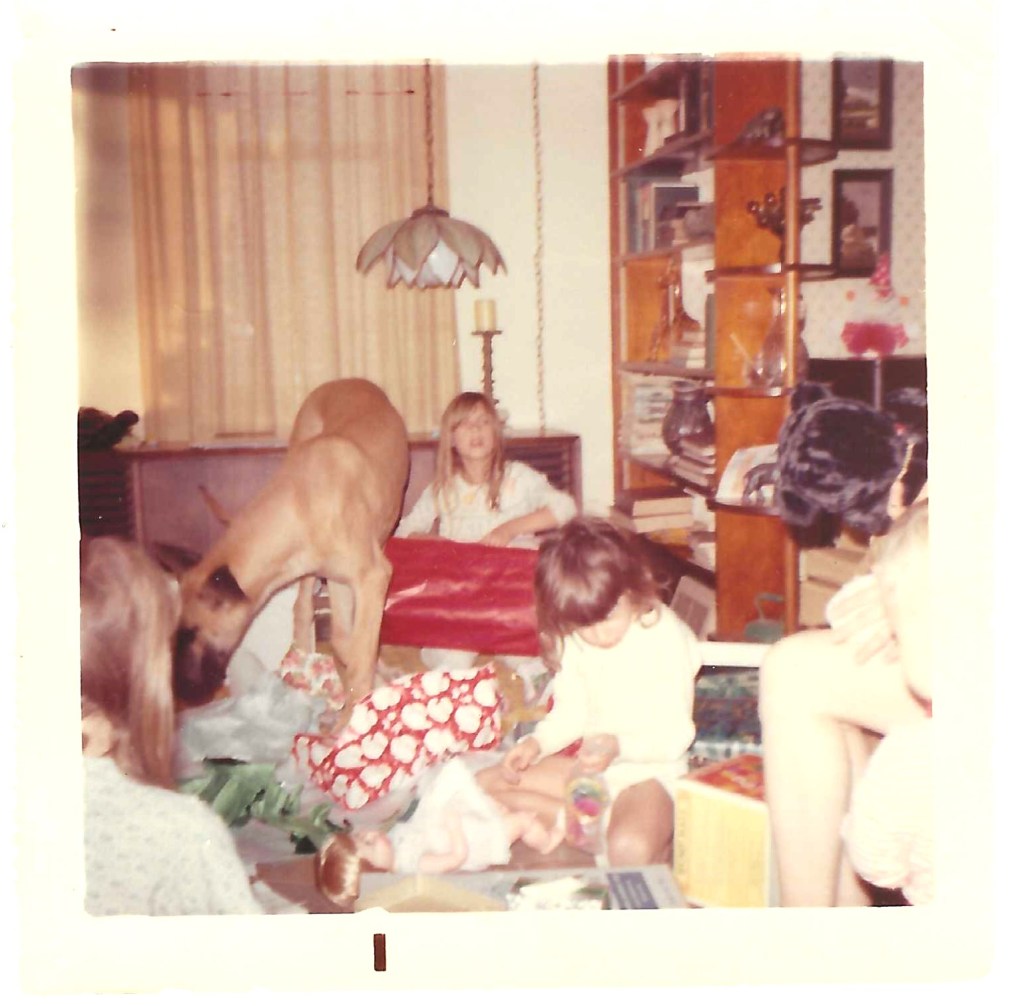
Christmas morning, circa 1969
Christmas morning never disappointed. We opened our presents one at a time because my parents wanted to see us enjoy each of our gifts. Mom was a wonderful Santa. There were always some toys from our lists, but each year she surprised us with wonderful presents we hadn’t even known we would want. Puzzles, games, art supplies, books, pajamas, and clothes spread across the floor as we unwrapped our gifts.
Once the wrapping paper was cleaned up and breakfast had been eaten, our job was to stay out of the kitchen and out of Mom’s way as she began to cook Christmas dinner, a feast of turkey, stuffing, sweet potatoes, mashed potatoes, gravy, and green bean casserole, all cooked to perfection. Later we would be asked to set the dining room table, and after dinner we helped wash and dry the dishes. But Christmas morning and afternoon belonged to us, a time to play with our new toys and games.
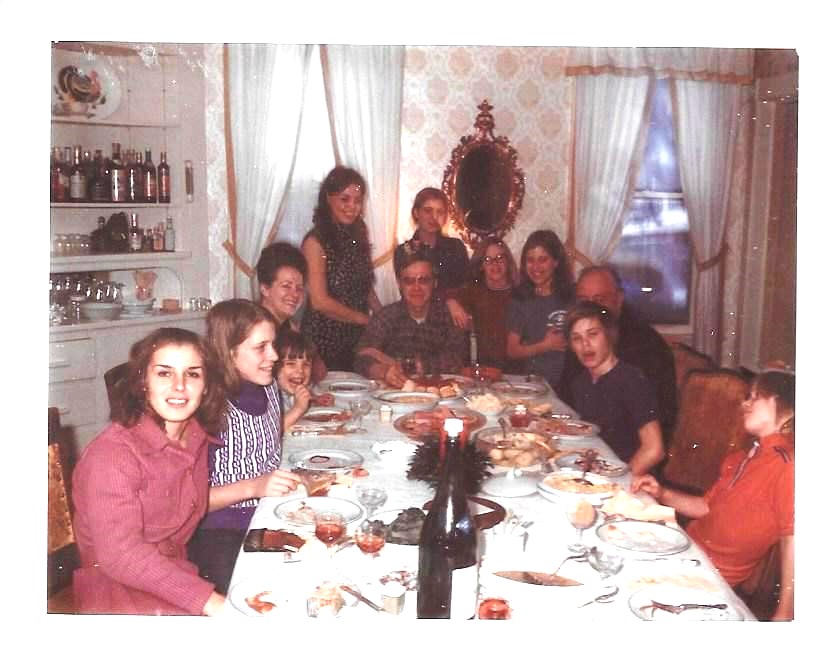
In mid-afternoon Uncle Freddy and Auntie Pat arrived with our three cousins (Brian, Dee Dee, and Lisa) and Nana Kitty. We ate at an elegant, second-hand burl wood dining table covered with a crocheted cloth my mother bought at an antique store. Before we filled our plates, someone said grace, giving thanks for our feast. Then began the passing of the dishes and the filling of the plates. With twelve people seated around the table, this took some time. It was fair game to interrupt any conversation with “Could you please pass me the . . . ?”
Christmas dinner. From the left and clockwise: Auntie Pat, me, Steve, Nana, Mom, Uncle Fred, Kimberly, Dee Dee, Suzanne, Grandpa Howard (who had recently married Nana) Brian, and Lisa. My father took the photo, circa 1972.
At the end of the day, when the dishes were done, when the company was gone, except for Nana who stayed to babysit us, my parents would meet up with friends at a local theater to see a movie. It was the perfect end to a perfect day. My siblings and I would fold up the crocheted tablecloth, exposing the thick pad that protected the dining table, and set up our new art supplies. We painted or sketched or wove hot pads while Nana visited with us. We snacked on cookies and soda. At bedtime we put on our new Christmas jammies. As we drifted off to sleep, we knew before we could do it all again, we had to wait 365 days. A lifetime to a child. A snap of the fingers to an adult.
Christmas gives me the blues. I miss the magic of childhood Christmases spent with my siblings, and I miss the magic of Christmas mornings I spent with my young children. I miss family and friends who have passed away, and the special Christmas traditions we had. Because nothing stays the same, nostalgia can be heart-wrenching.
So, I’m weaving some new traditions into some old ones.
When I was in my twenties, my mother-in-law took me to my first ballet, along with my two sisters-in-law. It was December, so of course, we went to The Nutcracker. I loved it. For two hours enchanting music, graceful dancing, sparkling costumes, and magical sets swept me away to another world. Attending The Nutcracker with my mother-in-law became a tradition for a handful of years.
This year I took my twelve-year-old granddaughter, Clara, to see The Nutcracker, her first ballet. My mother-in-law would be happy to know I’m reviving her tradition.
Clara and I were dressed in the past and present. I wore a pair of old garnet earrings given to me by a friend, a black-and-red plaid sweater given to me by another friend, and a string of pearls given to me by my mother. I carried a black purse my sister had sent me. Clara wore a black skirt I’d bought her, black leggings, and a cream-colored sweater with a brown geometric design that her grandmother had worn when she was young. We were wrapped in the beauty of the present and the comfort of the past.
The ballet started at two o’clock, so we left the house at one o’clock. Because it’s a short drive to Symphony Hall, we arrived early. Happily, we discovered a foosball table in the lobby. This might be an odd place for a game table, but Symphony Hall is next to a college hockey arena. (An air hockey game would’ve been more appropriate, but they are noisy, like the ear-splitting clack-clack of a pickleball game.) There was no foosball table when I went to the ballet with my mother-in-law. But she would have approved. She liked quiet adventures. In her seventies she painted her nails with canary-yellow and key-lime-pie-green nail polish. She changed the spelling of her first name. She asked me to take her to see Willie Nelson. She went to see The Pirates of the Caribbean with me.
My granddaughter reached the foosball table first. She dropped the ball down the side chute and pushed and pulled on the handles. “Want to play?” I asked. “Sure,” she said. A small smile tickled the corners of her mouth.
Dressed in our semi-elegant, mostly black clothes and coats, we stood opposite one another. We cranked handles and spun our foosball players. Trash talking was minimal. We focused, each of us giving 110% to our plastic, featureless foosball athletes. The game went back and forth with the lead changing many times, but in the end, I prevailed by one goal. I wanted to do a Chariots of Fire victory stride, but well . . . I was wearing pearls.
The lights reflected in the window make it appear as if the sky has lights that illuminate the Aerial Lift Bridge.
It was after 1:30, but the ushers still weren’t taking tickets. I wondered why there were so few people in the lobby. But then a ship came through the canal, and the staff, Clara, and I walked out onto a balcony to watch it glide into the harbor. No matter how many vessels we locals see enter the canal, we never tire of watching them chug under the lift bridge and into the harbor to take on a load of cargo. After the ship passed by, the staff, Clara, and I returned to the warmth of the lobby.
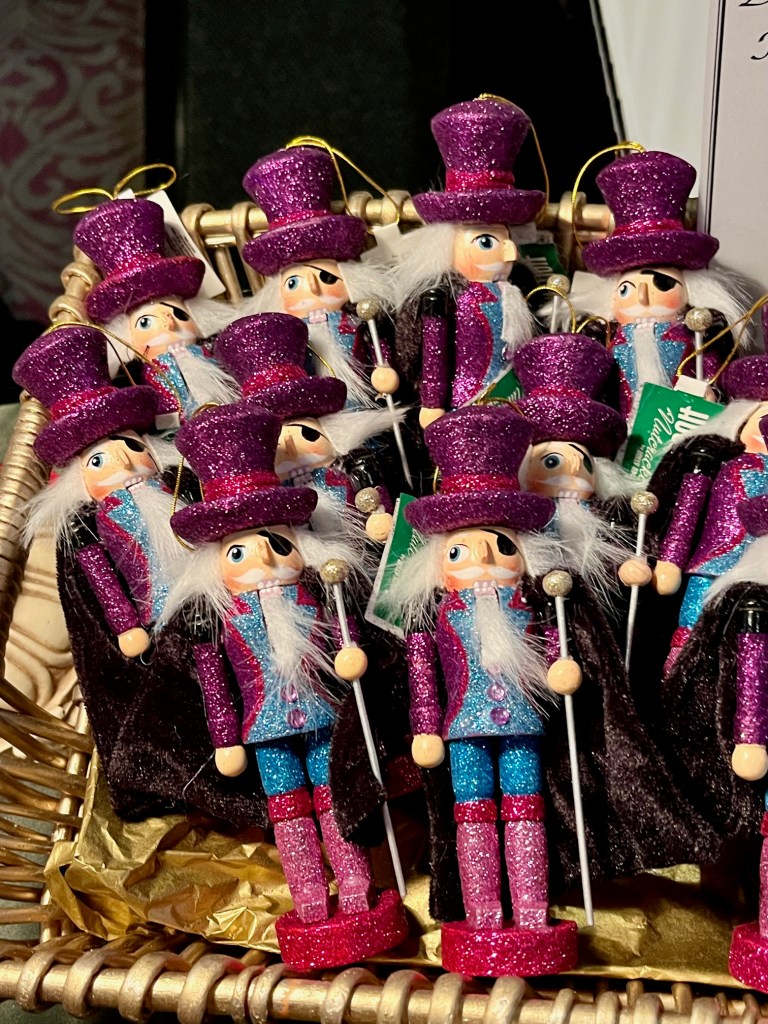
The ushers still weren’t taking tickets, and I got a strange feeling. After I talked to one of the staff, I found out the ballet actually started at three o’clock. Clara and I had been an hour early. We had time to whittle away, so we explored the lower level of the building. We sat in lobby chairs and watched people walk by. We checked out The Nutcracker merchandise. I bought Clara a light-up wand made of optical fibers and myself a pair of socks decorated with nutcrackers.
Finally, the auditorium doors opened, ushers handed us programs, and we found our seats.
Shortly after three o’clock, the lights in the auditorium dimmed, the orchestra began to play, and the curtain rose. My Christmas blues were chased away by pirouettes and leaps, jumps and high kicks all performed by dancers in colorful costumes. Some of the old tradition of the ballet I’d seen with my mother-in-law remained, but it was given a new twist. Instead of being set in the Victorian-style home where Clara’s family and Drosselmeyer gather on Christmas Eve, the set had been transformed into a train station. The ballet was still set in the early 1900s, but the dancers, other than the lead ballet performers, were dressed as street vendors, travelers, lumberjacks, and gingerbread cookies. I have to admit that at first I missed the version I’d seen with my mother-in-law. But the ballet was so good. And clinging to the past too tightly brings a sense of melancholy. Nothing stays the same. So, I let it go and wove the night’s new traditions in with the old.
If life were A Christmas Carol, my mother-in-law would have been Fred, the ever-cheerful nephew of Ebenezer Scrooge. She knew how to keep the spirit of Christmas in her heart all year long and how to rise above characters like Scrooge. (Circa 1935, I chose this photo for the cover of the book I helped my mother-in-law write about her life because it captured her personality so well.)
After rounds of curtain calls and clapping until our palms hurt, Clara and I exited the auditorium. We left the bright lights of the lobby behind and walked out into the dark, cold night. We stuffed our chilled hands into our mittens. Beneath our stylish coats, our hearts were warm.
And for a while my Christmas blues were banished. Maybe next year we will go to the symphony or a Christmas play, then the following year back to The Nutcracker. It’s good to look to the future.





 Writing Near the Lake